INTRODUCTION
The fisheries resources of the Puerto Rico–US Virgin Islands (USVI) shelf are socially and culturally important and support important commercial and recreational fisheries. Although formal stock assessments are few, every assessment in the last 30 years has shown some degree of overfishing, with trends worsening over time (Olsen & LaPlace Reference Olsen and LaPlace1978; Stevenson Reference Stevenson1978; Colin Reference Colin, Huntsman, Nicholson and Fox Jr1982; Appeldoorn & Lindeman Reference Appeldoorn, Lindeman, Vivien and Salvat1985; Dennis Reference Dennis1988; Acosta & Appeldoorn Reference Acosta and Appeldoorn1992; Appeldoorn et al. Reference Appeldoorn, Beets, Bohnsack, Bolden, Matos, Meyers, Rosario, Sadovy and Tobias1992; Bohnsack et al. Reference Bohnsack, Meyers, Appeldoorn, Beets, Matos and Sadovy1991; Appeldoorn & Posada Reference Appeldoorn and Posada1992; Beets & Friedlander Reference Beets and Friedlander1992; Reference Beets and Friedlander1999; Appeldoorn Reference Appeldoorn1993; Mateo & Tobias Reference Mateo and Tobias2002). Symptomatic of the larger problem, the status of the vast majority of the over 150 managed stocks is unknown (139 species alone are within the Shallow-water Reef Fish Fisheries Management Plan). Currently, the US National Marine Fisheries Service (NMFS) designates only three species as overfished (goliath Epinelphelus itajara and Nassau E. striatus groupers and queen conch Strombus gigas), but under the Sustainable Fisheries Act, National Standard 1 Amendments the yellowtail snapper (Ocyurus chrysurus) and the misty (E. mystacinus), red (E. morio), yellowedge (E. flavolimbatus), tiger (Mycteroperca tigris) and yellowfin (M. Venenosa) groupers would also be designated as overfished, while parrotfishes (Scaridae), triggerfishes (Balistidae), boxfishes (Ostraciidae) and four species of deepwater snapper (Lutjanidae) would be considered ‘at risk’ (CFMC [Caribbean Fishery Management Council] 2004). However, this is widely viewed as an extreme underestimate of the total number of species subject to obvious growth overfishing and potential recruitment overfishing.
While the existence of overfished stocks in the US Caribbean is not unusual in comparison to other Regional Fishery Management Councils (RFMCs) (NMFS 2006), there are unique characteristics of the fisheries of the US Caribbean that suggest that standard approaches to fisheries management, especially those considered by other RFMCs, would not be applicable. For example, fisheries in the US Caribbean are highly diverse with respect to species, gears, habitats and landing sites; these factors greatly limit the capacity to collect data sufficient to meet management needs under current approaches and mandates. Further complicating this situation, Puerto Rico and the USVI collect different types of catch statistics, thus preventing coordinated assessments. The commercial fishery is artisanal and competes directly with a recreational fishery equally diffuse and of comparable yield. The insular shelves in the US Caribbean are narrow, fish distributions are tightly coupled to habitat (Appeldoorn et al. Reference Appeldoorn, Recksiek, Hill, Pagan, Dennis, Lessios and Macintyre1997; Christensen et al. Reference Christensen, Jeffrey, Caldow, Monaco, Kendall and Appeldoorn2003; Mateo & Tobias Reference Mateo and Tobias2004; Reference Mateo and Tobias2007; Aguilar-Perera & Appeldoorn Reference Aguilar-Perera and Appeldoorn2007; Monaco et al. Reference Monaco, Friedlander, Caldow, Christensen, Rogers, Beets, Miller and Boulon2007; Pittman et al. Reference Pittman, Christensen, Caldow, Menza and Monaco2007), and fishing generally operates at small spatial scales. This magnifies the importance of coastal habitat protection for fisheries production and the need for management to be integrated among the CFMC and local governments. This is particularly true for Puerto Rico, where territorial jurisdiction extends nine nautical miles (16.65 km) and covers the vast majority of the insular platform.
Capacity building and a greater allocation of resources are clearly needed and would improve this situation; however, limitations arising from the diverse and complex nature of these fisheries would still prevent full single-species management from being fulfilled. Additional factors critically affect the potential for meaningful fisheries management. These include the historical lack of management cooperation and coupling between federal and local waters or the agencies responsible for them, lack of coupling between fisheries management and coastal zone management, lack of dialog between stakeholders and management agencies and the absence of focused oversight over primary institutional actors (Kimmel & Appeldoorn Reference Kimmel and Appeldoorn1992; Appeldoorn et al. Reference Appeldoorn, Kimmel, Meyers, Sadovy and Valdez Pizzini2005).
It is now widely recognized that fishing has had a major impact on marine habitats and natural communities (with obvious feedback to production), and this is particularly acute in Caribbean reef-ecosystem-based fisheries (Hughes Reference Hughes1994; Jackson et al. Reference Jackson, Kirby, Berger, Bjorndal, Botsford, Bourque, Bradbury, Cooke, Estes, Hughes, Kidwell, Lange, Lenihan, Pandolfi, Peterson, Steneck, Tegner and Warner2001; Hughes et al. Reference Hughes, Bellwood, Folke, Steneck and Wilson2005; Littler et al. Reference Littler, Littler, Lapointe and Barile2006a). Problems are magnified by the concentrated suite of additional non-fishing stressors degrading essential fish habitat (EFH) (Rogers Reference Rogers1990; Nemeth & Nowlis Reference Nemeth and Nowlis2001; Littler et al. Reference Littler, Littler, Lapointe and Barile2006a). In response to this, ecologists and fisheries scientists have recognized the importance of embracing an ecosystem-based approach to fisheries management (see for example Busch et al. Reference Busch, Brown and Mayer2003; Jennings Reference Jennings2004; Kaufman et al. Reference Kaufman, Heneman, Barnes and Fujita2004; Pikitch et al. Reference Pikitch, Santora, Babcock, Bakun, Bonfil, Conover, Dayton, Doukakis, Fluharty, Heneman, Houde, Link, Livingston, Mangel, McAllister, Pope and Sainsbury2004; Hughes et al. Reference Hughes, Bellwood, Folke, Steneck and Wilson2005; Mangel & Levin Reference Mangel and Levin2005). On the surface, ecosystem-based management appears to offer some hope in addressing the problems of Caribbean reef fisheries, as it ought to address the close habitat linkages supporting productivity and trophic/ecosystem alterations that have occurred. However, except for some ‘warm and fuzzy’ notions concerning basic concepts and outcomes (Quinn & Collie Reference Quinn II and Collie2005), at present there is no agreement on what form ecosystem-based management should take, with most approaches characterized as ‘single-species management plus’, where an additional layer of detailed ecological data is added to the extensive data needs of single-species stock assessments (Babcock & Pikitch Reference Babcock and Pikitch2004). In the Caribbean, where there are insufficient resources available to collect and analyse the data required for single-species assessments, the single-species management plus approach represents a data trap from which agencies could never escape.
The purpose of this paper is to help outline how ecosystem-based management could be used to address problems and deficiencies in current efforts to manage reef fisheries in the US Caribbean, with clear applications to reef fisheries elsewhere. Emphasis is on the biological aspects of fisheries management. While it is recognized that the human component of fisheries management (i.e. stakeholders, managers, governance or institutional structures) will be critical to any management success and eventually must be integrated into a more complete ecosystem approach, the ecological basis of fishery production provides the context within which the system must operate. In particular, any effort to increase incentives among fishers for sustainable practices (Hilborn et al. Reference Hilborn, Punit and Orensanz2004; Jennings Reference Jennings2004) should be based on knowledge of what practices foster sustainability.
ADVANTAGES OF ECOSYSTEM-BASED MANAGEMENT
The key step in transforming fisheries management into an ecosystem-based approach is to shift the primary objective of management from one of maximizing (relative to some target) fisheries catch, to one of maintaining the ecosystem in a state that will lead to productive and sustained fisheries yields over the long term. This is a fundamental departure from current discussions of ecosystem-based management, where emphasis is still on maximizing fisheries yield as an objective, with the problem being one of developing a methodology for translating ecosystem health into expected fisheries yields (Babcock & Pikitch Reference Babcock and Pikitch2004). Past emphasis on maximizing catch relative to some tenuous level has led to the need for high resolution data and real-time monitoring of catch, neither of which has proved practical in fisheries management in general (Walters Reference Walters, Pitcher, Hart and Pauly1998), and within the biodiverse Caribbean in particular. By not attempting to maximize catch, but rather keeping the system within conservative bounds of production, management is diverted from trying to maintain the fishery at a point where slight increases in fishing pressure may result in stock collapse. This inherently moves the catch levels well below maximum sustainable yield (MSY) and toward maximum economic yield (MEY), reduces data needs, allows for uncertainty to be accommodated and opens up other options for management (besides single-species assessments), including spatially explicit interventions as detailed habitat maps become more available via remote sensing and GIS technology. Importantly, this greater flexibility also allows management practices to be tuned to local biological and social realities of the system and the capabilities for management.
FIRST PRINCIPLES
This ecosystem approach is based on first principles regarding the ecosystem and will initiate a series of strategies based on these principles. These principles must be agreed to by stakeholders prior to discussion of any specific management strategies. Experience has shown, given a set task such as protecting the productive capacity of the ecosystem, that stakeholders are fully capable of reaching consensus weighing conservation and fisheries (see Bohnsack Reference Bohnsack, Lessios and Macintyre1997; Delaney Reference Delaney2003). The reef-based fisheries in the US Caribbean would include the following seven first principles.
Rigorously protect structural habitat
The close association of reef fishes with habitat through ontogeny is now well established (Appeldoorn et al. Reference Appeldoorn, Recksiek, Hill, Pagan, Dennis, Lessios and Macintyre1997; Reference Appeldoorn, Friedlander, Sladek Nowlis, Ussegilo and Mitchell-Chui2003; Cocheret de la Morinière et al. Reference Cocheret de la Morinière, Pollux, Nagelkerken and van der Velde2002; Nagelkerken et al. Reference Nagelkerken, Roberts, Van Der Velde, Dorenbosch, van Riel, Cocheret de la Morinière and Nienhuis2002; Christensen et al. Reference Christensen, Jeffrey, Caldow, Monaco, Kendall and Appeldoorn2003; Nagelkerken & van der Velde Reference Nagelkerken and van der Velde2004; Mateo & Tobias Reference Mateo and Tobias2004, Reference Mateo and Tobias2007; Aguilar & Appeldoorn Reference Aguilar-Perera and Appeldoorn2007; Monaco et al. Reference Monaco, Friedlander, Caldow, Christensen, Rogers, Beets, Miller and Boulon2007; Pittman et al. Reference Pittman, Christensen, Caldow, Menza and Monaco2007). A critical concept embedded within this realization is that the unit of management is not the species or community, but the habitat, and, as in terrestrial systems, that habitat can be used as a surrogate for demography (Hansen et al. Reference Hansen, Urban, Marks, Hansen and di Castri1992; Merriam & Wegner Reference Merriam, Wegner, Hansen and di Castri1992). Recognition of the importance of maintaining healthy habitats is explicit within current US management under the concern for EFH and the designation of Habitat Areas of Particular Concern (HAPCs). In the US Caribbean, the CFMC has broadly defined EFH for reef species and has already designated several HAPCs (CFMC 2004).
Protect water quality
The aqueous environment of coral reefs represents a specific component of habitat as well as an important mechanism for transporting materials and nutrients. It is the component of habitat most immediately impacted by terrestrial activities such as coastal development, poor land-use practices, offshore sewage outfalls and pollution events. Primary productivity of coral reefs is based on benthic production of algae, sea grasses and coral-symbiotic zooxanthellae, and these can be severely impacted when turbidity reduces light penetration (Kinzie et al. Reference Kinzie, Jokiel and York1984). In US Caribbean coastal waters, suspended sediments and eutrophication are the major factors responsible for the higher turbidities (Acevedo & Morelock Reference Acevedo, Morelock, Choat, Barnes, Borowitzka, Coll, Davies, Flood, Hatcher, Hopley, Hutchings, Kinsey, Orme, Pichon, Sale, Sammarco, Wallace, Wilkinson, Wolanski and Bellwood1988; Nemeth & Nowlis Reference Nemeth and Nowlis2001; Burke & Maidens Reference Burke and Maidens2004; Garcia-Sais et al. Reference García-Sais, Appeldoorn, Bruckner, Caldow, Christensen, Lilyestrom, Monaco, Sabater, Williams, Diaz and Jeffrey2005; Warne et al. Reference Warne, Webb and Larsen2005). In addition to loss of primary productivity, sedimentation and eutrophication can affect the structural composition of coral reefs (Loya Reference Loya1976; Kinzie et al. Reference Kinzie, Jokiel and York1984; Rogers Reference Rogers1990; Littler et al. Reference Littler, Littler and Brooks2006a, Reference Littler, Littler, Lapointe and Barileb) and associated fish communities (Bejarano Rodriguez Reference Bejarano Rodríguez2006). With maintaining water quality an important component of ecosystem management (Souter & Linden Reference Souter and Linden2000; Jameson et al. Reference Jameson, Tupper and Ridley2002), fisheries management will have to expand in significant ways to cover land-use practices affecting reef environments. As a consequence, management strategies will also have to expand to include indicators of water quality and ecological health (for example see Jameson et al. Reference Jameson, Erdmann, Karr and Potts2001; Bejarano Rodriguez Reference Bejarano Rodríguez2006).
Maintain ecosystem integrity
In terrestrial conservation biology, an important management goal is to maintain ecological integrity (Leopold Reference Leopold1966; Merriam & Wegner Reference Merriam, Wegner, Hansen and di Castri1992). Ecosystems are a composite of not only structural habitats, but also the species found within them, each interacting in innumerable ways. It is impossible to model and assess all species within an ecosystem. It is equally impossible to predict the long-term consequences of loss of biodiversity that may result from exploitation or management intervention. Risk aversion dictates that one goal should be to maintain all species within a system, subject to natural levels of variation, such as those resulting from island biogeographic (MacArthur & Wilson Reference MacArthur and Wilson1967) or successional (for example Duran & Castilla Reference Duran and Castilla1989) processes.
Maintain ecosystem function
A healthy self-sustaining ecosystem requires not only that the essential structural components (species, habitats) are intact, but also that the functional components are intact as well (Hughes et al. Reference Hughes, Bellwood, Folke, Steneck and Wilson2005). Key functional components would be primary production, herbivory, predation, trophic pathways, nurseries, migration, shelter and reproduction. Many of these are habitat based, such as the use of distinct nursery habitats by newly settled and small juvenile fishes (Eggleston Reference Eggleston1995; Appeldoorn et al. Reference Appeldoorn, Recksiek, Hill, Pagan, Dennis, Lessios and Macintyre1997; Beck et al. Reference Beck, Heck Jr, Able, Childers, Eggleston, Gillanders, Halpern, Hays, Hoshino, Minello, Orth, Sheridan and Weinstein2001; Lindeman et al. Reference Lindeman, Pugliese, Waugh and Ault2000; Nagelkerken et al. Reference Nagelkerken, Roberts, Van Der Velde, Dorenbosch, van Riel, Cocheret de la Morinière and Nienhuis2002) or site specific spawning aggregations for snappers and groupers (Shapiro et al. Reference Shapiro, Sadovy and McGehee1993; Sadovy et al. Reference Sadovy, Colin and Domeier1994; Lindeman et al. Reference Lindeman, Pugliese, Waugh and Ault2000; Claro & Lindeman Reference Claro and Lindeman2003; Ojeda-Serrano et al. Reference Ojeda-Serrano, Appeldoorn and Ruíz-Valentín2007). However, equally important is the flow of nutrients and species across habitats within the seascape. These include the movement of species across habitat boundaries during ontogeny, feeding or reproduction (Cocheret de la Morinière et al. Reference Cocheret de la Morinière, Pollux, Nagelkerken and van der Velde2002; Appeldoorn et al. Reference Appeldoorn, Friedlander, Sladek Nowlis, Ussegilo and Mitchell-Chui2003; Kendall et al. Reference Kendall, Christensen and Hillis-Starr2003; Nagelkerken & van der Velde Reference Nagelkerken and van der Velde2004) and associated transport of organic matter and nutrients (Meyer et al. Reference Meyer, Schultz and Helfman1983; Clark et al. Reference Clark, Monaco, Appeldoorn and Roque2005).
Maintain a series of control areas for monitoring
The ecosystem approach advocated here does not rely on exact prediction of the state of the ecosystem. History and simulation studies have demonstrated the inability to precisely and accurately determine both the current state of the fishery and its theoretical point of optimal production in the face of incomplete data, unknowns and annual variability of natural systems (Sissenwine et al. Reference Sissenwine, Brown, Palmer, Essig and Smith1982; Walters Reference Walters, Pitcher, Hart and Pauly1998). However, the approach does require monitoring, a process that is both much more tractable and useful for adjusting management tactics as needed. Monitoring can be used to determine directions and rates of change. Comparisons between fished and unfished areas would be critical in relating any observed changes to the impacts of fishing (Bohnsack Reference Bohnsack1998). Such an approach is not new; in the 1880s the Scottish Trawling Experiment compared open and closed areas to demonstrate the negative impact of trawling on plaice (Smith Reference Smith1994), while more recently, Polovina (Reference Polovina1994) compared fished and relatively unfished areas to suggest that the decline in the Hawaiian spiny lobster resources was due to climate, rather than fishing. New observations in unfished areas in the North-west Hawaiian and Northern Line Islands (Friedlander & DeMartini Reference Friedlander and DeMartini2002; Stevenson et al. Reference Stevenson, Katz, Micheli, Block, Heiman, Perle, Weng, Dunbar and Witting2007; Sandin et al. Reference Sandin, Smith, DeMartini, Dinsdale, Donner, Friedlander, Konotchick, Malay, Maragos, Obura, Pantos, Paulay, Richie, Rohwer, Schroeder, Walsh, Jackson, Knowlton and Sala2008) are redefining perceptions of the structure of unexploited reef ecosystems. These types of comparisons also help ground truth the validity of theoretically constructed reference points. Reference points are a fundamental component of current single-species fisheries management, and single-species reference points will continue to be valuable (Quinn & Collie Reference Quinn II and Collie2005). In the USA, key reference points are derived from an estimation of MSY and spawning potential ratio (SPR). Both of these are theoretical constructs and require detailed life-history data and/or long time-series of accurate data on catch and effort. The latter are generally not available for fisheries within the US Caribbean. Life-history and length-frequency data can only hope to be collected for the most important and abundant species. In addition, new reference points will need to be developed at the ecosystem level. Some of these may be specifically related to ecosystem health, such as indexes of biotic integrity (Jameson et al. Reference Jameson, Erdmann, Karr and Potts2001). Others (for example FAO [Food and Agriculture Organization of the United Nations] 1999; Busch et al. Reference Busch, Brown and Mayer2003) may be developed from theoretical and practical considerations.
Employ a precautionary approach at all times
The present degree of uncertainty in Caribbean fisheries is high due to the limited data relative to the large numbers of species. The precautionary approach to fisheries, embodied in the Code of Conduct for Responsible Fisheries (FAO 1999), was specifically designed to deal with the problems of uncertainty. It recognizes that all forms of fishing have negative impacts, and that management should be forward looking but must also operate with incomplete data. This requires a standard of proof to be used in decisions regarding authorization of fishing activities that is commensurate with the potential risk to the resource. Additionally, it states ‘that where the likely impact of resource use is uncertain, priority should be given to conserving the productive capacity of the resource’ (FAO 1999). In this view, adopting an ecosystem-based approach to fisheries management is itself a fundamental component of the precautionary approach.
Recognize there are limits to production; therefore control rates of extraction
All species have limits to their rate of production. As a first rule of limiting harvest to maintain production, juveniles should be allowed to mature and adults should be allowed to spawn. Typically, species productivity is related to M/K, the ratio of the instantaneous coefficients of natural mortality and growth (Beverton & Holt Reference Beverton, Holt, Wolstenholme and O'Connor1959; Pauly Reference Pauly1980), but more generally these can be related to longevity, and as a surrogate, maximum fish body size. Thus, productivity rates will vary among species and larger longer-lived species will have lower rates of production. This makes it impossible to maximize production across species in a multispecies fishery; either larger species will be overfished or smaller species will be underfished. Given the important role of larger predatory species in top-down control of ecological processes (Jackson et al. Reference Jackson, Kirby, Berger, Bjorndal, Botsford, Bourque, Bradbury, Cooke, Estes, Hughes, Kidwell, Lange, Lenihan, Pandolfi, Peterson, Steneck, Tegner and Warner2001), ecosystem considerations would place special emphasis on limiting fishing pressure on these species.
TACTICS DERIVED FROM FIRST PRINCIPLES
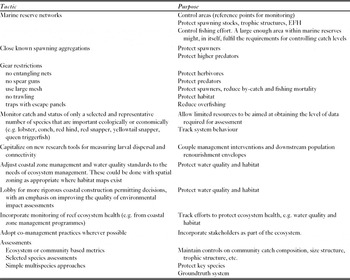
Adherence to first principles should lead to management tactics designed to protect ecosystem function and lead to sustainable production, while at the same time allow for relevant data collection (Table 1). This approach also allows for a more complete use of resources and integration of management objectives. For example, efforts currently underway in both Puerto Rico and the Virgin Islands to establish marine reserves in both local and federal waters could be integrated and designed to form a network of reserves, thus fostering integration of fisheries, coastal zone and coral conservation programmes. Similarly, coral reef monitoring, including fishes, currently conducted within coral conservation or coastal zone programmes could provide valuable ecological assessments for fisheries management.
Potential management actions derived from first principles of ecosystem-based management.

STRUCTURAL BARRIERS TO IMPLEMENTATION
Sustainable Fisheries Act
The language and structure of the USA's Sustainable Fisheries Act (SFA) is not designed with the US Caribbean in mind. It serves to address the more typical industrial-scale fisheries that are characterized by a few high-value high-volume stocks where information can be channelled through a few centralized landing sites and which have a relatively large management and research infrastructure. Nevertheless, the SFA does have a degree of flexibility; most importantly, it does not strictly define what constitutes a ‘fishery’. It clearly does not link a fishery with either a species or species stock, which allows for using multispecies units or subunits when complying with the mandates of the SFA relative to each fishery. The SFA is rigorous in the demands placed on resource scientists and management. For every fishery, levels must be set for MSY and allowable catch, and the point when a fishery is considered overfished must be defined in specific terms. This approach, known as weak-stock management, tries to manage all fisheries such that none are overexploited. Where each fishery is a single species or species stock, predator-prey, competitive and technological (by-catch) interactions could lead to a situation where ‘almost all of the potential yield from the fishery will be forgone if the objective is to prevent overfishing for all stocks’ (Hilborn et al. Reference Hilborn, Punit and Orensanz2004). Viewing a fishery as multispecies could relax this constraint and allow a greater maximization of societal benefits. Using a multispecies approach, the SFA does not preclude using ecosystem metrics in the definition of overfishing, and MSY and allowable catch could be determined on a two-tiered level, one for the multispecies complex (satisfying the mandates of the SFA) and another for targeted sub-component species or species groups to control key ecological or economic components (reminiscent of, but not exactly like what was used in the fisheries off the north-east USA; Brown et al. Reference Brown, Brennen, Gosslein, Heyerdahl and Hennemuth1976). In some sense, the recent amendments of the Shallow Water Reef Fish Management Plan of the CFMC already represent a move in this direction, where multispecies subunits are defined (for example Grouper Unit 4 = misty, red, tiger, yellowedge and yellowfin groupers) and overfishing status is assessed for the group as a whole.
The importance of healthy habitats within a coral reef ecosystem framework cannot be overemphasized, and the SFA specifically mandates that important habitats be identified and cared for. However, the RFMCs are not given any authority to see that this is done. The main authority lies directly within the National Oceanic and Atmospheric Administration (NOAA) and its role is largely limited to issues that fall within NOAA's jurisdiction. The agency is at least required to communicate its concerns to other federal and local agencies, but it is limited in the capacity to which these concerns are addressed. Control of anthropogenic stresses in nearshore reef systems is critical, and authorities here lie with the local governments and various federal agencies (for example the US Army Corps of Engineers, the Department of Agriculture and the Environmental Protection Agency), regulated largely by the US National Environmental Policy Act (NEPA).
Lastly, the use of control areas for ecosystem assessment seems incompatible with the immediate mandates of the SFA. Closed areas will need considerable time, of the order of decades, before they might approach a condition that could be considered baseline. However, most marine reserves in reef ecosystems start to respond rapidly after implementation (Polunin & Roberts Reference Polunin and Roberts1993; Roberts Reference Roberts1995; Russ & Alcala Reference Russ and Alcala1996), thus allowing them to start being used to assess fishery impacts.
Federal versus local jurisdiction
All of the nearshore nursery habitats fall within local jurisdiction and much (almost all in the case of Puerto Rico) of the insular platform is also under local control. Any attempt at ecosystem-based management, especially using a network of no-take areas will require cooperation on a scale that is not evident at present. Both levels of government would have to share the same vision and have regulations that are compatible both with that vision and between governments. Data collection and analysis must also be shared, and enforcement must be modified and strengthened. Key to this endeavour is for the local governments to feel that they are full partners in this effort, so they take ownership in the process and responsibility for the outcome. It is unlikely that a top-down approach from NOAA or the CFMC would succeed.
The cultures of science and management
Implementation of an ecosystem-based approach requires changes in the way scientists and managers view their roles, the systems that they work with and the way in which they do business. Ecosystem-based management as outlined here constitutes a distinct paradigm shift. Managers will have to alter how they interact with fisherfolk and other stakeholders, with mechanisms devised to allow more direct involvement of these groups. Processes being developed for community participation in the design and implementation of marine protected areas (MPAs) may serve as a role model (see Delany Reference Delaney2003; Howard et al. Reference Howard, Connolley, Taylor and Mou2003). Scientists will have to break out of the narrow confines of current fisheries routines, think more creatively about the ways in which the status of a fishery can be assessed and incorporate concepts of habitat condition. This may explain why fish ecologists have been at the forefront of the push toward ecosystem-based management (see Jennings Reference Jennings2004; Kaufman et al. Reference Kaufman, Heneman, Barnes and Fujita2004; Hughes et al. Reference Hughes, Bellwood, Folke, Steneck and Wilson2005; Mangel & Levin Reference Mangel and Levin2005) while stock assessment scientists struggle with the question as to how to implement the process (see Busch et al. Reference Busch, Brown and Mayer2003; Babcock & Pikitch Reference Babcock and Pikitch2004).
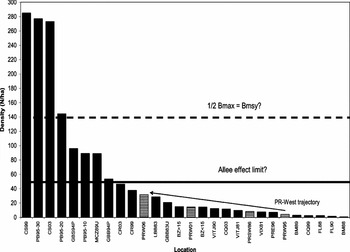
While paradigm shifts inherently take time, there are indications that such transitions are already occurring (Berkes et al. Reference Berkes, , McConney, Pollnac and Pomeroy2001). A recent exercise in the single-species assessment of queen conch, a large gastropod, in the US Caribbean serves to show how open traditional assessment scientists are to new ideas. After reviewing existing conventional catch-effort and size-structure data, the review panel concluded ‘the available data on queen conch abundance and fishing pressure are inadequate or insufficiently informative to allow a stock assessment or associated projections and benchmark statistics to be presented’ (SEDAR [South-east Data Assessment and Review] 2007a, b). Yet when shown the relative density of conch in Puerto Rico (from survey data) compared to unfished and heavily fished areas around the Caribbean (Fig. 1), which clearly showed the Puerto Rico stock to be below a crude but theoretically defensible MSY, they also supported using such a collation of densities across fishing gradients and concluded ‘preliminary results of such an exercise . . . show considerable promise as an innovative approach to placing survey findings in the context of potential population benchmarks. The [Review Panel] considered that progress with this approach is a high, short-term priority, and recommended that further attention be paid to the influence of habitat type and stock structure (juveniles and adults) on the comparisons.’ (SEDAR 2007a, their emphasis).
Queen conch (Strombus gigas) densities for shelf wide surveys throughout the US Caribbean. Densities are unadjusted for any potential differences, such as habitat distributions or proportion of juveniles. Striped bars are values for western Puerto Rico. Solid line represents the density below which reduced reproductive output may be expected based on studies in the Bahamas. Dashed line represents the level at which density is half the maximum density observed in the deep stratum on Pedro Bank (PB95-30), assumed to reflect virgin stock density there. Arrow shows the general direction of density increase off western Puerto Rico over the past 10 years (from SEDAR 2007b).

FACILITATORS OF IMPLEMENTATION
Although change is never easy, there are several factors that would facilitate implementation of ecosystem-based management in the US Caribbean. The first of these is the nature of the fishery itself. The small geographic scale of the US Caribbean offers an opportunity for management experimentation that is simply not possible in other RFMC areas, due to their much larger geographic and economic scales and concomitantly larger entrenched interests. The Caribbean fishery's small-scale nature and close dependence on benthic habitats limits the number of key players, forces all jurisdictions to be included equally and can significantly facilitate the process of creating reserve networks. There is no industrial-scale fishery placing undue economic demands, and the large shelf-based recreational fishery is diffuse and open to the use of marine reserves. Secondly, advances being made in a number of areas, if coordinated, could both facilitate and act as a multiplier to improved fisheries management. These include the sweeping alteration of fisheries regulation in Puerto Rico under PR Law 278 of 1998, the need to protect coral habitat under PR Law 147 of 1999, efforts to establish marine reserves at the local (PR Resolution 301 and current efforts in Culebra, Rincón, Desecheo, Mona and La Parguera in Puerto Rico and St Croix's East End Marine Park in USVI) and federal level (Virgin Islands Coral Reef Monument, Buck Island Reef National Monument and closures in the exclusive economic zone (EEZ) under the CFMC's new SFA amendment). Lastly, recent and ongoing research in Puerto Rico and the US Virgin Islands on the biological and socioeconomic aspects of fisheries, EFH and MPA design and implementation have laid the foundation for ecosystem-based management with an understanding of the complex processes that characterize the human–ecosystem interface, from exploitation to policy making.
THE PATH FORWARD
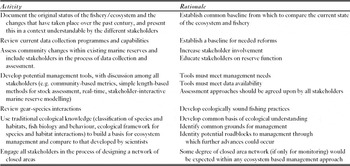
To fully overhaul fisheries management in the US Caribbean requires more than just implementing ecosystem-based management. It requires that all agencies and stakeholders participate fully and equally in the process. A necessary requisite for this is that all parties speak the same language and have the same frame of reference. To implement ecosystem-based management three sets of activities (not mutually exclusive) are recommended: (1) develop a common baseline among stakeholders, (2) develop needed management tools, and (3) develop a common management framework. Key activities that would serve these purposes (Table 2) would simultaneously promote the development of comprehensive ecosystem-based management and foster greater engagement by, and communication with, stakeholders, especially fisherfolk.
Key activities that might initiate ecosystem-based management in the US Caribbean.
ACKNOWLEDGEMENTS
Impetus for undertaking this review came from Ken Stump, whose comprehensive review of US Caribbean fisheries rekindled a desire to do something about it. Ken Lindeman, Joshua Sladek Nowlis, Conrad Recksiek and Miguel Rolón provided helpful criticism during the manuscript's gestation. Supporting funds were provided by the Caribbean Coral Reef Institute and the Lenfest Ocean Program.