1. Introduction
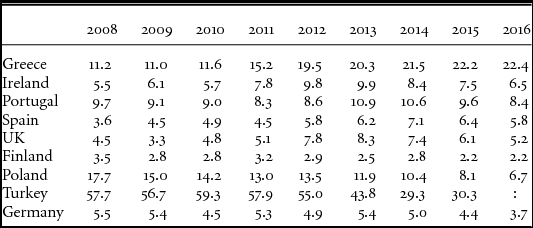
The Great Recession severely impacted some countries such as Greece, Spain, Ireland and Portugal while others like Germany and Poland were relatively unaffected. Unemployment in the EU-27 group increased from around 7 per cent in 2007 to 11 per cent in 2013. In some countries it reached over 25 per cent. Austerity measures intensified the deterioration in living standards with severe material deprivations almost doubling in Greece, Italy, Ireland, Spain and the UK in the same period (See Appendix Table 1).Footnote 1
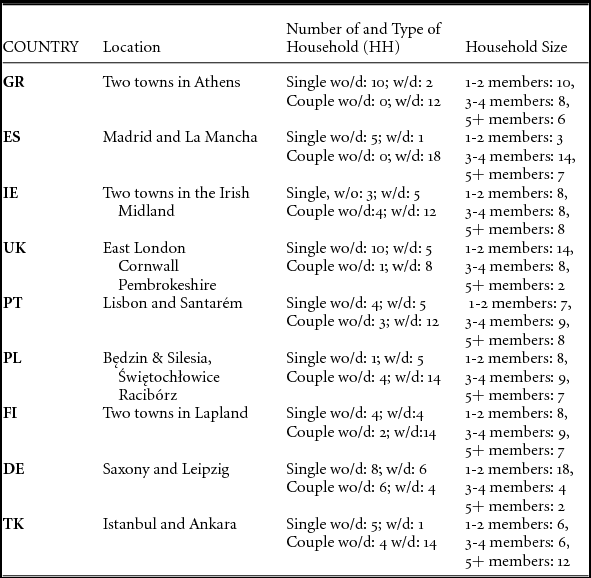
Key Information about Participants

w/d: with dependents, wo/d: without dependents
A prolific literature has emerged on the causes of the crisis since 2008 (for a selected reading, see Barba and Pivetti, Reference Barba and Pivetti2009; Tregenna, Reference Tregenna2009; Dymski, Reference Dymski2010; Cynamon and Fazzari, Reference Cynamon and Fazzari2016). However, noting some exceptions (see Kennett et al., Reference Kennett, Jones, Meegan and Croft2015), less attention has been paid to how households coped with its consequences.Footnote 2
This paper aims to contribute to the growing literature on resilience by focusing on how people responded to hardship during the Great Recession. The distinction of the resilience approach is its emphasis on positivity and agency. This approach argues, contrary to much of the poverty studies literature, that the poor are not victims but people with control over their circumstances and with the resilience to bounce back (Dagdeviren et al., Reference Dagdeviren, Donoghue and Promberger2016, Harrison, Reference Harrison2013; Orthner et al., Reference Orthner, Jones-Sanpei and Williamson2004). In this study, resilience has been examined in the context of household responses to hardship during the Great Recession on the basis of the structure-agency debate, drawing upon primary data gathered through household and key informant interviews in nine European countries (Greece, Portugal, Spain, Ireland, the UK, Germany, Finland, Poland and Turkey). Three essential elements of coping with hardship are emphasised: efforts to reduce cost of living, protecting incomes and rearranging the use of internal and external assets and resources around the household.
An important contribution of this paper is to distinguish different forms of agency in the context of structural constraints faced by participants. More specifically, household responses are discussed on the basis of three types of agency: absorptive, adaptive and transformative. The findings show that most forms of coping fall under the category of absorptive and adaptive agency, characterised here as burden-bearing actions that ‘fit into’ changing circumstances rather than shaping the circumstances.
In the next section, a brief review of the literature on resilience and the structure-agency debate is provided. This is followed by a section on research approach, method and a description of the data. The findings are presented in detail in Section 4 and conceptualised in relation to different forms of agency in Section 5. The final section presents the conclusions.
2. Resilience, structure and agency
The use of the concept of resilience in social sciences is relatively new. Its origins lie in the natural sciences where it has been used to explain how subjects respond to unforeseen developments such as disasters, crises and hazards. It has been particularly successful in ecosystems research (Holling, Reference Holling1973; Berkes et al., Reference Berkes, Colding and Folke2003). In social sciences, its application has accelerated with rising social disorders (e.g. terror attacks) natural disasters (e.g. floods) and the impacts of the Great Recession on household welfare. Increasingly, the resilience approach is being used to understand ways of withstanding and overcoming hardship. Its popularity is partly due to its positive view of people in hardship and poverty. Rather than reflecting them as victims of circumstances, the resilience approach highlights their agency and resourcefulness in overcoming the odds through employing multiple practices, such as savvy use of resources, networks and support structures (Rose, Reference Rose2007; Frost and Hoggett, Reference Frost and Hoggett2008; Raco and Street, Reference Raco and Street2012; Lowndes and McCaughie, Reference Lowndes and McCaughie2013).
The emphasis on agency and the neglect of structural influences on poverty can be seen in the framing of resilience as an ‘ability or capacity of an individual’ to make a positive adjustment to trauma or other negative experiences (Fraser et al., Reference Fraser, Richman and Galinsky1999; Orthner et al., Reference Orthner, Jones-Sanpei and Williamson2004), thereby rebounding from hazards, threats, crises and adversity (Luthar et al., Reference Luthar, Cicchetti and Becker2000; Vale, Reference Vale2009). Some consider it to be an ability for sustaining everyday routines in the face of financial constraints to meet basic needs (Snel and Staring, Reference Snel and Staring2001) or to show active struggle against adversity and achieve better outcomes in spite of it (Mullin and Arce, Reference Mullin and Arce2008; Canvin et al., Reference Canvin, Marttila, Burstrom and Whitehead2009; Masten, Reference Masten2001). Others view it as a capacity to use problems to affect change (Harrison, Reference Harrison2013; Batty and Cole, Reference Batty and Cole2010) and restore order and balance during crises by benefiting from and contributing to a network of relationships (Okech et al., Reference Okech, Howard, Mauldin, Mimura and Kim2012).
Neglecting social and structural factors in the development of a conceptual framework for resilience leads to major problems. For example, what appears as resilience (or lack of it) may be reflecting the result of factors such as privilege (or social exclusion) or the efficacy of social protection systems. The term can legitimise an ideological agenda and mask the potential detrimental effects of coping with hardship (Dagdeviren et al., Reference Dagdeviren, Donoghue and Promberger2016). Indeed, the potential influences of structural conditions on individual resilience are increasingly being accepted. Bercht (Reference Bercht2013), for example, argues against resilience as a personal attribute and views it as domain specific. Some authors consider resilience to be an outcome of social rights (Walsh-Dilley et al., Reference Walsh-Dilley, Wolford and McCarthy2016). Keck and Sakdapolrak (Reference Keck and Sakdapolrak2013) use the term ‘social resilience’, which they conceive in connection to politics, participation and power. Revilla et al. (Reference Revilla, Martín and de Castro2018) and Boost and Meier (Reference Boost and Meier2017) consider ‘social resilience’ to be a resource-related concept involving processes rather than attributes. Where they are integrated into the analysis, it has been done in a manner in which they are ‘reduced to the appearances of choices and practices of individuals’ (Chandler, Reference Chandler2013: 278). However, there has been a failure to incorporate these factors into the resilience framework.
As the main aim of this paper is to examine whether the focus on agency in the resilience approach is justified, it would be appropriate to consider it in the context of the structure and agency debate. Several critical points are pertinent for the discussion in this paper. The first is the extent to which structure or agency influence one another. There is a long established tradition in social sciences, highlighting the importance of structural constraints for individual action while recognising the pitfalls of extreme structuralism. This is true even for those with strong structuralist positions, such as Parson (Reference Parsons1937), whose view of ‘voluntarism' means that people are able to take different courses of action depending on the extent of freedoms or agency. Although Giddens (Reference Giddens1984) and Bourdieu (Reference Bourdieu1977) are known to have a more balanced approach, they too were criticised for incorporating into their analysis a strong tendency towards the reproduction of existing social systems (Sewell, Reference Sewell1992). The second critical point concerns how ‘change’ is explained within a structure-agency paradigm and this is crucial in terms of the concept of resilience and its application to the times of crises. A number of scholars have found the current state of the debate inadequate:
Change is commonly located outside of structures, either in a telos of history, in notions of breakdown, or in influences exogenous to the system in question. Consequently, moving from questions of stability to questions of change tends to involve awkward epistemological shifts (Sewell, Reference Sewell1992: 3).
Sewell is right to some extent but there is also considerable discussion around time, temporality and change in sociology, as noted by Bates (Reference Bates2006). For Bourdieu (Reference Bourdieu1993) and Giddens (Reference Giddens1984), the temporal dimension involved routines, rule following, adaptation and the influence of power relations in everyday life. It is seen to regulate stability and change in social structures. Giddens, in particular, refers to de-routinisation during critical times that break habitual and customary conduct (Giddens, Reference Giddens1979). On the other hand, critical realists, especially Archer (Reference Archer1995, Reference Archer2010) and Bhaskar (Reference Bhaskar1989), made use of the notion of ‘emergence’ – in which one thing arises from another diachronically or synchronically. Giddens was criticised by Archer (Reference Archer2010: 234) for viewing change as a ‘passive process’ explained by external events such as war. Despite the similar criticisms by King (Reference King2009) and Schatzki (Reference Schatzki1997), Giddens, in fact, acknowledged this in his work (1984). For Archer (Reference Archer1995), diachronic aspects of change are more prominent. She views structures as the products of social actions of the past because, for her, ‘structure’ precedes ‘agency’, is autonomous and exerts ‘causal influence upon it’ (Reference Archer1995: 183). In another source she argues that ‘structure logically predates the actions which transform it’ (Reference Archer2010: 238). Interestingly, the emphasis on diachronic aspects of change brings Archer closer to Giddens. For example, using an example of the education drive in Cuba, she shows that structural constraints take time to disappear despite political and collective determination to transform (2012: 239).
Finally, autonomy of structures and actors in the production and reproduction of social systems remains at the heart of debates in relation to change and resilience. To achieve ‘an effective separation’ between the roles of structure and agency, critical realists referred to ‘degrees of freedom’ of actors and structures and argued that theories depict agents as powerless or entirely self-created (Archer, Reference Archer2010: 234) and that change is either mostly credited to the agency or the structure. (Archer, Reference Archer1995).
This paper relates directly to these debates, in that it focuses on the significance of actors’ autonomy at a time of major change (i.e. crisis and austerity). This is in order to examine the validity of the resilience approach, which emphasises the agency of actors to ‘beat the odds’ in such times. Our purpose is not to settle differences between various sociological approaches. Instead, we take advantage of the advances made in sociology on temporality/emergence to understand household responses to hardship in times of crisis and analyse the nature of agency to assess the merits of the resilience approach. In particular, we see the following to be important in explaining change, actions and outcomes after major shocks or adversities:
a) nature of household responses (e.g. de-routinisation and adaptation to/after crises)
b) nature of agency or the extent of actors’ autonomy
c) diachronic and synchronic aspects of change and their interface with structure and agency
The next section provides three elements of empirical analysis in this paper. First, drawing on the existing literature, it develops a framework within which to discuss household responses to hardship in times of major change. Second, three different forms of action have been described, to make sense of the nature of the agency and its influence on the production and reproduction of structures. This is followed by a description of the data used here.
3. Approach, Method and Data
Studies into household responses, to hardship in times of major change such as economic restructuring (Wallace, Reference Wallace2002; Datta et al., Reference Datta, McIlwaine, Evans, Herbert, May and Wills2007), provided a plethora of ways in which these can be classified. Elder (Reference Elder1974), for example, referred to expenditure-reducing and income-generating strategies in a study of the Great Depression. Heflin et al. (Reference Heflin, London and Scott2011) discussed work, network and agency-based strategies. In Russia, Piirainen (Reference Piirainen1997) identified market-oriented, traditional-defensive and proletarian strategies. Lokshin and Yemtsov (Reference Lokshin and Yemtsov2004) used active (e.g. seeking supplementary work), passive (e.g. cutting down expenditure) and network-based strategies. Smith and Stenning (Reference Smith and Stenning2006) considered market-based, non-market-based (e.g. reciprocity) and alternative strategies (e.g. black market). In developing country contexts, Dearcon (Reference Dearcon2002) referred to ex-ante (preventative) and ex-post strategies (containment and overcoming). Park (Reference Park2006) investigated risk pooling to deal with poverty in Bangladesh.
Despite the differences in the classification of household responses to hardship, most studies refer to them as ‘strategies’ to highlight the autonomy of individuals in overcoming their hardship (Wallace, Reference Wallace2002). It is considered that the term ‘strategy’ reflects how individuals or families modify their behaviour through intent and consciousness (Giddens, Reference Giddens1984; Elster, Reference Elster1986). Pahl (Reference Pahl1984), for example, used the term ‘household strategy’ to signify the scope for choice despite structural constraints. For Tilly (Reference Tilly1987) it meant implicit rules, developed by families to solve emerging problems in a context of pre-existing practices. On the other hand, Crow (Reference Crow1989) provided a more critical view of the term, by highlighting that it is adapted from military and business contexts. He drew a parallel between the term ‘household strategy’ and the ‘rational choice’ theory, highlighting the well-known defects of the latter, e.g. lack of recognition of cognitive boundaries, uncertainty and influence of social conditions such as customs and power relations. In line with Crow's (Reference Crow1989) assessment, the term ‘household responses’ is used here to describe the variety of reactions by the participants in this study rather than the more popular notion of ‘household strategy’ as the latter overemphasises rationality and calculative power to the detriment of the intricacies of social relations.
Moreover, discussing responses to hardship in the context of ‘the household’ is not unproblematic, for it may imply collective decision-making and hide power relations and conflict amongst its members. ‘Family’ is preferred by many scholars for good reasons (see Daly and Kelly, Reference Dagdeviren, Donoghue and Meier2015) but it also suffers from similar drawbacks. This paper uses ‘household’, as it describes families as well as units of co-habitation with no familial ties. Besides, decisions with respect to the ways of coping with hardship are likely to affect all members even if they reflect intra-household inequities with respect to power, gender, etc.
Drawing on the literature discussed above, ‘emergence’ in household responses to cope with hardship during the Great Recession is framed with the use of three distinct categories of actions in this paper:
a. Efforts to reduce cost of living
b. Efforts to protect incomes
c. Efforts to draw on individual, group, social/public assets & resources
The degrees of autonomy (or nature of agency) and its interaction with structural conditions is assessed through three categories of agency – absorptive, adaptive and transformative – as was done by Obrist et al. (Reference Obrist, Pfeiffer and Henley2010), Béné et al. (Reference Béné, Frankenberger and Nelson2015) and Keck and Sakdapolrak (Reference Keck and Sakdapolrak2013), following Holling (Reference Holling2001) and Berkes et al. (Reference Berkes, Colding and Folke2003). For the purposes of this study, they are described in the following manner.
Absorptive agency involves efforts to cope with a shock in the short term with potentially negative and sometimes damaging consequences. For example, a severe reduction in nutritional intake to manage existing means is a form of absorptive agency that reflects structural constraints weighing heavily on the autonomy of individuals. Such actions with negative impact on wellbeing are ‘burden bearing’ rather than ‘structure shaping’. Adaptive agency involves efforts that lock people into certain practices in the medium to long term. Examples include use of debt to meet basic needs or taking on low-pay, low-quality jobs under duress. Adaptive agency differs from absorptive agency with respect to the timeframe in which these practices and their impact remain effective but both underline the influence of structural constraints on individual autonomy. As will be seen in the next two sections, most household responses in this paper fall into absorptive or adaptive agency categories.
Transformative agency involves actions that not only help with recovery but move people to a new level where they are better off and less vulnerable on a long-term basis. It reflects strong individual autonomy, possibly with enabling structural forces. Its impact on individuals and society can differ. For example, the prevalence of employment insecurity is a structural problem from which some individuals can escape over time, yet it remains a general feature of the labour market that will continue to cause hardship for others. Alternatively, consider the legal action of the five disabled tenants against the so called ‘bedroom tax’, introduced as a measure to reduce welfare (housing) benefits in the UK.Footnote 3 Had they been successful, this would have represented a change in the welfare structure, affecting wider sections of society, not just those who took legal action.
The research results discussed in the next section are based on in-depth, semi-structured interviews conducted in 2014–2015 as part of an EU-funded research project in Greece, Ireland, Portugal, Spain, the UK, Finland, Germany, Poland and Turkey. This selection aimed to include a mixture of countries. They differ from each other with respect to the type of welfare regime (e.g. UK/liberal, Germany/conservative, Finland/social democratic, Turkey/clientelistic, Spain and Portugal/Mediterranean etc.) and generosity, with Germany, Finland, the UK – and Ireland until the crisis– having more generous welfare systems (relatively speaking), while Spain, Portugal, Poland and Turkey have younger and less generous welfare regimes (see Ferragina and Seeleib-Kaiser, Reference Ferragina and Seeleib-Kaiser2011 for a state-of-the-art overview of welfare regimes). Greece, Ireland, Portugal, Spain and the UK had heavy exposure to the financial crisis and high growth of unemployment post crisis (ranging from 40 per cent for Portugal to a three-fold rise in Ireland between 2007 and 2011, according to Eurostats). Others (Finland, Germany, Poland and Turkey) were less heavily affected by the 2008 crisis with lower or shorter term growth in unemployment.
In each country, interviews were conducted in at least one urban location (coded as UH) and one rural location (coded as RH). Overall, in each country, 40 sets of interviews with households and a minimum of 8 interviews with key informants were conducted. The key informants provided expert knowledge on a number of key issues facing our participants, including housing/homelessness, issues with benefits, employment and food poverty. Key informants were drawn from food banks, law centres, legal advice charities, homelessness and housing charities, and anti-poverty organisations. In a number of cases, they acted as gatekeepers and were able to help the researchers recruit suitable participants for the household interviews.
The initial interviews with 24 households in each country lasted up to two hours. These were followed by photo elicitation interviews with 16 households selected from the initial sample. Participants were asked to take pictures of their everyday lives as objects of discussion in the follow up interviews (for a more extensive discussion see, Gray and Dagg, Reference Gray and Dagg2018). Sample selection for households was based on a loose description of hardship, prioritising the difficulty to make ends meet at the time of interviews rather than earnings or owned assets. This was the most appropriate approach because, although resilience is overwhelmingly associated with hardship, it is also an important concept for those who have been able to escape from hardship or those under threat of falling into hardship.
More specifically, participants were from households where:
• all members were unemployed (in some countries they were in receipt of welfare support);
• some members were in part-time or irregular work but struggled to make ends meet;
• some members had reasonable earnings but were in hardship due to the larger size or special needs of their households.
Note that in Greece, Portugal, Ireland, Spain and the UK, a proportion of participants (between 16 and 33 per cent) had occupied middle-class positions but had fallen into hardship after the crisis and austerity.
4. Household responses to hardship during the Great Recession
The discussion in this section is based on empirical material from the RESCUE project reports for Workpackage 4 to which a great number of scholars in the project team contributed. The details about these can be found in the bibliography by following the references in this section.
Efforts to reduce the cost of living
Adjustments were found to be most widely made on the consumption side by all participants in this study. Despite considerable variety within and across countries, there were also remarkable similarities in the ways participants coped with hardship. Firstly, ‘sacrifice’ (i.e. lowering consumption) was a prominent theme in the narratives of participants in all case study countries. They frequently talked about cuts in ‘non-essential’ spending related to holidays, treats for children, smoking and going out. Some families reflected a frustration about the lack of scope for further spending cuts.
‘I don't read newspapers anymore. This is dramatic for me. . . . It hurts me but this was a cost cut. . . . I also rarely go to the cinema now, it is also very expensive.’ (DE - RH13, couple with 5 children, project report for Germany, by Meier et al., Reference Meier, Boost and Promberger2015)
‘I don't go to the hairdresser's or to bars. I don't know how we can cut back on anything else.’ (ESP, RH1, couple with 2 adult sons, project report for Spain by Arnal et al., Reference Arnal, Castro, Martin, Revilla and Serrano2015)
As for essentials, cuts in energy use were most common. Participants talked about using public spaces such as libraries or going to bed early or connecting to the grid illegally to save on heating costs. In Greece, Poland and Germany some participants reported delaying or cutting necessary medical expenses (medicines, spectacles and dental treatment). Cutting down on food was also common. Some households admitted limiting their meals to one or reducing or eliminating expensive items from the diet such as meat. One participant in Poland explained how she gave more precious food such as pork cutlets to her child and to her husband (the bread winner), while another participant in the UK talked about skipping meals as a way to stay within his means:
‘I don't always eat breakfast and I sort of budget that way, I kind of might have something that's gonna fill me up a bit by lunch, night-time, sometimes I survive on say one meal a day rather than three meals a day.’ (UK, RH4, single man in his 50s)
Secondly, interview data pointed to a relentless pursuit of bargain hunting to reduce expenditure without compromising the level of consumption. Shopping at second-hand markets and charity stores for clothing and furniture was common. A participant living in a rural area of Wales highlighted the potentially labour intensive nature of bargain hunting, especially when every penny counts:
‘obviously when you've got a restricted income you do look around and you think ‘oh that's 3p cheaper there’ but then I've got to travel six miles in the car so is it actually 3p cheaper, no it's not! But it does make you think a lot more.’ (UK, RH8, single man in his 40s)
Thirdly, households substituted self-provision for purchased goods and services. In some cases (e.g. in Lapland) these involved established practices that pre-dated the Great Recession. In other cases, it became a necessity as a result of austerity, as in Portugal, where some families began using vacant public land to cultivate vegetables and raise poultry and rabbits (Capucha et al., Reference Capucha, Calado and Estevao2015).
‘I maintain everything (machinery) that I can do alone. Then once the things get impossible I turn to other people.’ (Lapland, RH11, male in his 60s living with his wife, project report for Finland by Vuojala-Magga et al., Reference Vuojala-Magga, Tennberg and Vola2015)
Fourthly, planning day-to-day life helped with exerting some control over the outgoings. Households usually prioritised rents and bills when money came in and then allocated income to other necessities. Frequency of shopping was planned on a regular basis; monthly or weekly or daily, depending on needs as well as the cycle of wages or welfare benefits. Food planning was a frequent theme in the narratives of participants. In Poland, a woman explained how she apportioned chicken into parts to cook and serve for several meals. One participant said:
‘I live with a pencil in hand. I always plan menus for the whole week. I do it usually on Sundays, although I should have some rest.’ (PL, UH10, single woman in her 60s, living with adult son, project report for Poland by Wodz et al., Reference Wodz, Nowalska-Kapuścik and Mandrysz2015)
Finally, an intricate web of social and informal economies of exchange (involving solidarity and reciprocity) enabled households to share risks. In Germany, making the most of networks was essential, whether that be sharing fruit and vegetables or offering to fix (or even rebuild) a car:
‘If we want to save some money. . . . Everybody looks out if they can get somebody who can help. Because there is not much to receive from the state.’ (DE, RH 10, woman in her 60s living with husband, project report for Germany, by Meier et al., Reference Meier, Boost and Promberger2015)
In this, kinship played a significant role although more so in some countries than others. In Greece financial and material support (e.g. nutritional) provided by the family emerged as the most important source of help that sustained individuals under austerity. The older members with pensions shared their already reduced earnings (Kampouri et al., Reference Kampouri, Marinoudi and Petraki2015). In Turkey, farming households sent foodstuff (fruits, vegetables, pulses) to their relatives who had migrated to urban locations (Erden and Senturk, Reference Erden and Senturk2015). In Spain, families helped by lending money for unforeseen payments, clothes, school supplies or debt repayments (Arnal et al., Reference Arnal, Castro, Martin, Revilla and Serrano2015). Support by third-sector organisations such as charities, churches and solidarity groups played a considerable role. In the UK, for example, foodbanks have provided emergency relief for over one million individuals since 2013 (Trussell Trust, 2016), reflecting temporary spells of destitution for many of them.
Efforts to protect and/or stabilise incomes
Wages and salaries were reported as the most important contributor to household incomes in this study followed by welfare benefits.Footnote 4 Three adaptations with respect to changes in labour markets stood out almost without exception in all countries. One was the tendency to take on jobs for which the participants were overqualified. Many worked in insecure jobs to scrape a living (e.g. cash-in hand, part-time, sporadic, informal jobs as well as successive short-term contracts in the formal sector). Increases in non-permanent, low-paid and casual employment is well explained by Standing (Reference Standing2011) in his book, The Precariat. What is notable in our findings is that precarity expanded over the professional and middle classes during the Great Recession. For example, Simon in East London had a university degree in law but he was working as security personnel on a zero-hours contract. In Portugal, Carla, an ophthalmology technician, worked on commission as a cab driver (Capucha et al., Reference Capucha, Calado and Estevao2015). Vivi, an experienced sound engineer in Greece, started working as an intern hairdresser with no contract and survived on informal hairdressing jobs (Kampouri et al., Reference Kampouri, Marinoudi and Petraki2015).
Another way of ‘patching it together’ was the use of unreported work, especially when participants transitioned from unemployment to welfare or when benefits did not cover the cost of basic needs. For example, a participant in the UK who had previously had a professional job was compelled to take on informal work after being made redundant. He found work ‘through a friend of a friend’:
‘Do you want some work, you come with me, you lay tarmac, I'll show you what to do, I'll pay you by the day at the end of the day. . . . No questions asked, no paperwork, no names, nothing.’ (UK, RH8, single man in his 40s)
A journey through the crisis
Researcher: And you said you used to own a property, so what happened with that, did you have to sell or. . .?
Kimberley (*): First of all, I was hit in the recession . . . I used to read law in the evenings, did that every day for six years, as well as working full-time and two young children,. . .‘cos my doctors were saying things like, you know, “You can't live like this,” and so I decided to give myself a year off if you could call it that to do the legal practice course. And I got a Professional Studies Loan to do that, I took out a loan of £15,000, so not a massive amount really, and then, I couldn't get any job because it was the time of the credit crunch and a couple of months later I had to start repaying the loan.
Researcher: Yeah, but you had to. . .
Kimberley: Had to pay for my housing, the loan, all the bills, food for the three of us, everything, and it was awful, so I started selling everything that I owned and negotiating with the bank. . . I asked them if I could just pay the interest for a while but they just would not let me. . . so I ended up putting my house on the market and selling it at about a £30,000 loss. I did get a job at that point at the Health and Safety Executive as an inspector but it was at the time of civil service recruitment freeze, so although I'd got through I couldn't have a job because they'd taken away all the vacancies in the south west. . .now that I suppose there are loads of people applying I don't get anywhere. I've noticed that the competencies increased a lot. Before you used to write about five or six areas, now the competencies are like, 20, 25, 30 and some of my applications are about 6,000 words.
(*) Kimberley is a single mother in her 40s, living with 2 adult children in the UK.
Furthermore, migration has played some, albeit limited, role in improving the chances of employment and earnings. In Poland, examples mostly involved younger generations using international migration (Wodz et al., Reference Wodz, Nowalska-Kapuścik and Mandrysz2015). In Greece, where agricultural activities survived in contrast to other activities, migration from urban to rural areas took place to escape the higher cost of living (Kampouri et al., Reference Kampouri, Marinoudi and Petraki2015). Finally, a number of participants from Greece, Britain and Portugal undertook further education or vocational training, often at their own cost, to improve their chances of employment. But their expectations failed to materialise because of the prolonged downturn in the labour market.
Efforts to make better use of assets and resources around the household
Most participants did not own many physical assets, except for varying degrees of home ownership.Footnote 5 A crucial response to high housing costs in Greece, Ireland, Finland, Spain, Poland, Portugal and Turkey was to remain in or return to the family home. In the UK, people put in every effort to qualify for, and move themselves up, the so called ‘priority list’ for severely limited social housing. For example, in her first interview, a 35-year-old single woman in London was preparing for eviction and ‘working full-time’ on her social housing application. At the second interview, she was already in ‘temporary accommodation’ from her local authority. Although her eviction had caused much anxiety and the new accommodation was so small ‘she could barely move around without hitting some furniture’ she was optimistic about being on the path to ‘affordable housing’.
Most participants had no savings. Indebtedness, on the other hand, was a serious issue in many countries covered in this study. The origin of over-indebtedness did not always lie in the pre-crisis period. Wage reductions or loss of employment under austerity made it difficult to keep up with the cost of living. Persephoni in Greece, for example, was a director at a cultural institution which could not pay her salary after the crash. As the main bread winner, she could not afford her family's basic needs, lived without heating and electricity and incurred a considerable amount of debt (Kampouri et al., Reference Kampouri, Marinoudi and Petraki2015).
In the UK, too, many resorted to debt through overdrafts, payday loans, etc. to manage daily spending or other essential outgoings (such as replacing a boiler etc.) rather than wealth accumulation:
I owe about a grand in payday loans because I've not been working. . . that payday loan thing is a vicious cycle that I've probably been in for quite a while, I mean like a couple of years so every month it's, you know, when I get paid you can probably take £500 straight out because of payday loans (UK, UH13 married male in his 40s with one child).
On the positive side, making use of open access public resources played a crucial role in enhancing participants’ quality of life. Walks and games in nearby woodlands were used as a substitute for paid-for holidays in Spain, Ireland, Britain and Poland. Participants talked about fishing and foraging for fruits and mushrooms and collecting firewood from the forest to substitute for costly fuels. In Finland, free healthcare, library services, affordable and accessible sport facilities and evening courses provided by municipalities are highlighted for the crucial role they played in the wellbeing of the communities (Vuojala-Magga et al., Reference Vuojala-Magga, Tennberg and Vola2015).
Elizabeth, Caroline and Hawar in the UK described how libraries, children's centres, leisure centres, playgrounds in the public parks and city farms enhanced their quality of life despite hardship. What these findings imply is that the austerity policies, to the extent that they target key public services and resources, can directly intensify the deprivations of the poorest sections of the society as well as having a negative impact on the welfare of other groups.
5. Analysis of household responses to hardship, the nature of agency and resilience
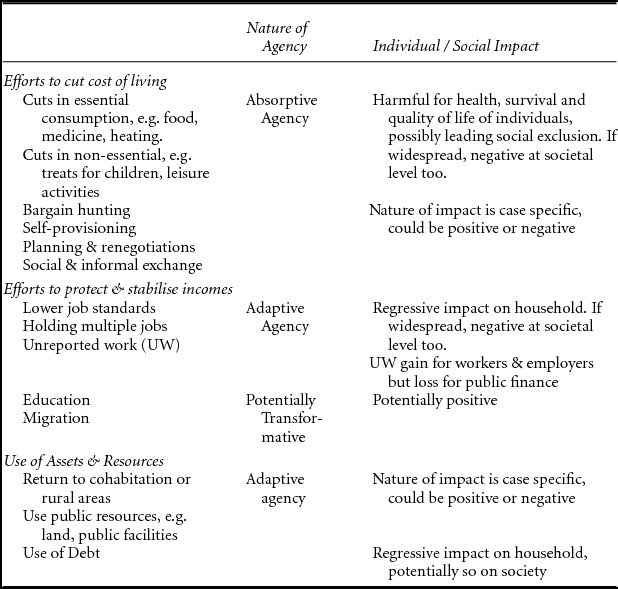
The research findings presented in the previous section provide a fertile ground to examine various dimensions of ‘emergence’ in household responses to hardship during the Great Recession under austerity. In Table 2, we reproduced the highlights of household responses to hardship and suggested the nature of agency and potential impacts for individuals and society. While this table highly simplifies what are likely to be complex relationships between responses, impact and agency, it can be a useful tool as a way of abstraction and analysis. We presume impact on society is influenced, amongst other things, by the size of the population displaying similar responses (a synchronic aspect) and the nature of change in behaviour (i.e. temporary or long term, with or without conviction).
A snapshot of household responses, implied impact and agency

Cuts from essential consumption such as medicine and food reflect an absorptive agency with perverse consequences (recall that absorptive agency characterises actions to deal with immediate and pressing difficulties, sometimes at the cost of a threat to wellbeing). They reflect the dominance of structural constraints, severely limiting the availability of choices for people and weakening their autonomy. This is a synchronic emergence complicated and moderated by old or new forms of social cooperation and support (e.g. foodbanks in the UK and family-based assistance in Greece) which may be considered as a positive structural development. However, the methods of adjustment have to be evaluated as inferior to the pre-crisis position since having work or entitlement to welfare benefits would be preferred to, say, collecting food parcels from a food bank. Similarly, cuts in non-essential expenditure through ‘not going out’, bargain hunting and self-provisioning also reflect an absorptive agency and limited autonomy. Although they involve de-routinisation as well as new routines, they fit into the changing conditions rather than shaping the conditions. Absorptive actions can turn into adaptive or transformative (longer-term) practices. Whether emerging practices are structural or temporal depends on their prevalence. For example, in a few countries, use of open access natural resources for leisure activities, fishing and foraging contributed in modest to significant ways to households’ welfare. If these responses were entrenched into the longer term practices of households they would represent a transformative change but not if households return to old routines when hardship is over.
Overall, the data suggest that coping through reducing spending has been the most predominant response in comparison to other types of household actions. This is not surprising given that a great majority of the participants were low-income, working-class households that did not have much in terms of assets and savings. In the face of this and limited labour market prospects, a focus on cutting the cost of living was the only viable alternative. This reflects the ‘diachronic’ aspect of emergence, using Archer's terminology: that is, the initial socio-economic conditions constrain the ‘degree of autonomy’ participants could display in the face of hardship. In other words, structural constraints (e.g. socio-economic status and labour market conditions) play an important role in coping and the nature of agency. These findings resonate with the conclusions of a number of other studies. For example, Caplan and Schooler (Reference Caplan and Schooler2007) argued that the socio-economic status of families affects the choice of ‘strategies’. Henley et al. (Reference Henley, Danziger and Offer2005) argue that help from poor families’ social networks facilitates coping without significantly improving economic status, because of the small size of the transfers while Lokshin and Yemtsov (Reference Lokshin and Yemtsov2004) indicate that richer families have better prospects of coping more effectively with the crisis.
Deterioration in labour market conditions, both in terms of job availability and precarity, has been a dominant theme in the narratives of participants, especially those from heavily affected countries such as Portugal and Greece. The principal reactions involved both adaptive and potentially transformative agency. Being compelled to take on lower quality jobs is an adaptation, to arrest the decline in incomes when employment opportunities are limited. Assuming that these responses are not unique to the participants of this study, they would reinforce or widen existing labour market insecurities that are structural in nature. Similarly, unreported work is likely to reduce pressure on family budgets but, if this were a widespread practice, it would represent regressive transformative agency from a social perspective.
Such synchronic transitions in the labour market created parallel transitions in the socio-economic status of households: that is, some middle-class families found themselves in hardship after the crisis and austerity. Similarly, we found that precarity in the labour market was extended to middle-class and professional occupations, although this was moderated by their access to various assets and networks in the heavily affected countries such as Spain (Arnal et al., Reference Arnal, Castro, Martin, Revilla and Serrano2015).
Instead, working-class households with limited assets depended on either the labour market or welfare support, which restricted their recovery in a time of austerity. An interesting contrast between those who experienced a downward social mobility and those in longer-term hardship is that the participants in the former group seemed not as well-equipped to deal with the immediate consequences of adversity. On the other hand, the participants in the latter group seemed to have accumulated some tacit knowledge to cope with adversity: for example, by using a wide range of shopping and budgeting strategies and seeking help from others. Hence they were better able to deal with newly encountered adversities (see Dagdeviren et al., Reference Dagdeviren, Donoghue and Meier2017 for greater detail on this).
Re-arrangements in the use of internal or external assets and resources (e.g. returning to the family home to cut housing costs) were also predominantly adaptive. Although such practices enable survival, they cannot be considered as progressive adaptations to the extent that they are non-ideal solutions undertaken to deal with hardship (as explained by some participants who felt a loss of autonomy or that they were a burden on their family). The crucial role that debt played in ‘keeping up with the Jones’ in the lead up to the 2008 crisis has been extensively discussed by economists. A synchronic emergence in the aftermath of the crisis is that debt represented an important aspect of coping with hardship and austerity in Greece, Britain, Ireland and Turkey although, this time, to cater for basic needs (food, shelter and utility bills) rather than investment in housing, etc. This constituted another form of adaptive agency, reflecting the limitations imposed on participants by the structural conditions (easy availability of debt, declining incomes and welfare benefits).
Transformative agency and change was almost completely absent in our data. Although further education and training to improve employment prospects potentially reflects transformative agency, the recessionary economic environment hindered the materialisation of this possibility in the few cases encountered in this study. Migration can represent a transformative change for the individuals – and, if widespread, for a society – but was not observed frequently in this study, reflecting perhaps the lack of opportunities elsewhere in Europe.
Let us consider the implications of the discussion above for the resilience approach. Recall that the resilience view distinguishes itself from poverty studies in two respects. First, it attributes stronger agency to individuals in controlling their circumstances. Our findings did not provide much support for this view. Instead, they showed that household responses to hardship during the Great Recession mostly involved absorptive and adaptive adjustments. These reflected the prominence of structural constraints such as labour market conditions and initial conditions of families (e.g. their assets and resources), limiting the participants’ ‘degrees of freedom’ or ‘autonomy’ and hence the nature of their agency. Their responses displayed a tendency to ‘fit in’ and ‘conform to’ the changing conditions rather than shaping the conditions. Hence, we identified plenty of examples of survival and coping amongst the participant households, but very few cases of ‘beating the odds’ and transcending to a better state of living. Transitions in labour market (e.g. from professional to precarious work) and socio-economic status (e.g. from middle class to poverty) also reflect the influence of structural factors and these cannot be explained with reference to a lack of resilience.
Second, the findings provide some basis for critical reflection on ‘positivity and resilience’. The fact that families used cuts in spending as a primary response to hardship suggests detrimental consequences such as lower welfare and social exclusion. Bargain hunting or self-provisioning created extra burdens for participants already juggling a busy family life. Risk sharing within family and friends had a negative impact on those who shared their meagre incomes as in the case of Greek pensioners, mentioned earlier. In particular, describing spending cuts that result in deprivations of essential consumption goods and services, such as food and medical care, as ‘resilience’ would be a way of glossing over the reality and understating the costs of the struggles people put up against varieties of hardship.
Conclusions
This paper critically examined the resilience approach in the context of coping with hardship during the Great Recession in Europe, drawing on primary data gathered through semi-structured interviews in nine European countries. The analysis has been located within the structure-agency debate with emphasis on emergence and autonomy. The aim of the paper was to explore household responses to hardship in terms of the nature of their agency.
From a theoretical point of view, three different forms of agency have been distinguished in the context of austerity and hardship: absorptive, adaptive and transformative agency. Further analysis of agency has been facilitated by classifying households’ socio-economic practices into efforts to cut spending, protect incomes and rearrange use of assets / resources.
We found that the resilience of participants through their agency and autonomy in times of hardship has been significantly constrained by structural forces. Much of the interview data highlighted the predominance of absorptive and adaptive agency, displaying the influence of constraints such as the initial conditions of families (e.g. low incomes, lack of resources and assets) that led them to rely on coping through cutting down expenditure as a primary response to hardship. Cutting down on food to the point of persistent ‘hunger’, rough sleeping, and ignoring medical necessities signified the limits of the choices available to the participants. Limited labour market opportunities meant that the welfare systems played a crucial role. Where they were downsized under austerity, a number of diachronic and synchronic emergences were observed such as the rise of community support systems (e.g. foodbanks) and resorting to kinship-based assistance. Lack of resources and restrictions on welfare provision led to growing use of debt to meet basic needs. On the other hand, open access to public resources such as parks, libraries, playgrounds and leisure centres enhanced the quality of life of many participants. This finding has an important policy implication regarding the impact of austerity measures: that is, when living standards of households are severely affected by an economy-wide crisis, cuts in public spending in these areas intensify their deprivations further.
In a few cases of potentially transformative agency, the impact of actions on the lives of people (education, re-training) was muted because of the context in which they took place (i.e. crisis, downturn and austerity).
Finally, the consequences of household actions to cope with hardship such as indebtedness and rising material deprivations challenge the so-called ‘positivity’ in the resilience approach. A number of interrelated negative transitions took place as a consequence of prolonged austerity (which itself reflected a hegemonic policy choice of structural influence). These included use of debt rather than earnings (or welfare support) to finance basic needs such as food and shelter – labour market precarity being extended to professionals and some middle-class families falling into poverty. It is likely that some of these transitions will continue to prevail in the near future.
Appendix
Population affected by severe material deprivations (as % of total population)