


Introduction
The processes underlying the onset and progression of psychotic disorders are poorly understood. Recent advances have been made in the identification of genetic factors that appear to be involved (Tandon, Keshavan and Nasrallah, Reference Tandon, Keshavan and Nasrallah2008), but a complete understanding of the aetiology and onset of these complex disorders is yet to be achieved.
Stress is one factor that has been consistently included in models of the development and maintenance of psychotic illnesses. Previous research suggests that the experience of stressful events that exceed an individual's coping capacity, and/or the employment of inappropriate or ineffective coping strategies, may promote psychobiological changes that lead to the expression of psychotic symptoms (Nuechterlein and Dawson, Reference Nuechterlein and Dawson1984; Zubin and Spring, Reference Zubin and Spring1977). Furthermore, individuals with poor coping skills or inadequate coping resources might have an underlying vulnerability to the eventual development of psychosis (Hardesty, Falloon and Shirin, Reference Hardesty, Falloon, Shirin and Falloon1985; Lukoff, Snyder, Ventura and Nuechterlein, Reference Lukoff, Snyder, Ventura and Nuechterlein1984; Marsella and Snyder, Reference Marsella and Snyder1981; Norman and Malla, Reference Norman and Malla1993; Rabkin, Reference Rabkin1980). Myin-Germeys and colleagues from the Netherlands have conducted a series of studies indicating that increased sensitivity to stress may be a vulnerability marker for psychosis through biological and psychological pathways (reviewed in Myin-Germeys and van Os, Reference Myin-Germeys and van Os2007). An understanding of the potential roles that stress and coping play in the development and maintenance of psychotic disorders might be important in the refinement of psychological interventions aimed at recovery and prevention.
Previous studies that have sought to investigate this potential relationship have been hampered by considerable methodological limitations such as retrospective design, small sample sizes, and inappropriate comparison groups (Phillips, Francey, Edwards and McMurray, Reference Phillips, Francey, Edwards and McMurray2007, Reference Phillips, Francey, Edwards and McMurray2009). Critically, most previous investigations have simply assessed the number of events an individual has experienced (Phillips et al., Reference Phillips, Francey, Edwards and McMurray2007), rather than considering an individual's appraisal of the meaning and potential impact of events, in line with the transactional model of stress and coping (Folkman and Lazarus, Reference Folkman and Lazarus1985; Lazarus and Folkman, Reference Lazarus and Folkman1984).
The development of criteria thought to identify young people at heightened risk of developing a psychotic disorder has enabled closer investigation of the processes involved in the development of a psychotic disorder (McGorry, Killackey and Yung, Reference McGorry, Killackey and Yung2007). In addition to providing information about the process underlying the onset of psychosis, studies with high risk cohorts might influence the development of preventive interventions. However, only two studies investigating experiences of stress and coping by young people who meet “at risk” criteria have been published to date.
The Edinburgh High-Risk Project (EHRP) assessed the experience of stressful events by a cohort of young people deemed at “high-risk” by virtue of a family history of psychosis. Miller et al. (Reference Miller, Lawrie, Hodges, Clafferty, Cosway and Johnstone2001) reported that there were no differences in the number of major life events experienced by the high-risk group and two comparison groups (healthy controls and first episode psychosis patients) and the experience of “intermediate” or “minor” stressors was not associated with symptom levels. Subjective or qualitative aspects of the experience of stressful events were not assessed.
An alternative strategy that has been developed to identify young people at heightened risk of psychosis is the “ultra high risk” (UHR) approach. Bell (Reference Bell1992) recommended applying “multiple-gate screening” and “close-in follow-up” strategies in developing criteria to identify high risk individuals as it was argued this would then minimize false positive rates. Essentially, multiple-gate screening refers to maximizing the level of risk in the selected sample by requiring that an individual must meet a number of conditions to be included in the high-risk sample, rather than just one. Close-in follow-up involves focusing on the period of time immediately preceding the transition to acute psychosis, thus shortening the duration of follow-up. With this in mind, researchers in Australia at the Personal Assessment and Crisis Evaluation (PACE) Clinic developed UHR criteria (Yung, Phillips and McGorry, Reference Yung, Phillips and McGorry2004). These criteria are drawn from retrospective research of the psychotic prodrome and focus on recent changes in mental state that are thought to be indicative of an emerging psychotic process, such as hearing an occasional voice or experiencing low-grade levels of paranoia, although family history of psychotic disorder is also considered (Yung, Phillips and McGorry, Reference Yung, Phillips and McGorry2004). Three inclusion groups have been defined. The first group combines the known trait risk factor of family history of a psychotic disorder in a first degree relative with a recent decline in general functioning. The other two inclusion groups reflect the recent experience of low-grade, attenuated positive psychotic symptoms or a brief and spontaneously abating episode of acute psychotic symptoms. Operational criteria for the three intake groups as well as acute psychosis have been defined and are provided later. The reliability of the UHR criteria has been supported in longitudinal studies with transition rates to full-blown psychosis of 9% to 54% (Olsen and Rosenbaum, Reference Olsen and Rosenbaum2006) being reported. Further information about the UHR and psychosis criteria can be found in previous publications from the PACE team (Phillips, Yung and McGorry, Reference Phillips, Yung and McGorry2000; Yung et al., Reference Yung, Phillips, Yuen, McGorry, Francey and McFarlane2003; Yung, Phillips, Yuen and McGorry, Reference Yung, Phillips, Yuen and McGorry2004).
The experience of stressful life events did not predict the onset of psychosis in a cohort of young people who were thought to be at UHR of developing a psychotic disorder according to a study from the Personal Assessment Service (PAS) in Newcastle, Australia (Mason et al., Reference Mason, Startup, Halpin, Schall, Conrad and Carr2004). Unfortunately, the study was cross-sectional and measurement was limited to the quantitative assessment of life events.
Further study of the experience of stress by individuals at heightened risk of psychosis is required. A sound exploration of the experiences of stress and coping by young people identified as being at UHR of psychosis is the central focus of the current study. Strengths of this study are that it has a prospective design and stress and coping are evaluated from both subjective and objective viewpoints. The primary research questions this study sought to answer were: Do young people who are identified as being at UHR of developing a psychotic disorder experience more stressful events and hassles and higher levels of distress than members of a healthy comparison (HC) group? Are there differences in appraisals of life events and hassles between the two groups? Does the UHR cohort utilize different strategies in response to life events than a HC cohort? In line with these research questions, it was hypothesized that members of the UHR group would report more stressful events (life events and hassles), higher levels of distress and more negative appraisals of life events, and would utilize different coping techniques (specifically emotion-oriented and avoidance strategies) than the HC group.
Method
The current study was incorporated within a larger research program investigating factors underlying the development of psychosis and evaluating potential preventive interventions aimed at the UHR population (Yung et al., Reference Yung, McGorry, Francey, Nelson, Baker and Phillips2007; Phillips, Nelson et al., Reference Phillips, Nelson, Yuen, Francey, Leicester and Simmons2009). The study was conducted according to ethical guidelines outlined by the North Western Mental Health Behavioural and Psychiatric Research and Ethics Committees and the University of Melbourne, Human Research Ethics Committee. Both UHR and HC participants received a small payment for their time and travel expenses following the initial assessment and all subsequent assessments.
Participants
UHR group. Consecutive referrals to the PACE Clinic between 1 January 1999 and 30 November 2003 were screened for inclusion in the study. Referrals were from health, education and support services that provide assistance to young people aged 14 to 30 years across the entire Melbourne metropolitan area. All referrals were initially triaged over the telephone and a face-to-face assessment with a clinician was organized if information gathered over the telephone suggested that UHR criteria might be met.
UHR and psychosis criteria were operationalized according to scores on the Comprehensive Assessment of At-Risk Mental States (CAARMS; Yung et al., Reference Yung, Yuen, McGorry, Phillips, Kelly and Dell'Olio2005). This semi-structured interview was developed to assess and monitor pre-psychotic symptomatology. The complete CAARMS consists of 7 subscales and 27 items that assess a wide range of symptomatology that has been associated with the psychotic prodrome. However, only the Disorders of Thought Content (TC), Perceptual Abnormalities (PA) and Disorganized Speech (DS) subscales are used when determining if UHR or acute psychosis criteria are met. (It should be noted that since completion of this study the criteria for identifying UHR individuals has changed slightly and four subscales of the CAARMS are now considered).
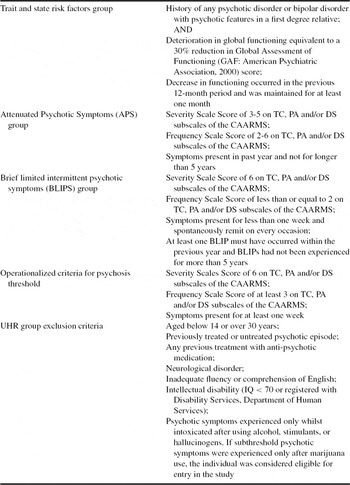
UHR group membership relied on meeting criteria for at least one of the groups described in Table 1. The psychosis threshold criteria, also shown in Table 1, reflect the intensity and frequency of psychotic symptoms that would routinely result in anti-psychotic medication being prescribed by a psychiatrist (Yung, Phillips and McGorry, Reference Yung, Phillips and McGorry2004). Young people were not accepted into the UHR group if they did not meet CAARMS criteria, if their past or present symptoms exceeded the psychosis threshold, or if one of the exclusion criteria shown in Table 1 was met.
UHR and psychosis threshold criteria

Of 1484 young people referred to PACE over the assessment period, 410 (28% of total referrals) met UHR criteria. All of those young people were given information about the current study and 143 agreed to involvement and subsequently completed questionnaires. There were no differences between the UHR cohort included in this study and the young people who met UHR criteria but declined involvement in this research in age (t (1, 408) = −1.33, p = .185) or gender (χ 2 (1, N = 410) = 1.01, p = .315).
Treatment
All the UHR participants attended the PACE Clinic for treatment and support whilst they were involved in this study. They had a psychologist/case manager assigned to work with them and at the minimum received supportive counselling and assistance with practical difficulties such as housing or seeking employment. Some participants also received more structured, cognitively-oriented therapy. Anti-depressant and anxiolytic medication was prescribed if appropriate. All UHR participants had access to a 24-hour crisis service, and family support and education were available.
UHR subjects recruited after August 2000 were given the opportunity to be involved in one of two treatment trials. The first was a 12-month randomized controlled trial comparing cognitive behavioural therapy and risperidone (up to 2 mg nocté), cognitive behavioural therapy and placebo, or supportive therapy and placebo. Interim results of this trial have been published (Phillips, Nelson et al., Reference Phillips, Nelson, Yuen, Francey, Leicester and Simmons2009; Yung et al., Reference Yung, Phillips, Nelson, Francey, Yuen and Simmons2011). The second study was an open trial of lithium (up to 450 mg day) for 12 months (Berger et al., Reference Berger, Dell'Olio, Amminger, Cornblatt, Phillips and Yung2007).
Healthy comparison group
Healthy comparison (HC) participants were recruited via advertisements placed at local employment agencies, a university and a residential college for tertiary students and through “snowballing” with respondents to advertisements. The advertisement called for volunteers for a research project who were aged between 16 and 30 years and had no personal or family history of mental illness. Potential comparison group participants were excluded from involvement if they met UHR criteria, if they met any of the UHR exclusion criteria (Table 1) or if they had a family or personal history of mental illness. All 32 young people who responded to advertisements calling for participants or who were nominated by a friend already in the HC group, met HC criteria and agreed to involvement in the study.
Measures
Demographic information. Demographic information was collected from both UHR and HC participants including date of birth, country of birth of participant and parents, years of formal education, current employment status, marital status, current housing and, for the UHR group, duration of time they had experienced any psychological symptoms.
Cognitive functioning. The National Adult Reading Test-Revised (NART-R: Nelson and Willison, Reference Nelson and Willison1991) was administered to both UHR and HC participants at the baseline interview to obtain an estimate of “premorbid” intellectual ability. Subject scores were calculated using Australian norms adjusted for educational level (Willshire, Kinsella and Prior, Reference Willshire, Kinsella and Prior1991).
Measures of stress and coping
Life Events Interview Schedule. The experience of life events (LE) was assessed using the Life Events Interview Schedule (LEIS) developed by Ventura and colleagues at UCLA specifically for research with individuals experiencing a first psychotic episode. At the time of writing the scale had not been published but is available from its author. The LEIS expanded and updated the Life Event and Difficulty Schedule (LEDS: Harris, Reference Harris1991), which was used by Brown and Birley (Reference Brown and Birley1968) in the well-known study that first reported a relationship between stress and the onset of psychotic episodes. Unlike the LEDS, which only assesses the experience of major stressful life events, the LEIS assesses the experience of both major and minor events.
The LEIS was administered as a semi-structured interview. Participants were asked to describe any positive or negative events that had occurred in all areas of daily living – such as employment, education, finances, relationships, and accommodation – during the month prior to the interview. The interviewer also presented the participant with a list of 250 possible events to prompt recall. For each reported event the respondent completed an 8-item questionnaire, which assessed various qualitative features of the LE that were reported: familiarity of the event (Familiarity), level of control over the occurrence of the event (Control), advance notice of impending event (Notice), change to routine caused by event (Routine), amount of time the event has been in the respondents thoughts (Time), the desirability of the event (Desirability), how well they felt they coped with the event (Coping) and how upsetting or uplifting the event was (Uplifting). Possible LEIS subscale scores ranged from 9 to 72.
As the LEIS was developed in America, some of the listed events were not relevant in the Australian context and had to be re-worded. The list of events also did not include several events that were quite commonly experienced by both the UHR and HC participants, such as difficulties obtaining social security benefits. Reliability and validity data for the LEIS are not yet available.
Hassles scale. The experience of “hassles” or minor distressing events was assessed using the adult version of the Hassles Scale (Kanner, Coyne, Scharfer and Lazarus, Reference Kanner, Coyne, Scharfer and Lazarus1981). Three scores were derived from the Hassles Scale: i) Number of hassles – a count of the number of items occurring over the rating period (possible scores: zero to 121); ii) Cumulative severity – sum of the severity ratings (possible scores: zero to 351); and (3) Intensity – Cumulative severity score divided by the number of hassles – an indication of how strongly or intensely the average hassle was experienced.
Perceived Stress Scale. Level of distress (“the degree to which situations in one' life are appraised as stressful”) was assessed using the 14-item Perceived Stress Scale (PSS: Cohen, Karmarck and Mermelstein, Reference Cohen, Kamarck and Mermelstein1983). PSS-Total scores and two factor scores, General distress and Perceived coping, were calculated. Higher scores for the factors indicate higher levels of distress and a perception of poorer coping skills, respectively.
Coping Inventory for Stressful Situations. The adult-version of the Coping Inventory for Stressful Situations (CISS: Endler and Parker, Reference Endler and Parker1990) was used to assess coping strategies used by the participants. Scores were derived for three basic coping scales (Task, Emotion, and Avoidance) and two subscales of the Avoidance scale (Distraction and Social Diversion).
Procedure
The baseline interview was scheduled as soon as possible once consent was obtained. Subsequent interviews took place at monthly intervals for the UHR group. The HC group were interviewed at baseline and then every second month over the course of a year (i.e. months 3, 5, 7, 9, and 11). For the purposes of conducting this study one month was equivalent to 28 +/− 4 days. Demographic questions, the GAF and the NART were only administered at the baseline interview. All other measures were administered at baseline and every subsequent assessment point. Members of the UHR group were withdrawn from follow-up if acute psychosis developed.
Sixty-five UHR participants (46%) did not complete the full 12-month follow-up period because they were either lost to follow-up, missed assessment points or their symptoms exceeded the psychosis threshold sometime after the baseline assessment (18 participants met this latter category). Out of a maximum of 12 interviews that were possible, the mean number of interviews that actually took place was 7.64 (SD = 3.51), with only 16 subjects participating in all 12 interviews. To ensure that there was not a selection bias between UHR participants who completed all interviews and those who did not, a series of comparisons were performed (UHR participants who developed psychosis at some point over the 12 month follow-up period were not included in this analysis). No differences were found between UHR participants who completed 12 interviews and those who did not in age (t(1, 123) = −0.73, p = .468), gender (χ 2 (1, N = 125) = 0.84, p = .360), average number of life events per month (t(1, 122) = −1.20, p = .848) or hassles per month (t(1, 122) = 1.18, p = .241). This indicates that UHR participants who took part in all 12 assessments were representative of the entire UHR sample, although they were in the minority. There were fewer drop outs in the HC group: 19 of the 32 participated in all six interviews, with the mean number of interviews being 5.12 (SD = 1.39). Twenty-five HC participants were involved for the full 12 months of the study.
Data analysis
All statistical procedures were conducted using Statistical Package for the Social Sciences (SPSS) 17.0.1 for Windows (SPSS Inc., 2003). First, demographic information was compared between the groups. Categorical data were analysed using chi-square tests, whilst t-tests were used for comparisons of continuous variables between two groups.
It was initially thought that the longitudinal nature of the stress and coping data lent itself to the application of repeated measures analysis of variance (ANOVA) to compare responses to the stress and coping measures between the UHR and HC groups. However, whilst the timing of the baseline interview for the UHR participants had some significance (it coincided with referral to the PACE Clinic), the baseline interview date of the HC group was arbitrary. Additionally, repeated measures ANOVA did not utilize all of the available data because participants with data missing at any assessment point were excluded from the analysis. Repeated measures ANOVA were therefore not considered the most appropriate approach. Instead, mean scores of the monthly, or bi-monthly assessments were calculated for each variable and were compared between the UHR and HC groups using SPSS General Linear Model (GLM) controlling for age. The exceptions to this were the comparisons of the number of life events and hassles. The number of life events reported at months 1, 3, 5, 7, 9 and 11 were added and compared between the groups. These were the months that the HC group was assessed. Adding the number of events reported by the UHR participants at every month would have inflated the total for that group. The same procedure was used to compare the number of hassles experienced.
To reduce the likelihood of Type 1 error, a Bonferroni adjustment was made to the alpha level. There were 20 comparisons all together (Number of life events, LEIS subscales, Number, Severity and Intensity of hassles, five CISS subscales, PSS-Total score and two PSS subscales, so the adjusted p-value required for significance was 0.0025.
Effect sizes were also calculated. Using SPSS, the effect size index that is computed when the GLM feature is performed is the partial η2 (eta-squared). An η2 of 0.01, 0.06 and 0.14 represent small, medium and large effect sizes respectively (Pallant, Reference Pallant2004).
Results
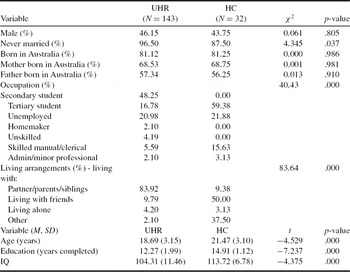
Basic demographic data for the two subject groups are shown in Table 2. Results of statistical tests assessing differences between the groups are also shown. The UHR group were significantly younger than the HC group. In line with the age difference, the UHR group were significantly less likely to be married or in a de facto relationship and were more likely to be living with family (in most cases their parents) at entry into the study and had spent significantly fewer years in formal education than the HC group. The UHR group had significantly lower IQ than the HC group according to NART scores. Differences between the two groups in IQ, level of education, occupation and living circumstances are likely to be largely attributable to the significant difference in age (the NART-IQ equivalent was calculated using a formula that incorporates highest educational level achieved (Willshire et al., Reference Willshire, Kinsella and Prior1991). However, when comparisons between the groups were repeated controlling for the influence of age, both NART score (F (1, 154) = 9.208, p = .003) and years of education (F (1, 175) = 28.349, p = .000) remained significantly different. As previous studies have suggested that the type of stressful events that are experienced and coping responses vary with age (Jackson and Finney, Reference Jackson and Finney2002; Sperling, Reference Sperling2003), age was included as a covariate in subsequent comparisons.
Descriptive information for the UHR and HC groups

Stress and coping measures
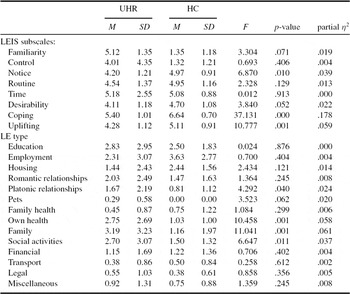
Life Events Interview Schedule. The UHR group reported experiencing significantly fewer LE (marginal mean = 12.018, standard error = 0.656) than the HC group (marginal mean = 17.767, standard error = 1.411) when controlling for age (F(1, 170) = 13.206, p = .000). The effect size of this comparison was medium (partial η2 = .07). Despite reporting fewer life events overall, the UHR group reported significantly more life events associated with platonic relationships, social activities, own health and family than the HC group (Table 3).
Comparison of LEIS subscale scores and types of life events reported between the UHR and HC groups

Despite reporting significantly fewer LE than the HC group, the UHR group rated the LE they experienced as significantly more upsetting (Uplifting subscale) than those reported by the HC group (Table 3). The UHR group also rated their coping ability as significantly poorer than the HC group. The UHR group also indicated that they felt they had less advance warning about events (Notice), and that the events they experienced were more undesirable (Desirability), but these differences were not significant after Bonferroni adjustment.
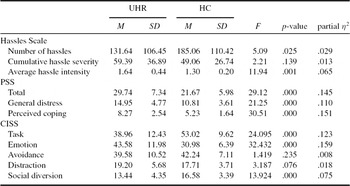
Hassles Scale. The HC group reported experiencing more hassles than the UHR group but this difference was not significant at the adjusted p-value (Table 4). However, the UHR group rated the hassles they experienced as significantly more intense than the HC group rated their hassles. The groups did not differ in the cumulative severity of hassles that were experienced.
Comparison of Hassles Scale, PSS and CISS scores between groups

Perceived Stress Scale. Mean PSS-Total and subscale scores for the UHR and HC groups are shown in Table 4. The UHR group scored significantly higher PSS-Total and subscale scores than the HC group, indicating that they reported significantly higher levels of general distress (indicated by the total score and the first subscale score) than the HC group but rated their own capacity to cope with stressors significantly worse than the HC group rated their coping abilities.
Coping Inventory for Stressful Situations. Summary scores for the CISS are displayed in Table 4. The UHR group reported significantly higher usage of emotion-oriented coping strategies than the HC group and significantly less use of task-oriented strategies. Whilst there were no differences between the groups in the use of Avoidance strategies overall, the UHR group were significantly less likely to utilize Social Diversion than the HC group. There were no differences between the groups in the use of Distraction as a coping technique.
Discussion
It was hypothesized that members of the UHR group would report more stressful events (life events and hassles), higher levels of distress and more negative appraisals of life events, and would utilize different coping techniques (specifically emotion-oriented and avoidance strategies) than the HC group. Whilst all other predictions were supported, the UHR group reported significantly fewer life events than the HC group and no difference was found between the groups in the number of hassles they experienced (although the analysis suggested a trend towards higher levels in the UHR group). The UHR group did not experience an absence of life events as they reported experiencing an average of 12 events over the 12-month period compared to 18 events reported by the HC group. These results are similar to the only previously published study comparing the experience of life events between a high risk cohort and a comparison group (Miller et al., Reference Miller, Lawrie, Hodges, Clafferty, Cosway and Johnstone2001). However, it should be noted that Miller and colleagues assessed the number of events experienced over the entire lifetime prior to recruitment to that study whilst in the current study only events experienced over the previous month were counted.
The significantly lower number of life events reported by the UHR group compared to the HC group was not anticipated, as in most previous studies individuals with established psychotic disorders report more life events than healthy comparison groups (Brown and Birley, Reference Brown and Birley1968; Canton and Fraccon, Reference Canton and Fraccon1985; Schwartz and Myers, Reference Schwartz and Myers1977a), although there have been a few studies that have reported the opposite (Al Khani, Bebbington, Watson and House, Reference Al Khani, Bebbington, Watson and House1986; Gureje and Adewunmi, Reference Gureje and Adewunmi1988; Ventura, Nuechterkein, Subotnik, Hardesty and Mintz, Reference Ventura, Nuechterlein, Subotnik, Hardesty and Mintz2000). In particular, Horan et al. (Reference Horan, Ventura, Nuechterlein, Subotnik, Hwang and Mintz2005) reported that individuals with schizophrenia reported significantly lower rates of life events over a year than a nonpatient comparison group.
It is noted that the average number of life events reported by both groups in the current study was higher than the number of events reported in studies of established psychotic disorders (for example, Brown and Birley, Reference Brown and Birley1968; Schwartz and Myers, Reference Schwartz and Myers1977b). This difference is possibly associated with the measure of life events that has been used. The measures used in the studies with psychotic cohorts assessed the experience of major stressful life events only, whilst the LEIS, used in the current study, assessed the experience of both major and minor events. The LEIS was developed specifically for use with first episode psychosis populations and was therefore thought also to be appropriate for use with the UHR population.
Most life event studies with individuals with established psychotic disorders have simply quantified the number of events experienced by subjects and have not investigated the type of events experienced. One exception is Jacobs and Myers (Reference Jacobs and Myers1976) who reported that individuals with schizophrenia were more likely to have experienced events categorized as “family related” or “relocations” (moving house) than a healthy comparison group. Betensky and colleagues (Reference Betensky, Robinson, Gunduz-Bruce, Sevy, Lencz and Kane2008) also reported that individuals with a psychotic disorder experienced more stressful events associated with the “domestic environment” than healthy volunteers. In the current study, the UHR group reported experiencing significantly more life events associated with platonic relationships, social activities, personal health and family than the HC group. This difference in the types of events that members of each group reported experiencing was found even when age was included as a covariate in comparisons between the groups. The inclusion of age-matched comparison groups in future studies is recommended. These results suggest that the UHR group maintained a level of social activity albeit with some difficulty and distress despite experiencing significant levels of psychiatric symptomatology. It is perhaps not surprising that a group of help-seeking individuals who were experiencing psychological distress would find stressful events more distressing and perceive their coping as poorer than healthy controls. However, the findings of this study suggest that exploration of perceptions of social support by UHR young people is warranted and may provide further insights into both stressors experienced by this cohort as well as the availability of coping resources.
The indication that UHR individuals are able to maintain a level of social activity may also provide some explanation for the higher number of life events reported by the UHR group in this study compared to individuals with established schizophrenia in previous studies. The emergence of more intense and distressing symptoms, including negative symptoms, and the high possibility of social withdrawal that often accompanies full-blown psychotic illness, are likely to result in fewer life events being experienced. This of course also highlights one of the attractions of working clinically with UHR individuals and reasons to be hopeful about the development of preventive interventions with this cohort: they are likely to be socially and vocationally engaged.
The LEIS and HS enabled assessment of qualitative aspects of the events that were reported. Hence it was found that despite reporting significantly fewer life events than the healthy comparison group, the UHR group rated the life events they experienced as significantly more upsetting. The UHR group also indicated that the events they experienced were less desirable than the comparison group rated their events, although this difference was not significant. Horan and colleagues (Reference Horan, Ventura, Nuechterlein, Subotnik, Hwang and Mintz2005) reported that individuals with schizophrenia appraised the events they experienced as less controllable and more poorly handled than a comparison group, and also appraised positive events as less desirable, but there were no differences between the groups in number of events reported nor level of distress. The UHR group rated the hassles they experienced as significantly more intense or distressing than the HC group rated their hassles, suggesting the UHR individuals are more likely to be negatively affected by stressors associated with comparatively normal circumstances than young people without mental health difficulties. There have been no previous studies that have investigated the experience of minor events or hassles by young people at heightened risk of psychosis. It is possible that the increased level of social difficulties reported by the UHR group could have resulted in lower perceived social support and therefore contributed to the reduced sense of control over the daily hassles that were experienced.
The UHR group reported significantly higher levels of distress associated with both major and minor events than the HC group. The current study is the first to investigate this subjective quality of stress in a UHR cohort. In fact, there are few studies that have investigated the level of distress of individuals with established psychotic disorders (Farhall and Gehrke, Reference Farhall and Gehrke1997; Horan et al., Reference Horan, Ventura, Nuechterlein, Subotnik, Hwang and Mintz2005; Malla and Norman, Reference Malla and Norman1992; Nayani and David, Reference Nayani and David1996; Norman and Malla, Reference Norman and Malla1991). Norman and Malla (Reference Norman and Malla1991) reported that the level of distress reported by individuals with schizophrenia was significantly correlated with the number of minor stressors experienced, but not with the number of life events. They concluded that individuals with schizophrenia were more distressed as a result of comparatively normal circumstances (hassles) than less frequent major life changes and challenges. A similar pattern was not found in the current study.
In addition to appraising events as more distressing or upsetting than the HC group, the UHR group also indicated they felt less able to cope with stressors than the HC group. Although there have been no previous studies of perceptions of coping ability in a UHR cohort, the perception of poorer coping skills has been reported in two previous studies of individuals with psychosis (Macdonald, Pica, McDonald, Hayes and Baglioni, Reference Macdonald, Pica, McDonald, Hayes and Baglioni1998; Horan et al., Reference Horan, Ventura, Nuechterlein, Subotnik, Hwang and Mintz2005).
Significant differences were also found between the UHR and HC groups in the coping strategies they were likely to use to respond to stress. The UHR group were less likely to utilize task-oriented coping strategies and more likely to utilize emotion-oriented strategies than the HC group. Whilst van den Bosch, van Asma, Rambouts and Louwerens (Reference van den Bosch, van Asma, Rambouts and Louwerens1992) similarly reported that individuals with established psychosis were more likely to use emotion-oriented strategies than task-oriented strategies, other studies have not reported such coping characteristics in psychotic populations (Brenner, Boker, Muller, Spichtig and Wurgler, Reference Brenner, Boker, Muller, Spichtig and Wurgler1987; Pallanti, Quercioli and Pazzagli, Reference Pallanti, Quercioli and Pazzagli1997; Wiedl and Schottner, Reference Wiedl and Schottner1991). The only previous study of coping strategies employed by UHR individuals also reported that the UHR group used less adaptive coping (task-oriented coping) than individuals with either first psychotic episode or established schizophrenia (Lewin et al., Reference Lewin, Carr, Halpin, Barnard, Beckmann, Walton and Chapman2001). Unfortunately, that study did not include a healthy comparison group.
The finding that the UHR group were more likely to utilize emotion-oriented coping strategies than task-oriented strategies is in line with the view held by the UHR group that they were unable to cope well with stressors. Generally, if a person perceives that a situation is amenable to change then task-oriented coping strategies tend to be applied (Folkman and Lazarus, Reference Folkman and Lazarus1980). If the person does not believe that they can influence events, emotion-oriented strategies are more likely. This also ties in with the finding that the UHR group felt they had less control over events occurring as locus of control has been cited as a key influence on coping strategies (Bollini, Walker, Hamann and Kestler, Reference Bollini, Walker, Hamann and Kestler2004; Giankos, Reference Giankos2002; Moore, Reference Moore2002; O'Connor and Shimizu, Reference O'Connor and Shimizu2002; Zuckerman, Knee, Kieffer and Gagne, Reference Zuckerman, Knee, Kieffer and Gagne2004).
There was no overall difference between the UHR and HC groups in the use of avoidance as a way of coping with stressors. There was also no difference between the UHR and HC groups in the use of distraction as a specific avoidance technique, but the UHR group were less likely to utilize social diversion – that is, engagement with others to distract attention from stressors than the HC group. There have been no previous investigations of the use of avoidance as a coping technique by UHR groups.
In summary, the comparison of stress and coping variables between the UHR and HC groups indicated that the groups experienced different types of stressors and interpreted and reacted to them differently. Unfortunately, the study did not permit analysis of whether the experiences of stress and coping described by the UHR group preceded the onset of UHR symptoms or if there had been a change with the onset of the UHR mental state changes. To do this, individuals would need to be followed longitudinally from before the onset of any UHR symptoms. Despite this, the results of this study suggest that treatment strategies focusing on stress management and enhancing coping skills might be important components of preventive interventions.
Although the young people identified as being at heightened risk of psychosis did not experience more stressful events than young people without mental health concerns, they interpreted their experiences of stress and distress differently. Using Lazarus' terminology from the transactional model of stress (Lazarus and Folkman, Reference Lazarus and Folkman1984), the UHR group appraised their experiences as more distressing than the HC group rated their own experiences.
The heightened distress reported by the UHR group has two potential sources. First, the UHR group rated events as more upsetting and undesirable than the HC group, although the latter was not significant. Applying Lazarus' terminology again, this suggests that the primary appraisal of stressful events by the UHR group was that they posed a degree of threat to the individual, resulting in heightened feelings of distress. Levels of distress experienced by the UHR group were negatively correlated with perceptions of desirability, advance notice and control over events. Second, the UHR group rated their ability to cope with stressors as poor. In other words, their secondary appraisal was that they had insufficient resources to manage stressors effectively. This perception is likely to have influenced the finding that the UHR group were more likely to utilize emotion-oriented coping strategies than the HC group and less likely to utilize task-oriented strategies, as well as heightening feelings of distress. Therefore, social withdrawal was possibly used by the UHR group in a bid to reduce the number of life events experienced and, hence, to minimize feelings of distress. It is also possible that the increased incidence of socially related problems as reported by the UHR group influences the level of distress reported by that group. The UHR group may perceive they have fewer social supports to draw on than the HC group and this contributes to a reduced sense of control over the experience of hassles and life events. Of course, the temporal relationships between these variables can only be speculated at this time and this putative relationship supports the need for future work in this area that might benefit from exploring perceptions of social support by UHR young people. It would also be interesting for future studies to include an assessment of stigma as the appraisal of hassles and capacity to cope with stressors could be influenced by the perception that one is experiencing mental health difficulties.
The experience of childhood trauma, which has been suggested as a causal factor in the development of psychosis (Kilcommons and Morrison, Reference Kilcommons and Morrison2005; Bendall, Jackson, Hulbert and McGorry, Reference Bendall, Jackson, Hulbert and McGorry2008; Shevlin, Houston, Dorahy and Adamson, Reference Shevlin, Houston, Dorahy and Adamson2008), was not assessed in this study. Thompson and colleagues (Reference Thompson, Kelly, Kimhy, Harkavy-Friedman, Khan and Messinger2009) recently reported that the vast majority (97%) of UHR young people they assessed reported having experienced at least one general traumatic event during childhood, with 83% reporting physical abuse, 67% emotional abuse, and 27% sexual abuse. Similarly, the experience of trauma has been found to increase the risk of psychotic symptoms in vulnerable young people (Spauwen, Krabbendam, Lieb, Wittchen and van Os, Reference Spauwen, Krabbendam, Lieb, Wittchen and van Os2006). Bak and colleagues (Reference Bak, Krabbendam, Janssen, de Graaf, Vollebergh and van Os2005) have suggested that the experiences of early trauma by individuals with an established psychotic disorder impacts on subsequent perceptions of control and emotional reaction to events. Investigating the experience of trauma by participants in this study would have enabled that relationship, and others, to be explored in relation to UHR status.
The results of this study may not be representative to a wider population of young people at heightened risk of psychosis. UHR participants in this study were help-seeking and agreed to participate in the research (the majority of young people who met UHR criteria at the PACE Clinic over the study's recruitment phase declined to participate). The majority of participants were born in Australia of Australian born parents, further limiting the representativeness of the sample. Finally, as with most UHR cohorts, the group included in this study had experienced psychotic symptoms and/or a change in functioning for an extensive period of time – the mean duration of any symptoms in the UHR cohort was 355.63 days (SD = 446.93). Thus, young people with a rapid onset of psychosis may be under-represented in this cohort.
All members of the UHR group in this study received supportive counselling, anti-depressant or anxiolytic medication if necessary and had access to a 24-hour crisis service. In addition, some of the UHR participants were involved in clinical trials being conducted at the PACE Clinic at the same time as the current study. The provision of some form of clinical treatment to UHR individuals is considered an ethical responsibility in light of the distress that is commonly experienced by this group of young people and their help-seeking behaviour (McGorry, Yung and Phillips, Reference McGorry, Yung and Phillips2001; Yung, Phillips and McGorry, Reference Yung, Phillips and McGorry2004). Nevertheless, treatment was a confounding factor that could have impacted on the development of psychosis, as well as on the appraisal of stressors and implementation of coping strategies.
It has already been suggested that the increased number of life events reported by UHR participants in this study compared with previous studies of established psychosis may have been due to the life event measure that was used, the LEIS. It would be ideal to have LEIS data for a psychosis cohort to directly compare experiences between those two groups. Similarly, continuing to assess the experiences of the 12 UHR participants who developed a psychotic disorder after onset of the disorder could have elicited interesting information about changes in experiences of stress or coping after that time. In addition to meeting UHR criteria, many UHR young people meet diagnostic criteria for a mood or anxiety disorder (Yung, Phillips and McGorry, Reference Yung, Phillips and McGorry2004). Future studies could also incorporate a comparison group of young people with a mood or anxiety disorder but not sub-threshold psychotic symptoms to determine if the UHR participants have a unique way of viewing stress and coping, if it is accounted for by level of depression in light of the well-described association between life events and depressed mood (Brown and Harris, Reference Brown and Harris1978), or if this is common across all areas of mental health difficulty. This is clearly necessary before any further advances can be made in understanding this area.
It is noted that the HC group were significantly older, more intelligent, better educated and more likely to be living independently than the UHR cohort. It is possible that these differences were likely to have been due to the strategies undertaken to recruit this group and may have accounted for the increased number of life events experienced and also potentially the range and proficiency of coping strategies employed by the HC group. Obviously future studies should aim to reduce such differences between groups.
Future studies of stress and coping in UHR cohorts could incorporate investigations of possible neurobiological underpinnings of the link between the experience of stressful events and psychosis, including the hypothalamic-pituitary adrenal (HPA) axis (Phillips et al., Reference Phillips, McGorry, Garner, Thompson, Pantelis and Wood2006; Walker, Mittal and Tessner, Reference Walker, Mittal and Tessner2008) and the dopamine system (Kapur, Reference Kapur2003). Other methods of assessing the experience of stress and coping, particularly the ESM methodology, might provide additional insights that questionnaire-based methodologies cannot (Lardinois et al., Reference Lardinois, Myin-Germeys, Bak, Mengelers, van Os and Delespaul2007; Myin-Germeys and van Os, Reference Myin-Germeys and van Os2007).
Conflict of Interest
All the authors declare the absence of any conflict of interest associated with undertaking this research and development of this manuscript.
Acknowledgements
We gratefully acknowledge the young people and their families who agreed to involvement in this research project, as well as the numerous clinicians and research staff who assisted in conducting this research. This work was supported in part by a project grant from the National Health and Medical Research Council and in part through an investigator-initiated grant from Janssen-Cilag Pharmaceuticals (RIS-AUS-9). Janssen-Cilag had no role in study design, in the collection, analysis and interpretation of data, in the writing of this manuscript or in the decision to submit this paper for publication.



Comments
No Comments have been published for this article.