Implications
Milking robots have revolutionized the dairy industry with farmers achieving high levels of robot utilization obtaining greater returns on asset. The first installations were typically associated with ‘indoor’ systems and nearby grazing fields. Nowadays there is an increasing interest regarding the integration of robots into larger scale pasture-based dairy systems. This review explores the published literature on both ‘indoor’ and ‘pasture-based’ dairy systems in relation to milking robot utilization.
Introduction
Robotic milking systems have revolutionized the dairy industry. The first dairy cow was milked, more or less without traditional human involvement, in 1986 with a robotic milking box at the experimental farm de Waiboerhoeve, Lelystad, the Netherlands by Gascoigne Melotte, following the US Patent 4010714A (Notsuki and Ueno, Reference Notsuki and Ueno1977). A system from the company Prolion was installed on the experimental farm IMAG-DLO Duiven, the Netherlands, in 1990 and on a commercial dairy in 1992. More institutes and companies became active in the development of robotic milking systems in the nineties as described by Kuipers and Rossing (Reference Kuipers and Rossing1996). Since that time until 2011, automatic milking systems (AMS) have been installed on over 10 000 farms worldwide (de Koning, Reference de Koning2011). These installations are predominantly for ‘indoor’ systems where cows are generally ‘housed’ in barns and offered a partial mixed ration (PMR) in the feeding alley and grain-based concentrate supplement either in the milking unit or in a nearby concentrate self-feeder. While there have been numerous AMS installations in indoor dairy systems, there is an increasing interest regarding the integration of AMS into pasture-based dairy systems. Ketelaar-de Lauwere (Reference Ketelaar-de Lauwere1999) pioneered the concept of pasture-based AMS as a hybrid ‘housed grazing’ system in the Netherlands (Duiven, Gelderland province), followed by entirely pasture-based AMS in Australia (Greenall et al., Reference Greenall, Warren, Warren, Meijering, Hogeveen and de Koning2004), New Zealand (Woolford et al., Reference Woolford, Claycomb, Jago, Davis, Ohnstad, Wieliczko, Copeman and Bright2004), and more recently partial grazing in America (Utsumi, Reference Utsumi2011) and Ireland (O’Brien, Reference O’Brien2012). This interest and global spread in pasture-based AMS is likely to accelerate given the ability to follow established grazing management principles as developed in conventional systems and achieve high levels of pasture utilization (Clark et al., Reference Clark, Farina, Garcia, Islam, Kerrisk and Fulkerson2015). However, grazing systems add another factor, and element of complexity, to consider when targeting optimized robot utilization.
Irrespective of geographic location or feeding regime (PMR or pasture), a milking robot represents a large capital investment for farmers and utilizing this investment across the full 24 h period in a day is a requirement to achieve an acceptable return on asset (Wade et al., Reference Wade, van Asseldonk, Berentsen, Ouweltjes and Hogeveen2004; Jago et al., Reference Jago, Roche, Kolver and Woolford2006). As time is required for the system to wash, coupled with milking failures, periods of non-attendance and technical maintenance, levels of achievable robot utilization of between 20 and 22 h/day are deemed the sustainable maximum (Halachmi, Reference Halachmi2004; Lyons et al., Reference Lyons, Kerrisk and Garcia2014). Such high levels of utilization can be achieved by milking more cows/robot, at the expense of reduced herd milking frequency (Woolford et al., Reference Woolford, Claycomb, Jago, Davis, Ohnstad, Wieliczko, Copeman and Bright2004); or if milking frequency is maintained, increased waiting time in the pre-milking yard (Halachmi, Reference Halachmi2009) and associated reduction in animal health and production due to extended time, away from feed, and increased milking interval. A comprehensive review of milking frequency management conducted by Lyons et al. (Reference Lyons, Kerrisk and Garcia2014), provides a good understanding of different factors such as age and experience of the cow, environmental conditions and management strategies that impact the static mean daily levels of milking frequency, however, the dynamic nature of milking robot utilization across a 24 h period, which is of equal importance to the overall performance of any AMS, is still poorly understood. Irrespective of milking frequency targets that may differ with feeding system (Lyons et al., Reference Lyons, Kerrisk and Garcia2014), achieving high milking robot utilization by having cows present to the milking robot across 24 h with minimal waiting time is ideal for all AMS farmers.
This review draws together current knowledge on indoor and pasture-based robot utilization across 24 h, with a specific focus on the factors that impact utilization levels. It is the intent of this novel review to explore both the opportunities that exist for improved system efficiencies on-farm and those that exist for further research.
Material and methods
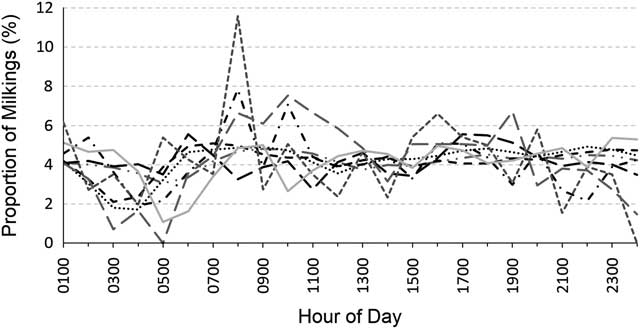
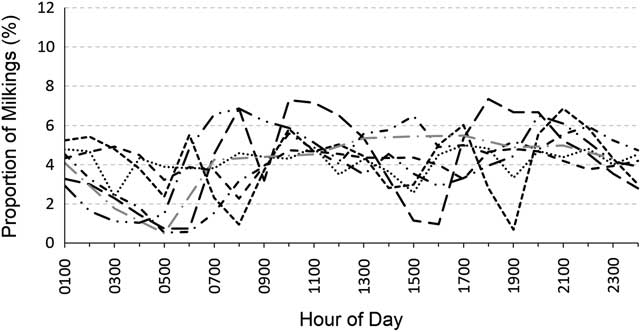
A thorough review of the published literature found 15 data sets across 13 studies (Table 1) that provided robot utilization over 24 h. Results from the literature were categorized according to predominant feeding system (indoor or pasture-based AMS). Indoor AMS studies (n=8) predominantly featured an indoor barn or open shed type layout and PMR as the cow’s primary feed source, with some studies including a period of access to pasture during the day. Pasture-based AMS studies (n=7) offered cows grazed pasture as the cow’s primary feed source. Levels of milking robot utilization for each study were converted to a ‘proportion of total milkings/h’ to allow the presentation of results on a common scale (Figures 1 and 2). In this way, achieving 4.2% of milkings/h (100%/24 h) would represent an entirely uniform and distributed milking pattern.
Proportion of milkings/h (% total) for dairy cattle in indoor automatic milking systems from Belle et al. (Reference Belle, Andre and Pompe2012) ( ), Halachmi et al. (Reference Halachmi, Maltz, Livshin, Antler, Ben-Ghedalia and Miron2000) (
 ), Halachmi et al. (Reference Halachmi, Ofir and Miron2001) (
 ), Halachmi (Reference Halachmi2004) (period A
 ; period B
 ), Stefanowska et al. (Reference Stefanowska, Ipema and Hendriks1999) (
 ), Wagner-Storch and Palmer (Reference Wagner-Storch and Palmer2003) (
 ) and Winnicki et al. (Reference Winnicki, Kolodziejczyk, Glowicka-Woloszyn, Myczko and Musielska2010) (
 ).

Proportion of milkings/h (% total) for dairy cattle in pasture-based automatic milking systems taken from Davis et al. (Reference Davis, Jago, Wieliczko, Copeman, Bright and Woolford2005) (), John et al. (Reference John, Clark, Freeman, Kerrisk and Rawnsley2013) (farm A ; farm B ), Lyons et al. (Reference Lyons, Kerrisk and Garcia2013b) (), Scott et al. (Reference Scott, Kerrisk, Thomson, Lyons and Garcia2015) ( ), van Dooren et al. (Reference Van Dooren, Heutinck, Biewenga and Zonderland2004) () and Woolford et al. (Reference Woolford, Claycomb, Jago, Davis, Ohnstad, Wieliczko, Copeman and Bright2004) (
 ).

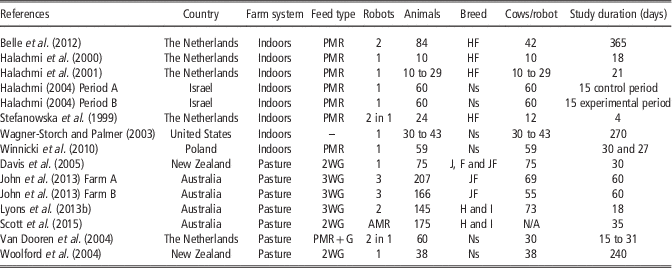
Summary of manuscripts reporting 24 h robot utilization for indoor and pasture-based farm systems

PMR=partial mixed ration; 2WG=two-way grazing; 3WG=three-way grazing; G=grazing; 2 in 1=two boxes with one robotic arm; AMR=automatic milking rotary; HF=Holstein–Friesian; J=Jersey; JF=Jersey–Friesian cross; H=Holstein; I=Illawarra; NS=not specified.
The number of cows across the studies ranged from 10 to 207, with a mean of 83.9±63.0 (±SD). The large disparity in herd size, environment and management between studies needs to be taken into consideration when interpreting the findings. For this reason, possible tendencies as well as significant differences were considered.
Statistical analysis
The distribution of milking robot utilization/h was determined to be normal from visual analysis of normal probability plots. Repeated measures ANOVA function in Genstat 16th edition was used to determine the impact of feeding system (S) (‘indoor’ and ‘pasture-based’), cows/robot (R) (‘high’ ⩾50 cows/robot and ‘low’ <50 cows/robot) and time of day (T) (0100, 0200… 2400 h) factors on milking robot utilization using the following model:
 $$Y_{{ijk}} =T_{i} {\plus}TS_{{ij}} {\plus}TR_{{jk}} {\plus}{\varepsilon}_{{ijk}} $$
where Y is the dependent variable (proportion of total milkings/h) and ε ijk the random error. Due to the source data requiring transformation to proportion of total milkings/h allowing for comparison between studies, the main factors ‘feeding system’ and ‘cows/robot’ were unable to be statistically compared as individual main factors, as the categories within these factors all shared the same mean of 4.2% milkings/h.
Mean hourly robot utilization and standard deviation were calculated for both feeding systems. The lack of replicates within regions (Australia, the Netherlands, New Zealand, United States, Israel and Poland) prevented region being a factor in the analysis.
Results
Across all studies, the distribution of milking robot utilization varied by time of day (P<0.01). Levels of robot utilization through time for each individual farm are shown in Figures 1 (indoor farms) and 2 (pasture-based farms).
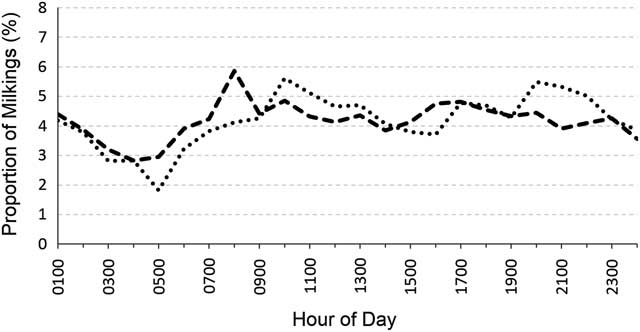
There was no interaction (P=0.43) between cows/robot and time of day on milking robot utilization through time. Likewise, the interaction between feeding system and time of day on robot utilization through time was not significant (P=0.24), though both feeding systems tended to have reduced milking robot utilization in the early hours of the morning (0200 and 0600 h) with the reduction in number of milkings during the morning greater for pasture-based feeding systems (Figure 3) and 50% more variability in the proportion of milkings across time for pasture-based (SD=0.9%) as compared with indoor (SD=0.6%) feeding systems.
Mean proportion of dairy cattle milkings/h (% total) for pasture-based ( , SD=0.9%, n=7), and indoor (, SD=0.6%, n=8), automatic milking systems.

Discussion
The following discussion examines factors impacting robot utilization through time and has been divided into three main sections: feed, animal and management factors. Each of these factors are explored through the 15 data sets provided in the current analysis as well as drawing on information from 53 other studies relating to AMS.
Feed factors
Timing of allocation
Given the choice of consuming feed or being milked, cows will choose the option to consume feed (Prescott et al., Reference Prescott, Mottram and Webster1998). As such, feed is the most important influence of voluntary cow traffic in both indoor and pasture-based AMS. Therefore, the timing, type and quantity of feed offered play a vital role in encouraging voluntary cow traffic in AMS. Pasture-based cows seek out and ingest feed (graze) during daylight hours predominantly during dawn and dusk, with night feeding activity only accounting for 10% to 15% of daily grazing time and intake (Stobbs, Reference Stobbs1970; Krysl and Hess, Reference Krysl and Hess1993). These behaviours can be attributed to a multitude of factors, including variation in diurnal feed quality, photoperiod and cow hormone levels (Gregorini, Reference Gregorini2012). Decreased milking robot utilization in pasture-based AMS during the period 0200 to 0600 h (Figure 2) can be primarily attributed to the circadian eating behaviour of cows, with pasture-based cows exhibiting a more diurnal pattern compared with those offered a PMR (Jago et al., Reference Jago, Newman, Davis and Woolford2005).
Diurnal feeding behaviour has also been observed in indoor dairy systems (DeVries et al., Reference DeVries, von Keyserlingk and Beauchemin2003). Wagner-Storch and Palmer (Reference Wagner-Storch and Palmer2003) observed a large decline in both feed bunk activity and milking robot utilization in the early morning period of an indoor AMS, with the majority of feed bunk utilization between 0700 and 2000 h and robot utilization following a similar trend. Differences between indoor AMS voluntary traffic across time are likely related to feed bunk activity as per Halachmi et al. (Reference Halachmi, Maltz, Livshin, Antler, Ben-Ghedalia and Miron2000) where feed bunk activity was evenly distributed throughout 24 h alongside milking robot utilization. This hypothesis is supported by DeVries et al. (Reference DeVries, von Keyserlingk and Beauchemin2005) who found an increase in feeding activity and diurnal feeding pattern during the early morning when PMR was offered four times per day as compared with two times per day. Though, the evenly distributed milking robot utilization achieved in the Halachmi et al. (Reference Halachmi, Maltz, Livshin, Antler, Ben-Ghedalia and Miron2000) study was likely influenced by the 6 h (four feeding periods per day) concentrate feeding regime, along with the PMR offered in this system, whereby each animal could access a new allocation of concentrate in each of the four feeding periods. As cow feeding activity is the main motivator for voluntary cow traffic to and from the milking robots (Prescott et al., Reference Prescott, Mottram and Webster1998; Kerrisk, Reference Kerrisk2010) and appears to be linked with milking robot utilization, ways to alter the number and timing of feed allocations, both forage and concentrate, to achieve an evenly distributed feeding pattern throughout 24 h is a clear opportunity for improving robot utilization for indoor AMS and for future research, particularly on pasture-based AMS.
Reduced early morning milking frequency and milking robot utilization in pasture-based AMS was the basis behind the work of Lyons et al. (Reference Lyons, Kerrisk and Garcia2013b). This work aimed to modify the diurnal pattern by offering a third allocation of pasture, known as three-way grazing (3WG), within a 24 h period, compared with offering two-way grazing. With 3WG, milking robot utilization levels were increased throughout the day and remained consistent throughout 24 h. However, most pasture-based AMS farmers in Australia use 3WG and still report a drop in milking robot utilization at night in commercial systems (N. Lyons, personal communication). Dalley et al. (Reference Dalley, Roche, Moate and Grainger2001) offered fresh pasture between 0200 and 0600 h and found decreased grazing duration during daylight while maintaining total time spent grazing, highlighting the ability to manipulate when cows are actively eating without impacting intake. Also, Livshin et al. (Reference Livshin, Maltz and Edan1995) found that cows subjected to 4 and 6 h feeding periods were able to learn each routine and adapt the timing of their movement to, and from, the feed bunk to match the duration of the feeding period applied. Thus, voluntary attendance to the grain-based concentrate feeders was a result of the cows ‘learning’ the system, raising the possibility of controlling AMS cow traffic by modifying the frequency of feeding. The work of Belle et al. (Reference Belle, Andre and Pompe2012) found early morning milking robot utilization was greater on farms using an automatic TMR feeder compared with conventional TMR feeding, with an automatic feeding event in the early morning possibly encouraging the cows to move to the feed bunk at this period of the morning. This may partially explain the earlier increase in milking robot utilization levels observed in the indoor AMS studies in Table 1, as cows may have increased motivation to move through the milking robot due to PMR being available and of consistent nutritive value. Thus, manipulating the diurnal feeding patterns of cows is one of the key areas that is both under the control of the farmer and likely to have an impact on cow grazing behaviour and therefore warrants further investigation.
Feeding system
From the compilation of literature presented as Figures 1 and 2, dairy cows tend to be more motivated to consistently visit the milking robot throughout 24 h in an indoor AMS, compared with pasture-based AMS. A possible explanation for these findings is the consistent nutritive value of a PMR compared with pasture as per Charlton et al. (Reference Charlton, Rutter, East and Sinclair2011a), who showed when given the choice, cows will prefer PMR v. pasture two out of three times, with an even larger difference found in the total time spent indoors (92%) as compared with pasture (8%). In contrast, studies by Charlton et al. (Reference Charlton, Rutter, East and Sinclair2011b) and Motupalli et al. (Reference Motupalli, Sinclair, Charlton, Bleach and Rutter2014) found a partial preference for cows to be at pasture v. indoors. Motupalli et al. (Reference Motupalli, Sinclair, Charlton, Bleach and Rutter2014) hypothesized that the animal’s lack of exposure to pasture in the study by Charlton et al. (Reference Charlton, Rutter, East and Sinclair2011a) was the likely cause for their greater preference to be indoors compared with the other studies. Clark (Reference Clark2013) found the pasture intake of individual animals in pasture-based AMS varies in quality and quantity depending on when a cow enters the pasture allocation, as pasture has been shown to decrease in nutritive value as it is grazed over the duration of its allocation. These findings concur with those of Ketelaar-de Lauwere et al. (Reference Ketelaar-de Lauwere, Ipema, van Ouwerkerk, Hendriks, Metz, Noordhuizen and Schouten2000), who found an increased number of visits to the robotic milking unit as pasture mass (and presumably quality) decreased. The consistency of PMR quality compared with the inconsistent characteristics of grazed pasture, is a clear distinction between indoor and pasture-based systems and likely to be a key factor in the larger variability in robot utilization seen in pasture-based AMS farms throughout the day.
Dairy cows are highly selective when presented with multiple forage options and this preference changes not only with forage species, but also across seasons, with water soluble carbohydrate (WSC) content of forage the main driver of cow preference (Horadagoda et al., Reference Horadagoda, Fulkerson, Nandra and Barchia2009). Indoors, the replacement of roughage by soy hulls (greater NDF digestibility) had no impact on total dry matter intake or attendance rate to the milking robot (Halachmi et al., Reference Halachmi, Metz, Maltz, Dijkhuizen and Speelman2006), though an increase in milk production was observed due to an increased intake of digestible NDF (Halachmi et al., Reference Halachmi, Shoshani, Solomon, Maltz and Miron2004). Likewise, the incorporation of grazed soya bean into the rotation of a pasture-based AMS has also been investigated (Clark et al., Reference Clark, Horadagoda, Kerrisk, Scott, Islam, Kaur and Garcia2014b); however, there was no significant improvement in voluntary traffic or milk yield associated with grazing soya bean (WSC=10.0% DM) and kikuyu pasture (WSC=8.5% DM) compared with kikuyu pasture alone. Despite the cow preference for forages with a greater content of WSC, it would appear that levels of WSC, or the type of forage offered, have limited impact on voluntary cow traffic particularly when forages are located a distance away from the milking robot as per pasture-based AMS. However, Raubenheimer and Simpson (Reference Raubenheimer and Simpson2007) suggest, through their geometric framework approach to nutrition, that behavioural and physiological responses cannot be attributed to a single limiting component such as WSC, rather, animals have a dynamic intake target for different macronutrients based on their current physiological state. Therefore, the ratio of macronutrients, in this case protein and carbohydrates, may play a role in a cows willingness to seek out certain feeds and presents an opportunity to test feeds with different macronutrient ratios on voluntary cow traffic.
Feed quantity
The amount of feed offered is more pertinent to pasture-based AMS compared with indoor AMS, as allocating the correct amount of pasture is crucial to achieving voluntary cow traffic (Kerrisk, Reference Kerrisk2009). These findings are reinforced by Ketelaar-de Lauwere et al. (Reference Ketelaar-de Lauwere, Ipema, van Ouwerkerk, Hendriks, Metz, Noordhuizen and Schouten2000) who showed the number of daily visits to the robotic milking unit to significantly increase from 4.4 to 7.3 visits/day from a high to low pre-grazing sward height, respectively. Dickeson (Reference Dickeson2010) investigated the impact of ‘inaccurate’ pasture allocation in pasture-based AMS with two-way grazing, where the proportion of feed offered between the two daily allocations were 50 : 50% for the ‘accurate’ (or consistent) allocation and 75 : 25% for the ‘inaccurate’ allocation, with the latter offered in combinations of 75 : 25% and 25 : 75% to achieve the same pasture allowance as 50 : 50% over a 48 h period. The impact of short-term inaccuracy in pasture allocation on 24 h robot utilization was not reported, however, no impact on milking frequency or milk yield was observed. The proportion of feed offered for the inaccurate treatment, though not consistently offered as 75 : 25% or 25 : 75% inadvertently raises the concept of variable allocation, whereby different quantities of feed are offered in each of the feed allocations throughout 24 h to manipulate voluntary traffic levels. The concept of variable pasture allocation has since been associated with increased levels of robot utilization at night on a commercial pasture-based AMS, offered as a consistent combination of 40 : 40 : 20% across the three daily allocations (farm A) (John et al., Reference John, Clark, Freeman, Kerrisk and Rawnsley2013). In the same study, a second farm (farm B) used one larger allocation of pasture between 1230 and 1930 h and two smaller allocations of pasture between 1930 and 0500 h and 0500 and 1230 h and achieved inconsistent levels of robot utilization. The smaller allocation on farm A, offered between 1730 and 0200 h, may have been depleted more rapidly with cows seeking fresh feed earlier compared with the 40% allocations, thus encouraging voluntary cow traffic in the early morning (John et al., Reference John, Clark, Freeman, Kerrisk and Rawnsley2013). The impact of strategically varying forage quantity across the three allocations to alter feeding behaviour in 3WG still remains to be thoroughly investigated. While studies have investigated the impact of high and low concentrate allowances in the milking unit on milk yield and milking frequency (Halachmi et al., Reference Halachmi, Dzidic, Metz, Speelman, Dijkhuizen and Kleijnen2005; Bach et al., Reference Bach, Iglesias, Calsamiglia and Devant2007) there is the potential to improve robot utilization through temporal variation in feed allowance. One practice may be to offer a larger proportion of feed during the night to encourage visitation to the milking robot at night. Conversely, offering less feed at night to deplete feed sooner may encourage cows to search for a new allocation of feed in the early morning hours, where they are subsequently milked. The effect of novel feeding practices should be explored as understanding the interaction between cow behaviour and the temporal variation in feed quantity and quality (both forage and concentrate) may offer performance gains for pasture-based and indoor AMS alike, as achieving a uniform herd level feeding pattern appears to be the key to achieving high levels of milking robot utilization throughout 24 h.
Animal factors
Temperature
Temperature can have a dramatic effect on cow activity, dry matter intake and milk production (West, Reference West2003) and therefore on the voluntary traffic of cows. The suggested threshold at which Holstein–Friesian cows begin to suffer from heat stress is ~25°C ambient air temperature and above this point, measures should be put in place to reduce cow body temperature (Berman et al., Reference Berman, Folman, Kaim, Mamen, Herz, Wolfenson, Arieli and Graber1985). One of the first attempts to combine AMS with grazing located the robot in a temporary structure, with the cows observed returning to the structure for shade and water (Ketelaar-de Lauwere et al., Reference Ketelaar-de Lauwere, Ipema, Lokhorst, Metz, Noordhuizen, Schouten and Smits1999). Anecdotal evidence from pasture-based AMS farmers in Australia suggests a similar occurrence, with cows reportedly moving out of a paddock early in hot conditions in search of shade and water. In this regard, Australian AMS farmers in areas of high temperature commonly provide cows with shaded housing, often associated with a feed pad, for relief from the sun during the peak of summer. A significant reduction in the duration cows spend at pasture was observed by Ketelaar-de Lauwere et al. (Reference Ketelaar-de Lauwere, Ipema, Lokhorst, Metz, Noordhuizen, Schouten and Smits1999) as Black Globe Humidity Index (BGHI) increased in an indoor system offering cows 24 h access to pasture during summer. Lessire et al. (Reference Lessire, Hornick, Minet and Dufrasne2015) also observed this behaviour, with ‘mild heat stress’ increasing milking frequency and milk yield in an indoor AMS offering cows 24 h access to pasture during summer, as cows moved to, and remained in, the barn during the hotter periods of the day; though the mean temperature of the ‘mild heat stress’ period was 23.1°C below the aforementioned 25°C threshold. While the majority of indoor AMS farms are found in Central and Northern Europe where temperatures are relatively cool, indoor AMS systems have been incorporated into countries with hotter climates, such as Israel, and this encompasses a unique set of challenges to achieve high levels of robot utilization (Halachmi, Reference Halachmi2004). The study by Halachmi (Reference Halachmi2004), where heat stress caused a decrease in robot utilization during the hottest period of the day on one of the study farms, showed a combination of fan cooling and strategic concentrate feeding was able to overcome the depression in robot utilization between 1100 and 1200 h, when the hottest conditions occurred. This solution may work well in an indoor environment, however there needs to be further research into management strategies for pasture-based systems in hotter climates as the same strategies for cow cooling may not be ideal and/or too costly. For instance, providing cooling at the milking shed may cause cows to congregate in this area and not return to the paddock, while providing cooling at pasture may not be possible. Determining suitable management strategies to maintain acceptable milking robot utilization and cow health during periods of hot weather in pasture-based systems will provide farmers with more confidence to increase the uptake of AMS in combination with grazing in hotter climates.
Herd dynamics
Social dominance and herd dynamics are another important area to consider when evenly distributed milking robot utilization is desired. Implementation of AMS has a significant impact on the social synchronization of dairy cows in regard to eating and resting (Uetake et al., Reference Uetake, Hurnik and Johnson1997), and also on when cows present for milking (Jago et al., Reference Jago, Jackson and Woolford2003). Cows have been observed to travel between indoor and outdoor locations in groups of two or more animals and rarely spend time alone, while also acting in a more synchronized fashion when outdoors compared with when they were indoors (Ketelaar-de Lauwere et al., Reference Ketelaar-de Lauwere, Ipema, Lokhorst, Metz, Noordhuizen, Schouten and Smits1999). Jago et al. (Reference Jago, Jackson and Woolford2003) found compared with high social ranked cows, low and middle social ranked cows were more likely to be milked during the period from 0000 to 0600 h, as the milking robot was likely more accessible during this period due to the low level of attendance by high ranking cows. This concurs with the findings of Ketelaar-de Lauwere et al. (Reference Ketelaar-de Lauwere, Devir and Metz1996) who found low social rank cows visited the milking unit between 0000 and 0600 h, whereas, higher ranked cows visited the milking unit more frequently between 1200 and 1800 h. Further, the simulation study by Halachmi (Reference Halachmi2009) showed low-rank cows to wait 69 min in the queue, compared with only 10 min for a middle-rank animal and 4 min for a dominant-rank animal. Together these findings suggest the distribution of milkings throughout the day in an AMS herd is largely determined by the social ranking of individual cows, with lower ranked cows visiting the robot during the early morning hours due to reduced competition.
Within a given feeding period, Livshin et al. (Reference Livshin, Maltz and Edan1995) observed the feeding order of cows in an indoor AMS to follow a defined sequence rather than a random cycle of cows feeding within each 4 to 6 h period. This raises the question of how social hierarchy impacts access to both feed, and subsequently the robot, in both indoor and pasture-based AMS. Anecdotal evidence from Australian pasture-based AMS farmers suggests an increase in visitations to the milking unit around gate change times, when a new pasture allocation is due to become available, as cows appear to learn the times that new pasture allocations open and voluntarily traffic back to the dairy at these times in search of a fresh pasture. These cows may be motivated by the ability to access greater nutritive value feed early in the pasture allocation period. Whether this behaviour is also dominance driven, or influenced by other factors is a subject for further enquiry. Incorporating other cow breeds into the herd may provide another way to increase voluntary cow traffic in AMS. Clark et al. (Reference Clark, Kwinten, van Gastel, Kerrisk, Lyons and Garcia2014a) found Illawarra breed cows (an Australian cow breed) to have 9% more gate passes compared with the Holstein breed cows in a pasture-based AMS. This raises a number of questions such as what breeds are better suited to AMS, the benefit of mixed breed herds v. single breed herds and also whether there are social hierarchy interactions between the two breeds which may benefit voluntary cow flow and robot utilization.
Management factors
Herd size
The total capacity of an AMS depends on the type and number of robots the operator chooses to incorporate into their system. Generally, the capacity of a single box robot is around 60 cows. Thus, herd size is usually increased in a modular fashion to match the number of robots being added. For a large indoor herd of 500 cows, Harms and Wendl (Reference Harms and Wendl2010) suggested a modular layout, comprising four groups of 125 cows each, milked by two robots; each group split based on individual cow factors such as parity, stage of lactation, milk yield, body condition and social rank, in order to maximize robot utilization efficiency. Smaller groups would minimize the time spent waiting in the pre-milking area, especially for animals with low social ranking within the herd, as they spend significantly longer waiting for access to the milking robot (Melin et al., Reference Melin, Hermans, Pettersson and Wiktorsson2006; Halachmi, Reference Halachmi2009). The waiting times for lower ranked cows are likely to be exacerbated in large herd pasture-based AMS, as cows cannot be split into small groups to mitigate the increased competition from having more cows in the waiting yard. Further, cows exhibit synchronized behaviours at pasture, with up to 50% of a herd grazing at the same time (Sporndly et al., Reference Sporndly, Krohn, van Dooren and Wiktorsson2004). The robotic milking 600+project (FutureDairy, Australia), which aims to test the feasibility of milking 600 cows using an Automatic Milking Rotary (DeLaval, Tumba, Sweden) in a pasture-based system, will likely provide a clearer understanding of milking large herds in a pasture-based AMS. However, with the current body of literature only covering herd sizes up to 200 cows, the impact of integrating large herds with pasture-based AMS on robot utilization remain to be seen.
Distance from feed to milking robot
When grazed pasture is incorporated into the diet, walking distance becomes a factor in cow attendance to the robot. Walking distance is particularly important as herd size increases, as the grazing area and thus walking distance required for cows to access pasture also increases. Certainly, the estimated distance cows are willing to traffic voluntarily in a pasture-based AMS have increased over time. Initial investigations analysed cow traffic on European farms during the summer grazing period (Wiktorsson and Sporndly, Reference Wiktorsson and Sporndly2002; Sporndly and Wredle, Reference Sporndly and Wredle2004). In these systems, distances of up to 260 m were found to have a slight impact on milk yield and milking frequency, though, Motupalli et al. (Reference Motupalli, Sinclair, Charlton, Bleach and Rutter2014) found evidence contrary to this, with no decrease in milk yield for pasture-based cows up to 254 m from the dairy. Ketelaar-de Lauwere et al. (Reference Ketelaar-de Lauwere, Ipema, van Ouwerkerk, Hendriks, Metz, Noordhuizen and Schouten2000) and Dufrasne et al. (Reference Dufrasne, Robaye, Knapp, Istasse, Hornick and Warda2012) found no drop in milking frequency for distances of up to 400 and 450 m, respectively, when combining indoor AMS with grazing. The introduction of AMS into year round pasture-based systems saw distances of 700 m (Greenall et al., Reference Greenall, Warren, Warren, Meijering, Hogeveen and de Koning2004) and 900 m (Woolford et al., Reference Woolford, Claycomb, Jago, Davis, Ohnstad, Wieliczko, Copeman and Bright2004) being tested. In both instances, it was found that cows would voluntarily walk these distances with milking frequencies of up to 2.5 milkings/day (Greenall et al., Reference Greenall, Warren, Warren, Meijering, Hogeveen and de Koning2004; Woolford et al., Reference Woolford, Claycomb, Jago, Davis, Ohnstad, Wieliczko, Copeman and Bright2004), though distances from 500 to 1000 m have been reported to increase the duration between cows returning for milking (or milking interval) (Lyons et al., Reference Lyons, Kerrisk, Dhand and Garcia2013a). While these studies have focussed on the impact of distance to pasture on milking frequency, the interaction between time of day, location of the robot relative to shade and distance to pasture on milking robot utilization is yet to be investigated. In this regard, the hypothesis of allocating paddocks closer to the milking robots at night to encourage cows to return to the dairy during these times of low activity is yet to be investigated and would appear to be a logical change in management to improve robot utilization during this time.
Number of cows per milking robot
The evenly distributed milking robot utilization achieved in the experiment by Halachmi et al. (Reference Halachmi, Maltz, Livshin, Antler, Ben-Ghedalia and Miron2000) is surprising considering only 10 cows were used in a system with two robots capable of milking up to 100 cows. With the capacity to milk all 10 cows every hour, cows had the opportunity to be milked, eat and sleep as a herd at the same time; however, the herd evenly distributed their milking, feeding and lying activity throughout the day. As more cows are introduced to an AMS, milking robot utilization naturally increases due to more milkings and feeding events being required to be completed each day (Halachmi et al., Reference Halachmi, Ofir and Miron2001). However, a single milking box has a limited capacity of around eight milkings/h (Ketelaar-de Lauwere et al., Reference Ketelaar-de Lauwere, Ipema, van Ouwerkerk, Hendriks, Metz, Noordhuizen and Schouten2000; Kerrisk, Reference Kerrisk2010). Therefore, increasing the number of cows/robot could increase the time cows spend waiting in the pre-milking yard, particularly for low socially ranked or less experience cows (Halachmi, Reference Halachmi2009), as this capacity would be exceeded during periods of the day when peak milking activity occurs. By reducing the ‘peak’ milking events to achieve a more evenly distributed robot utilization pattern throughout 24 h, robot capacity could be increase by up to 10 cows (assuming a milking frequency of 2.5 milkings/day) due to the 25 additional milking events achieved at night (John et al., Reference John, Clark, Freeman, Kerrisk and Rawnsley2013).
In some cases, it may be more efficient in pasture-based AMS to milk more cows at a reduced milking frequency (Woolford et al., Reference Woolford, Claycomb, Jago, Davis, Ohnstad, Wieliczko, Copeman and Bright2004). A comparison of low (2% feed imported) and high (18% feed imported) input pasture-based AMS with 92 and 72 cows/robot and milking frequency targets of 1.5 and 2.0 milkings/day, respectively, is the only pasture-based analysis of cow to robot ratio for differing feed systems, with the study finding that both systems are financially viable options for pasture-based AMS (Jago and Burke, Reference Jago and Burke2010). However, the majority of pasture-based AMS farmers appear to target a lower cow to robot ratio and greater milking frequency than the work of Jago and Burke (Reference Jago and Burke2010) and the impact of a greater cow to robot ratio is yet to be extensively tested in a commercial situation. A simulation model for pasture-based AMS, such as that designed by Halachmi (Reference Halachmi2000) for designing indoor AMS, would allow for the systems mentioned above to be tested and would be a valuable tool in the design and implementation of pasture-based AMS farms.
Conclusions
The aim of this review was to draw together current knowledge on both indoor and pasture-based AMS robot utilization across 24 h, with a specific focus on feed, animal and management factors that impact utilization levels. Further, it was the intent of this novel review to draw together both the opportunities that exist within these areas for improved system efficiencies on-farm and those that exist for further research. A number of conclusions can be drawn from the literature presented on this topic, encompassing herds up to 85 cows in various countries and some larger herds in Australia. It has been shown that consistent levels of robot utilization distributed throughout 24 h can be achieved in AMS using both indoor and pasture-based feeding systems. Although there are examples of consistent robot utilization being achieved, it is more common for robot utilization to be inconsistent throughout 24 h. Regardless of the feeding system; robot utilization patterns appear closely linked with feeding patterns. Management practices that distribute feeding bouts evenly throughout 24 h are likely to positively impact robot utilization levels and therefore require further investigation. Opportunities to influence feeding behaviour appear to be related to strategic allocation of feed through 24 h. Further to this, the allocation of feeds with different macronutrient ratios may also provide further benefits in this area. Exclusive of feeding strategy, a range of opportunities exist for non-feed related factors to further enhance robot utilization. A greater understanding of management strategies for hot climates, especially in pasture-based AMS, will help alleviate a decline in robot utilization during the hottest period of the day. Likewise, the management of extended walking distances will become more important as AMS is adopted into larger pasture-based farms. Perhaps the least understood area to date is social hierarchy within AMS herds and how this impacts feed and robot access in both indoor and pasture-based AMS. This review not only provides a benchmark and reference for levels of robot utilization across feeding systems but provides key areas of research to be conducted and opportunities for on-farm changes in management to significantly improve levels of milking robot utilization.
Acknowledgements
The authors gratefully acknowledge the Dairy Research Foundation for its support of the Dairy Science Group and the investors of the FutureDairy project (Dairy Australia, NSW Department of Primary Industries, The University of Sydney, and DeLaval). The authors acknowledge Dr. Evelyn Hall for her statistical input and the European Community for financial participation in Collaborative Project EU-PLF KBBE.2012.1.1-02-311825 under the Seventh Framework Programme. This manuscript is contribution no. 713/15 from the Institute of Agricultural Engineering, Agricultural Research Organization, the Volcani Center, P.O. Box 6, Bet Dagan 50250, Israel.