


One contemporary line of research for theorists of musical multimedia is to document a conventionalized association between a progression of two harmonies—usually two consonant triads, typically generalized up to different transpositional and voice-leading realizations—and extra-musical states (images, characters, settings, narrative elements, psychological dispositions, and so forth) with which these progressions coincide.Footnote 1 One of the extra-musical states drawing recent attention from multiple screen-music researchers in particular is heroism. Erik Heine has shown that two successive major triads with roots a minor third apart accompany ten on-screen depictions of heroic characters or actions in several mainstream movies from the late twentieth century into the first decade of the twenty-first.Footnote 2 Heine abbreviates this harmonic progression as M3: the upper-case M represents the major quality of both triads, and the 3 represents the three chromatic steps of the minor third. Frank Lehman has cataloged the flat-VII→V harmonic progression as a half cadence (HC) in eighty-three musical cues composed to represent on-screen cowboys starting in the mid-1950s, contending that, after the late 1950s, flat-VII→V became “the quintessential harmonic gesture of the American Western film…with its brash energy and larger-than-life heroes.”Footnote 3 I have charted a concerted rise of the flat-VI→IV harmonic progression as an accompaniment for heroes of both big and small screens, especially franchised superheroes from Marvel and DC comic books during the 2010s, naming thirty-four soundtracks and alluding to seventy-two others.Footnote 4
More than the extra-musical state of heroism relates these three studies. The musical signifier of each of these three claims (M3, flat-VII→V, flat-VI→IV) is quite similar but not equivalent to the other two: both flat-VII→V and flat-VI→IV are specific subtypes of M3. To demonstrate these subordinate correspondences concretely, Example 1 transcribes portions of two well-known cinematic themes that exemplify each of the two M3 subtypes and adds the aforementioned labels as annotations below the music. (At the risk of potentially confusing some readers, these annotations include subscript-enabled labels above the music that will be explained shortly.) The flat-VII→V at the half-cadential end of the first eight-measure phrase in Elmer Bernstein’s main theme in E-flat major for the 1960 western, The Magnificent Seven (Example 1a), involves D-flat-major and B-flat-major triads, whose roots are indeed three semitones apart, making this progression a M3. Likewise, the multiple flat-VI→IVs in Alan Silvestri’s main theme in E minor for the Marvel superhero film, The Avengers (Example 1b), involve C-major and A-major triads, whose roots are also three semitones apart, making this progression also an M3.
The heterogeneity of the labels that identify these three components—diatonically based Roman numerals on one side, a bespoke and chromatically based name on the other—belies a straightforward understanding of both their commonalities and differences; yet the explication and expression of these subtype relationships is vital in placing these three studies in dialog with one another and with the present essay. My taxonomy for chord progression well suits this need.Footnote 5 Not only does it naturally accommodate these and a few other superordinate and subordinate classifications, but it also encodes such classifications into its labeling system, patently displaying gradated comparisons and differentiations of the heroic progression types under present scrutiny.
This taxonomy, like the one for individual chords by Clifton Callender, Ian Quinn, and Dmitri Tymoczko upon which it is modeled, fundamentally stems from the notion that analysis—and analytical labeling—entails a selective attention to, or ignoring of, effects from a certain set of transformations.Footnote 6 Specifically, two transformations pertain to the screen-music studies reviewed above, constituting one example of what I call a “scope”: whether the progression’s position changes with respect to a key, abbreviated as K, and whether the two triads of the progressions change to their temporal retrograde, abbreviated as R. Heine’s M3 designation ignores any K transformations (for example, I→flat-III and II→IV are both M3s) as well any R transformations (for example, FM→DM and DM→FM are both M3s). This comparatively broad definition casts a wide net for Heine to procure supporting examples for his heroic sign across genres and time periods, and conveniently subsumes Lehman’s and my corpora. By contrast, each subtype of M3 on which Lehman’s and my heroism studies focus attends to, rather than ignores, any changes wrought by both K and R transformations; hence, the Roman numerals and arrows used thus far for the subtype labels. Unsurprisingly, the type of cinematic heroism with which each study’s more precise M3 subtype tends to coincide is concomitantly more precise both generically and chronologically.
The label for a category of harmonic progression that I mainly use in my research stems directly from this transformational methodology. First of all, if a label necessarily applies to both a progression and the progression’s transformation, then the single letter representing this transformation is added as a final subscript to the label. Second of all, the label’s subscripts indicate how to interpret the rest of the label as a “prime form.”Footnote 7 Here are three examples relevant to the current study:
-
The synonym for Heine’s M3 in my taxonomy is M3MRK, because the M3 label appertains to both a progression and its transformation, either by retrograde (R), or by repositioning the progression within the key (K), or both. The boosting of the number of Ms in the label from Heine’s one to my two accommodates the possibility of a major (M) or minor (m) quality of either triad, and the subscripts R and K mean that the number 3 of M3MRK denotes the fewest number of semitones between realizations of the two roots, irrespective of their ordering in time, also known as the roots’ “interval class.” Each of the supporting examples in Heine, Lehman, and my studies of heroic screen music is an M3MRK.
-
The category of progression that includes both the flat-VII→V and flat-VI→IV progressions takes on a label with only a K subscript, as a change of the progression’s orientation with respect to the key preserves the label; in other words, the category’s definition disregards which pitch is tonic, if any. However, playing the progression backwards does not preserve the label. This attention to order appertains to both Lehman’s and my studies, as neither grants comparable hero-signifying weight to V→flat-VII and IV→flat-VI, respectively. For both flat-VII→V and flat-VI→IV, this K-subscripted label is M9MK: the K subscript means that the number 9 of M9MRK denotes the fewest number of semitones from some realization of the first root up to some realization of the second root, also known as the “ordered pitch-class interval” from the first root to the second root. Heine’s study is distinct from mine and Lehman’s in that M3MK (for example, AM→CM) and M9MK occur roughly equally in Heine’s supporting data set.
-
In my lexicon, flat-VII→V becomes M109MØ and flat-VI→IV becomes M89MØ. Compared to the previous label, the null set (Ø) replaces K as a subscript because reorienting a progression relative to the key no longer maintains the application of the label, although all else from the K-based prime form, such as R as a label-preserving transformation, continues to apply. The subscripted numeral symbolizes the ordered pitch-class interval from tonic to the first root. To illustrate, the labels placed above the notation of each of the apposite progressions in Example 1 show these progressions as belonging to two different classes: the first root of D flat is ten semitones “above” the tonic of E flat in Example 1a’s M109MØ, and the first root of C is eight semitones “above” the tonic of E in Example 1b’s M89MØ. Unlike Roman numerals, this nomenclature makes both the taxonomic similarities and differences of these two progressions more transparent. On the one hand, the three shared M9M characters of M89MØ and M109MØ indicate that both progressions are not only M3s but also M9MKs. On the other hand, the dissimilar subscripts of M89MØ and M109MØ indicate that these progressions reside in two different locations with respect to the key. With its basis in chromatic instead of diatonic steps, Ø-based labeling also disambiguates certain Roman-numeral progressions: for example, is VI→IV a M89MØ or M99MØ?
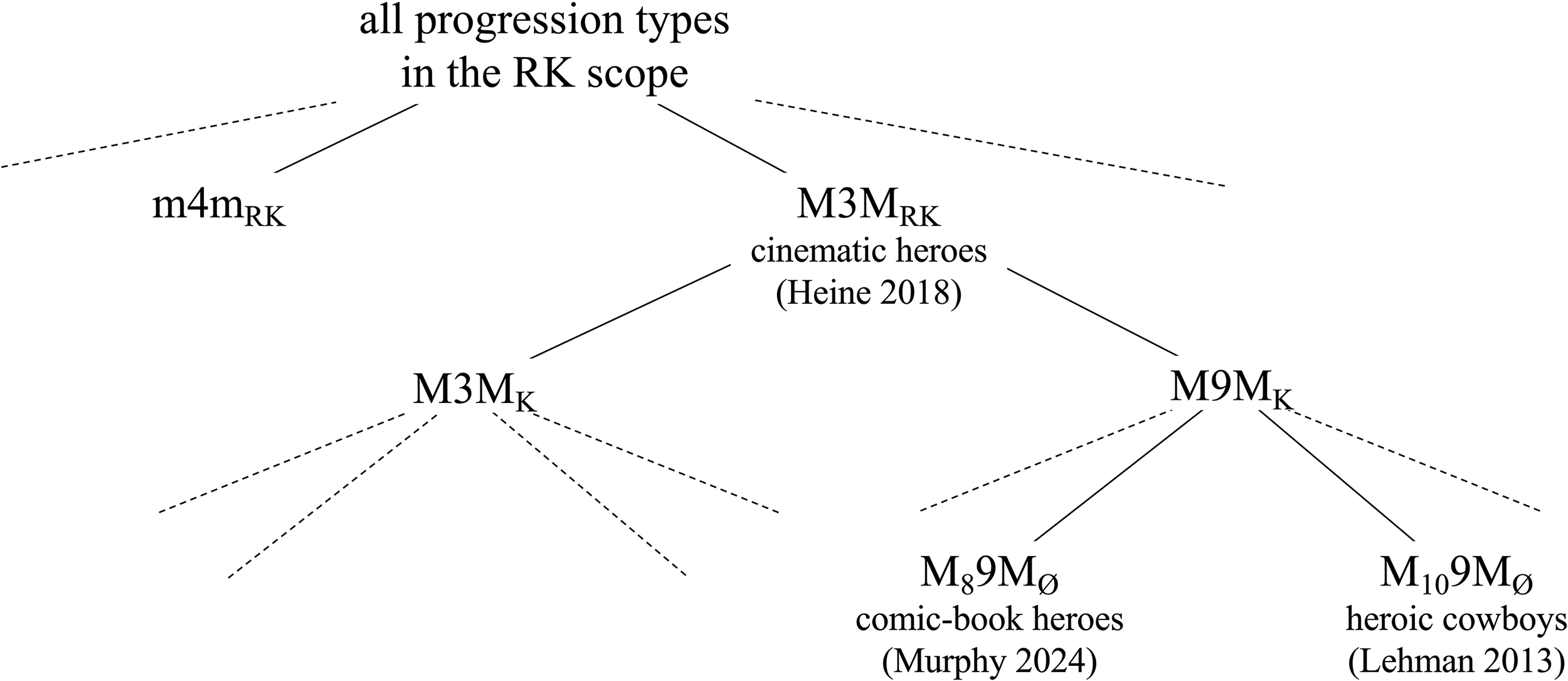
Figure 1 places these types and subtypes, annotated with their heroic associations and their scholarly provenances, into a hierarchical structure that summarizes the exposition up to now; the dashed lines provide a sense of the larger tree of which the branch connecting the relevant categories is a relatively small part. In this hierarchy, the M9MK category stands out as a category adjacent to each category used in the three aforementioned associational studies, although matching none of them. It is also the single best-fitting category of any of those within the RK scope to describe the distinctive harmonic progressions of a pre-1900 precedent of the heroic semiotics claimed in the three aforementioned associational studies. Such an identification of one or more extra-corpus precedents is a common component of the type of corpus-based associational research to which these three studies belong.Footnote 8 For one example, Hollywood’s frequent coupling of villainy/tenebrosity with two minor triads a major third apart—what Heine calls m4, and what I call m4mRK—can be traced back to nineteenth-century Europe: multiple scholars cite the “Tarnhelm” progression from Wagner’s Das Rheingold of 1854 and its coupling with the nefarious Alberich as this association’s locus classicus.Footnote 9 However, none of the studies by Heine, Lehman, or me cited above offers a historically comparable precedent that affiliates their chosen category of harmonic progression with the heroic. At minimum, this article redresses this lack by proposing the conclusion of Franz Liszt’s symphonic poem Les préludes from 1848, which contains clear instances of M9MK and a poetic program that aligns these progressions with heroism.Footnote 10 Remarkably, and making Les préludes much more directly relevant as a precedent for Lehman’s and my studies, the two heroic M9MKs in the symphonic poem belong to the subcategories of M89MØ and M109MØ. Even more remarkably, two highly popular American products of new narrative media from the first half of the twentieth century—the Flash Gordon film-serial franchise and the radio program The Lone Ranger—incorporate as incidental music the conclusion of Les préludes in a manner that presages both M109MØ’s association with cowboy heroics in the second half of the twentieth century and M89MØ’s association with comic-character heroics in the twenty-first century, as detailed below.
Partial, hierarchical display of taxonomy of RK scope.

Exemplars of M3 subtypes: (a) Elmer Bernstein, The Magnificent Seven (1960), main theme, first nine measures; (b) Alan Silvestri, The Avengers (2012), main theme, first eight measures.

The primary purpose of this redress is not to claim that a particular media composer like Bernstein or Silvestri, or one of the people involved in making programs like Flash Gordon or The Lone Ranger, consciously or even subconsciously aligned some choice they made to some preceding known media. Rather, I wish to explore if and how artists who tell stories that involve music—even if these artists belong to different decades or centuries, or to different cultures or continents—might share, in some manner and to some degree, an intersubjective response to the question of how a harmonic progression might sound heroic. One advantage of a taxonomic space like that of Figure 1 is its accommodation of some of these varying manners and degrees.
The Precedent: Les préludes, M9MK, and Heroism
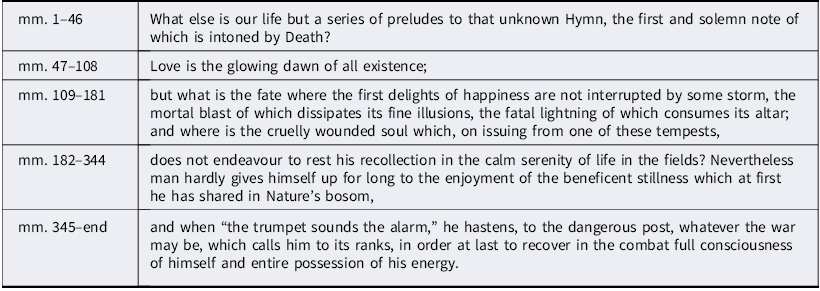
Credited by many with inventing the genre and by even more with inventing its name, Franz Liszt wrote twelve symphonic poems between 1848 and 1858, although some of these works incorporate music created earlier.Footnote 11 One such derivative work of these twelve is Les préludes, which Liszt began composing as early as 1845 under a different title and for a different purpose: as an overture to the unpublished choral work Les Quatre Elémens. Andrew Bonner has demonstrated how in 1846–47 Liszt contemplated using the poem Les préludes from Alphonse de Lamartine’s Nouvelles méditations poétiques of 1823 as a model for a possible symphonic poem.Footnote 12 By 1853–54, “Liszt eventually found in the overture a pre-existent piece of music that fit closely the poetic model he had been considering for at least seven years.”Footnote 13 (This type of judicious repurposing would become commonplace in cinematic soundtracks.) The prefatory text, likely written by Princess Carolyne zu Sayn-Wittgenstein and accompanying the initial 1856 publication of Les préludes, greatly distills aspects of Lamartine’s poem.Footnote 14 Table 1 prints the prefatory text along with the correspondence of its lines with partitions of Liszt’s music, as asserted by Richard Taruskin.Footnote 15 According to Taruskin, the preface’s final line clearly corresponds to the final measures (mm. 345–420) of the musical work. The final line is the preface’s only overt reference to heroism, as the hero voluntarily and unhesitatingly rushes into the fray.
The preface to Les préludes and Richard Taruskin’s text-music correspondences

Table 1 Long description
The table has five rows and two columns. The first column lists text excerpts, and the second column lists corresponding musical measures. Row 1: mm. 1-46, What else is our life but a series of preludes to that unknown Hymn, the first and solemn note of which is intoned by Death?. Row 2: mm. 47-108, Love is the glowing dawn of all existence;. Row 3: mm. 109-181, but what is the fate where the first delights of happiness are not interrupted by some storm, the mortal blast of which dissipates its fine illusions, the fatal lightning of which consumes its altar; and where is the cruelly wounded soul which, on issuing from one of these tempests,. Row 4: mm. 182-344, does not endeavour to rest his recollection in the calm serenity of life in the fields? Nevertheless man hardly gives himself up for long to the enjoyment of the beneficent stillness which at first he has shared in Nature's bosom,. Row 5: mm. 345-end, and when “the trumpet sounds the alarm,” he hastens, to the dangerous post, whatever the war may be, which calls him to its ranks, in order at last to recover in the combat full consciousness of himself and entire possession of his energy.
Example 2 provides a harmonic reduction of the concluding 36 measures—mm. 385–420—of Les préludes. Reflecting Liszt’s commitment to cyclic form, these measures restate a grand theme in C major heard near the symphonic poem’s beginning—mm. 35–44 correspond to mm. 406–15—but with the addition of military percussion and trombones doubling the bass countermelody. The cyclicity complicates the music’s measure-by-measure alignment with the prefatory text, which has no textual mention of heroics in its opening. However, although six measures of dominant preparation precede the statement of the grand theme at both the symphonic poem’s beginning and ending, the two dominants are themselves prepared differently. Before the restatement’s dominant, the tonally fickle music of mm. 385–94 opens into a big “arrival six-four” rooted on B-flat-major in mm. 395–98, which, after a bass adjustment in m. 399, leads to the G chord as dominant of key of C in the manner of a retransitional HC customary before a recapitulation in a classical sonata-form work.Footnote 16 From the retrospective view of the grand theme’s key, this creates a M109MØ progression, which anticipates in the manner of a harmonic Vorimitation the M109MØ in mm. 409–10 that functions as the grand theme’s first chromatic progression between two triadic roots a third apart. No such M109MØ occurs before the grand theme at the symphonic poem’s beginning. If M3 in general and M3MK in particular is indeed a sign of heroism, the additional M109MØ subtly disambiguates the music’s measure-by-measure alignment with the preface by doubling up on this particular marker of heroism, similar to how the orchestration is enhanced. After the second M109MØ (the theme’s first) in mm. 409–10, the theme includes a pair of M89MØs in mm. 412 and 414, resulting in four M9MKs in total within the span of sixteen measures. The remainder of the symphonic poem (mm. 415–20) adheres strictly to the C-major scale.
Liszt, Les préludes, mm. 385–420, harmonic reduction with annotations.

Strain #1: The Lone Ranger, M109MØ, and Cowboy Heroism
Those who were telling stories and constructing identities in the middle of the twentieth century unquestionably heard something heroic in this portion of Les préludes.Footnote 17 No doubt these creators attended to Liszt’s loud brass, pounding drums, dotted rhythms and triplet anacruses, forceful duple time, and vaulting melody, all of which contribute to a march topic whose associations perennially invoke the heroic.Footnote 18 However, evidence also suggests their possible attunement to nuances involving the particular temporal and tonal position of Liszt’s triadic harmonies. One of the most tuned-in radio programs in the medium’s history, The Lone Ranger ran from 1933 to 1956 with over three thousand broadcasts.Footnote 19 Each episode lasted around thirty minutes, divided into two roughly equivalent halves with a mid-episode cliffhanger. The soundtrack of each radio drama intermittently featured excerpts of classical music as dramatic underscore. The conclusion of the Overture to Guillaume Tell by Gioachino Rossini, accompanying both the episode’s introduction and conclusion, became the most famous of these excerpts, but listeners also learned to associate music from Les préludes with the show. In particular, the conclusion of the symphonic poem—starting particularly around m. 350 and ending at some point from m. 406 to m. 415—began to be consistently used as entr’acte music for the episode’s midpoint, starting with episode #1235, “Peace Comes to the Frontier,” which was broadcast on December 23, 1940. Ushering in the music was the narrator’s line: “The curtain falls on the first act of our Lone Ranger story. Before the next exciting scenes, please permit us to pause for just a few moments.” Liszt’s music would then fade under “Now to continue our story,” usually followed by a recap of the mid-episode cliffhanger.
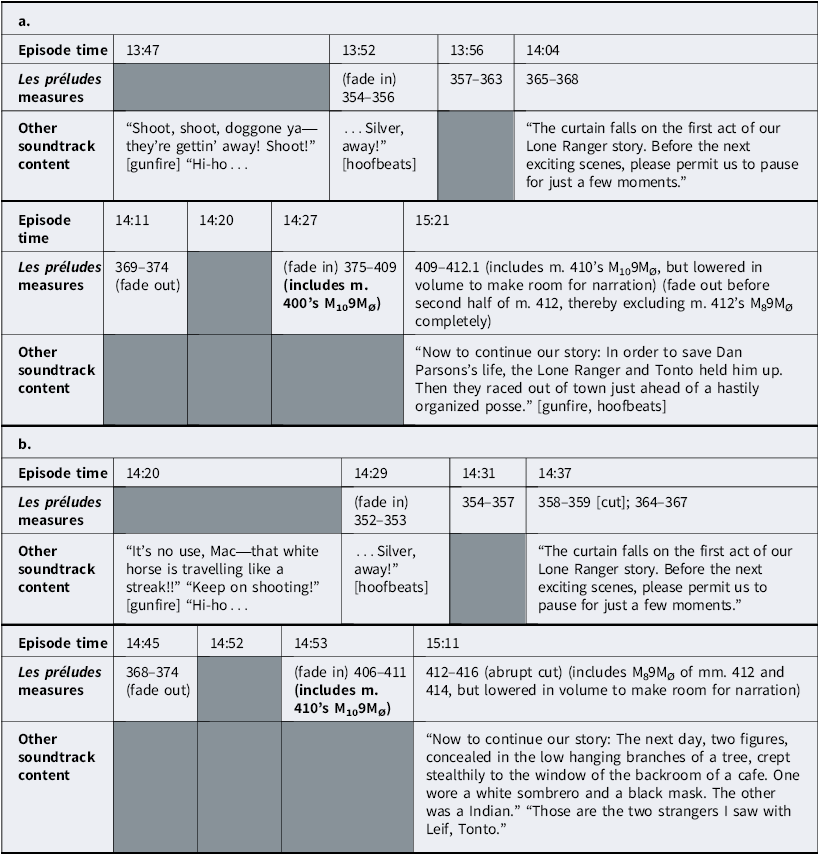
Although the recording of the conclusion of Les préludes would often be cut and situated with the rest of the soundtrack using one of two different layouts, exactly one of the two M109MØs indicated in Example 2 is always fully audible regardless of which of these two layouts is used; the progression is heard without competition from any other soundtrack component or a reduction in the mix. Furthermore, by the later M89MØs progressions in Liszt’s original composition, the music has either faded out completely beforehand with the first layout or dropped in volume under narration under the second layout. Table 2 provides a tabular description of two mid-episode cliffhangers that each represent one of these two layouts. Layout 1 presents the M109MØ from m. 400 without sonic competition, and Layout 2 presents the M109MØ from m. 410 without sonic competition. If Liszt and his Lamartine-based heroism whittled Heine’s M3 down to M9MK, the particular timings of the elements of The Lone Ranger’s entr’acte soundtrack further whittled M9MK down to M109MØ, pinpointing the association of this specific progression with cowboy-based heroism.
Description of soundtrack during The Lone Ranger mid-episode cliffhanger of representatives of two contrasting categories of musical layout (grayed cell indicates absence and boldface indicates fully audible M109MØ within Les préludes, and its contrasting location to the other layout): (a) Layout 1 Exemplar: Episode #1235 “Peace Comes to the Frontier” (23 December 1940), total duration of 28:28; (b) Layout 2 Exemplar: Episode #1533 “Thundering Hoofs” (18 November 1942), total duration of 28:01

Table 2 Long description
Panel A: The table has four rows and four columns. The columns are labeled Episode time, Les préludes measures, and Other soundtrack content. The rows present data for two different time segments. For the first segment, Episode time ranges from 13:47 to 14:04, Les préludes measures range from 354-356 to 365-368, and Other soundtrack content includes phrases like 'Shoot, shoot, doggone ya' and 'The curtain falls on the first act of our Lone Ranger story.' For the second segment, Episode time ranges from 14:11 to 15:21, Les préludes measures range from 369-374 to 409-412.1, and Other soundtrack content includes phrases like 'Now to continue our story: In order to save Dan Parsons life, the Lone Ranger and Tonto held him up.' Panel B: The table has four rows and four columns. The columns are labeled Episode time, Les préludes measures, and Other soundtrack content. The rows present data for two different time segments. For the first segment, Episode time ranges from 14:20 to 14:37, Les préludes measures range from 352-353 to 358-359, and Other soundtrack content includes phrases like 'It's no use, Mac—that white horse is travelling like a streak!' and 'The curtain falls on the first act of our Lone Ranger story.' For the second segment, Episode time ranges from 14:45 to 15:11, Les préludes measures range from 406-411 to 412-416, and Other soundtrack content includes phrases like 'Now to continue our story: The next day, two figures, concealed in the low hanging branches of a tree, crept stealthily to the window of the backroom of a cafe.'
The standard organization of each episode’s intermission ran for nearly ten years, until mid-episode commercials were introduced with episode #2751, “Mountain Siege,” broadcast on September 4, 1950. In the first episode in the new format, an advertisement for the Wheaties cereal brand replaced the conclusion of Les préludes and its M109MØs. Lehman’s explication of the history of the association between M109MØ and the Hollywood movie western traces the progression back from well-known themes for The Big Country (1958) and Example 1a’s The Magnificent Seven (1960) to earlier lesser-known themes for westerns such as The Proud Rebel (1958) and Hondo (1953).Footnote 20 My analysis of the entr’acte music for The Lone Ranger suggests another precedent for this convention that resounded over most of the previous decade.
In addition, The Lone Ranger’s precedent anticipates M109MØ’s formal function in Hollywood’s western themes, at least in its Layout 1. As mentioned previously, the M109MØ-flavored HC in m. 400 of Les préludes concludes a retransition back to C major and immediately precedes the return of the opening grand theme in this key; six measures of “standing on the dominant” heighten the anticipation of this return. A typical interpretation of this HC casts it as an interrupted perfect authentic cadence, precipitating the ensuing resumption of the primary line as coincident with the recurrence of the primary theme. (It is fitting that a musical interruption accompany an intermission within a radio play, and that the added protraction of dominant harmony sound near the play’s cliffhanger.) In a typical late-eighteenth-century sonata-form movement, an interrupting HC, or at least arrival on the main key’s dominant chord, occurs at the end of the development section, ushering in the start of the recapitulation. Relative to other modifications to sonata form wrought by nineteenth-century composers, this pre-recapitulatory dominant remains a common choice after Beethoven.Footnote 21 Given the long time between the grand theme’s first statement and its return in Les préludes, m. 400 closely resembles an interruption on the scale of sonata form. A typical interpretation of the smaller-scale antecedent-consequent period likewise proposes an interruption at the end of the antecedent, triggering the next phrase to begin like the last, as Phrase 2 does in Example 1a. Correspondingly, the most common formal location for an on-screen cowboy theme’s M109MØ is at the end of the theme’s antecedent, appropriately prompting Lehman to label the progression by this formal role: “S-HC,” for “subtonic (flat-VII) half cadence.”Footnote 22
Strain #2: Flash Gordon, M89MØ, and Comic-Character Heroism
Earlier in 1940, the same year that The Lone Ranger began featuring the conclusion from Les préludes, Universal Studios released the science-fiction action-adventure movie serial Flash Gordon Conquers the Universe in twelve weekly chapters, its third and final movie serial based on the comic strip that first appeared in newspapers in 1934. The musical scores for all three movie serials, including the previous Flash Gordon (1936) and Flash Gordon’s Trip to Mars (1938), were constituted almost entirely of passages lifted from both classical works and previous Universal films, as painstakingly detailed in an essay by Richard H. Bush, with some of the same cues used throughout all three serials.Footnote 23 The first two movie serials reused recordings from Universal’s archives, known as “tracking,” but under union pressure, the major studios agreed to end the practice of tracking in April of 1938. Therefore, for Flash Gordon Conquers the Universe, some of the previous cues, which fans already closely associated with the story, were freshly recorded, some with minor adjustments to the musical content.Footnote 24 However, these types of adjustments were already being made in the use of new recordings of classical pieces before the labor dispute, such as the reworking of the love theme from Tchaikovsky’s Romeo and Juliet Fantasy-Overture for the opening and closing titles of each chapter of Flash Gordon’s Trip to Mars.
Unlike the previous Flash Gordon movie serials, Conquers the Universe heavily incorporates music from throughout Liszt’s Les préludes, such as its turbulent passages for fight scenes, and its dulcet theme for Flash’s love interest, Dale Arden. Bush finds this music and its “distinct stamp of a classical work” often “oddly out of place in the serial,” but, as with Romeo and Juliet in the previous serial, the music department also incorporated an adjustment to Les préludes.Footnote 25 Portions of a recording of a revised conclusion of Les préludes bookend each chapter. Rather than end with m. 420 and the four purely diatonic measures that precede it, the revision concludes with the tonic triad of m. 415, not through a quick fade, but with a new recording that includes a slight ritard at the end of m. 414 and an arrangement that simply sustains a C-major triad in m. 415 with no onsets after the downbeat. This truncation, shown in Example 3, gives the two M89MØs statements the final say.
For the longer opening credits, the new recording starts around the Più maestoso of m. 379. The first three chapters’ openings go all the way to m. 415, but the remaining nine chapters shave off around twenty seconds from the recording with cuts both near the beginning and at the end: although both M109MØs remain, the music stops with the downbeat of m. 412, cutting off the two concluding M89MØs. However, as all twelve chapters finish, the much shorter music is only M89MØ: the second half of m. 412 to the revised end. In the first eleven chapters, this music accompanies a thrilling cliffhanger and the title card inviting moviegoers back to the theater next week for the upcoming chapter. Figure 2 shows the final image for the first chapter. For Flash Gordon spectators, the extreme cropping of Liszt’s music not only thematizes M89MØs but also stamps it with both the experience of the hero’s most fearsome perils and with the fundamental structure of movie serialization.
Flash Gordon Conquers the Universe, Episode 1 “The Purple Death,” still frame at 20:23.

Reduction of revised conclusion of Les préludes (cf. Example 4, mm. 412–415) for all 12 endings (11 cliffhanging) of Flash Gordon Conquers the Universe (1940).

The triple union of (1) American-made comic-illustrated superheroes brought to life in the motion pictures, (2) film serialization that set these heroes along perpetually renewed narrative arcs, and (3) an orchestra signposting progress along these arcs with a foregrounded M89MØ, appears as tightly knit for the DC and especially the Marvel cinematic universes of the early twenty-first century as it was for Flash Gordon Conquers the Universe of seventy years before. Such a musical parallel may surprise those familiar with other aspects of Flash Gordon’s afterlife, as they may have been expecting a different cinematic franchise as the primary inheritor of this musical sign. Along with its two Flash Gordon film serial predecessors, Flash Gordon Conquers the Universe underwent various forms of repackaging, retitling, syndication, and reissue in the following decades, including a nationwide rebroadcast of the original twelve chapters on PBS in 1975. The broadcast took place two years before George Lucas, unable to secure the rights for a Flash Gordon movie, made Star Wars instead.Footnote 26 Cinephiles recognize the many visual, narratological, and commercial resemblances between the Star Wars movies and movie serials such as Flash Gordon Conquers the Universe, such as the opening vanishing-point text crawl and frequent wipe transitions.
However, M89MØ is conspicuously absent from Star Wars releases that predate the rise of M89MØ in the 2010s as a more commonly chosen marker of heroism.Footnote 27 Rather, Lehman has observed that the first phrase of John Williams’s marquee “Main Theme” for Star Wars, reduced and analyzed in Example 4, ends with the cowboy-affiliated S-HC (M109MØ) performing its usual antecedent-ending duty. Based on this, it seems, at least when considering the M3MRKs of Flash Gordon and The Lone Ranger as musical forebears, the music for Star Wars as “space western” leans much more toward the “western” descriptor than the “space” descriptor.Footnote 28
John Williams, Star Wars “Main Theme,” mm. 3–12, reduced with annotations.

Example 4 Long description
Panel A: A musical staff with notes and annotations. The score is divided into two phrases, labeled Phrase 1 and Phrase 2. Various musical notations such as triplets and dynamic markings are present. The key signature indicates B flat minor. Panel B: Continues the musical staff with additional notes and annotations. The phrases are further divided with labels such as M109M and HC. The score includes various musical symbols and dynamic markings.
Strain #3: Star Wars, M9MK, and Basic-Level Heroism
Despite the leaning of Star Wars’ Main Theme toward cowboy heroism, heroic music for the Star Wars saga in general actually resonates much more evenly with all of the associations introduced thus far. As prominent a thematic position as the Main Theme enjoys in these films, the “Rebel Fanfare” theme much more often attaches itself to courageous characters and actions throughout the franchise. In his exhaustive thematic compendium for the Star Wars universe, Lehman displays the Rebel Fanfare in its most standard rhythmic form, which is replicated with analytical overlay in the top “in-time” staff of Example 5.Footnote 29 He portrays the origin of the Rebel Fanfare theme as the S-HC unfastened from the Main Theme and “distill[ed] down to an underlying minor third transformation (an oscillatory T9 followed by T3 of root position triads).”Footnote 30 Example 5 places these transpositions above the score using solid arrows. Therefore, his oscillatory reading of the harmonic progression summarizes to M3MRK, matching Heine’s M3 reading of the same theme: both scholars ignore chord order and tonal orientation when categorizing the progression.Footnote 31
On the one hand, Lehman’s and Heine’s ignoring of tonal orientation conforms to a deployment of the Rebel Fanfare across the Star Wars universe. One YouTube audio compilation of the Rebel Fanfare across nine films includes fifty-one occurrences of the theme—the vast majority of them in the video—that sound over a clear bass pedal tone that acts a brief tonic.Footnote 32 Among these instances, the ordered pitch-class interval between the bass pedal pitch class and the root of the first triad of the Rebel Fanfare fluctuates among all but one of the twelve possibilities. The “in-time” top part of Example 5 shows this fluctuation in the abstract with the subscripted numeric ranges in the labels above the theme. The “out-of-time” bottom part of Example 5 shows this fluctuation more concretely, with the eleven possible bass pedal notes below the theme as notated in B flat (the key of its first appearance in Episode IV, the earliest Star Wars movie), the number of separate instances in these nine films subcategorized by tonal position, and the earliest film of each Ø-class progression’s first occurrence.Footnote 33 Thus, a label with at least a K subscript befits the Rebel Fanfare theme in general, not because its tonality is “agnostic”—Lehman’s term for music whose tonal orientation is unknowable or disregarded by a listener—but because its tonality is “ecumenical”: each instance’s tonal center is knowable but likely to vary from that of other instances.Footnote 34
On the other hand, whereas both Heine and Lehman identify M3MRK (T9 or T3 between major triads) as the primary harmonic correlate of heroism in the “Rebel Fanfare,” four reasons recommend the more precise M9MK (only T9 between major triads) as serving this function and appearing as the primary progression label heading the analysis of Example 5:
-
1. Identifying the Rebel Fanfare only by M3MRK glosses over how the grouping of triads through clear trochaic (long-short) rhythmic articulations spotlights only the T9 minor-third progressions. In the rhythmic notation of Example 5, the only rest in between chords a minor third apart occurs during a T3 progression, making the theme’s oscillation between its two initial major triads less of a smooth undulation back and forth and more of a slip-stick reset of the T9 as the focal harmonic gesture.
-
2. Articulation aside, the majority of the foreground minor-third motions in the Rebel Fanfare from a major triad to the next major triad point downwards (T 9 ) instead of upwards (T 3 ). As illustrated with dotted arrows in Example 5, this foreground preference percolates into the middleground with a T 9 transposition spanning the first and last triads of both the theme’s obligatory first half as well as the theme’s longer version, which, as recognized by Example 5’s brackets, commonly but not always sounds.
-
3. The first triadic transposition in the Rebel Fanfare is T 9 . In other associational research involving K-based progressions that both do and do not oscillate, such as my evidence for m11MK’s signification of “mortal liminality” in recent popular film and television, the first progression of the oscillation carries the signifying weight, as it matches the versions that do not oscillate but are documented to signify equally.Footnote 35
-
4. When interpreting a major or minor triad as a synecdoche for the diatonic scale for which the triad serves as the major- or minor-mode tonic, respectively, M9MK invokes a sharpward shift of three accidentals around the circle of diatonic key signatures. For example, the M9MK at the beginning of Example 5 stands in for a diatonic progression from two flats (the B-flat-major key signature) to one sharp (the G-major key signature). This shift exactly matches that of m0MK—for example, G minor to G major—when similarly interpreted. At the level of opening and concluding keys in a movement or multi-movement work, m0MK is a defining feature of music that Robert Hatten recognizes as “heroic epic” and placed within the “tragic-to-triumphant” expressive genre, atop which Beethoven’s Fifth Symphony and its per aspera ad astra trek from C minor to C major sits as prime exemplar.Footnote 36 If the heroism particular to this sharpward shift bleeds through at all from the diatonic m0MK on a large scale to some other triadic progression on a small scale, it would flow most toward M9MK (tragic-to-triumphant), less to M3MRK (tragic-with-triumphant), and much less to M3MK (triumphant-to-tragic).
John Williams, Star Wars “Rebel Fanfare,” with annotations; tally of occurrences of “Rebel Fanfare” by tonal position over the main nine Star Wars movies (Episodes I-IX), Rogue One, and Solo; and indication of the movie providing the first appearance of each tonal position.

A Rebel Fanfare that stakes out a M9MK-as-heroic territory in the last quarter of the twentieth century, rather than the M3MRK-as-heroic territory, also enables a smoother historiography of screen media’s musical heroics during the decades before and after. Using Figure 1 as a landscape upon which associations migrate over time—and such migrations are inevitable within the cinema or any other form of art—M9MK holds a central location, as subordinate category for Heine’s heroic progression but also as a superordinate category for Lehman’s and mine: what cognitive psychologists call a “basic-level” category.Footnote 37 One narrative recounting Hollywood’s exploration of this landscape begins with the courageous cowboys’ M109MØ of the 1950s and 1960s. From here, it is but a unit move in the hierarchy to untether this music from its tonal orientation to become M9MK of the “Rebel Fanfare,” starting in the 1970s and remaining tonally ecumenical in the following decades, during which the Star Wars franchise and its music vaulted into a preeminent position of influence. From here, it is both a single hypernymic step to account for Heine’s more temporally flexible M3MRK examples from the 1980s–2000s and a single hyponymic step to account for my more tonally fixed M89MØ examples from the early twenty-first century.
During a beloved cue John Powell crafted for the Star Wars 2018 spinoff movie Solo, the composer encapsulates this historical narrative in tones rather than words.Footnote 38 In the excerpt transcribed in Example 6, Powell replaces the HC-supporting M109MØ that has customarily ended the first phrase of the Star Wars Main Theme since 1977 with the Rebel Fanfare in the M89MØ tonal orientation of twenty-first-century superheroism; Powell even uses the same key as Example 1b.Footnote 39 Moreover, Powell’s rendering is the first occasion that the Rebel Fanfare has occurred in this tonal orientation, at least among the 51 instances arrayed in Example 5, which highlights its first occurrence with an enclosure. Although the music accompanies the titular character’s admiring first sight of the Millennium Falcon, such a sight is probably not the filmgoer’s first: the M89MØ-in-place-of-M109MØ cleverly condenses decades of fans witnessing the spaceship’s heroics into one panoptic (panacoustic?) harmonic substitution.
John Powell, Solo: A Star Wars Story, 1:01:34–1:02:02.

Recognizing the Rebel Fanfare theme as an ecumenical M9MK also situates the conclusion of Les préludes as a precedent for the theme’s signification of heroism in the movies. Not only is M9MK the most precise category of harmonic progression best suited to correlate with the symphonic poem’s textual associations with heroism, but Les préludes’s M9MK is also tonally ecumenical, appearing in the two different tonal subspecies of M89MØ and M109MØ, as shown in Example 2. To be sure, the M9MK Rebel Fanfare enjoys a much higher degree of what taxonomists call polytypicality than the conclusion of Les préludes, with seven Ø-class subspecies in the first film alone. Nonetheless, Liszt’s presentation of his two M9MK subspecies within ten seconds—M109MØ at the beginning of m. 410, to M89MØ halfway through m. 412—readily generalizes to M9MK. This category of harmonic progression serves both as the closest categoric match for the European symphonic poem’s harmonic heroism and as the category closest to the center of a network of several different types of harmonic progression that would conspicuously accompany heroism in American new-media entertainment during the next two centuries.
Acknowledgments
I am indebted to two anonymous reviewers for their close readings and instructive feedback.
Scott Murphy is a professor of music theory at the University of Kansas. His research focuses on a variety of Western musical styles and works from the past three centuries, with particular attention to music for mainstream English-language multimedia such as movies and television. The composers for music he has analyzed in other publications include Buxtehude, J.S. Bach, Haydn, Clara Schumann, Robert Schumann, Brahms, Holst, Ives, Bartók, Myaskovsky, and Penderecki.




 Open access

