INTRODUCTION: A TRANSCULTURAL AND SOCIO-POLITICAL APPROACH
The department store is a spectacular emblem of consumption-centered modernization, and representative of the tendency of spaces themselves to become central to the cultural experience of shopping. Commercial indoor spaces in the department store appear “democratized” and foster an illusory image of an “eleemosynary institution maintained for the purpose of serving the public without regard for profit.”Footnote 1 The emergence of grand-scale multifunctional shopping spaces not only meant changes in shopping culture and the retail business; it also had much broader socio-political implications.Footnote 2
In this article, the department store is seen as illustrative of important changes that took place in modern East Asia. In particular, I view early department stores in East Asia as a glamorous manifestation of a collective mass culture and discuss how colonialism and nationalism influenced the shaping of urban mass culture. The department store's social significance has often been explained in association with the notion of the “middle class”—a notion that has commonly been predicated on the European history of the bourgeois individual. However, even in European history, the emergence of the department store has been seen as signaling the end of a culture centered on the individual and based on contemplation and visual observation. Siegfried Kracauer and Walter Benjamin believed the transition from arcades to the department store signified the dissolution of the bourgeois culture of the individual, the end of flânerie, and the emergence of a mass consumer culture predicated on distracted and multifarious corporeal engagements with urban spectacle.Footnote 3 The department store puts on display the spectacle of the urban masses—the spectacle of masses of goods and people.
In East Asia, department stores emerged in major cities such as Tokyo, Osaka, Kyoto, Hong Kong, Shanghai, Dalian, Seoul, Pyongyang, and Daegu in the early twentieth century.Footnote 4 In the past few decades, early East Asian department stores, in particular Japanese ones, have increasingly been researched. Studies of Japanese department stores, written in both Japanese and English, have discussed the topic in a more systematic and profound way than have those on Chinese and Korean department stores. For instance, books in Japanese by Hatsuda Tōru, Miyano Rikiya, Nishitani Fumitaka, and Hayashi Hiroshige have provided an in-depth and comprehensive understanding of early Japanese department stores. Articles, book chapters, and books in English by Tomoko Tamari, Louise Young, Harry Harootunian, Mike Featherstone, Noriko Aso, and Jordan Sand have also discussed this topic at a profound level. These scholars have pointed out the department store's didactic role in introducing and domesticating “Western” customs and culture and “civilizing” the urban middle class, or the “public.”Footnote 5
Regarding early Chinese department stores, historical studies on management and business have been dominant. The founders of major department stores, such as the Guo brothers and the Ma brothers, have been popular topics in both Chinese and English studies.Footnote 6 Several Korean-language studies on Korean department stores have been published, including on literary texts in which the department store figures as an important motif.Footnote 7 Oh Jinseok's studies on Hwashin 和信 and other department stores in colonial Seoul constituted a significant contribution to the historical study of Korean department stores.Footnote 8Asian Department Stores, edited by Kerrie L. MacPherson, is noteworthy for its expansive coverage of Asia.Footnote 9
Benefiting from previous research on Asian department stores, this article presents a transcultural mapping of early department stores in East Asia. It directs attention to the broader intercultural dimensions and political implications of East Asian department stores rather than delving into one country or into one aspect of the department store, such as retailing, management, or consumer culture. Nationalism and Japanese expansionism had an undeniably strong influence on the development of the department store in early twentieth-century East Asia. This study illuminates how department stores were located on national and imperial frontiers. By implementing this trans-regional approach, it attempts to provide insights that are not easily gained in studies limited to within national boundaries. This article also brings to the fore the Korean case, which has conventionally been marginalized or omitted in trans-Asia research.
The transcultural methodology adopted in this article may require further elucidation. This article highlights coeval phenomena such as multidirectional, dynamic connections, cultural fluidity and diffusions rather than differences among the department stores in each country or differences between “Western” and “Asian” department stores. This study's transcultural approach is a conscious attempt to overcome the limitations of linear comparisons that highlight differences between the West and the non-West; scholars in various fields have criticized such comparisons. If a linear conception of temporality is the legacy of nationalism, the habitual imagining of spatial linearity may have been inherited from imperialism. Comparative parallels between the colonizer and the colony were long considered the academic norm.Footnote 10 Practically, because of the approach taken, this study does not allocate a proportional number of pages to the three countries. Moreover, research on department stores in the countries has differed in regard to areas of study and in the level of detail; this study has attempted to avoid revisiting facts that have already been covered in the existing scholarship.
The department store was a global—rather than a Western—institution. This study conceives of East Asian department stores as situated in the global department store context; department stores in other regions are referred to when necessary. Department stores in Asia are often characterized as “Westernized” in terms of retailing, management, and culture.Footnote 11 However, when we take into consideration the fact that inter-referentiality between department stores existed worldwide, including between American, European, and Australian stores, it is clear that the global phenomenon of the department store can be better grasped by conceiving of multidirectional global networks rather than Westernization as a one-way street. Following the opening of Bon Marché in Paris in 1852, the department store became a global phenomenon around the late nineteenth century; department stores soon came to share similar management tactics and spatial features, such as fixed prices, home delivery of mail and telephone orders, shuttle vans and bus services, credit sales, bargain sales, gift vouchers, fully guaranteed return policies, standard service provided by sales staff, a tendency to employ female shop assistants, convenient locations close to subway and railway stations, and grand Renaissance architecture featuring monumental structures and resplendent materials.
I examine early department stores in East Asia—namely, Mitsukoshi 三越 in Tokyo, Wing On 永安 and Sincere 先施 in Shanghai, and Mitsukoshi, Minakai 三中井, and Hwashin in Seoul. The article consists of four parts focused, respectively, on urban masses of goods, shoppers, workers, and Japanese department stores' expansion in East Asia. The first part examines the translingual-scape of the department store in relation to the other regional neologisms that connote universalism, such as “encyclopedia” and “world exposition.”Footnote 12 It shows how the modern universalism celebrated in the period, in reality, contributed to shaping an exclusive social class. The second part surveys items for sale and the political implications of such items in relation to nationalism and colonialism. I argue that the term “baihuo” 百貨 primarily referred to “manufactured goods”; in colonial Korea, which lacked a manufacturing industry, the cultural climate surrounding the department store was particularly cynical and hostile. The third part pertains to department store workers. Early East Asian department stores presented mass spectacles not only through goods but also through well-trained female and male workers. The appearance of female sales staff in East Asian department stores was socially sensational in East Asian countries, but to different degrees. East Asian department stores shared a common management style that was patriarchal and militaristic; this style was also greatly influenced by the founders' personal credos and experiences. The last part examines Japanese department stores' expansion in East Asia. Korea, Gyeongseong (or Keijō, 京城 the name for Seoul during the colonial period) in particular, was an important stage for competition and expansion when the Japanese domestic market shrunk in the 1930s and 1940s. In particular, Minakai was operational only in Korea and China. The growth of the Korean department store Hwashin amidst the four major Japanese department stores in Seoul is also examined.
This article is based on my archival research in Japan, China, and Korea, including at the Mitsui Archives in Tokyo, where I researched historical materials; the Takashimaya Historical Museum in Osaka; Nakae Jungorō's house and the Ōmi Merchant Museum in Gokashō; the Shanghai Library archives in Shanghai; and in Seoul, where I researched original publications such as newspapers and magazines from colonial Seoul and the Seoul Historical Museum archives.
MASSES OF MANUFACTURED GOODS: TRANSCULTURALLY MAPPING “BAIHUO/BAEKHWA/HYAKKA”
Baihuo/baekhwa/Hyakka: Manufactured Goods in Modern Cities
According to my historical survey, it was around the 1920s when the word baihuo/baekhwa/hyakka 百貨 (literally, 100 goods or miscellanies) began to be commonly used in East Asia. Before the word hyakka came into common use, the word gofukuten 呉服店 ([silk] cloths store) was used together with the loanword depāto in Japan.Footnote 13 The word hyakkaten 百貨店 replaced gofukuten and other options around the mid-1920s.Footnote 14 In China, a more general word, gongsi 公司 (company), represented the department store, as in Xianshi Gongsi (Sincere) and Yong'an Gongsi (Wing On). The Chinese department stores were often part of larger companies that also included insurance companies, banks, hotels, and manufacturing companies. It is known that the first company to use baihuo in its name in China was Zumei Baihuo Shangdian 組美百貨商店 on Jinling East Road, Shanghai in 1921.Footnote 15 In Korea, the term baekhwajeom was used for the first time in the name of Kim Yun Baekhwajeom, which opened on Jongno 2 ga in 1916. Although the store used the term baekhwajeom, it dealt only with porcelain and steel products.Footnote 16 Instead, at the time, a notion similar to the department store was pursued with the use of the term sanghoi 商會.Footnote 17 For instance, when the Japanese department store Minakai opened its store in Daegu, Korea in 1905, it was named Minakai Sanghoi. Moreover, Hwashin Baekhwajeom was originally founded as Hwashin Sanghoi in 1929. The first Korean department store, Hanyang Sanghoi, was established in 1908 and sold stationery, cosmetics, Western liquor, tobacco, and accessories for Western suits. In 1910, Hanyang declared itself a depaatomentosutoa (department store) as Mitsukoshi did in Japan in 1905, but soon vanished as the country was annexed by Japan.Footnote 18
It merits attention that the term “department store” was translated as baihuo(shang)dian/baekhwajeom/hyakkaten in East Asia. In Japan, the term “department store” was first translated from English not as hyakkaten but, more literally, as bumonbetsu oodana 部門別大店 (large store divided into departments) and as senmon oodana 専門大店 (specialized big store).Footnote 19 Miyano, a scholar of Japanese department stores, speculates that the reasons for finally settling on hyakkaten were that it was easy to pronounce and also that the word takara/ka 貨 has the additional connotation of “treasure” (takara 宝), which gave it an advantage over other options like shina/hin 品 and mono/motsu/butsu 物.Footnote 20
However, we may find a more convincing explanation for the region's choice of the Chinese characters for baihuo/baekhwa/hyakka in turning our eyes to China. In modern Chinese, the term baihuo developed from zahuo 雜貨 and yang(guang)huo 洋(廣)貨. In China, there were zahuo pu 雜貨舖 and zahuo dian 雜貨店, which sold everyday miscellanies, mainly handicraft products. According to the local specialties they sold, zahuo dian were also called jinghuo dian 京貨店 (stores specializing in products from Beijing) or guanghuo dian 廣貨店 (stores specializing in products from Guangdong). After the Opium War, as imports from foreign countries increased dramatically, there appeared yangguang zahuo dian 洋廣雜貨店 (stores specializing in Western products and products from Guangdong) and huayang zahuo dian 華洋雜貨店 (stores specializing in Chinese and Western products), which sold more foreign goods than domestic goods.Footnote 21 These stores can be seen as predecessors to Chinese department stores in the sense that they used glass display cases and advertisements. In semantic terms, the modern Chinese term baihuo originated from zahuo and was transformed into yang(guang)huo before finally becoming baihuo; this seems to be the linguistic background for the common use of the term baihuo(shang)dian/baekhwajeom/hyakkaten as a translation for the term “department store.”
As suggested in the discussion above, the Chinese term baihuo has an important meaning: it refers to manufactured goods. This distinguishes baihuo from zahuo, which refers to handicraft goods. Yanghuo was a transitional term that indicated machine-made Western goods. In this sense, the common use of the term baihuo/baekhwa/hyakka highlighted the emergence of the modern city in the region: the modern city, compared with the pre-modern city, was mainly distinguished by its function as a market for mass-produced goods rather than local handicrafts. The popular use of the term baihuo/baekhwa/hyakka can be understood in relation to the growth of modern cities and the gradual dominance of manufactured goods in modern East Asian cities.
The Encyclopedia and the Department Store: Universalism in Paradox and the Shaping of Exclusive Groups
As described above, in East Asia, the term baihuo/baekhwa/hyakka semantically referred to manufactured goods in the context of the modern city. As it contains the Chinese character for 100, the term denotes a great number of goods—or more ambitiously, everything. From the beginning, department stores in the West promoted the notion of all-inclusiveness. As shown by the motto of Harrods in London—“All Things for All People, Everywhere (Omnia Omnibus Ubique)”—the department store proclaimed itself a “universal provider.”Footnote 22 In East Asia, this idea was expressed in the Chinese character for 100; the term baihuo/baekhwa/hyakka appears to bring universalism to the fore more than its English counterpart “department store” does. The connotation of comprehensiveness is found in other modern neologisms in East Asia such as “world exposition” (wanguo bolanhui/manguk bakramhui/bankoku hakurankai: 萬國博覧會 literally, “exposition of 10,000 countries”) and “encyclopedia” (baike cidian/baekgwa sajeon/hyakka jiten: 百科辭典 literally, dictionary of 100 subjects). The Chinese characters for 100 and 10,000 in the three modern words, “department store,” “expo,” and “encyclopedia” imply the universalism of “everything,” “all countries,” and “all subjects.” In this part, I examine the universalism shown by the term baihuo/baekhwa/hyakka in comparison with the term baike/baekgwa/hyakka 百科 and uncover how these words signified “universalism” but, in reality, had the opposite effect and facilitated the formation of a certain social group.
The ideal of all-inclusiveness in encyclopedias of the pre-modern period was by no means weaker than in the modern period. As is well known, China boasts a long and impressive tradition of making encyclopedias, which are represented in great collections such as the Yongle dadian 永樂大典 (1403–1408) and Siku quanshu 四庫全書 (1773–1782).Footnote 23 However, the connotation of universalism in the modern period is related more to the scope of readership than to that of subjects. Richard Yeo argues that universalism in the encyclopedias of eighteenth-century Europe not only referred to the ambitious scope of subjects but also suggested the universal appeal of such knowledge and pointed to a large potential audience.Footnote 24 In the universalism of encyclopedias, he highlights the aspect of the communication of knowledge rather than the boundaries of knowledge. The Chinese characters for “100 subjects” seem to indicate only that such encyclopedias covered a broad range of subjects, but in reality, encyclopedia projects were possible only with the development of the publication industry and the widening of the readership.Footnote 25
In China, the ideal of the universal circulation of knowledge in the modern encyclopedia project was closely associated with the popular promotion of changshi 常識, or common knowledge or common sense, as Chen Pingyuan points out.Footnote 26 Thus, the encyclopedia's potentially broad openness, in reality, contributed to the social configuration of the educated middle class, discerning a social group who had changshi from those who did not.
Similarly, the universalism upheld by the notion of “100 goods” was based more on the modern circulation of goods than on the comprehensiveness of goods. The department store constantly circulates goods; for large retailers, quickly circulating goods became part of essential business protocol. The department store's propagation of the notion of “fashion” contributed greatly to its rapid development. The global circulation of goods became possible thanks to the development of technologies: transportation such as steamships and trains, and communication technologies such as telephones and telegrams. The department store's development was also based on smooth flows of people. Within cities, department stores became important nodes in the everyday movements of urbanites following the development of modern forms of transport such as trams, cars, subways, and bicycles. Within stores, escalators and elevators ensured unhindered flows of customers and enhanced their diffident excitement. The department store was a converging node of perpetual flows of commodities and people.
Just as the encyclopedia cannot contain all subjects, the department store naturally cannot carry “all things,” despite posturing as a “universal provider.” Paradoxically, universalism circumscribed the boundaries of “common” goods and created a certain sense of social exclusiveness, distinguishing those who shopped at department stores from those who did not. For instance, compared with the overstatement of the Harrods motto, “All Things for All People, Everywhere,” the Chinese department store Wing On worked under the more realistic goal of carrying all the goods needed by “high society.”Footnote 27 Consequently, the goods that were sold in department stores can be examined to uncover information related to social group formation. In the next part, I explore the kinds of goods sold in the department stores, how they signified a particular kind of select lifestyle in each country, how the selection of goods was influenced by national political conditions, and how consumptive activities were related to the formation of a certain social group.
MASSES OF URBAN SHOPPERS: ITEMS FOR SALE, LIFESTYLES, AND COLONIALISM
Items for Sale and Domestic Production: Japan and China
Department stores generally originated as either dry-goods stores or food stores. For instance, Harrods started as a food store whereas Bon Marché, Mitsukoshi, and Daimaru sold dry goods before they developed into department stores. Wing On grew from the Guo brothers' success in the Wing On fruit store (established 1897) in Sydney.Footnote 28 The Hwashin department store in Seoul was perhaps an exception: it did not start as a dry-goods or food store but developed from a jewelry shop in the 1890s.
Items for sale, the departments into which they were divided, and floor plans were similar among department stores around the world.Footnote 29 East Asian department stores generally followed global practices but exhibited a few characteristics that reflected their distinctive political status and modernization processes in the cities in which they were situated. Among the departments in the sales division of Sincere, Shanghai in the mid-1920s, those for hobbies and health merit attention. Dentistry, pharmacy, and optics had separate departments. Films and music also became important enough to merit their own departments.Footnote 30 This departmentalization offers a glimpse of the city's higher-class lifestyle and the fact that a Western sense of hygiene and Western cultural entertainment were part of its purview. Vacuum flasks, a daily necessity for the locals, were also given their own important department; the department store also seems to have catered closely to the local lifestyle.
Items for sale in department stores were influenced greatly by foreign residents in the (semi-)colonial cities of Shanghai, Hong Kong, and Seoul. Department stores in Shanghai sold goods mainly from countries that had foreign settlements in the city; in particular, they sold English products. Notably, they not only imported foreign brands but also reproduced goods in their factories for Chinese customers. As mentioned above, Wing On targeted high-class customers, including Chinese bureaucrats and rich merchants' wives, as well as foreign residents in the city. After carefully researching local customers' needs, Wing On manufactured domestic versions of luxury foreign brands to suit the local clients' particular needs, tastes, or sizes.Footnote 31 Japanese department stores also reproduced foreign imports adapted for local customers in their factories; however, one difference was that this domestic production of Westernized goods was actively led by the government in Japan. Like Western department stores, department stores in Japan introduced exotic goods from the colonies to the metropole as well. Mitsukoshi in Tokyo carried products from the Japanese colonies like Taiwanese rattan chairs and Korean ginseng.Footnote 32
Items for Sale and Underdevelopment of a Manufacturing Industry: Korea
Department stores in colonial Korea were primarily distinguished by the absence of domestic production. After the competition settled down, there were “four plus one” major department stores in Seoul (Gyeongseong): four Japanese department stores (Mitsukoshi, Chōjiya 丁字屋, Minakai, and Hirata 平田 and one Korean department store, Hwashin. All four Japanese department stores were located in the Japanese commercial district of Honmachi 本町; they differed slightly in marketing strategies. Mitsukoshi was known for high-end products and generally retained top status in total sales.Footnote 33 Hirata was popular among lower-middle-class Japanese and Korean residents of the city, as the store provided affordable daily miscellanies in large quantities. Chōjiya and Minakai were business rivals as both primarily targeted the salarymen who made up the Japanese (and Korean) middle classes. Both formed intimate relationships with the army and the government too.
The main import source for the department stores of Seoul was Japan. In particular, Japanese fabric was an important sales item. Mitsukoshi Seoul was commonly called Samwol Obokjeom 삼월오복점, the Korean pronunciation of Mitsukoshi Gofukuten 三越呉服店 in Korea. In 1930, the drapery department occupied the entire second floor of the newly built building.Footnote 34 Minakai department stores in Korea promoted brand-new fabrics from Kyoto as their top specialty.
Department stores in Seoul sold mainly seasonal shopping goods (seonmaepum 選買品) rather than daily necessities (pyeonyipum 便宜品) until the mid-1930s.Footnote 35 The global retail institution of the department store popularized the notion of “seasonal fashion,” which greatly helped to boost sales. Korean department stores also played a role in setting trends; it was said that fashion in Seoul was about one year behind fashion in Japanese cities.Footnote 36
Historical research has shown that Koreans accounted for about 60 percent of department store customers in Seoul during the 1930s and 1940s.Footnote 37 In colonial Korea, the stylish urban lifestyle inspired by department stores seems to have been a more complex socio-political issue than in Japan and China. In the Korean print media, Korean shoppers at department stores in Seoul were a popular topic; particularly during the golden age of the department store in the 1930s, such shoppers were usually portrayed in a disapproving and cynical tone. The following paragraph from a newspaper report provides a glimpse of the contemporary perception of the department store in the early 1930s:
Department stores at night nowadays are truly urbanites' places for merrymaking (hwanlak 歡樂) and entertainment (orak 吳樂). Department stores, which cherish fashion (ryuhaeng 류행 流行) as if it was their life, extravagantly display decorative goods for young people such as clothes, shoes, and cosmetics. In front of the goods, “sales girls” (ssels ggeol 쎌스껄), who are seductive beauties with ample modern feeling (gamjeong 感情), provide “service” (sseobisu 써비스) in an implicitly coquettish way.Footnote 38
Colonial Koreans who lived modern lifestyles were portrayed as pretentious copycats who were also privileged and fashionable.Footnote 39 Korean women who frequented department stores received more direct scorn than did male shoppers.Footnote 40 This social cynicism and culture of self-mockery can be explained in relation to the lack of a domestic manufacturing industry as a result of the colonial economy. The urban masses in the city, including salarymen and college students, faced a dilemma: to live urban lives, they had few choices other than shopping for Japanese baekhwa (mass-produced goods), but doing so induced social contempt and incited self-mockery. Urban shoppers' tastes were shaped by baekhwa; most of these goods were imported from Japan. Self-mockery and cynicism were natural in the context of Korea's colonial economy; moreover, cultures of self-derision and self-deprecation are systemic in colonialism in general. In Seoul, department store visitors were the recipients of a contempt that was also apparent in the broader culture of demonizing urban intellectuals, including college students. The contemporary popular media generally viewed urban intellectuals in an extremely negative and critical light. This perspective can be understood in the context of colonial politics, in which potential dangers to the dominator are suppressed.
The heavy reliance on foreign imports and the lack of a manufacturing industry in the colonial economy imposed problems on department stores also, beginning in the late 1930s, as they tried to expand to attract middle-class customers. From the inception of colonialism, Japanese imperialists envisioned colonial Korea as at once a supplier of raw materials and labor power and a market for final products. As a result, Korea lacked a foundation for light industry and small-scale local manufacturers were gradually destroyed by giant Japanese manufacturers.Footnote 41 In other words, Korea did not develop modern baihuo/baekhwa (manufactured goods) industries until the end of the colonial period (1945); Korean industry remained at a stage in which it was only capable of producing zahuo/japhwa (handicrafts and local specialties). Han Seungyeon, a graduate of the business school at Columbia University, pointed out the systematic problem faced by Korean department stores in a popular magazine in 1936:
The department store is a mass-retailing institution (daeryang somae giguan 大量小賣機關) that developed in mass-producing countries (daeryang saengsan'guk 大量生產國) … We cannot say that Joseon is currently in the phase of commodity distribution (sangpum baegeup 商品配給). We cannot meet even half of the product demand; rather, we supply mostly foreign products … It may be true that department stores may cause social problems in the future as they develop.Footnote 42
Similar to my historical approach to the term baekhwajeom/baihuodian/hyakkaten, Han defines the department store as a dealer of “mass-produced” commodities and stresses Korea's lack of an economic base. In fact, this problem became a real issue two years after Han's warning.
Beginning in the mid-1930s, department stores in Korea expanded in scale, store size, and number. As they broadened their customer base to include the middle classes (both Japanese and Korean), daily miscellanies and food became important sales items. In particular, after the introduction of the Wartime Controlled Economy in 1938, department stores were strongly urged to carry everyday essentials rather than luxury goods by the Government-General.Footnote 43 A quote from Lee Gyujae, Managing Director at Hwashin, captures the general transition among department stores in Gyeongseong: “It's like luxury goods stores have been replaced by practical goods stores.”Footnote 44 However, sales of luxury goods did not fall at Hwashin or at other department stores even after the start of the Sino-Japanese War (1937). On the contrary, sales went on increasing until the early 1940s.Footnote 45 It can be said that, beginning in the mid-1930s, the customer bases of Korean department stores grew to include both the upper classes and the middle classes.
When the Government-General enforced “production-centrism” in the early 1940s, store managers complained that they could find few machines or facilities that could be used to manufacture daily necessities in the country: as some said, “I have heard about 70% of department stores' goods are imported from naeji 內地 (the inner land, Japan)” and “What we can do right now is just limited to the level of the handicraft industry.”Footnote 46
However, insufficient supply at Korean stores was a good business opportunity for Japanese department stores such as Mitsukoshi, which had suffered in the economic depression in Japan during the war. The Korean branches made up for shrinking wartime profits in Japan; this is further discussed later.
Department Stores and National Defense
In China and Japan, unlike in Korea, department stores were seen more as dealers of foreign and domestic goods than as foreign goods dealers. In semi-colonial China, nationalistic consumption was considered an important way of preserving national sovereignty. This public sentiment is evidenced in a comment by one intellectual: “We believe that military invasion absolutely cannot destroy China but we fear that economic invasion can.”Footnote 47 China was being colonized by multiple powers—but only unofficially, as occupying military was not usually involved. In semi-colonial China, commodities reflected not only the wish-images of a collective fantasy but also a collective fear of the creep of colonialism. Non-governmental and governmental organizations led various activities to encourage nationalist consumption; such activities often pivoted on boycotts and the burning of foreign, especially Japanese, goods.Footnote 48 Thus, department stores that sold foreign goods were often targeted for arson attacks by nationalist activists. Chinese department stores had to maneuver around the public hostility toward dealers of foreign goods. Wing On had an astute survival strategy in the context of the intense tension concerning foreign and domestic goods that is clearly represented in the company's public slogan: “Manage global goods, promote sales of Chinese native products.”Footnote 49
Korea also had a campaign to promote national products; however, the Korean campaign was more moderate than its Chinese counterpart. In the 1920s, the Japanese Government-General lifted restrictions on businesses owned by Japanese entrepreneurs in Korea. In order to protect national industries from an imminent invasion of Japanese entrepreneurs, Korean nationalists such as Jo Manshik initiated the National Products Promotion Campaign (Mulsan jangryeo undong 物産奬勵運動), which had as its motto “Joseon people for Joseon, living only with Joseon products,” in 1923. Hwashin willingly joined the campaign, as it was good for business. The nationalist campaign was criticized for its insufficient ability to support the development of Korean industries and thereby benefiting the Korean people. In colonial Korea, individual entrepreneurs figured prominently in nationalist tropes more than worker collectives or consumers, partly because industrial production and consumption had flourished less in Korea compared with China and partly because the colonial occupation suppressed the formation of collectives. The public implicitly accepted that capitalists such as Kim Seongsu and Park Heungshik, both of whom were involved in the campaign, were representatives of the nation although they were often (in)voluntary collaborators. In this context, Hwashin purported to be the national department store and thus became a source of national pride.
MASS SPECTACLE OF SERVICE WORKERS: “BEAUTIES” AND DISCIPLINE
“Sales Girls” as a Spectacle on the Floors
Department stores aim to put on display not merely a whole raft of commodities and glamorous spaces but also immaculate service. Accompanied by the modern ideology of professionalism, the standardization of service labor took place rapidly around the globe. With various training programs, department store managers in East Asian cities created the spectacle of service labor(ers).
In East Asia, the spectacle of service labor appears to have hinged firstly on the beauty of saleswomen. At the early department stores in the region, the public was enthralled by the appearance of saleswomen. In Europe, the department store was considered a “ladies' paradise,” as seen in the title of Émile Zola's novel Au Bonheur des Dames (1883). Managers of department stores in general preferred to employ female workers to serve female customers. Department stores in the United States, like Macy's, also hired more female sales staff than male staff, but this was related more to the low wages paid to female workers.Footnote 50 In Japan, female sales staff were first hired by Mitsukoshi and Takashimaya in 1900, and the first saleswomen only started to work for Mitsukoshi in 1903.Footnote 51 Mitsukoshi's poster advertisements continuously promoted an image of “beauty” as a main attraction. For instance, a Mitsukoshi poster copy in 1910 had the caption “An Oriental beauty presenting Mitsukoshi Department Store to the world.”Footnote 52
In East Asia, the presence of women on the selling floor was considered sensational and aroused anxiety. Ma Yingbiao of Sincere department store in Hong Kong employed salesgirls from the outset (1900) to attract customers. However, this practice provoked public discomfort; Ma was forced to lay off all of the “female clerks, including his own wife and sister-in-law.”Footnote 53
In Korea, salesgirls were very nearly a symbol of the department store, as seen in the aforementioned Dong'a Ilbo report. Korean salesgirls were often writers or subjects in popular magazines.Footnote 54 A common saying in Seoul was that “all of the beauties of the town are gathered in airplanes and department stores.” Two Korean department stores, Hwashin and Dongah, were established and competed with each other on the same street in 1932. Dongah attempted to beat Hwashin mainly by employing female sales staff who were more beautiful. However, this practice ended disastrously for Dongah after six months as scandalous rumors about relations between male managers and female staff spread in the city and tarnished the store's reputation greatly.Footnote 55 Hwashin prohibited romantic relationships among employees. Mitsukoshi Tokyo was also aware of such a problem and attempted to prevent it in advance. The manager at Mitsukoshi asked female staff who were hired to sign agreements that “they would not date the male staff but see them as the enemy.”Footnote 56 However, in Japan, female workers in department stores generally enjoyed a progressive image as educated, white-collar working women.Footnote 57
Patriarchal and Military-style Staff Training
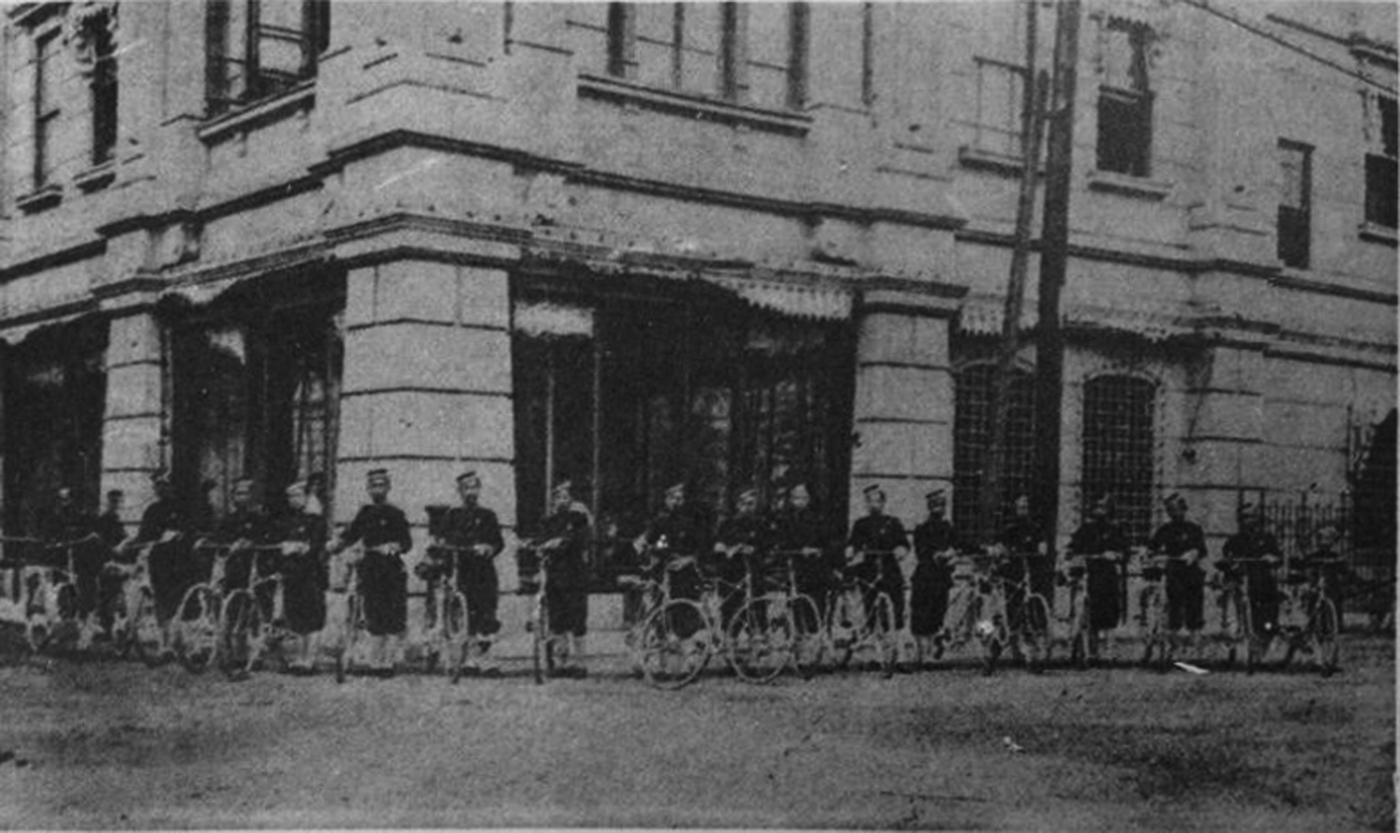
Department stores in East Asia boasted a great number of “disciplined workers” as well as “beautiful workers.” They had strict programs for staff training and continuously presented the spectacle of marshaled workers to the public. Spectacles were not only associated with female sales staff but also with the “marshaled” force of male employees. In general, the number of male workers exceeded that of female workers in department stores in Seoul. For instance, the numbers of male and female workers were as follows in 1938: Chōjiya had 270 male and 135 female workers; Minakai had 172 male and 182 female workers; and Hwashin had 300 male and 200 female workers.Footnote 58
Messenger boys with bicycles at the Mitsukoshi Nihonbashi Branch. Mitsukoshi Times, vol. 7, no. 12, October 1909.

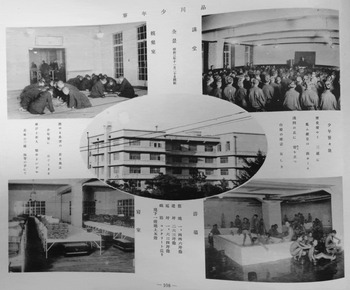
Department store employees were trained in a patriarchal and military fashion in East Asia and this was mainly possible because of collective residence. Most department stores in East Asia offered dormitories for employees.Footnote 59 Mitsukoshi's male dormitories in Japan were called “boys' dormitories,” either shōnen ryō 少年寮 or kodomo kishukusha 小供寄宿舎; these dormitories enforced a tight time schedule outside work on the young workers in residence. For instance, the Mitsukoshi History Album depicts a day at its Tokyo Hongō dormitory in 1910: “300 boys were awakened at five o'clock in the morning by bugle and left the dormitory at 6 am, at the sound of another bugle, to march down the street together to the day's battlefield (yichinichi no senjō 一日の戦場), led by two supervisors.”Footnote 60 Young workers led a collective lifestyle that was more similar to lifestyles in school dormitories and military training camps. In fact, a great number of male employees were conscripted into the military after 1937.
Shinagawa shōnen ryō (Boys' dormitory in Shinagawa, Tokyo). The Photo Album of Great Mitsukoshi's History.

Minakai's application of military culture was most conspicuous. Minakai called its employees “merchant soldiers” (shōsenshi 商戦士) and espoused the notion that they were to be the successors of the “spirit of the Gokashō merchants.” The staff members were given military ranks instead of ordinary managerial titles. Employees were encouraged to announce their determination to be “merchant soldiers” in the company's magazine, Minakai Monthly.Footnote 61
In Seoul department stores, unmarried employees stayed in dormitories on principle. In particular, Minakai, Mitsukoshi, and Chōjiya ran youth training centers (cheongnyun hunryeon so 青年訓練所) for young male workers. The Chinese characters hunryeon 訓練 had connotations of schooling, discipline, and physical training; Minakai's training camp for workers under twenty-three was centered on military drills.Footnote 62 Hwashin was also strict about staff training and control. It employed supervisors who had worked as policemen and introduced a meticulous staff work code. Mitsukoshi began to publish a systematic work code in the Mitsui Gofukuten period. Minakai Seoul distributed a similar work code to workers.Footnote 63 Mitsukoshi Seoul's employees were trained according to the Japanese flagship's managerial style and were required to attend imperial events as well as the memorial service for Hibi Ōsuke (the general manager at Mitsukoshi and “father of Japanese department stores”). Life in the dormitories of Korean and Japanese department stores, which was in the style of military camps, may have been a practical preparation for the military service of the young boys in the future.
In Chinese department stores, the staff also received strong and distinctive—but not necessarily military-style—training and education while residing in dormitories. Three departments were tasked with carrying out training at Wing On: the Department of Moral Education (deyu bu 德育部); the Department of Intellectual Cultivation (zhiyu bu智育部), which also taught English; and the Department of Physical Education (tiyu bu 體育部).Footnote 64 Wing On's paternalistic training was centered on the notion of character building and upholding the traditional values of zhi 智, de 德, and ti 體. Notably, both Wing On and Sincere required employees to attend mandatory Christian services on Sunday mornings. As Wellington Chan points out, the training program combined the Confucian ideal of character building with overseas Chinese Christian values.Footnote 65 The entirety of a person's character, including their religious beliefs, was addressed in training in early Chinese department stores.
As Hochschild's notion of “emotional labor” highlights, service labor involves emotion, etiquette, and physical appearance.Footnote 66 In East Asian department stores, the features of service labor as “emotional labor” were enhanced with the goal of building a person's whole character through intellectual, social, and physical training. Confucian values such as de (virtue) were applied, as seen in Wing On's staff-training program and Chōjiya Seoul's female worker-training program, Deokseonghoei 德成會 Society for Accomplishing Virtue). Hwashin in Seoul and Mitsukoshi in Japan organized an annual sports outing day and, as aforementioned, Wing On had a separate department for physical training. Workers were often treated like students or soldiers in such collective residence and training programs.
In East Asian department stores, managerial styles derived primarily from the personal experiences and beliefs of the founders and general managers; their leadership was thought to be the most significant factor in the success of the enterprise. Leadership could be helmed by individuals—for example, Hibi Ōsuke and Park Heungshik (the founder of Hwashin) or brothers—for example, the Ma, Guo, and Nakae brothers at Sincere, Wing On, and Minakai, respectively. Many department stores instilled the founders' creeds in the employees. What was called the “Hwashin spirit” reflected Park Heungshik's personal credo of “harmony on the inside, trust on the outside (naehwa’oeishin 内和外信),” from which the company's name (Hwashin) originated. Minakai highlighted the spirit of the merchants of Gokashō, the brothers' hometown. Wing On and Sincere were both based on their founders' overseas business experiences, hometown nepotism (both the Guo and the Ma brothers were from Xiangshan County, Guangdong), and Christianity. The legacy narratives also to some extent influenced the directions of historical research on Asian department stores.
COLONIAL EXPANSION OF JAPANESE DEPARTMENT STORES IN EAST ASIA
Japanese Department Stores in Japan
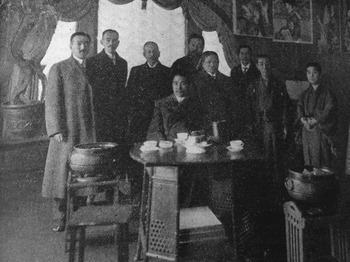
Japanese department stores such as Mitsukoshi, Takashimaya, and Minakai closely cooperated with the government in carrying out the imperial mission within and outside Japan. Within Japan, major Japanese department stores like Mitsukoshi and Takashimaya provided butler-like services for the Imperial Palace. Takashimaya decorated the Imperial Palace and the Diet House and Mitsukoshi hosted many distinguished guests for the palace;Footnote 67 the Korean prince who later became King Sunjong 純宗 visited Mitsukoshi in 1906 in the company of the Resident-General of Korea, Itō Hirobumi (who was assassinated by Korean nationalist An Jung-geun in 1909). Sun Yatsen visited the department store in 1913. Mitsukoshi defined a role for itself as a host of national VIPs.Footnote 68Mitsukoshi magazine made it a rule that photos of eminent foreign visitors to the store appeared in every issue.
“Mr. Sun Yatsen, who visited our store.” Mitsukoshi, vol. 3, no. 2, February 1913.

At the peak of the war period, Mitsukoshi actively participated in mass mobilization: Mitsukoshi hosted a great number of war-related public events such as exhibitions and provided military necessities such as uniforms.Footnote 69 It gave over some of its floors to the government in the early 1940s (as they did not have sufficient supplies of goods anyway) and donated one airplane each to the Army and the Navy.Footnote 70 Additionally, many of its employees were conscripted into the Army and the Navy; as a result, the company suffered from a paucity of workers on top of its general problem of insufficient goods during wartime.
Department stores' marketing, in general, focused on toys and other children's goods; in particular, Mitsukoshi concentrated its energy on “Children's Expositions” around 1910. One of the main characteristics of Japanese department stores is often said to be their development into “familial” institutions or entertainment spaces. In tune with the state's ideological vision, department stores in Japan contributed to stabilizing the nuclear family, centered on children, as the basic unit composing the urban masses.
Japanese Department Stores in Korea
Outside the country, Japanese department stores developed in close alliance with the country's military expansion; as aforementioned, during wartime, revenue from branches outside the country supplemented for shrinking revenues within the country. In fact, early modern retail businesses outside Asia also developed in close alliance with military expansion; among such businesses, the Army & Navy Stores (established in 1871 and acquired by the House of Fraser in 1976) are representative. Japan entered a financial crisis in 1926; its situation deteriorated further after the Great Depression (1930). However, this was a golden period for Japanese department stores in Korea and China. Korea was particularly important for Japanese department stores' colonial expansion; and between 1926 and 1940, Japanese department stores in Seoul were at their peak, increasing in size and number of Korean branches. The Japanese Government-General was directly or indirectly involved in the expansion of department stores in Korea. For instance, it was known that, upon the proposal of Resident-General Itō Hirobumi, Mitsukoshi had opened an office in Gyeongseong in 1906.Footnote 71
Japan engaged in numerous wars and conflicts in the first half of the twentieth century, including the Russo-Japanese War (1904–1906), World War I (1914–1918), the Manchurian Incident (1931), the Sino-Japanese War (1937), and World War II (1939–1945). This engagement created favorable conditions for the development of Japanese department stores in Korea, especially in connection with competition from smaller traders. By introducing various economic policies for control beginning in 1937, the Japanese colonizers facilitated company takeovers and mergers; companies became larger in size and thus easier to control. Department stores in Korea had the upper hand in the trade industry and were granted even more advantages in the wartime economy.
After the establishment of Manchukuo in 1932, Japanese department stores competed to open branches in the region as well as on the Korean peninsula in order to take advantage of a “Manchuria boom” (or the idea of it as such). Minakai established a branch in Xinjing (or Shinkyō, the capital of Manchukuo and present-day Changchun) in 1933. Chōjiya also upgraded its office (est. 1931) in Xinjing into a proper branch in 1933 and opened a new office in Pengtian (present-day Shenyang). The Takashimaya Department Store also expanded both in Korea and China.Footnote 72 In 1929, Mitsukoshi replaced its branch office in Dalian and established a proper branch; Dalian was the commercial and industrial center of the Guandong (Kwantung) Leased Territory. The branch building had been built earlier, in Reference Mitsukoshi1927, on Tokiwabashi Street 常盤橋通り in the southern half of the city, where Japanese investment was concentrated. Between 1941 and 1945, Mitsukoshi Seoul's sales were about 1.7 times greater than Mitsukoshi Dalian's sales.Footnote 73 The Seoul branch had the second-highest sales after the Nihonbashi, Tokyo flagship store in 1945. Korea was the main business stage for Japanese department stores' expansion.
Minakai merits special attention because it started out in the department store business in Korea (Daegu 1905); it ran department stores and trading companies only in Korea and China; and its flagship was located in Seoul. Minakai was established by the Nakae brothers, who were from Gokashō in the Kyoto area. In business style, it preserved the strong local traditions of the Ōmi merchants in Gokashō. It boasted the greatest number of department stores in Korea and Manchuria: in 1940, Minakai had thirteen branches in Korea and six in China.
Minakai was able to provide military supplies more quickly than other traders as they were able to read the Army's movements in Manchuria by using wireless radio communication; this was a technique they learned from the Joseon Army and the Kwantung Army.Footnote 74 Notably, while the other Japanese department stores chose first-tier cities like Gyeongseong, Pyeongyang, and Busan to build branches, Minakai established branches in the second-tier cities like Gunsan, Gwangju, and Daejeon, where Japanese residents had difficulties finding Japanese goods.Footnote 75 As a latecomer to the retail business, Minakai attempted to grow its business by closely catering to the needs of Japanese residents. A rapid communication system to facilitate contact between the Japanese offices in Tokyo and Kyoto (which was, for practical purposes, the headquarters of the company), the Gyeongseong flagship store, and the Xinjing branch, was put in place. Minakai's business strategy was to carry a broad selection of goods from Tokyo (mainly electronics), Osaka (mainly furniture), and Kyoto (dry goods, the store's main item). Minakai made a principle of not carrying goods from Korea.Footnote 76
Tensions between Korean Shops and Japanese Department Stores in Seoul
In Korea, Japanese and Korean department stores developed through conflict but also in cooperation. The Korean department store Hwashin rapidly grew by taking advantage of, rather than falling victim to, the complex politics and economy of the colonial situation. On one hand, it carefully maintained its image as a national icon; on the other, it never failed to collaborate with Japanese colonizers in Korea. The tension between Korean and Japanese department stores did not seem as serious as that between small- and medium-sized (Korean) stores and larger department stores. In this conflict, Hwashin stood for large mass retailers. Hwashin's president, Park Heungsik, discouraged small- and medium-sized traders from running such businesses, which, he argued, were unpromising.Footnote 77 He became the first chief director of the Association for Department Stores in 1940.Footnote 78 Nevertheless, Hwashin also engaged in business with small Korean retailers. Unlike Japanese department stores, Hwashin's expansion was limited to the Korean peninsula, and he found business opportunities in chain shops (or voluntary chain shops, yeonsoejeom 連鎖店) and created the greatest retail chain in Korea. Hwashin yeonsoejeom provided local chain shops with “all kinds of baekhwa except for silk cloths.”Footnote 79
Korean historical narratives have considered Hwashin's development to have been heavily dependent on the legacy of its founder, Park Heungshik. He was known for his unfailing lobbying activities and his enthusiastic and obstinate managerial style. He forged strong, wide-ranging connections with key Japanese players in commerce, the military, banking, and the Government-General, including with Governors-General like Ugaki Kazushige (1868–1956). The department store closely followed and promoted all of the wartime campaigns led by the Government-General in the 1930s and 1940s.
Department store locations conspicuously exhibited the competition between Japanese department stores and small Korean shops. Department stores were usually located in the commercial center of the foreign quarters in colonial (or semi-colonial) cities. Major department stores in Shanghai such as Wing On and Sincere were located at the center of the highly glamorous International Settlement, on Nanjing East Road. In Seoul, the four Japanese department stores were in the Japanese commercial district of Honmachi.
In colonial Seoul, there were semi-officially considered to be two commercial districts: Bukchon 北村, or the Northern Village, was a Korean commercial district dominated by small- and medium-sized shops, and Namchon 南村, or the Southern Village, was centered on the Japanese commercial district of Honmachi. The four Japanese department stores were all built on the Japanese commercial streets of Namdaemun and Chungmuro in Honmachi in the Southern Village. Hwashin was located on the Korean street of Jongno 2 ga in the Northern Village.
There was a serious amount of tension between Bukchon and Namchon. For instance, a news report in the Dong'a Ilbo, “The Northern Invasion Scheme of Mitsukoshi, a Commercial Colossus, and the Dongyang Products Building in Question,” shows the extent to which Bukchon merchants were aware of large Japanese entrepreneurs' encroachment into the Korean commercial area of Bukchon.Footnote 80 According to the article, Bukchon merchants were so concerned about an “invasion” that they formed an implicit pact not to sell large buildings in the area to non-Korean buyers.
CONCLUSION
The business of the department store was based on fast flows of commodities as represented by the notion of seasonal fashion; consequently, the department store was a lavish ornament to the ideologies of early capitalism and globalism. Department stores provided temporal and spatial punctuations for the urban masses. “Seasonal fashion” was associated with the fast tempo of urban life and a Baudelairean sense of urban ephemerality. Department stores lent a temporal syntax to urban life by, for example, introducing the celebration of festivals from abroad, promoting traditional festivals through seasonal sales, and encouraging a culture of gift giving. The department store operated on the basis of the “public” values of multifunctionality and the democratization of space. It purported to be a universal provider and an avenue of liberation and escape for urban residents. Large, multifunctional retailers fused commercial and public features and the urban mass culture surrounding the department store was an important signifier of socio-political changes. By providing a broad, transcultural mapping of department stores, this study has attempted to elucidate socio-political characteristics, such as the concrete influences of colonialism, on the mass culture of the department store.
Rather than taking “universalism” at face value, I examined the notion of baihuo in relation to neologisms connoting universalism such as “encyclopedia” to argue that universalism, as promoted by department stores, in fact implicated the emergence of a social class who were confident enough to claim universality. Moreover, the “universalism” of the department store in reality indicated the emergence of technologies that enabled the (global) circulation of commodities, people, and information. Based on etymology, I argue that the Chinese term baihuo signified “manufactured goods” for the urban masses in the region, though in Korea the colonial economy obviated the development of a domestic manufacturing industry, which influenced the development of department stores. This problem was associated with a nationalistic dilemma for the Korean urban masses and with a mass culture defined by cynicism.
In China, the department store was a popular battleground, where nationalist consumers fought an unofficial imperialist invasion. In colonial Korea, capitalist consumerism was a kind of a mirage; the department store played a role similar to the literary salon for modern intellectuals as well as the role of shopping venue. For most Koreans, the Hwashin department store represented national capital (minjok jabon 民族資本) in the retail business and was seen as an illusory symbol of national pride. Department stores in China and Korea were associated with the national collectivity of the “ethnic nation” (minzu/minjok/minzoku 民族); however, Japanese department stores contributed to the propagation of the domesticated form of the nuclear family.
The appearance of female workers on the sales floors in department stores was socially sensational in East Asia. Department stores in East Asia also implemented training programs for workers that were generally militaristic and patriarchal. The patois and culture of the military were fused into the department stores' managerial systems. Moreover, in the region, the personal credos and styles of the founders or general managers of department stores significantly influenced managerial style.
The Japanese government played an active guiding role in the expansion of Japanese department stores into East Asia, in particular in Korea. In Korea, the Resident-General ensured favorable conditions for large retailers, including the Korean department store Hwashin, to the detriment of smaller Korean retailers, in particular after the introduction of the wartime economy in 1941. The department store was on the cultural border between the foreign and the domestic and the country's colonial status was a decisive factor in the department stores' borderline position. By analyzing the department store, this study has attempted to present a transcultural approach to colonialism.