


Openness to international markets has long been a contentious domestic issue. Traditionally, a major source of opposition was the threat that import competition will hurt local producers (Irwin Reference Irwin2005; O'Rourke and Williamson Reference O'Rourke and Williamson1999). In recent years, however, sharp decreases in communication and transportation costs have increasingly enabled firms to take advantage of cost disparities between countries by “offshoring” manufacturing operations and business functions to locations overseas. This offshoring trend has substantially broadened the range of local jobs that are exposed to competition from abroad (Blinder Reference Blinder2006; Jensen and Kletzer Reference Jensen, Kletzer, Abraham, Harper and Spletzer2008) and elevated the threat to domestic workers posed by globalization into a salient electoral issue. Notably, political campaigns are not only raising the specter of local job losses, but also specifically highlighting foreign competition as a root cause (Public Citizen 2006).
In the U.S. presidential elections of 2004, for example, the Democrats made offshore outsourcing a staple issue of their campaign, charging that the president's policies were rewarding corporations for “shipping U.S. jobs overseas.”Footnote 1 In the midterm elections held 2 years later, foreign competition was again a ubiquitous electoral issue used in 115 congressional campaigns,Footnote 2 a trend that further intensified during the 2008 elections, when the number of paid campaign ads concerned with trade and offshoring increased almost sixfold.Footnote 3 This trend suggests that politicians sense that voters are anxious about globalization's impact on their employment prospects and also perceive this anxiety as an effective electoral issue, giving rise to two related questions: (1) does globalization's impact on the labor market have a demonstrable effect on people's voting preferences?; and (2) are voters sensitive to job losses per se, or is there a unique electoral response when job losses are caused specifically by foreign competition?
The notion that voters’ preferences are sensitive to the impact of economic openness underlies a range of arguments in the literature. For example, some scholars posit that trade liberalization leads to an increase in social spending as governments seek to prevent a backlash by voters in the face of growing employment risks from international competition (e.g., Burgoon Reference Burgoon2001; Cameron Reference Cameron1978; Garrett, Reference Garrett1998; Rodrik Reference Rodrik1998; Ruggie Reference Ruggie1982). Other studies explain governments’ choice of trade policy as a function of the likely support the policy would obtain by the electorate if it were put to vote (e.g., Dutt and Mitra Reference Dutt and Mitra2002; Hillman Reference Hillman1989; Mayer Reference Mayer1984). Again, the logic is that governments seek to avoid retribution from voters adversely affected by trade openness. Notably, both strands of research link citizens’ preferences to policy outcomes (on welfare expansion or on trade) by assuming that the consequences of international economic integration affect how citizens vote. Yet, to date, systematic evidence to back up this key assumption has been scant.
Several recent studies have made initial steps in examining the link between economic integration and voting by using survey data to reveal associations between self-perceived job insecurity and support for parties and candidates skeptical of globalization (e.g., Mughan, Bean, and McAllister Reference Mughan, Bean and McAllister2003; Mughan and Lacy Reference Mughan and Lacy2002). However, their reliance on observational survey data and the absence of objective measures of the labor market impact have made it difficult to establish a causal link between economic integration and voting outcomes. As a recent review of this literature concludes, there is a notable paucity of empirical evidence that globalization's consequences actually affect voting behavior (Kayser Reference Kayser2007).Footnote 4
To explore the electoral consequences of globalization's labor market impact and address some of the key methodological issues hampering past research, I assembled a novel dataset based on plant-level data from the U.S. Department of Labor (DOL). This dataset includes every application made over an 8-year period (1996–2004) to the DOL's Trade Adjustment and Assistance (TAA) division to request compensation to workers whose employment was harmed by trade-related competition. I use these data to generate geographically detailed measures of the impact of various forms of trade openness on layoffs in each U.S. county. Matching these objective measures with electoral data, I exploit the variation over time and across geographic units to estimate the localized effect of trade-related job losses on vote choice. In addition, by incorporating data on the TAA's actual certification decisions, I also explore the link between government compensation schemes and the sensitivity of voters to the labor market consequences of globalization.
A central finding of this article is that trade-related job losses, predominantly those resulting from offshoring, have a significant negative effect on support for the incumbent that is above and beyond the “generic” electoral effect associated with local reduction in employment. This effect is found across multiple election cycles, under both Republican and Democratic presidents. Between 2000 and 2004, the electoral cost to the incumbent of a marginal job lost due to foreign competition was, on average, more than twice as large as the effect of a job loss resulting from other causes (e.g., domestic competition). I demonstrate that this effect holds across a wide range of specifications and cannot be explained by measurement issues or by the method used to account for employment changes in the county. I also test my identification strategy with a placebo specification and offer further evidence that the finding is not spurious.
I find that the overall national electoral effect of trade-related job losses in the 2004 elections was about a 0.2 percentage point drop in support for the incumbent, equivalent to the electoral effect of an increase of half a percentage point in counties’ unemployment rates between the elections. Notably, my analysis suggests that this effect was probably offset by the electoral gains associated with trade's contribution to the national economy. Yet, I also find significant geographic variation in the electoral impact of job losses stemming from trade, whereby the president's support was almost unaffected in some areas but dropped by upward of 4 percentage points in the hardest hit counties. In Wisconsin, a state with 10 electoral votes, the electoral impact associated with job losses due to foreign competition was in fact larger than the swing needed to overturn the election's outcome. These findings suggest that the localized electoral impact of trade-related job losses, although modest at the national aggregate, could still have a significant influence on a government's trade agenda by potentially risking the president's chances in specific closely fought states or by threatening the electoral chances of some of the administration's allies in Congress, thus depriving the president's trade policy of crucial support in the legislature.
A final notable result is that during the first Bush Administration, the anti-incumbent effect of trade-related job losses was smaller in those counties where more of the harmed workers were made eligible to receive trade adjustment assistance from the government. This result ties into the ongoing debate over the policies needed to sustain public support for globalization (e.g., Kletzer Reference Kletzer2001; Marcal Reference Marcal2001; Scheve and Slaughter Reference Scheve and Slaughter2007) and suggests that a government-funded compensatory scheme can do more than help workers readjust in the labor market. It can also serve as a political tool for politicians that want to advance trade liberalization but fear its electoral repercussions.
This article contributes to the literature on the political economy of trade (e.g., Hillman Reference Hillman1989; Hiscox Reference Hiscox2002; Rogowski Reference Rogowski1987) by estimating the electoral impact of a key political aspect of trade liberalization, namely, its effect on domestic job losses. It also adds to the literature on economic voting that holds that vote choice reflects citizens’ retrospective assessment of the economic conditions (e.g., Kinder and Kiewiet Reference Kinder and Kiewiet1979; Lewis-Beck and Stegmaier Reference Lewis-Beck and Stegmaier2000). Indeed, economic voting models typically include employment as one of the factors that influence vote choice. The finding that layoffs due to foreign competition have a uniquely large electoral impact, particularly when caused by offshoring, demonstrates that vote choice is not responsive to all job losses in an equal fashion. Rather, the electoral effect varies as a function of the cause of the job loss, indicating that the retrospective assessments of voters are perhaps more discriminating than assumed in most models of economic voting.
The remainder of the article is organized as follows. The next section provides a theoretical overview and background. I then explain the empirical strategy, describe the data, and review the main measurement issues. The results of the analysis ensue. I begin by examining the impact of trade-related job losses on voting. Next, I explore the political implications of the finding by focusing on the differential effects of offshoring and on the electoral impact of government compensation for trade-affected workers. The final section investigates the mechanism underlying the unique electoral response to trade-related job losses.
THEORETICAL OVERVIEW AND BACKGROUND
A large body of research examines how the distributive consequences of globalization, particularly its impacts on the labor market, affect various political outcomes. For example, some scholars attribute the growth in social spending to a shift in the public's preferences on welfare policy wrought by economic openness (e.g., Burgoon Reference Burgoon2001; Cameron Reference Cameron1978; Rodrik Reference Rodrik1998). Others assign an important role to the preferences of the constituents in shaping the policy positions that elected officials take on trade (e.g., Dutt and Mitra Reference Dutt and Mitra2002; Mayer Reference Mayer1984; Milner and Kubota Reference Milner and Kubota2005). These studies rely on the assumption that citizens will electorally punish candidates that ignore these preferences induced by economic openness. Yet, as noted, very little empirical evidence has been put forward to date to establish this key assumption.
For trade openness to have such an effect on voting behavior, two conditions must be met: (1) voters need to be able to make a connection between trade openness and its impact on their well-being, and (2) the impact needs to be sufficiently meaningful to influence their voting preferences. So far, the empirical literature has predominantly offered evidence on the first condition. By examining individual-level survey data, a number of studies find that people's preferences on trade policy correlate with the labor market consequences of trade (e.g., Mayda and Rodrik Reference Mayda and Rodrik2005; Scheve and Slaughter Reference Scheve and Slaughter2001). Baker (Reference Baker2005) offers cross-national evidence that people's attitudes on trade policy reflect the effect of trade not only on employment, but also on consumption options. Taken together, these empirical regularities suggest that people do make a connection between openness to trade and its impact on their material well-being.
However, evidence on the second condition (i.e., on the electoral consequences of openness) is a lot more tentative. In fact, some studies argue that if governments are perceived by voters to be constrained by the international market, economic integration may decrease the prevalence of economic voting (Hellwig Reference Hellwig2001; Hellwig and Samuels Reference Hellwig and Samuels2007). Yet, other findings in the literature point to several reasons why jobs lost due to economic openness might bring about a uniquely strong electoral response.Footnote 5
An Emerging Threat. Offshoring, particularly in the services sector, is a relatively new phenomenon that is predicted to accelerate dramatically over the next two decades. As Blinder (Reference Blinder2006) notes, “We have so far barely seen the tip of the offshoring iceberg, the eventual dimensions of which may be staggering” (114). According to his estimates, “offshoring encompasses between 22% and 29% of all the jobs in the 2004 U.S. workforce, with the upper half of that range perhaps more likely than the lower half” (Blinder Reference Blinder2009, 77). This implies that up to 38 million U.S. jobs could potentially be offshored in the coming years. Jensen and Kletzer (Reference Jensen, Kletzer, Abraham, Harper and Spletzer2008) estimate the figure to range between 15 million and 20 million jobs, still a sizable portion of the U.S. labor force. In addition, offshoring could adversely affect workers whose jobs are not outsourced by suppressing wages of certain low-skilled sectors in large economies (Grossman and Rossi-Hansberg Reference Grossman and Rossi-Hansberg2008). Voters may thus be more electorally sensitive to job losses that result from offshoring because it is perceived as an emerging threat to a broad segment of the population.Footnote 6
Intensity of Media Coverage. The very visible nature of offshoring (i.e., of a local plant relocating its operations abroad) might be drawing greater media attention to instances of job losses due to this specific cause. Because the media has substantial influence over the issues that voters use to assess politicians (e.g., Iyengar and Kinder Reference Iyengar and Kinder1987; Miller and Krosnick Reference Miller and Krosnick2000), more frequent reporting on job losses when caused by offshoring may bring about a stronger shift in citizens’ vote choice in localities hurt by this form of foreign competition.
Severity of Consequences. Empirical analyses show that displaced workers in import-competing manufacturing are on average older and less educated, tend to suffer lower reemployment rates, and experience more sizable earning losses postplacement than the average displaced worker in the non–manufacturing sector (Kletzer Reference Kletzer2001, Reference Kletzer2004).Footnote 7 Voters in communities hurt by trade might therefore be more electorally responsive because the consequences of trade-related job displacements on the workers and their families are more damaging in objective terms.
Clarity of Responsibility. Voters tend to punish elected officials for adverse outcomes in conditions when assignment of responsibility is clearer (e.g., Powell Reference Powell2000; Powell and Witten Reference Powell and Whitten1993).Footnote 8 If job losses due to trade are perceived by the electorate as a direct outcome of government policy (e.g., due to the signing of a trade agreement), then people's vote choice might be more affected than when the cause of the job loss is less clear.
Economic Nationalism and Ethnocentricism. A number of studies find a close empirical relationship between opposition to trade openness and nationalist and ethnocentric sentiments (e.g., Mansfield and Mutz Reference Mansfield and Mutz2009; Margalit Reference Margalit2006; O'Rourke and Sinnott Reference O'Rourke and Sinnott2001). If a perception that foreigners are taking away “our jobs” is stirring such sentiments, then trade-related job losses may instigate a strong electoral backlash. Lou Dobbs’ “Exporting America,” a television series dedicated to exposing local businesses that are “sending American jobs overseas,” is a prominent example of this sentiment.
These different factors suggest that the adverse labor market effects of economic openness, particularly those resulting from offshoring, may generate a strong electoral response. Indeed, several studies offer survey-based evidence that the consequences of economic openness are associated with shifts in voting preferences. Mughan and Lacy (Reference Mughan and Lacy2002) use survey data of U.S. voters from the 1996 presidential elections to show that Americans that reported higher levels of job insecurity were more likely to vote for the third-party candidate Ross Perot. They attribute this vote choice to Perot's opposition to the North American Free Trade Agreement (NAFTA) and his appeal to the “widespread sense of job insecurity rooted in the perception that free trade . . . was depleting the stock of good jobs for Americans” (515). Mughan, Bean, and McAllister (Reference Mughan, Bean and McAllister2003) study voting in the 1998 Australian general elections and find that a sense of personal job insecurity increased support for restrictionist immigration policies, which in turn led to a higher probability of voting for the populist One Nation Party. In a similar vein, Walter (Reference Walter2010) uses survey data from Switzerland to show that employment in a sector exposed to competition from overseas (a proxy for globalization-induced job insecurity) was associated with greater support for welfare expansion, which in turn increased the probability of voting for the Social Democratic Party.
These studies make headway by offering evidence that links economic openness, job insecurity, and shifts in voting preferences. Although certainly plausible, the evidence put forward is either indirect or based on survey data that have significant limitations. In particular, most studies (with the exception of Walter) rely solely on respondents’ self-assessments of job insecurity and are therefore vulnerable to the possibility that survey respondents are rationalizing their vote choice ex post: After voting for a party that made a certain issue salient, respondents may seek to “justify” their vote choice by reporting that issue (in this case, job insecurity) as a major concern. A second and more serious limitation is that in using only cross-sectional survey data without temporal or spatial variation, these observational studies are constrained from identifying a causal effect.
In this article, I offer new evidence that helps address the deficiencies described previously and sheds new light on the link between globalization's labor market impact and vote choice. I study the effect of trade-related job losses on voting in U.S. presidential elections between 1996 and 2004. During the latter election, a relatively new form of international trade, commonly referred to as offshoring or offshore outsourcing, became a central campaign theme.Footnote 9 It rose to national prominence following a statement in the 2004 Economic Report of the President, which asserted that “When a good or a service is produced more cheaply abroad, it makes more sense to import it than to make or provide it domestically” (229). Seizing on this statement, Senator Kerry criticized the president as being intent on “export[ing] more of our jobs overseas” and introduced new legislation that proposed to eliminate the deferral of corporate tax on some overseas earnings of U.S. multinationals. Soon after, the president responded by warning of “politicians in Washington” whose response is to “build a wall around this country and to isolate America from the rest of the world.”Footnote 10 Figure 1 presents the monthly frequency of media reports that discuss either offshoring or international trade and its impact on jobs in five major news outlets. The graph illustrates the sharp spikes in the media's interest in offshoring during the year preceding the 2004 elections.Footnote 11
Media Reports on Offshoring or on Trade and Jobs in Major News Outlets (January 1996–March 2005)

Throughout the year preceding the elections, the threat posed by international competition to the U.S. workforce was a highly contentious topic. However, despite the Democrats’ success in elevating the issue in the public debate, President Bush won the 2004 elections by a fairly comfortable margin of 2.4%. In the months immediately following the elections, offshoring and trade policy faded from the media spotlight. Whether the threat of foreign competition had an effect on vote choice remains open for debate. In the following sections, I explore this issue in some detail.
EMPIRICAL STRATEGY
Studying the electoral impact of trade openness poses a substantial empirical challenge. First and foremost, the difficulty lies in measuring the effect of trade openness on the voters. Simply assuming that all individuals with a certain skill set or that all those employed in a given industry were harmed by trade liberalization is grossly inaccurate.Footnote 12 As a way to address this measurement issue, I collected data from the DOL's TAA division, which is in charge of certifying workers hurt by trade-related competition to receive government compensation. This data cover every DOL review of job dislocations claimed to be a result of trade openness. With this detailed data, I generate measures for each U.S. county of the proportion of its workforce whose employment was hurt by trade-related competition. I then estimate the electoral effect of those job dislocations on the change in the president's vote share in each county between the two elections.
I begin the analysis by examining the shift between the 2000 and 2004 elections because data on the exact causes of the trade-related layoffs (e.g., imports, offshoring) was not collected during the previous election cycle (1996–2000). However, I also later incorporate data from the previous elections using a more aggregated measure of trade-related job losses.
By using the first difference in the president's vote share across the two elections as the dependent variable, the model is essentially controlling for any unobserved time-invariant, county-level characteristics that are correlated with support for the president. I estimate a linear model, where the main regression is

where i denotes the county, and Xi is a vector of covariates of county-level social, economic, and demographic characteristics. Trade Comp is the percent of workers hurt by trade-related competition as a share of the total county workforce. To test whether there is an electoral consequence to the fact that job dislocations are caused specifically by international competition, the model also controls for the level of unemployment in the county, as well as the change in unemployment rate in the year preceding the elections and in the 4-year period between the elections.Footnote 13 To ensure that the results are representative of the average voter, and because the precision of the county vote share decreases the smaller the number of votes, I weight the observations by the number of votes cast in the county in the 2000 elections.Footnote 14
A few comments regarding the interpretation of the estimates and the limitations of my empirical approach are in order. First, by including controls for the county's employment level in 2004, as well as controlling for changes in employment in the years between elections, the value γ in Equation (1) should be interpreted as an estimate of the localized effect of the job dislocation resulting specifically from foreign competition, not as an estimate of the total electoral impact of the job dislocation itself. Second, this analysis estimates the localized electoral effect of trade-related losses using the within-county variation. This specification allows us to estimate the effect of additional trade-related job losses across counties, but it does not capture nationwide shifts in support for the incumbent due to trade's impact on jobs. In the model, such a national time trend is captured in the constant term [α in Equation (1)]; however, one cannot distinguish the specific nationwide effect of trade openness from other national trends that shifted the electorate's preferences. Given that the nationwide impact of trade-related job losses on support for the incumbent is probably not positive, this analysis most likely provides a conservative estimate of the electoral effect of these job losses on the nationwide vote.
Third and finally, the analysis should not be seen as estimating the total impact of trade openness on voting. It could be, for example, that a county that experienced many trade-related job losses gained other jobs from trade-related investments, perhaps leading to a net gain of jobs. Moreover, trade openness has an impact on the overall state of the economy (e.g., by spurring growth), which in turn also affects voters’ preferences. The findings of this analysis should therefore be interpreted as capturing the electoral impact of one aspect of trade, albeit a politically salient one, namely, the loss of local jobs.
DATA AND MEASUREMENT
The analysis covers all 3,111 U.S. counties on which complete voting data are available. The counties of Alaska are excluded because its electoral wards do not match the county boundaries. The voting data comes from the Congressional Quarterly's Voting and Elections Collection. Data on trade-related job losses are based on applications submitted to the TAA program in the DOL. Because the measure of trade-related job losses is central to all subsequent analyses, this section describes the TAA data in some detail.
Trade Adjustment and Assistance Data
The TAA program was established as part of the Trade Expansion Act in 1962, with the objective of providing reemployment services and benefits to workers whose employment was hurt by America's trading relations. By providing legislatures with a means to compensate constituents hurt by the signing of new free trade agreements, the TAA was seen as a useful political tool for helping pass legislation geared toward trade liberalization. To be eligible for TAA benefits, a worker must receive certification by the DOL confirming that certain requirements are met: (1) the worker's employer produces an article; and (2) the workers applying have been totally or partially laid off as a result of (a) import competition that led to decline in sales or production, (b) a shift in production to another country with which the United States has a trade agreement, or (c) due to loss of business as an upstream supplier or downstream producer for another company that is TAA certified.Footnote 15
Each application, which requires at least three petitioners, refers to a group of workers at a specific location that produces a specific product for a specific company. Applications made to the TAA division are then reviewed by investigative teams at the DOL and, if found to have merit, are granted a TAA certification that provides the workers with eligibility to a range of benefits.Footnote 16 If the petition is certified, then the certification covers all workers in the group regardless of whether their names appeared as claimants on the petition.
TAA petitions include information about the name of the employer, the estimated number of affected workers, the application and determination date, and the address of the workplace.Footnote 17 In total, the dataset I use for the 8-year period between 1996 and 2004 includes 22,287 applications representing 2,110,310 employees.Footnote 18 Table 1 provides the key summary statistics.Footnote 19
Descriptive Statistics: TAA Applications 1996–2004, by Administration Period

Notes: NAFTA, North American Free Trade Agreement; TAA, Trade Adjustment and Assistance. Data prior to 2002 includes both TAA and NAFTA-TAA programs combined.
As noted, the key dependent variable of interest in the analysis is the relative change in Bush's vote share between the 2000 and 2004 elections. I therefore calculate all trade-related job dislocations that occurred in the 4 years between the two elections based on the determination dates provided by the TAA. Within this period, I classify the applications along two dimensions. The first dimension distinguishes between applications that the DOL certified for TAA benefits and those that were denied. The second dimension is the cause that brought about the job dislocation: (1) offshoring of production, (2) import competition, and (3) indirect foreign competition.Footnote 20 I then calculate the percentage of workers affected by each cause as a share of the total workforce in the county.
The DOL produces a report explaining each decision to deny workers TAA certification. A reading of those reports, as well as conversations with personnel at the TAA division, suggest that many of the cases denied TAA certification are nonetheless instances in which workers were hurt by foreign competition, even if not in a way that met the DOL's eligibility criteria for receiving government compensation. The TAA's reports reveal two common reasons for denial. The first is when the applicant is not able to prove that the job dislocation was caused primarily by foreign competition. That is, workers whose employer was hurt by both foreign competition and other reasons are often denied TAA certification. The second reason is when the employer is judged not to produce an “article,” a definition that can exclude some providers of services.Footnote 21 In both cases, the workers included in the applications had good reason to view themselves as hurt by trade openness, despite being ineligible for TAA certification. For this reason, in the subsequent analysis, I measure trade-related job dislocations using all applications submitted to the TAA, whether certified or denied. I then repeat the analysis using separate measures for certified and denied cases.
Businesses from about half the U.S. counties (50.2%) applied to the TAA in the 4 years preceding the 2004 elections. In those counties from which TAA applications were submitted, an average of 2% of the workforce was represented. In total, 76% of the applicants were certified to receive TAA compensation. The most common reason for certification was import competition (43%), followed by offshoring (42%). Notably, the location of trade-related job losses was not evenly spread geographically. As the map in Figure 2a shows, the areas that suffered the highest share of trade-related layoffs were the Northeast, the “Rust Belt,” the South, and the Midwest. In contrast, employment in the Great Plains region (e.g., Nebraska, North and South Dakota, Oklahoma) was almost unaffected by trade-related competition. Notably, Figure 2 also highlights the fact that the geographic pattern of trade-related layoffs differs from the pattern of the overall change in unemployment in that period (Figure 2b), the concentration in absolute levels of unemployment in 2004 (Figure 2c), and the pattern of “generic” (i.e., not only trade-related) layoffs in that same 4-year period.Footnote 22 These variables capture related, yet clearly different phenomena.
Geographic Distribution of Job Dislocations and Unemployment (November 2000–November 2004)

The prevalence of trade-related layoffs varied not only across geographic units, but also across industries. Overall, applications to the TAA were made by 340 different industries.Footnote 23 Between 2001 and 2004, the industry with the highest number of affected workers was the “electronic components and accessories,” followed by “men's and boys' furnishing, work clothing, and allied garments” (with 115,218 workers and 65,119 workers, respectively). See Table A2 in the online Appendix (available at http://www.journals.cambridge.org/psr2011003) for more details on the distribution of TAA applications across industries.
One potential concern in using the TAA data for this analysis is selection bias. For selection bias to affect the results of the analysis, one must consider two distinct possibilities. The first is that the “nonapplicants” (i.e., those workers whose employment was hurt by trade-related competition but did not apply to the TAA) are dispersed geographically in a similar fashion to those that did apply. Put differently, no location factors account for, or correlate with, workers’ decision to apply for TAA certification. If that is the case, estimates of the electoral effect of trade-related layoffs will be overstated. However, this concern is at least partly alleviated by the fact that the analysis relies on the firm-level data collected as part of the DOL's investigation of an application, not on each affected worker petitioning individually. In other words, a single application from a plant that laid off workers is sufficient for the entire number of affected workers in the plant to be recorded in the TAA data, regardless of whether those workers then collected the TAA benefits.Footnote 24
The second possibility is that some characteristics of the counties from which applications were submitted also account for the propensity of workers to apply for TAA compensation. Given this possibility, we must again consider two scenarios. The first is that these county characteristics are also correlated with decreasing support for the president. Although theoretically possible, for this to be the case, any determinant of the decision to apply for TAA compensation must be—as revealed by the results presented here—dispersed geographically in a manner that correlates with opposite partisan shifts between the 1996–2000 elections (Democrats losing votes) and the 2000–04 elections (Republicans losing votes). This possibility, in itself, seems quite improbable. The second option is that the same county characteristics that explain workers’ decisions to apply for TAA compensation are orthogonal to voting preferences. In this case, the results would be biased against finding that trade-related layoffs have a larger electoral effect; this would be because counties from which no TAA applications were made did in fact experience trade-related job losses that are not captured in the data. My estimates, in this case, would represent a lower bound of the true electoral effect of trade-related job losses. In conclusion then, selection bias is unlikely to be the explanation for the findings presented in the later analyses.
Other Controls
The benchmark specification in the analyses controls for three types of county-level factors that may account for variation in voting outcomes: unemployment, income, and demographic characteristics.
Unemployment measures are included in the analysis in order to control for the “generic” electoral effect associated with absolute level and change in level of employment in the county. Employment data are obtained from the Local Area Unemployment Statistics (LAUS) program of the Bureau of Labor Statistics (BLS). As noted, estimations include three unemployment measures: unemployment rate in the year of the election, the change in unemployment rate in the year preceding the election, and the change in unemployment between the two election years. For robustness, I also use measures of general layoffs (i.e., not only trade related) at the county level using data from the Mass Layoff Statistics (MLS) program at the BLS. As Figure 2 indicated, the correlation between the different unemployment variables is not particularly high (ranges from 0.16 to 0.42). Therefore, multicollinearity between the unemployment covariates is not a serious concern in this case.Footnote 25
Income controls are included in the model because previous research finds a strong association between economic standing and vote choice (e.g., Gelman, Park, and Shor Reference Gelman, Park and Shor2008; McCarty, Poole, and Rosenthal Reference McCarty, Poole and Rosenthal2006). Measures include the counties’ per capita income in the year of the election and the percent change in per capita income from the previous elections. These data are obtained from the Regional Economic Information System at the U.S. Bureau of Economic Analysis (BEA).Footnote 26
Demographic controls include measures of the racial composition, the age distribution, and percent of home ownership in the counties’ population based on the U.S. Census.Footnote 27 Using data from the Religious Congregations Membership Study (RCMS), the model also controls for the breakdown of religious denominations in the county. The analysis also controls for the share of small employers, small-to-medium enterprises, and large corporations among the county's business establishments using figures from the BLS's Business Patterns Data.Footnote 28 These controls serve as a proxy for the ease with which the government could preemptively assist local businesses to avoid layoffs.Footnote 29 They also help reduce the possibility that the electoral effect associated with trade-related job losses is instead capturing a response to the impact of government policies geared toward different types of businesses.Footnote 30 Finally, to examine the potential impact of the media coverage of local job losses, some specifications control for the counties’ designated market areas (DMAs), commonly referred to as “media markets.”Footnote 31 Accounting for the media coverage is important because despite the spread of cable and Internet services, Americans still receive a major share of their news from local broadcasts (Gilliam and Iyengar Reference Gilliam and Iyengar2000; Pew Research Center 2010). Summary statistics for all these control variables are provided in Appendix Table A1.
RESULTS
A central result of the analyses is a consistent and statistically significant association between the share of county workers hurt by trade-related job losses and a decline in the level of support for the president between the 2000 and 2004 presidential elections. This result holds while including a range of controls for the employment shifts in the county, demonstrating the strong electoral impact of trade-related job losses above and beyond the electoral effect of changes in the unemployment rate. The first set of analyses is presented in Table 2. The dependent variable in the analysis is the change in Bush's vote share between the two elections. The measure of trade-related job losses is based on the share of all county workers that applied to receive TAA certifications in the 4-year period between the elections. As the results indicate, decline in support for President Bush was greater the higher the share of adversely affected workers in the county.
Effect of Trade-related Job Losses on Change in Republican Presidential Vote Share (2004 Level – 2000 Level)

Notes: TAA, Trade Adjustment and Assistance. Standard errors are corrected for clustering at the state level. An observation in the model is a county. The dependent variable is a change in support of President Bush between 2004 and 2000.
†significant at 10%; *significant at 5%; **significant at 1%.
To examine the sensitivity of the findings, Table 2 shows the results from estimating a number of different specifications. In the first column, I estimate Equation (1) without controls. The bivariate relationship between trade-related layoffs and change in support for Bush is negative yet statistically insignificant. In column (2), adding to the model controls for level and change in the county's income, the coefficient of trade-related layoffs is more than doubled in size, remains negative, and is statistically significant. The results also show that Bush gained votes in counties that experienced higher rates of growth between the two elections. In column (3), when adding controls for shifts in the counties’ employment situation, the magnitude of the estimated effect of trade-related layoffs decreases and the estimate is marginally significant in statistical terms. As expected, the results show that an increase in a county's unemployment rate is negatively associated with support for the incumbent. In column (4), which also includes the demographic controls, the point estimate of trade-related job losses is slightly larger and the estimate is more precise (as indicated by the smaller standard error). In column (5), I add state fixed effects because these may capture unobserved time-invariant effects at the state level. Inclusion of the fixed effects substantially increases the variation explained by the model (from 33% to 64%), and the coefficient of trade-related job losses decreases somewhat, yet remains significant in statistical terms (p = .02). Finally, to examine whether a longer-term trend of decline in counties’ support for the Republicans accounts for the observed effects, column (6) also includes a control for the voting trend in the preceding election cycle (between 1996 and 2000). Controlling for this trend only marginally decreases the estimated effect of trade-related job losses, which remains negative and highly significant.
Robustness Tests
Before proceeding to the substantive interpretation of the relationship between trade-related job losses and the decrease in support for the president, I subject the results to a number of robustness tests by using a different coding of the dependent variable or a different unit of analysis as control, estimating a placebo treatment, or employing an alternative measure of shifts in the labor market.
Table 3 indicates that replicating the analysis using the two-party vote share instead of the all-party vote share as the dependent variable does not produce substantially different results [column (1)]. This indicates that the findings are unrelated to the relatively successful run of the third-party candidate Ralph Nader in the 2000 elections. The results are also robust to controlling for the vote share in 2000, instead of using the change in vote share between the 2004 and 2000 elections [column (2)].
The Electoral Effect of Trade-Related Job Losses: Robustness and Placebo Specifications

Notes: DMA, designated market area; DV, dependent variable; MLS, Mass Layoff Statistics; TAA, Trade Adjustment and Assistance. Standard errors are corrected for clustering at the state level. In column (4), standard errors are corrected for clustering at the DMA level. All specifications include the same full set of controls used in column (6) of Table 2. Placebo specification excludes the control for (2000–1996) election results.
†significant at 10%; *significant at 5%; **significant at 1%.
As another test of the identification strategy, column (3) presents the equivalent of a placebo treatment, examining the effect of trade-related job dislocations between 2000 and 2004 on changes in the Republican vote share in the previous election cycle (1996–2000). The expectation is that job dislocations that happened after the elections took place will have no effect on their outcome.Footnote 32 Indeed, as column (3) indicates, the correlation between the trade-related job losses that occurred between 2000 and 2004 and the electoral change in the earlier elections is weak, and the parameter estimate is a good deal smaller than its standard error.Footnote 33
Column (4) examines the robustness of the findings when using local media markets (DMAs) instead of states as the control unit. The presumption is that exposure to common information via media reporting may account for similar shifts in voting behavior within a media market. The model estimated in column (4) is the same as the benchmark specification but includes fixed effects for media markets instead of state fixed effects (and also clusters the standard errors by DMAs instead of by states). The results show that the addition of more than two hundred controls (the DMA fixed effects) slightly decreases the magnitude of the estimated effect associated with trade-related layoffs (from −0.091 to −0.085), although the standard error remains small and the coefficient is highly significant (p = .02). The fact that the overall fit of the model increases suggests that the shared media content to which voters in different counties are exposed may have an influence on their voting behavior.
A final robustness test deals with the possibility that the electoral effect associated with trade-related job losses is due to the fact that the various measures used to capture the “generic” (i.e., the full, not only trade-related) changes in counties' levels of employment are insufficiently sensitive to the layoffs taking place. For instance, the measure of change in the county's unemployment level does not capture cases where an individual loses his or her job but finds a new one within the same calendar year. Similarly, if someone loses a job while another, previously unemployed person, finds a job that same year, the event is also not reflected in the aggregate unemployment statistics. An alternative interpretation for the findings presented thus far might therefore be that the impact associated with trade-related job losses is a reflection of the fact that any jobs were lost, rather than a response to the fact that the jobs were lost specifically due to trade-related competition.
To perfectly address this concern one would need an exact figure of all county workers that lost their jobs during the time period of interest, minus the number of job losses due to trade. One would then be able to compare the electoral effect of each type of layoff: those associated with international competition and those that are not. Unfortunately, such data are not collected by any government agency. I therefore use data collected by the MLS program in the BLS as a second-best source for this calculation. These data capture all instances in which at least 50 workers from a given establishment were laid off for whatever reason and are based on the claims for unemployment insurance (UI) filed against the employer. Although these data do not capture every layoff that occurred, they do provide us with a significant data source on general layoffs at the county level, which we can use to test the robustness of the results regarding the electoral impact of trade-related layoffs.
During the period of interest (2001–04) there were slightly more than 4.4 million laid-off claimants covered in the MLS data, representing, on average, 3.02% of counties’ workforces. This figure is approximately three times larger than the total of trade-related layoffs (as measured by the TAA data) in that same period. I use the MLS data to generate a measure of the share of the county workforce that lost their jobs for any reason (% Workforce Laid off: MLS) and include this measure as a control in the model. As before, the dependent variable is the change in support for Bush between 2004 and 2000.
Column (5) presents the regression results when both measures—trade-related layoffs and generic layoffs—are included in the model. The other controls are the same as those included in the benchmark specification [Table 2, column (6)]. The results show that trade-related job losses are significantly associated with weakening support for Bush (p = .02); however, generic layoffs are not. The coefficient for the MLS-based measure is much smaller in size and does not approach statistical significance.
Of course, this estimation includes a significant degree of “double counting” because many of the layoffs reported in the MLS data are also trade-related job losses. In fact, applications of 50 or more adversely affected workers represented almost 90% of the workers in the TAA applications made between 2001 and 2004. As a second robustness test, I generate a Net-MLS measure that subtracts from each county's total MLS figure the trade-related job losses in that county that occurred as part of mass layoffs (i.e., of at least 50 workers).Footnote 34 The Net-MLS variable thus provides a more accurate measure of the share of county workers laid off for reasons other than trade-related competition. Column (6) presents the results of an estimation that includes the Net-MLS variable as a control and shows that this measure is, again, not statistically significant. In contrast, the effect of trade-related job losses is negative and narrowly specified (−0.101, p = .008). Notably, the effect associated with trade-related job losses is more than four times larger than the estimated effect of the generic job loss and the difference in magnitude between the two effects is significant at p = .06.
In sum, the unique electoral effect associated with trade-related job losses is not an artifact of the specification of the dependent variable, the fixed effect or clustering unit (state vs. media market), or the measures used to control for the generic change in the county's employment.Footnote 35
Assessing the Substantive Effect
How costly were trade-related job losses to President Bush's support in the 2004 elections? To calculate the electoral effect of these job losses, the results of the benchmark specification indicate that the calculation must take into account three factors: the share of county workers that lost their jobs due to trade-related competition, the contribution of these job losses to the change in the county's unemployment rate between the two elections, and the decrease in a county's workforce size resulting from workers dropping out of the labor force.Footnote 36 Given that some of the trade-displaced workers soon find new employment, I use the reemployment and drop-out rates recorded for each industry in the BLS's 2004 report on Worker Displacement to estimate for each county the number of trade-displaced workers that either remained unemployed or dropped out of the labor force at the time of the 2004 elections.Footnote 37 Applying these figures to the results from the benchmark specification, I obtain an estimate of the total share of votes lost by the president in each county.Footnote 38
The calculation indicates that a 1 percentage point increase in the share of county workforce losing a job due to foreign competition cost the president approximately 0.15 percentage points. In contrast, a similar job loss caused by other factors is associated with a 0.070 percentage point decrease. This difference in magnitudes implies that a marginal job loss due to foreign competition is, on average, more than twice as “costly” to the incumbent in electoral terms as a job lost for other reasons such as domestic competition.
The calculation based on the Worker Displacement data indicates that about 3.5% of the unemployment rate at the time of the election was due to trade-related reasons.Footnote 39 Overall, the average share of county workforce hurt by trade-related job losses was almost exactly 1%, which, as noted previously, meant that the overall drop in the president's national vote share was just under 0.15 percentage points.Footnote 40 Substantively, this electoral effect is equivalent in size to the loss of vote share associated with an increase of about half of a percentage point in the counties’ unemployment rates between the two elections.
Notably, the estimate of the national electoral impact of trade-related job losses masks substantial geographic variation in the size of the effect. Whereas support for the president in some counties was unaffected, trade-related job losses led to a drop in the president's vote share by more than 4 percentage points in other counties. Of course, this variation is meaningful because in America's majoritarian electoral system what politically matters most is the geographic distribution of the effect, not its average. Aggregating the county-level results to the state level (after weighting each county by its size), we find that the effect of trade-related job losses was almost nil in states such as North Dakota and Hawaii, but between 0.3 and 0.4 percentage points in harder-hit states such as North Carolina or Oregon. In the closely fought state of Wisconsin, which Kerry won, the localized effect of trade-related job losses (a loss of 0.22 percentage points) was even slightly larger than the swing needed to reverse the state's vote (0.19 percentage points).Footnote 41
The overall drop of 0.15 percentage points means that approximately 180,000 voters shifted their support away from Bush due to trade-related job losses. Given that the TAA applications represented about 1.28 million workers during the period between the elections, these figures imply that the president lost one vote for every 7.1 job dislocations due to foreign competition.Footnote 42 However, this figure probably understates the true electoral impact of the job losses because in 2000 the president had the support of only half the voters. Assuming that much of the anti-incumbent effect came from the job losers themselves, the “per job” electoral effect was probably closer to twice as large (i.e., one lost vote for every 3.5 trade-related job losses).Footnote 43
Yet, even this figure is most likely a conservative estimate of the true electoral effect of each trade-related job loss. For one, this calculation focuses only on the electoral cost of the employment effects of trade-related job losses and ignores any additional income effects of these job losses, which are expected due to lower earnings of both unemployed and reemployed workers, as well as due to a lower local multiplier effect that further depresses the county's economy.Footnote 44 These adverse income effects are likely to further decrease support for the incumbent. Moreover, measurement error due to the fact that the TAA reports only the geographic location of the plant, but not the residence of each affected worker, is likely to lead to an underestimate of the electoral effect of trade-related layoffs.Footnote 45 Finally and as noted, the localized estimate ignores nationwide shifts due to trade-related job losses (e.g., by worsening perceptions of the president's competence on economic matters), which may further weaken support for the incumbent.
Electoral Effects of Different Types of Foreign Competition
The measure of trade-related job losses used so far in the analyses included all TAA applicants. It did not distinguish between those workers ultimately certified and those denied government assistance by the DOL. I argued that many of the workers denied TAA certification had good reasons to view themselves as harmed by foreign competition, and that it therefore makes sense to include all applicants in the analysis of the relationship between trade-related job losses and voting. Nonetheless, in Table 4, I reanalyze the data using measures of county exposure to trade-related job losses that are based only on the individuals who were certified by the DOL as having been hurt by foreign competition. Furthermore, in this analysis, I exploit the fact that all applications certified from 2002 onward included information about the more specific cause of the layoffs (imports, offshoring, or indirect competition) and examine whether layoffs resulting from different types of foreign competition are associated with different electoral impacts.
Effect of Different Types of Trade-related Job Losses on Change in Republican Presidential Vote Share

Notes: TAA, Trade Adjustment and Assistance. Standard errors are corrected for clustering at the state level. In column (4), standard errors are corrected for clustering at the designated market area (DMA) level. Models (2)–(4) include the complete set of controls as in the benchmark specification in column (6) of Table 2.
†significant at 10%; *significant at 5%; **significant at 1%.
A key question one would like to address with these data is whether job losses resulting from certain forms of foreign competition produce a larger response from the voters. The answer to this question can tell us how discriminating voters are in their response to various forms of job losses, but it is also meaningful because the various modes of foreign competition are subject to very different forms of government regulation, which in turn carry different political consequences. For example, curtailing the impact of import competition may rouse an international dispute (e.g., by revisiting signed trade agreements), whereas offshoring can be more easily curtailed using domestically oriented means (e.g., Kerry's proposed overhaul of corporate tax subsidies). In other words, the political implications of government efforts to forestall the loss of jobs could vary substantially depending on the form of foreign competition it seeks to curb.
The dependent variable in the analysis in Table 4 is again the change in the president's vote share in the county vote. The results indicate that layoffs due to offshoring were associated with a large negative impact on Bush's vote share, whereas job losses caused by other forms of international competition were less so. Column (1) includes just the three measures of trade-related job losses with no additional controls. The results show all three forms of trade-related job losses to be negatively associated with change in Bush's vote share, but none of the estimates is statistically significant. In column (2), which includes the full set of controls from the benchmark specification, the efficiency of the model is increased substantially, the standard errors decrease, and the estimate of offshoring is significant in statistical terms (p < .05). Column (3) also controls for the share of the county workforce that was denied TAA certification. Again, the effect of offshoring remains significant and the point estimate is stable. Finally, column (4) presents a similar specification to the model in column (3), but the model includes media market fixed effects (instead of states), and the standard errors are also clustered by media markets (instead of states). This specification results in a small increase in the size of the coefficient of offshoring, and the estimate is again narrowly specified.
The size of the coefficient of offshoring (−0.183) is notably larger than the estimate associated with the effect of imports or indirect competition. An F test suggests that the coefficients of offshoring and of indirect competition differ in magnitude (p = .06). As noted, this result may be explained by the fact that offshoring was a salient issue in the Democrat's campaign. However, it could also be that media coverage of the offshoring phenomenon induced voters to respond more strongly when jobs lost in their county were shifted overseas. Later, I return to explore the factors that account for voters’ sensitivity to specific forms of foreign competition.
Finally, Table 4 reveals that the effect of TAA denials was also associated with a decrease in support for Bush. In fact, the estimated effect of the denied applications is quite substantially larger than the effect associated with layoffs caused by imports or indirect foreign competition. This finding may indicate that voters electorally “punish” the incumbent when denied by the government the benefits of trade adjustment compensation. The subsequent sections investigate this finding in greater depth.
Were the 2004 Elections Unique?
The robust electoral impact associated with foreign competition, and particularly with offshoring, is perhaps explained by the uncharacteristic prominence of the issue in the Democrats’ 2004 campaign. How representative is this finding with respect to voting in other elections? To address this question, I expand the analysis and also incorporate data on trade-related layoffs from the 4 years under President Clinton's second administration. Combining the data from the previous elections, I estimate the effect of trade-related job dislocations over three elections (1996, 2000, and 2004).Footnote 46 In this analysis, identification of the effects of trade-related job losses on the preferences of voters comes from the fact that over the election cycles, different counties experienced varying degrees of trade-related job dislocations. Conceptually, the model specification has a structure somewhat similar to a difference-in-differences estimator:

where the dependent variable is the change in the vote share of the incumbent in county i between the two elections, and Xi denotes a set of time-varying covariates at the county level.Footnote 47 Election ‘04 is an indicator variable that takes the value “1” when denoting the 2004 election period and zero otherwise. Certified denotes the share of county workforce that was TAA certified as hurt by trade-related competition, and Denied is the share of county workforce denied TAA certification. The key point of interest in this analysis is whether trade-related job losses had a similar anti-incumbent effect in both election cycles. More specifically, if θ1 is negative (positive) and significant, that would imply that the electoral effect of certified job losses on decreasing incumbent support was greater (smaller) in 2004 than it was in the 2000 elections. In a similar fashion, the sign and significance of θ2 would indicate the relative effect of TAA denials on vote in the two election cycles.
Table 5 presents the results of the analysis. Again, all specifications include income, unemployment, and a set of demographic controls. In column (1), the estimates pool both elections together. In columns (2)–(4), all variables, including the shares of TAA-certified and TAA-denied workers, are interacted with an indicator variable denoting the 2004 elections. Column (3) includes state fixed effects, and column (4) includes media market (DMA) fixed effects.
Effect of Trade-related Job Dislocations on Incumbent Vote Share, 1996–2004

Notes: DMA, designated market area; FE, fixed effects; TAA, Trade Adjustment and Assistance. Standard errors are corrected for clustering at the state * year level. In column (4), clustering of standard errors is by DMA * year level. Models in columns (2)–(4) include control variables available for both elections cycles: income controls, unemployment, racial distribution, and employment characteristics. All controls are interacted with the Election 2004 indicator variable.
a These measures were calculated for the 4-year period preceding the election.
†significant at 10%; *significant at 5%; **significant at 1%.
The results in Table 5 make several points evident. First, the share of county workers that were TAA certified is negatively associated with vote for the incumbent in both election cycles, both when a Republican and when a Democrat president was in office. As controls are included, the size of the effect remains fairly stable across specifications and, in the best fit model (column (4)), the coefficient is also precisely estimated (βCertified = −0.103, p = 0.02).Footnote 48 In contrast, the anti-incumbent vote among the workers denied TAA certification is observed only when the Republicans were in power (βElection04*%Denied = −.366, p = 0.04) but not when the Democrats controlled the White House.Footnote 49 In fact, the results indicate that the anti-incumbent effect associated with the share of county workers denied TAA certification in 2004 was consistently larger than among those that had received certification.
In sum, we find that the electoral effect of jobs lost due to trade-related competition is not unique to the 2004 elections and is observed also in the previous election cycle. However, the results suggest that the two election cycles were different in the sense that areas with higher rates of voters denied TAA compensation were particularly likely to shift their votes against the Republican incumbent in the 2004 elections. This result, while only marginally significant in some specifications, points to a potentially important political impact of compensation schemes for assisting trade's losers, namely blunting the anti-incumbent electoral response to job losses resulting from openness. Yet, before accepting this interpretation of the results, the next section examines a plausible alternative explanation.
ALTERNATIVE EXPLANATION: REVERSE CAUSALITY
The previous section indicates that the decrease in support for President Bush in 2004 associated with trade-related job losses was greater in counties with a higher share of workers denied TAA compensation than when the same share of workers were certified for TAA compensation. One interpretation of this finding is that during the Bush presidency, workers that lost their jobs were more prone to electorally punish the incumbent when they were denied the TAA benefits, but less inclined to do so when certified to receive the package of pecuniary and job retraining benefits. However, an alternative explanation of the finding might be that the DOL's certification decisions were granted on a political basis, rewarding counties that were seen as more likely to support the president's reelection bid and denying applicants in areas that were more likely to vote for the Democrats. Determining which of the explanations is correct is key for addressing the broader question of whether access to government assistance reduces the political backlash resulting from trade-induced job losses.
To arbitrate between the two explanations, I propose a falsification exercise aimed at showing that the process applied for allocating TAA certifications under the Bush Administration was not politically driven, or at least not in a way that can account for the observed voting patterns reported in the previous section. For the ideal falsification exercise, one would want to know the “true” merit of each application submitted to the DOL, and then examine whether a political logic can account for the DOL's certification decisions. Given that we do not know the true merit of each application, I exploit two features of the data that provide a useful test of this partisan-centered explanation. First, each application to the TAA is classified by the employer's three-digit SIC industry classification. Second, the dataset also covers the applications made to the TAA division during years in which the Democrats controlled the White House (1996–2000). With this data in hand, I am able to construct a new measure of the simulated certification rate for each county during the 2000–04 period, a measure based on the DOL's determination decisions made during the years of the second Clinton Administration.
The logic for constructing this falsification exercise is as follows: If the decisions made by the DOL during the years of the first Bush Administration were political rather than merit based (i.e., made in anticipation of the likelihood that a given locality would reward the Republicans with increased support), then we should observe that these certification decisions differ systematically from those made under the Clinton Administration. However, if we find that the actual certification rates made during the Bush Administration and the simulated Clinton-based rates in each county are very similar, then that would go against the argument that the DOL's certification process was dictated by a partisan logic.
The method for calculating the simulated rates of certification is a two-stage estimation. In the first stage, I estimate the probability that an application would be TAA certified based on the DOL's decisions during the Clinton Administration. To do so, I estimate a probit model that takes the form:

where the dependent variable is a binary measure denoting whether application j is certified. Industry SIC is a vector of indicator variables for each industry classification, taking the value “1” when the workers applying to the TAA belong to that industry and zero otherwise. Industry predictors are included in the model because certification decisions are likely to vary based on the industries’ exposure to foreign competition. Estimated Workers is the number of applicants represented in application j, a control included because the DOL may apply different certification standards for applications that represent a large number of workers. Finally, I control for the Year of the application because the DOL may have employed different certification standards over time. I then use the results of this estimation to generate the predicted probabilities of the applications made during the Bush years (2001–04) being certified. Multiplying these predicted probabilities by the number of workers represented in each application and aggregating the results by county, we can now examine whether political variables are able to predict the DOL's certification decisions during the first Bush Administration.
To do so, I divide all applications made to the TAA into three groups: applications made from states that were solidly Republican in the 2000 elections (>55% Republican), solidly Democratic (<45% Republican), or swing states (between 45% and 55% Republican vote share in 2000). If a political calculation was guiding the DOL's certification process, deviations between the actual and the simulated (Clinton-era) rate can be expected in areas that the Republicans favor, whereas lower values would be expected in areas that are politically expedient.Footnote 50
The second stage of the estimation regresses the (actual) share of denied county workers on the two measures of the county's electoral characteristics (the Republican's 2000 vote share in the county; the closeness of the race at the state level in 2000), controlling for the simulated certification rates. The model I estimate thus takes the form:

where the dependent variable is the share of county workers TAA certified in county i in state s, Xi is the same vector of county-level demographics used in the benchmark specification, and Solid Democratic state and Swing State are binary variables that denote the closeness of the vote in the 2000 presidential elections in state s. In a second specification, I try an alternative measure of political considerations by using the county-level support for the Republican candidate in 2000.
Table 6 presents the results. The analysis shows that controlling for the simulated measure, the political characteristics of the county do not predict the DOL's certification decisions. Neither the Republican candidate's share of the county's 2000 vote nor the closeness of the state's voting in 2000 are significantly associated with the rate of denials to applicants from the county. These results provide quite strong evidence that the DOL's certification decisions are not based on a simple partisan logic.Footnote 51 In turn, this suggests that voters did indeed “punish” Bush electorally in areas where employment was hurt by foreign competition and that they were particularly inclined to do so in areas where the dislocated workers were denied the government trade adjustment compensation.Footnote 52
Voting in 2000 as Predictor of TAA Certification Decisions under the Bush Administration (2001–04)

Notes: TAA, Trade Adjustment and Assistance. Standard errors are corrected for clustering at the state level. Models include the same demographic controls used in the benchmark specification.
† significant at 10%; *significant at 5%; **significant at 1%.
MEDIA COVERAGE AND VOTERS' SENSITIVITY TO OFFSHORING
An open question remains why trade-related job losses, predominantly those caused by offshoring, bring about a stronger electoral response. Based on past research, the Theoretical Overview section laid out a set of possible explanations for this finding. Untangling the exact explanation(s) underlying the results is beyond the scope of this article, yet this section seeks to provide an initial exploration of the empirical support for some of these explanations. I do so by comparing the media's coverage of layoff events that took place in the 2 years preceding the 2004 elections. Examining the intensity of the reporting and the information conveyed to readers about the various events of local job losses, this analysis can perhaps point to the factors that bring about the electoral response identified in this article.
The analysis centers on media reports of 500 layoff events randomly selected from five categories: a hundred cases from each of the four categories of TAA determinations (import competition, offshoring, indirect foreign competition, and denied applications) and an additional hundred “random” cases selected from BuildCentral, a general database of plant shutdowns. For each case, I count both local and national media reports that made an explicit mention of the specific layoff event. The search was conducted using the LexisNexis search engine and employed the exact same search string for every case, each time substituting only the name of the company and its location.
Table 7 presents the results of the analysis. The first column presents the percentage of layoff events in each category for which media reports were found, comparing whether job losses resulting from specific causes were reported more frequently in the news.Footnote 53 The results indicate that this is not the case. All forms of layoffs were reported at almost the exact same rate, and as noted in parentheses, also at a similar level of intensity. This pattern helps discard the explanation that the sensitivity of voters to a specific cause of job loss is a consequence of greater media coverage of local instances of layoffs that are the result of that cause (e.g., offshoring).Footnote 54 It is also notable from column (1) that only about one third of the layoff events were reported by the media, suggesting that media coverage of local plant closings does not play a major role in the politics of job loss.
Media Reports of Layoff Events, by Cause

Notes: TAA, Trade Adjustment and Assistance. Reports based on LexisNexis searches. N = 500, one hundred cases in each category. Trade-related layoff events were selected from TAA applications. Random cases based on plant shutdowns reported in the BuildCentral database.
Column (2) reports the share of lay-off events for which media reports provided a reason for the layoffs. These reported reasons differ quite substantially across cases, ranging from a report that attributes the shutdown of a local pasta producer to the fact that “consumers have given up pasta for low-carb regimens like the Atkins and South Beach diets” to a local producer of paper that “moved its operations to Mexico to increase profitability.” Indeed, the results indicate that readers were somewhat more likely to be offered a reason for the layoff in the media reports when the cause of the layoff was offshoring; however, the difference in frequency is not statistically significant across the various forms of job losses. Examining the reasons mentioned in those reports, column (3) indicates that hardly any of the reports explicitly described a government action (including a mention of a trade agreement) as the cause of the layoff. This seems to go against the “clarity of responsibility” explanation proposed earlier, namely, the notion that voters were more electorally responsive to trade-related job losses because those instances were more commonly attributed in the news in relation to government actions.
An explanation for voters’ unique sensitivity to job losses stemming from offshoring can perhaps be found in the final two columns of Table 7. Column (4) reports the share of cases for which foreign competition was mentioned as a cause of the layoffs, and column (5) reports the share of cases that mentioned a specific foreign country as either a contributing cause or as the destination of the domestic jobs that were lost. Here, a notable distinction arises: Media reports of offshoring-related events are much more likely to describe foreign competition and to name a foreign country as a contributing factor to the layoffs (predominantly, Mexico, China, and India). Compared to the random cases (which due to their selection process also include some job loss events caused by foreign competition), this difference in reporting patterns is sizable (54% vs. 31%, p = .03; 44% vs. 24%, p = .08). These findings are consistent with the notion that voter sensitivity to job losses caused by offshoring is greater because these are more clearly associated with overseas competition and perhaps even with a recognized “villain” in the form of an explicit name of a foreign country. This is also consistent with the explanation that economic nationalism or ethnocentric sentiments perhaps contribute to the unique electoral response to offshoring.
In sum, this exploratory analysis indicates that voters were not more likely to be exposed to media reports of local layoff events that resulted from a specific cause, nor did the reports attribute the job losses to government actions. Rather, the most distinct characteristic of the media's coverage was the prominence of the foreign threat as the source of the hardship and the mention of a specific foreign country when layoffs were caused by offshoring.
DISCUSSION
What do the results of this study imply about a president's calculus when forming a trade policy? Trade liberalization, similar to many policies, encompasses electoral trade-offs: Although it can lead to some voters losing their jobs, it can also contribute to the expansion of local businesses and boost domestic earnings. Previous studies of U.S. presidential elections find that an election-year increase in real disposable income of 1 percentage point produces more than a 2 percentage point increase in the incumbents’ nationwide vote share (Markus Reference Markus1988; Nadeau and Lewis-Beck Reference Nadeau and Lewis-Beck2001). Given that estimates in the literature of trade's contribution to annual income range from 1% (Bivens Reference Bivens2007) to more than 13% of gross domestic product (GDP) (Bradford, Grieco, and Hufbauer Reference Bradford, Grieco, Hufbauer and Bergsten2005),Footnote 55 this would suggest that the electoral gains from current levels of trade openness more than compensate the incumbent for the estimated drop in vote share associated with trade-related layoffs. The fact that trade openness also creates new jobs, which tend to increase public support, further tips the political calculus in favor of maintaining a pro-trade stance.
Examining the localized electoral effect from job losses due to trade, one might therefore argue that its magnitude and the fact that it is offset by the income gains from trade indicate that incumbents are largely free to pursue international trade agreements as they deem desirable; the electoral costs from the subsequent job losses are, by this view, not a meaningful political constraint. This interpretation of the findings, I submit, is misguided. The prospect of trade-related job losses could still loom large in a president's calculus for a number of reasons.
First, in battleground states, even small electoral shifts can be decisive to the eventual outcome. Although in 2004 the localized electoral impact of layoffs due to trade was of a magnitude sufficient to affect the eventual outcome of only one state, in closer elections the impact could be consequential to a president's prospects in a larger number of states. Second, in pursuing new measures of trade liberalization, a president is crucially dependent on support from members of Congress. If the effect of job losses due to trade is also significant in local races, then these job losses could stir opposition to further liberalization from vulnerable Congress members, even from within the president's own party. Such occurrence could deny the president's trade policy of crucial support in the legislature. As a preliminary exploration of this possibility, I reestimated the benchmark model to predict changes in partisan support in the Senate vote. Indeed, the results indicate that between 2000 and 2004, the Republican vote share in Senate races was also harmed by trade-related job losses, and again, substantial variation in the size of the effect was evident across states. Given how close votes on trade expansion measures have been in recent years (Drezner Reference Drezner2006, 15), the potential impact of trade-induced job losses on congressional races could significantly impede a government's leeway in pursuing a liberal trade agenda.
Third, one must keep in mind that the incidence of trade-related job losses during the period examined in this study was substantially lower than the figures predicted for the coming years. During the first 4 years of Bush's presidency, the TAA data indicate that the employment of about 1.3 million workers was harmed due to trade-related reasons. Yet, as noted, recent estimates suggest that up to 38 million workers are employed in offshoring-vulnerable jobs (Blinder Reference Blinder2009), those same jobs that my analysis found to be the most costly in electoral terms. If continued globalization leads to the dislocation of even a limited share of these jobs, the electoral threat to the incumbent could be an order of magnitude larger than the impact observed during the 1996–2004 period.
Finally, it could be that the larger electoral impact of plant closings due to foreign competition lies less in their localized effect, which was the focus of this study, but rather in their potential use by the opposition to stoke anxiety and discontentment among the broad voting public. In other words, the greater political significance of job losses due to foreign competition may be in turning the national sentiment against the incumbent, more than in changing the voting preferences of the workers and communities in which the closing plants reside.
In sum, then, although presidents probably experience a net gain in the nationwide vote from the impact of trade openness on the overall economy, plant closings induced by openness may nonetheless extract meaningful electoral costs to which incumbents are likely to pay heed when considering measures of trade expansion.
The finding that job losses caused specifically by offshoring have a significantly larger electoral impact may also provide a hint at the nature of trade protectionist measures we are likely to witness in the coming years. As noted, unlike the traditional policy tools for combating imports (e.g., higher tariffs), which are often constrained under the regulated international trading system, governments that seek to curtail offshoring can do so without violating international agreements and with lower likelihood of triggering an international outcry. For example, to curtail the offshoring of American call center jobs, a recent bill proposed by Senator Schumer (D-NY) requires U.S. companies to disclose to customers when their calls are being transferred outside the country and also imposes a fee for each call transferred. This type of legislation may be a sign of things to come. Heightened electoral sensitivity to the offshoring of local jobs means that changes to corporate tax legislation, as well as new regulations requiring disclosure from firms that use services offshore, may become increasingly prominent forms of trade protectionism.
The analysis finds that Bush's electoral support was harmed less by trade-related job losses in those counties where a higher share of the displaced workers was made eligible to receive special government assistance. Using a falsification exercise, I demonstrate that this result is not an outcome of reverse causality (i.e., driven by a partisan-based TAA certification process). This result provides empirical support for the underlying premise of the studies that causally link economic openness to an increase in social spending (e.g., Cameron Reference Cameron1978; Rodrik Reference Rodrik1998; Ruggie Reference Ruggie1982). It also speaks to the debate over whether a domestic agenda that compensates workers adversely affected by trade can help build support for further liberalization (Hays, Ehrlich, and Peinhardt Reference Kletzer2005; Scheve and Slaughter Reference Scheve and Slaughter2007). On this question, President Clinton lamented that “. . . too often those who support trade oppose the domestic agenda, and those who support the domestic agenda oppose trade.”Footnote 56 My findings suggest that by reducing the electoral costs of trade-related job losses, compensatory programs such as the TAA should be conducive to broadening political support for trade liberalization. The explanation for the reality described in the quote is probably not the disagreement over the specific features of the compensation schemes for trade's losers. More likely, it is rooted in the broader polarization of the U.S. political system, which has transformed the traditionally bipartisan issue of trade policy into one that is increasingly fought along partisan lines (Destler Reference Destler2005).
An open question remains whether the findings of this study pertain only to the United States or whether they reflect a broader political phenomenon. Although a definitive answer requires replication of a similar analysis to this one in other countries, several factors are worth considering. On the one hand, recent theoretical analysis suggests that the impact of offshoring on the wages of low-skilled workers is expected to be negative only in large economies that influence world prices (Grossman and Rossi-Hansberg Reference Grossman and Rossi-Hansberg2008). This suggests that the electoral impact captured in this analysis might be stronger in the United States than in other countries. On the other hand, the U.S. economy is relatively insulated from international competition compared to those of many other countries. By the standard measure of economic openness (trade as share of GDP), economies of smaller countries such as the Czech Republic, France, Norway, or Poland are substantially more open than the United States. The fact that these smaller countries have had successful parties embracing a message skeptical of economic integration suggests that the electoral effect of international competition in the United States perhaps represents a lower bound of the phenomenon in a comparative perspective.Footnote 57 Subsequent research can shed more light on this question.
Future research could also investigate whether and in what way the partisan identity of the incumbent moderates the response to trade-related job losses. The data presented here cannot distinguish whether President Bush was “punished” electorally for government denials of TAA compensation in a way that Clinton was not because he is a Republican or whether this was a result of Kerry's campaign emphasis on the issue of foreign competition. To further illuminate the nature of this difference in the public's response, in ongoing research I assess the effect of trade-related layoffs on voting in congressional elections. The larger number of cases and the greater variation between partisan affiliation and incumbency may help account for the causes underlying the electoral impact associated with TAA denials.
The public's response to international competition is a particularly topical issue at a time of a sharp global economic recession. Following the outbreak of the financial crisis of late 2008, various media outlets noted widespread concerns about the resurgence of economic nationalism and a shift toward trade protectionism.Footnote 58 Such concerns are understandable. After all, the passing of the Smoot-Hawley legislation, a watershed event in American protectionist trade policy, took place during the “big slump” of the 1930s. In conditions of a severe economic slowdown, unemployment rises, and with it the popular hostility toward its perceived causes. Politicians, as this article suggests, may see electoral incentives in portraying foreign competition as the source of domestic woes. In such circumstances, concerns about the resurgence of economic nationalism may yet prove to be prescient.
APPENDIX
Descriptive Statistics

Notes: MLS, Mass Layoff Statistics; TAA, Trade Adjustment and Assistance.
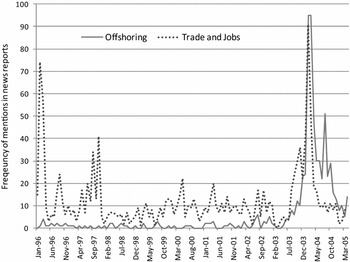
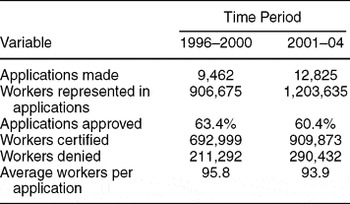
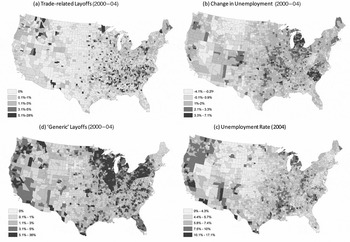
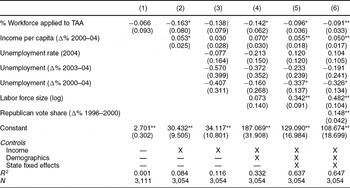
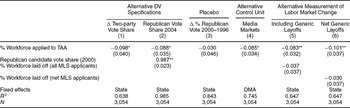
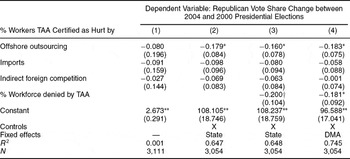
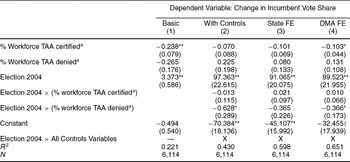
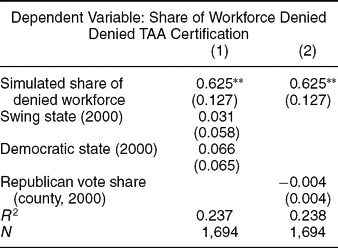
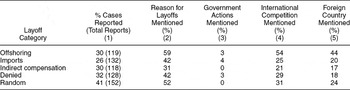
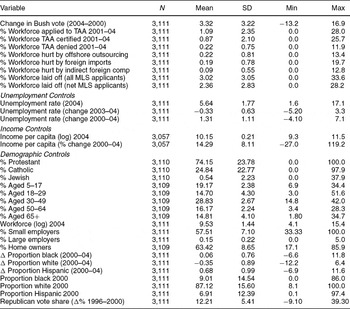




Comments
No Comments have been published for this article.