INTRODUCTION
Within narrative studies the interview as a research method has until recently been viewed as a problem to overcome. William Labov, for instance, famously popularized the use of “danger of death” questions, which were intended to make interviewees forget about the context of elicitation. It was believed that eliciting stories that showed little or no interference from the interviewer was possible. Critics of this approach have often emphasized that interviews are never context-free events of elicitation, with many arguing that interviews are instead deeply genred speech events (Briggs Reference Briggs1986) that should not be confused with naturally occurring narratives (see Goodwin Reference Goodwin1997, Schegloff Reference Schegloff1997, Ochs & Capps Reference Ochs and Capps2001). For some critics, these facts suggest that interview-based narrative elicitation is artificial and should be avoided in favor of narratives told in ordinary interaction. There are at least two issues here: one concerning the problematic distinction between “natural” and “artificial” interaction (see De Fina & Perrino's introduction to this Special Issue), and the other concerning the more basic issue of how stories emerge in social interaction. On the second issue, on which this article focuses, contemporary researchers on narrative often argue that one has to examine the interplay between representation and interaction. That is, one cannot study stories only by lifting out a narrative's literal content—the denotational text, for example, information about what characters exist and what events occur. (This earlier view of narrative as a denotational text made it easy to see narrative as something that could be decontextualized and that could therefore escape the biasing influences of the interview.) Rather, the formation of narrative as a denotational text must be studied in relation to the flow of the interaction itself, what some have called the interactional text (Bauman Reference Bauman1986, Silverstein Reference Silverstein and Sawyer1997, Wortham Reference Wortham1994, Reference Wortham2000, Reference Wortham2001). Stories emerge dynamically in interaction between interviewer and interviewee, and as Wortham (Reference Wortham2001) in particular has shown well, participants often play an active role in regulating and controlling this interplay. Rather than suggesting the need to abandon the interview as a social-scientific method, work like Wortham's shows how interviews can remain an important site for the study of storytelling as an interactional practice.
In this article, I build on this interactional turn in the study of narratives by examining how narrators align story and storytelling event in interview contexts. I focus on the way speakers use language to anchor stories in time and space as they narrate. Narratives of personal experience are typically understood as “past” by default, so that the expectation is that the speaker will use spatio-temporal deixis and other linguistic resources to frame the narrative as there-and-then, not to be confused with the here-and-now storytelling event. In such cases, the alignment between what Jakobson (Reference Jakobson, Waugh and Monville-Burston1957) called the “narrated event” and the “event of speaking” involves a “displaced mode” (Chafe Reference Chafe1994:196) where story and storytelling event appear maximally distinct. There is no conflation of the interactant's world with the story world. The narrated event is treated as separate and located in a past that one looks back upon from the standpoint of the present interaction (Perrino Reference Perrino2005:349). To use Bakhtin's terms, the two events are made to occupy separate “chronotopes,” literally time-space configurations, or as Silverstein (Reference Silverstein2005:6) usefully defines it: “the temporally (hence, chrono-) and spatially (hence, -tope) particular envelope in the narrated universe of social space-time in which and through which, in emplotment, narrative characters move.”
Though the expectation is for a story to be deictically anchored as there-and-then, there are many cases in which the two chronotopes are not clearly separated, as is the case with coeval alignment (cf. Silverstein Reference Silverstein2005:17–18) where the two narrative chronotopes—story and storytelling event—appear to overlap in time and/or space. The most familiar case of this is the “historical present” in oral narrative, where speakers shift into nonpast deixis for events that are otherwise framed as, or assumed to be, past. I argue here that the historical present is only one familiar way in which storytellers align the chronotope of the story and the chronotope of the here-and-now storytelling event as coeval. This blurring of the boundary between chronotopes can be accomplished with many different resources and methods, and there are varieties of coeval alignment that go even further than the historical present; some go so far as to transport participants in the here-and-now “into” stories. I have explored this kind of movement into stories in my earlier work on Senegalese narrative practices (Perrino Reference Perrino2005, Reference Perrino2007) and I will touch on them again below.
Shifts of alignment are important in the study of narrative in interview contexts, since these shifts allow speakers themselves to manage the relation between representation and interaction. In what follows, I illustrate some of these alignment strategies, drawing on narrative data in interviews from two very different sites where I have conducted research—Italian oral narrative from the Veneto region of northern Italy and Wolof/French oral narrative from Dakar, Senegal. When compared, these examples are meant to broaden the phenomena of coeval alignment beyond the special case of the “historical present,” and to illustrate, more generally, the importance of mapping alignment (cf. Wortham Reference Wortham1996) in the study of narrative in interview contexts. I argue that shifting time-space alignments are an important area of study because they help reveal how stories reflect and shape the shifting relations between interviewer and interviewee.
MAPPING COEVAL ALIGNMENT IN AN ITALIAN ORAL NARRATIVE
I begin with a few elementary examples of coeval alignment using a six-minute-long personal narrative produced by Tiziana,Footnote 1 a schoolteacher in her late forties who lives in Silea, a town in the Veneto region of northern Italy. My interview with Tiziana, which lasted fifty-six minutes, focused on the issue of how Italian hospitals and hospital personnel are reacting to new waves of immigrants in Italy. At a certain point, when she was talking about the relationship between Italian doctors and immigrant patients, she launched into three personal narratives. In one narrative Tiziana recounted an experience she had with a neurologist. Her father had been previously hospitalized for a possible brain tumor. After the doctors performed a CAT scan on him, Tiziana went to the neurology department to learn about her father's diagnosis and met the department's director.Footnote 2
(1)

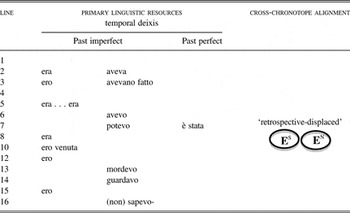
Table 1 focuses on patterns of verb tense and aspect to expose Tiziana's repetition of past-tense deictic framing, especially the past imperfect (e.g. ero, era ‘to be’ and aveva, avevano, avevo, etc. ‘to have’; there is one case of past perfect (‘passato prossimo’, è stata). At the beginning of this story, the two events—the narrated and narrating events—are kept separate through a “displaced” or “displaced-retrospective” perspective. That is, it is as if the narrator is standing back and recounting this past event; the past does not seem to overlap with the present. However, shifts in cross-chronotope alignment are common when people tell stories, and Tiziana initiates a shift in alignment in the lines that follow.
(2)

Cross-chronotope alignment at start of narrative (lines 1–16; 37 sec.).

Es=“event of speaking” or storytelling event; En = “narrated event” or story; lines 9–11 were omitted because they were produced by the interviewer.
While past framing continues, a shift into the historical present occurs in line 20, when she uses the nonpast verbum dicendi dico as a matrix clause verb in a direct report. The historical present is very familiar in storytelling and the tendency to use nonpast verbum dicendi in the matrix clause of direct reports has been noted by Chafe (Reference Chafe1994) and others (e.g. Wolfson Reference Wolfson1982, Schiffrin Reference Schiffrin2006). The tropic reading of the historical present is as deictic transposition, in which Tiziana is addressing the head of the neurology department as if he were metaphorically present in, and part of, the here-and-now interview.
After this moment, Tiziana does not return to past-tense framing. Instead, she produces a continuous stretch of direct reported speech without any matrix reporting clauses to mark this discourse as reported speech, and hence with no opportunities to use the historical present. But this does not mean that coeval alignment depends only on phenomena like the historical present. The long stretch of direct reports without matrix clauses (which belong to the narrating event) also helps blur the boundary between past and present, especially since it occurs after an instance of historical present. The doctor finally gives a response to Tiziana (line 25) which greatly unsettles her, and this is an emotional peak in the story. After this stretch of reported speech, Tiziana finally returns to a retrospective-displaced alignment between narrated and narrating events (line 26). Tiziana, in a sense, has “returned” to the present interview. As is typically the case and as this stretch of discourse illustrates, her story alternates between moments of coeval alignment and displaced alignment. In this simple case, the resources for producing coeval alignment are very limited, and in terms of pragmatic effects, at most, the alignment helps create a stretch of interaction in which there is a sense of heightened emotion and “connectedness” initiated by the interviewer. Importantly, this case also illustrates that the historical present is not the only resource for producing coeval alignment. This becomes especially obvious in more extreme cases of coeval alignment, discussed below, where Senegalese narrators draw interlocutors “into” their stories or otherwise blur the boundaries between the two events.
MAPPING COEVAL ALIGNMENT IN SENEGALESE ORAL NARRATIVE
Storytellers in Senegal sometimes use a narrative strategy that may be called “participant transposition,” or what some of my Senegalese informants called in French, démarche participative (lit.‘participatory move’). Transposition is a notion introduced by Bühler (Reference Bühler1990) and has been used in linguistic anthropology (e.g. Hanks Reference Hanks1990, Haviland Reference Haviland, Gumperz and Levinson1996) to describe how speakers can shift the origo (the zero point of deictic reckoning) away from the here-and-now speech-event (e.g. through direct reported-speech constructions). By participant transposition, I refer to a practice in which narrators blur the boundary between story and storytelling event in a manner roughly similar to the historical present, but they go further by moving interlocutors “into” their stories (Lempert & Perrino Reference Lempert and Perrino2007, Perrino Reference Perrino2005, Reference Perrino2007). They assign people in the present to characters in the past, either explicitly or implicitly. Using direct reported speech, for instance, the narrator may begin to talk to co-present audience members as if they were characters. In interviews with Marc, my main informant and research assistant, he used the verbs ‘transpose’ and ‘transport’ to gloss démarche participative: “la démarche participative, pour te faire rentrer dans ce contexte-là. C'est comme si je t'avais transposée, transportée dans mon histoire-là” (‘the participatory move [is done] in order to make you enter that context. It is as if I had transposed [or] transported you inside my own story’).
Two patterns of coeval alignment tend to co-occur in these cases: participant transposition, where interlocutors are addressed as a character in a story, and deictic transposition, particularly the “historical present.” In the narrative data I analyzed, participant transposition tended to co-occur with deictic transposition in order to align story and storytelling event as coeval, as if they were occurring in the same chronotope.
I illustrate and map these patterns in a brief stretch of discourse below. In a two and a half hour interview I conducted with Marc, I selected the first hour (which was followed by a lunch break) for transcription and analysis and found four major narratives, the first three of which were personal-illness narratives. In one story, Marc told me of a case of diarrhea he had when he was younger. When his past self develops symptoms of diarrhea, Marc consults his father, who worked as a nurse, and his father hands him some medicine. Marc takes the medicine and goes to sleep without dinner, but when he awakens he has to run to the bathroom. There he discovers blood in his stool, and the diarrhea with blood continues for three months. At a particular moment when he is describing how he had to run to the bathroom five times a day, he starts using participant transposition. This begins at line 281b below.
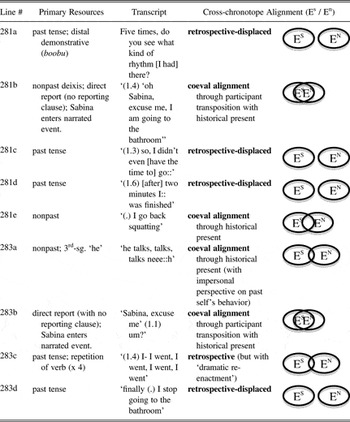
(3)

In lines 281b and 283b, Marc addresses me as if I were witnessing his past self's need to rush to the bathroom. In this brief case of participant transposition, I become a witness. Other instances of participant transposition last longer and are more elaborate in terms of role assignment. This segment of discourse is useful to compare with the Italian material from Tiziana's narrative because of the rapid shifts in cross-chronotope alignment here. These shifts are clear when we map the linguistic resources involved in alignment effects, as shown in Table 2 (cf. Wortham Reference Wortham1996).
Shifts in cross-chronotope alignment in a Senegalese narrative (lines 281a–283c; 35 sec.).

Unlike the Italian example provided earlier, which lasted nearly the same amount of time (the Italian example was 37 seconds, this one is 35 seconds), this brief stretch of discourse shows rapid shifts in cross-chronotope alignment. (In Table 2 below, shifts are summarized in the right column and graphically illustrated with separate or partially overlapping semicircles; the overlap represents degrees of coeval alignment of story [En] and storytelling chronotopes [Es]. Key resources in producing these effects are listed, as in Table 1, on the left.) Marc alternates between phases of discourse in which he seems based in the present and merely talking in a displaced mode “about” past events, and phases of discourse in which he blurs the boundaries between past and present.
Though there is no space here to illustrate this, in other work on participant transposition in Senegalese oral narrative (Perrino Reference Perrino2005, Reference Perrino2007) I have shown how these moments of coeval cross-chronotope alignment are locally occasioned and interactionally consequential. In an analysis of a series of narratives by Marc, I found that he tended to use participant transposition as part of a strategy to redefine the interaction in progress, often by assigning me to characters in his story so that what he said (the denotational text) came to loosely represent our recent interactional past (the interactional text). This alignment of story and storytelling event was used not only to convey information “about” his past self but also to redefine the present. In the story cited above, for example, he recruited me to serve as a “witness” who appreciates the intensity and frequency of his past self's diarrhea. This occurred not long after I had asked a question that implied that he was exaggerating about his past self's symptoms; he said there had been blood “streaming” out of him when his past self had diarrhea, and that is what I had questioned. Using participant transposition, he turned me into someone who appreciates exactly what I had questioned: the severity of his past self's symptoms. In another case, Marc inserted me into the story of a religious teacher, a Marabout named El Haji Malick. El Haji Malick had no patience for people who dropped rice when they ate (Senegalese traditionally eat with their hands from a communal plate). The complication occurs when a guest arrived who had a tendency to drop rice. El Haji Malick could not discipline the guest due to norms of hospitality, so he decided to hand the guest a stick and told him to beat anyone who dropped rice. Not a grain of rice was dropped. In the retelling, Marc used participant transposition and replaced rice-dropping with smoking (prohibited by Islam). He recruited me to the role of the “smoker” (following stereotypes of Italians that he often brought up during our interviews), who needs to be disciplined; he, in turn, played the role parallel to that of El Haji Malick. Interactionally, in that interview he had positioned himself consistently as “teacher” and me as the “student”—and often a student who needed some extra discipline. Again, as with the diarrhea story, strong parallels were created between chronotopes of story and storytelling event (for details see Perrino Reference Perrino2005), though with varying degrees of elaboration.
These types of alignment effects need attention because they can reveal how people come to play interactional roles that parallel roles described in the story. In a number of studies that range from schools to therapeutic interviews, Wortham (Reference Wortham1994, Reference Wortham1996, Reference Wortham2001), in particular, has shown how interactants produce complex parallels between story and storytelling events (see also Ochs, Gonzales, & Jacoby Reference Ochs, Gonzales, Jacoby, Schegloff and Thompson1996). Not unlike the Senegalese case, the cases he observed involve doubled roles, where students in the classroom, for example, take on roles denoted in the stories they read in addition to the roles they already have as students in the classroom. In a discussion of Plutarch's Life of Lycurgus, for instance, some students came to play the role of Spartan mothers, others became Helots (slaves and serfs), while still others played the role of Ephors (the Spartan elders). Wortham showed how this kind of doubling of roles creates dynamic analogies that are often linked to larger scale relations between groups in society (e.g. Helots became likened to “welfare mothers”; see especially Wortham Reference Wortham2006). Like the Senegalese case, these analogies are actively constructed in discourse by people in the interaction. In Wortham's classroom, there is a school-wide pedagogy that promotes what he calls “participant examples,” where students take on roles described in the books they read (Wortham Reference Wortham1994). Among Senegalese narrators, there is also a relatively conventionalized strategy of participant transposition that is designed to create forms of coeval alignment.
CONCLUSIONS
In sum, the interview continues to be a useful method for the study of narrative, so long as narrative is studied in terms of the interplay between representation and interaction. As illustrated here, mapping cross-chronotope alignment in interviews is one method to study this interplay systematically. In addition to analyzing how coeval alignment can help create parallels between what is said and what is enacted, questions can also be asked about the distribution of such alignment effects over larger stretches of discourse. In Senegalese narratives generally, I observed that extreme coeval alignment between story and storytelling event chronotopes tended not to occur on first tellings but on retellings. Somewhat similarly, coeval alignment in Italian oral narrative (in the corpus of data I collected) tended to have a delayed onset. For example, in terms of the relative time spent on direct reported speech (which was one important resource for creating coeval alignment in that interaction), there is a marked increase in direct reports over the course of Tiziana's three narratives, ranging from 6% in the first narrative (3.65 seconds out of 61.14 seconds) to 29% in the second narrative (48.08 out of 167.91) to 54% in the third and final narrative (48.09 out of 89.71). (In terms of tokens of past-tense reporting verbs, there was one in the first narrative, four past and one historical present in the second narrative, and three past and one historical present in the third narrative.) Both the second and third narratives have long stretches of reported speech, mostly with null matrix clauses, such that the speech is not continually framed as “past” even when an occasional past-tense verbum dicendi occurs; as I suggested earlier, these patterns help contribute to coeval alignment. Also, only in the second and third narratives do tokens of the historical present occur. Such larger scale patterns need to be examined on a large corpus of narratives, but they may suggest that the delayed onset of coeval alignment is typical of narratives told in interview contexts. This distribution of coeval alignment may thus indicate something very general about this phenomenon, specifically, that it tends to presuppose (and at times helps create) a degree of interpersonal connectedness between interviewer and interviewee. In other words, patterns of coeval (and displaced) alignment deserve to be studied within units larger than utterances and in stretches of discourse larger than a single story.
As this article and the others in this special issue argue, more empirical attention should be paid to the dynamic relationship between stories and their interactional environments such as the interview, and what I have illustrated here are a few important methods by which participants themselves reflexively manage these dynamics. Mapping cross-chronotope alignment within and across storytelling in interview contexts is thus a strategy for revealing the shifting alignments among participants while contributing to our understanding of storytelling in interviews.
APPENDIX: TRANSCRIPTION CONVENTIONS
- fast
fast speech rate
- |
overlapping utterances
- =
latching
- (00.00)
time intervals
- ::::
syllable lengthening
- -
syllable cut-off
- .
stopping fall in tone
- ,
continuing intonation
- ?
rising intonation
- […]
omitted material
- [ ]
transcriber's comments