


Introduction
A central aspect in studies on the aetiology of depression is low self-esteem (Sowislo and Orth, Reference Sowislo and Orth2013). Consequently, increasing self-esteem is a common therapeutic goal and intact self-esteem constitutes a protective factor against the development of depressive symptoms (Dumont and Provost, Reference Dumont and Provost1999).
Although low self-esteem is a diagnostic criterion of depressive disorders according to the DSM-IV (American Psychiatric Association, 1994), surprisingly cognitive behavioural therapy (CBT) does often not include self-esteem interventions. In this study we conducted a non-randomized, naturalistic, treatment manual-based group-based CBT focusing on enhancing self-esteem (seGCBT; Potreck-Rose and Jacob, Reference Potreck-Rose and Jacob2003) and consequently improving self-esteem in clinically depressed patients. The study aimed at (1) treating depressive symptoms by applying cognitive and behavioural interventions in a group-therapy setting that focused on self-esteem enhancement, and (2) exploring co-variation in depression symptoms and self-esteem over the course of the intervention. We expected that a possible reduction of depressive symptoms would co-vary with an increase of self-esteem.
Method
One hundred and forty-seven patients out of 241 psychiatric in-patients, who attended a GCBT, were included (85 females; mean age 39.95±14.34 years). All 147 patients suffered from an affective psychiatric disorder according to DSM-IV criteria (American Psychiatric Association, 1994) with a current depressive episode. In detail: 98 (66.7%) patients had a recurrent major depression (DSM-IV: 296.3), 36 patients (24.5%) received the diagnosis of a major depression (DSM-IV: 296.2), 11 (7.5%) patients had a bipolar disorder I, with a current depressive episode (DSM-IV: 296.5) and two patients (1.4%) suffered from dysthymia (DSM-IV: 300.4; for further information regarding clinical characteristics, see Table 1). The patients were diagnosed by experienced and trained psychiatrists using the Structured Clinical Interview for DSM-IV Axis I, German version (SKID I; Wittchen et al., Reference Wittchen, Wunderlich, Gruschwitz and Zaudig1997). Ninety per cent of the included patients received pharmacotherapy.
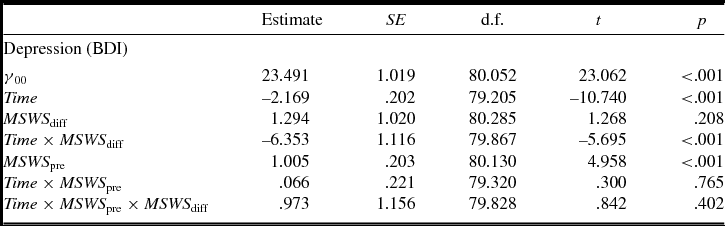
Results of the full linear mixed growth analyses of change in the BDI sum score

Estimate, estimated parameter value; SE, standard error of the parameter estimate; d.f., degrees of freedom; t, t-value; p, probability of committing a type-I error; γ00, intercept; Time, linear growth variable; the suffix ‘diff’ indicates the difference score (e.g. difference between pre-test score and last score of therapeutic relation) and the suffix ‘pre’ indicates the pre-test score of these variables.
The 4-week CBT group therapy programme consisted of eight group sessions (each 90 minutes), which took place twice a week. Each intervention was undertaken in a group of a maximum of 15 individuals. The group therapy intervention was based on five modules (Potreck-Rose and Jacob, Reference Potreck-Rose and Jacob2003): psychoeducation (session 1), self-awareness (sessions 2, 3 and 4), self-care and positive activities (session 5), cognitive reconstruction (sessions 6 and 7), and prevention of relapse (session 8). The group therapy was conducted by two experienced clinical psychologists.
The Multidimensional Self-Esteem Scale (Multidimensionale Selbstwertskala; MSWS) was applied 1 week before the first therapy session (t0, pre-intervention) and after five weeks (t4, post-intervention). The Beck Depression Inventory (BDI) was completed weekly (t0, pre-intervention; t1, after the first week; t2, after the second week; t3, after the third week; t4, after five weeks). Clinical response was defined by a reduction of at least 50% in the BDI sum score after 5 weeks of treatment, and partial clinical response was defined by a reduction of at least 25% in the BDI sum score.
Statistical analyses
Using mixed linear models, the BDI sum score was regressed on the growth curve (labelled Time), in order to quantify the linear gradient development of the BDI sum score. A linear relationship with an autoregressive co-variance structure was considered for the Time factor, as measurements were performed at regular weekly intervals. As depicted in the extended report online (see supplementary material Figs S1 and S2), all necessary assumptions for conducting mixed linear models were met. Model complexity was increased by including the MSWS pre-test score (MSWS pre) as well as the MSWS difference score (MSWS diff first minus last MSWS measurement) as co-variates in the analysis to evaluate their impact of self-esteem on the symptom change. Also, variables modelling the two-way interactions MSWS pre × Time, MSWS diff × Time, and MSWS pre × MSWS diff, as well as the three-way interaction MSWS pre × MSWS pre × Time were included in the model. To test for distinctions in model fit between the concurring models, χ2 likelihood ratio tests were conducted. All tests were run two-tailed.
Results
Regarding clinical response, 27 patients were responders, 28 patients were partial-responders, and 29 patients were non-responders. Sixty-three of the participants did not show up for the last measurement (t4) and therefore could not be classified. In order to rule out potential baseline effects, a Welch two sample t-test was calculated comparing initial BDI scores of patients who missed their last measurement compared with patients who did not. No significant effect of symptomatic severity at baseline was found [t (143.92) = 1.93; p = .054], justifying considering that values were missing at random.
Linear mixed growth analysis
As a result of the linear mixed growth analysis of the decrementing BDI sum score, a mean decrease of Time = 2.26 points per session [t (436.7) = –15.04; p < .001] was found, starting at a mean intercept of γ 00 = 24.42 [t (173.3) = 29.42; p < .001], which represents the average BDI sum score in the pretest. Thus the decrease in the BDI sum score can be linearly described.
A second model was estimated, including random inter-individual differences in the response trajectories. In this model, a mean intercept of γ 00 = 24.44 [t (146.23) = 29.14; p < .001] and a mean linear decrease of Time = 2.28 [t (123.47) = –11.91; p < .001] per session were estimated. A model comparison using a χ2 likelihood ratio test revealed a significant improvement in model fit (ΔAIC = 23.4; Δd.f. = 2; p < .001), so random response trajectories were in all subsequent models.
Analysis of process-related change factor impact
In the following analysis, the influence of MSWS pre and MSWS diff on the overall value level and their interaction with the linear decrease of the BDI were investigated by including both variables as well as their all possible interactions in the model. The variables underwent z-transformation before entering the model.
The mean intercept of the model was γ 00 = 23.49 [t (80.05) = 23.06; p < .001], representing the predicted BDI sum score in the pre-test for a person with an average MSWS score. The significant mean linear decrease from the antecedent models was replicated at Time = –2.17 [t (79.20) = –10.74; p < .001]. A significant effect of the initial self-esteem level on the overall BDI score could be found [MSWS pre = –6.35; t (79.87) = –5.70; p < .001]. In other words, individuals who started with higher self-esteem ratings showed lower overall BDI scores. The interaction term quantifying the influence of the MSWS difference score on the symptom slope was significant at Time × MSWS diff = 1.05 [t (80.13) = 4.96; p < .001], indicating a stronger decrease in BDI values along with increasing MSWS difference scores.
The BDI includes two items that may overlap with the self-esteem construct: items 7 (self-aversion) and 8 (self-accusation). Because this overlap may have artificially inflated the statistical relationship between the BDI sum score and the MSWS measures, the analyses were re-run without these items. However, the results remained stable, as can be seen in Table S3 in the supplementary extended report (online only).
Discussion
First of all, a linear decrease in the BDI sum score could be observed, indicating that the depressive symptom severity amongst patients was reduced. Also, patients with higher self-esteem showed fewer symptoms in the pre-test. Over the course of the investigation, depressive symptoms showed a stronger linear decline for patients with higher gains in self-esteem between the first and the last measurement but the decrease was not related to initial self-esteem. The present results are thus in accordance with Kunikata et al. (Reference Kunikata, Yoshinaga and Nakajima2016), who reported a steady increase of self-esteem along with seGBT in a sample of community-living patients.
The linear decrease in depressive symptoms was more pronounced for patients that experienced an increase in self-esteem between the first and the last measurement. This finding is important, as it provides further evidence for the relationship between self-esteem and depression. Notably, initial self-esteem was not related to the change in the BDI score, which indicates that this finding cannot be explained by a change in severely depressed subjects with low self-esteem. Also, no significant interaction between initial self-esteem and the self-esteem difference score was present, ruling out possible floor effects. This pattern is in line with results of Morton et al. (Reference Morton, Roach, Reid and Stewart2012), who found GCBT to be effective in increasing self-esteem and reducing levels of depression and anxiety in women.
Moreover, the initial level of self-esteem was not predictive for the decrease at all but only predicted the other point estimate in the regression model: the initial level of depressive symptoms. The picture that evolves is therefore remarkably clear: initial self-esteem is unrelated to the change in depression and initial depression is unrelated to the change in self-esteem while the change in one predicts the (linear) change in the other. The design of the present study does not allow conclusions about causality, but Sowislo and Orth (Reference Sowislo and Orth2013) reported in their meta-analysis that the effect of self-esteem on depression can be assumed to be twice as high and vice versa.
Regarding limitations, the present study included only two measures of self-esteem: at the first (t0) and the last time point (t4). Even though the slope of depression has been shown to be related to the difference in self-esteem between these two measures, a design pinning the decrease in depressive symptoms directly to the gradual increase in self-esteem would be a major improvement to the model, which could not be established with the available data. Another caveat is the lack of a control group, especially as a heterogeneous clinical sample, which included mainly patients with major depressive disorder (91.2%) but also patients with dysthymia and bipolar I disorder, was included. Thus, further research is needed to confirm the applicability of seGCBT as a transdiagnostic approach in samples with mood disorders, and randomized controlled trails are needed to compare its efficacy and effectiveness in relation to alternative treatments.
Taken together, these limitations – in particular the absence of a control group – indicate that the results of the present investigation have to be carefully interpreted: the majority of the patients received anti-depressant medication along with the seGCBT and it is not experimentally verified that the decrease in depressive symptoms is caused by (or even related to) the seGCBT. The current investigation should therefore be regarded as a naturalistic study that highlights seGCBT as a promising approach for treating depressiveness with a potentially positive effect on the process of recovery, as depressive symptoms and level of self-esteem seem to co-vary.
Ethical statements: The authors assert that all procedures contributing to this work comply with the ethical standards of the relevant national and institutional committees on human experimentation and with the Helsinki Declaration of 1975, and its most recent revision. Formal approval to conduct the investigation was obtained by the local ethics committee.
Conflicts of interest: The authors have no conflicts of interest with respect to this publication.
Supplementary material
To view supplementary material for this article, please visit https://doi.org/10.1017/S1352465818000243




Comments
No Comments have been published for this article.