Introduction
This article presents a case study that focusses on how one university collaborated with service users or the term agreed by the project team, patients and carers (PCs) to develop a curriculum for radiotherapy students that reflected caring values and positioned patient and carer involvement (PCI) at the heart of education. The need to develop and subsequently demonstrate caring and compassionate behaviours is central to therapeutic radiographers’ professional practice. 1 Furthermore, compassionate care is congruent with the core values of the NHS Constitution and applicable to the wider healthcare workforce. 2 Compassion is a key recommendation in health legislation 3 – 6 following a number of high profile incidents in the United Kingdom where inadequate care reduced the quality of life of patients. 7 – 9 Improving the patient experience is another important facet of UK health policy 10 – Reference Cornwell and Goodrich 13 and compassionate behaviours are regarded as synonymous with patient-centred care.Reference Cornwell and Goodrich 13 , 14 Patient-centred care is a complex and multi-factorial concept. However, the underlying principle focusses upon the necessity of healthcare professionals and services to create effective care pathways by providing quality information and involving patients in decisions about their own care. 15
For students in radiotherapy to develop as professionals with the ability to facilitate meaningful PCI, then the concept must be introduced in their training. As a result of a comprehensive literature review, Towle et al. propose that while active involvement of patients and carers is evident in health education a more embedded approach is required.Reference Towle, Bainbridge and Godolphin 16 While this article focusses on one professional group in the United Kingdom the messages are applicable to the global health and social care workforce and the design of health-care education in general.
Previous research at the university demonstrated that PCs involvement in the curriculum has positive benefits for those individuals sharing their experience and for the students’ learning.Reference Keenan and Hodgson 17 , Reference Hill, Thompson, Willis and Hodgson 18 PCs value the opportunity to raise awareness of cancer and input into student training. In addition, the personal benefit to their confidence and self-esteem cannot be underestimated. Patients viewed their involvement with students as an important aspect of their survivorship journey.Reference Keenan and Hodgson 17 For students, learning directly from interactions with PCs, provided a unique opportunity to develop competence in emotional encounters and reflect on how they present themselves as professionals in the clinical setting.Reference Hill, Thompson, Willis and Hodgson 18 , Reference Hodgson 19
PCI in curriculum activities that focus on sharing emotional experiences can promote emotional awareness in students.Reference Allan 20 – Reference Theodosious 22 Reflecting on those experiences encourages emotional expression in students and as a consequence they are able to better articulate care values.Reference Allan 20 Reflection also promotes further cognition as described by Dilts and DeLozier who propose that experiential learning encourages emotional expression and management.Reference Delozier and Dilts 23 Dilts and DeLozier, further suggest that higher level thinking influences an individual’s professional values and identity, which may then promote a sense of connectedness with patients.Reference Thorne, Kuo, Armstrong, Mcpherson, Harris and Hislop 24 Todres et al.Reference Todres, Galvin and Holloway 25 describes this sense of embodiment as humanisation of care. The inference is that humanisation creates a sense of connection and this is linked to notions of compassion.Reference Todres, Galvin and Holloway 25 While students may value this feeling of being connected with PCs the literature on compassion places emphasis on the relational nature of the concept,Reference Paulson 26 – Reference Sabo 28 and that compassion revolves around the way in which people relate to each otherReference Dewar 29 . The interaction between PC and student can promote shared understanding of experience and thus provides a catalyst for caring actions.Reference Schantz 30
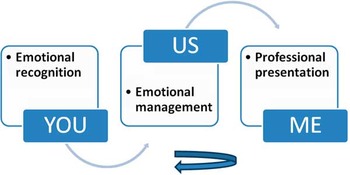
Figure 1 illustrates how learning from PCs begins with interaction and is characterised by the psycho-dynamic nature of their conversation (YOU-US-ME). This pedagogical model encourages dialogue; external dialogue with PCs and internal dialogue synonymous with thinking and learning. ‘I hear you – we talk and I learn about you – I also learn about myself and how I want to be as a professional’. This process of learning that begins in the classroom at the start of the programme continues throughout training and in clinical practice. It was this understanding of the pedagogy and the power of learning that we wanted to capture in curriculum enhancements.
Learning through interaction: a psycho-dynamic model.

The aim of the curriculum project was to involve a group of PCs in ensuring we were developing a truly patient-centred programme. Research findingsReference Keenan and Hodgson 17 – Reference Hodgson 19 supported the value of PCI, however we wanted to develop relevant, authentic and collaborative teaching and learning. There was also a drive to enhance the curriculum in line with professional and regulatory standards that had changed explicitly to require PCI. In preparation for re-approval of the undergraduate course in 2013 we developed a plan to co-develop the curriculum with our PC partners. The key objectives were that the new curriculum should facilitate emotional development, promote understanding of diversity and individualism, challenge the students intellectually and include support for PC and students.
Method
Recruitment to the PC group was on the basis of the individual having previously being diagnosed with cancer or being a family member, carer, friend or relative of an individual with cancer. PCs were identified through patient support groups, social media patient forums and radiotherapy departments and invited to join the group. Further recruitment has occurred via PC group members and their own peer support networks. As part of the recruitment process each PC is informed about the nature of the course, potential for involvement in research, course evaluation and where video/audio recording might occur. Each PC provides signed consent to acknowledge their understanding and acceptance of their involvement. We sought advice on whether the project required ethics approval and the university ethics committee identified this as a quality improvement initiative and thus we did not require approval apart from the usual consent process explained above.
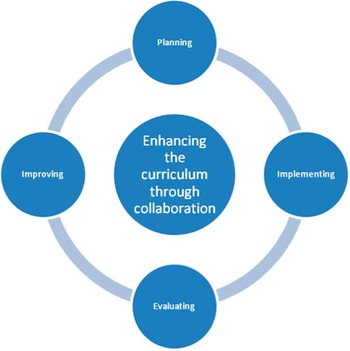
We adopted a quality improvement approach to the project 31 (see Figure 2). This began with a review of current PC involvement activity followed by a plan with our partners how this could be enhanced. Changes were implemented and then evaluated both from the students’ and PC perspective. The four stages of the project are outlined below.
Continuous improvement of the curriculum through collaboration.

Plan
Collaborative planning began with a meeting to share our PCI activity to date at the university with the PC group which consisted of eight people who were patients, carers and bereaved individuals from our existing PC group and three from a local cancer support group (December 2012). The session began with us sharing the findings of two research projects that focussed on the experiences of five PCs who had been involved in educating students and the student cohort they delivered workshops to.Reference Keenan and Hodgson 17 , Reference Hodgson 19 The purpose of this was to stimulate discussion. Lecturers and PCs who had been involved in teaching reflected on the three workshops that had been previously delivered: (1) communication skills role play facilitated by PC, (2) PC experience workshop facilitated by five PCs with diverse experiences of cancer, (3) Sensitive communication role play delivered by PC and health professional. Each workshop was planned by a lecturer and PCs. The general consensus at that initial planning meeting was that more could be developed within the curriculum. The PC views were documented and an action plan drafted.
The second meeting in March 2013 was a forum where we discussed the theme of ‘care’ as a fundamental aspect of the programme and began to identify the detail of what changes could be made. The PCs had ideas about simulation, different formats for role play and giving feedback to students. PCs brought to the discussion their experiences of having treatment and thought this could be used more effectively with students. However, they were not keen to assess students as they felt it was too much of a responsibility, particularly by a patient undergoing treatment. Although, they thought giving students’ feedback on their performance should be developed in some way. We discussed our ideas for clinical placement de-brief sessions they thought that a good idea to help students develop their skills. Throughout the discussions there was a sense that the PCs cared about the students’ development and wanted the curriculum activities to be helpful. When the PCs were asked what was important to them, they said things such as ‘feeling cared for’, ‘someone being friendly’, ‘listening to me’. A more detailed action plan that became the framework for the project was agreed with the PC group which is further described.
Do
Discussions translated into a number of additional workshops and educational activities that could be included across the curriculum. Specifically, four additional workshops were added to the programme from September 2014. PCs were both involved in the planning and delivery of the workshops. The first was a session on palliative care with patients talking about their feelings of being told the cancer had spread and how that impacted on them emotionally. The carer experience of palliative care was also shared from a PC who had been bereaved and a support worker in palliative care. A workshop exploring care and compassion was introduced with patients, carers and students discussing a shared understanding of this in practice. Furthermore, we designed a session around emotional intelligence and another on the role of PCI in healthcare and research.
Preparation and de-brief are crucial elements of effective PCI both for PCs and students. Before delivery PC’s are involved in the preparation of the sessions including course materials and delivery, this enables active engagement through co-production. De-brief sessions are conducted face-to-face following the delivery of the session to obtain immediate response on how the PC’s feel it was delivered and the students’ levels of engagement. The PC’s are invited to provide additional feedback either by phone, e-mail, or face-to-face in the period following the session, thus allowing a reflexive approach to be taken by providing the PC’s time to process the events.
Students were informed of the nature of the teaching sessions. At the beginning of the session the facilitator acknowledged the potential that it could be emotional and a second facilitator was available for support. Observing interactions and body language is important and time was allowed at the end of the session should anyone wish to discuss issues.
Study
For any improvement project, a plan for evaluation is crucial to the ethos of continuous development and this was undertaken in three ways. Each workshop included time for immediate feedback and students were asked to rate enjoyment, learning and areas for improvement, students were also asked to provide qualitative comments. This feedback was shared with the PCs. Module evaluations are standard and the students are asked to identify three things they enjoyed the most and three things that can be improved. This approach allows the workshop to be rated as part of a module of study. The third aspect of evaluation is completed at a programme level and assesses the contribution of PCI to overall learning.
Act
As with any quality improvement the Plan-Do-Study-Act (PDSA) approach ensures that constant enhancement to the curriculum is made. At the end of academic delivery the PC group discussed all the feedbacks and recommendations were made collaboratively about how PCI could be improved for the following year. In addition, at this point programme review occurs and the PCI evaluation feeds into the overarching action plan for improvement.
Results
Plan
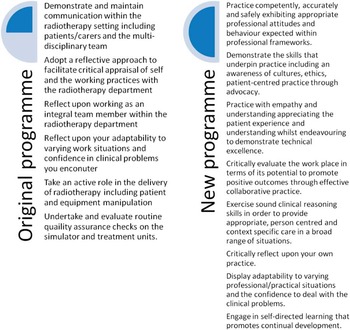
As a result of this collaborative approach to curriculum development, the newly approved programme (2014) had three key themes, which typifies the radiotherapy profession: (1) Care and Compassion; (2) Technology and (3) Professionalism. The influence of PC group was evident in the first theme. As a result, the learning outcomes were modified to ensure delivery and assessment matched the ethos of care and compassion which had been a direct result of the project (see Figure 3). The four additional workshops were planned by the programme team and PC group.
Patient and carer involvement enhanced learning outcomes.

Do
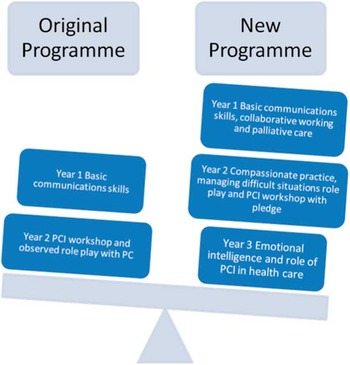
The new programme included four additional workshops featuring PCI that encouraged collaborative learning between PCs and students (see Figure 4) based on the curriculum developments highlighted in response to the study conducted by Hodgson.Reference Hodgson 19 The palliative care workshop was well received although students admitted this was a difficult topic for them. Key learning was identified as recognition of the caregiver experience and the importance of support. Module evaluation identified that the PCI session on palliative care was preferred over the formal lecture on palliative radiotherapy. The workshop on care and compassion was interactive and prompted lots of discussion about practice. Other workshops promoted PCs who were actively involved in research and service development and a self-assessment of emotional intelligence facilitated reflection on practice. Although the PCI workshops were intended to emphasise ‘care for others’ feedback from students on the emotional nature of working in oncology was an important outcome. As a result, we also incorporated ‘self-care’ across the curriculum. A key feature of the new workshops was the collaborative approach to pedagogy, where reciprocal learning occurs and shared understanding of concepts such was compassion is generated.
Change in balance of patient and carer involvement (PCI) in the curriculum.

Study
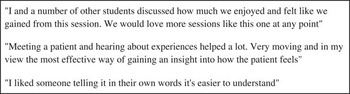
Evaluation from the additional PC workshops has had impact both at a programme level and on the practice of students exposed to this pedagogy. The PC sessions consistently gained positive feedback (Figure 5) and module/programme evaluations have highlighted the benefit of PCI. In addition, at course management committees and faculty academic board the student representatives have expressed the importance of PCI in the curriculum. Feedback from students and the PC group have highlighted how improvements can be made. Specifically, students would like more facilitation of workshops by PCs. The PCs have also been proactive in feeding back their thoughts about the curriculum activities, suggesting ways they could be adapted, often between two workshops on the same day to engage students more in discussions.
Feedback from students’ post-patient and carer involvement sessions.

In addition to the formal evaluation of modules and the programme, we have seen in other ways how the ethos of care is evident in students’ reflections on clinical practice and the focus of their dissertation topics on patient and carer experiences of cancer. Each year the students plan and organise a conference and this year (2016) the theme had a patient-centred focus and they approached someone who had recently completed treatment for breast cancer to be the key speaker.
Act
The inclusion of a stronger patient voice in the curriculum was reflected in the new approved programme (Figure 3). An example of this change in emphasis can be seen where the original programme learning outcomes required students to ‘Demonstrate and maintain communication within the radiotherapy setting including patients/carers and the multi-disciplinary team’. The new programme addressed a similar professional domain, but worded to have greater emphasis on what those skills should be, and include an ‘awareness of cultures; ethical user and carer centred practice in which advocacy and strategies to challenge oppression are key’ and ‘Practice with empathy and understanding appreciating the patient experience in the wider context of your professional development’. The new learning outcomes provide students with improved guidance on what those ‘softer skills’ related to care comprise and ensure they are valued within the professional framework. The programme team continue to promote this ethos with new students and the PC group continue to be central to further curriculum developments. As new programmes are established, PCs are regarded as key stakeholders in the planning process and PCI is embedded in education institutions.
Discussion
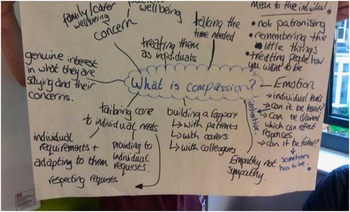
Explicit involvement of PCs in programme design and delivery has ensured that patient care is central to students’ learning. Reflective discussion about PC experiences and students’ own experience in practice provides a powerful opportunity for learning and improving practice. There was a sense that involvement in the curriculum should be designed to increasingly challenge students’ thinking and encourage them to better understand the PCs’ perspective. The ‘care and compassion’ session prompted students to ‘put aside’ their own views and ask PCs what this meant to them. Figure 6, demonstrates the results of this activity. A related PCI project used co-created resources from workshops to develop a piece of artwork that represents authentic partnership in learning, and is displayed in the faculty building.
Co-creation of a shared sense of compassion.

The project highlighted the how PCI is a means of developing core professional skills and values among our students. In addition this has prompted us to develop PCI in the recruitment process to identify candidates with potential to develop the skills of listening and empathy that reflect care values. 3 PCI in student recruitment has been particularly successful with co-design of interview questions, talking-head development and sitting on the interview panel. The talking-head is a short video clip played to candidates prior to interview and they are asked to discuss what they perceive to be the issues around that patient’s experience of care. Candidates are also asked how they would improve patient care and how they respond to this question influences the interview scores. Thus, PCI has shaped the recruitment of radiotherapy students directly.
While this work has influenced the undergraduate radiotherapy programme, one may argue the principles of a collaborative approach to learning would be relevant to most health and social care professions as it reflects the tenets of what it means to be a professional. Learning directly from PCs about the experience of illness and disability can enhance the technical knowledge that is profession specific and inform notions of care. The premise of PCI pedagogy focusses on relational knowledge construction in collaboration, utilising reflective processes that are central to the application of knowledge to new situations.Reference Evans, Guile, Harris and Allan 32 In essence this model of learning can be translated wider into post-graduate and professional education. Such learning should not be confined to pre-registration programmes, but is a vital aspect of continuing professional development (CPD). CPD is a mandatory requirement of UK professional registration and requires the practitioner to evidence how their learning impacts directly on users of their services. 33 By addressing PC focussed philosophy in post-graduate study too, it can ensure skills update and knowledge development that encompasses care and compassion alongside advancing techniques and technologies associated with the radiotherapy profession.
Adhering to the ethos of continuous improvement, future changes to PCI activity will focus on the tricky issue of assessment and how this can be developed further. In addition, work is taking place in conjunction with PCs across the faculty to develop consistent and embedded approaches to PCI in course design, recruitment of students, teaching, assessment and research.
Limitations
This was an educational project with the aim of improving a programme of study, which drew on the research findings in higher education. As such, it is not a formal research study, rather a case study outlining the steps of the PDSA cycle. With any project that seeks to improve or enhance practice, the actions and outcomes are dependent on the individuals who are involved. Changes planned should resonate with the wider population and we worked with a diverse group of individuals to ensure broad representation of ideas and experiences. Some aspects of our curriculum developments are clearly relevant to other universities and health professions, but this may not be transferable to all contexts. Curriculum developers teams should be cognisant of socio-economic, cultural, and environmental factors in order that PCI is relevant. In addition, it should be acknowledged that for involvement to be meaningful a shared agenda between students, PCs and lecturers must be established at the outset. While PCI celebrates individual experience this project sought to gain consensus on how that could be translated into a pedagogical model and we were fortunate that we were able to realise this for our programme. One should also be mindful that PCI is time-consuming and requires long-term commitment from university lecturers to ensure respectful and genuine involvement is achieved. There is a view that patients can become ‘professionalised’ which in turn may negatively impact on authenticity. Thus, our intention is to refresh the PC group to reflect authentic and current experiences in oncology.
Conclusion
This collaborative project demonstrates the value of an approach that regards PCs as partners in learning and utilises their unique expertise by experience to co-produce a caring curriculum. The project has informed a curriculum that stimulates and challenges students to think differently and develop their practice. In addition, it has been the catalyst for other co-developments such as student recruitment, university panels and research projects. Moreover, it has contributed to an inter-university network in the United Kingdom to share best practice in PCI developments. The future direction of curriculum development will be to embed PCI assessment of students and this will require a fundamental shift in thinking. Defining non-academic assessment criteria and measuring impact on practice. Members of the PCI group have been involved in academic research studies and perhaps future directions should see PC designed and conducted research.
Acknowledgements
The authors would like to express gratitude to the patients and carers whose commitment to shaping education has been inspiring.
Conflicts of Interest
There are no conflicts of interest to declare in the submission of this article.