Introduction
Cultivar Italia [Piróvano 65 (VIVC 5582)] is a hybrid from the cross Bicane × Muscat Hamburg, developed by Italian Angelo Pirovano in 1911 and introduced in the state of São Paulo, Brazil, in 1927. Its culture started in the municipality of Marialva, northwestern region of the state of Paraná, in 1962 (Camargo, Reference Camargo1998). The form of maintaining and multiplication of cv. Italia vineyards has been by vegetative propagation. The first vines planted in Marialva (PR) were on Yamanaka's and Wakita's farmland, with propagation material from the vineyards of municipality of Ferraz de Vasconcelos (São Paulo) (Oliveira-Collet et al., Reference Oliveira-Collet, Collet and Machado2005).
For more than four decades after the introduction of cv. Italia (Vitis vinifera L.) in Brazil, several somatic mutations in the genome of cv. Italia and its somatic mutants gave rise to phenotypes which generated at least five new cultivars of fine table grapes: Rubi (Kishino and Mashima, Reference Kishino and Mashima1980), Benitaka (Sousa, Reference Sousa1996), Redmeire (Pires et al., Reference Pires, Sawazaki, Terra, Botelho, Conagim and Nogueira2003), Brasil (Gonçalves, Reference Gonçalves1995) and Black Star (Roberto et al., Reference Roberto, Assis, Genta, Yamamoto and Sato2012). In spite of several somatic mutations leading towards the emergence of different varieties of table grapes from cv. Italia, no genetic variation has been observed for seven enzyme systems in Italia, Rubi, Benitaka and Brasil cultivars (Oliveira-Collet et al., Reference Oliveira-Collet, Collet and Machado2005). No polymorphism in the seven analysed genes indicated apparent genetic stability over the long period of cultivation of the Italia cultivar and no genetic divergence among the four cultivars was detected.
Although no allele variation for carboxylesterase and acetylesterase was detected in the four grape cultivars, a high frequency of null alleles (61.7%) has raised the suspicion of genetic variation within Italia, Rubi, Benitaka and Brasil grapes (Orasmo et al., Reference Orasmo, Oliveira-Collet, Lapenta and Machado2007). High level of polymorphism in random amplified DNA segments was also detected within Italia, Rubi, Benitaka and Brasil cultivars, but no differences in RAPD markers between the coloured mutant and the original clone (cultivar Italia) were reported. This fact foregrounded the hypothesis that non-coloured and coloured mutants form the same cultivar (Maia et al., Reference Maia, Mangolin, Oliveira-Collet and Machado2009). To date, no molecular marker has been effective in discriminating cv. Italia and the coloured mutant.
Since transposable elements (also known as retrotransposons) have been described as major contributors to introduce genome variability triggering somatic variations. Current study analyses the polymorphism in amplified DNA sequences between retrotransposons by IRAP (Inter Retrotransposon Amplified Polymorphism) method and investigates polymorphism between microsatellite sequences and retrotransposons by REMAP (Retrotransposon-Microsatellite Amplified Polymorphism) method. According to Du et al. (Reference Du, Zhang and Luo2009), markers based on retrotransposons are an important tool in the study of genetic instability and genomic evolution, with special reference to retrotransposons with long terminal repeats (LTRs). In the present study, primers for LTR sequences were developed from databases of the Vitis genome to analyse IRAP and REMAP in Italia, Rubi, Benitaka, Brasil and Black Star cultivars. Current analysis features that the analysis of polymorphisms in retrotransposon sequences may be useful to evidence how grapevines of the coloured cultivars (Rubi, Benitaka, Brasil and Black Star), emergent by clonal propagations of somatic mutations, are genetically structured.
Materials and methods
Samples of Italia, Rubi, Benitaka, Brasil and Black Star cultivars
After 10 years of its introduction in the state of Paraná, a spontaneous somatic mutation occurring on one side branch of the cv. Italia grown in vineyards of the producer Kotaro Okuyama, in the municipality of Santa Mariana, northeastern region of the state of Paraná, Brazil. The new cultivar was named cv. Rubi (VIVC 22689) in 1972 (Kishino and Mashima, Reference Kishino and Mashima1980). In 1988, 16 years after the emergence of cv. Rubi, another somatic mutation occurring on one side branch of cv. Italia grown in the vineyards of producer Kotaro Okuyama of Floraí, northwestern region of the state of Paraná, Brazil. The cultivar was tagged cv. Benitaka (VIVC 19816; Sousa, Reference Sousa1996). In 1991, 3 years after their establishment, one side branch of cv. Benitaka propagated by the producer Hideo Takura, also from Floraí, engendered cv. Brasil (VIVC 19817). Contrastingly to the other cultivars, cv. Brasil was not derived from cv. Italia, but by spontaneous somatic mutation of cv. Benitaka (Gonçalves, Reference Gonçalves1995). Further, another somatic mutation from cv. Italia occurred after 15 years of the emergence of cv. Benitaka. Mutation occurred in the municipality of Urânia, state of São Paulo, Brazil, and named cv. Redimeire by Pires et al. (Reference Pires, Sawazaki, Terra, Botelho, Conagim and Nogueira2003). Moreover, in 2006, after 15 years of the establishment mentioned above, one side branch of cultivar Brasil, propagated in Marialva, gave rise to the cultivar Black Star (Roberto et al., Reference Roberto, Assis, Genta, Yamamoto and Sato2012). Emerging from somatic mutations of cultivars Italia and Brasil, respectively, Redmeire and Black Star cultivars have not yet been catalogued on the Vitis International Variety Catalog (VIVC) database.
Partially expanded contaminant-free leaves were collected from 18 plants of each vineyard of Italia, Rubi, Benitaka, Brasil and Black Star cultivars, established at 23°30′56″S/51°47′57″W, in Marialva PR Brazil. Samples were individually stored in labelled plastic screen bags to avoid mixing of grape varieties, maintained in ice (4°C), transferred to the laboratory, frozen in liquid nitrogen and stored at −80°C until DNA extraction.
DNA extraction
DNA was extracted from leaf tissues, following Thomas et al. (Reference Thomas, Cain and Scott1994), with minor modifications, which included 100 mg of leaves from individual plants, instead of 2.0 g. Samples from each plant (18 plants of each vineyard of Italia, Rubi, Benitaka, Brasil and Black Star cultivars; total of 90 plants) were individually centrifuged for 10 min, 3.000 rpm, at room temperature (≈22°C) to separate the cellular debris from the supernatant containing the DNA. DNA was extracted from supernatant following Thomas et al. (Reference Thomas, Cain and Scott1994). DNA quantity was determined by Picodrop Spectrophotometer (Pico 100 – Version 4.0/21/03/11). DNA averaged between 33 and 450 ng/μl per sample. After quantification, DNA samples were diluted in 10 ng/μl concentration till use.
Retrotransposon-based marker development
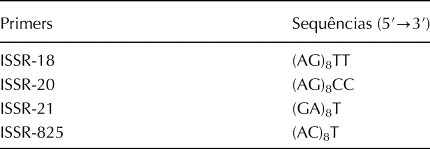
The primers for LTR sequences of IRAP and REMAP markers were edited from the grape sequence databases available at GenBank (https://www.ncbi.nlm.nih.gov/genbank/). Each sequence obtained in GenBank was copied and inserted into the database Phytozome Blast accessed at http://www.phytozome.net/ to locate retrotransposon sequences. Sequences were then compared to the available grape genomes for selection of a 100 kb sequences with LTR. LTR were searched using LTR-Finder program (http://tlife.fudan.edu.cn/ltr_finder/). Sequences obtained were then aligned with the program CLUSTAL W (Thompson et al., Reference Thompson, Higgins, Gibson and Clustal1994). Primers were edited by taking into account the regions with the most conserved sequences of each LTR, with amplification directed away from retrotransposon, between LTRs, and also considering CG composition between 25 and 66%. Edited primers featured between 19 and 25 bases. Twenty-four primers named DKS 001–DKS 024 (Table 1) were edited from information of sequences deposited in GenBank. One or two LTR primers were used in the same reaction for the IRAP markers, whereas primers LTR and ISSR (Inter Simple Sequence Repeats) (Table 2) were employed for results of REMAP markers. ISSR primers used in the REMAP method are already part of the primer bank of our laboratory.
Nomenclature, class, sequence of primers LTR and percentage of C:G bases for each primer synthesized for retrotransposons of Vitis vinifera cultivars

Nucleotide sequences of the each ISSR primers used for the REMAP markers analyses of the Vitis vinifera cultivars

Amplification and data analysis of IRAP and REMAP markers
Amplification reactions were performed with DNA extracted from 18 young leaves obtained from each of the cultivars Italia, Rubi, Benitaka, Brazil and Black Star, with 90 samples analysed. Since they exhibited a pattern of well-defined amplified fragments, 14 out of the 24 LTR primers edited (DKS001–DKS024) were selected. Primers which failed to amplify specific fragments were discarded post-tested. (1) Primers of individual LTR, (2) combination between two primers LTR, and (3) combination between one LTR primer and one ISSR primer were amplified to analyse the five cultivars.
Polymerase chain reaction (PCR) was performed in Veriti thermal cycler (Applied Biosystems). Amplifications were performed with 20 µL, containing 20 ng of genomic DNA, 1× buffer reaction (10 mM Tris–HCl pH 8.8), 2.5 mM of MgCl2, 0.2 mM each of dATP, dGTP, dCTP, dTTP, 0.12 µM of each primer, and one unit of Taq polymerase platinum (Invitrogen) and Milli-Q water to bring the reaction to the final volume. DNA amplification occurred with initial denaturation at 95°C, for 2 min, and 30 cycles at 94°C, for 30 s, with annealing temperature at 40–55°C, for 45 s, and extension at 72°C, for 90 s. A final extension was carried out at 72°C for 10 min.
Further, 4 µl loading buffer (0.25% bromophenol blue and 30% glycerol) was added to every amplification product and electrophoresis was performed in 2% agar gel, with 0.5× TBE buffer (44.5 mM Tris-borate and 1 mM EDTA) at 80 V, for 5 h. After electrophoresis, the gels were stained with ethidium bromide at 0.5 µg/ml and images were taken with a Molecular Image Loccus L-PIX – HE by Picasa 3. The size of PCR alleles was determined with a 1 Kb DNA Ladder (Invitrogen).
Polymorphisms from IRAP and REMAP markers were analysed as dominant markers [(1) presence and (0) absence of amplified DNA segments] by POPGENE 1.32 (Yeh et al., Reference Yeh, Yang and Boyle1999) to estimate genetic diversity indices [% of polymorphic DNA segments, genetic identity estimated by Nei coefficient (Nei, Reference Nei1973), and genetic divergence (G st)]. FreeTree software (Pavlícek et al., Reference Pavlícek, Hrdá and Flegr1999) was also used to bootstrap analyses for the comparison of specimens between the five vineyards of Italia, Rubi, Benitaka, Brasil and Black Star. Distance similarity matrix was computed with UPGMA (Sneath and Sokal, Reference Sneath and Sokal1973), followed by Jaccard's clustering method, with resampling analysis, using 1000 replications. A dendrogram was constructed and edited from a reference tree by TreeView program (Page, Reference Page2001). Analysis of Molecular Variance (AMOVA, GenAlEx 6.53; Peakall and Smouse, Reference Peakall and Smouse2006) was performed to explore the hierarchical partitioning of genetic variation within and between vineyards of Italia, Rubi, Benitaka, Brasil and Black Star cultivars.
Results
Three hundred and forty-nine DNA segments were amplified by 13 individual primers LTR (DKS001, DKS002, DKS003, DKS007, DKS011, DKS012, DKS014, DKS015, DKS016, DKS019, DKS020, DKS022, DKS024), by eight primers between LTR/LTR (DKS001/DKS002, DKS004/DKS007, DKS011/DKS014, DKS011/DKS015, DKS011/DKS012, DKS011/DKS020, DKS016/DKS019, DKS003/DKS022) combinations for IRAP method, and by four primers between LTR/ISSR (DKS011/ISSR18, DKS011/ISSR20, DKS012/ISSR21, DKS020/ISSR825) combinations for REMAP method, at an average of 13.96 amplicons per primer pair (Table 3). The size of the amplified products ranged between 3000 and 140 bp. Primer DKS024 generated the highest number of amplified segments (22), while the highest number of polymorphic segments (8) in the five vineyards was detected by DKS007 in Benitaka cultivar (Table 3).
Number of DNA amplified sequences (AS) with DKS, DKS/DKS and DKS/ISSR primers, annealing temperature (AT), and number of polymorphic sequences (PS) detected in each Italia (It), Rubi (Ru), Benitaka (Be), Brasil (Br) and Black Star (BS) cultivars

The highest polymorphism rate of IRAP and REMAP retrotransposons was detected in the Benitaka cultivar (10.6%) and the lowest proportion of polymorphic DNA segments was observed in the Rubi cultivar (8.6%) (Table 3). Polymorphism detected in cv. Black Star was equal to that in cv. Brasil (10.03%). Polymorphism in cv. Italia reached 9.74%.
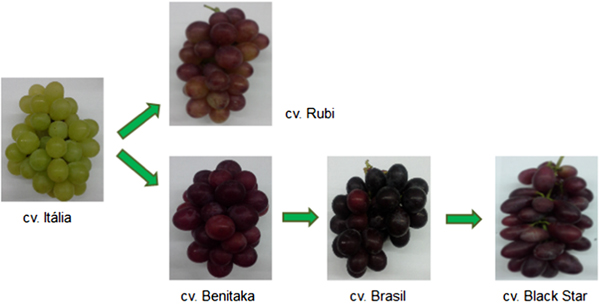
Genetic identity was high (Table 4) due to the common origin of the four coloured cultivars from cv. Italia cultivar. Cultivars Brasil and Benitaka proved to be the most similar (0.9920), while cvs. Italia and Black Star were the most divergent (0.9807). Identity rates complied with expectations, since cv. Brasil was formed from cv. Benitaka (Gonçalves, Reference Gonçalves1995), while cultivars Black Star and Italia had the most distant genomes (Fig. 1).
Origin of coloured grapes from cv. Italia grape (white). Somatic mutations in cv. Italia generated cv. Rubi and cv. Benitaka, while mutations in cv. Benitaka originated cv. Brasil; somatic mutations in cv. Brasil produced cv. Black Star.

Identity coefficient (diagonal above) and genetic distance (diagonal below) of Nei (Reference Nei1973) between the Italia, Rubi, Benitaka, Brasil and Black Star cultivars

Despite the high levels of genetic similarity among the five cultivars (I ≥ 0.98), the vegetative and clonal multiplication of each mutant sector determined the formation of genetically structured populations. Genetic divergence (G ST) among the five cultivars was high (G ST = 0.2355). According to Wright (Reference Wright1978), G ST rates between 0.15 and 0.25 are high and indicate that populations formed are genetically divergent. Polymorphic DNA sequences are different in each variety and determine the high genetic divergence among the five cultivars.
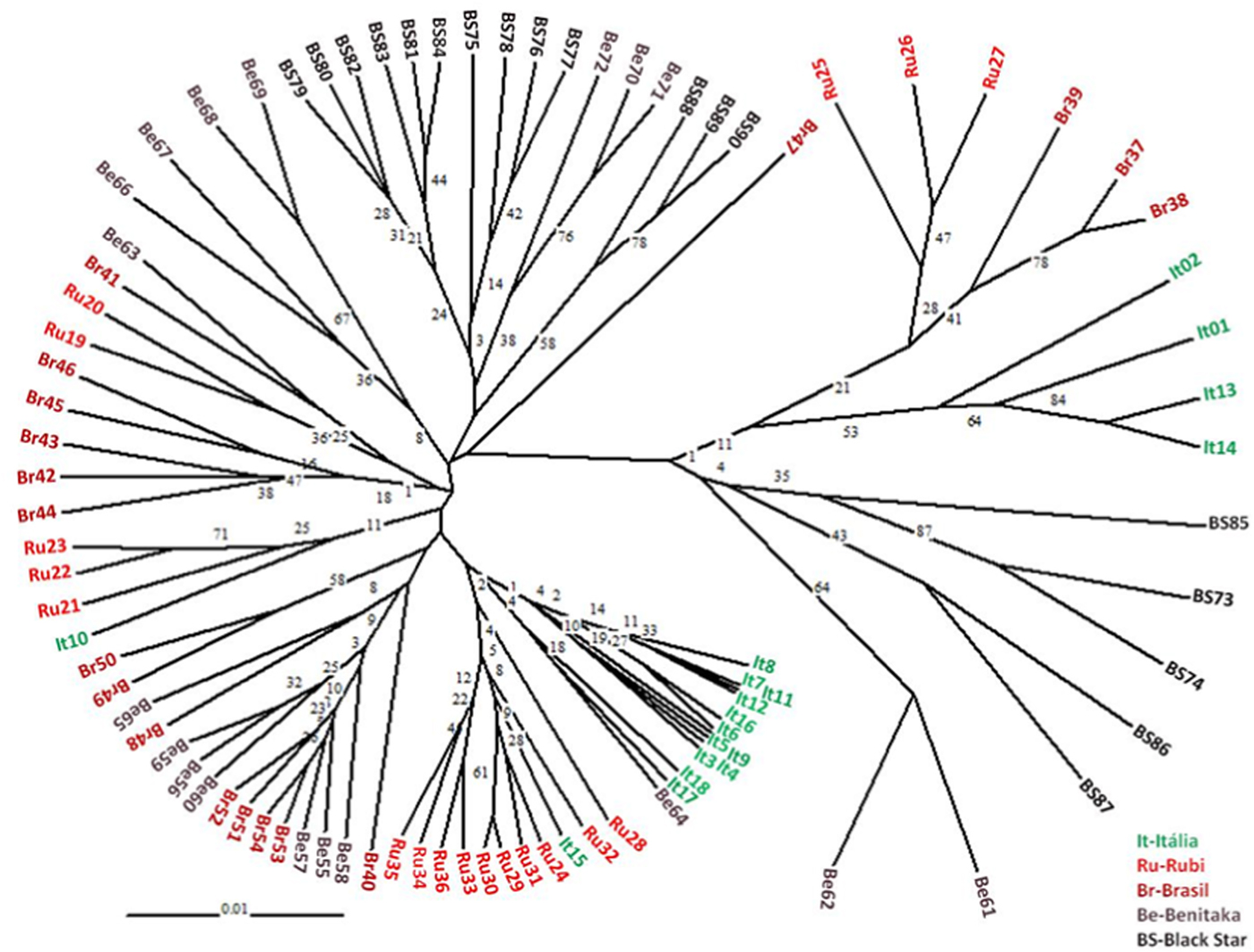
AMOVA also revealed that 20% of total genetic variation occurred among the samples (SSQ = 125.978; P < 0.001). Dendrogram, built from 25 IRAP and REMAP data primers, identified six groups formed by 90 plants from different cultivars (Fig. 1). The dendrogram also demonstrated the effects of the common origin of the five vineyards. The mixture of different cultivars in a given group should be due to the common origin of the five cultivars, or rather, from the ancestral genome Italia. Dendrogram in Figure 2 shows that more than 72% of the plants of cv. Black Star formed a group with the plants of cv. Benitaka, whereas more than 27% of cv. Black Star lay within another large group mixed with the plants of cvs. Brasil, Benitaka, Italia and Rubi.
Dendrogram generated by Jaccard's coefficient from analysis of individual plants of Italia (It), Rubi (Ru), Benitaka (Be), Brasil (Br) and Black Star (BS) cultivars obtained from vineyards in Marialva PR Brazil, based on retrotransposons IRAP and REMAP, using FreeTree program. Numbers besides nodes indicate relative bootstrap frequencies (%).

Discussion
Polymorphisms in retrotransposon sequences were employed to evidence how grapevines of the coloured cultivars (Rubi, Benitaka, Brasil and Black Star), emergent by clonal propagations of somatic mutations, are genetically structured. The recent emergence of cv. Black Star, obtained by somatic mutation in cv. Brasil, should justify the same polymorphism rate which is evident in the retrotransposons of IRAP and REMAP markers of the two cultivars. Black Star grape appeared in 2006, derived from a natural somatic mutation in a commercial vineyard of the cv. Brasil, at Sítio Esperança, in Marialva (Roberto et al., Reference Roberto, Assis, Genta, Yamamoto and Sato2012). The most striking feature that distinguishes the Black Star grape as a new variety of cv. Brasil is the ellipsoid elongated shape of the berries. Despite the similar polymorphism observed in the newly separated cv. Brasil and cv. Black Star (little more than 10 years), the somatic mutations occurring in the retrotransposon sequences do not seem to be associated with the age of the cultivars. Polymorphism was lower in cv. Italia (9.74%), maintained for 56 years by vegetative propagation in the municipality of Marialva since 1962 (Oliveira-Collet et al., Reference Oliveira-Collet, Collet and Machado2005), than polymorphism in cv. Benitaka (10.6%) and cv. Brasil (10.03%). Cultivars Rubi and Benitaka were separated from cv. Italia since 1972 (46 years) and 1988 (30 years), respectively (Kishino and Mashima, Reference Kishino and Mashima1980; Sousa, Reference Sousa1996; Camargo, Reference Camargo1998) and cultivar Brasil, which arose by spontaneous somatic mutation of the cultivar Benitaka in 1991 (Gonçalves, Reference Gonçalves1995), has been cultivated separately for 27 years.
The polymorphism in retrotransposons IRAP and REMAP of cv. Italia is smaller than the polymorphism detected in microsatellite loci (11.8%) of the cv. Italia vineyards distributed in different regions of the states of São Paulo and Paraná (Maia et al., Reference Maia, Mangolin, Oliveira-Collet and Machado2009), and also smaller than the polymorphism of ISSR markers (12%) (Strioto et al., Reference Strioto, Pepineli, Eisele, Marinelli, Mangolin, Cantagali, Oliveira-Collet and Machado2019). However, IRAP and REMAP retrotransposons may be a promising strategy to analyse DNA-level polymorphism of samples from the five cultivars because 349 sequences have been generated that may be used to compare the samples. A smaller number of markers on retrotransposons has been described in other grape cultivars. Villano et al. (Reference Villano, Carputo, Frusciante, Santoro and Aversano2014) observed only 44 segments in the genome of 62 grape varieties. The evaluation of 41 cultivars of Vitis with six combinations of REMAP generated 99 segments (Castro et al., Reference Castro, D'Onofrio, Martín, Ortiz, Lorenzis, Ferreira and Pinto-Carnide2012b) and D'Onofrio et al. (Reference D‘Onofrio, Lorenzis, Giordani, Natali, Cavallini and Scalabrelli2010) described 209 bands in 29 genotypes of Vitis, using eight combinations for REMAP.
High genetic divergence between cultivars Italia, Rubi, Benitaka, Brazil and Black Star inferred from the polymorphism in the retrotransposons IRAP and REMAP contradicts previous evidences of genetic uniformity described in more than a hundred plants of cultivars Italia, Rubi, Benitaka and Brasil, after the analysis of several isozymes of seven enzymatic systems (Oliveira-Collet et al., Reference Oliveira-Collet, Collet and Machado2005). Although polymorphism of RAPD markers in Italia, Rubi, Benitaka and Brazil showed genetic variability within each cultivar (Maia et al., Reference Maia, Mangolin, Oliveira-Collet and Machado2009), cultivars Rubi, Benitaka and Brazil were considered clones of Italia. The analysis of DNA sequences in retrotransposons IRAP and REMAP performed in the current study showed that Italia, Rubi, Benitaka, Brasil and Black Star were genetically divergent cultivars. The above features useful and promising information for proposals for genetic improvement with the five cultivars. Polymorphism in retrotransposon sequences is different in different cultivars and the crossing between them may develop into new cultivars.
Despite the morpho-agronomic descriptors (Castro et al., Reference Castro, Neves, Jesus and Oliveira2012a) or enzyme activities (Stajner et al., Reference Stajner, Popovic, Boza and Kapor2009) and other molecular markers (Ocanã et al., Reference Ocanã, Walter and Schellenbaum2013) that may be employed to characterization of different clones of grapes, the analysis of the polymorphism of IRAP and REMAP retrotransposons in plants of cultivars Italia, Rubi, Benitaka, Brazil and Black Star was relevant to show that the clonal propagation of somatic mutations may lead to the formation of genetically divergent cultivars with the formation of genetically structured vineyards, and to show the mixture of ancestral genomes within each cultivar. Italia, Rubi, Benitaka, Brasil and Black Star vineyards are genetically divergent and may be recommended for crosses capable of generating new cultivars.
Acknowledgments
The authors would like to thank the Coordination for the Upgrading of Higher Education Personnel (CAPES) for its financial support (Proap 68/07 – Capes).