
Introduction
Human strongyloidiasis is a neglected parasitic disease caused mainly by Strongyloides stercoralis with a worldwide distribution, especially in tropical and subtropical areas with high humidity including Africa, Southeast Asia and Latin America. The exact prevalence rate of Strongyloides infection is not easily predictable due to large number of asymptomatic cases and the low sensitivity of available parasitological methods; however, it is estimated that approximately 600 million individuals are infected worldwide (Nutman, Reference Nutman2017; White et al., Reference White, Whiley and Ross2019; Buonfrate et al., Reference Buonfrate, Bisanzio, Giorli, Odermatt, Fürst, Greenaway, French, Reithinger, Gobbi, Montresor and Bisoffi2020).
Strongyloides stercoralis infection begins when the infective third-stage larvae (iL3) penetrate the host skin and migrate through blood vessels to reach the lungs and then the digestive tract where they become parasitic female adults in the small intestine, producing eggs by parthenogenesis; these eggs generate rhabditoid larvae that are released into the environment along with the faeces. The possibility of autoinfection exists when rhabditoid larvae are retained in the intestine and become iL3 while still in the host. Therefore, massive re-penetration and larval migration may result in disseminated infection or hyperinfection syndrome (Nutman, Reference Nutman2017). S. stercoralis infection is usually chronic and asymptomatic, but hyperinfection syndrome with dissemination to other organs can occur, especially in immunocompromised individuals reaching a mortality rate from 15% to 87% (Vadlamudi et al., Reference Vadlamudi, Chi and Krishnaswamy2006; Marcos et al., Reference Marcos, Terashima, Dupont and Gotuzzo2008).
Diagnosis of Strongyloides infection is generally based in the detection of larvae in stool samples using conventional parasitological methods, such as direct faecal smear examination, concentration methods and coproculture (Requena-Méndez et al., Reference Requena-Méndez, Chiodini, Bisoffi, Buonfrate, Gotuzzo and Muñoz2013). However, the diagnosis may be difficult due to low parasitic load and the irregular larvae release in the faeces, resulting in tests with high rate of false-negative results (Vadlamudi et al., Reference Vadlamudi, Chi and Krishnaswamy2006; Requena-Méndez et al., Reference Requena-Méndez, Chiodini, Bisoffi, Buonfrate, Gotuzzo and Muñoz2013). With the aim of achieving better sensitivity and specificity, molecular methods such as polymerase chain reaction and its variants have also been applied to detect parasite DNA in tissue and faecal samples, but these approaches have shown low sensitivity in chronic strongyloidiasis (Buonfrate et al., Reference Buonfrate, Requena-Mendez, Angheben, Cinquini, Cruciani, Fittipaldo, Giorli, Gobbi, Piubelli and Bisoffi2018).
For these reasons, detection of antibodies by immunoserological methods were developed using antigenic preparations from Strongyloides species. These tests include indirect immunofluorescence assay, gelatin particle agglutination, enzyme-linked immunosorbent assay (ELISA) and western-blot (Requena-Méndez et al., Reference Requena-Méndez, Chiodini, Bisoffi, Buonfrate, Gotuzzo and Muñoz2013), but the most widely used test is the ELISA whose main advantages are its high sensitivity and its usefulness in seroepidemiological studies (Nunes et al., Reference Nunes, Emídio, Marques, Caldas, Souza, Kanamura and Costa-Cruz2018; Casado et al., Reference Casado, Rodriguez-Guardado, Boga, Fernández-Suarez, Martínez-Camblor, Rodríguez-Perez, García-Pérez, Vazquez and Gascon2019). However, due to limitations in obtaining antigens from S. stercoralis, other species such as Strongyloides ratti and S. venezuelensis have been used as a good heterologous source of antigens to develop these mentioned immunoassays (Kalantari et al., Reference Kalantari, Chehrazi, Ghaffari and Gorgani-Firouzjaee2020). S. ratti and S. venezuelensis are parasites from rats, but also are capable of infecting other rodents, such as mice and gerbils; whereas hosts infected with S. ratti excrete both eggs and early-stage larvae, hosts infected with S. venezuelensis excrete early stage eggs with the faeces. These two species can be maintained in the laboratory conditions and are the most widely used to study Strongyloides infection and mucosal immunity in animal models (Viney and Kikuchi, Reference Viney and Kikuchi2017).
Different somatic antigenic preparations from S. venezuelensis have been evaluated for detection of antibodies, and those including soluble and membrane fractions from iL3 (Feliciano et al., Reference Feliciano, Gonzaga, Gonçalves-Pires Mdo, Gonçalves, Rodrigues, Ueta and Costa-Cruz2010; Corral et al., Reference Corral, Paula, Gottardi, Meisel, Chieffi and Gryschek2015a, Reference Corral, Paula, Meisel, Castilho, Gonçalves, Levy, Bydlowski, Chieffi, Castro-Borges and Gryschek2017) or female adults (Gonçalves et al., Reference Gonçalves, Rocha, Gonzaga, Gonçalves-Pires Mdo, Ueta and Costa-Cruz2012; Corral et al., Reference Corral, Paula, Gottardi, Meisel, Castilho, Gonçalves, Chieffi and Gryschek2015b), showing that iL3 antigenic preparations possess a better performance for the serodiagnosis of human strongyloidiasis.
On the other hand, parasitic helminths release a variety of molecules into their environment, generally referred to as excretory−secretory (E/S) products, which stimulate or modulate the host immune response leading to a host-protective immune response, expressed as either death or expulsion of the parasites. These E/S products also provide a valuable source of antigens for the immunodiagnosis of helminth infections (Lightowlers and Rickard, Reference Lightowlers and Rickard1988; Harnett, Reference Harnett2014). In this context, E/S products from S. venezuelensis iL3 have been little explored and applied for the immunodiagnosis (Cunha et al., Reference Cunha, de Carvalho, de Sousa and Costa-Cruz2017). Thus, the aim of this study was to assess the diagnostic accuracy of two types of somatic antigenic preparations and E/S products from S. venezuelensis iL3 for the immunodiagnosis of human strongyloidiasis using ELISA.
Material and methods
Serum samples
A panel of 260 serum samples from imunocompetents individuals was used to evaluate the three types of antigenic preparations and these were divided in three groups:
• Group 1 comprised 71 serum samples from individuals infected with S. stercoralis (presence of rhabditoid larvae in stool samples);
• Group 2 comprised 105 serum samples from apparently healthy individuals with negative results for parasites in stool samples;
• Group 3 comprised 84 serum samples from individuals with other helminth infections, and these included: Ascaris lumbricoides (17 cases), Ancylostoma sp. (seven cases), Enterobius vermicularis (two cases), Trichuris trichiura (20 cases), Taenia sp. (one case), T. solium neurocysticercosis (11 cases), Hymenolepis nana (13 cases), Diphyllobothrium latum (five cases), Fasciola hepatica (six cases) and Schistosoma mansoni (two cases).
The presence or absence of intestinal parasites was diagnosed following direct faecal smear examination, spontaneous sedimentation technique (Tello et al., Reference Tello, Terashima, Marcos, Machicado, Canales and Gotuzzo2012) and coproculture (Koga et al., Reference Koga, Kasuya, Khamboonruang, Sukhavat, Ieda, Takatsuka, Kita and Ohtomo1991). Neurocysticercosis cases were diagnosed following magnetic resonance imaging results and positive result for western-blot test (Tsang et al., Reference Tsang, Brand and Boyer1989).
Production of iL3 from S. venezuelensis
The strain of S. venezuelensis used in this study was maintained by serial passages in male Wistar rats (Rattus norvegicus) at the Instituto de Medicina Tropical de São Paulo, USP, São Paulo, Brazil. Male Wistar rats from 30 days of age were inoculated subcutaneously with approximately 30 000 iL3 in the abdominal region. Six days post-infection, rat faeces containing Strongyloides eggs were collected, moistened with tap water and mixed with granulated animal bone-activated charcoal; the mixture was incubated in wide glass jars at 28°C for 3 days. iL3 were recovered by a modified Baermann technique (Lok, Reference Lok2007); the larvae were treated with sodium hypochlorite 0.25% for 5 min and then washed four times with sterile distilled water at 7000 × g for 1 min.
Somatic antigenic preparations
A soluble somatic fraction (SSF) was prepared according to the procedure described by Corral et al. (Reference Corral, Paula, Meisel, Castilho, Gonçalves, Levy, Bydlowski, Chieffi, Castro-Borges and Gryschek2017). Briefly, approximately 200 000 washed iL3 were resuspended in 1 mL of 25 mm Tris–HCl, pH 7.5, containing a protease inhibitor cocktail (Sigma-Aldrich, St. Louis, MO, USA), and sonicated on ice using five cycles of 20 s pulse each. The mixture was centrifuged at 12 400 × g for 30 min at 4°C and the supernatant (SSF) was collected and stored at −20°C until use. The pellet obtained from the first extraction was resuspended in 5 m urea, 2 m thiourea and 4% CHAPS detergent, and homogenized on ice for 30 min, centrifuged at 12 400 × g for 30 min at 4°C, and the supernatant [membrane somatic fraction (MSF)] was collected and stored at −20°C until use.
E/S products
E/S products were obtained based in the procedures described by Soblik et al. (Reference Soblik, Younis, Mitreva, Renard, Kirchner, Geisinger, Steen and Brattig2011) and Cunha et al. (Reference Cunha, de Carvalho, de Sousa and Costa-Cruz2017), but with some modifications. Briefly, approximately 400 000 living iL3 larvae were placed in sterile polypropylene tubes containing 5.0 mL of phosphate-buffered saline 0.01 m, pH 7.2 (PBS) supplemented with a mixture of antibiotics (penicillin 100 U/mL, streptomycin 100 U/mL, gentamicin 50 μg/mL and amphotericin 2.5 μg/mL) and incubated at 37°C under 5% CO2 for 48 h to obtain E/S products. After incubation, the supernatants were collected and mixed with a cOmplete™ Protease Inhibitor Cocktail (Sigma-Aldrich Chemical Co., Saint Louis, MO, USA) and stored at −20°C. All the supernatants were mixed and concentrated 100-fold using an Amicon YM10 membrane (EMD Millipore, Billerica, MA, USA), and then dialysed against distilled water, centrifuged at 13 000 × g for 30 min at 4°C, filtered through a membrane of 0.22 μ m (EMD Millipore, Billerica, MA, USA) and stored at −20°C until use.
Protein determination
The protein content from the three types of antigenic preparations was determined by using the Bio-Rad DC protein assay (Bio-Rad Laboratories Inc., Hercules, CA, USA), based on the method of Lowry et al. (Reference Lowry, Rosebrough, Farr and Randall1951).
Enzyme-linked immunosorbent assay (ELISA)
Detection of serum anti-Strongyloides IgG antibodies was performed by ELISA based on the procedure described by Toledo et al. (Reference Toledo, Corral, Meisel, Gottardi, Abdala, Costa, Pierrotti, Lescano, Gonçalves, Castilho, Chieffi, Gryschek and Paula2019). The test was previously standardized by checkerboard titration using different concentrations of the three antigenic preparations (0.5, 1, 5, 10 and 20 μg/mL) and different dilutions for serum samples (1 : 50, 1 : 100, 1 : 200, 1 : 300 and 1 : 400) and for conjugate secondary antibody (1 : 10 000, 1 : 20 000, 1 : 30 000, 1 : 40 000, and 1 : 50 000). The following procedure describes the best conditions obtained with each one of the three different antigenic preparations. Briefly, Costar® 96-well flat-bottom microtitration polystyrene plates (Sigma-Aldrich Chemical Co., St. Louis, MO, USA) were coated (50 μL/well) with each type of the antigenic preparations at a concentration of 10 μg/mL (SSF and MSF) or 1 μg/mL (E/S products) in carbonate−bicarbonate buffer (0.06 m, pH 9.6). The plates were incubated for 2 h at 37°C and then overnight at 4°C. After three washings (300 μL/well) of 5 min each with PBS containing 0.05% Tween-20 (PBS-T), the plates were blocked with 5% nonfat milk diluted in PBS-T for 1 h at 37°C. The plates were washed three times with PBS-T for 5 min each and then dried. Each serum sample was tested in duplicate (50 μL/well) diluted 1:200 in blocking solution and incubated for 45 min at 37°C. After three washings of 5 min each with PBS-T, peroxidase-conjugated goat anti-human IgG (Fc specific) antibody (Sigma-Aldrich Chemical Co., St. Louis, MO, USA) was diluted 1: 30 000 in blocking solution, added to the plates (50 μL/well) and incubated for 45 min at 37°C. The assay was developed by adding 3,3′, 5,5- tetramethylbenzidine (TMB) chromogen solution (Thermo Fischer Scientific, Waltham, MA, USA)(100 μL/well) for 6 min and the reaction was stopped with 2N sulphuric acid (50 μL/well). The plates were read at 450 nm using an ELISA reader (Thermo Fischer Scientific, Waltham, MA, USA) and the results were expressed in optical density (OD) units. All assays were monitored by including a positive (pool of serum samples from group 1) and negative (pool of serum samples from group 2) control sera as well as a blank without any serum sample. A 10% variation in the results from positive and negative control sera was tolerated as an internal control in each assay.
Statistical analysis
Statistical analysis was performed using the GraphPad Prism software, version 5.0 (Graph Pad Software Inc. San Diego, USA). One-way analysis of variance (one-way ANOVA) was used to compare the means of the ELISA ODs obtained in each group of sera, using the different antigenic preparations. In order to evaluate the diagnostic accuracy of each antigenic preparation, sera from group 1 (cases) was used to calculate the diagnostic sensitivity and sera from groups 2 and 3 (controls) were used to calculate the diagnostic specificity following the receiver operating characteristic (ROC) curve analysis [with a 99% of confidence interval (CI)], in which cut-off values for 100% sensitivity or 100% specificity were calculated. Other measures of diagnostic accuracy such as area under the ROC curve (AUC), positive predictive values (PPV) and negative predictive values (NPV), likelihood ratio (LR) for positive test results (LR+) and negative results (LR−), diagnostic odds ratio (DOR) and overall accuracy (OA) were also calculated (Eusebi, Reference Eusebi2013).
Results
The reactivity of sera from the three groups against each of the three types of antigenic preparations evaluated by ELISA is shown in Table 1. Sera from group 1 were highly reactive to E/S antigens followed by SSF, and then by MSF with differences statistically significant (F = 12.7; P < 0.0001). Sera from group 2 were poorly reactive to E/S products and showed a slightly narrower range of OD units when compared with SSF and MSF, but these differences were no statistically significant (F = 0.13; P = 0.8754). Interestingly, sera from group 3 showed low reactivity to MSF followed by E/S, and then by SSF, with differences statistically significant (F = 3.31; P = 0.038) (Table 1).
Characteristics of the reactivity of sera from patients with strongyloidiasis, healthy individuals and patients with other helminth infections against the two types of somatic antigenic fractions (SSF and MSF) or the excretory−secretory products (E/S-PBS) from S. venezuelensis larvae for detection of IgG antibodies by ELISA

SSF, Soluble somatic fraction; MSF, Membrane somatic fraction; E/S-PBS, Excretory−secretory products obtained in phosphate-buffered saline (PBS), pH 7.2.
ROC curve analysis showed that E/S products had an AUC of 0.9989 (99% CI = 0.9967–1.001, P < 0.0001); SSF had an AUC of 0.993 (99% CI = 0.9841–1.002, P < 0.0001), and MSF had an AUC of 0.9925 (99% CI = 0.9838–1.001, P < 0.0001).
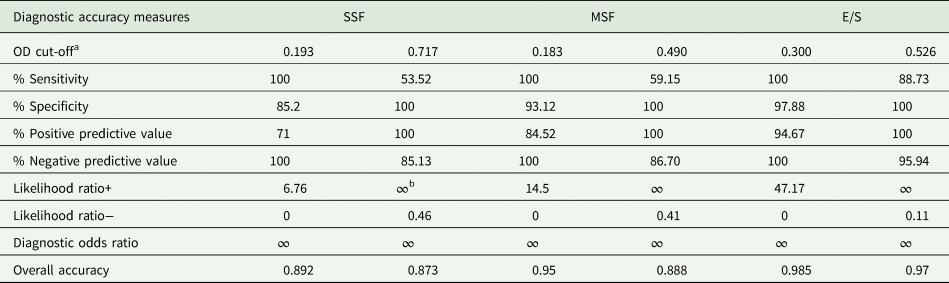
For a cut-off value calculated for 100% sensitivity, E/S products achieved a specificity of 97.88% whereas MSF achieved a specificity of 93.12% and SSF achieved a specificity of 85.2% (Table 2). E/S products achieved a PPV of 94.67%, whereas MSF and SSF achieved a PPV of 84.52% and 71%, respectively. E/S products had the best value of LR+ (47.17) due to its higher values of sensitivity and specificity. On the other hand, the LR + of MSF (14.5) was higher than SSF (6.76) because its specificity was over 93% (Table 2).
Diagnostic accuracy from somatic antigenic fractions and excretory−secretory products from S. venezuelensis infective larvae

a Cut-off values were calculated for either 100% sensitivity (cut-off 1) or 100% specificity (cut-off 2) following a ROC curve analysis using sera from group 1 as positive cases and groups 2 and 3 as negative cases.
b ∞ = undefined. SSF, soluble somatic fraction; MSF, membrane somatic fraction; E/S, excretory−secretory products.
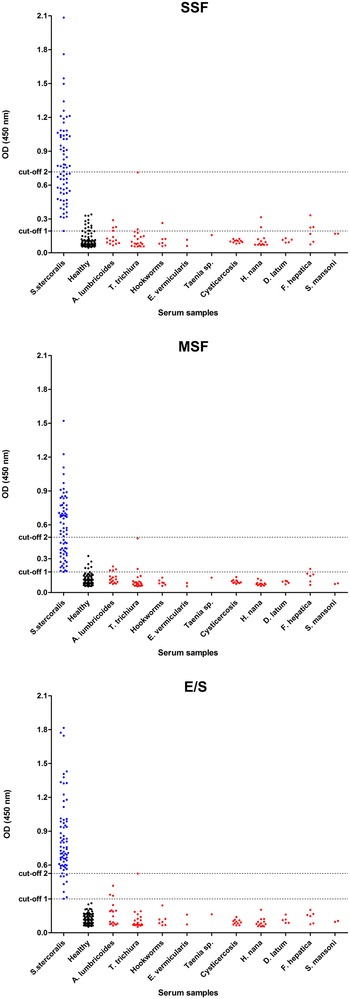
In sera from group 3, E/S products showed a cross-reactivity of 4.76% (three individuals infected with A. lumbricoides and one individual infected with T. trichiura); MSF showed a cross-reactivity of 8.33% [four individuals infected with A. lumbricoides, two individuals infected with T. trichiura and one individual infected with F. hepatica), and SSF showed a cross-reactivity of 17.86% (seven individuals infected with A. lumbricoides, two individuals infected with T. trichiura, one individual infected with hookworms, two individuals infected with H. nana, three patients infected with F. hepatica) (Fig. 1).
Reactivity of sera (expressed in ELISA OD at 450 nm) from patients with strongyloidiasis (n = 71), healthy individuals (n = 105), individuals infected with A. lumbricoides (n = 17), hookworms (n = 7), E. vermicularis (n = 2), T. trichiura (n = 20), Taenia sp. (n = 1), cysticercosis (n = 11), H. nana (n = 13), D. latum (n = 5), F. hepatica (n = 6) and S. mansoni (n = 2) against three antigenic preparations from S. venezuelensis iL3: soluble somatic fraction (SSF), membrane somatic fraction (MSF) and excretory−secretory products (E/S products). Each graphic shows the cut-off value for 100% sensitivity (cut-off 1) and for 100% specificity (cut-off 2).

In order to eliminate the cross-reactivity, the cut-off value from each antigenic preparation was increased to achieve 100% specificity. In these new conditions, E/S achieved a sensitivity of 88.73% whereas MSF achieved a sensitivity of 59.15%, and SSF achieved a sensitivity of 53.52%. Even though all antigenic preparations achieved 100% PPV, E/S showed the best NPV (95.94%) when compared with MSF and SSF (Table 2). The DOR was always undefined for each type of antigenic preparation when its sensitivity or specificity reached 100% (Table 2). E/S achieved always the best OA values (0.985 or 0.97) when compared with MSF (0.95 or 0.888) or SSF (89.2 or 0.873) when its sensitivity or specificity reached 100%, respectively (Table 2).
Discussion
Strongyloidiasis is a human parasitic infection that is still underdiagnosed and underestimated, resulting in a serious public health problem worldwide. Even though the detection of antibodies cannot be useful for post-treatment monitoring, detection of IgG antibodies by ELISA is preferred for the serodiagnosis of strongyloidiasis due to its high sensitivity, reproducibility and its capacity to work with high number of samples, being a powerful tool for both the clinical diagnosis and seroepidemiological studies (Kalantari et al., Reference Kalantari, Chehrazi, Ghaffari and Gorgani-Firouzjaee2020). However, ELISA requires classify a result as positive or negative and the most used method to choose a cut-off value is the ROC curve analysis, where the AUC determines the inherent ability of the test to discriminate between the diseased and healthy populations (Eusebi, Reference Eusebi2013).
A meta-analysis published by Kalantari et al. (Reference Kalantari, Chehrazi, Ghaffari and Gorgani-Firouzjaee2020) about serodiagnostic test accuracy using antigens from different Strongyloides species showed that antigens from S. venezuelensis were more sensitive and specific than antigens from S. stercoralis or S. ratti, and proposed that heterologous antigens from S. venezuelensis are an excellent alternative for the serodiagnosis of human strongyloidiasis. The results of the present study confirm the potential use of these antigens obtained from S. venezuelensis iL3 which showed remarkable AUC values over 0.99, being considered with excellent diagnostic accuracy for the detection of IgG anti-Strongyloides antibodies.
In certain situations, it is necessary to prioritize a high sensitivity (i.e. a screening test for epidemiological studies) or high specificity (i.e. a diagnostic test to confirm a disease) and the choice of the cut-off value will depend on the objective of the study. In the present study, the diagnostic accuracy of three antigenic preparations from S. venezuelensis iL3 was evaluated through ELISA using cut-off values to reach 100% sensitivity or 100% specificity, and E/S products were better than the somatic preparations (SSF and MSF) in both situations.
S. venezuelensis E/S products were 100% sensitive and 97.88% specific for the detection of IgG antibodies when its cut-off was 0.300. These values were higher than the values obtained by Cunha et al. (Reference Cunha, de Carvalho, de Sousa and Costa-Cruz2017) (95% sensitive and 96.7% specific) using S. venezuelensis, and higher than the values published by Rokni and Kia (Reference Rokni and Kia2005) (88.2% sensitive and 86.2% specific) using S. stercoralis E/S antigens. Differences in the performance and diagnostic accuracy may be due to variations in the procedure for obtaining E/S products (i.e. time, number of parasites and volume of medium used for in vitro maintenance of larvae), which may affect the quality of the final antigenic product, and the number and type of serum samples used to evaluate these antigens. In this study, 48 h of in vitro maintenance at 37°C were used to obtain E/S products from 80 000 larvae/mL because preliminary experiments showed that a great percentage of larvae die after 48 h of in vitro maintenance. Our procedure differs from the procedure described by Cunha et al. (Reference Cunha, de Carvalho, de Sousa and Costa-Cruz2017), who maintained 30 000 larvae/mL in either RPMI 1640 medium or PBS for 72 h, and from Maeda et al. (Reference Maeda, Palomares-Rius, Hino, Afrin, Mondal, Nakatake, Maruyama and Kikuchi2019) who maintained about 6153 larvae/mL in PBS for 12 h or in Dulbecco's modified Eagle's medium (DMEM) for 36 h. With regards to other Strongyloides species, Brindley et al. (Reference Brindley, Gam, Pearce, Poindexter and Neva1988) maintained 50 000– 100 000 S. stercoralis larvae/mL for 24 to 48 h in DMEM, and Soblik et al. (Reference Soblik, Younis, Mitreva, Renard, Kirchner, Geisinger, Steen and Brattig2011) maintained 30 000 S. ratti larvae/mL for 24 h in RPMI 1640 medium. The survival time of Strongyloides larvae from different species can vary and in vitro maintenance in certain fluids (medium culture or PBS) do not create natural environmental conditions, which may affect the metabolic pattern of E/S products released by the parasite.
Within the host, E/S products released by the helminth parasites continuously stimulate the host immune system, generating a humoral and cellular immune response and more attractive than somatic antigens for the development of tests for the serodiagnosis of helminth infections (Lightowlers and Rickard, Reference Lightowlers and Rickard1988). However, the E/S products from Strongyloides species have been little explored for the serodiagnosis of human strongyloidiasis and so far, few studies on this subject have been published.
A critical limitation of the current serological assays for the immunodiagnosis of human strongyloidiasis is the cross-reactivity in sera from patients with other helminth infections (Conway et al., Reference Conway, Atkins, Lillywhite, Bailey, Robinson, Lindo, Bundy and Bianco1993; Koosha et al., Reference Koosha, Fesharaki and Rokni2004; Norsyahida et al., Reference Norsyahida, Riazi, Sadjjadi, Muhammad Hafiznur, Low, Zeehaida and Noordin2013; Eamudomkarn et al., Reference Eamudomkarn, Sithithaworn, Sithithaworn, Kaewkes, Sripa and Itoh2015; Corral et al., Reference Corral, Paula, Gottardi, Meisel, Chieffi and Gryschek2015a). In the present study, cross-reactivity was observed in sera from patients with ascariasis, trichuriasis, ancylostomiasis, hymenolepiasis and fascioliasis. SSF was the antigenic preparation with high rate of cross-reactivity (17.86%), followed by MSF (8.33%). SSF and MSF are somatic antigenic preparations which may contain shared antigens with other helminths, as mentioned in other studies (Conway et al., Reference Conway, Atkins, Lillywhite, Bailey, Robinson, Lindo, Bundy and Bianco1993; Koosha et al., Reference Koosha, Fesharaki and Rokni2004). Even though E/S products were highly sensitive and specific for the detection of IgG antibodies, there was cross-reactivity in sera from three patients with ascariasis and one patient with trichuriasis. The presence of coinfection in these patients could not be ruled out since the techniques used for parasitological diagnosis have low sensitivity for the detection of larvae in the faecal sample, especially in chronic infections. Therefore, the possibility of undiagnosed strongyloidiasis as part of a polyparasitism cannot be ruled out, mainly in individuals from endemic areas of soil-transmitted helminth infections such as Latin America. The cross-reactivity could be eliminated by increasing the cut-off value to reach 100% specificity, but the sensitivity was really compromised; in this condition, E/S products still had the best sensitivity (88.73%) whereas the sensitivity of SSF and MSF dropped to values below of 60%.
Several studies on standardization and evaluation of immunoassays for the serodiagnosis of infectious diseases, including strongyloidiasis usually use only sera from healthy individuals to calculate the diagnostic specificity and do not include sera from patients with other parasitic infections (Feliciano et al., Reference Feliciano, Gonzaga, Gonçalves-Pires Mdo, Gonçalves, Rodrigues, Ueta and Costa-Cruz2010; Gonçalves et al., Reference Gonçalves, Rocha, Gonzaga, Gonçalves-Pires Mdo, Ueta and Costa-Cruz2012). The results of the present study suggest the importance of including this type of sera to determine a more suitable cut-off value for the immunoassay, especially when the study is performed in endemic areas for parasitic diseases, such as Brazil.
Although the main advantage of using antigenic somatic extracts is their availability in terms of protein concentration, E/S products were better than SSF and MSF in terms of sensitivity and specificity. Finally, E/S products have shown to be the antigenic preparation with the highest diagnostic accuracy and would be the best option to be used in the serodiagnosis of human strongyloidiasis.
Author contributions
WHR designed the study, performed the experiments, wrote the manuscript and prepared all figures. DMCLM helped to carried out the experiments and discuss the results. FMP designed and supervised the study, discusses the results and contributed to writing the manuscript. RCBG provided reagents, antigens and human serum samples, supervised the study and sought funding.
Financial support
WHR is receiving support from Edital MCT/CNPq-Brazil, Process N° 142056/2018-9. RCBG is receiving support from Fundação de Amparo à Pesquisa do Estado de São Paulo, Brazil (FAPESP Grant N° 2013/04236-9).
Conflict of interest
None.
Ethical standards
This study was approved by the Ethical Committee from Hospital das Clínicas da Faculdade de Medicina da Universidade de São Paulo (Protocol N° 4.012.674). The strain of S. venezuelensis followed the animal ethics guidelines adopted by Ethical Committee on Animal of Instituto de Medicina Tropical da Faculdade de Medicina da Universidade de São Paulo (protocol N° 356A).