Introduction
Since the mid- to late 20th century, African American gospel music has increasingly been recognised in the literature as a unique and distinctive idiom which has had a pervasive influence upon the development of contemporary popular music and which is worthy of scholarly attention in its own right. While there are now many published sources available on African American gospel music, the focus of the vast majority of these studies is on the sociological, historical and stylistic aspects of the music, rather than on analysing, identifying and codifying specific musical characteristics and performance practices. Many of the first and most significant publications in this field of research date from the 1970s and 1980s, including work by African American scholars Eileen Southern, Pearl Williams-Jones, Horace Clarence Boyer, Mellonee Burnim and Portia Maultsby.Footnote 1 However, even within more recent studies, research into musical features and performance practices within African American gospel music still seems to play second fiddle (or possibly, second ‘Hammond’) to the rich tapestry of ethnomusicological research that has been conducted into the origin and social evolution of the genre. This is in spite of the observation made by one of the leading scholars of African American religious music, Portia Maultsby, that ‘a comprehensive understanding of any musical genre is possible only if the scope of study includes significant and documented facts about its origin, social evolution, musical features or characteristics and performance practices’ (Maultsby Reference Maultsby1976, p. 54, italics added for emphasis). While there have been some attempts made by musicologists to discuss the musical features and performance practices that characterise African American gospel music,Footnote 2 few sources published to date include examples in musical notation that illustrate exactly how these practices are realised in performance. More often than not, performance practices within this genre of music have been viewed by scholars as features that are predominantly aurally communicated (Cusic Reference Cusic1990, p. 92), usually only learned by rote, culturally and spiritually sensitive, and not particularly ‘academic’ in nature (Moore Reference Moore2002, pp. xvii, 1).
Of course, many of these issues are ones that are shared with popular music studies in general and have been hotly debated by musicologists and other scholars of popular music since the final two decades of the 20th century, when this area of scholarship began to gain currency. In particular, there has been considerable attention paid – especially by ethnomusicologists – to the role of musical analysis and to whether or not written notation is an adequate and appropriate medium for capturing and expressing features of popular music that vary (or, at least, are given a different degree of emphasis) to those of Western art music (see McClary and Walser Reference McClary, Walser, Frith and Goodwin1990; Moore Reference Moore2003). For instance, Philip Tagg asserted in the early 1980s that ‘popular music, not least in its Afro-American guises, is neither conceived nor designed to be stored or distributed as notation’ and for this reason advised that notation should not be the popular music analyst's main source material (Tagg Reference Tagg1982, p. 41). In the early 1990s, the largely negative attitude towards applying music-analytic tools to popular music started to change, as several prominent writers began employing traditional musicological tools in their analyses, sometimes modifying them in order to find an approach more suitable for examining and representing aspects that are unique to the popular music idiom (see Moore Reference Moore1993; Shuker Reference Shuker2008, p. 97). McClary and Walser (Reference McClary, Walser, Frith and Goodwin1990), for example, note that while the medium of recorded performance seems to have an ‘indisputable advantage over notated music’ due to its capacity to capture all of the music's ‘gestures and nuances intact’, this ‘converts to disadvantage … because analytic methods are still tied to those aspects of music that can be fixed or accounted for in notation’ (McClary and Walser Reference McClary, Walser, Frith and Goodwin1990, p. 241). While acknowledging that transcription is not an entirely ‘innocent’ activity, McClary and Walser (Reference McClary, Walser, Frith and Goodwin1990, p. 241) point out that ‘not to transcribe is perhaps not to be able to demonstrate one's points in a written medium’. Yet, as Nicholas Cook (Reference Cook1998, p. 270) and others have observed, the use of words is essential if we are to create meaning out of the music that we produce and listen to, and is also vital in sharing that meaning with a wider audience. As a solution to these complex issues, numerous scholars have recognised the need for the development of new terminologies for the definition and discussion of concepts that are unique to popular music, as well as for devising new analytical approaches that are in essence ‘customised’ to permit the close examination, interpretation and sharing of knowledge of popular music, particularly for those dimensions that traditional musicology systematically overlooks (see McClary and Walser Reference McClary, Walser, Frith and Goodwin1990, pp. 239, 241; Walser Reference Walser and Moore2003).
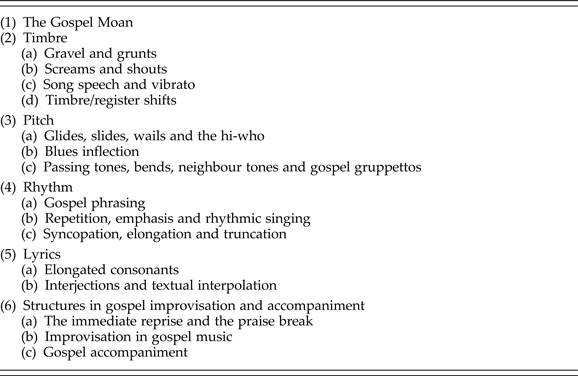
While there have been some attempts to present new theories for the analysis of popular music, as well as to develop some key terms for describing its characteristic traits, the type of detailed analytical codification provided by Legg in ‘A taxonomy of musical gesture in African American gospel music’Footnote 3 remains comparatively rare, not only in the field of gospel music research, but across contemporary popular music studies in general. As a distinctive form of music that has also had a considerable and, we would contend, foundational influence upon the development of many different types of popular music, African American gospel music is now attracting considerable interest from singers, listeners and choir directors outside its originating culture, with numerous active gospel choirs now established in various cities across Europe, Asia and Australia.Footnote 4 As the popularity of performing and listening to gospel music continues to increase around the globe (following in the footsteps of jazz and the blues), there exists an identifiable need – particularly among choir directors and participants with little or no ethnic or historical connection to African America – to develop and utilise some key terms to describe the nature, sound and intent of the iconic and unique performance techniques employed by African American gospel singers and musicians. In ‘A taxonomy…’, Legg defines and annotates some of the key descriptive terms commonly applied to African American gospel singing techniques and introduces an annotated and recording-referenced analytical notational system of musical gesture within African American gospel music.Footnote 5 Through the definition and annotation of key descriptive terms, ‘A taxonomy…’ aims to standardise the language used to describe some of the most common terms applied to African American gospel singing techniques so that greater consistency and clarity can be achieved in relation to their usage within contemporary popular music research and also to provide a framework for comparative analytical research within the area of gospel-inspired contemporary popular music (Legg Reference Legg2010, p. 103). The gospel singing techniques that are examined by Legg in ‘A taxonomy…’ are based on the previous work of Williams-Jones (Reference Williams-Jones1975) and Boyer (Reference Boyer1979) and include the gospel moan and elements relating to timbre and pitch, as summarised under the first three numbered points in Table 1.
The present article seeks to build upon and extend the discussion of the primary gospel singing techniques included in ‘A taxonomy…’ by examining some of the key performance practices associated with the techniques listed under points (4) to (6) in Table 1 – namely, elements of ‘rhythm’, ‘lyrics’ and ‘structures in gospel music improvisation and accompaniment’ – with reference to Legg's Taxonomy (see Legg Reference Legg2010, pp. 126–29). For the purposes of the current article, however, some of the points listed under (4) Rhythm and (5) Lyrics in Table 1 will be addressed together (such as ‘Gospel phrasing’ and ‘Syncopation’) in order to facilitate a more natural flow to the discussion of techniques that are often inextricably linked in a performance context. Additionally, while ‘A taxonomy…’ focuses primarily on the musical style, techniques and performance practices of the gospel singer, the current article expands the discussion to address the characteristic performance practices of gospel piano players, who are increasingly taking on more prominent roles within contemporary gospel music, particularly outside the African American tradition.
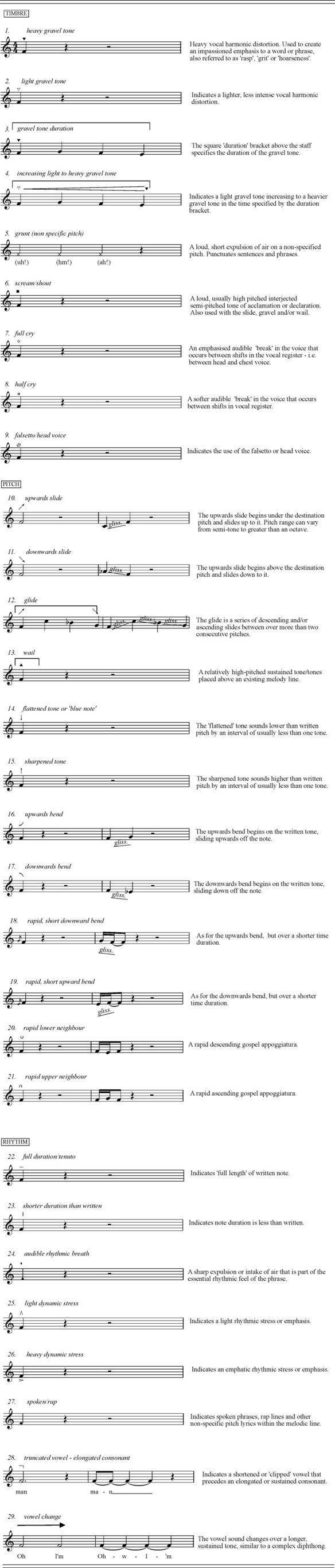
The analysis included in ‘A taxonomy…’, as well as the present article, has been informed by Legg's extensive performance experience with African American gospel choirs and bands within the USA, and focuses on specific recordings of gospel tunes – each providing a snapshot of specific gospel techniques at a particular point in time. In the musical figures contained in these two articles, the use of a relatively conventional notational framework has been supplemented with additional new diacritical markings, typically used above the scores, to highlight ‘non-conventional’ techniques discussed in the text (see Table 2). Given the limitations of symbols to represent actual aural events, each figure included in the articles is accompanied by a reference to a specific commercially produced recording that illustrates the example in sound. The choice to include these references to recordings was also made on the basis that the notated examples are transcriptions of specific recordings and because Legg's own performance capacity and experience as pianist and choral director have played critical roles in the development of his analytical construct, and that critically his musicianship is informed by and couched in the overriding force of the aural tradition that underpins both gospel music and the contemporary popular music idiom.
Of course, the object of any musical analysis is not static; analysis is, rather, a descriptive study of a constantly moving historical context and performance practice. It follows therefore that African American gospel music is not a fixed, unchanging musical entity and that there are considerable internal variations under the single banner of ‘gospel music’. Nevertheless, although time and place, interpretation and individuality are significant factors that need to be kept in mind while studying any art form, there are a number of enduring aspects to gospel music practice – as previously described and notated by Boyer (Reference Boyer1979) and Williams-Jones (Reference Williams-Jones1975) – which the research included in the present article seeks to examine in greater detail.
When combined with ‘A taxonomy…’, the current study aims to provide a frame of reference for the definition and discussion of some of the primary techniques and performance practices inherent within the African American gospel music tradition. This may be particularly useful for non-African American gospel choir directors and participants, as well as their audiences, and may also help to facilitate and enhance the ongoing dialogue relating to these concepts among musicologists and other scholars of popular music. As ‘A taxonomy…’ notes, the descriptive terms and diacritical markings that have been developed in conjunction with this research have not been created for the purpose of providing a type of ‘conductor's guide’ to making any choir sound like an African American gospel choir (if, indeed, such a thing were even possible). Rather, this research attempts to provide a common language for the discussion and comparative analysis of what ultimately are some of the significant hallmarks, or cultural touchstones, of African American gospel music. Coupled together, this pair of articles aims to go some way towards addressing the gap in the literature relating to musical characteristics and performance practices within African American gospel music so that, when considered alongside the great wealth of existing historical and sociological research in the field, a more comprehensive understanding of this musical genre is possible.
Aspects of rhythm and lyric treatment in gospel music
Gospel phrasing and syncopation
As the American folklorist Harold Courlander writes in his 1963 study, Negro Folk Music, ‘It is commonplace that Negro church music and secular music not only ‘swing’ but also have much more sophisticated elements of off-beats, retarded beats, and anticipated beats than does Euro-American folk music in general' (Courlander Reference Courlander1963, p. 29). The sophistication of rhythmic elements that Courlander refers to leads to a musical environment in which phrasing, for the gospel singer, is always subordinated to the expressive and rhythmic momentum and ‘swing’ of the song. Sentences, expressions and even monosyllabic words can be broken for textual emphasis and dramatic effect in a manner quite different from the dominant European classical tradition. In the song ‘Good To Be Kept By Jesus’, James Cleveland and his vocal ensemble sing the lyric ‘to walk in God's beautiful sunshine’ in 3/4 time and at a slow tempo. Taking the melody notes from the original recording, a more conventional notation for this lyric is suggested in Example 1, with the contrasting transcription of Cleveland's actual performance shown in Example 2.
Gospel phrasing A: James Cleveland, ‘Good To Be Kept By Jesus’.

Gospel phrasing B: James Cleveland, ‘Good To Be Kept By Jesus’ (Table 2, items 22, 23) (Col CD 6102, Reference Cleveland1998; TCR 1:30–1:41).
Cleveland and his singers repetitively break the sentence phrase in unusual places according to Western Classical tradition; after the word ‘walk’; after the second syllable of ‘beau-ti-ful’; and between ‘beautiful’ and ‘sunshine’ (using a simple moan-like gruppetto).Footnote 6 Additionally, ‘to walk’ is phrased almost as one word, ‘to-walk’; the singers move rapidly from the vowel to the consonant ‘n’ in the word ‘in’, elongating the ‘n’ sound and therefore adding a slight but perceptible rhythmic emphasis; and the break-up of the word ‘beautiful’ is placed rhythmically so as to add emphasis to the underlying swing/triplet rhythmic grouping.Footnote 7 Cleveland uses these African American concepts of rhythm and phrasing to communicate and express not only the music, but his character and his message with great intensity and depth of meaning.
Mavis Staples also provides a simple example of ‘gospel phrasing’ in the first verse of ‘Are You Sure’ (CK4733; 1991; TCR 1:30–1:41). Staples takes a breath and breaks the natural sentence phrase ‘sorry now and take-a an inventory, you'll come up with a different story’ between ‘take-a’ and ‘an inventory’, using the ‘a’ sound after ‘take’ as an additional rhythmic device and not a textual one. She then breaks the subsequent phrase in the same place with an audible breath – ‘you'll come up with (breath) a different story’, allowing the fundamental rhythmic structure to dominate her lyric delivery. Rather than opting for a succession of smooth and interconnected lines, gospel singers often construct the rhythm of their phrase in a way that works within, and emphasises, the rhythmic subdivisions of the pulse that contemporary musicians refer to as the ‘feel’, ‘groove’ or ‘beat’. As Pearl Williams-Jones (Reference Williams-Jones1975) has observed:
Breathing between words and short phrases is not considered improper to the idiom. The audible breath intake and expulsion of air acts as a rhythmic factor and is an essential part of black timing and rhythmic pacing. (Williams-Jones Reference Williams-Jones1975, p. 382)
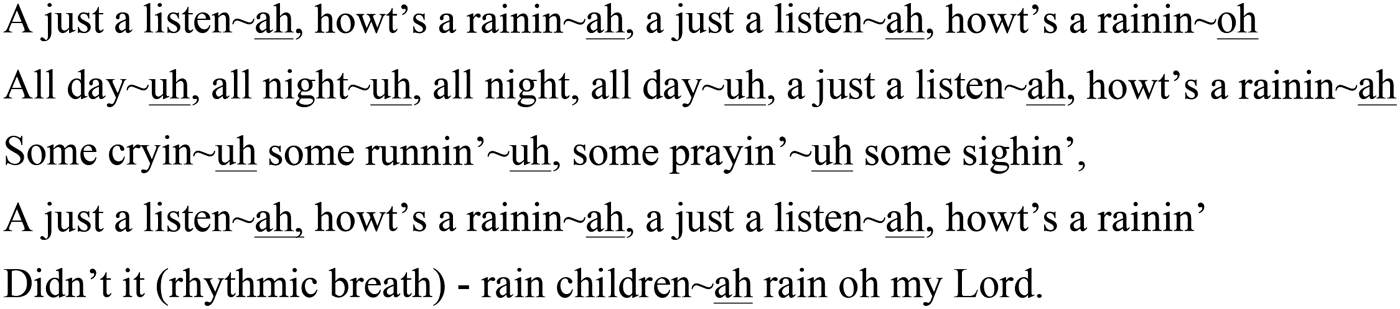
This rhythmic technique of using the breath as part of the phrase, or ‘audible rhythmic breathing’, is particularly evident in the performances of Mahalia Jackson. In her live European recording ‘Didn't It Rain’, Jackson breaks a succession of sentences by punctuating her singing with audible, rhythmic breaths – the air is expelled with an ‘ah’ or ‘oh’ grunt-like sound before the breath is taken – at the end of each short phrase that she joins to the final syllable of the previous word (see Example 3).
Audible rhythmic breathing A: Mahalia Jackson, ‘Didn't It Rain’ (R2CD 40-39/1; Reference Jackson1997; TCR 0:53–1:34).
Example 4 illustrates Jackson's use of audible rhythmic breathing and the grunt-like sounds ‘ah’ at (a) and (b) that she syncopates, placing them on the last quaver of the triplet quaver subdivision, which gives an affecting emphasis to the gentle ‘gospel swing’ of the melody. Jackson also truncates some lines – ‘how it's a-raining’ becomes ‘Howt's a-rainin’ – enabling her to add further rhythmic emphasis, in this case, to the syncopation at the beginning of this phrase. The resulting ‘audible rhythmic breathing’ is a style of rhythmic singing where the all-important subdivision of the beat – in this case, the triplet swing feel – is explicit and carried by the combination of sung note, breath noise and other non-textual utterances. The gospel singer's performance contains rhythm and feel, melody and soul, emotion and meaning; in fact, all the required fundamental musical information is contained within the vocal performance itself.
Audible rhythmic breathing B: Mahalia Jackson, ‘Didn't It Rain’ (Table 2, items 14, 16) (R2CD 40-39/1; Reference Jackson1997; TCR 0:53-1:34).
Repetition, emphasis and rhythmic singing
The gospel singing style also reflects the African American styles and traditions of oratory and preaching that Williams-Jones (Reference Williams-Jones1975) refers to as the ‘rhetorical solo style of the black gospel preacher’:
In seeking to communicate the gospel message, there is little difference between the gospel singer and the gospel preacher in the approach to his subject … the singer perhaps being considered the lyrical extension of the rhythmically rhetorical style of the preacher. Inherent in this also is the concept of black rhetoric, folk expressions, bodily movement, charismatic energy, cadence, tonal range and timbre. (Williams-Jones Reference Williams-Jones1975, p. 381)
One significant aspect of this ‘preaching style’ is the emphasis of different words within the repetition of an important phrase. In his 1996 ‘Homecoming’ address at the Greater Saint Mark Missionary Baptist Church, Dr Anthony Campbell concluded with the repetition of two phrases, ‘leave it there’ and ‘take your burden to the Lord and leave it there’,Footnote 8 which he borrowed from the title (and also key lyric line) of Charles Tindley's gospel song, ‘Leave It There’:
You must trust – and leave it there. You must not doubt – and leave it there. Take your burden to the Lord and leave it there. Take your burden to the Lord and leave it there. Take your burden to the Lord and leave it there. (Batastini Reference Batastini2001, item 420)
This hymn is widely known and loved among the African American church community, and Campbell's use of such a text undoubtedly resonated with the congregation for this reason. However, of equal significance to this resonance was the manner in which he delivered the final phrase, for with each repetition of ‘take your burden to the Lord and leave it there’, the dynamic level and amount of ‘gravel’ in his voice increased dramatically, the pitch of his voice rose and, finally, he overemphasised different words within that one phrase (the underscoring marks the emphasis):
Take your burden to the Lord and leave it there. Take your burden to the Lord and leave it there. Take your burden to the Lord and leave it there. Take your burden to the Lord and leave it there. Take your burden to the Lord and leave it there. Take your burden to the Lord and leave it there.Footnote 9
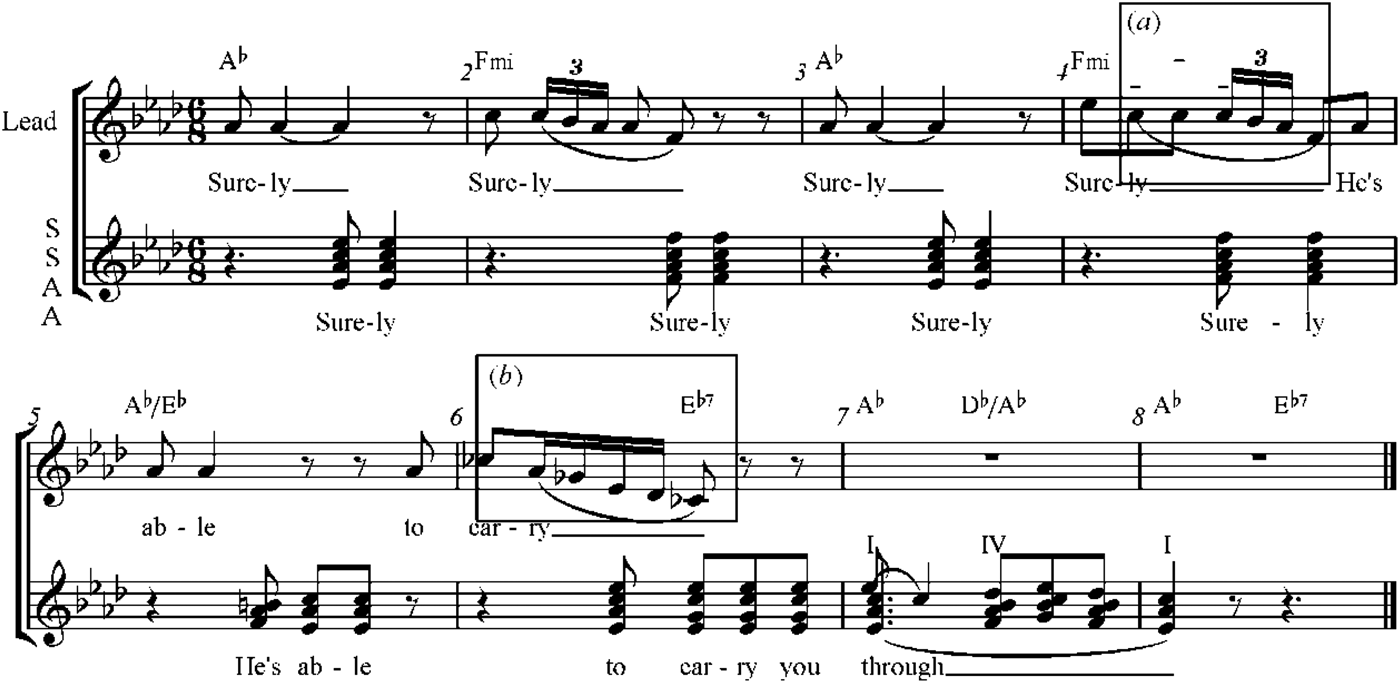
Gospel singers use repetition and emphasis in a similar fashion to add rhythmic character and, often, new meaning and interpretation to the lyrics of the songs that they sing. These devices are perhaps most clearly demonstrated by the Ward Singers in ‘Surely God is Able’. Clara Ward's rearrangement of the Brewster song – originally titled ‘Our God is Able’ – employs a completely new introduction section, which she based on the repetition of the word ‘surely’ (see Example 5).Footnote 10 Ward also uses repetition in Example 5(a), re-sounding the ‘ee’ vowel sound of sure-ly to add further emphasis to the pleading nature of her interpretation. Additionally, she employs a disjunct descending gospel gruppetto in Example 5(b) to emphasise the word ‘carry’ – adding emotional ‘weight’ to the suggestion of being carried through life's tribulations. Such was the power of Ward's arrangement – underscored by the impassioned employment of repetition and emphasis – that it redefined the song in the public consciousness.Footnote 11 As a result, Brewster subsequently retitled his original composition ‘Surely God is Able’, reflecting the significance of Ward's reinterpretation, and in deference to its subsequent widespread popularity. Ward's emphasis and re-emphasis of the word ‘surely’ is insistent and pleading in the opening line (‘surely, surely, surely, surely, He's able to carry you through’) and is immediately reflective of the preaching style, using repetition and emphasis to create a reinterpretation of the phrase for greater emotional impact.
Repetition and emphasis: Clara Ward, ‘Surely God Is Able’ (MCCD 093; Reference Ward1992; TCR 0:00–0:13).
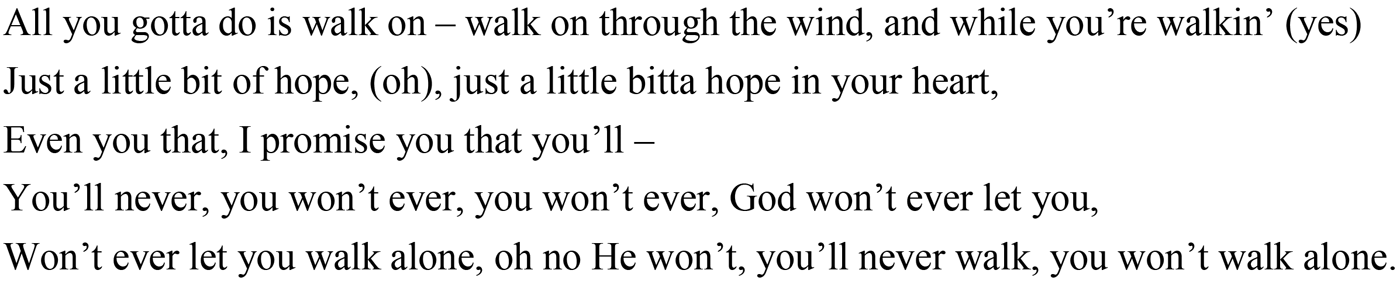
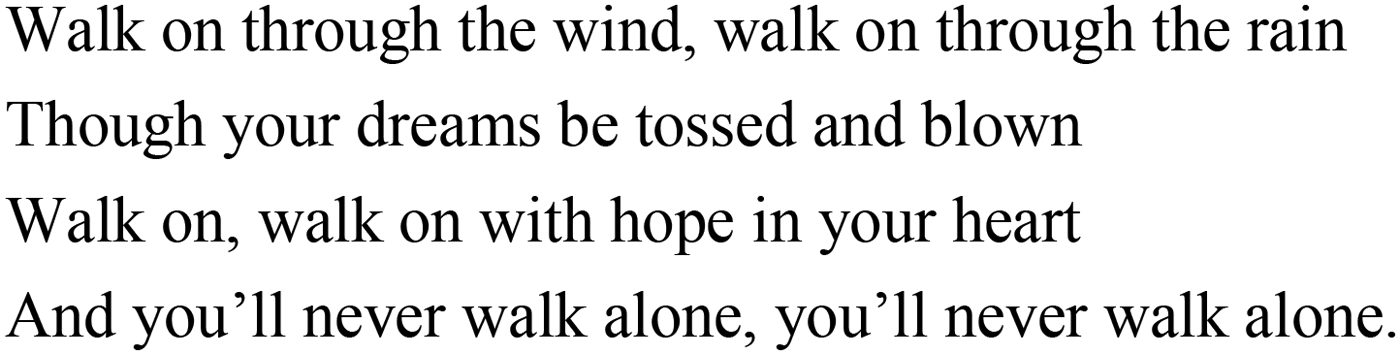
Similarly, Aretha Franklin uses exaggerated repetition and emphasis in ‘You'll Never Walk Alone’ when she initially sings the line ‘at the end, at the end of the storm’ (R2 75627; Reference Franklin1999; TCR 1:20–1:56). Franklin's vocal style then becomes more improvisational and ‘preacher-like’ (Example 6), and in marked contrast to the original song lyrics (Example 7), she uses these techniques to add increasingly to the passion and personal emotional content of the song towards the climax of her performance.
Repetition and emphasis: Franklin lyrics, ‘You'll Never Walk Alone’ (R2 75627; Reference Franklin1999; TCR 1:20–1:56).
Repetition and emphasis: original lyrics, ‘You'll Never Walk Alone’.
Additionally, Fred Hammond plays on this concept in ‘My My My God is Good’, in which he uses a colloquial expression that derives from this practice (‘My, my, my’) as the title and rhythmic propulsion for the main ‘hook’Footnote 12 of the song (01241-43197-9/Ch.3; Reference Hammond2003; TCR 4:35–5:37).
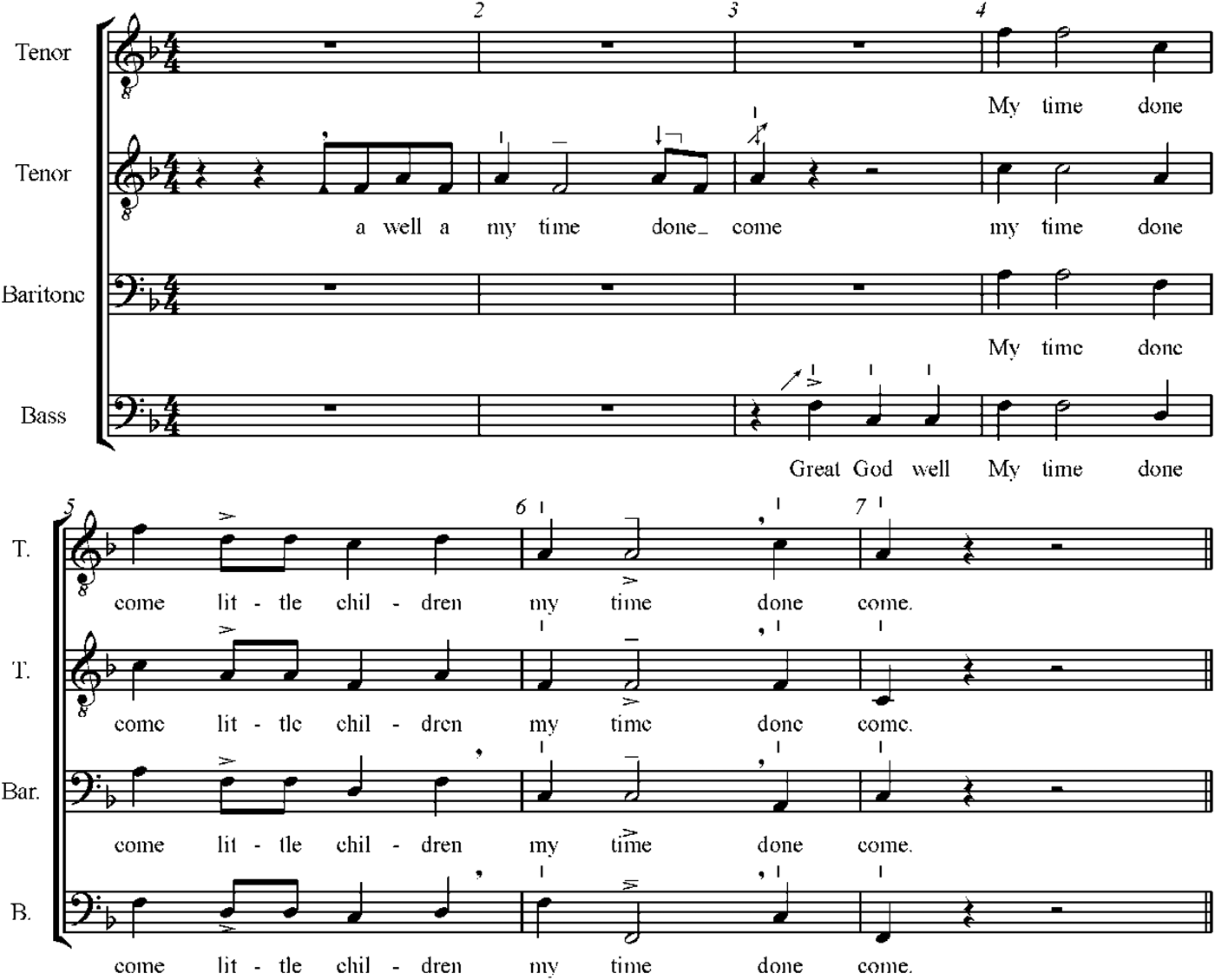
The use of rhythmic emphasis is also a significant factor in the creation of ‘feel’ and ‘groove’ in music.Footnote 13 Gospel quartets often employ a particularly rhythmic style of singing that gives considerable forward momentum to their performances. The Golden Gate Quartet, for instance, provides an excellent example of rhythmic emphasis in ‘My Time Done Come’, in which the opening lyric – ‘my time done come’ – is preceded by the rhythmic phrase ‘a-well-a’, which is also punctuated with audible rhythmic breaths that firmly establish the feel of the song from the outset (US 0279; 2000; TCR 0:00–0:07). The phrasing of the subsequent lyrics in the chorus – ‘my time done come, little children, my time done come’ – overemphasises the contrasts between the short and long notes that in turn emphasise the underlying crotchet pulse, giving the vocal parts a ‘bounce’ that propels the music forward (see Example 8).
The combination of several techniques – audible rhythmic breaths, exaggerated note durations, rhythmic emphasis of most second and fourth crotchet beats, elongation and truncation of vowels and consonants – produces a gospel singing style that is propelled forward under its own, self-generated momentum. Mahalia Jackson uses these same techniques in ‘The Upper Room’, in which she sings the repeated phrase – ‘in the upper room’ – with an exaggerated rhythmic emphasis that makes the phrase sound as ‘the up–perroom’ (Example 9).
Rhythmic singing: Mahalia Jackson, ‘The Upper Room’ (Table 2, items 22, 23) (R2CD 40-39/1; Reference Jackson1997; TCR 4:10–4:17).
Jackson sings two full-value notes (‘in’ and ‘the’) followed by a shortened tone (‘up’), finishing the phrase with two more full-value notes (‘per-room’); this creates a bounce in the rhythm that drives the song forward. Although it could be argued that the meaning of this simple repetitive phrase is never totally obscured – the lyric has already appeared on numerous occasions, and it is also in the title of the song – nevertheless, the rhythmic emphasis and momentum at this point are of far greater importance to the vocal performance than the lyric.Footnote 14 The Kings of Harmony also employ repetition, emphasis and rhythmic singing in ‘Little David’, when they sing the first line – ‘Little David, play that on your harp, hallelu’ – with the following additional, non-textual syllables: ‘Little David play that on-a-your harp and-a hallelu, hallelu’ (US 0279; 2000). These extra syllables function in a manner that supports the overall rhythmic momentum or feel of the song. The repetition of the acclamation ‘hallelu’ is preceded by an audible breath that breaks the phrase and further adds to the dynamic emphasis that the Kings of Harmony apply to it, both drawing the listeners' attention to the phrase ‘hallelu’ and emphasising the second beat of the bar in a syncopated-like manner.
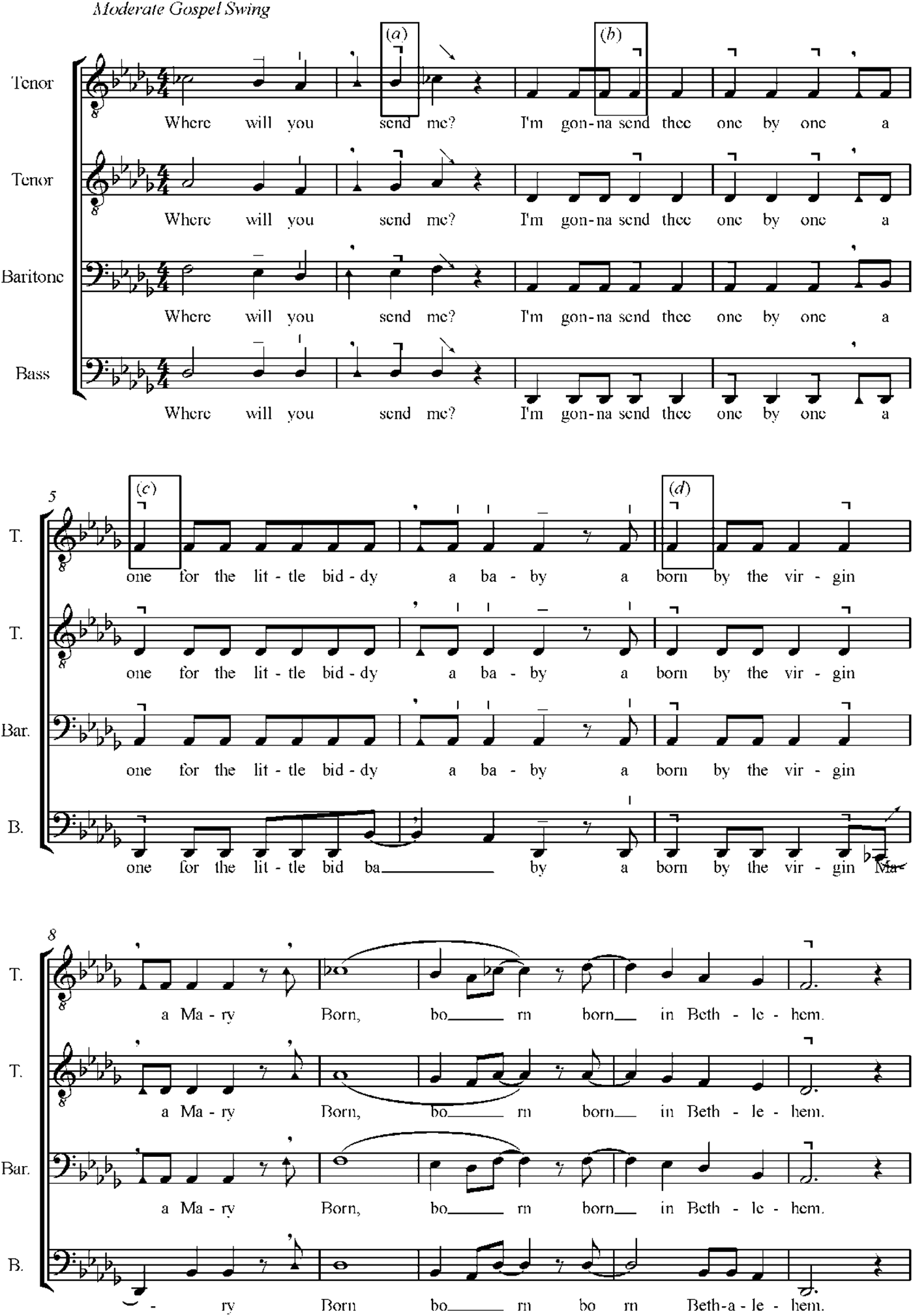
Finally, The Fairfield Four articulately demonstrate the use of gospel repetition, emphasis and rhythmic singing in ‘Children Go Where I Send Thee’ (see Example 10). They use a gentle handclap on the backbeatFootnote 15 in this medium-tempo song with a gospel swing feel, and immediately emphasise the word ‘send’ at (a) in bar 2, by preceding it with an audible breath on beat 1, and by truncating the vowel sound (‘eh’) and elongating the consonant ‘n’. The duration of the word ‘send’ appears shorter than the notated crotchet would indicate as the consonant ‘n’ (also used with ‘m’) is softer in dynamic than the vowel, as the mouth is closed, with the sound resonating through the nasal cavity. The word acquires an attack as a result, and The Fairfield Four employ this technique throughout this song – as shown in Example 10 at (a), (b), (c) and (d) – adding a gentle rhythmic emphasis to the melody that conventional notation does not adequately describe. The phrase breaks between bars 1 and 2 (‘where will you – send me’), bars 5 and 6 (‘little biddy – a baby’) and bars 7 and 8 (‘born of the virgin – a Mary’), are all immediately preceded by an audible rhythmic breath and an additional non-textual rhythmic syllable (‘a’). The complex combination of these techniques produces a musical expression that is simply elegant, and it is this deceptive simplicity that belies the complexity of the rhythmic and other techniques that are foundational constituents of the feel and character of the gospel song.
Elongation and truncation
As demonstrated in the previous example by the Fairfield Four, gospel singers frequently ‘play’ with the durations of notes for rhythmic and textual emphasis. In particular, the ‘m’ and ‘n’ consonants at the conclusions of a phrase or word are often elongated following a truncated vowel, with the ‘m’ or ‘n’ sound resonated through the nasal cavity with the mouth closed. Mahalia Jackson demonstrates this technique in ‘Amazing Grace’, with the lyric ‘how sweet the sound’, where she initially adds a slight dynamic emphasis to the consonant ‘s’ in the word ‘sound’ before using an upper neighbour tone to precede an elongated ‘n’ at the conclusion of the word (Example 11). Jackson does not sustain the A ♭ in a traditional manner with the open vowel sound but moves quickly to the consonant ‘n’, where her tone is warm and softer and moan-like in dynamic as a result of the sound resonating in the nose with the mouth closed.
Elongation: Mahalia Jackson, ‘Amazing Grace’ (0 76119 40392 6; Reference Jackson1997; TCR 0:45-0:57).
Marion Williams demonstrates the same technique in ‘There's A Man’ when she elongates the ‘n’ in ‘man’ to enable her to sustain both the note and the mood she has created (LC5762; Reference Williams1993; TCR 0:19–0:30). The Golden Gate Quartet also utilises this technique in ‘Hush’ (R2CD 70-07/1; 1998; TCR 0:15–0:27). To contrast with the heightened tension of the line ‘death comes creepin’ in the room', which is sung at a moderately loud dynamic, all four singers subsequently quickly drop the dynamic level in the next line (‘soon one morning’), elongating the ‘n’ of ‘soon’, and truncating the ‘i’ vowel and elongating the ‘ng’ sound at the end of ‘morning’. They masterfully use this technique to create a sense that they are ‘whispering’ to their audience, as the subject is sensitive and not to be spoken ‘out loud’. Lastly, Fred Hammond uses elongation in a more contemporary setting but still to great effect in ‘Interlude #1’ (82876-71019-2; 2005; TCR 0:10–0:25), in which he elongates the ‘n’ on the word ‘pain’, changing and personalising the character of that word and the whole phrase as a result. Hammond, like all gospel singers, makes a series of emotional and expressive decisions – subconsciously or deliberately and improvised at the time of performance – that utilise a number of conventional and non-conventional techniques, such as the sustaining of consonants, to create an ever-changing and intensely personal musical expression where the immediacy of communication and connection with the listener are profound.
Interjections and textual interpolation
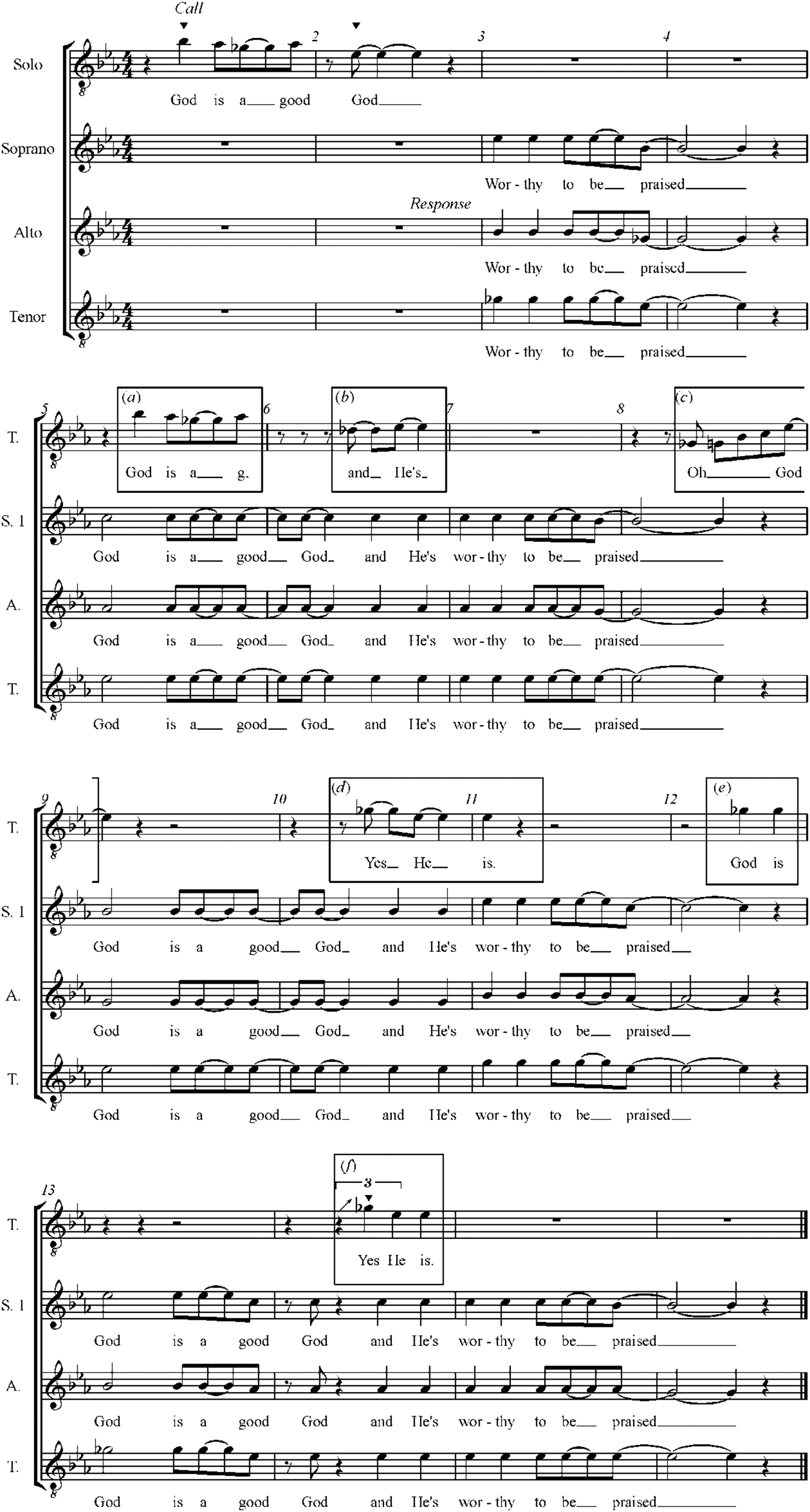
Gospel singers interject acclamatory phrases such as ‘Hallelujah’, ‘O Lord’ and ‘Yes Child’ to punctuate the natural call and response structure of the gospel song. Interjections are rhythmically significant and allow the gospel singers to emphasise or add their ‘agreement’ to a preceding lyric phrase. Additionally, gospel singers use interjections to connect lyric lines or reinterpret and personalise lyrics in a song. Bishop Paul Morton demonstrates this technique in ‘God Is A Good God’, in which he punctuates the original chorus lyric (‘God is a good God and He's worthy to be praised’) with the connective and acclamatory interjections notated in Example 12. Morton begins the song in call and response style with the opening line ‘God is a good God’, following this with a series of interjections: in bar 5 (a), ‘God is a g’ (truncation of the final word ‘good’); bar 6 (b), ‘and He's’; bar 8 (c), ‘Oh God’; bar 10 (d), ‘Yes He is’; bar 12 (e), ‘God is’; and bar 14 (f), ‘Yes He is’. The function of these interjections varies from a more accompanying-style of ‘God is a g’ at (a), to the emphatic declamatory style of ‘Yes He is’ at (d) and (f), where each interjection is further emphasised with the use of a preceding upward slide and heavy gravel timbre.Footnote 16
Interjection: Bishop Paul S. Morton, ‘God Is A Good God’ (Table 2, itmes 1, 12) (5497; Reference Morton2003; TCR 0:10–0:25).
Mahalia Jackson further illustrates this technique with her interjection ‘well, well, well’ in ‘He's Right On Time’ (CK 85282; Reference Jackson2001; TCR 2:08–2:15) and ‘hallelujah’ in ‘Elijah Rock’ (R2CD 40-39/1; Reference Jackson1997; TCR 2:50–3:05), and James Cleveland uses an emphatic ‘hallelujah’ in ‘Jesus Is The Best Thing’ (SCD 7059; Reference Cleveland1980; TCR 3:05–3:43), which he follows with a succession of increasingly intense interjections including ‘Can I get a witness up here?’, which has become a favourite catch-cry for preachers and singers alike.
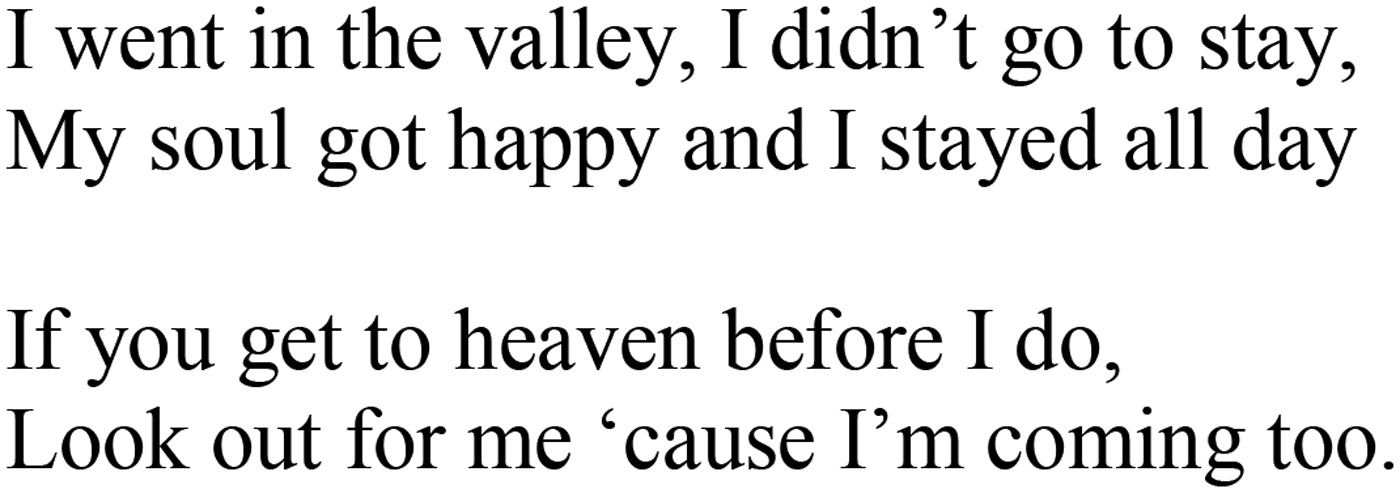
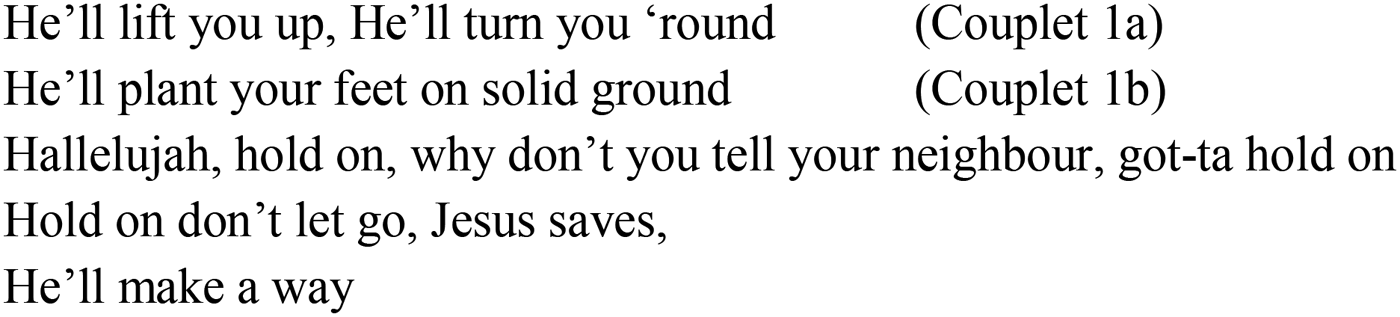
Boyer (Reference Boyer1979, p. 27) describes ‘textual interpolation’ as the ‘adding of extra words to the original text. These additions … may complement the text or may be completely unrelated.’Footnote 17 He further describes the way in which this technique makes use of rhyming couplets and quatrains, a practice common in the performance of Negro spirituals; ‘… group[s] of rhyming couplets are catalogued and when a variety of text or words for a contrasting section are needed, the singer selects an appropriate or favourite couplet and inserts it into the song’ (Boyer Reference Boyer2000, p. 109). In addition to the examples of common couplets that Boyer provides (Example 13), Marion Williams from the Ward Singers adds couplets at the conclusion of ‘Surely God Is Able’ (Example 14) in a recording that was to firmly entrench the use of rhyming couplets in gospel performance practice (MCCD 093; Reference Ward1992; TCR 1:08–1:30).
Rhyming couplets: Boyer Examples (Boyer Reference Boyer2000, p. 109).
Rhyming couplets: The Ward Singers, ‘Surely God Is Able’ (MCCD 093; Reference Ward1992; TCR 1:08–1:30).
Finally, Legg participated in a recording of the Gospel Music Workshop of America conference choir in Cincinnati in 1997, and the title track from this album, ‘In Time He'll Bring You Out’ (51416 1348 2; 1997), with soloist James Bignon, illustrates the use of a rhyming couplet, along with several interpolations, in the context of a contemporary gospel song (Example 15).
Rhyming couplet: GMWA Choir, ‘In Time He'll Bring You Out’ (51416 1348 2; 1997; TCR 4:15–).
Structures in gospel music improvisation and accompaniment
The immediate reprise and the praise break
More a structural device than a vocal technique, the immediate reprise occurs after the conclusion of a song where, in response to audience affirmation or the emotional intensity experienced by the performers, the gospel singer ‘reprises’ or repeats a section of that same song – a verse, chorus, or often the additional vamp chorus. The immediate reprise can take more time to perform than the initial song itself, as the singers and musicians are ‘carried away by the spirit’ in a state of musical and spiritual trance-like ecstasy. The reprise also effectively functions as another means of ‘emphasis’, here reinforcing and affirming the perceived emotional and psycho-spiritual state of the ‘community’ – performers and audience/congregation together – that has found expression in the particular performance of a gospel song. Richard Smallwood uses this technique in ‘Total Praise’, following the emotive ‘Amen’ chorus when, after the audience's applause, he immediately reprises the ‘B’ section (‘you are the source of my strength’) and the concluding ‘Amen’ chorus or ‘C’ section as well (01241-43015-2; 1996; TCR 1:47–4:45).
Additionally, Kirk Franklin twice reprises the vamp chorus at the end of ‘It's Rainin’ (INTD-90093; 1997; TCR 2:49–3:30), and Dorothy Norwood and the Northern Californian Mass Choir reprise the chorus of ‘Victory Is Mine’ (R2CD 70-07/1; 1998; TCR 3:41–) after Norwood employs several interjections (‘hallelujah’, ‘glory be to God’) and an improvisational, preacher-like contextual testimony (‘when I got up this morning, when I got up this morning, you know what I said?’). Norwood's technique here is also indicative of the ‘praise break’, a gospel singing technique that incorporates song-speech, interjections and other improvisational devices and which generally occurs at the conclusion of a song, where the singer and instrumentalists perform an improvisational song ‘in the spirit’ – the same heightened emotional and psycho-spiritual state that can precede the immediate reprise. In the case of the praise break, however, the response is less organised and more frenetic, often chaotic and ecstatic. The whole community – singers, instrumentalists and congregation – responds collectively but with individualised physical movements (jumping, running, kneeling, chest-beating, hand-raising), verbal and sung praises and acclamations. If instruments are present, they will either follow a prescribed chord sequence and feel, or one that is initially improvised and then organised as the praise break develops. Kirk Franklin demonstrates the praise break at the conclusion of ‘Don't Take Your Joy Away’, where the soloist improvises short, shouted phrases of gravel-toned interjections over a sustained F7 chord (including additional harmonic inflections) that finally modulates to A♭ major for the ‘praise break’, which is, in this case, based on the traditional gospel song ‘When I Think About Jesus’ (GCD2127 G2 1C 7575 1 72127 2; 1995; TCR 5:36–). Hezekiah Walker's recording of James Cleveland's ‘Lord Do It’ also develops into an ‘under-the-spirit’ praise break that plays for as long as the song itself (B00005A8BC; 2011; TCR 7:05–).
Improvisation in gospel music
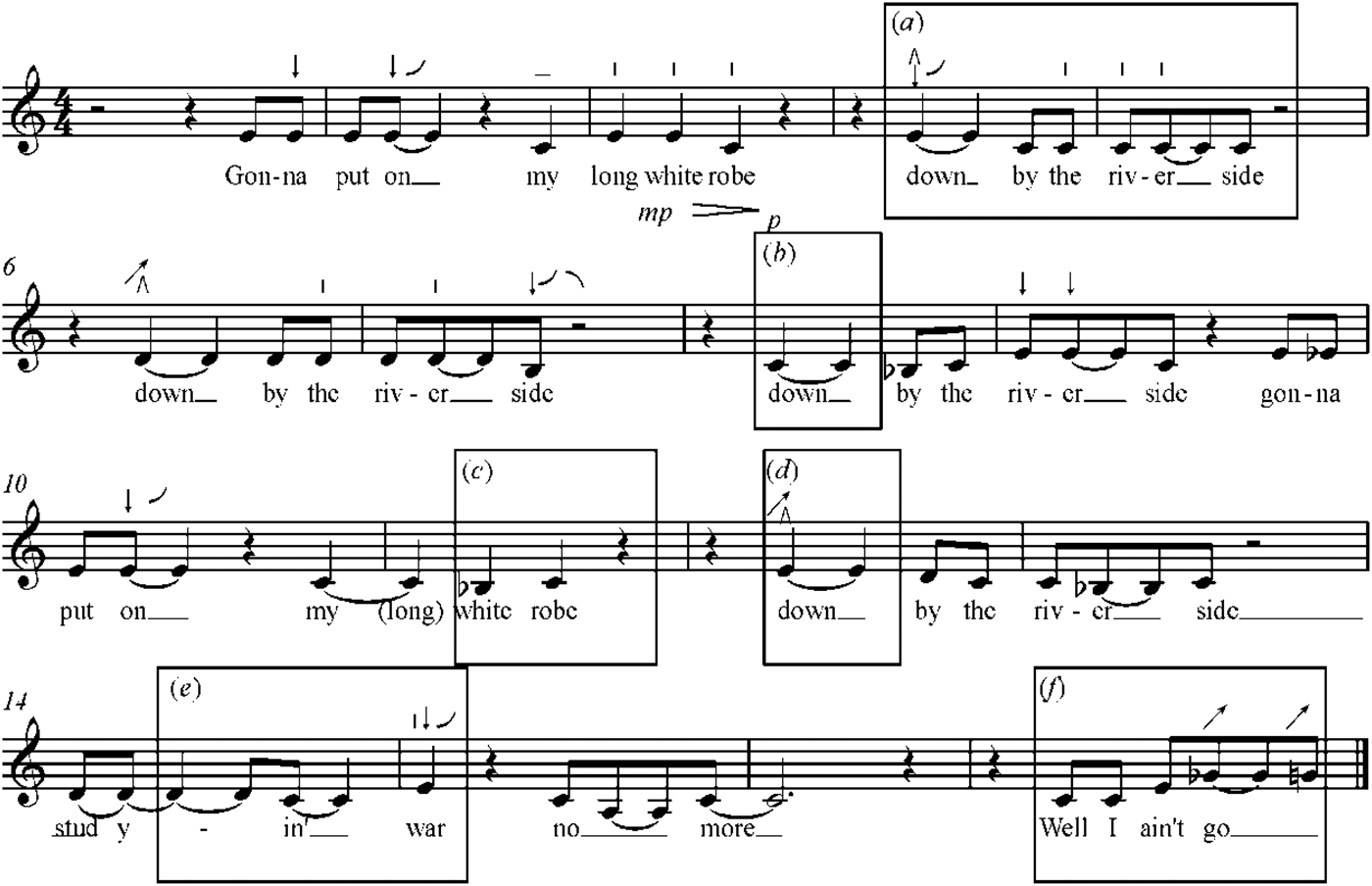
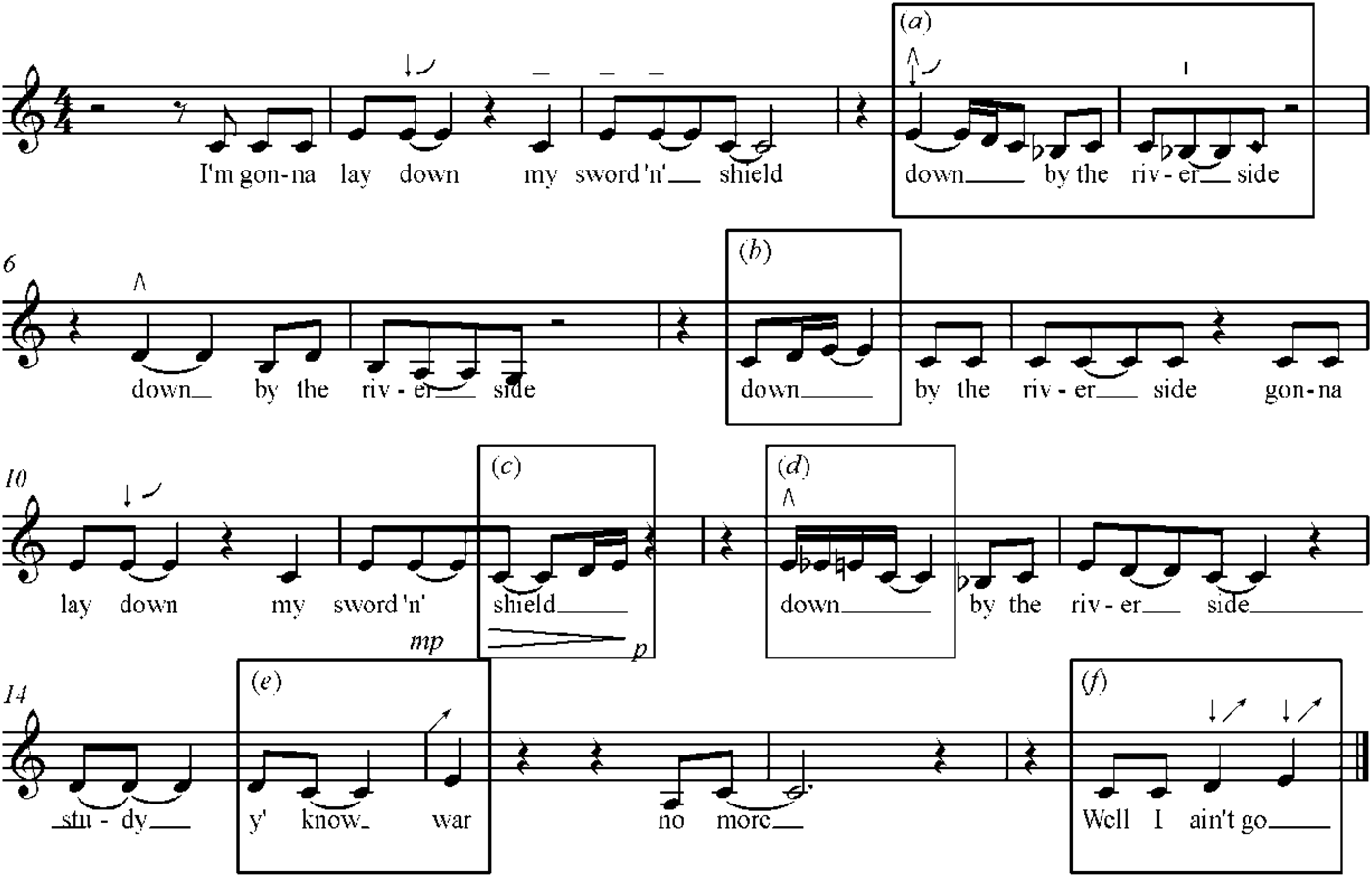
One of the many significant contributions that African American culture has made to contemporary music in general has been the reintroduction of improvisation and its foundational primacy in music performance practice. Eileen Southern (Reference Southern1997), for example, draws our attention to the importance of improvisation within early African American history, as she describes ‘the singing at Cresswell's “Negro Ball” reflect[ing] the African propensity for musical improvisation’ (Southern Reference Southern1997, p. 48) and then references William Faux from 1820, as he describes the spontaneous and improvisatory style of worship that he encountered in an African Methodist Episcopal church (Southern Reference Southern1997, p. 78). While many of the gospel music performance techniques examined in the current article could, conceivably, be ‘studied’ by prospective gospel singers in a similar manner to which a contemporary popular or jazz musician might refer, for example, to Paul Berliner's (Reference Berliner1994) analytical and ethnographic study Thinking In Jazz (1994) or Ingrid Monson's (Reference Monson1996) Saying Something: Improvisation and Interaction (1996), ultimately many of these techniques only provide the basic tools for the gospel singer, whose primary role it is to manipulate them through melodic and rhythmic improvisation in order to articulate musical and spiritual expression. Although lyrics, melodic, rhythmic and harmonic structures are prescribed and even rehearsed, these musical fundamentals are subservient to the expressive, the spiritual and to the music and emotion created ‘in the moment’. Every aspect of the gospel singer's performance is to an extent improvised; every element is open to significant change, interpretation, reinterpretation and recontextualisation based on the performer's desire and intent, the audience's reactions and interaction, and the move and often indefinable influence of the ‘Spirit’; and all of this is informed by the defining, self-sustaining and all-encompassing deeply embedded cultural trace.Footnote 18 Mahalia Jackson's (Reference Jackson1962) many recordings of ‘Down By The Riverside’ provide excellent illustrations of the improvisational variations that can typically be found between the various performances of a gospel song, and Examples 16 and 17 transcribe two different performances of this song by Jackson, recorded during the early 1960s in America (A) and Europe (B), respectively.
Mahalia Jackson, ‘Down By The Riverside’: A (USA) (Table 2, items 10–27) (15 300; 1992; TCR 0:22–0:28).
Mahalia Jackson, ‘Down By The Riverside’: B (Europe) (Table 2, items 10–27) (CK 85282; Reference Jackson2001; TCR 0:22–0:37).
Both Examples 16 and 17 are transcriptions of Jackson's first verse, the different lyrics resulting from a swap in the order of the verses (‘gonna put on my long white robe’ and ‘gonna lay down my sword and shield’). Although the general melodic direction and rhythmic intention are the same, the specific melodic and rhythmic order of the notes is quite different, as bars 4 and 5, 8 and 9 clearly demonstrate. Jackson adopts a slower, more measured tempo for the European performance and matches this with a generally louder dynamic and a more emphatic and precise articulation. In the American performance, Jackson contains her energy and vitality to a degree, employing a softer dynamic and a slightly gentler rhythmic swing, even losing the occasional word to her expression of the rhythmic feel (Example 16, bar 11, ‘long’).
The way in which Jackson's improvised placement and use of gospel singing techniques also define the individual character of each performance of the song is equally significant. Example 17 evidences Jackson's greater use of passing tones (a), neighbour tones (d) and slightly more rhythmically complex phrasing in general at (a), (b), (c) and (d) when compared to the corresponding bars and letters in Example 16. Example 16 delivers a slightly faster, less melodically ornate interpretation, with greater emphasis on the shaping of notes with bends and slides (Example 16, bars 6 and 7) and truncated note values (‘long white robe’, Example 16, bar 3).
Contemporary gospel singer Fred Hammond (Reference Hammond1995) further develops the concept of improvisation in gospel in ‘You Are The Living Word’ (B4418-4008-2; 1995; TCR 4:07–4:33), where he uses interjections and song-speech (‘now let's call Him one more time’, ‘Jesus’) and sustained non-textual vocal sounds (‘whoa, oh’) to create a more complex and intricate improvised melodic line – leading, prompting, responding and interweaving with the choir and band.
Finally, LaKeisha Grady takes the notion of improvisation in gospel one significant step further in her performance of Kirk Franklin's ‘He Loves Me’ (INTD-90178; 1998; TCR 1:38–3:32), echoing the expressive melodic inventions of jazz greats like Cassandra Wilson and Dianne Reeves. Grady combines lyric and vocalese over a Kirk Franklin gospel song that is heavily influenced by jazz harmonic and rhythmic concepts and reflects the trend in contemporary gospel to search for new ideas and find inspiration in other musical genres beyond its traditional boundaries.
Gospel accompaniment
As gospel music has developed, ‘the piano has become the principal accompanying instrument’ (Boyer Reference Boyer2000, p. 22) and gospel pianists typically employ several key idiomatic stylistic features that have come to characterise this unique style of accompaniment. The gospel piano style has been directly informed by the vocal performance practices of gospel singers and has been favoured because of its ability to produce the full range of lyrical to aggressively percussive tones that can support and complement the extremes of physical and musical expression of the gospel singer.
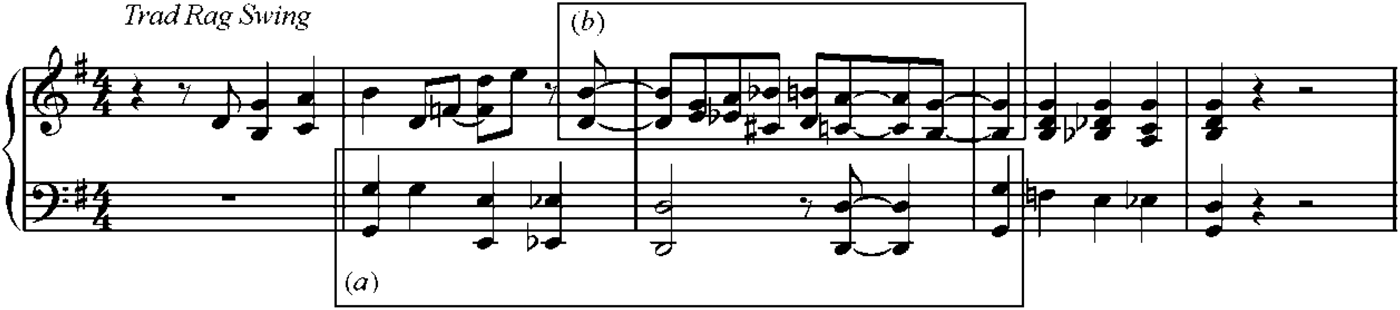
The use of the piano for accompaniment in gospel music developed along with the rise of gospel music in the Pentecostal religious movement from as early as 1920,Footnote 19 but was not a stable component of gospel until the 1930s, when a distinct style of gospel piano emerged based on the concept of the ‘rhythm section’Footnote 20 employed by early blues and jazz musicians. The first acknowledged gospel pianist was Arizona Dranes, whose playing style in the early 1920s is described by Boyer (Reference Boyer2000, pp. 37–8) as a ‘combination of ragtime, with its two beats to the bar feel, octave passages in the left hand, exaggerated syncopation in the right hand, and heavy full and ragged (syncopated) chords of barrelhouse piano, and the more traditional chords of the standard Protestant hymn’. Dranes' piano introduction for the Texas Jubilee singers in ‘He's Coming Soon’ (Example 18) illustrates her use of left-hand octaves (a), ragtime-influenced syncopation (b), and a general focus on the middle register of the piano, which were to become significant characteristics of the gospel piano style.
Piano accompaniment: Arizona Dranes, ‘He's Coming Soon’ (DOCD-5186; Reference Dranes1998; TCR 0:00–0:07).
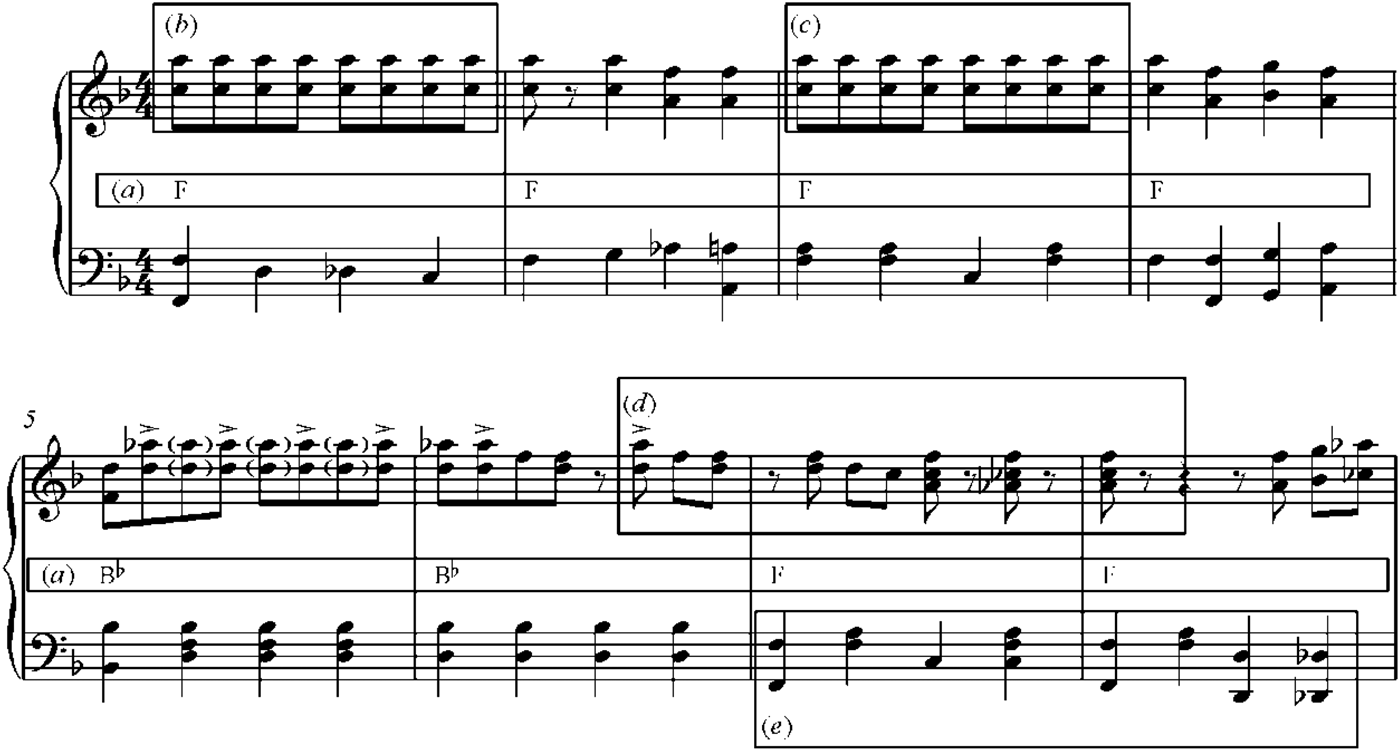
Boyer (Reference Boyer1979) also identifies in Dranes' 1928 recording, ‘I Shall Wear A Crown’, her technique of incorporating the melodic notes into the right-hand chord structures; she does not play a distinct ‘melody’ line with the right hand, but rather uses ‘chords which support the melody, a practice still observed in contemporary gospel piano’ (Boyer Reference Boyer1979, p. 32). He also describes her use of simple harmonic structures, illustrated here in Example 19 (a), as well as repetitive, right-hand eighth-note chords to create a sense of perpetual forward motion (b) and (c), and the heavily syncopated rhythms (d) and stride left hand (e) typical of ragtime piano.Footnote 21
Piano accompaniment: Arizona Dranes, ‘I Shall Wear a Crown’ (DOCD-5186; Reference Dranes1998; TCR 0:22–0:29).
Roberta Martin later brought a more refined approach to gospel piano, building on many of Dranes' techniques, notably employing right-hand chord voicings that supported and usually contained the notes of melody. Martin, however, also incorporated richer harmonic textures, single note and octave melodic runs that punctuated the vocal phrases, and percussive ‘bombs’ – loud and unexpected single octave bass explosions within an otherwise softer dynamic – in the recordings ‘He Has Done Great Things’ (SCD7018 70577; 1990; TCR 0:00–1:54) and ‘Be Still My Soul’ (SCD7018 70577; 1990; TCR 1:35–1:45). Clara Ward and James Cleveland were also influential in the development of the gospel piano style. Ward (Reference Ward1993) began using the IV chord as a passing chord over tonic harmony (such as in ‘The Last Mile’, LC 5762; 1993; TCR 0:50–0:57), which Boyer (Reference Boyer1979, p. 33) describes as ‘more a rhythmic inflection than [a] tonal [one and that] contributed to the development of a faster harmonic rhythm in the style’, while Cleveland used extremes of dynamic range and rhythmic accentuations over the full range of the keyboard to meld with his preaching-singing style (such as in ‘Jesus Is The Best Thing’; MCCD 093; Reference Cleveland1992; TCR 0:20–1:37).
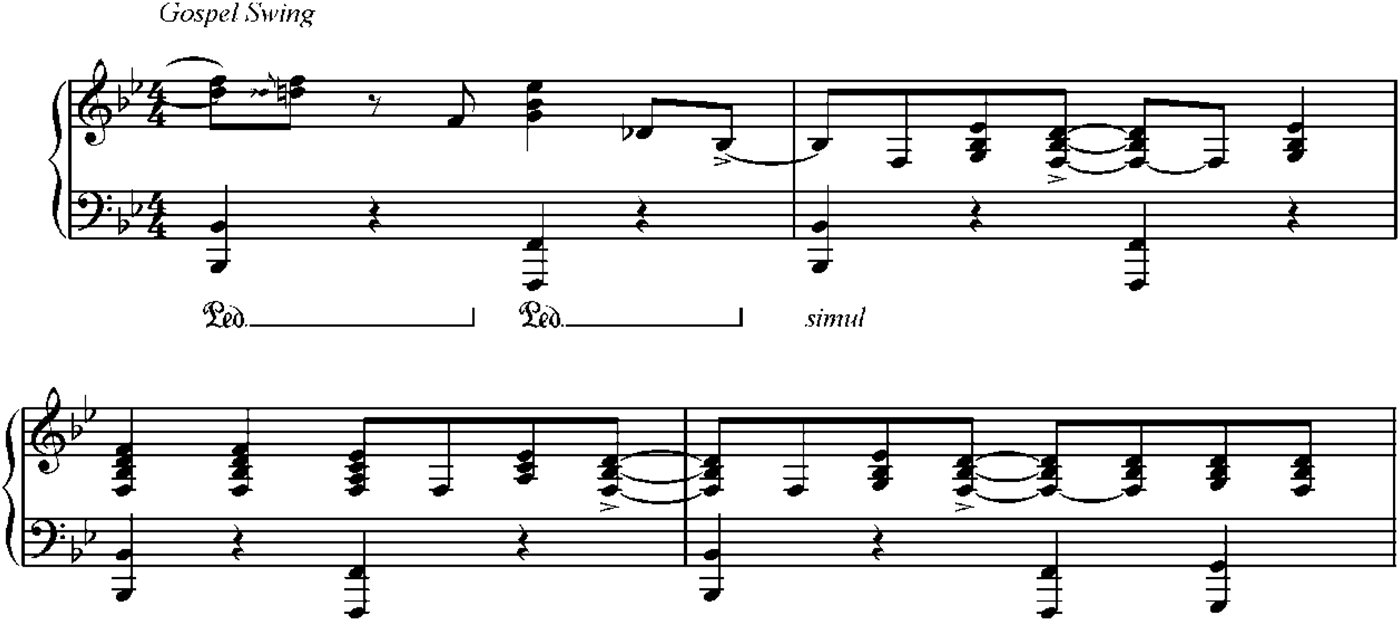
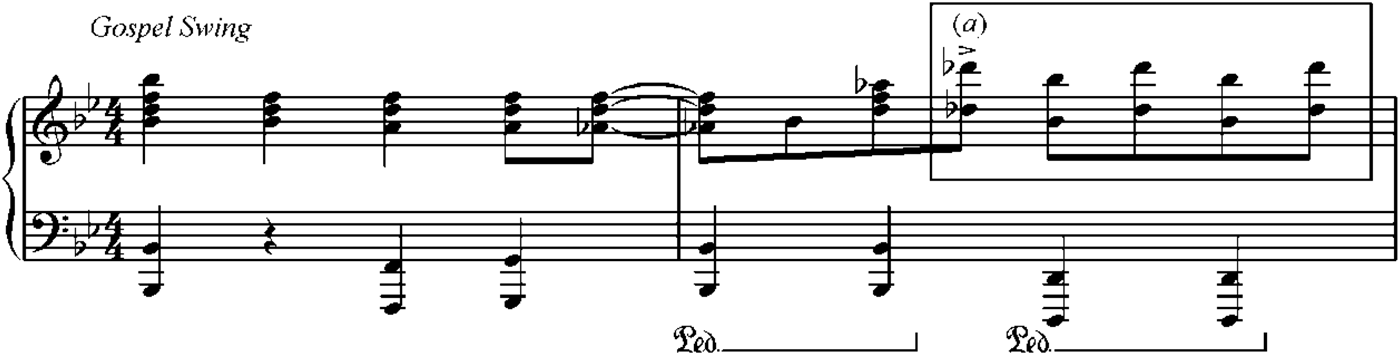
The gospel piano style uses the lower extremities of the keyboard in the left hand to function as an upright bass or tuba might in a traditional jazz band. Placing tonic notes in octaves on beats 1 and 3 in 4/4 metre, and alternating with the dominant or other passing tones on beats 2 and 4, the left-hand bass pattern underpins the essential harmony and feel. The right hand is focused mostly in the middle range of the piano, alternating between on-beat playing and syncopated, ragtime-like rhythms that support the vocal line in the chordal harmony, with the ‘melody’ placed within the chord voicing, usually on the top. Both of these techniques are used by Mahalia Jackson's long-time accompanist Mildred Falls in ‘He's Right On Time’ (Example 20). In this recording, Falls also demonstrates the use of a brass-like octave excursion into the upper register, carefully placed in the spaces between verse lines and individual phrases, which often function as the ‘response’ to the singer's ‘call’ in the call and response style, as in Example 21, bar 2 (a).
Gospel piano: Mildred Falls, ‘He's Right On Time’ (CK 85282; Reference Jackson2001; TCR 2:15–2:37).
Gospel piano: Mildred Falls, ‘He's Right On Time’ (CK 85282; Reference Jackson2001; TCR 2:15–2:37).
In ‘Bless The Lord’ (01241-43015-2; 1996), contemporary gospel singer, composer and pianist Richard Smallwood demonstrates the way in which gospel piano players tend to keep the vocal melody and choir parts in the right-hand piano voicings (see letters (a), (c), (e) and (f) of Example 22), as well as to supply a brass-like, descending ‘response’ to the gospel singer's ‘call’ (see letters (b) and (d) of Example 22).
Gospel piano: Richard Smallwood, (Reference Smallwood1996) ‘Bless The Lord’ (01241-43015-2; 1996; TCR 0:10–0:21).
More recently, contemporary gospel pianists have incorporated more advanced harmonic and rhythmic concepts into their gospel piano style. For example, Kirk Franklin's gospel piano style in ‘He Loves Me’ (INTD-90178; 1998; TCR 3:16–4:10) borrows voicings, harmonic structures and the concept and stylistic execution of the improvised piano solo from jazz, while Bobby Sparks' gospel piano playing on Fred Hammond's ‘Keep On Praisin’' reflects the influences of the jazz-funk and jazz-rock hybrid styles in his choice of voicings, groove and in his use of an electronic keyboard (82876-86952-9; 2006; TCR 0:00–0:16). The harmonic language of jazz and the newer African American genres of funk, rap and urban R&B have significantly influenced some of the most recent developments in gospel music and this presents yet another avenue for future research in the area of gospel music studies.
Conclusion
The ‘taxonomy’ of musical gesture for African American gospel music originally introduced by Legg (Reference Legg2010) is further developed here through analysis and discussion for the primary purpose of facilitating the communication of some of the key extended techniques and characteristics of this complex and dynamic performance style within an Australian musical context, where the contextual touchstones of African American gospel music are not present to any significant degree. While the aim of the analysis, codification of diacritical markings and the inclusion of notated and recorded examples, both in the present article and in ‘A taxonomy…’ has been to create a frame of reference for the classification of key terminologies and performance practices inherent within African American gospel music, it is worth reiterating here that the authors are not suggesting that the taxonomy be used in the creation of a music score that can be ‘read’ and realised in a performance context. As noted in ‘A taxonomy…’, ‘The great depth of subtlety and complexity of nuance and gesture that the taxonomy attempts to capture can make the annotated score necessarily complex and therefore difficult to interpret in “real time”’ (Legg, Reference Legg2010, p. 124). Rather, the significance of this analytical framework, and the research and analysis that accompany and underpin it, lies in its provision of concise definitions and descriptions that can be utilised by choir directors, conductors, performers, listeners and researchers to assist in the interpretation, understanding and comparative analysis or discussion of specific musical techniques that are deeply embedded within the African American gospel tradition and which are not always clearly understood outside its original performance culture.
The analytical framework presented in this article goes some way towards providing greater clarity around the language and concepts used in the description of key performance practices within African American gospel music, and may also be of use to scholars working in the broader contemporary popular music idiom. While the performance practices of the gospel singer, in particular, continue to be fundamental to the characteristic sound of African American gospel music, the roles of instrumental musicians and the gospel band are also gradually increasing in prominence, especially among choirs operating outside the USA.Footnote 22 While there is still considerable scope for further research in this area, the current article has extended the discussions instigated by Williams-Jones (Reference Williams-Jones1975) and Boyer (Reference Boyer1979) in relation to elements of rhythm, lyrics and structures in gospel music improvisation and accompaniment. Considered in conjunction with ‘A taxonomy…’, this research has examined what can be identified as many of the primary musical features, techniques and performance practices that characterise the genre of African American gospel music. When combined with the aforementioned studies on the origin and social evolution of African American gospel music, and African American religious music more generally, this research can help to facilitate a more comprehensive understanding of this unique and increasingly influential realm of music and the impact that it has upon various aspects of contemporary popular music within Western society.
Acknowledgements
The authors wish to gratefully acknowledge the assistance of Dr Anne-Marie Forbes and Dr Glen Hodges, as well as the insights of two anonymous peer reviewers, in helping to shape and refine the final version of this article.