Introduction
In addition to anti-inflammatory and immunosuppressive activities, synthetic glucocorticoids such as dexamethasone affect gluconeogenesis, glycogen deposition, protein and calcium metabolism (Courtheyn et al., Reference Courtheyn, Bizec Le, Brambilla, Brabander de, Cobbaert, Van de Wiele, Vercammen and Wasch de2002). The effect of these substances on carbohydrate metabolism led to their use as growth promoters in beef cattle fattening, and in the United States they are still used to increase carcass fatness and meat marbling (Corah et al., Reference Corah, Tatum, Morgan, Mortimer and Smith1995). Although the use of corticosteroids as growth promoters is banned in Europe, illegal administration (Courtheyn et al., Reference Courtheyn, Bizec Le, Brambilla, Brabander de, Cobbaert, Van de Wiele, Vercammen and Wasch de2002) in order to increase feed intake, water retention and live weight gain (Istasse et al., Reference Istasse, de Haan, van Eenaeme, Buts, Baldwin, Gielen, Demeyer and Bienfait1989) is highly suspected. Beef farmers first began administering dexamethasone in combination with other substances such as β-agonists, at low dosages, in order to exploit additional or synergic growth effects and perhaps conceal its use from public service veterinarians conducting checks at the slaughterhouse (Courtheyn et al., Reference Courtheyn, Bizec Le, Brambilla, Brabander de, Cobbaert, Van de Wiele, Vercammen and Wasch de2002). Dexamethasone and other corticosteroids are now becoming the most commonly used growth promoters, however, because their detection in organic matrices does not necessarily testify the use for non-therapeutic reasons. Dexamethasone alone has also been administered recently in low dosages because field experience and scientific results showed that high dosage inhibits growth and leads to muscle atrophy (Istasse et al., Reference Istasse, de Haan, van Eenaeme, Buts, Baldwin, Gielen, Demeyer and Bienfait1989; Corah et al., Reference Corah, Tatum, Morgan, Mortimer and Smith1995; Courtheyn et al., Reference Courtheyn, Bizec Le, Brambilla, Brabander de, Cobbaert, Van de Wiele, Vercammen and Wasch de2002).
Various studies have been performed to assess the effects of non-therapeutic dexamethasone use on beef cattle growth and slaughter performance (Brethour, Reference Brethour1972; Dicke et al., Reference Dicke, Farlin and Arthaud1974), while others (Renaville et al., Reference Renaville, Massart, Lognay, Devolder, Sneyers, Marlier, Severing, Burny and Portetelle1994; Corah et al., Reference Corah, Tatum, Morgan, Mortimer and Smith1995) also considered metabolic parameters and nutrient partitioning hormones. None of the above-mentioned works considered cattle welfare, however, which is currently one of the most important issues for the consumer (McGlone, Reference Mcglone2001). Precisely because behaviour is a good indicator of welfare, in addition to assessing growth and slaughter performance, this study also evaluated the effect of prolonged daily oral administration of a low dosage of dexamethasone on beef cattle behaviour.
Material and methods
In accordance with Decreto Legislativo n. 116/1992, the Italian Ministry of Health authorized this study following the submission of a detailed description of the experimental plan by the project’s scientific coordinator.
Animals, housing and management
The study was conducted in a commercial farm in Brugine (Padova, Italy). At the outset, 15 Marchigiana breed finishing bulls were considered, nine of which served as the Control group and six bulls as the dexamethasone per os (Dexa)-treated group. At day 30, one of the Control bulls was excluded from the experiment due to an ocular trauma, and therefore the total number of animals considered was 14. The Dexa per os-treated bulls received orally 0.75 mg of dexamethasone (Desashock®; Fort Dodge Animal Health SpA, Bologna, Italy) every day. Prior to the distribution of the feed each morning, the animals in both groups were caught at the feeding trough, where two trained technicians using a drenching gun gave one capsule containing the compound to the treated animals and an empty capsule to the Control bulls.
The experimental phase in vivo lasted 56 days starting with the weighing of the bulls. The animals were allotted to pens in the Control group or to the Dexamethasone group according to initial body weight (BW) (487 ± 14.9 kg). The treatment was administered for 49 days, from day 5 to day 53 of the experimental period.
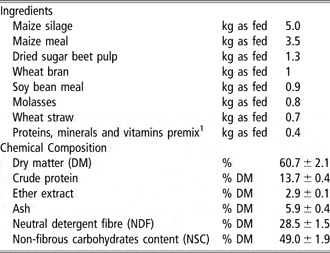
The bulls were housed in five contiguous straw-bedded pens of three animals each with 4 m2/head space allowance and 100 cm/head manger space. Drinking water was available ad libitum and supplied by two waterers per pen. Bulls were fed ad libitum the same diet provided as total mixed ration once a day at 0830 h. Feed composition of the diet is reported in Table 1. Samples of the diet were collected weekly and analysed for dry matter (DM), crude protein (CP), ether extract and ash according to AOAC methods (2004). Analysis of neutral detergent fibre of the same samples was conducted according to Van Soest et al. (Reference Van Soest, Robertson and Lewis1991) and the non-fibrous carbohydrates content was calculated as proposed by Mertens (Reference Mertens1992). Diet chemical composition is presented in Table 1.
Feed composition and chemical analysis of the diet given to the bulls during the experimental period

1Premix supplied (on DM basis): 38% of crude protein, 2% of fat, Ca, 180 g; Na, 104 g; P, 70 g; Mg, 35 g; Zn, 3400 mg; Mn, 1500 mg; Fe, 200 mg; Cu, 200 mg; I, 60 mg; Co, 20 mg; Se, 10 mg; Mb, 10 mg; 1 000 000 IU of vitamin A; 120 000 IU of vitamin D; 100 mg of vitamin E; 20 mg of vitamin K; 5000 mg of vitamin PP; 100 mg of vitamin B1; 50 mg of vitamin B2; 0.4 mg of vitamin B12.
Animal growth performance and health status
The bulls were weighed at the outset, on day 27 and on day 55. The average daily gain (ADG) was calculated as the difference between two subsequent BWs. The pen DM intake was recorded 3 days a week as the difference between the amount of diet delivered and the feed residue in the manger 24 h later. Pen feed conversion ratio was calculated by dividing the average intake by the ADG.
Bull health status was monitored daily by recording all individual pathological events and medical treatment.
Blood parameters
Jugular vein blood samples were taken from all the animals in the morning at days 6, 27, 48 and 56. Heparinized vacutainer tubes (Becton Dickinson, Meylan Cedex, France) were used for blood glucose determination measured using a BM Hitachi 911 analyser (ROCHE, Basel, Switzerland).
Insulin evaluation specimens were collected in anticoagulant-free vacutainer tubes (Becton Dickinson) and analysed by a chemiluminescent technique using an automatic analyser (Immulite One, Medical System, Genoa, Italy).
Behavioural observations
Bulls were observed for 9 consecutive hours at days 23, 37 and 51, starting from 0900 h. The animals were directly observed by trained personnel using the scan-sampling technique with a 5-min interval between two subsequent scans. At each scan, the number of animals per pen that were lying, inactive, eating, ruminating, sniffing-licking or grooming was recorded. The number of conflicts and mounting performed within each pen during the entire observation session was also recorded with the behaviour sampling technique (Martin and Bateson, Reference Martin and Bateson1993).
Slaughter measurements and meat quality evaluation
All the bulls were slaughtered in the morning at day 57, and their carcasses were weighed both after slaughter and 24 h later in order to calculate individual dressing percentage. Carcasses were also graded for conformation and fatness according to the European grading system (OFIVAL, 1984). Twenty-four hours after slaughter, a joint sample of Longissimus Thoracis muscle was excised from the 7th to the 9th rib of each right half carcass. The samples were vacuum packed and stored at 4°C in a chilling room for a 7-day ageing period. After ageing, meat samples were analysed for pH, DM, CP, ether extract and ash according to AOAC methods (2004). Meat colour was measured with a CR 100 Chromameter (Minolta Camera, Osaka, Japan) equipped with C illuminant on samples exposed to air for 1 h at 2°C (Boccard et al., Reference Boccard, Buchter, Casteels, Cosentino, Dransfield, Hood, Joseph, Macdougall, Rhodes, Schon, Timbergen and Touraille1981). Colour data were expressed using the Hunter Lab system. Drip losses were measured as weight losses of the meat sample used for colour determination hung in a plastic bag at 4°C for 24 h. Weight cooking losses were determined on 2.5-cm-thick steaks cooked in a water bath at 75 °C for 50 min and cooled in running tap water for 40 min (Boccard et al., Reference Boccard, Buchter, Casteels, Cosentino, Dransfield, Hood, Joseph, Macdougall, Rhodes, Schon, Timbergen and Touraille1981). Meat tenderness was instrumentally measured using a Warner Blatzer shear force meter (Instron Ltd, High Wycombe, UK) on cylindrical core samples of cooked meat 1.25 cm in diameter (Joseph, Reference Joseph1979).
Statistical analysis
Bull growth and slaughter performance, and meat quality data were submitted to one-way ANOVA within PROC-GLM (SAS, 1990) in order to evaluate the effect of dexamethasone treatment. The animal was the experimental unit and the treatment effect was tested using pen within treatment variance as the error term. Considering that feed intake and feed conversion ratio were calculated on group pen basis, data were reported as means of the pen and not processed.
Behavioural data were transformed into frequencies before undergoing statistical analysis. This data transformation was obtained by dividing the number of animals per scan observed performing a given behaviour by the total number of animals housed in the pen. The normal distribution of the behavioural and blood variables included in the dataset was tested by SAS PROC UNIVARIATE (1990) with the Shapiro-Wilk test. All the variables tested showed values of W > 0.80 and were therefore considered normal and submitted to ANOVA within SAS PROC-GLM (1990). The total frequency of all behavioural variables was analysed adopting the SAS repeated measurement option. The statistical model considered the effects of treatment, pen within treatment, observation day and treatment per observation day. For these variables as well, the treatment effect was tested using pen within treatment variance as the error term. The same model was adopted to analyse the blood parameters; the experimental unit was the single animal.
Results
Animal health status and growth performance
The health status of the bulls was satisfactory during the entire experimental period with the exception of one Control bull, which showed clinical signs of trauma to the cornea of one eye at day 30. The animal was treated for several days with specific drugs and therefore excluded from the experiment. None of the other bulls received specific medical treatment.
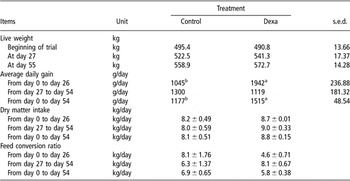
Average live weights were similar in both Dexa per os and Control bulls due to the wide variation within groups (Table 2). ADG, on the other hand, was higher in the animals treated (1515 v. 1177 g/day; P < 0.05), but this result was due to the different gains recorded only in the first 26 days of the experiment (Table 2). Untreated and treated animals showed similar DM intakes, whereas on average feed conversion ratio of bulls receiving dexamethasone seems improved (Table 2).
Growth performance of Control and treated (Dexa) bulls during the experimental period

Different superscript letters (a, b) within row indicate significant differences P < 0.05.
Blood parameters
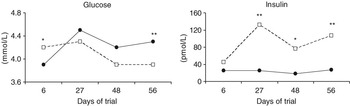
Plasma glucose was significantly higher in the animals receiving dexamethasone only at the first collection made after 1 day of drug administration (Figure 1). No effect of treatment was observed in the next 2 sampling days. The Control group showed higher glucose concentration at day 56 (Figure 1).
Plasma concentration of glucose (s.e.d. = 0.13) and insulin (s.e.d. = 15.43) in Control bulls ( ) and in animals treated with dexamethasone per os (
 ) from day 5 to day 53 of the trial. *Least square means within sampling day are significantly different for P < 0.05. **Least square means within sampling day are significantly different for P < 0.01.

The administration of dexamethasone per os increased insulin concentration from the second sampling day.
Behaviour
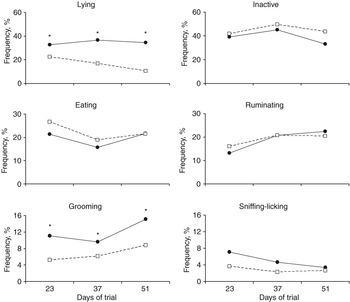
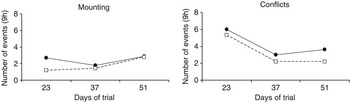
The results of the behavioural observations are shown in Figure 2. Eating, ruminating, sniffing-licking and inactive behaviour were not affected by the administration of Dexa per os. Grooming and lying frequencies were always lower in the animals receiving corticosteroid than in the Control group. The number of mounting events and the number of conflicts among pen mates were unaffected by treatment (Figure 3).
Development of the frequencies of lying (s.e.d. = 4.38), inactive (s.e.d. = 4.04), eating (s.e.d. = 4.21), ruminating (s.e.d. = 1.73), grooming (s.e.d. = 1.23) and sniffing-licking (s.e.d. = 1.05) in Control bulls ( ) and in animals treated with dexamethasone per os (
 ) from day 5 to day 53 of the trial. *Least square means within sampling day are significantly different for P < 0.05.

Number of mounting (s.e.d. = 0.62) and conflicts (s.e.d. = 0.56) in Control bulls ( ) and in animals treated with dexamethasone per os (
 ) from day 5 to day 53 of the trial.

Slaughter performance and meat quality evaluation
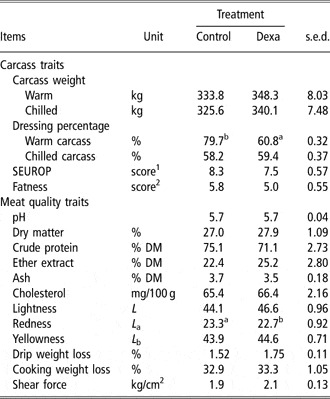
Dressing percentage calculated on warm carcass was the only slaughter measurement significantly affected by the administration of dexamethasone, and was higher in the bulls treated (Table 3). With regard to meat quality traits, the pH and chemical composition of the Control group and the bulls treated were similar. Only colour was modified by treatment, with the Control bulls showing higher redness (Table 3).
Slaughter performance and meat quality evaluated on Longissimus Thoracis muscle of Control and treated (Dexa) bulls

11 = Poor to 15 = Excellent.
21 = Minimum to 15 = Maximum.
Different superscript letters (a, b) within row indicate significant differences P < 0.05.
Discussion
The study was conducted as an attempt to identify the illegal administration of dexamethasone to beef cattle during the finishing period through variations in performance and behaviour.
Courtheyn et al. (Reference Courtheyn, Bizec Le, Brambilla, Brabander de, Cobbaert, Van de Wiele, Vercammen and Wasch de2002) reported that providing glucocorticoids in low dosages increases feed intake and ADG and improves the feed conversion ratio. In our study, however, although the use of dexamethasone significantly increased ADG, feed intake for both Control and treated animals was similar, and therefore this gain in the weight of the bulls treated might be related to an improved feed efficiency. ADG increased particularly in the first part of the trial, and this result is in agreement with a previous study by Istasse et al. (Reference Istasse, de Haan, van Eenaeme, Buts, Baldwin, Gielen, Demeyer and Bienfait1989) in which a low dosage of dexamethasone was provided by four intramuscular injections with a 1-week interval. These authors observed an increased live weight gain immediately after the first injection and a subsequent decrease in this parameter from the fourth week of treatment. Dexamethasone provided in low dosage therefore appears to have a noticeable growth promoter effect for brief periods of treatment only. Longer low-dosage administration of dexamethasone seems to have the same effect as high-dosage treatment, however, which according to Courtheyn et al. (Reference Courtheyn, Bizec Le, Brambilla, Brabander de, Cobbaert, Van de Wiele, Vercammen and Wasch de2002) reduces growth rates and leads to muscle atrophy. This controversial growth promoter effect of dexamethasone has also been discussed in other studies. Johnson and Silcox (1986), in fact, obtained a decrease in ADG in yearling Angus bulls given 20 mg of dexamethasone twice weekly during an 84-day finishing period, whereas Corah et al. (Reference Corah, Tatum, Morgan, Mortimer and Smith1995) did not observe any difference in ADG between the Control group and animals treated with 100 mg implants 60 and 30 days prior to slaughter. Tarantola et al. (Reference Tarantola, Schiavone, Preziuso, Russo, Biolatti and Bergero2004) observed the lowest daily gain and the worst feed conversion ratio in veal calves receiving a prolonged oral low dose of dexamethasone.
Regarding the blood parameters involved in energy metabolism, the higher glycaemia detected in the bulls treated with dexamethasone after 1 day of treatment might be the result of the effect of the glucocorticoids on both gluconeogenesis promotion in the liver and the drop in peripheral glucose utilization (Eisenstein, Reference Eisenstein1973; Schimmer and Parker, Reference Schimmer and Parker2001). Either by increasing fat deposition and/or interstitial water retention but not through muscle development (Schimmer and Parker, Reference Schimmer and Parker2001), this metabolic pattern in the animals treated may have been responsible for the increase in ADG in the first part of the trial. During the same period, dexamethasone, acting as endogenous glucocorticoid, and hyperglycaemia might have promoted insulin production by the pancreatic β cells. The reduction of glycaemia observed during the last part of the experiment in the bulls treated is likely due to the hypoglycaemic role of insulin (Insel et al., Reference Insel, Liljenquist, Tobin, Sherwin, Watkins, Andres and Berman1975; Mori et al., Reference Mori, Kitahara, Miura, Mine and Tajima2004). The organism’s response to prolonged oral administration of a low dosage of dexamethasone in terms of the hepatic synthesis of glucose is immediate, whereas response in terms of insulin production seems to require a longer adaptation period. This hypothesis is partially supported by the studies conducted by Istasse et al. (Reference Istasse, de Haan, van Eenaeme, Buts, Baldwin, Gielen, Demeyer and Bienfait1989) and Corah et al. (Reference Corah, Tatum, Morgan, Mortimer and Smith1995), who detected an immediate increase in glucose following corticosteroid supply and a subsequent increase in insulin production. These works do not, however, permit the plotting of insulin release trends in relation to time of treatment.
The administration of Dexa per os had a moderate effect on cattle behaviour, inducing a reduction of the time spent lying and grooming. These changes in behaviour cannot be considered relevant in making a clear distinction between treated and untreated animals. In terms of animal welfare, the prolonged standing time measured for the bulls treated might have limited their opportunity for rest (Rotger et al., Reference Rotger, Ferret, Manteca, De la Torre and Calsamiglia2006), and according to Mogensen et al. (Reference Mogensen, Krohn, Sorensen, Hindhede and Nielsen1997), this might have a negative affect on daily gain. Moreover, the reduction of auto- and allo-grooming observed in the same animals might also be an expression of their lack of interest in pen mates.
Recent studies on humans (Kam and Yarrow, Reference Kam and Yarrow2005; Trenton and Currier, Reference Trenton and Currier2005) have shown that some of the side-effects of the corticosteroid abuse by athletes included significant psychiatric symptoms, such as aggressiveness, violence, mania and other status of psychosis. In this study, conflicts and mounting occurred with a low frequency in both the Control group and treated bulls, especially when considering the results of previous studies in which bulls did not receive corticosteroids (Gottardo et al., Reference Gottardo, Ricci, Fregolent, Ravarotto and Cozzi2003).
Consistent with Corah et al. (Reference Corah, Tatum, Morgan, Mortimer and Smith1995), the bulls treated had an improved carcass dressing percentage but in our study this was not due to an increase in carcass muscularity because there was no significant difference in SEUROP scores. Considering that dressing percentage calculated on chilled carcass was similar in both Control and treated animals, the Dexa group carcasses probably had higher water losses during the chilling process, and this supports the hypothesis of increased interstitial water retention due to treatment. In our study, carcass fatness was similar in both treated and untreated animals, and this confirmed the result obtained by Brethour (Reference Brethour1971). The same author reported contrasting carcass fatness results in a subsequent study using different dexamethasone administration protocols (Brethour, Reference Brethour1972). However, Istasse et al. (Reference Istasse, de Haan, van Eenaeme, Buts, Baldwin, Gielen, Demeyer and Bienfait1989) observed no differences in the lean meat and adipose tissue percentages of the carcass of the animal treated and its monozygotic twin used for Control, whereas Corah et al. (Reference Corah, Tatum, Morgan, Mortimer and Smith1995) reported a greater thickness of external fat in steers treated.
Regarding meat quality traits, the administration of Dexa per os did not affect intramuscular fat deposition measured as ether extract. The literature available is controversial for this parameter as well, probably due to differences in dexamethasone administration time, dosage and method. Johnson and Silcox (1986) observed that treatment decreased marbling scores in Angus finishing bulls, whereas Istasse et al. (Reference Istasse, de Haan, van Eenaeme, Buts, Baldwin, Gielen, Demeyer and Bienfait1989) recorded increased muscle ether extract content and improved degrees of marbling, while Brethour (Reference Brethour1972) and Dicke et al. (Reference Dicke, Farlin and Arthaud1974) reported intramuscular fat deposition.
Tarantola et al. (Reference Tarantola, Schiavone, Preziuso, Russo, Biolatti and Bergero2004) studied the effect of corticosteroid on meat colour in veal calves, observing that animals treated per os had lighter and paler meat than the Control calves. This supports our findings with adult cattle, even if precisely how the treatment affected myoglobin concentration and oxidation level is unclear.
Conclusion
Farmers currently appear to be using dexamethasone illegally as a growth promoter for increased economic benefits. The results of our study suggest that low dosages of dexamethasone per os increase cattle growth in the short period due to hyperglycaemia, which may be responsible for increased fat deposition or interstitial water retention. The corticosteroid’s initially strong growth effect declined, however, as the administration period is prolonged to 50 days, and was probably weakened by insulin response.
The effect of low dosage on behaviour was not evident enough to permit a clear distinction between untreated and treated bulls, even if the reduced lying and grooming of the latter may be related to impaired animal welfare.
The increased warm carcass dressing percentage observed in treated bulls at the slaughterhouse may provide farmers with a certain economic benefit, given that chilled dressing percentage is routinely calculated as a fixed percentage of warm carcass weight. This benefit may be limited in the European market, however, by the lack of any increase in carcass fleshness or fatness.
Acknowledgements
This study was financed by a grant from the Italian Ministry of Health. The authors are grateful to Mr Roberto Rampazzo and Mr Roberto Chimetto for their precious technical support.