Introduction
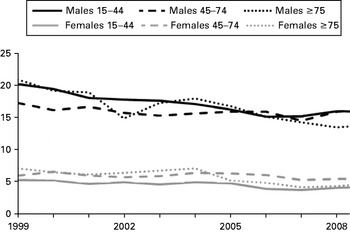
The UK has seen an overall decline in suicide since the turn of the century; the male rate of suicide declined steadily between 1999 and 2007, increased in 2008 and stabilized in 2009 (Fig. 1). The female rate saw a slow overall decline but with a small increase in 2008. These official statistics combine deaths receiving a coroner's verdict of suicide with those of undetermined intent, as a significant proportion of deaths with open verdicts are probably suicides (Dennis et al. Reference Dennis, Read, Andrews, Wakefield, Zafar and Kavi2001). Although suicide rates have fallen in young men, they are still relatively high and remain a concern (NMHDU, 2009), as do increases in the rate of attempted suicide in the older population (Shah, Reference Shah2009).
Age-standardized suicide rates by age group and gender: England 1999–2009. Source: Office for National Statistics (ONS): Suicides in the United Kingdom – England and Wales, 1991–2009. Rates per 100,000 population standardised to the European standard population (www.ons.gov.uk/ons/publications/re-reference-tables.html?edition=tcm%3A77-233434). Accessed 20th January 2012.

The British National Psychiatric Morbidity Survey (NPMS) includes repeated large-scale cross-sectional surveys of the adult household population based on a core group of identical measures (Jenkins et al. Reference Jenkins, Meltzer, Bebbington, Brugha, Farrell, McManus and Singleton2009). A central objective of the programme was to monitor trends in mental health. It thereby provides a unique opportunity to investigate whether the prevalence of suicidal ideation has declined over time in parallel with suicide rates. This is key to the impact of the National Prevention Strategy for England, published in September 2002 (Department of Health, 2002). If the drop in suicide rates is attributable to improved mental health in the wider population, possibly due to improved economic conditions, then there should be a parallel decline in suicidal ideation. Alternatively, the decline in suicides might be due to the success of the National Strategy in reducing risk in key high-risk groups or reducing availability and lethality of suicide methods, in which case, decreases in the conversion rate from ideation to suicide would be expected. If this were the case, then the decline in suicide rates since 2000 might be accompanied by no change (or even an increase) in the prevalence of ideation.
Because these surveys comprise a repeated cross-section, it was possible to compare the health experience of successive birth cohorts, resampled as they aged over 7 years. In the current study we tested the hypothesis that the age-specific prevalence of suicidal ideation declined between 2000 and 2007, in line with the incidence of suicide.
Method
Data source
The National Psychiatric Morbidity Survey in 2000 (NPMS 2000) included people aged from 16 to 75 years in Great Britain. The 2007 survey, known as the Adult Psychiatric Morbidity Survey (APMS 2007), included those aged ⩾ 16 years in England. We therefore restricted analysis to the English household population. Previous analyses of the 2000 survey found that suicidal thoughts and death wishes were rarer in older people (Dennis et al. Reference Dennis, Baillon, Brugha, Lindesay, Stewart and Meltzer2007) and explored the relationship between suicidal ideation, suicide attempts and deliberate self-harm (Bebbington et al. Reference Bebbington, Minot, Cooper, Dennis, Meltzer, Jenkins and Brugha2010).
Full details of the two national surveys are provided elsewhere (Singleton et al. Reference Singleton, Bumpstead, O'Brien, Lee and Meltzer2001; McManus et al. Reference McManus, Meltzer, Brugha, Bebbington and Jenkins2009). Adults living in English private households were recruited using population-based two-phase probability sampling and interviewed in the first phase by lay interviewers. In both surveys data were weighted to represent the English household population at the time of survey. The sample size was designed to provide sufficient statistical power to estimate the prevalence of rare disorders (0.5–1.0%) by age, sex and region, and in consequence it was also large enough to analyse the prevalence of suicidal ideation by age, sex and 7-year birth cohort. The sample can be described as a pseudo-cohort, as different individuals from the same birth cohorts were sampled in 2000 and 2007. Fieldwork was carried out between March and September 2000 and between October 2006 and December 2007, using computer-assisted interviewing. Response rates were 69% in 2000 and 57% in 2007.
Definition of suicidal ideation
As part of the phase 1 questionnaire in 2000 and 2007, participants were asked a set of identical questions about suicidal ideation:
-
• Have you ever felt that life was not worth living? Was this … in the last week/in the last year/or at some other time? (tiredness of life)
-
• Have you ever wished that you were dead? Was this … in the last week/in the last year/or at some other time? (death wish)
-
• Have you ever thought of taking your own life, even if you would not do it? Was this … in the last week/in the last year/or at some other time? (suicidal thinking)
We chose to analyse a broad definition of suicidal ideation based on a positive response to any one of these questions. The questions about timing were used to derive variables indicating suicidal ideation in the past week and past year. Participants reporting suicidal ideation in the past week were taken as positive for both suicidal ideation measures.
Participants
Data were weighted to allow for survey design and differences in non-response by age and region, and socio-economic status, so that results are representative of the English household population at each survey. The lower age limit was 16 years, the upper age limit surveyed was 74 years in 2000 and there was no upper age limit in 2007. For the pseudo-cohort analysis, participants were grouped into eight 7-year birth cohorts, covering birth dates from 1936 to 1991. Birth dates were not ascertained, so birth cohort attribution is approximate. Those aged 72–74 years in the 2000 survey were excluded because they did not form a complete 7-year birth cohort. Those aged ⩾ 79 years when interviewed in 2007 were excluded from the pseudo-cohort analysis, as these birth cohorts were only sampled once and were strongly selected by survival, making interpretation difficult. Men and women were analysed separately.
Statistical analysis
All participants were included in the initial comparison of prevalence of suicidal ideation by age and survey, using the svy proportion procedure in Stata v. 11.0 for Windows (Stata Corporation, USA) to adjust for the complex sampling design and non-response. The prevalence of suicidal ideation was graphed by age (midpoint of 7-year age group) and birth cohort.
To assess evidence of trend across the two surveys, models similar to those of Clayton & Schifflers (Reference Clayton and Schifflers1987) were fitted to estimate the prevalence of the dependent variable by age (midpoint of age group) and 7-year drift. Drift is a regular trend in the log-odds of prevalence of suicidal ideation between 7-year birth cohorts or between surveys, attributable to an unknown mixture of cohort and period effects. Drift can be estimated identically from either age-survey or age-cohort models. This analysis avoids the pitfalls of a more traditional ‘cohort-blind’ statistical approach, relying on an age-survey model alone (Smith, Reference Smith2008).
Lack of drift indicates that age-specific prevalence is identical between surveys and between birth cohorts. However, statistically significant drift indicates a regular trend in log-odds of prevalence of the dependent variable (between birth cohorts or between surveys), attributable to an unknown mixture of cohort and period effects.
The svy logistic procedure in Stata v. 11.0 was used to fit logistic regression models accounting for the complex survey design. Backwards selection was used to determine the adjustment for age (midpoint of the 7-year age group), starting with quartic age. Where quartic age was statistically significant, we assessed the statistical significance of a term for quintic age. The resulting model was assessed for outlying age–sex groups. Based on this, a model for age and drift was then fitted by entering a term for the date of survey to test the null hypothesis that there was no change in age- and sex-specific prevalence of suicidal ideation between the surveys. Models were compared using the Wald test (Armitage & Berry, Reference Armitage and Berry1994) with a 5% significance level. Residuals for the final model were calculated and inspected visually. In the case of suicidal ideation in the past year, there was sufficient power to test for trends evident at particular age ranges by fitting an interaction of drift with age, using 21-year age groups (16–36, 37–57 and 58–78 years). Further details on the analysis are given in the online methodological supplement.
Results
Sample characteristics
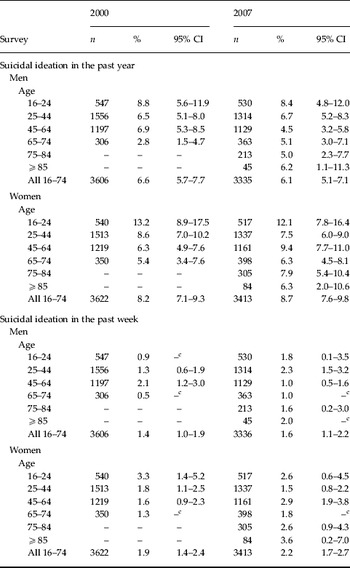
In the 2000 survey 7247 adults aged 16–75 years were interviewed in English private households; of these, 6799 aged 16–71 years comprised complete 7-year age/sex groups and were included in the pseudo-cohort analysis. In 2007, 7403 adults aged ⩾ 16 years were interviewed, of whom 6815 aged 16–78 years were included in the pseudo-cohort analysis. The older individuals excluded from the pseudo-cohort analysis are included in the prevalences reported in Table 1. Missing items were few (n = 14 in 2000; n = 16 in 2007) and had no effect on the conclusions. The prevalence of suicidal ideation in the past year increased between surveys in women aged 45–64 years and men aged 65–74 years but decreased in men aged 45–64 years (Table 1). Suicidal ideation in the past week was rare in all age–sex groups.

Trends in the experience of suicidal ideation within the past year
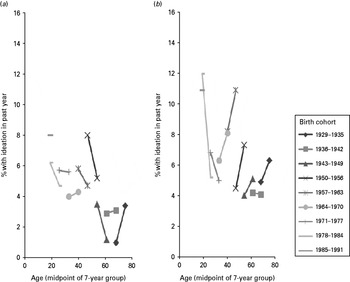
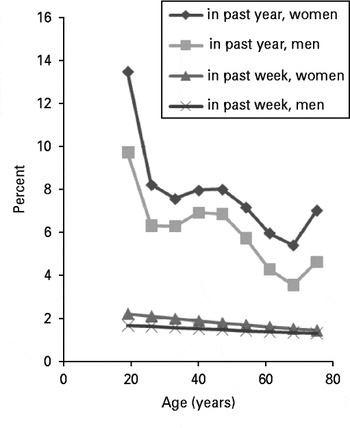
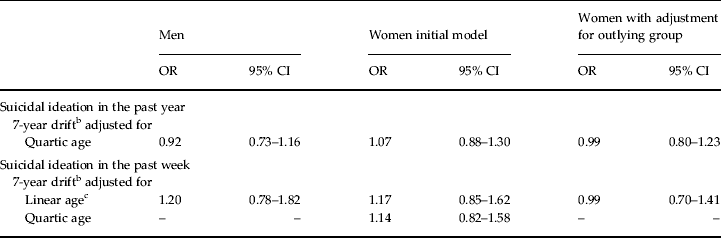
The prevalence of suicidal ideation in the past year declined with age, from around 9% in younger men to around 4% in those aged > 60 years (Fig. 2 a). Without adjustment for survey or birth cohort, there was statistically significant evidence of a quartic relationship of log-odds of ideation with age. Smoothed prevalence (Fig. 3) was high during the transition to adulthood, and then declined into the thirties, before a shallower peak in the forties. Declining prevalence across the fifties and sixties was followed by a somewhat increased prevalence in the oldest groups. There was no evidence of a regular trend by survey year or birth cohort, either in the whole dataset (Table 2), or when the term for drift was allowed to vary across the three 21-year age groups (p = 0.49 for age by drift interaction). Men aged 44–50 in 2000 had an unusually high prevalence, with 9.2% having suicidal thoughts in the past year, compared to a predicted value of 7.0% from the final model.
Prevalence of suicidal ideation in the past year by age for (a) men and (b) women. Data are weighted to represent the English household population of comparable age at time of survey.

Smoothed age profiles of prevalence of suicidal ideation by sex, for the median cohort born 1957–1963 with outlying group accounted for.


The prevalence of suicidal ideation in the past year also declined across the age groups in women (Fig. 2 b). There was a high prevalence in the young, and also an unusually high prevalence in women in the 1957–1963 birth cohort, when surveyed aged 44–50 years in 2007 (12.5% compared to 9.2% predicted from the model with adjustment for quartic age). As in the male population, there was statistically significant evidence for a similar quartic relationship between log-odds of prevalence and age. This remained significant when an indicator variable was included to allow for higher prevalence in the outlying group aged between 44 and 50 years in 2007. There was no evidence of drift either in the dataset as a whole (Table 2) or when the value of drift was allowed to vary by 21-year age group (p value for age by drift interaction 0.06, or 0.21 after accounting for the outlying group).
Trends in the experience of suicidal ideation within the past week
The prevalence of suicidal ideation in the past week varied around an average of 1.5% [95% confidence interval (CI) 1.2–1.9] in men and 2.0% (95% CI 1.7–2.4) in women but with no statistically significant evidence of systematic variation by age, or of a regular trend by survey year or birth cohort (Table 2).
As with ideation in the past year, suicidal ideation in the past week was unusually frequent in women born between 1957 and 1963, when surveyed aged 44–50 years in 2007 (4.4% compared to the female average of 2.0%). Prevalence was also high for women born between 1978 and 1984 when surveyed in 2000 (3.8%). There was statistically significant evidence of a quartic relationship between log-odds of suicidal ideation in the past week and age in women, with no adjustment for survey or birth cohort, but this was attributable to the outlying group. There was no significant association of prevalence of suicidal ideation with age once the outlying group was accounted for. There was no evidence of regular trends by survey or birth cohort, regardless of the adjustment for the outlying group (Table 2).
Our measure of suicidal ideation combines suicidal thoughts, death wishes and tiredness of life. To investigate the possibility that tiredness of life is a different construct, we repeated the analysis defining suicidal ideation as suicidal thoughts or death wish, with largely unchanged results. We also analysed the prevalence of suicidal thoughts in the past year separately. Findings were again largely unchanged, except that women aged 37–43 years and also those aged 44–50 years had unusually high prevalence of suicidal thoughts in the past year when surveyed in 2007. These analyses are described in the online supplement.
Discussion
Suicidal ideation is the ground from which suicidal behaviour emerges. Thus, in the World Mental Health Surveys, the conditional probability of reporting any suicide attempt among those with lifetime suicidal ideation was 29% (Nock et al. Reference Nock, Borges, Bromet, Alonso, Angermeyer, Beautrais, Bruffaerts, Chiu, de Girolamo, Gluzman, de Graaf, Gureje, Haro, Huang, Karam, Kessler, Lepine, Levinson, Medina-Mora, Ono, Posada-Villa and Williams2008). Similarly, around a third of those who reported suicidal ideation in the APMS 2000 also reported a lifetime suicide attempt (Singleton et al. Reference Singleton, Bumpstead, O'Brien, Lee and Meltzer2001).
We therefore hypothesized that suicidal ideation would decline in parallel with recent reductions in suicide over the period from 2000 to 2007. In fact, we found no evidence of a declining trend in ideation by survey or birth cohort. The prevalence of past-year suicidal ideation followed a W-shaped profile with age in both surveys. However, in 2007 there was a very high prevalence in women born between 1957 and 1963 (then aged 44–50 years). When analysis was restricted to suicidal thoughts in the past year, the high risk in 2007 extended to women aged 37–43 years. The prevalence of suicidal ideation in the past week did not vary systematically by age group, except for the high prevalence in the same outlying group of women aged 44–50 years.
A peak in suicidal ideation in adolescence has also been reported in other studies (Värnik et al. Reference Värnik, Kõlves, Allik, Arensman, Aromaa, van Audenhove, Bouleau, van der Feltz-Cornelis, Giupponi, Gusmão, Kopp, Marusic, Maxwell, Oskarsson, Palmer, Pull, Realo, Reisch, Schmidtke, Pérez Sola, Wittenburg and Hegerl2009). A W-shaped pattern similar to our results, with a peak in adolescence and a shallower peak in the early forties, was found in the cross-sectional US National Comorbidity Survey (Kessler et al. Reference Kessler, Borges and Walters1999).
The period from 2000 to 2007 was one of moderate decline in suicide rates for men and for women aged 15–44 years and ⩾ 75 years (Fig. 1). During this period the peak age for female suicides switched from those aged ⩾ 75 years to those aged 45–54 years, consistent with the high prevalence of suicidal ideation in middle-aged women in the 2007 survey. Major depression in women peaks in the perimenopause (Desai & Jann, Reference Desai and Jann2000). However, we found the excess prevalence of suicidal ideation was much larger in middle-aged women in 2007 than in 2000. In the 2000 survey, the prevalence peak of suicidal ideation in early middle age is of similar magnitude in men and women.
The decline in male suicide rates is plausibly attributable to favourable changes in known risk factors such as unemployment, substance misuse and antidepressant prescribing (Biddle et al. Reference Biddle, Brock, Brookes and Gunnell2008), but it is not reflected in trends in suicidal ideation. Our findings therefore suggest that the decline in suicide rates could be due to a reduction in rates of progression from ideation to achieved suicide, rather than in the frequency of ideation. This is consistent with emphasis in the national strategy on vulnerable groups, as is the reduction in non-fatal self-harm reported in three centres in England (Bergen et al. Reference Bergen, Hawton, Waters, Cooper and Kapur2010). As vulnerable groups are relatively small, progression to self-harm or suicide may be reduced while the overall prevalence of suicidal ideation remains largely unchanged. Reducing access to the means of suicide is important in suicide reduction strategies and may be particularly relevant. During 2005–2007, co-proxamol was withdrawn from use because of frequent association with fatal self-poisoning; this led to a major reduction in deaths from analgesic poisoning, and was associated with an overall reduction in probable suicide by self-poisoning in the 3-year period (Hawton et al. Reference Hawton, Bergen, Simkin, Wells, Kapur and Gunnell2012).
The relative disconnection between the stable prevalence of suicidal ideation and the declining suicide rates might lie in changes in suicide reporting practice; in particular, coroners' increasing use of narrative verdicts may affect the validity of official statistics adversely (Carroll et al. Reference Carroll, Hawton, Kapur, Bennewith and Gunnell2012). Furthermore, there is recent evidence that a high proportion of deaths from poisoning and hanging that receive accidental verdicts are found, when subjected to clinical review, to be suicides (Gunnell et al. Reference Gunnell, Bennewith, Simkin, Cooper, Klineberg, Rodway, Sutton, Steeg, Wells, Hawton and Kapur2012). It is also possible that declining suicide rates at a time of constant ideation prevalence may be attributable to environmental effects that are independent of prevention strategies. However, similar trends in suicide in young males in Germany, Scotland and Spain have been attributed to national action on suicide prevention (Värnik et al. Reference Värnik, Kõlves, Allik, Arensman, Aromaa, van Audenhove, Bouleau, van der Feltz-Cornelis, Giupponi, Gusmão, Kopp, Marusic, Maxwell, Oskarsson, Palmer, Pull, Realo, Reisch, Schmidtke, Pérez Sola, Wittenburg and Hegerl2009).
Strengths and limitations
This study provides unique evidence from two national population-based surveys, with comparable measures of suicidal ideation spanning 7 years, enabling examination of trends. Restriction to two cross-sections meant that the pseudo-cohort analysis was limited, and we were unable to investigate differences in prevalence of suicidal ideation between specific birth cohorts. In particular, the finding of increased ideation in the oldest groups is largely due to those aged 72–78 when surveyed in 2007. Although no significant trend in prevalence was found, the analysis does leave open the possibility of some decrease. At the lower limit of the 95% CIs, the odds ratio for 7-year drift in prevalence of ideation in the past year is 0.73 for men and 0.80 for women. This amounts to a decrease of between 0.7 and 2.5 percentage points in prevalence between 2000 and 2007 across the age–sex groups in Table 1. Statistical power was particularly limited in the analysis of suicidal ideation in the past week, and clinically important trends in this measure may have been missed.
As with any comparison across limited time points, the results may be confounded by short-term fluctuations and trends in intervening years may have been missed.
Although national surveys generate data on large representative samples, there is some concern about falling response rates (Gunnell et al. Reference Gunnell, Bennewith, Simkin, Cooper, Klineberg, Rodway, Sutton, Steeg, Wells, Hawton and Kapur2012). The 2007 survey obtained a response rate of 57%, although 70% of those successfully contacted did participate. However, bias was reduced by sophisticated weighting procedures. In addition, recent analyses of Scandinavian surveys indicate very little non-response bias on a wide variety of physical and mental health measures (Korkeila et al. Reference Korkeila, Suominen, Ahvenainen, Ojanlatva, Rautava, Helenius and Koskenvuo2001; de Leeuw & de Heer, Reference de Leeuw, de Heer, Groves, Dillman, Eltinge and Little2002; de Winter et al. Reference de Winter, Oldehinkel, Veenstra, Brunnekreef, Verhulst and Ormel2005).
The prevalence of self-reported suicidal ideation may have been an underestimate, being based on face-to-face questioning. In 2007, the survey included a question on lifetime suicidal thoughts that was later repeated in a section of the interview completed on a laptop computer by participants themselves, a technique specifically designed to increase frankness and, thereby, accuracy (McManus et al. Reference McManus, Meltzer, Brugha, Bebbington and Jenkins2009). The reported prevalence of lifetime suicidal thoughts was indeed somewhat higher for the self-completion procedure than for the face-to-face questioning (16.7% v. 13.7%). Of note, the discrepancy in prevalence between these two methods varied demographically, being greater most particularly in women aged 23–29 years, where the level of under-reporting was a third (16.4% compared to 24.4% on self-completion; see supplement for details). Some of the observed fall in the past-year prevalence of suicidal thoughts between the teenage years and the twenties may be due to a change in reporting behaviour as people enter adulthood. In older people (men > 64 years and women > 72 years), prevalence in the self-completion was similar to or less than in the interview.
It should be noted that we had no measures of the intensity, frequency or intrusiveness of suicidal ideation. Thus it is possible that these aspects of suicidal ideation had improved, even though the proportion of people reporting suicidal ideation remained constant.
People living in institutions, including prisons, were not covered in these surveys and are likely to have higher rates of suicidal ideation (Gill et al. Reference Gill, Meltzer, Hinds and Petticrew1996; Singleton et al. Reference Singleton, Meltzer, Gatward, Coid and Deasy1998; Jenkins et al. Reference Jenkins, Bhugra, Meltzer, Singleton, Bebbington, Brugha, Coid, Farrell, Lewis and Paton2005). However, these groups are too small to affect national trends.
Implications
The findings of this study have significant implications, especially for three groups: younger men, women aged 44–50 years, and the very elderly (aged ⩾ 80 years).
Despite the fall in younger male suicide in England up to 2007, young men still had the highest suicide rates. The prevalence of suicidal ideation remained high in these men during this period of relative economic stability. In the current economic and financial crises, rising unemployment has particularly affected young people. Economic conditions, and in particular unemployment rates, are known to have a major influence on suicide incidence (Gunnell et al. Reference Gunnell, Platt and Hawton2009; Meltzer et al. Reference Meltzer, Bebbington, Brugha, Jenkins, McManus and Dennis2011). During 2008, suicide in younger males increased, and the finding of persisting high prevalence of suicidal ideation in this age group imparts an even greater urgency to the delivery of an appropriate suicide prevention strategy to minimize the impact of such economic adversity.
The finding of a high prevalence of suicidal ideation (past year and past week) for women aged 44–50 years could represent an emerging trend towards poor mental health in middle-aged women or a quirk of sampling. However, women aged 40–49 years had the highest female suicide rates in England in 2007. In addition, the highest prevalence of common mental disorder was also observed in this age–sex group in the APMS 2007 (McManus et al. Reference McManus, Meltzer, Brugha, Bebbington and Jenkins2009; Spiers et al. Reference Spiers, Bebbington, McManus, Brugha, Jenkins and Meltzer2011). The presence of common mental disorder was strongly associated with suicidal ideation in the NPMS 2000 (Bebbington et al. Reference Bebbington, Minot, Cooper, Dennis, Meltzer, Jenkins and Brugha2010). In the 2007 survey, more than three-quarters of adults with common mental disorders were not in receipt of medication or counselling. This further emphasizes the importance of systematic assessments to ensure early diagnosis, and of easier access to brief evidenced-based treatments in the primary health care setting, including psychological therapies (NHS, 2012).
Targeting high-risk groups in particular has been shown to be effective, and was a key focus of the first suicide action plan in England (White et al. Reference White, Bickley, Roscoe, Windfuhr, Rahman, Shaw, Appleby and Kapur2012). The newly launched second-generation strategy for preventing suicide in England also includes improving mental health for specific groups (Department of Health, 2012). Included in this domain are: older people with depression, disability and chronic painful conditions; younger people vulnerable due to social and economic circumstances; and people with untreated depression. All these areas have been highlighted as important in our study; it is vital that they remain a focus of attention within the suicide prevention strategy.
Conclusions
There is no evidence for a hypothesized decrease in the prevalence of suicidal ideation between 2000 and 2007, despite the apparent decline in suicide rates. Groups consistently vulnerable to suicidal ideation comprise those in the transition to adulthood, in early middle age, and over 70 years old. High levels of suicidal ideation in women aged 44–50 years when surveyed in 2007 may be a cause for concern, with important implications for availability and access to systematic assessment and treatment in primary care.
Supplementary material
For supplementary material accompanying this paper visit http://dx.doi.org/10.1017/S0033291713000317.
Acknowledgements
We thank the participants and interviewers of the NPMS 2000 and the APMS 2007.
We sadly report that Howard Meltzer, our co-author, colleague and friend, died on 23 January 2013.
Declaration of Interest
None.