Writing in Ugarit at the end of the Late Bronze Age
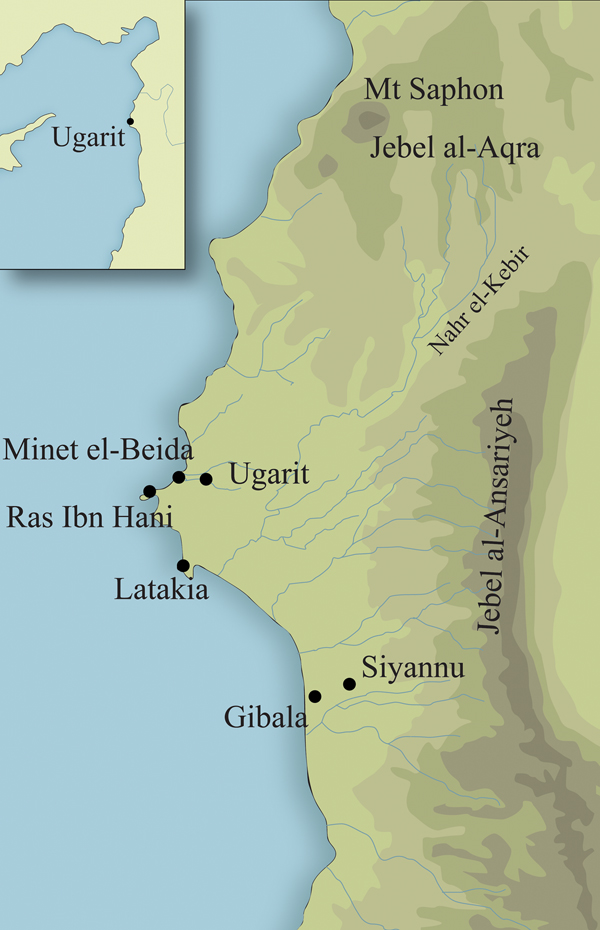
The city of Ugarit lies at modern Ras Shamra, near the Syrian coast and not far from modern Latakia (Fig. 1). In the Late Bronze Age it was the capital of a small but important kingdom bounded to the north and east by the Jebel al-Aqra and Jebel al-Ansariyeh mountains, respectively. Its southern border is less well defined, but ancient Gibala (modern Tell Tweini) was probably one of its most southerly holdings. Ugarit's political situation is the focus of much of the discussion in this paper, but it may be helpful to non-specialists to state at the outset that, like many Levantine polities, it found itself charting a course between the regional superpowers of the Hittite Empire, Egypt and Assyria. Despite a strong earlier connection with Egypt, from around the mid fourteenth century bc onward, Ugarit was a Hittite vassal.
The Kingdom of Ugarit in the Late Bronze Age. (Drawing: author, based on Calvet Reference Calvet, Matoïan, Al-Maqdissi and Calvet2012, fig. 1.)

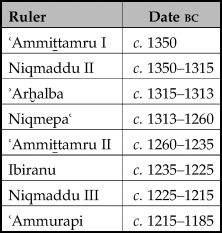
Excavations began at Ugarit and its port, Minet el-Beida, in 1929 under the directorship of Claude Schaeffer, and have continued with only relatively brief interruptions ever since, first under French control and latterly as a joint Syro-French undertaking. Almost at once, the site rose to great prominence because of the discovery of significant quantities of clay tablets and other written materials. These are split roughly equally between Akkadian, in standard logo-syllabic Babylonian cuneiform, and the previously unknown Alphabetic Cuneiform script, used mainly to write the local Ugaritic language, which is closely related to Phoenician and Hebrew. Although these account for the vast majority of textual material from the site, there are also texts in Hurrian, Sumerian, Hittite, Luwian, Egyptian and Cypro-Minoan, utilizing a broad range of writing systems. The question of dating the written material will be discussed at greater length below, but for now it will suffice to say that all the tablets date to the Late Bronze Age (see timeline, Table 1), and these various writing systems were in use simultaneously by the time of Ugarit's destruction around 1185 bc.
Kings of Ugarit during the period documented by Akkadian and Ugaritic texts. King numbers are conventional, but variations are occasionally seen. King-lists attest numerous rulers before these, apparently stretching back centuries. These are less pertinent to this paper and the exact reconstructions and their dates are debated, so they are excluded here for brevity.

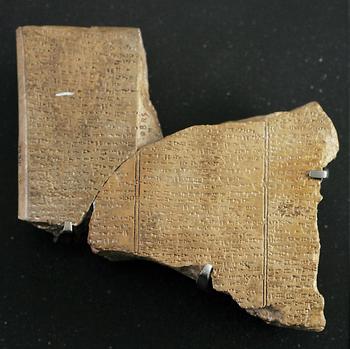
The number of texts from Ugarit is now in the thousands, and covers a spread of genres. Most celebrated are the famous mythological and religious compositions in Alphabetic Cuneiform (Fig. 2), which have attracted considerable attention due to their parallels with certain passages from the Bible and the evident connection of the underlying mythology. These are, however, considerably outnumbered by hundreds of mundane administrative and economic documents and plentiful letters in both Ugaritic and Akkadian. As the lingua franca for the Late Bronze Age Near East, Akkadian was predominantly used for international correspondence, while letters in Ugaritic are presumed to be from within the city, or at least the kingdom. There are also a much smaller number of inscriptions—mostly in Ugaritic—which appear on objects other than tablets, such as seals, labels, offerings (such as a cache of bronze tools bearing dedications), and ivory livers presumed to have been used in divination.
A tablet of the epic of Baʿal. Alphabetic Cuneiform/Ugaritic. Musée du Louvre, Paris. (Image from Wikimedia Commons user Rama, CC BY-SA.)

Although a large proportion of Ugarit's written material was discovered in the Royal Palace, around 11 other archives or libraries have been identified in other locations all over the tell, and written material has also come to light at the neighbouring sites of Ras Ibn Hani and Minet el-Beida. Many of the archives were in buildings which have been identified as private residences, although they include material which we might wish to see as ‘official’, such as royal diplomatic correspondence. Consequently, the occupants of many of these homes are generally believed to have been senior officials, with their archives relating to both their public and private activities without any distinction between them. Some of these people also seem to have served as teachers to apprentice scribes, to judge from the numerous scribal exercises found at various locations across the city.
The Alphabetic Cuneiform writing system is not entirely unique to Ugarit—a handful of inscribed objects have been found elsewhere in the Levant, and even one item as far afield as Tiryns in Greece—but these are few and extremely non-standard. They generally attest a smaller repertoire of signs, less fixed writing-direction (standard Alphabetic Cuneiform is left-to-right) and a number of variant signs. Most are found on items other than purpose-made tablets.Footnote 1 The large-scale use of Alphabetic Cuneiform by a state and its formally trained scribal infrastructure is, so far as we currently know, a phenomenon confined to Ugarit in the Late Bronze Age Levant.Footnote 2
The alphabet in the Late Bronze Age Levant
The use of Akkadian in Ugarit is typical of the Near East in this period; the use of the Alphabetic Cuneiform writing system is not. Its origins and the reasons for its official adoption by the Ugaritian state are matters of considerable debate, which have far-reaching implications for our understanding of both the history of writing (and the alphabet in particular) and the society and culture of Ugarit itself in the Late Bronze Age.
This discussion feeds into a wider conversation about the status of alphabetic writing more generally in the Late Bronze Age Levant. The linear alphabet is first attested in the so-called ‘Proto-Sinaitic’ inscriptions found in the Sinai peninsula and the Egyptian desert, and widely dated to the early second millennium bc (for up-to-date summaries, see Haring Reference Haring, de Jong, van Gool and Moors2015 and Reference Haring, Boyes and Steeleforthcoming). A number of inscribed objects from across the southern Levant attest its continued use and development during the second millennium (when it is generally known as ‘Proto-Canaanite’), culminating in a relatively standardized Phoenician script being used for royal inscriptions at Byblos around the tenth century bc. Unfortunately, the scarcity and lacunosity of the Late Bronze Age data do not permit many firm conclusions to be drawn beyond the existence of active experimentation with the linear alphabet in the Levant at this time; there is considerable debate about the extent and level of its adoption. Some, such as Zamora López (Reference Zamora López and Michaud2007), have argued that there may have been widespread official use of the linear alphabet in a form analogous to the use of the cuneiform alphabet at Ugarit, but that this material does not survive because the natural medium for such writing would be perishable materials, such as paper or parchment. This is plausible, but lacks firm evidence to support it. Another possibility is that experimentation in the linear alphabet was relatively low-level and substrate, and was not subject to official adoption by states before the tenth century. This would fit well with the diverse and unstandardized nature of the objects inscribed in Proto-Canaanite, as well as the lack of any monumental inscriptions, but, again, cannot be definitively proven. A final suggestion has been advanced primarily by Benjamin Sass (Reference Sass2005; Reference Sass2017; Finkelstein & Sass Reference Finkelstein and Sass2013), who believes the linear alphabet did not spread beyond the region of the Shephelah and Philistia in the southern Levant before the ninth century bc, and that it was subsequently subject to extremely rapid adoption, standardization and development into regional scripts. This has to be considered less likely for a number of reasons beyond the scope of this paper (but see Rollston Reference Rollston2008).
There are definite signs that Alphabetic Cuneiform was developed by someone familiar with the linear script: it essentially shares the same repertoire and order (although with slightly more signs than are present in first-millennium alphabets from Phoenicia and the southern Levant, since the Ugaritic dialect does not seem to have undergone some sound mergers seen in Canaanite) and many of the signs may be cuneiform adaptations of linear prototypes (Dietrich & Loretz Reference Dietrich and Loretz1988; Stieglitz Reference Stieglitz1971). Although it is often assumed that this adaptation must have taken place in Ugarit itself, this is not actually confirmed.
Given these considerable uncertainties about the wider situation, there is an obvious difficulty in assessing how typical or otherwise the situation in Ugarit was. Nevertheless, both the likeliest possibilities suggest the city was in some way unique: either its use of an alphabetic script for the local language was common in the Levant, but its choice of a cuneiform rather than linear script was not, or it was unique for writing at an official level in an alphabet and local language at all. Either way, unless and until more evidence is available, we must proceed on the basis of what we have: evidence for a large-scale official adoption at Ugarit of an otherwise extremely uncommon writing system, used principally for the local language. This is a privileging of the vernacular that was without parallel elsewhere in the Near East.
In seeking reasons for Ugarit's adoption of alphabetic cuneiform, there is occasionally discussion of the perceived advantages of the alphabet over logo-syllabic cuneiform: ostensibly it is simpler, easier to learn, and by adopting a cuneiform rather than linear version of the alphabetic principle, it was easy for existing scribes familiar with Akkadian to adapt to it without requiring a wholesale change in their methods. This may well be true, although we should perhaps be cautious of assuming that features such as efficiency or ease of learning were as valued in the Late Bronze Age Near East as they are by us today. But there is no question that implementing such a large-scale change in writing practices must also have had an important ideological component; as is shown amply by modern cases where societies have chosen between multiple potential writing systems (see contributions to Grivelet Reference Grivelet2001), the perceived advantages or disadvantages of the script itself often take a back seat to questions of ideology, identity and other aspects of culture. It is on these that I will focus in this paper.
Ugarit, Akkadian and the ‘vernacular revolution’
Previous discussions of these issues have rightly seen the adoption of alphabetic cuneiform as an important indicator of Ugaritian responses to the city's place within the cosmopolitan, global system of the ancient Near East. As Sanders puts it, ‘Ugarit seems to be the first known society to have produced a written vernacular literature, and to have created a writing system especially for it. […] The cosmopolitan scribes of Ugarit deliberately, and uniquely, made their writing system local.’ (Sanders Reference Sanders2004, 46).Footnote 3
Similar ideas have been put forward by Hawley, Pardee and Roche-Hawley:
[I]n fostering and implementing the development of a local alphabetic written tradition for the vernacular language, they were also insisting on their apartness, in affirming their specific regional and cultural identity with respect to their neighbors. This situation, too, prefigures Iron Age developments in the history of writing and scholarship in the Eastern Mediterranean. (Hawley et al. Reference Hawley, Pardee and Roche-Hawley2015, 236)
The East Mediterranean Late Bronze Age is a cultural and political milieu which, at least to modern scholarly eyes, can seem dominated by the supraregional and international, so this recognition of the significance of Ugarit's choice to elevate the local vernacular is an extremely important one. It places the rise of Ugaritic as a written language, and the emergence of a standardized, establishment version of Alphabetic Cuneiform with which to write it, squarely in the realm of post-colonial theory (Bhabha Reference Bhabha1994; for more archaeology-focused discussions, see Areshian Reference Areshian2013; Gosden Reference Gosden2004; Lyons & Papadopoulos Reference Lyons and Papadopoulos2002; and for linguistic, Schmidt-Brücken et al. Reference Schmidt-Brücken, Schuster and Wienberg2016); we can view it in terms of a dialectic between dominant external cultural and political influences and the subaltern local. Indeed, much has been written by post-colonial theorists on the great importance of language choice and official recognition, and of the weighty ideological and practical issues entangled in vernacularization (Kamwangamalu Reference Kamwangamalu, Bayley, Cameron and Lucas2013, with further references). As Kamwangamalu points out, these include not just the ideological baggage of the hegemonic and vernacular languages themselves, but also wider questions relating to the diverging but entangled urges towards the global and the local, an intertwining that has been called ‘glocalization’ in modern theoretical works on globalization (Caldwell & Lozada Reference Caldwell, Lozada and Ritzer2008).
For Sanders, and subsequently Morrow (Reference Morrow2008), this ‘vernacular revolution’ (Sanders Reference Sanders2004, 26) was mainly a reaction to cultural rather than political hegemony, namely the introduction of Mesopotamian scribal culture and accompanying Akkadian language that were virtually synonymous with Late Bronze Age globalization, statehood and literary prestige. While not wrong, this correspondence is rather less straightforward than they present it, not least due to chronological issues. Morrow in particular makes two rather doubtful assumptions with regard to Ugaritian writing: first, that Akkadian and the associated scribal culture were late introductions to the city, coming in the fourteenth century (Morrow Reference Morrow2008, 334); and second, that Ugaritic and its Alphabetic Cuneiform writing system were also adopted at this time as part of a parallel but opposed process.
Let us tackle these in turn. The idea of a fourteenth-century origin for Akkadian scribal culture in Ugarit is an attempt to explain one of the great puzzles of Ugarit studies: the absence of surviving Akkadian tablets from the city from before the mid fourteenth century. There is, however, evidence that Akkadian was used in the city before this point: namely the dynastic seal used by successive Ugaritian kings. This is inscribed, in Old Babylonian Akkadian, with the name of a king Yaqaru,Footnote 4 whose reign is variously placed between the third millennium bc and around 1500, depending on how one dates the seal iconography and the cuneiform ductus, whether one considers it to be archaizing or genuinely archaic, and what one estimates as an average regnal length when reckoning on the basis of king-lists (see originally Nougayrol Reference Nougayrol1955, xli–xlii, and more recently Vidal Reference Vidal2006 and Di Paolo Reference Di Paolo, Feliu, Llop, Millet Albà and Sanmartín2013, with extensive further references). Although a date around the fifteenth or sixteenth centuries bc seems to be the most plausible, any of the possibilities would put Mesopotamian-style sealing practices and the use of Akkadian cuneiform and language in Ugarit rather before the fourteenth century. We cannot, of course, say how Akkadian was used beyond the category of royal seals, if at all, but this does render impossible the idea that Ugarit's first encounter with cuneiform culture came in the fourteenth century. Additional circumstantial support comes from early references to Ugarit elsewhere in the Near East, such as Zimri-Lim of Mari's visit to the city in the eighteenth century bc (Sasson Reference Sasson, Bagnall, Broderson, Champion, Erskine and Huebner2013) and a letter from Aleppo to Mari which mentions that the king of Ugarit has written to the king of Aleppo expressing an interest in travelling to Mari (Schaeffer Reference Schaeffer1939, 16). Ugarit was evidently literate, in contact with the logo-syllabic cuneiform world and presumably familiar with its scribal culture, at least to some extent.
This leaves us with the unsolved mystery of the lack of surviving Akkadian tablets from before the fourteenth century. One possibility—though not a particularly convincing one—is that all earlier records were destroyed in the fire in the royal palace reported in Amarna Letter EA 151 (Moran Reference Moran1992). Alternatively, we might wonder if it had something to do with Ugarit's incorporation into the Hittite Empire, but it is hard to imagine exactly what might have motivated a wholesale destruction of earlier material (we should hardly picture the chancery staff frantically pulping incriminating documents as the Hittite officials approach the gates). Ultimately, resolving the issue will require further evidence. What is important for the current discussion is that the Akkadian language and Mesopotamian scribal culture are unlikely to have been entirely new introductions to Ugarit in the mid fourteenth century.
The second question surrounds the dating of Alphabetic Cuneiform. Sanders repeats the traditional view: that the earliest datable text in this writing system is the Baʿal Cycle (KTU 1.1-6),Footnote 5 and that it was composed in the mid fourteenth century under the reign of the same Niqmaddu (II: see Table 1) who took Ugarit into the Hittite sphere of influence, and to whose reign are dated the earliest surviving Akkadian tablets. It made sense at the time to assume that both sets of documents began simultaneously. In this interpretation, the Baʿal epic stands as a magnificent piece of foundational literature akin to Homer in Greek, first and greatest exemplar of what the writing system was capable of and intimately bound up in the ethnic and ideological implications of the language and writing systems themselves (Sanders Reference Sanders2004, 45).
While there remains debate on the issue, and it cannot be proved conclusively, most Ugaritic scholars, including myself, now take a differing view, dating the Baʿal tablets, and Alphabetic Cuneiform in general, around a century later, to the second half of the thirteenth century, and thus the city's final decades (Bordreuil & Pardee Reference Bordreuil and Pardee2009; Hawley et al. Reference Hawley, Pardee and Roche-Hawley2015; Pardee Reference Pardee and Miller2007). At the centre of this re-dating is the scribe responsible for the Baʿal tablets, named in the colophon as ʾIlimilku the Šubbanite, pupil of ʾAttenu the Diviner and said to be working during the reign of King Niqmaddu. In 1988 and 1992, archaeologists excavated the building known as the House of Urtenu, which contained an archive that can be firmly dated to the end of Ugarit's existence, based on archaeology, the events described in the texts and the people involved, such as the Egyptian pharaoh Merneptah. Among these texts was a fragmentary colophon, which, while missing the scribe's actual name, nevertheless matched the rest of the titles of ʾIlimilku the Šubbanite, including the name of his teacher (KTU 1.179).Footnote 6 It therefore seems most likely that the Baʿal tablets were actually written at the end of the thirteenth century, under the reign of Niqmaddu III (Dalix Reference Dalix1997). This meant that the Baʿal myths could no longer be considered the oldest Ugaritic texts, but rather among the last. The first unambiguously dated material in the Alphabetic Cuneiform script now comes from the reign of ʿAmmittamru II (c. 1260–1230).
These two facts create a significant separation between the origins of Akkadian and Ugaritic in the city, which makes far more sense given that much of the development of Ugaritic, from tablet types to working methods, implies a prior familiarity with the Mesopotamian cuneiform tradition. But if these two writing systems can no longer be considered twin outcomes of an Ugaritian encounter with Mesopotamian scribal culture in the fourteenth century, this is not to say that a reaction against the global cultural dominance of Akkadian did not factor into the decision to adopt and promulgate Ugaritic. Rather, the correlation is less clear-cut and we must ask ourselves what changed in Ugarit's final decades that led its élites and scribes to begin this ‘vernacularization’. To answer this, we must look to Ugarit's colonial encounter not with Mesopotamia, but with the Hittites.
Ugarit and the Hittites: domination and resistance
In contrast to much scholarship about ancient Near Eastern imperial encounters, previous discussions have generally been fairly good at considering Ugaritian agency alongside that of the imperial power; probably because there is far more documentation on the subject from Ugarit itself than there is from Ḫattuša.Footnote 7 It is only recently, however, that the question has been directly formulated in post-colonial terms as one of power, resistance and negotiated relationship with empire, principally in an article by Claudia Glatz (Reference Glatz and Areshian2013, 46). Glatz utilizes textual sources—which have long been interpreted as showing an increasing assertiveness in Ugarit's dealings with its overlords as the Late Bronze Age neared its end—and iconography, but does not directly address the issue of writing system or language. Before we move on to considering how the themes of resistance and negotiation identified by Glatz and others might fit in with the ‘vernacularization’ observed by Sanders and others, it is helpful to present a brief summary of Ugarit's imperial entanglement with the Hittites.
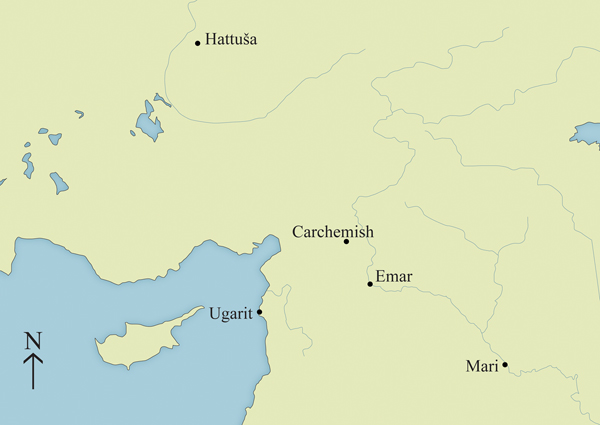
Regional map with sites mentioned in the text. (Drawing: author.)

Apart from one Amarna letter,Footnote 8 Ugarit's surviving written history begins during the reign of Niqmaddu II, not long before its incorporation into the Hittite Empire. This can make it difficult to compare the city's history under Hittite suzerainty with what came before, especially given the poor publication of material culture from key parts of the site, such as the Royal Palace. What does seem clear is that, like other Levantine coastal polities, Ugarit enjoyed a close relationship with Egypt and that its élites talked the talk of vassalage when it suited them, even if any direct political control by Egypt seems unlikely.Footnote 9
The exact circumstances of Ugarit's incorporation are somewhat unclear from the texts that remain to us, but it appears that the proximate cause was hostile action by neighbouring Syrian polities. Ugarit was never militarily strong, and appealed to Hatti for aid. More long-term, both the internecine strife and Ugarit's response seem to have arisen out of growing Hittite expansion into north Syria, both directly and through political influence at a distance. Niqmaddu's decision to invite the Hittites in is generally seen as a bowing to the inevitable, the Ugaritian king having the good sense to jump before he was pushed.Footnote 10
It may have had little choice, but, nominally at least, Ugarit came under Hittite control peacefully and at its own request, and this does seem to have counted for something. The treaty granted the city a significant expansion in territory at the expense of neighbours who had been less perspicacious in crossing over to the Hittite banner in a timely fashion. This goodwill seems to have been tested early on, with Niqmaddu II's son ʾArḫalba apparently doing something sufficiently unacceptable to the Hittites that he was deposed and replaced by his brother Niqmepaʿ; most scholars assume he joined or supported the neighbouring state of Nuhašši's rebellion. The treaty between Niqmepaʿ and Muršili II, reconfirming Ugarit's vassalage, also transferred Ugarit's own vassal Siyannu-Ušnatu into the direct supervision of Carchemish, reducing Ugarit's territory by around a third (Singer Reference Singer, Watson and Wyatt1999).
Even after this early wobble, the Hittites were unwilling to interfere overmuch in a successful and prosperous trading centre whose profits could be harnessed to their needs.Footnote 11 As with other Syrian vassals, for example, they did not impose their own system of weights and measures (Monroe Reference Monroe2009, 51ff). Politically, directives were occasionally sent from Ḫattuša, or, more commonly, from the Great King's viceroy at Carchemish; and Hittite imperial agents such as the ‘Sons of the King’ (DUMU.LUGAL)Footnote 12 did intervene in Ugarit from time to time. However, there seems to have been less direct imperial bureaucracy in place at Ugarit than at some other Syrian vassal polities. In the archives of Emar,Footnote 13 for example, we read of the ‘Overseer of the Land’ (UGULA.KALAM.MA), a high-ranking and apparently peripatetic imperial official with fingers in many pies, from administrative and judicial oversight to intelligence gathering and even cult practice, possibly comparable in role to the ‘Lord of the Watchtower’ (bēl madgalti) who acted as a district governor for directly administered territory in Anatolia proper (Beckman Reference Beckman, Chavalas and Hayes1992, 47; Reference Beckman, Carruba, Giorgieri and Mora1995, 28). There seems to have been no equivalent post in Ugarit, with these responsibilities remaining within the purview of the Ugaritian king. When a higher authority was needed, this was usually the king in Carchemish rather the Great King at Ḫattuša himself, although some important matters with diplomatic implications, such as the scandal surrounding ʿAmmittamru II's divorce (see below), did make it all the way to the court in Ḫatti.
But we should not assume that the Hittites afforded Ugarit's rulers an entirely free hand. The removal of ʾArḫalba was ample proof that local kings ruled under the sufferance of their overlord, and that failure to fulfil the Great King's wishes could lead to swift regime change. What the Great King gave, he could also take away: boons of territory or excusal from providing military assistance proved short-lived and were reversed when circumstance demanded, or to punish perceived insubordination.Footnote 14 The most constant burdens, however, and—if surviving correspondence is any indication—the ones that seem to have chafed the Ugaritian kings the most, were the routine tribute demands and the requirement that vassals present themselves regularly at the court of their overlord. Ḫatti's treaties with Ugarit stipulated an extremely high level of tribute even by the standards of Syrian vassals, and lend credence to the notion that their relatively light touch was motivated by a reluctance to jeopardize the smooth running of Ugaritian trading operations whose profits they intended to reap for themselves. Dissatisfaction with Ugarit's fulfilment of these obligations is a recurring feature of correspondence from Carchemish and Ḫattuša, and on more than one occasion is accompanied by complaints that the Ugaritian king has failed to visit the court. One of the more notable of these complaints is that of the Hittite prince (or Son of the King) Piḫawalwi (RS 17.247), who pointedly omits King ʾIbiranu's title and scolds him for both inadequate tribute and failure to visit the Great King at any point since his accession to the throne.
The relationship between Ugarit and its overlords was thus nuanced, and both sides (all three, if we include Carchemish as a player in its own right, as we should) had to walk a line whereby they could assert themselves and seek to improve their position without jeopardizing valued benefits—the fruits of Ugaritian prosperity for the Hittites: comparatively hands-off rule and regional peace and stability for Ugarit (Glatz Reference Glatz and Areshian2013, 30). Political resistance to Hittite domination in Ugarit was therefore, as Glatz puts it (Reference Glatz and Areshian2013, 31), less overtly aggressive, characterized by evasion, insubordination and negotiation.
As we have mentioned, however, there are signs that Ugarit became willing to flex its muscles and test the boundaries of Hittite forbearance more and more openly as the thirteenth century progressed. ʿAmmittamru II's disastrous marriage to an Amurrite princess is the first major sign of this. It seems likely that this woman (whose name is not preserved) was a granddaughter of the Hittite Great King as well as daughter of the king of Amurru, and so the marriage was something of a diplomatic coup for Ugarit, recognition of its standing. Unfortunately the woman committed, or at least was accused of committing, some misdemeanour against the king, the nature of which is also not preserved, but usually assumed to be political plotting or adultery. ʿAmmittamru divorced her and sent her home to Amurru, but then thought better of it and began proceedings to have her extradited back to Ugarit for further punishment. The legal wrangling lasted for years and is documented in at least 15 separate documents, eventually culminating in ʿAmmittamru paying her brother Šaušgamuwa, king of Amurru, a vast sum of blood money for the right to do what he wanted to her. Apart from being a major diplomatic mess, the scandal also seems to have had implications for the Ugaritian succession: RS 17.159 mentions that the crown prince Utri-Šarruma was given a choice as to whether he wanted to remain loyal to his father or side with his mother and lose his rights to the throne. His decision is not explicitly recorded, but the next king was a different son of ʿAmmittamru, ʾIbiranu (Singer Reference Singer, Watson and Wyatt1999, 681).Footnote 15 ʿAmmittamru's all-consuming rage at his former wife still blazes brightly from the ancient tablets,Footnote 16 and the incident has much to tell us about the treatment of women in the Bronze Age Near East; but it is also clear that this is the behaviour of an assertive king who felt able to throw his weight around on the international stage, even at the risk of upsetting his overlords. And indeed, he got what he wanted. The former queen was returned to Ugarit, where we can assume that nothing good came to her.
It is perhaps surprising is that this was not the last time a king of Ugarit married into the family of the Hittite Great King, and that the next one was even more of an honour for Ugarit. The Akkadian tablets RS 17.226 and RS 17.355, from the reign of Ugarit's last king, ʿAmmurapi, detail the disposition of property of a former Ugaritian queen and daughter of the Hittite Great King, who was leaving Ugarit. It has been thought by some that this marks a second divorce, this time of an even more high-status princess, but Singer (Reference Singer, Watson and Wyatt1999, 702–3) points out that it is not stipulated that the woman has been divorced or that she was ʿAmmurapi's wife. Instead, he proposes that she may have been the widow of the previous king, Niqmaddu III. Even so, for her to leave (be expelled from?) the city after his death, rather than retaining the rank and authority of queen for the remainder of her life, as was normal, seems to be something of a slight, and hints at far more going on in this affair than we are currently able to reconstruct.
Between these two marriage-related incidents are various signs that Ugarit was less than entirely committed to its Hittite alliance. During the reign of ʾIbiranu, tensions were high between the Hittites and Assyria. Ugarit initially managed to secure an excusal from providing military assistance to its overlords, but the decision was soon overturned and a Hittite official was scheduled to visit the city and inspect its forces for combat readiness. It is not clear whether the decisive battle, recounted in RS 34.165, occurred before or after the decision to have Ugarit join the fight after all, but the fact that the events are described to the Ugaritian administration in a letter does imply that their own representatives were not present to report back. What is even more striking is that the letter comes not from the Hittites, but the Assyrians. Singer (Reference Singer, Watson and Wyatt1999, 689) has seen this as an Assyrian attempt to foster closer relations.
Ugarit was also more than capable of making its own diplomatic approaches to potential allies. Following the peace of Qadesh, the traditional enmity between the Hittites and Egypt gave way to a profitable alliance in which Ḫatti became increasingly reliant on Egypt as its main grain supplier. Despite these improved relations, it is still significant when Ugarit makes direct bids to strengthen its ties with its traditional partners in the south. The House of Urtenu has produced tablets of a diplomatic exchange between either Niqmaddu III or, more likely, ʿAmmurapi and the pharaoh Merneptah, in which the Ugaritian monarch requests an Egyptian craftsman to produce a statue of Merneptah to stand in the temple of Baʿal. The pharaoh responds that no-one is available, but nevertheless sends a lavish consignment of diplomatic gifts. For Singer,
this exchange of letters can point to nothing less than a forthright overture to restore the traditional political ties between Egypt and Ugarit, notwithstanding the latter's obligation to her Hittite overlord. Such an official correspondence could hardly have escaped the notice of the Hittite foreign office which operated scores of diplomats and messengers both in Ugarit and in Egypt. (Singer Reference Singer, Watson and Wyatt1999, 711)
It also raises the question of material culture, which is an important index of how the people of Ugarit, both élite and common, sought to define themselves and where their cultural aspirations lay. The dedication by the king of an Egyptianizing statue in one of the city's principal sanctuaries is wholly in keeping with what we can reconstruct from the admittedly rather problematic archaeological record.Footnote 17 Several Egyptian-style statues were found in the temples of Baʿal and Dagan (Callot & Monchambert Reference Callot and Monchambert2011) and even around the time of the Hittite takeover there is the ‘Niqmaddu Vase’, a highly Egyptianizing alabaster vessel, complete with pictorial decoration and a hieroglyphic inscription showing Niqmaddu II marrying a woman depicted as a high-status Egyptian (Feldman Reference Feldman2002). A great deal of ink has been spilled attempting to determine whether this woman was an Egyptian princess (Feldman Reference Feldman2002, with further references)—and if so, how this can be reconciled with Amarna letter EA 4's supposedly iron rule that no Egyptian princess is ever given in marriage to a foreigner—or whether she was a lower-ranking Egyptian lady, or even a local Ugaritian decked out for a classy Egyptian-themed wedding. Less sensational, but nevertheless significant, is the plethora of other Egyptian material, particularly the abundant alabaster vessels which were a hallmark of diplomatic contacts with the pharaonic court. Ugarit has produced more of these than any other site in the Levant for the fourteenth and thirteenth centuries, including many which date from after its becoming a vassal of the Hittites (Sparks Reference Sparks, Matthews and Roemer2003). One example, bearing the cartouche of Horemheb, even points to contacts when the Hittites and Egypt were still bitter enemies.
As Glatz (Reference Glatz and Areshian2013) has pointed out, these strong Egyptianizing elements in élite Ugaritian material culture stand alongside influences from the Aegean and Mesopotamia too, commingling into a hybrid, cosmopolitan Ugaritian material culture style. What is notably absent, however, is much that is definitively Hittite. There are almost no known Anatolian imports at the site and very little in the way of stylistic influence, although there have been some suggestions of architectural influence on Ugarit's fortifications (Maner Reference Maner, Baysal and Karakatsanis2017). What there is cannot easily be dated to the period of political domination (Glatz Reference Glatz and Areshian2013). Even in the rarefied world of high-status administration we find little evidence of Hittite cultural impact. A frequently cited example is sealing practices: other Syrian vassals such as Amurru, Emar, Carchemish and Alalaḫ incorporated Hittite elements into their glyptic repertoires, most notably the use of Luwian hieroglyphics. These are entirely absent at Ugarit, where the only Luwian inscriptions are found in the seals of Hittite letter-writers.
Indeed, the lack of evidence for the use of Hittite language at Ugarit is striking, especially given how polyglot and multiscript the city is otherwise. Not only are there only a very few Hittite texts from the city, which were most likely written elsewhere, but there is also no clear evidence of Hittite grammatical influence on the city's dialect of Akkadian, in contrast to signs of Babylonian, Assyrian and Hurrian impact (Huehnergard Reference Huehnergard1989; Singer Reference Singer, Watson and Wyatt1999, 650).
Like Glatz, I would see the lack of engagement with Hittite culture as a deliberate choice, showing an active negotiation of what vassalage meant on the part of the local élite. Political realities may have meant that it was necessary to toe the Hittite line from time to time, but the effect of Hittite overlordship on Ugaritian culture was relatively shallow, even within élite circles. Among the wider population, inasmuch as lower-status Ugaritian life is recoverable for us, it seems to have been non-existent. Instead, prestige display continued to look towards Egypt, while wider forms of cultural life drew on influences in Mesopotamia and the Mediterranean.
The decline of Bronze Age globalism and the rise of vernaculars
Politically, we might divide Ugarit's relations with the Hittites into two broad phases: early, running from Niqmaddu II to Niqmepaʿ and characterized by relatively close obedience and a strong Hittite response when Ugarit did step out of line; and later, running from ʿAmmittamru II to the end of the city, when Ugarit's kings were increasingly assertive, uncooperative and truculent, and, despite frequent complaints, the Hittite leadership seems to have been willing to tolerate and even indulge this wilfulness. This second phase exactly coincides with the attested use of Alphabetic Cuneiform by the Ugaritian establishment. Should we see this, then, as yet another example of Ugarit trying to carve out its own identity, independent of its supposed masters and apart from the global system of empires and great kings they represented?
Support is lent to such a proposition by similar movements towards the local and the vernacular in other societies around the East Mediterranean, including Ḫatti itself. The Phoenician cities to the south (principally Byblos, Sidon and Tyre), with which Ugarit shared much culturally, seem to be a prime example. I have previously suggested that, at the end of the Late Bronze Age, élites in these polities ceased to aspire to the model of prestige exemplified by Egypt and the Amarna system (Boyes Reference Boyes2013). The poor attestation of the twelfth and eleventh centuries makes it hard to uncover the exact details of this shift, but there are some signs in iconography, burial practice and other areas of culture that there was an initial turn inwards towards Levantine models, and then, in the Early Iron Age, participation in new forms of warrior-trader aristocratic culture that were gaining currency across much of the Mediterranean.
The question of language and writing is very important here, both for understanding the history of the Phoenician cities themselves and to know whether the connection I am suggesting between resistance to imperialism and the adoption of vernacular writing at Ugarit was unique to that city, or merely an unusual cuneiform version of a response common across the region. If use of the linear alphabet was particularly common and long established then, as Zamora López argues (Reference Zamora López and Michaud2007), we might have to conclude that we are not dealing with vernacularization at all, but rather that official use of the vernacular had always been the norm in the Levant.
Unfortunately, as we have already mentioned, the linguistic and scriptal situation of the coastal Levant in this period is extremely uncertain. Like Ugarit, the Phoenician cities wrote logo-syllabic cuneiform for diplomatic purposes, as seen in the Amarna letters, although unlike Ugarit, the language this represented is not anything approaching good Akkadian.Footnote 18 We have no definitive evidence as to whether this was accompanied by large-scale official use of the linear alphabet, or if the latter supplanted the former, and if so, when this transition occurred; only that by the eleventh century just linear, alphabetic Phoenician is attested. The first definitively official appearance of the alphabet and the vernacular language south of Ugarit is on the sarcophagus of Aḥiram, king of Byblos, generally dated to the tenth century, although not without problems (Lehmann Reference Lehmann2005; Reference Lehmann2008; Rehm Reference Rehm2004; Rollston Reference Rollston2008; Sass Reference Sass2017). We are thus forced to reconstruct the Late Bronze Age situations in Phoenicia and the southern Levant from their eventual outcomes, which of course involves much speculation. While the notion of widespread use of the alphabet on perishable materials (but not, apparently, in monumental inscriptions before the Iron Age) is tantalizing, the only firm evidence we have at present is for relatively limited, low-level use of alphabetic writing outside official spheres. At some point before the tenth century, this ‘grass-roots’ use of alphabetic writing seems to have evolved into official adoption. Unlike Ugarit, where the process was curtailed by the destruction of the city, Phoenicia seems, then, to represent the successful ‘vernacularization’ of official language and writing in the transition from Bronze to Iron Age. The same is true of the southern Levant (Sanders Reference Sanders2004).
In Anatolia, Luwian Hieroglyphics gained in popularity from the fourteenth century onwards, and were the only writing system used for monumental inscriptions. It has been suggested that this may indicate that a growing proportion, or even the majority, of the population may have spoken Luwian rather than Hittite; signs of Luwian linguistic interference in thirteenth-century royal inscriptions may indicate that by this time even the élite were effectively bilingual. The choice of Luwian for monumental display has been seen as owing to its visual characteristics; Payne (Reference Payne, Collins, Bachvarova and Rutherford2010, 121) suggests that it was preferred both for being more visually imposing than cuneiform wedges, and because, as a pictographic system, it may have been able to convey more information to a largely illiterate populace (though the degree to which most Anatolians could extract meaning from these inscriptions is of course a matter of speculation). Even if the general population could not discern the meaning of the texts or determine that the underlying language was the widely spoken Luwian one, Yakubovich (Reference Yakubovich and Kazansky2008) has argued that the hieroglyphs’ visual distinctiveness nevertheless made the inscriptions markedly Anatolian, and served to demonstrate élite ‘solidarity’ with the common populace. As in Phoenicia, this new, vernacular form survived the end of the Bronze Age where the prestigious, globalized language and writing system did not: although there is a lacuna in attestation, by the first millennium, the neo-Hittite states such as Carchemish were once again using Hieroglyphic Luwian in monumental display, pointing to continuity in usage, presumably on perishable materials (Van den Hout Reference Van den Hout and Sanders2006).
A similar motivation may lie behind the choice in Ugarit to establish the local vernacular as an official language of palace administration, religion and culture. However, political realities mean that the situations are not exactly parallel. Despite the infighting and instability that bedevilled Hittite dynastic concerns towards the end of the Late Bronze Age, they were operating within a framework of imperial hegemony and a secure place among the great powers of the east Mediterranean. The Phoenicians of the Early Iron Age were living in a post-Amarna-era world in which, temporarily at least, they were not directly beholden to the dictates of international diplomacy or foreign political pressures. In both cases, comparative freedom existed to alter linguistic practices and change writing systems as they wished.
In contrast, Ugarit was a relatively peripheral player within an international political, economic and diplomatic network which was still of great importance. For all its increased flexing of its muscles during the thirteenth century, it still needed to operate within that network, both at the mundane level of continuing to have a scribal apparatus capable of conducting business in accordance with the expected Akkadian linguistic and cultural norms and at the political level of charting a course which did not express so much independence that it crossed the line of what the Hittite Empire was prepared to tolerate. It is for this reason, most likely, that the writing system chosen for transcribing Ugaritic seems to temper distinctive Levantism with a careful dose of Mesopotamian-derived tradition.
In its taking-up of the consonantal principles already well established in the Levant, Alphabetic Cuneiform aligns itself very clearly with the local tradition of writing. It is likely that several of the signs are derived from linear prototypes (Dietrich & Loretz Reference Dietrich and Loretz1988; Rollston Reference Rollston2010, 17; Stieglitz Reference Stieglitz1971). As I argue elsewhere, there is reason to believe that outside Ugarit, the writing system was used somewhat informally, by relatively middle-class literates rather than élites or formal scribal schools (Reference Boyes, Boyes and SteeleBoyes forthcoming). It is not unreasonable to assume that it may have carried localist, comparatively populist connotations, especially in comparison with Akkadian. There are few examples of monumental inscriptions from Ugarit, but the best examples we have are in Ugaritic language and Alphabetic Cuneiform script, such as the stele found outside the temple of Dagan (KTU 6.13; Callot & Monchambert Reference Callot and Monchambert2011, fig. 154).
There has been a suggestion too that popular associations for Alphabetic Cuneiform are evident in scribal culture. Roche-Hawley and Hawley see a ‘profound rupture’ (Roche-Hawley & Hawley Reference Roche-Hawley, Hawley, Collins and Michalowski2013, 13, emphasis original) between an old guard of Akkadian-writing scribes, whose colophons stress their belonging to long-standing and prestigious scribal dynasties, and a new wave of Ugaritic-users exemplified by ʾIlimilku. ʾIlimilku seems no less politically important than his Akkadian-writing counterparts, but, in the place in his colophons where a patronymic would usually be used to stress his place in the inherited tradition, instead he names his home-town, Šubbanu, a small settlement southeast of the capital, thus emphasiszing his origins in the wider community, beyond the rarefied world of the royal court (Roche-Hawley & Hawley Reference Roche-Hawley, Hawley, Collins and Michalowski2013; van Soldt Reference van Soldt2005). This is an appealing suggestion, but remains speculative when ʾIlimilku's are the only proper Alphabetic Cuneiform colophons we have, and not even all the Akkadian ones use patronymics.
On the other hand, it is undeniable that Alphabetic Cuneiform is much less visually distinct from Mesopotamian cuneiform than are Luwian Hieroglyphics or the linear alphabets that could also have been a plausible choice (and seemingly were chosen further south). As far as we can tell, monumental inscriptions seem to have been rare, meaning that the vast majority of use of this new writing system would have been on clay tablets that few outside the scribal cadre would ever have even seen. These tablets continued to be Mesopotamian in format, and for all the relatively minor changes in how Ugaritic-writing scribes presented themselves, the overarching scribal structure and practices continued to be largely Mesopotamian-derived.
Even if the wider population did encounter Alphabetic Cuneiform, and some understood it, it is doubtful whether the illiterate majority would readily have recognized it as different from logo-syllablic cuneiform. If the élites of thirteenth-century Ugarit were adopting a policy of vernacularization in their use of writing, then the intended audience for this message was not the wider population, but the élite itself. Whether this reflected a wider change in the way the establishment interacted with its subjects, or was a purely solipsistic exercise in how Ugarit's rulers and administrators thought about themselves, is hard to determine from currently available evidence. It makes most sense, perhaps, to see this as an early step in a long-term process that was curtailed by the destruction of the city and which might, given time and the breaking of Hittite control at the end of the Bronze Age, eventually have evolved into a fuller embracing of local writing traditions of the kind seen in first-millennium Phoenicia.
The adoption of the alphabet in Ugarit is not, then, the singular innovation it is sometimes painted as, but is merely one strand in a much wider process affecting the east Mediterranean. As the Late Bronze Age approached its end, there was a growing counter-impetus to the prevailing internationalist, élite culture. Particularly in the later decades of the thirteenth century, as the crises of the period bit and the old empires began to lose their lustre as aspirational icons, there was a growing desire to emphasize local distinctiveness in both material culture and language. Even among the élites of great powers, such as the Hittites, there seems to have been a recognition that they needed to be seen to be local as well as global if they were to maintain support and legitimacy—an act of cynical political expediency as much as an ideological opposition to the global system in which they were a major player. For Ugarit, flexing its muscles under a weakening Hittite overlordship, but nevertheless mindful of the dangers of overstepping the line, the official adoption and promulgation of the local language and an associated alphabetic writing system was merely one of many ways it sought to negotiate its relationship with the Hittites and define its own identity within the globalized systems which were both the source of its trading prosperity and the political oppressors who were a continual thorn in its rulers’ sides.
Put like that, it is hard not to draw analogies with modern politics. For Sanders, the comparison is with post-Enlightenment nationalism, with only the absence of printing and mass literacy holding Ugarit back from being readable in such terms: ‘One could imagine Ugarit as the first historical instance of the modern nationalist ideal of one people—one state—one culture—one language, more than three thousand years before modern nationalism’ (Sanders Reference Sanders2004, 48). His points are good ones, but for me it is hard to see this old-fashioned, ethno-nationalist ideology in the plural, cosmopolitan world of Ugarit. Rather, a closer comparandum is modern globalization, where élites are both utterly entangled in global systems of politics, finance and commerce, while pandering to deep popular ambivalence to them for the sake of maintaining their own domestic legitimacy. The nationalist drive for unity and homogeneity is both harnessed to, and fed by, popular discomfort at perceived separation from the centres of power: in a globalized world, the core is everywhere and nowhere, we are all periphery.
Localism is thus the flip-side of globalism, Hyde to its Jekyll. If, as Sherratt and others have suggested, the crisis of the end of the Bronze Age owed more to the increasing undermining of the centralized economic and political great powers than to the traditional bogeymen of mysterious invading hordes (Sherratt Reference Sherratt, Dever and Gitin2003), then linguistic and scriptal vernacularization is both a product of and contributor to the processes which eventually transformed the east Mediterranean world at the end of the Bronze Age. In hastening the disintegration of the global systems it relied upon, Ugarit hastened the crisis that brought its own end: within less than a century its vernacular experiment was ended and the élites that had brought it about were gone.
Acknowledgements
This research was carried out as part of the Contexts of and Relations between Early Writing Systems (CREWS) Project at the University of Cambridge. This project has received funding from the European Research Council (ERC) under the European Union's Horizon 2020 research and innovation programme (grant agreement No 677758). I am grateful to our Principal Investigator, Philippa Steele, for her suggestions and support in writing this article, and to the two anonymous reviewers for their constructive and helpful advice. Any errors are, of course, my own.