In 1905 Hyacinthe Bélilon (1846–1913) and Camille Bélilon (1851–1930), two sisters working under pseudonyms as writers, began attending criminal trials and issuing unofficial verdicts as part of a new organization: the jury féminin, the women's jury.Footnote 1 Led by the sisters, this organization consisted of a panel of twelve female jurors who attended trials in Paris.Footnote 2 As witnesses to the courtroom spectacle, these women would have been seated as members of the public audience, behind the gates of the barreau, the open space where attorneys and witnesses addressed the judges.Footnote 3 Following each trial, the jury féminin issued their own unofficial verdicts and published their reasoning in the monthly newspaper Journal des femmes over a period of 5 years.Footnote 4 The resulting trove of verdicts for eighty cases highlights the ways in which these unauthorized female jurors made decisions to exonerate or assign responsibility to the defendants.
The jury féminin contributed to a sustained public protest against male bias in the justice system, a condemnation of official all-male juries’ role in perpetuating a double moral standard and the inequalities of the French civil and penal codes. Their feminist legal commentary on criminal cases challenged the assumption that the legal system provided equal treatment for female victims or defendants. These activists’ courtroom appearances and published articles were forms of protest that furthered the political campaign to admit women to criminal juries, and by extension, to promote an enlarged role in civic life for women. For these and other jury reformers, the admission of women to the criminal jury system was a fundamental means by which the French Third Republic could fulfill its revolutionary potential by enacting egalitarian principles.
The historic activism by French feminists to open the jury system to women's participation is akin to what scholars describe as “legal feminism” in late twentieth century contexts. Scholar Ann Scales defines legal feminism as “the concrete analysis of systematic oppressions, which analysis has led to a critique of objectivity in epistemological, psychological, and social—as well as legal—terms.”Footnote 5 Such a description applies to the work undertaken by the Bélilon sisters, who used the forum of the criminal courts to focus the scope of their critique and combined criticism with advocacy.Footnote 6 Their activism reopened a debate about jury composition that had previously been divisive around the Law of November 21, 1872 which had set juror qualifications. Historian James Donovan details the split over the 1872 law on jurors between the political left, who viewed jury service as a right necessary to “safeguard” the “people's freedom,” and the conservatives, who viewed it as a public function best reserved for “intelligent” and morally “firm” property-owning men.Footnote 7
Echoes of these political divisions resurfaced in the controversy over women's place on the jury, but not always cleanly, as will be discussed. The campaign to admit women to jury service was launched in 1885 and would unfurl to encompass legislative petitions, speeches, books, and debates that eventually led to the introduction of proposals in the Chamber of Deputies in 1901, 1927, and 1929.Footnote 8 In these debates, proponents questioned whether female defendants had the right to a jury of their peers, who constituted a peer, the significance of jury service for citizens, whether exclusively male juries undermined a democratic society, and the role of criminal juries in shaping the moral behavior of society. The arguments used by advocates for women's access to the jury consistently emphasized “equality in difference,” that is, that gender difference justified women's inclusion on the jury. Jury reform advocates used the presumption of the complementarity of the sexes to justify the need for equal representation. These activists demanded jury representations by women for women and thus challenged the prevailing practice that permitted only men to enjoy this and other rights of citizenship. Through jury reform, they were attempting to construct equality in the courtroom even as it was denied in the political realm.Footnote 9
A jury can be a site of participatory justice when its membership is constituted by the community and embodies communal values. The expansion of the jury pool in 1908 in France that resulted in the extension of this role to laborers and the poor has been recognized by historian Pierre Rosanvallon as part of the historical redefinition of the individual in ways that impacted citizenship.Footnote 10 That individuals carry a gender identity as well as a class identity mattered fundamentally in these debates on women's potential jury service both in terms of jury qualifications and in the analysis that anticipated how gender would influence jurors’ judgements. That men and women were fundamentally different as a consequence of physiological factors and societal forces was a given in these debates during the late-nineteenth and early-twentieth centuries.
Jury service was (and is) distinct from voting, but eligible individuals’ names appeared on the same lists, which served both civic and electoral functions. Jury service and voting are both key to citizens’ participation in their democracy. Consequently, the debates about women's potential jury service intersected with concerns about women's representation and engagement in democratic governance. The political movement for women's rights gained considerable political traction in Belle Époque France, prompting profound questions about the relationship of men and women in personal, political, and legal terms, including access to the jury. The consequence of women's marginal civil and political status was, in the words of suffragist Hubertine Auclert (1848–1914), that women were obliged to submit to the “regime of masculine law” and only through their inclusion in the “sovereign people” would women be emancipated from the “tyranny” of man-made law.Footnote 11 For a brief historical moment, the debates on jury service raised the possibility of redefining the sovereign people to include individuals of both sexes.
To analyze this history of gender and the jury system in the context of Third Republic France, this article is organized to first, briefly introduce characteristics of the French jury system, and second, to explore the various paths pursued for women's inclusion on the jury. The third section examines the jury féminin, a group that demonstrated the capacities of the female jury as lesson and protest, and thereby generated a record of feminist legal criticism. The fourth section analyzes the centrality of gender roles and suffrage in the jury reform debates of the 1920s. Throughout these events, the French wrestled with defining the significance of the jury as an arbiter of societal norms, and the role of gender in framing the rights and opportunities of the nation's citizens.
Overview of the French Jury System
Trial by jury was introduced in France in 1791, and the composition of the jury was disputed over the next 153 years. The defeat of the pro-royalists in the 1870s and the return of republicanism under a stabilized Third Republic (1870–1940) ushered in new rights and duties for participatory citizenship, including jury service. The jury operated only in criminal cases in the cours d'assises (assize courts), unlike the British and American jury systems that function in civil and criminal courts. The Law of November 21, 1872 mandated that potential jurors be drawn from among male citizens 30–70 years of age who were eligible to vote, with the exclusion of foreigners, convicts, servants, the bankrupt, and the illiterate. Day laborers and workers (journaliers and ouvrièrs) were eligible to vote but exempt from jury service.Footnote 12 The miserly compensation for jury duty in the 1872–1908 period limited the participation of the poor.Footnote 13 Potential jurors in Paris were identified in each arrondissement by a justice of the peace and other local officials who drew up lists annually. In these years, the requirements and implementation of jury selection resulted in a disproportionately bourgeois jury composition in contrast to the defendants, who tended to be working people who owned little property and lived in economically precarious circumstances.Footnote 14 Only after the reforms enacted in 1908 would a broader base of working-class men participate in jury service, as will be explained.
At the same time that women claimed a place on the jury, the institution itself had come under intense scrutiny. As historian Eliza Ferguson demonstrates, the criminal jury system of the fin de siècle was dominated by jurors who were engaged in a subjective and personal “popular system of redistributive justice” that magistrates and elite jurists decried as excessively lenient. The high rate of acquittals of the accused in cases of domestic violence was an indicator of jurors’ permissive attitudes toward such offenses, a phenomenon that disappointed judges. During the Belle Époque, the acquittal rate for crimes against people was higher than for crimes against property. The oath that French jurors swore asked them “to examine with the most scrupulous attention the charges brought” against the accused and to “follow your conscience and your inner conviction” with impartiality.Footnote 15 Juries rarely followed the letter of the law in their deliberations, because of their lack of familiarity with the requirements and their subjective interpretations of what constituted wrongdoing. Although the jury served as an enforcement mechanism of societal norms, the restriction on jury membership to only certain categories of jurors undermined its ability to be representative of the whole, as the political debates about the jury made clear. Changes in women's status as influenced by the opening of public, free, and mandatory secular education for girls (1881, 1882, and 1886); the reinstitution of divorce and civil marriage (1884); the admission of women to the bar (1900); and freedom of association (1901) also shaped the jury debates.
Critics of the institution of the jury maintained that stricter and more “correct” applications of the law would result in more convictions.Footnote 16 Re-populationists and pronatalists concerned with the declining birthrate criticized the jury for its leniency in abortion cases. The acquittal rate for abortion in 1900 was 62%. Additionally, 81% of those who were convicted had their sentences reduced as a result of mitigating circumstances.Footnote 17 The Law of November 21, 1901 eliminated the death penalty for infanticide in an effort to reverse decades of juries’ refusal to convict. When the 1901 law did not lead to increased convictions, magistrates successfully campaigned to move such cases to the correctional courts, where a panel of judges decided defendants’ fates and convictions consequently increased.Footnote 18 The Law of July 31, 1920 would later criminalize the dissemination of birth control literature and anticonception devices; it also transferred cases against abortion providers directly to judges and out of the hands of juries. With the Law of March 27, 1923, all abortion trials were decriminalized, that is, transferred to judges’ control as part of a process described by Donovan as a “campaign against the [popular] juries” undertaken by professional elites.Footnote 19 In the years prior to the 1920 and 1923 reforms, the campaign to admit women onto juries to attenuate their moral and repressive authority was a significant, and still underappreciated, component of legal history.
Challenges to Exclusively Male Juries
Although the political campaign for women's access to the jury in France did not gain prominence until the 1880s, the claim itself is older, including demands in the moderate socialist paper the Gazette des femmes (1836–37).Footnote 20 Writer Jenny P. d'Hericourt appealed in her book La Femme affranchie (1860) for women and men to serve on juries to reflect the composition of society. She suggested that women understood other women's thinking better than men did, as well as that women were more “moral” and “merciful” than men. In her didactic style, she opined that women should serve as jurors: “Because the Code declares her the equal of man as regards culpability, misdemeanor, crime and punishment, she is thus declared capable like him of comprehending wrong in others; Because the jury is a guarantee for the male defendant, the female defendant should have a similar guarantee.”Footnote 21 Her claims were grounded in the principles of equality under the law and the defendant's right to a jury of peers, designed to extend the “rights of man” to women.
The arguments favoring women's admission to the jury gained traction during the Third Republic, especially toward the end of the nineteenth century. In 1880, lawyer Léon Giraud criticized the exclusively male jury system as useless, stating the “sword of justice failed to function,” because juries absolved men of responsibility for acts of seduction and abandonment. Giraud insisted that jury decisions mattered; he announced that lax juries’ frequent acquittals in infanticide cases led to the doubling of this practice between 1826 and 1875.Footnote 22 Claims for women's jury service evolved over time, as proponents framed this right first as a matter of fair treatment within the criminal justice system, second as a useful means to forge a single standard of morality, and third as an instrument through which women might establish their political standing as prospective voters.
Jury service for women was a demand championed by Hubertine Auclert and others in the association the Solidarité des femmes beginning in 1885. Their electoral program called for “tribunals and juries composed of men and women” and “la justice gratuite” (gratis).Footnote 23 Auclert criticized public and domestic law as tools of the oppression of women, as they permitted male appropriation of women's persons, goods, and labor.Footnote 24 She contended that all legislation was incomplete and lacked the “cachet of justice” because the legislature excluded women.Footnote 25 By 1891, Auclert demanded that in both the judiciary and the juries that functioned to “judge women and men be composed of both women and men.”Footnote 26 Given Auclert's focus on equal treatment under the law, she not only wanted to secure women's right to participate in the judicial system but also sought for their names to be added to the lists from which both voters and jurors were drawn.Footnote 27 Auclert asserted that the “failure” of the state to add women's names to such lists was a calculated “usurpation” of their authority designed to protect male privilege.Footnote 28 Auclert's published arguments, petitions, and other political actions intended to, according to historian Joan Scott's formulation, “bring women's knowledge of social questions to bear on the formulation of policy; to make women the full partners in the administration of the nation; and to end the separation between the political and the social without, however, fully dissolving the differences between men and women.”Footnote 29 Auclert argued that the failure to recognize women's right to citizenship in natural law undermined the foundation of the republic, and that the granting of “exorbitant power” to men as husbands was extended to all men as a right to superiority over all women. These sexual distinctions in law became a “foi civile,” civil faith, through which men elevated themselves to “gods” with the dispensation to act as “wild beasts.”Footnote 30 This attack on men by means of hyperbolic rhetoric was likely a strategy to put them on the defensive in the hopes that they would consequently act more honorably and chivalrously.
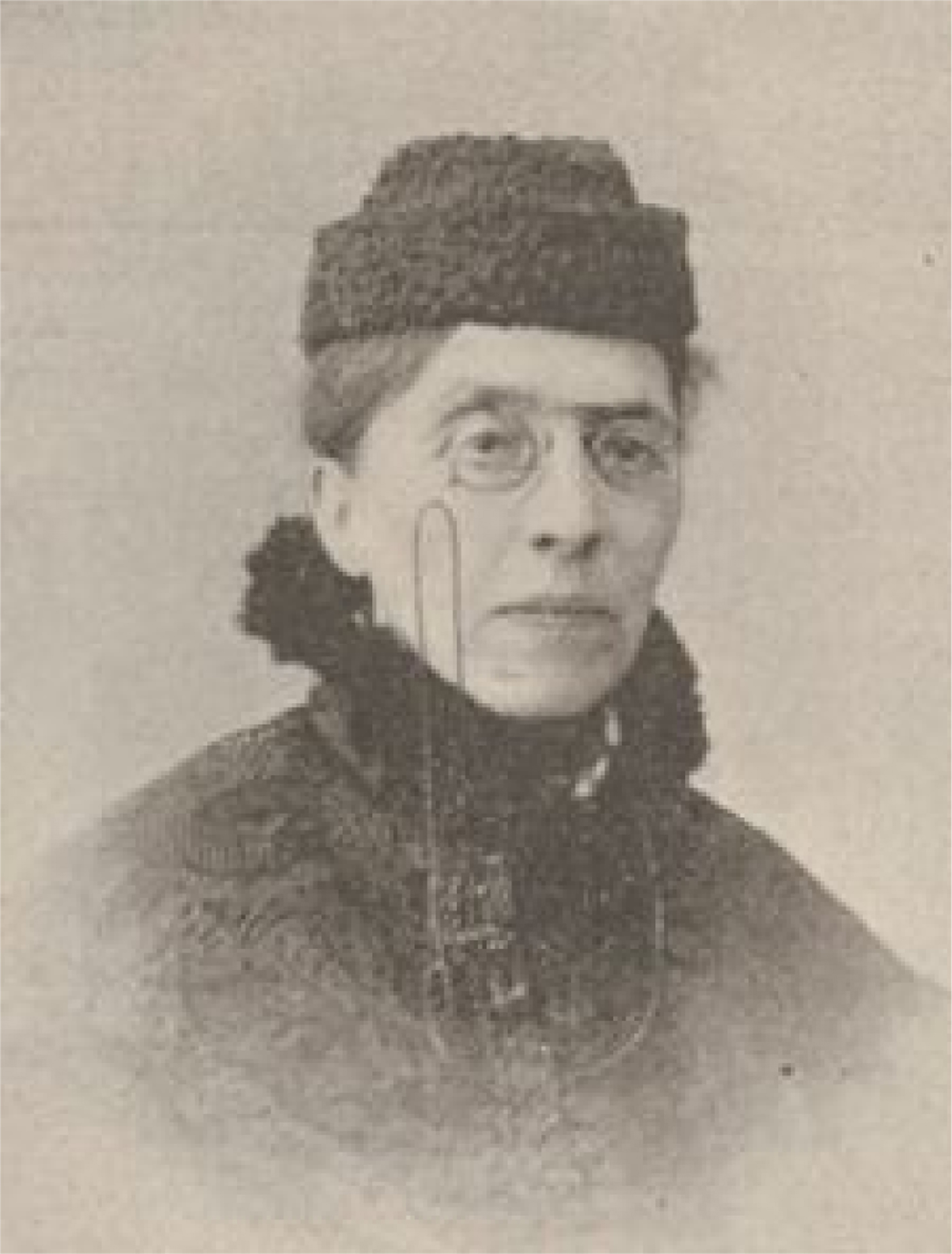
Women's rights advocates strategically pursued the inclusion of women on the jury to achieve broader objectives, such as securing greater respect for women through equality in moral and legal concerns affecting private life. Since 1878, women's rights activists had prioritized the ideal of establishing a single moral standard, and leaders alleged that women's exclusion from judicial decision-making contributed to the perpetuation of the moral double standard.Footnote 31 In particular, they criticized the 1810 Penal Code (Articles 336–39) that established onerous consequences for an adulterous woman (e.g., imprisonment and fines) whereas a man was treated lightly, even for the murder of his wife caught in flagrante delicto (Article 324). The jury issue was discussed but not voted on at the first “feminist” congress held in Paris, the Congrès général des sociétés féministes, of 1892.Footnote 32 Impatient with the lack of collective action, Eugénie Potonié-Pierre (1844–98) (Figure 1), a founding member of the Solidarité des femmes, petitioned the Chamber of Deputies in 1894 requesting the “right for women to participate in the criminal jury” and the rescinding of Article 324, which excused husbands for the murder of their wives in the event that their own lives were in danger, or while interrupting an adulterous act.Footnote 33 The original petition has not been located, yet it seems likely that the Solidarité activists had called for the diminution of double standard pertaining to adultery through the additional presence of female jurors. The reactionary Catholic newspaper La Croix disapproved of Potonié-Pierre's entreaty and characterized it as a threat to male power and even a “vœu homicide” (homicidal wish). A journalist insinuated that female jurors would use their newfound power to enact homicidal revenge: “Would she [Potonié-Pierre] like…the supremacy of the woman over the man, to give her the right to condemn all men to death?”Footnote 34 The feminists’ protests of domestic violence and spousal murder were met with the accusation that they were turning the tables on men. In this climate, the deputies rejected Potonié-Pierre's two-part request with their own defense of Article 324 and a dismissal of the claim that increases in “crimes of passion” justified women's admission to the jury.Footnote 35
Eugénie Potonié-Pierre. Source: “Le congrès féministe,” Le Monde illustré, vol. 40, no. 2038 (April 18, 1896): 278–79.

Even if so-called “crimes of passion” were not on the increase, historian Anne-Marie Sohn observes that court actions to rectify the consequences of adultery increased as much as tenfold (from 210 to 2,241 cases) between 1871 and 1921 (with only a fourfold increase from 1871 to 1891).Footnote 36 Married women turned to the courts to address problems of adultery and its ramifications, such as the loss of marital financial support. Once divorce was re-established in 1884, abandoned or unhappy women were increasingly inclined to initiate separation and divorce proceedings, which signaled a shift in power for the paterfamilias. The penal rules on adultery provided that adulterous wives could face long prison sentences, but adulterous husbands only risked fines. During this period of male privilege, the courts never assigned the maximum fine of 2,000 francs permitted by the penal code, and when fines were levied, they did not exceed 200 francs. For Sohn, the imposition of minor fines demonstrates “the will of the justice [system] to correct an inadequate law by softening the repression of a crime that was no longer considered as such.”Footnote 37 Male philandering may have been excused, but it created real consequences for others, a point that motivated some arguments favoring women's admission to juries. Admission of women to juries was anticipated to hold defendants more strictly accountable for their actions.
Historian Andrea Mansker argues that the Belle Époque was a crucial era for the proliferation of feminist arguments for women's role in protecting the family honor from men's corrupt sexual behavior. Social toleration of male adultery, their transactions with prostitutes, and the consequential spread of disease to virgin brides insulted women's honor, reformers argued. Contemporaries insisted that men's philandering made a mockery of the institution of marriage and women's virginity, the foundations of female honor. In such a climate, activist women felt obliged to expose and shame men who violated the “traditional” family code designed to protect women's honor, and pursue a new moral structure for France.Footnote 38 This was all part of a personal dimension of republican citizenship. Similarly, the jury féminin, although focused directly on jury reform, contributed to this broader effort to encourage a single moral standard in law and custom, imposing expectations of sexual discipline on men as it prevailed for women, for the purposes of modeling proper morality for children, the future citizens of the nation.
Intersections of Morality and Gender Politics in Jury Reform
The proponents of jury reform in France avouched that the incorporation of women would benefit not only women as a class but also judicial processes and the broader society. For those seeking to establish a single moral standard through the courts, jury reform appeared to provide a means to this end. Evidence of this approach appears in 1896, at the Congrès féministe international, organized in Paris by the Fédération des sociétés féministes, where Marie Bonnevial and pioneering law graduate Jeanne Chauvin called for the seating of female jurors to destabilize Article 324 of the Penal Code, an action that they hoped might begin to dethrone men from their authoritarian rule in marriage and to dislodge the immunity that husbands enjoyed relative to adultery.Footnote 39 Bonnevial was a “poly-militant,” associated with syndicalism, socialism, and feminism, and she was then the leader of the venerable Ligue française pour le droit des femmes (LFDF) (French League for Women's Rights). Chauvin endeavored to secure specific rights for women, including married women's rights to witness official documents, control their own earnings, and gain equal access to professions, as well as to secure legal education for girls.Footnote 40 Persuaded that female jurors were a necessity, the assembled congress voted unanimously in favor of their admission to the jury.Footnote 41 The notion that jury service for women was a “right” appeared on the conference program alongside the right to vote and equal treatment of women under the penal and civil codes.Footnote 42 Feminists professed that adult women were demonstrably capable and qualified to create and enforce laws, not just follow them, as a result of their experiences as employees, household managers, and taxpayers.Footnote 43
Jury service reform contained the potential to shift the balance of justice and civil obligations of citizens in a more egalitarian direction. “Les français,” in the masculine form, encompassed women as well as men in French civil and penal law, but not in electoral rights.Footnote 44 Despite the multiplicity of feminists’ reasoned arguments, Clotilde Dissard, editor of the Revue Féministe, pessimistically anticipated that the opposition would prevail: “Women's claim to the right to judge will continue to be disputed in the name of their too delicate sensibilities, and their hasty decision-making that too often excludes reflection.”Footnote 45 Emphasizing gender difference could function as an obstacle in arguments for equal treatment, yet it could also justify the expansion of opportunities.
The momentum favoring mixed-sex jury reform was sufficiently strong in the 1890s to provoke lawyer Maurice Thuriet, then a relatively young substitut du procureur général (assistant attorney general), to declare defensively that law was “men's work.”Footnote 46 At an 1896 rentrée event that coincided with the opening of the court sessions in Dijon, Thuriet insisted that laws and judicial systems must remain a male bastion because women lacked sufficient “respect” for them. He insisted that women were both more impulsive and more empathetic than men, a combination that would guarantee “inferior” jurors (his term). He implored his audience of lawyers and judges to oppose all feminist demands in order to protect the current judicial organization and gender relations. His antifeminist posture attempted to shore up masculine privilege that was under attack.Footnote 47
This perception of a feminist “assault” on the institutions and character of the law appears disproportionate to the actual modest demands of reformers. Posters hung by Solidarité around Paris in 1893 proclaimed: “Free and impartial justice. Tribunals and juries composed of men and women.”Footnote 48 The LFDF also promoted jury service as a woman's right in the organization's 1897 platform.Footnote 49 Men critical of male sexual license also appealed for female jurors to alter the balance of power in courtrooms. In 1897, jurist Raoul de la Grasserie favored female jurors in criminal trials, particularly where men's “irresponsibility” or immorality was the root cause of a woman's trouble, meaning abandonment or rape, seduction or infidelity.Footnote 50 He stressed that men were unreliable jurors in such trials, writing: “In this type of judgement, we must reestablish complete equality—that primary and irreducible justice. This can be done by introducing women into the composition of the jury for these types of cases, such as infanticide.”Footnote 51 The fulfillment of “true justice,” de la Grasserie insisted, required equality in the composition of some criminal juries, such as granting female defendants the right to a trial by female jurors.Footnote 52 The average male juror was assumed to be lenient toward male defendants in ways that may have sustained a sense of republican fraternity at the expense of law, morality, and equality.
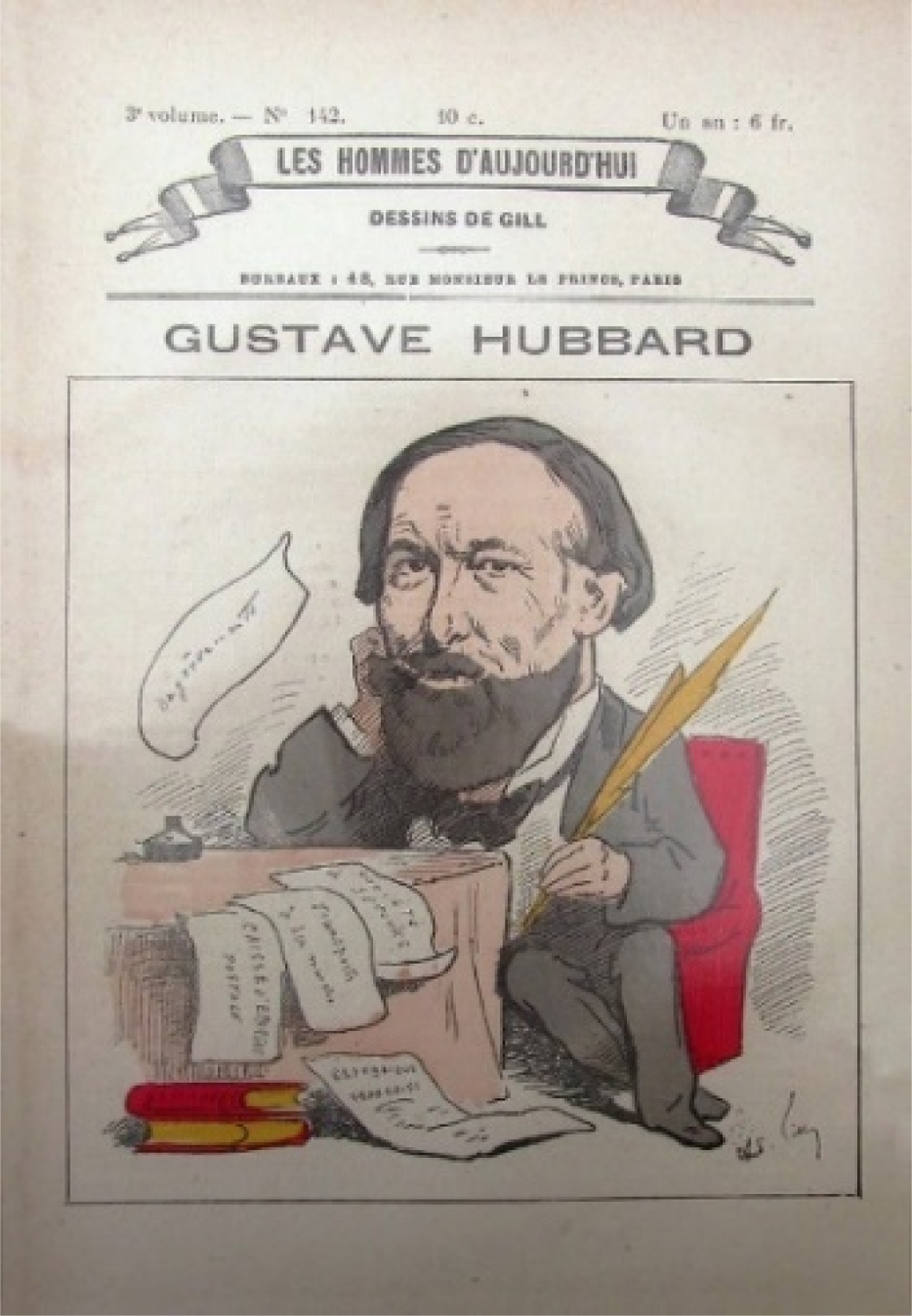
The first example of French legislation that proposed the admission of women to the criminal jury appears to have been the work of radical-socialist Deputy Gustave-Adolphe Hubbard (1858–1927) (Figure 2).Footnote 53 Hubbard worked alongside prominent feminist leader Maria Deraismes (1828–94), when he had shepherded Deraismes's petition into a successful bill that made “commerçantes” (business women) eligible to vote in matters decided by lay members of the tribunaux de commerce (commercial courts). This bill was approved in the Chamber of Deputies in 1889; and in the Senate in 1898.Footnote 54 As a consequence of these efforts, qualified women could be inscribed on the electoral lists to vote for representatives on the commercial courts only.Footnote 55
André Gill's caricature of Gustave Hubbard. Source: Les Hommes d'aujourd'hui, vol. 3, no. 142, 1881, cover.

In May 1901, Hubbard proposed a bill to the Chamber of Deputies to admit equal numbers (six each) of women and men to the jury, specifying that “les citoyens français” and “les citoyennes françaises” (male and female citizens) would be eligible. He also proposed the minimum age for women as 40, contrasting with the minimum age for men, which was 30, for the purposes of peremptorily excusing mothers with young children.Footnote 56 This qualification suggests that motherhood was perceived as a modifier on women's capability to fulfill to their rights, thus justifying restrictions on their access to such rights. Journalist Andrée Tery, writing for La Fronde, enthusiastically endorsed Hubbard's proposal, suggesting that if admitted to the jury then women could participate in “civic education” and collaborate in “communal work.”Footnote 57 In other words, jury service was a potential path to demonstrating women's public virtue. Pessimistically, however, Auclert suspected that the bill's use of the term “citoyennes” was too restrictive. For citoyennes to be admitted to lists of eligible jurors, their official political identity as equivalent to citoyens must first be assured, which it was not.
Auclert had a long history of petitioning various governmental and judicial institutions, and understood the challenges faced by reformers.Footnote 58 In particular, Auclert scrutinized the way the courts had addressed the question of whether citoyennes had the same rights as citoyens in 1885 and 1893. In 1885, Louise Barberousse, a school teacher and Communard, had attempted to register to vote, to test the “universality” of voting rights. The Cour de cassation decreed that women were permitted civil rights (Civil Code Article 7) independently from constitutionally determined voting rights, which were denied to them. The court specified that women's names must be on the electoral lists to be eligible to exercise political rights.Footnote 59 The court's reasoning implied that only through constitutional revision would women gain the full rights of their citizenship. Nevertheless, the lists that provided authorization for both eligible voters and potential jurors remained a target for activists seeking to exploit the ambiguity of the gendered qualifications for various rights and duties under French law. Activists brought another case in 1893 with identical results.Footnote 60
Although Hubbard's colleagues in the chamber appear not to have debated his proposal for equality on the jury in 1901, the press was keenly aware of potential ramifications of women's admission to the jury. Recalling the so-called feminist “assault” on the notion of electoral eligibility, writer Marcel Prévost maintained on the front page of the newspaper Le Figaro that women were too passionate, too undisciplined, and too engaged with political causes to be good jurors. Prévost appealed to opponents of clericalism and evoked the extremism of moralists: “See with what force, with what violence even, Woman defends the ideas that she adopted. See her fight in the crusades against alcoholism, against prostitution! Observe her indefatigable religious fanaticism! Woman loves ideas, she has an appetite for problems of conscience, her curiosity is endless.”Footnote 61 Another journalist associated potential female jurors with mercilessness and vindictiveness claiming that: “It is common knowledge that the mildest, most benevolent women show themselves, in regard to certain criminal affairs, capable of an implacable rigor which compels them to demand terrible punishments [for perpetrators] and [might] call for the reestablishment of torture from bygone ages … .”Footnote 62 The influential political economy professor Charles Turgeon likewise resisted a concurrent feminist ambition to join the judiciary; he urged the conservation of “a monopoly on justice for our male judges.”Footnote 63 Immediately following women's admission to the bar in 1900, Turgeon had condemned the rapidity of women's “invasion” into the “virile” professions and their “presumptuous” claims to justice. He insisted that women knew only how to use the “sword” of justice, not the “balance,” alluding to women's supposed violent irrationality, embodied in the mythic pétroleuses of the Commune.Footnote 64 To preserve the courts as a masculine domain, Turgeon maintained that women's mere presence would change the climate and, thus, the balance of power. His objections subsequently fueled the opposition to women's participation in the conseils de prud'hommes and tribunaux de commerce (the labor and commercial courts).Footnote 65
In the ensuing debate, however, Turgeon's critics multiplied and they reasoned that the male monopoly on justice was a sign of partiality, inequality, and subjectivity. Feminist Marie d'Abbadie d'Arrast advocated for female jurors because they recognized “the necessity of social repression,” and were less likely than men to “absolve criminals” because “we” are “less often the culprit[s]” in crimes of passion.Footnote 66 She asserted that women's participation in the courts would bring positive social change through effective decision-making. The exclusively male jury system was a perversion of the principle of justice, declared Belgian educator Isabelle Gatti de Gamond, because the criminal procedure should forbid anyone from being “party and judge in the same cause.”Footnote 67 She envisioned examples in which male jurors might themselves be guilty of seduction and impregnating women yet be called as jurors in parallel cases. The rate of acquittals in infanticide cases revealed to her that juries tolerated men's sexual transgressions whereas they punished women's. This debate illustrates how both sides tended to agree that men and women were not interchangeable as jurors because their gender differences influenced individual moral compasses and temperaments, which in turn, affected decision-making. Penal, civil, and constitutional laws disadvantaged women, and juries reinforced this state of affairs.
Arguments favoring exclusively male juries reinforced the gender dynamics that privileged male rule in the family and perpetuated men's sexual license (the latter a product of the moral double standard). Even current Prime Minister George Clemenceau acknowledged as much when he criticized the outcome of the case of Marie Devaillant, a pregnant woman who was sentenced to prison for the fatal stabbing of her fiancé (and his other lover) who refused to acknowledge his paternity. Clemenceau wrote that “the admission of women to the jury…could sometimes usefully change the verdict… . In cases like Marie Devaillant's, for example, it would have been enough for a woman” to be present on the jury to ensure use of the law to encourage a single moral standard.Footnote 68
Hyacinthe Bélilon and Camille Bélilon were staunch supporters of moral and political feminist causes and they contended that feminine influence was a valuable commodity absent from juries.Footnote 69 They observed criminal cases in the cours d'assises in the Department of the Seine and published their own verdicts on a regular basis in the Journal des femmes, a monthly newspaper edited by feminist Maria Martin.Footnote 70 The eighty articles they published from 1905 to 1910 constitute a sustained critique of male bias in the application of laws relevant to criminal jury trials typically involving murder, attempted murder, infanticide, abortion, and other acts of criminal violence. Their verdicts called attention to gender dynamics in cases concerned with domestic violence, child abuse, poverty, and unequal moral standards. By publishing their detailed case discussions, the jury féminin sought to model how to deliberate about guilt and innocence, weigh extenuating circumstances, and recommend a just sentence and thereby demonstrate women's competence to function as jurors. For their contemporaries, the efforts of the jury féminin meant that female lawyers were no longer the “only women” engaged in reflection and analysis of “juridical questions.”Footnote 71 By creating an alternative jury, the Bélilons made a symbolic declaration of equal rights for women as members of the national body.Footnote 72
The jury féminin newspaper column, signed primarily by Hyacinthe Bélilon, argued repeatedly that male jurors were incompetent to determine female defendants’ guilt or innocence because men failed to comprehend the nature of intimate violence or the circumstances that led a woman to commit, or be accused of having committed, the crimes of infanticide or abortion. The jury féminin claimed that women's perspective was essential to decision-making in the courts. Moreover, the jury féminin protested that the justice system failed to acknowledge men's responsibility in infanticide and abortion, arguing that the prosecution of women alone overlooked the “real criminal,” the man.Footnote 73 In other words, all-male juries were arbitrary, and by failing to fulfil their own criteria, were unjust.
The jury féminin’s verdicts drew attention to the gender dynamics of violence and power. In one 1907 case, a woman was accused of killing an abusive male partner, and although both the official and unofficial juries called for acquittal, they did so for different reasons. The men's jury rationalized that the defendant was not responsible for her behavior; by contrast, the jury féminin argued that abused women had a right to self-defense. Hyacinthe condemned the toleration of physical violence against women at the hands of men, and disapproved of the leniency in the courts that failed to punish abuse.Footnote 74 Observing such cases, Hyacinthe insisted that spousal murder was too readily acquitted and she called for the punishment of violent offenders. In another case in which a cuckolded husband was accused of shooting his wife and her married lover, she opined that he should have filed for divorce rather than resorting to violence, because legal divorce was a viable and appropriate alternative.Footnote 75 A divorce would have granted both partners their freedom, but male-initiated violence functioned to reassert masculine power and dominance.
In French criminal procedure, defendants in the pretrial phase were subjected to thorough investigations to amass evidence of guilt or innocence as warranted. Consequently, those cases that advanced to trial presented the judge and jurors with a preponderance of evidence of wrongdoing. Despite the formal efforts to bring only responsible parties to trial, Eliza Ferguson's research into the Paris court archives finds an acquittal rate of 28% for men and 64% for women in cases involving “crimes of passion” at the fin de siècle.Footnote 76 Ferguson argues that the low rate of convictions in such cases “indicates that instead of punishing private violence, the judicial apparatus was made to condone it, even in the heart of the family unit” thereby tolerating violence as a means of handling in domestic conflicts.Footnote 77 Acquittals were jurors’ means of enacting their popular attitudes towards domestic violence, illegitimate children, and sexual mores. The organization of the jury thus reinforced the status quo of sex inequality, a dynamic apparent to the jury féminin.
The Bélilon sisters’ jury féminin were active during the period historian Anne-Marie Sohn has labeled “the golden age of male adultery,” when adulterous acts became “a private, strictly conjugal grievance” that was still illegal but no longer “sinful.”Footnote 78 Men enjoyed sexual license and legal privileges in ways that disrupted marriages and troubled the sanctity of the family. For the Bélilons, male sexual freedom was detrimental to women, particularly when men proved inconstant as providers for their biological children (whether legitimate or not). Male juries, they professed repeatedly, failed to hold men sufficiently accountable for their generative roles in human reproduction. Public opinion was partially aligned with the Bélilons in a case in which an unwed mother, charged with attempted murder of her lover, was acquitted. The man in question had abandoned the defendant while she was confined in a maternity hospital and he had hurriedly married another woman.Footnote 79 His refusal to pay a 30 centimes allowance to provide for his infant's nutritional needs as the unwed mother requested was the incident that provoked her violence. The Bélilons were sympathetic to the defendant, as was the public. Following another case involving child abandonment and bigamy, Hyacinthe recommended that the state establish a “budget de l'Enfance,” a welfare fund, to provide for children's well-being in cases in which men neglected their dependents.Footnote 80 Rachel Fuchs's research into paternity cases reveals that judges too considered those who “made” the child were responsible for providing for it.Footnote 81 The Bélilons sought to reinforce this jurisprudence that was more beneficial to women and children than the existing legislation. Financial support for unmarried mothers and their children aligned with other welfare proposals of the era and clearly connected the women's jury to reformist policy recommendations.Footnote 82 In another case, in which a laundress caught her husband in flagrante delicto, the jury féminin demanded “equal treatment” of adultery under the law. Equality in this trial would have absolved the wife for the physical harm that she had caused to her cheating husband with a bottle of vitriol.Footnote 83
On the controversial issue of abortion, for which pregnant women were disproportionately held solely responsible, Hyacinthe underscored that the courts effectively erased men's responsibilities by failing to bring them to court; a woman simply cannot conceive a child on her own, she must have an “accomplice.” She also raised a crucial question about women's agency and autonomy: “Does a woman have the right to dispose of that which she carries within her and that which cannot live without her will?”Footnote 84 She posed this intriguing question hypothetically; it would be answered in the affirmative by bolder activists (notably Nelly Roussel, critic of the re-populationists, and Madeleine Pelletier, who later defended women's right to control their fertility).Footnote 85
The jury féminin also questioned the validity of male jurors’ judgement in other ways. Jurors made highly suspect decisions in the unfortunate series of murders of children by Jeanne Weber, known as the “Ogress of the Goutte d'Or.” Weber was repeatedly arrested, tried, and acquitted twice in 1906 and 1907 before she was finally determined to be mentally ill in 1908. Each time she was released Weber subsequently engaged in child murder that examining physicians erroneously attributed to other causes, such as disease. In Weber's initial 1906 trial, the jury féminin doubted her proclamation of innocence and recommended her confinement for insanity. At the same trial, the official male jury recommended acquittal. In 1908, Hyacinthe declared that if female jurors had been included in either of Weber's early trials, future crimes might have been prevented, as they had advocated in print for Weber's institutionalization.Footnote 86 Writer Paul Margueritte concurred that women should participate in criminal juries, a lesson reinforced in part by the failures associated with Weber's serial murders and trials.Footnote 87 Likewise, the debate on the 1909 acquittal of the notorious Marguerite Steinheil, mistress of President Félix Faure, accused of the murder of her mother and husband, raised questions about whether women would have been less lenient than the all-male jury.Footnote 88
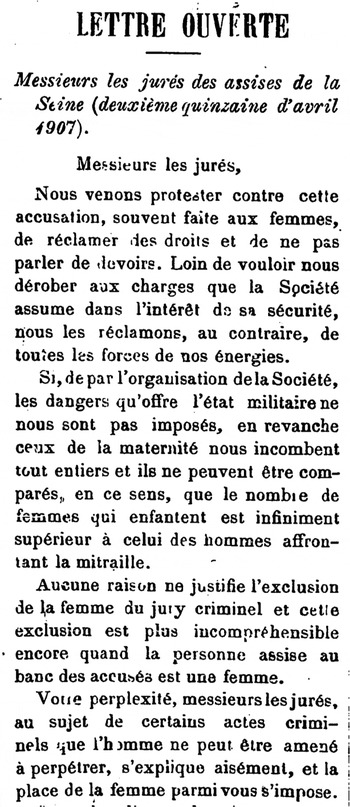
In April 1907, Hyacinthe Bélilon and Maria Martin appealed directly to male jurors with an open letter in which they argued that “no reasons justified the exclusion of women from the criminal jury” (Figure 3).Footnote 89 They dismissed the argument that women were intellectually incapable of jury service; au contraire, the performances by professional female lawyers to date offered sufficient proof of such intellect. Their open letter addressed to the “messieurs les jurés de la cour d'assises de la Seine,” asserted that women belonged on the jury because they could offer a missing feminine perspective on criminal cases. Moreover, by sharing this civic responsibility with women, men's chances of being called to serve would be reduced.Footnote 90 The activists pleaded for men's endorsement of their project, in the hopes of locating champions of women's participation in public deliberations of law, power, and gender justice on the grounds that both sexes needed representation on the jury. The jury was already gendered, but it did not represent the sovereign people who came in two forms: male and female.
Martin and Bélilon's open letter to male jurors. Source: Hyacinthe Bélilon and Maria Martin, “Lettre ouverte,” Journal des femmes 174 (1907): 1.

The Bélilons's jury project furthered feminist claims for citizenship by demanding the recognition of women's right and duty to participate in civic affairs for the purposes of improving social well-being through moral reform. Given the still controversial character of suffrage demands, perhaps their discretion was a cautious strategy. The French suffrage campaign would remain muted until 1909, and eschewed direct action until the 1920s.Footnote 91 Morality, not political rights, was the priority of a new group that Martin and Bélilon joined in summer 1909, the Ligue française de preservation morale et sociale de la jeunesse (French League for the Moral and Social Preservation of Youth). This organization opposed the objectification of women and abandonment of children, and called for the suppression of pornography and the promotion of moral discipline.Footnote 92
One factor that the jury féminin believed would change the gender dynamics of courtrooms was the presence of feminist lawyers. In 1909, when members of the jury féminin attended a trial at which pioneering lawyer Maria Vérone (1874–1938) provided the legal defense for the accused, they heard their own opinions reflected in Vérone's arguments. The Bélilons praised Vérone because she tipped the “scales of justice to the side of pity” when describing a female defendant's choices as having been shaped by her social condition and her crime as having been the consequence of desperation. Vérone's persuasive rhetoric, which included an analysis of gender and power, contributed to this female defendant's acquittal.Footnote 93 They appreciated Vérone's courtroom eloquence made, they observed, in support of social and moral justice.Footnote 94 Clearly however, the rare feminist lawyer was not a substitute for gender equity on criminal juries.Footnote 95
The matter-of-fact tone and succinct contents of the jury féminin columns shared nothing with the true-crime journalism designed to attract readers through lurid or salacious details. Rather, the Bélilon sisters’ articles resembled cautionary tales designed to expose, for the purposes of stimulating social and political action, the inequalities and inadequacies of the law relative to adultery, domestic violence, unwanted pregnancies, and abandonment. Additionally, the jury féminin column stigmatized certain behaviors, especially male sexual misbehavior that disrespected, exploited, or victimized women or children. The Journal des Femmes, where the jury féminin’s column appeared, consisted largely of news about the organized women's rights movement, both in France and internationally, with details about upcoming meetings, political platforms, and accomplishments.Footnote 96 Readers inspired to take sociopolitical action could have readily identified a variety of organizations that they might join. The jury féminin project merged three aspects of the French feminist program of the Belle Époque by calling out the consequences of prevailing sexual mores, pressing for social reforms to punish intimate violence, and advancing claims for women's full political rights by seeking to add women's names to the electoral lists that controlled access to both jury service and suffrage.
Feminists Respond to the 1908 Ministry Reform to the Jury
In January 1908, then Minister of Justice Aristide Briand issued a circular that opened the jury pool to members of the working class and established a fund for replacement wages. This was a significant breach in the bulwark of the organization of the French criminal courts.Footnote 97 Galvanized by this democratizing reform, Hubertine Auclert immediately urged Briand to also admit women, because the “intelligence and heart of both sexes” were necessary to determine the culpability or innocence of the accused.Footnote 98 Within days, lawyer Hélène Miropolsky also claimed women's right to sit on a jury by declaring that women were as equipped as men for jury duty because the republic's earlier education reforms, the Ferry Laws of 1881, 1882, and 1886, had provided free, compulsory, and secular education to boys and girls that prepared them to be reasoning citizens of the nation.Footnote 99 A juror did not need to resolve legal problems, she remarked, but rather must reach a decision based on the evidence provided in court, a process that required a basic education.Footnote 100 The question had public relevance; on February 13, the town hall of the popular eleventh arrondissement of Paris sponsored a debate on the issue.Footnote 101 Maria Martin also argued in favor of extending Briand's reform to women, who were “half the population,” in order “to enlighten and rectify the purely masculine judgments, which are often erroneous.”Footnote 102 The argument that all-male juries were unrepresentative and unfair endured.
The Bélilon sisters deepened the public debate on jury composition at the June 1908 Congrès national des droits civils et du suffrage des femmes (National Women's Rights Congress), where Hyacinthe denounced “unisexual” (i.e., all-male) juries as unjust. Hyacinthe characterized the male monopoly of criminal justice as “illogical,” “odious” and even “shocking” because she perceived sex exclusivity as self-serving. She condemned men for supporting the law that prohibited women from filing paternity suits, stating: “Who decreed this? Man. Man has misappropriated to himself the right to abandon, or rather to ignore, those to whom he gives life. Why, then, does he have to take care of their fate the day the woman whom he has dishonored makes them disappear? For it can be precisely the one he has made mother whom he is called to judge, to condemn.”Footnote 103 She recalled that the jury féminin was created in the face of “injustices, scandals, and crimes” because men failed to acknowledge their role as “accomplices” in crimes such as abortion.Footnote 104 She requested for support of mixed-sex criminal juries and declared that any verdicts issued by all-male juries were invalid.Footnote 105 How the congress voted in 1908, however, remains unclear in the historical record. The official congress record indicates that the group voted in favor of female-only juries based on language provided by sociologist Jacques Lourbet and lawyer Jacques Bonzon.Footnote 106 After the fact, however, feminist Jeanne Oddo-Deflou reported that the congress had approved a mixed-sex jury proposal.Footnote 107
This ambiguity in the historical sources reflects the fact that reformers did consider the potential consequences of adding either all-female juries or mixed-sex juries to the criminal courts. In a lengthy study on female criminality published in 1906, Inspector General Camille Granier endorsed both types of juries, depending on the nature of the crime and the sex of the defendant. Granier predicted that all-female juries would decide matters of “criminalité maternelle” (e.g., infanticide and abortion) more harshly than men. Granier deemed men untrustworthy as jurors in cases in which their peers had been complicit in creating the circumstances leading to women's criminal acts (e.g., sexual or immoral behavior); thus he endorsed female jurors. He also wrote that women's equal access to the jury pool would constitute a “revolution [for] women's rights.”Footnote 108
Just how revolutionary was the proposal to admit women to criminal juries in early twentieth century France? Attorney Maria Vérone saw this reform as a good in itself and a potential path to securing women's municipal suffrage in France. Vérone was enamored of the relative ease with which male workers had gained access to the municipal lists of potential jurors by Briand's 1908 decree. Because the same lists were used for both jurors and voters, she reckoned that if women's suffrage advocates could obtain the support of one minister who was “assez féministe” (sufficiently feminist) then a parallel decree could secure women's names on such lists.Footnote 109 This ministerial-based tactic would provide an alternative to the legislative debates on Paul Dussaussoy's bill for women's municipal suffrage that had been buried in the universal suffrage committee since its introduction in 1906.Footnote 110 In the autumn of 1908, Briand offered public approbation of the possibility of female jurors, but by the spring of 1909, he had not taken any action on it.Footnote 111
A frustrated Hubertine Auclert lamented that the ongoing denials of women's rights left women “outside justice” and “outside common law.”Footnote 112 Moreover, Auclert declared the current host of “vexing laws” meant that all people in France lived under “masculine tyranny.”Footnote 113 Socialist Deputy Marcel Sembat, who had advocated women's suffrage in the chamber, spoke out on behalf of women's jury access, describing their exclusion as “unjustifiable” and even “scandalous.” He drew parallels between Briand's 1908 decree and the action now needed: if juries staffed by only one social class were suspect as unjust, the same logic applied to sex. He accused men of perpetuating the subordination of women because the illusion that women were inferior constituted a self-serving “hallucination.”Footnote 114
Forward momentum on the municipal suffrage bill proposed by Dussaussoy occurred in 1910, with Deputy Ferdinand Buisson's endorsement of women's right to vote. He favored expanding municipal suffrage to women because they, like men, belonged to a “common humanity,” with each sex being socially and intellectually equivalent. He rejected assertions that women were too reactionary or revolutionary as overblown: “angels of the household” would not be replaced by “harpies of the political clubs.”Footnote 115 The jury question was ancillary; noted through comparative sections in which evidence from the Wyoming territory, for example, demonstrated women's social value as jurors and voters. Despite this auspicious endorsement, the Dussaussoy bill was permanently tabled in 1913.Footnote 116
Avocates (female lawyers) strategized that the suffrage campaign should be separated from access to the jury. Attorney Miropolsky affirmed that a woman possessed all the faculties necessary to determine the truth: “her reason and her conscience.” Moreover, she maintained that women were essential to the functioning of justice, and justice, in turn, was the guarantor of individual liberty. Whether female jurors were to be admitted on a selective or equal basis, Miropolsky averred that women's participation would benefit collective well-being.Footnote 117 Such arguments harkened back to the early Third Republic debates when leftists asserted that the jury was the “palladium of liberty.”Footnote 118 Parisian attorney Suzanne Grinberg insisted that rationales for excluding women had collapsed under social evolution: “Being a juror does not in fact require any special disposition or ability, and merely requires common sense, a little logic and reasoning, often only the ability to create an impression from the trial proceedings.”Footnote 119 She dismissed commonplace objections that women were too occupied with their domestic tasks to take time off for jury duty, that they were intellectually unprepared, or that they were too frail to be jurors. Moreover, she assumed that female jurors would benefit the institution, even revitalizing it as a consequence of the application of their “lively, generous, ardent, and comprehensive” minds.Footnote 120 Acknowledging sex differences, she endorsed equal treatment. Grinberg also appealed to social unity, a theme popular with the Solidarists then in political power, by claiming that mixed-sex juries could “restore equality between men and us.”Footnote 121
The imbalance of gender representation on the jury was increasingly seen as undermining the institution. In 1913, Germaine Louis-Besse, the director of Le Goût Parisien, a bimonthly home economics magazine, remarked that the opposition to female jurors was the result of “stupid prejudices” and “vain obstinacy.”Footnote 122 Louis-Besse affirmed women's capacity to succeed at “difficult” and “delicate” tasks, demonstrated already by female physicians who saved lives, and female lawyers who saved “heads.”Footnote 123 She also professed that women's greater knowledge of children and respect for the family, as well as their greater need for security, were all factors that could facilitate their effectiveness as jurors. Such claims were reinforced by public debates on the value of gender integration of the jury.Footnote 124 Writer Antoine Bonnefoy averred “there is not a person in France who could reasonably deny” that admission to women to the jury was “necessary and urgent.”Footnote 125
Distance of the Head from the Heart: Political Debates on Women's Jury Service, 1927–29
The war of 1914–18 interrupted the momentum of these campaigns. When the issue re-emerged in the 1920s, in an era of increasing specialization of knowledge and the rise of expertise, the possibility of increasing the pool of nonspecialist jurors held little appeal for sociologists and criminologists who called for the suppression of the jury, an institution that they denigrated as “baroque.”Footnote 126 Proponents of jury system reform still hoped to improve on a democratic institution they understood as providing a mechanism by which justice could be enacted “by all for all.”Footnote 127
Only in late 1927 did the Chamber of Deputies agree to consider a bill to admit women to criminal juries. Advocates used gendered arguments, observing that women had unique talents for jury service because “the heart is never completely estranged from the head.”Footnote 128 Deputy Raymond Baranton (independent communist), proposed a narrow bill in November 1927.Footnote 129 In his bill, the women designated as eligible were those citoyennes (female citizens) who, based on their status as taxpayers, could already participate in the labor courts, the business and agricultural courts.Footnote 130 In his rationalizations, Baranton criticized men as lacking perspicacity to detect dissembling by defendants or witnesses, and faulted men's insensitivity when faced with “unspoken suffering and despair.” To properly judge a case, he insisted, it was necessary “to understand [and] to feel” and female jurors could put their “subtle instincts” and “intuitive judgment” into the service of justice.Footnote 131 This argument for balancing rationality with empathy reflected the newer thinking on rehabilitative justice then evident in the juvenile courts. These debates unintentionally served to denigrate masculine qualities to uplift feminine ones.Footnote 132 In sum, gender differences justified the expansion and diversification of the jury pool. Fatefully, right-wing Deputy Anatole Biré attacked this proposal and it was sent to the commission on civil legislation, from which it never re-emerged.Footnote 133
Nevertheless, the socialist deputies continued to champion a representative jury and appropriate compensation for jury service. In December 1927, during a heated debate on the Ministry of Justice budget, Baranton supported a raise in pay because the current level was insufficient to replace a juror's lost wages, thus rendering service a luxury available only to the wealthy. He insisted on a jury pool mixed in sex and socioeconomic terms to reflect the “exact population” of France. Quoting the former socialist (Section française de l'Internationale ouvrière, SFIO) leader Jean Jaurès, he espoused that the jury was valuable as “the legal conscience” of the nation.Footnote 134 Socialist Albert Sérol agreed on the necessity of raising the rate of jury pay “if you want the jury to be a truly democratic institution.”Footnote 135 Class diversity was clearly the first priority of the political left, and women's presence remained a secondary and more inflammatory consideration. Not surprisingly, class issues trumped gender ones, despite socialists having voiced tepid support for women's suffrage since the 1906 Dussaussoy bill.Footnote 136
The legal feminists’ argument emphasized equal treatment of defendants and the fulfilment of the principle of justice. For Suzette Savy, an attorney in provincial Rochefort, the better justification for opening the jury, itself a “commonsensical” reform, was to treat the sexes equally, and to secure more effective judicial decision-making. She declared that justice rendered through the jury system was an expression of “public will” and “public conscience,” and therefore should include women.Footnote 137 Reacting to Senator Louis Martin's plan to equalize adultery penalties under Penal Code Article 324, Savy recommended pairing jury reform with identical punishment: “for equal crimes, equal responsibilities, and the right to be judged by women as by men.”Footnote 138 Positing women as chivalrous champions of the underdog, Savy added that female jurors were better than men at understanding the mentality of the accused, especially defendants accused of abortion and infanticide, and that female jurors would suggest appropriately tailored punishment to the sentencing judges. She asserted that female jurors could advantageously modify the whole “oeuvre of penal repression.”Footnote 139 Other reformers built strategic political alliances; lawyer Marcelle Kraemer-Bach secured procureur général (attorney general) Abel Prouharam's approbation for mixed juries, perhaps because they were both members of the centrist Radical Party. Agathe Dyvrande-Thévènin, the French president of the International Federation of Female Judges and Lawyers, suggested that women would be superior jurors as a result of their “sensibility and intuition,” which translated as an alignment of their judgements with the common will.Footnote 140 All these arguments bolstered the French feminist tradition of “equality in difference” that justified expanded civic and political opportunities on the foundation of gender distinctions.Footnote 141 At the 1929 Estates General conference of feminists, equality on juries remained an important, although tertiary, issue, with married women's rights and suffrage taking precedence.Footnote 142
In December 1929, Radical Party Deputy André Hesse affirmed that juries without women were not representative of the people. Hesse proposed another bill that would admit equal numbers of women and men to the criminal juries, but these would be “qualified women”; that is, those who were direct taxpayers and heads of households, heads of businesses, or working in the liberal professions. He also targeted as potential jurors those women who served in the commercial and labor tribunals, and those who were current or retired civil servants. Any mothers with children under 13 years of age could be excused from jury duty upon request.Footnote 143 Hesse's stated purpose was to strengthen the jury's punitive force.Footnote 144 These special requirements for women signaled that only “meritorious” women, and women most similar to men as heads of households, were therefore “worthy” of representation on the jury. Given Hesse's history of antifeminist statements, Maria Vérone suggested that the bill was actually a ruse to rally popular opinion against the institution of the jury.Footnote 145 “Feminizing” the jury, as proposed here, she surmised, was intended to speed its demotion.
Ruse or not, jury reform proponents seized on Hesse's proposal as an opportunity. In the Chamber of Deputies, Baranton stated: “We believe that the influence of female jurors will be felt in the sense of better distributed justice. More sympathetic towards the pitiable, they will show themselves more severe against criminals with no extenuating circumstances.”Footnote 146 Deputy Sérol asserted that “feminine psychology” will bring new and desired elements into a trial examination process.Footnote 147 Others on the political left contended that more criminal courts were needed, and more jurors were needed to fill them, to address an increase in caseloads, while avoiding excessive delays. Sérol insisted before his skeptical colleagues that admission to the jury would not grant women political rights.Footnote 148 The following questions remained: could women function as jurors without political rights, or would their eligibility for the jury further their claims to the right to vote?
The possibility that women's access to juries might usher in electoral rights concerned the Ministry of Justice. Minister Lucien Hubert intervened in the legislative debates to stipulate that women's jury service must not become a Trojan horse for the “premature” extension of women's suffrage.Footnote 149 Maria Vérone reacted angrily that women were excluded from formal rights while obligated to fulfill duties such as paying taxes. She protested that women could not put off their own taxes the way the Senate delayed approving women's suffrage: “Pay up, my sisters, we must pay, without the right to say [to the tax collector]: ‘Let's wait for next year.’”Footnote 150 Frenchwomen experienced taxation without political representation, and criminal judgment without equal participation. Consequently, French democracy was compromised by the perpetuation of legal inequalities of the sexes.
Despite the resistance they encountered, feminist social critics continued to demand jury duty as a necessity for France. They averred that men's engagement in intimate heterosexual acts occurred seemingly without consideration of women's experiences. In this light, women's participation on juries would hold accountable the “brutal husbands, seducers, deserters of paternity,” and thus begin to liberate women from being men's “eternal victims.”Footnote 151 The older claim that men were not impartial jurors, but rather used the jury to defend their masculine privileges as members of a common “caste,” was thus revived.Footnote 152 In 1930, “Martine,” a columnist for Les Dimanches de la femme, railed against male privilege and called for female voices on the jury with the promise that: “I am persuaded that there will be fewer women abandoned after promises of marriage, fewer children without a father, fewer infanticides, and fewer scandalous acquittals” with female jurors.Footnote 153 She attributed power to the mixed-sex jury: it could abolish male license to “treat woman like a slave” made for the happiness, flattery, and distraction of the “lord and master.”Footnote 154 The French League for Women's Rights also rallied its followers to support equal opportunities on the jury arguing that exclusively male juries were discriminatory.Footnote 155 These feminists asserted that jury trials mattered in the balance of power between the sexes and the fulfillment of fundamental French governing principles.
Conclusion
Jury deliberations were understood by contemporary observers as an expression of common will and common mores. From 1791, jury duty was a male privilege in France, yet reformers advocated the admission of women to the institution to remedy moral, social, and economic burdens experienced particularly by women and children. The perception that female jurors were needed evolved over time, as attitudes toward acceptable behavior by men changed, and as women gained respect in society, particularly as a result of their educational and professional achievements.
The historical evidence is replete with the recognition that physiological and reproductive differences meant that men and women were not identical for purposes of the courts and, by this logic, juries required women's participation for the institution to be representative. The argument that women's jury service could only follow after the granting of voting rights was politically expedient, and signaled the ways in which juror-enacted decision-making mattered to republican citizenship. The Senate's intransigent opposition to granting women's suffrage in 1922, when they refused to debate (156 to 134) the suffrage bill that the chamber passed in 1919, also hobbled the campaign for women's jury service. The unwillingness of elected officials to extend power to women through the jury or the ballot perpetuated discriminatory beliefs about the gender of decision-making authority in communal life.
The Bélilon sisters’ jury féminin project produced 5 years of withering critique in which they reported that the French criminal jury system rendered capricious verdicts through its unrepresentative juries. The strengthening of support for mixed-sex juries corresponded to a decrease in public confidence in the jury as an effective institution at a time when it was disparaged as “enslaved to [popular] opinion” and a “necessary evil.”Footnote 156 Criticism of the jury at the level of the magisterial elite, however, fueled the transfer of abortion cases from popular control into the hands of professional judges (1920, 1923). The public concern around expertise and legal authority for such sensitive cases was not resolved, but simply removed to a new venue.
The Bélilon sisters contributed to the sociopolitical movements calling for the extension of the rights and duties of the Declaration of the Rights of Man and Citizen to women in order to achieve equality in republican France. The jury féminin offered a new vehicle for feminist social criticism of the current practice of the adjudication of wrongdoing and the application of legal penalties. The unique contribution of the jury féminin was to move protests forward from a political assertion of women's right to jury service, as Auclert had done, to elucidating feminist legal analyses, enacting the role of jurors, and demonstrating women's aptitude for jury service. These modes of dissent were facilitated by the freedom of the press, the availability of legal news, and literate women's publications in the burgeoning women's and mainstream press. The jury féminin’s activism was also expedited by new opportunities for women to move unchaperoned in the urban milieu, and judges’ tolerance of their presence in the courtroom. By their actions, the Bélilon sisters affirmed the potential of the jury to function as a moral force in society. They connected categories of human experience to legal analysis to justify political reform, all of which was predicated on the recognition of gender difference and the malleability of legal institutions to suit evolving societal needs. Their arguments about the gendered nature of power shed light on the ways in which the universal ideals of equality were sacrificed on the altar of republican fraternity.
These jury reform debates are also historically significant because they deepened the profound questioning of the value of sex-specific knowledge, the recognition of the imbalance of power in sexual relations, and the disparity of responsibility among men and women toward contagious venereal diseases, pregnancy, and parenthood. Although public intellectuals debated the merits of the female juror, refusals and inaction by elected politicians protected masculine privilege over decades of vocal opposition. Consequently, criminal juries composed of both women and men would be delayed until November 17, 1944, 7 months after women's right to vote was granted.Footnote 157 Only then did women achieve symbolic parity with men as voters and jurors, and therefore as citizens with formal authority.Footnote 158