At Nottingham's borough court in 1374, William de Hontesdon sued Godesman Taylor and his wife, Elena, for a debt of 11 shillings. William claimed that he had delivered a barrel of herring worth 11 s. for Elena to sell, but the couple kept the herring or, more likely, the profit from its sale.Footnote 1 We might read this case as evidence of the legal dominance of husbands over their wives, encapsulated in the doctrine of coverture. However, it also demonstrates that married women were not hidden from view in legal documents and that their husbands did not simply act on their behalf. Instead, the actions of the Taylors and the inclusion of Elena in the complaint reveal her economic activity and the couple's joint accountability when the agreed-upon transaction broke down. Despite the well-known rules of coverture that governed the relationship between husband and wife, limiting the legal capabilities of married women and instead assigning responsibility to the husband as her representative, borough records such as these reveal the legal actions of hundreds of married women who were not simply “covered” by their husbands.Footnote 2 The records also document the actions and identities of numerous other women who were not married but were instead recorded under a range of different descriptors to identify their status at court. Together, these pleas offer insights into the ways that coverture was understood and applied in the borough court during the late medieval period and the role that marital status played in shaping women's experiences of the law.
To unpick the nature of coverture in Nottingham's borough court, I begin by examining the descriptors applied to the names of female litigants and critically consider how we identify coverture in the extant records. The various means of documenting married and nonmarried women's presence in the court records is central to our broader understanding and contextualization of the power of coverture and the role that marital status played in defining women's legal actions. To assess married women's varying roles in litigation, I then focus on actions of debt and trespass in the borough court over the fourteenth and fifteenth centuries, offering a new perspective on the marital partnership and the various ways that this was represented under local law. Litigation in Nottingham arose from the innumerable individual interactions of daily life, with the majority of cases relating to trade or misbehavior within the urban community. The court records thus make visible the obligations, restrictions, and expectations of married women and their husbands at the lowest level of England's legal hierarchy. While various studies have focused on women's involvement in one type of complaint, usually debt, this combined analysis allows for a more complete picture of wives’ legal actions and responsibility in a range of situations from the repayment of debts to the implications of a physical assault.
Discussions of coverture are largely structured around the disabilities imposed upon women by common law, often listing the numerous things that married women could not do, at least in theory.Footnote 3 However, studies of women's litigation in practice have identified the various means by which married women did take legal action despite these theoretical limitations. This apparent contradiction is a symptom of the often messy relationship between lived lives, law in practice, and legal theory. The thirteenth-century legal treatise known as Bracton, describing the nature of English law, had little to say on the practical legal rights of married women but set out the dual nature of coverture under common law: husband and wife were a “single person, because they are one flesh and one blood,” and men were the rulers of their wives and custodians of their property.Footnote 4 Thus, wives were unable to bring or answer complaints independently, except in a few extreme circumstances such as the murder of their husband.Footnote 5 However, as Tim Stretton has argued, the “practical fiction” of unity of flesh and blood did not mean that wives were not legal persons in reality or that they lacked the ability to wage law; instead, the essence of coverture in the Middle Ages lay in the power a husband wielded over his wife and her property.Footnote 6 Stretton has also highlighted how coverture in theory often differed from the practices of everyday life, by which many wives were able to earn money independently, buy and sell, accept gifts, and regard property as their own—something that Cordelia Beattie has recently illuminated through examining the wills of married women.Footnote 7 Understanding the workings of coverture in practice thus requires us to attend to “the lived reality of actual, as opposed to theoretical” women, as revealed by court records.Footnote 8 This “lived reality” has been the focus of various studies, revealing the flexibility and grey areas of coverture as applied in various courts, and the means by which this “ubiquitous misogyny” could be mitigated and negotiated.Footnote 9 But despite its inconsistent application, coverture nevertheless exercised considerable power and influence over the operation of law in practice, in both common law jurisdictions and beyond.Footnote 10 Medieval coverture was thus something of a slippery concept that does not lend itself to straightforward definition but was instead negotiated by the numerous individuals, officials, and jurisdictions that operated within the English legal system. The records of provincial borough courts allow us to add the experiences of a large number of urban women and their everyday disputes to this ever-evolving historical conversation.
Borough courts sat at the lowest level of England's complex legal hierarchy. They heard relatively minor civil complaints arising from the everyday interactions of urban dwellers. Borough courts did not have jurisdiction over more severe pleas relating to felonies or high value debts (above 40s.), but they offered easy, local access to the law for those living in towns, not just the wealthy, making them central to ordinary working people's experiences of justice. Nottingham's borough court was just one of hundreds of local courts that existed across medieval England, each operating according to its own customs and practices. The focus here on one court allows us to explore the experiences of women in the town in detail and raises important questions that might be considered for assessing women's legal status both within Nottingham and across the multitude of other jurisdictions that existed within medieval England. The records of Nottingham's court survive in considerable volume through the fourteenth and fifteenth centuries, making it an ideal location for in-depth study. The court was dominated by commercial complaints of debt, detinue, and covenant, all originating from the innumerable business and trading transactions that characterized urban life.Footnote 11 It also heard complaints of trespass, a broad category of wrongdoing encompassing physical and verbal assault, theft, and attacks on property.Footnote 12 The records are brief and formulaic, but they are nevertheless an excellent and underused resource for studying the lives of ordinary urban women during the late medieval period.
Identifying Women and Coverture
Any assessment of the nature of coverture rests on our knowledge of individual women's identities and the way their status was recorded in legal sources. The differing statuses of medieval women are often discussed via the “maid-wife-widow” model, which divides women into three key marital categories over the course of the life cycle, mapping their lives as a series of transitions between different marital stages.Footnote 13 This system of classification reflected the patriarchal attitudes that underpinned female status and defined women via their relations to men and far less often by their occupation or social status (as men were commonly defined). The nature of the court records and lack of biographical details beyond individuals’ names means that the way in which a woman's name was recorded—as wife, widow, daughter, singlewoman, or with no descriptor—is often the only means by which we can make an assessment of her marital status. These identifiers were inherent parts of individual identity but also signaled a woman's legal status and her capacity to act independently in court (or not). However, as I show here, the apparent tripartite model of female status was not employed consistently in documenting women's names when they appeared in court, and so the presence or lack of these descriptors should not be used to make assumptions about female status without careful consideration of how and why they were or were not applied in different cases. Amy Erickson has identified a similar problem in relation to the early use of the title “Mrs” and the distinct lack of rules concerning its usage. Footnote 14 These terms and categories were culturally constructed in relation to specific legal and social contexts, helping to account for their varying and differing usage.Footnote 15
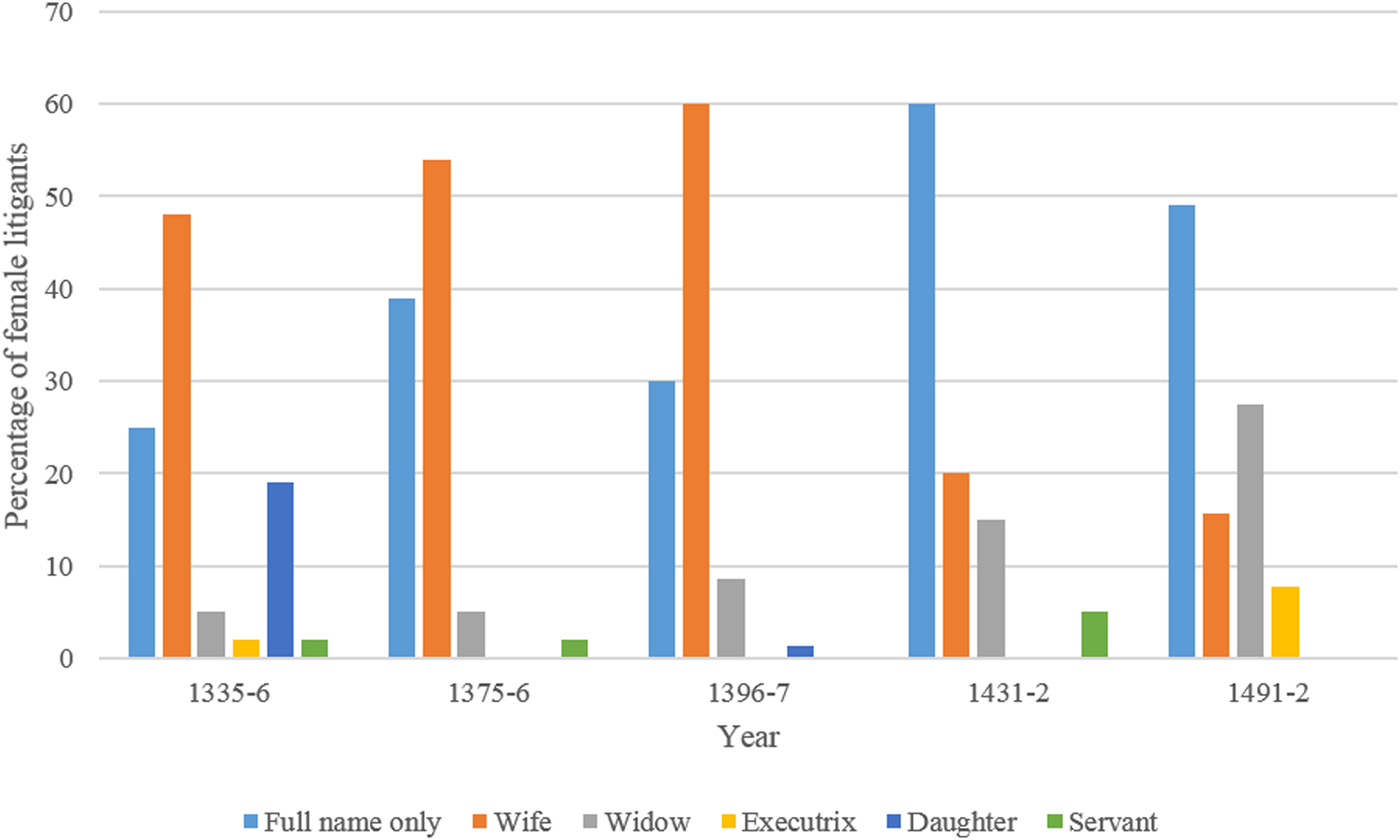
Rather than a neat trichotomy, at least ten different descriptors were applied to women's names in late medieval Nottingham. Some of these defined them in relation to men, but others did not; they were recorded by name only, as wife, widow, executrix, daughter, singlewoman, “sole,” or servant, as well as by their occupation or as “huswyf.”Footnote 16 Many of the descriptors were only used incidentally, but the five most commonly used have been sampled across a range of years and are displayed in the graph below.Footnote 17 While these patterns may indicate changing attitudes and preferences in the documenting of female status, there was also an element of choice on the part of scribes about which labels to apply.Footnote 18
The vast majority of women were recorded either by name alone (at times, up to 59 percent), or as wives (at times, up to 60 percent).Footnote 19 While other possibilities did exist, most women were thus defined according to a binary division of female status: they were simply married or not married. The large group of women recorded by name alone challenges the assumption that women were always classified and understood via their relationship to a man, while the significant proportion of women recorded as wives who litigated jointly with their husbands reveals the extent of married women's action in the borough court. It is noteworthy that the numbers of wives recorded fell in the fifteenth century, indicating a real decline in joint litigation of married couples, as it was only in these cases that women were described as “wife.”
The use of different descriptors over the period varied. At the same time that the number of wives fell, the proportion of women recorded by name only increased, reflecting the proportional decline in the litigation of married women alongside their husbands. These women were more than likely to have been unmarried women and therefore not under coverture, though whether they were women who had never (or not yet) married or widows was not deemed a necessary additional detail in most instances. However, the proportion of women described specifically as widows did increase by the end of the fifteenth century, which may point to a rise in the actual number of widows using the court but also signals increasing attention paid to documenting the specific legal status of individual women. The fluctuating use of this category warrants further attention: while 28 percent of women in court in 1491–92 were termed “widow,” a decade earlier there had been none.Footnote 20 The specific references to women described as “widow” do not necessarily indicate the only widows who used the court in a given year; various studies of widowhood have highlighted their important role and competency in managing the businesses of their late husbands as well as in asserting their customary rights, and this role may have drawn them into litigation.Footnote 21 However, it is likely that the shift reflected the differing choice or tendency on the part of scribes to describe women specifically as widows or simply by their full name, affecting their visibility within the legal records.
Personal Descriptors Applied to Women's Names in Nottingham Borough Court Rolls. Source: Nottingham Archives, CA1262, CA1279, CA1296, CA1322/I, CA1374.

Studies of widowhood have suggested that this part of a woman's life cycle was the best documented, highlighting the enhanced visibility and presence of widows in legal records and other sources due to their “transformation” in status from covered to independent.Footnote 22 However, the Nottingham court records present a different and more complicated picture, suggesting that the details of women's widowed status were not always deemed relevant. There may well have been plenty of widows using the court, but the relative lack of widow descriptors suggests that this specific life-cycle status was not rigorously recorded. Some widows were interchangeably referred to as “widow,” by their full name, or as “wife.” Within the space of a few weeks, Margery, widow of John Fox, was also called the wife of John Fox as well as his executrix.Footnote 23 She may have been very recently widowed, though the fact that she pleaded alone when she was termed “wife” suggests that her husband had already died by this point, and that the label was instead a legacy of her former marital status. For some women, like Margaret Stapulton, we can trace the shift from wife to widow more clearly. In November 1390, Matilda de Barley brought a plea of covenant against Hugh and Margaret de Stapulton, though Matilda and Hugh settled the complaint alone.Footnote 24 By March 1391, Margaret was the widow (“que fuit uxor”) of Hugh Stapulton when she sued Thomas de Coventre for a debt of 32d. owed to her late husband (a webster) for weaving equipment, indicating her continued interest in his affairs and possibly her continuing of his business after his death.Footnote 25 In other pleas she was simply called Margaret de Stapulton.Footnote 26 Similarly, Joan Samon featured in various debt pleas as both plaintiff and defendant and was referred to as the widow and executrix of Richard Samon, the widow of Richard Samon, and by her full name. The first of these descriptors was applied in 1394, when she faced claims for the payment of debts owed by her late husband (who had died in the previous year) and referred directly to her legal responsibility as his executrix.Footnote 27 In other debt suits concerning house rent and the dyeing of cloth, she was simply called Joan Samon, as these activities were not related to the fact that she was a widow.
This inconsistency in recording the names of individual women was relatively common but only becomes apparent when we pay close attention to the way that women's identities were recorded in different cases. Agnes Chadwyk, Margaret Derby, Margaret Tailour, and Margaret Thurston were all interchangeably recorded as “vidua” and by their full names in the court book for 1491–92.Footnote 28 Alice Tumby was recorded as wife of John Tumby, as well as by her name alone, in the various stages of a trespass plea brought in 1323 by Henry le Cancur, son of Ralph le Cancur.Footnote 29 In the same year, a drawn-out dispute concerning the detention of a strongbox by Geoffrey le Lockesmyth named the plaintiff variously as Emma, daughter of Roger le Brynkhull, and Emma de Brinchull (with various spellings) over the course of at least eight different court sessions.Footnote 30
The examples of Margaret Stapulton and Joan Samon, whose widowed status was sometimes central to their dealings around their late husbands’ debts, demonstrates how the differing labels affixed to women's names could be specific to the nature of the case in which they were involved. This is particularly notable where women performed the specific legal function of executrix. Elizabeth, wife of Robert Oldham, previously wife and executrix of William Johnson de Nottingham, brought a plea of debt for £6 10s. together with her new husband (Oldham) against John Strelley, “gentilman,” in 1492. Here we see the dual nature of Elizabeth's marital status as a remarried widow, as she was the former wife of one man and current wife of another. The money the couple sought, probably originally owed to Elizabeth's late husband, became her responsibility as his executrix, with her subsequent remarriage then necessitating the joint suit of husband and wife.Footnote 31 The label executrix denoted a specific legal status upon which the validity of a particular case could hinge, and it was used more consistently than other descriptors. Where legal action was directly related to a woman's (often recent) widowhood and the change in legal roles this brought, her widowed status was more likely to be recorded, and it is these pleas that have most in common with the more notable presence of widows in litigation at common law.Footnote 32
The descriptor “daughter” denoted a different type of not-married woman. Twenty-one different women were described as such in the court in 1335–36, though in 1322–23 only one daughter had been recorded. Later samples feature no “daughters” as litigants, suggesting that this status identifier fell out of official use, in line with the increasing proportion of women identified by only their full name. These women were likely to have been young and unmarried, probably still resident in the natal household and therefore known by association with their parents (usually fathers), though the fact they were able to take part in litigation indicates that they had reached the age of majority.Footnote 33 Most were involved in trespass pleas, demonstrating that they were perfectly able to get into trouble and have fights but were not perhaps of an age or status to contract debts or extend credit.Footnote 34 In 1335, sisters Emma and Juliana, daughters of Henry le Meirman, both separately claimed that Isolda Doget had assaulted them. Juliana also claimed that Doget had stolen a hood and kerchief from her. Doget brought a countersuit, saying that Juliana had attacked her and drawn blood in the town's marketplace.Footnote 35 All three women claimed damages at the standard sum of 40s. The jury reported that both Doget and Juliana had attacked one another, and both were awarded damages of 6d. But Emma was fined for bringing an unjust complaint against Doget, failing in what may have been a concerted attempt by the two sisters to harm Doget through litigation.Footnote 36 There were at least four Meirman siblings who featured in a range of complaints, including brothers William and John. In contrast to their sisters’ trespass suits, the brothers were parties to various debt pleas in the same year, and the differing nature of these suits suggests that the brothers were of a relatively superior economic status to their sisters, allowing them to participate in the credit networks of the town, occasionally leading to debt litigation. The sisters’ experience of the law, meanwhile, was as a result of their misbehavior and the breakdown of interpersonal relationships.Footnote 37 However, being classified as “daughters of” did not mean that these women were unable to take independent legal action; this descriptor was not a sign of wardship or of being “covered” by their father but rather an indication of youth and familial status, just as “sons of” was for their brothers.Footnote 38
The label of “singlewoman” emerged at a specific chronological moment. Judith Bennett and Amy Froide have suggested that approximately 10 to 20 percent of adult women of the period occupied this never-married status at any one time, but this descriptor only appears in the Nottingham court records from the end of the fifteenth century.Footnote 39 In 1495, Margaret Sydall, “synglewoman,” sued John Sye in the borough court for a debt of 6s. 10d.Footnote 40 The following year, Alice Spenser, “singlewoman,” brought a plea of detinue (an action relating to the wrongful detention or taking of personal property) against Emma Spenser, “vidua.”Footnote 41 In this second example, we see a distinction between two types of singleness, the singlewoman and the widow, and the hierarchical contrast of “ever-married” and “never-married” women.Footnote 42 The title also first appeared in the presentments of the sessions jury, a form of local policing, from 1495.Footnote 43
By the end of the fifteenth century, more descriptors were also being applied to men, with the majority being documented according to their occupation, such as John Hollyngworth, baker, or Nicholas Hyll, “alablasterman.”Footnote 44 The titles of “gentilman” and “husbondman” also first appeared at this point.Footnote 45 The Statute of Additions of 1413 required pleas in the royal courts to record details of occupation (“estate or degree, or mystery”) as well as place of residence and likely influenced practice in the lower courts.Footnote 46 It has been suggested that this requirement did not technically encompass female marital status, instead defined as a “condition,” though the increased use of all titles and epithets may have been a wider result of the law.Footnote 47 There was generally a strict gender division in this recording of status: few women had their occupations added to their names, instead being described according to marital status, reflecting the power of coverture. Marital status was understood to be the dominant facet of women's identity, but women's identities were also less defined by their occupations, as many women worked in more than one trade and were generally excluded from entry into skilled or professional trades via apprenticeship or education.Footnote 48 Some, such as Isabella Arden, “wydowe and capknytter,” were given both descriptors.Footnote 49 The use of the English “wydowe” alongside Arden's occupation represents another peculiar scribal choice, as all other widows were described using the various Latin terms. Perhaps Arden's status was noted in English due to the dual nature of her identity alongside “capknytter,” which did not easily translate into Latin. The occupations of others, such as Margaret Midwyff, were indicated by their surname.Footnote 50
Cordelia Beattie has argued that marital status had to be performed in order to be visible: it involved “living as a single person” or as a married person within a couple.Footnote 51 We find evidence of this performance in the court rolls, though this was also mediated by the ways in which women's marital status was documented by court scribes. The samples and examples discussed here reveal the dominance of marital status as a general delineating principle for women's status, while also making clear that court officials did not follow a strict or consistent means of describing women according to the tripartite life cycle model. The understanding of the limits on married women's litigation, as dictated by coverture, resulted in a general cultural-legal framework in which women were identified as married or not married, but additional details beyond this were not defined by a consistent or fixed set of rules. There may have been an element of individual choice in the recording of individuals’ status, or changes in policy and language, but these variations were also in part dictated by pragmatic concerns reflecting the nature of women's litigation in different cases. If a woman was married, she was required to plead alongside her husband; if a dispute related to her role as widow or executrix, then these details would be recorded; if she was still living within the natal household, she might be termed “daughter”; and if none of these factors applied, she might be recorded by her name alone.
Litigation and the Marital Partnership
The following sections draw specifically on married women's litigation in Nottingham to examine how it was defined by coverture and the role that married women took within litigation.Footnote 52 Complaints of debt and trespass are dealt with in turn to allow for comparison of the different reasons that women ended up in court.
Economic Litigation
Disputes arising from credit transactions were central to the negotiation of the commercial ties of credit and debt that underpinned the urban economy. The Nottingham court rolls reveal how women of all marital statuses made purchases, negotiated credit, produced various essential goods, and bought and sold a range of services on a daily basis. The urban economy relied on credit agreements and deferred payment at all levels, from the purchase of household essentials to mercantile trade and wholesaling. Debt pleas therefore dominated the borough court and involved individuals—male and female—of all statuses who used the court to enforce or contest credit obligations. These pleas did not necessarily indicate financial crisis: being sued for debt could actually reflect commercial connections and integration rather than an inability to pay.Footnote 53 Women's debt pleas echoed the general characteristics of women's work as being lower status, more marginal, and less professionalized than that of men, and their debts were on average of lesser value than those of men.Footnote 54 By the end of the fourteenth century, women were up 15 to 20 percent of all economic litigants, and debt accounted for over 60 percent of women's litigious action.Footnote 55
Many of these suits involved husbands and wives acting jointly as either plaintiffs or defendants, accounting for up to 50 percent of women's economic litigation and revealing the economic partnership of marriage and wives’ active role within it.Footnote 56 These joint suits were not unique to Nottingham's borough court: married women were parties to litigation in the central courts, with thousands of married women appearing in the Court of Requests in Elizabethan England.Footnote 57 In the Court of Common Pleas during the fifteenth century, married women were also frequent litigants. In cases relating to London, three-quarters of women's cases related to economic actions of debt, detinue, or account, and 43 percent of these featured a married woman as co-plaintiff or co-defendant.Footnote 58 At the city's sheriff's court, too, there was, according to Matthew Stevens, a “permissive attitude” toward married women's litigation.Footnote 59 In medieval Scotland, married women prosecuted debtors both on their own and on their husbands’ behalf, even though married women officially lacked the legal power to make contracts.Footnote 60 However, the fact that numerous types of court allowed wives to litigate with their husbands brings into question whether this practice was indeed a notably “permissive” one or part of a broader pattern whereby married women took part in legal action reflecting their role in the local economy and the marital partnership. Elsewhere in other towns and their courts, coverture was more powerful in hiding a wife's commercial roles behind the legal actions of her husband: her debts were his responsibility.Footnote 61 Craig Muldrew has argued that in early modern King's Lynn, credit transactions were recorded solely between men, obscuring the frequency with which women either lent or borrowed money and underscoring “the lack of legal autonomy faced by married women.”Footnote 62
The details of litigation show that wives’ economic activity translated into legal action in a variety of ways. Much of the joint debt litigation by spouses, such as the herring case cited at the opening of this article, related to agreements made by wives during marriage, despite the fact that they could not, in theory, enter into contracts. Numerous complaints explicitly exhibit wives’ agency both in agreeing to transactions and in enforcing these agreements in court in partnership with their husbands.Footnote 63 Barbara Hanawalt's study of London wives acknowledges the business and legal actions of femme sole wives, but while there is no evidence that this special status existed in Nottingham, wives were nevertheless able to act as legal persons alongside their husbands in litigation revealing numerous agreements of differing nature.Footnote 64 In March 1391, Robert de Howedeyn and his wife, Isabella, complained that Tysson Braban had broken a covenant with them: Isabella had given him some thread to make into cloth for both her and Robert, but Braban had subsequently lost the cloth.Footnote 65 Isabella was the key agent in this transaction, though the contract concerned both spouses. Emma Marchaunt sued Henry Prest and Katherine, his wife, in 1357, as Marchaunt claimed that Katherine had agreed to spin her wool for her, but Katherine had not done so in a good and competent manner, thereby breaking the covenant between them. Henry and Katherine both denied the claim of poor quality, and Emma Marchaunt sought damages of 40d.Footnote 66 Here it was Katherine Prest and Emma Marchaunt who made the agreement, but because Katherine was married, the complaint also involved her spouse. In March 1393, Thomas Fox complained that Richard Plattes and his wife, Lucy, owed him 11s. 6d. for “motley cloth” sold to Lucy almost two years earlier, again revealing the wife's agency in making commercial agreements.Footnote 67 These cases were not unique to medieval Nottingham; Cathryn Spence has shown that in early modern Scottish burghs, debt cases featuring husband and wife often related to instances where the wife was the principal actor.Footnote 68 Other cases reveal a clear expectation that payments were owed jointly to both husband and wife. For example, in January 1427, Thomas Lenton and his wife, Alice, sued John Lokyngton for detaining 5s. for rent since 1416. Why the couple waited more than ten years to recover this debt is not known; they alleged that sum had been received by Lokyngton from William Burton of Lowdham, to be paid to Thomas and Alice Lenton at Whitsun in 1416, but that Lokyngton had not done so.Footnote 69
Not all pleas detailed the specific role of wives in credit transactions, but the fact that they were named as parties indicates that they nevertheless played a role in both the original transaction and the subsequent litigation. Women's commercial roles can often be inferred, particularly when complaints related to common forms of women's work, such as brewing. Married women dominated the industry in towns, where their profits could provide important additional income to the household economy. They also had access through the household economy to the capital needed to invest in resources and equipment. However, brewsters’ limited contractual independence and access to credit, highlighted by Judith Bennett, is reflected in joint pleas concerning various stages of the brewing process that saw husbands and wives in court together.Footnote 70 In February 1402, Robert and Joan Glade complained that William Aschewe owed them 40d. for malt, which Aschewe acknowledged and paid, along with 2d. damages.Footnote 71 A few months earlier, in October 1401, Thomas de Bothall and his wife, Cecilia, similarly claimed that Hugh Burges owed them 3s. for malt, plus damages of 12d.Footnote 72 An inquest jury was summoned, though the result is not known. Laurence and Isabella Tyryngton sued Richard and Magota Grantham for 2s. owed for ale in 1375.Footnote 73 These married women took joint action with their husbands to recover debts that were probably accrued through their own engagement in the production and sale of ale. We know that these were not one-off activities, as both Robert Glade and Thomas de Bothall were fined for brewing against the assize in 1396, which may in fact have masked the brewing activity of their wives.Footnote 74 It is likely therefore that some of women's brewing work was similarly hidden beneath debt pleas between men.
Wives’ involvement in economic litigation was not merely symbolic. They were expected to be present in court when named in a suit, or to follow the formal procedures that excused attendance or allowed representation by others, at least in the initial stages of litigation. These pleas thus warrant greater attention than they have previously been accorded, as they show that wives were not merely adjuncts to their husbands but active participants in the legal process. When William del Peek complained about a debt owed by John and Margery Cook, neither of the Cooks had shown up when required, and both were ordered to appear at the next court session two weeks later.Footnote 75 In contrast, William de Brodbury and his wife, Agnes, sued Robert Squyer and his wife, Isabella, for debt in May 1393, and the roll records that both William and Agnes de Brodbury came “in their own person” but that Squyer acted as attorney for his wife.Footnote 76 This was not an automatic “covering” of his wife but Squyer's adoption of a formal legal role. However, the role that wives played could also vary. In 1397, Richard and Lucy Plattes complained that John Russell owed them 12d. for various amounts of lead bought from them the previous year.Footnote 77 The couple initially brought the plea together, but Lucy Plattes was not recorded in the subsequent court sessions. Husbands were, in some cases at least, able to continue a plea without their wives, though there must have been value in the women's initial inclusion in the plea. As Tim Stretton has argued, courts sometimes demanded the participation of women when it was relevant to the case, even when in theory husbands could have litigated on their own.Footnote 78
These cases all point to wives taking a practical role in credit transactions during their marriage and in the negotiation of these transactions and obligations within the borough court. Under coverture, they could not be held individually responsible for debts or contracts, though their legal partnership with their husbands extends the role of wives in debt and detinue suits beyond that suggested in previous studies—that wives’ involvement in debt pleas stemmed from debts they had transacted prior to marriage.Footnote 79 While medieval legal treatises did not deal with the practicalities of wives’ roles in debt pleas, the seventeenth-century text The Lawes Resolutions of Womens Rights also suggests that wives’ debts were only those contracted prior to marriage, implying that they would not be involved in transacting debts once married.Footnote 80 Certainly, some Nottingham pleas were rooted in premarital debts. In an action for detinue of April 1492, for example, Thomas and Margery Copeland complained that Thomas Higgin and his wife, Joan, had kept numerous household goods from Margery since before her marriage.Footnote 81 A similar debt plea of 1512 brought by Nicholas and Margaret Bowre referred to a debt owed to Margaret from the period while she was “sole.”Footnote 82 Some plaintiffs may have seen the marriage of previously single female debtors as an opportune moment to recover their money. Equally, some women may have waited until marriage to pursue complaints against others, particularly in relation to wages owed by previous employers, as the potential to sue jointly with their husband may have offered better prospects of a successful outcome.Footnote 83 However, the fact that details concerning premarital debts were rarely documented, with special justification recorded in these two instances, suggests that they were something of a departure from the norm and that premarital debts did not lie behind the majority of wives’ involvement in debt suits in Nottingham.
Wives’ economic agency within the marital partnership did not always lead to their being named among parties to litigation, even when it is clear that they were central to the disputed transaction. These complaints accord more with Muldrew's picture of borough court litigation, where men acted on behalf of their wives, a pattern that Alexandra Shepard has also identified in early modern Cambridge.Footnote 84 For example, in August 1367, John Baker complained that he had bought pair of millstones from Roger le Mason through Agnes, his wife, but Roger (a mason) had failed to deliver the stones.Footnote 85 Agnes had arranged the purchase of the millstones on behalf of her husband (a baker), for whom the millstones were essential to his work. However, perhaps because she was only acting as Baker's agent, when Roger le Mason broke the covenant, she was not involved in the plea. Various other cases followed this pattern. In 1357, Thomas Stanley complained that John Beeston owed him 27d. that Stanley's wife, Agnes, had given to Beeston in November 1354, to be repaid later in the year.Footnote 86 In August 1408, Robert de Wodburgh sued Robert de Stapulton for a debt of 17d. that had been loaned to Robert de Stapulton's wife.Footnote 87 Though we do not always know how or why these debts were contracted, the pleas identify the gap that could exist between married women's economic and legal agency as a result of coverture. Together, these cases demonstrate the lack of a consistent set of rules governing wives’ involvement in economic disputes, ranging from significant personal involvement and agency to being “hidden” behind their husbands.
Trespass Litigation
Trespass pleas were the second most common type of complaint in the borough court. They arose from the wide-ranging disagreements and misbehavior that were inevitable features of urban life and allowed monetary claims for damages to be sought as compensation for the harm caused by the actions of others. They concerned acts including assault, defamation, theft, housebreaking, and damage to real and movable property. In fourteenth-century Nottingham, women featured in between 37 percent and 43 percent of trespass suits, accounting for 17 to 30 percent of all litigants. Married women were regularly involved, pleading with their husbands as plaintiffs or defendants in 46 to 69 percent of all cases featuring women.Footnote 88
As plaintiffs, wives acted alongside their husbands to complain when they had been the victims of various attacks. For example, William Cancour and Avice, his wife, sued William de Wirsop for trespass and bloodshed in November 1364, claiming that de Wirsop had assaulted Avice Cancour, and de Wirsop was amerced (fined) by the court.Footnote 89 Often these complaints represented altercations between pairs of women. In October 1364, John Hester and his wife, Joan, brought a complaint of trespass and bloodshed against Roger of Grantham and his wife, Katherine, alleging that Katherine had assaulted Joan and bloodied her against the peace. Both Roger and Katherine answered that Katherine was not guilty.Footnote 90 Though the women could not bring their complaints independently, neither did their husbands simply act on their behalf.
As the previous example demonstrates, women did not appear in court only as victims but were also alleged to have committed transgressions, and the complaints of others clearly identify independent misbehavior of married women who were forced to take responsibility jointly with their husbands. In 1398, Joan Brailsford brought a plea of trespass against John Nottingham and his wife, Margaret, claiming that Margaret had come to her house several weeks earlier, assaulted her, dragged her, and thrown her down, breaking a bone in her thigh. Presumably such a serious injury as a broken leg would have been common knowledge or easily evidenced in court, and the jury agreed that Margaret was guilty.Footnote 91 Lady Alice Tannesley sued William Wade and his wife, Alice, in 1430, alleging that Alice had cut down and taken two damson trees from her garden, causing damages of 100s.Footnote 92 William Wade was eventually fined 3d., suggesting that he acknowledged his wife's misdemeanor and indicating his financial accountability as a direct result of coverture.Footnote 93 However, punishment could be directed specifically at wives. In October 1335, the jury found that Emma, wife of Roger Gaugy, had come to the house of Roger and Matilda Overandover and attacked Matilda. The court ordered that Emma be held in prison until damages of 12d. and the fine to the court could be paid.Footnote 94 Emma's imprisonment suggests that the couple did not have the money to pay the fine immediately, while also recognizing that it was she who was responsible for the attack. Imprisonment as an outcome of these cases was rare, though in this case it demonstrates the separation of the legal identities of wife and husband in cases of misbehavior.
Spouses also complained together about trespasses that had harmed them both, with damages reflecting the impact on the marital partnership. In 1330, Roger le Marchal and his wife, Agatha, complained that Henry le Marchal had attacked them both in John Dun's house. Henry had allegedly called Roger a false man and a thief and had beat, trampled upon, and maltreated Agatha, hitting her on the head with a dish, drawing blood and causing damages of 40s. The jury reported that Henry had beaten Agatha, and it awarded damages of 40d., though there was no verdict on the alleged verbal assault on Roger.Footnote 95 Some complaints specifically cited the combined financial, physical, and social harm for both spouses. In 1399, John and Alice Drapur sued William Asshewe for trespass, claiming that Alice had gone to Asshewe's house to collect various items that he had dyed for her (indicating some sort of commercial arrangement too), when Asshewe beat and “bore down on her” with abusive words. The claim for damages of 100s. cited the harm done to Alice Drapur, as well as the shame that was brought on John Drapur, and though the jury reported a guilty verdict, the court awarded only 4d. compensation, a typical outcome of such complaints. Footnote 96
The marital partnership, as represented under local law, therefore extended beyond the commercial ties and cooperation of husband and wife to their behavior and interpersonal relationships. The fact that these truly were joint pleas rather than simply the symbolic recording of wives’ names is again evidenced by the separate essoins (excuses for non-attendance) of husbands and wives, such as those of Richard le Couper and Juliana, his wife, defendants in a trespass plea brought by Richard Baldok in January 1325.Footnote 97 When Ralph of Stanton, his wife, Cecilia, and daughter, Margery, complained about the behavior of Margery, widow of Robert de Esthill, in 1335, all three members of the family were essoined separately by different men, clearly demonstrating the expectation that each litigant should be present at court or formally excused.Footnote 98 In February 1434, William Stuward complained that John Annesley and Emota, his wife, had taken forty pounds of animal skin from him. In responding to the complaint, John Annesley acted as Emota's attorney and replied that they were both not guilty, taking on the formal role of legal representative. The appointment of an attorney was something that was common for many litigants, both male and female, though in this instance there was an overlap in the couple's marital ties and Emota's legal representation.Footnote 99
Joint pleas were therefore part of established court practice and represented a pragmatic interpretation of coverture. However, a small number of examples show that married women could sometimes bring and answer complaints alone. In January 1491, William Cuymer brought a complaint of trespass against Agnes Gybson, wife of John Gybson. Cuymer claimed that Agnes Gybson had come to his house with force and arms, breaking and entering and taking goods and chattels worth 3s.Footnote 100 Agnes Gybson denied the attack, and the jury agreed. In 1495, Joan, wife of Antony Lancaster, complained that Thomas Orbney, “shomaker,” had assaulted her with sticks and knives as well as “malicious words.”Footnote 101 Orbney brought a successful countersuit against Joan, claiming that she had assaulted him in his house.Footnote 102 In neither of these complaints was there any indication that these women were acting incorrectly in bringing or answering the suits, suggesting that cases could continue if litigants overlooked these departures from usual practice.Footnote 103 Yet in a handful of contrasting instances, the women were challenged. Amya Litster attempted to sue Richard Brass for detinue of a cloak in 1397, claiming that she had loaned the cloak to Agnes, Brass's wife. However, Brass responded that Litster was married to a man named Thomas Harbard, so he was not obliged to respond to her complaint.Footnote 104 The outcome of this challenge has not survived, but we know that the court delayed further litigation while investigating the issue of Litster's marriage. Another woman, Agnes Halum, used a similar technique to get out of a trespass plea brought by William de Wyrsop in 1389.Footnote 105 Litigation enabled women to perform their marital status, which itself determined their ability to take legal action, and these women were well aware of this fact. We only see the blurring of these lines when individuals were challenged in court, but these cases suggest that other women appearing in court alone and under their full name might also have been married, further underlining the need for caution when categorizing women and making assumptions about individual status.
Conclusion
Coverture had wide-ranging implications for women's use of their local court in late medieval Nottingham. Their legal action was defined by a general framework that distinguished between the status and capabilities of married and not-married women. As a formal legal principle, coverture was rarely drawn upon as a justification or challenge to borough court litigation, demonstrating that its power was rather as a broad cultural understanding that informed the nature of the marital partnership both in everyday life and under the law. In Nottingham, married women's litigation was not exceptional, but it was always informed by the culture of coverture. Joint actions by husbands and wives did not render married women invisible or prevent them from claiming a legal identity, but that legal identity was also specific to the circumstances under which women came to court. This mutability was also reflected in the way that the court documented women's identities, both in relation to marriage and other descriptors that helped to determine and document female status. Women were not rigidly or consistently classified under various marital categories, their identities instead being described in a more pragmatic manner that reflected their specific role in legal complaints. The classificatory maid-wife-widow scheme may not have held as much sway in practice as the theoretical literature has suggested.
Married women's litigation demonstrates the centrality of the marital partnership to the practical application of coverture, reflecting Craig Muldrew's argument that “it was not individuals but households which were successful, or which failed,” despite the husband's legal control over material wealth.Footnote 106 The range of commercial complaints in which wives acted reflects their key role in contributing to the household economy, but their role in litigation varied, ranging from the explicit recording of their individual agency in making agreements during and prior to marriage to instances where their actions were more hidden or represented by their husbands. Litigants had some degree of choice in how to pursue disputes in which wives had played a role, offering some women a degree of legal agency that reflected their practical economic role. The legal ramifications of the marital partnership also extended beyond the household economy to complaints of misbehavior that arose from wives’ everyday interactions. Despite the legal responsibilities allocated to their husbands by coverture, many wives took an active role in the negotiation of relationships in court, as they did within the urban community more broadly. In addition, wives who were named as litigants were expected to participate or to be formally excused or represented by others. Taken together, women's roles and status across a range of legal complaints illustrate the pragmatic means by which the theoretical disabilities of coverture were negotiated in order to account for the reality of women's economic roles and the demands and disagreements that pervaded urban life in late medieval Nottingham.