Introduction
Thirteen percent of the world’s bird species are threatened with extinction (IUCN 2020). Threats to avian populations include habitat loss (Harris and Pimm Reference Harris and Pimm2004), climate change (Liang et al. Reference Liang, Xing, Zeng, Li, Peng, Li, Gao and He2018), overexploitation (Harris et al. Reference Harris, Green, Prawiradilaga, Giam, Giyanto, Putra and Wilcove2015, Panter et al. Reference Panter, Atkinson and White2019), persecution (Madden et al. Reference Madden, Rozhon and Dwyer2019), invasive species (Woinarski et al. Reference Woinarski, Woolley, Garnett, Legge, Murphy, Lawes, Comer, Dickman, Doherty, Edwards, Nankivill, Palmer and Paton2017) and the effects of anthropogenic activity such as energy production and use. One of the major impacts of energy production and use is electrocution of wildlife on power lines (Ferrer et al. Reference Ferrer, Riva and Castroviejo1991, Bevanger Reference Bevanger1998, Bayle Reference Bayle1999).
Electrocutions involve a wide range of taxonomic groups, including mammals (Boinski et al. Reference Boinski, Jack, Lamarsh and Coltrane1998, Katsis et al. Reference Katsis, Cunneyworth, Turner and Presotto2018, Kolnegari et al. Reference Kolnegari, Turk Ghashqaei, Hazrati, Basiri, Mojaver Tork Abad and Ferrer2018), reptiles (Fritts Reference Fritts2002), and birds (APLIC 2006, Lehman et al. Reference Lehman, Kennedy and Savidge2007, Ferrer Reference Ferrer2012). Electrocutions rarely impact power lines but when they do, outages (Dwyer and Mannan Reference Dwyer and Mannan2007, Kemper et al. Reference Kemper, Court and Beck2013, Kolnegari et al. Reference Kolnegari, Basiri, Hazrati and Dwyer2020), fires (Guil et al. Reference Guil, Soria, Margalida and Perez-Garcia2018, Dwyer et al. Reference Dwyer, Harness, Gallentine and Stewart2019), or equipment damage may occur (Fritts Reference Fritts2002, APLIC 2006) and the economic impacts can be substantial. For example, in the United States, power outages are estimated to cost 25–180 billion US dollars annually (Peretto Reference Peretto2010), and animals are prominent causes of such power outages. In one case, 19% of the power outages in a distribution system in Kansas, USA were attributed to animals (Sahai and Pahwa Reference Sahai and Pahwa2006). In another case in Portugal, White Storks Ciconia ciconia caused half of all power outages (Maricato et al. Reference Maricato, Faria, Madeira, Carreira and de Almeida2016).
Interactions between birds and power lines can cause not only outages and interruptions to electric power supplies (Wang Reference Wang2016), but also impact local bird populations through injury and mortality (Sergio et al. Reference Sergio, Marchesi, Pedrini, Ferrer and Penteriani2004, López-López et al. Reference López-López, Ferrer, Madero, Casado and Mcgrady2011, Ferrer Reference Ferrer2012, Loss et al. Reference Loss, Will and Marra2014). This lose-lose situation creates an opportunity for conservation groups and power companies to collaborate to find ecologically effective and cost-effective solutions. We hypothesize that one way to do so would be to focus on power outages.
Avian electrocutions can cause either transient faults, whereby automatic reclosers immediately restore the flow of electricity (Dou-niu and Li-qun Reference Dou-niu and Li-qun2015, Wang Reference Wang2016), or outages, defined as "abnormal electric currents that do not disappear when power is disconnected" (Wang Reference Wang2016); most faults are transient. Electricity consumers sometimes perceive transient faults as a brief flickering of lights. Electricity utilities can determine the causes of transient faults (e.g. bird-related contact, tree contact, climatic events and vandalism) by analyzing patterns in electrical waveforms (Wang Reference Wang2016), but the technology required is expensive and data processing is time consuming (Wang Reference Wang2016). Consequently, causes of transient faults tend not to be investigated.
In contrast, outages must be investigated, and the causes corrected, to restore the flow of electricity. Although outages represent a small proportion of total avian-caused faults, data from outage investigations can provide detailed insights into the source of the outage as carcasses, parts of carcasses or nests may remain attached to the infrastructure at the site of the fault and damage may also be present on the power equipment. The combination of biological and mechanical evidence can be used to determine exactly which components were involved in the outage (Dwyer et al. Reference Dwyer, Garrido Lopez, Martín and Horváth2017a). Outage investigations can also identify avian electrocutions as ignition sources for fires, an emerging risk multiplier for electric utilities potentially responsible for cascading effects associated with power line operation. Outage data are well-documented by power companies and are a primary metric for economic losses to power companies, however, often remain unpublished.
Avian body size is one of the most important characteristics making species susceptible to electrocution (Ferrer and Hiraldo Reference Ferrer and Hiraldo1992, Bevanger Reference Bevanger1998, APLIC 2006). Generally, larger birds are more susceptible to electrocutions as larger birds are more likely to bridge the airgaps between energized conductors and nearby power line components. This is not always the case, as Demerdzhiev (Reference Demerdzhiev2014) found body size had no significant overall impact on electrocution probability in Bulgaria, but the pattern is generally true. To date, there has yet to be a study focusing on the relationships between avian body size and electrocution on specific electrical components, likely because most studies are carcass-driven rather than outage-driven.
In this study, we conduct analyses of avian-caused outages along the electrical system in Iran. We focus on avian-caused outages as a novel source of information on relationships between avian body sizes and electrocutions on specific electrical components. To identify these relationships, we used information collected during outage investigations in Iran throughout 2018. This information allows us to simultaneously quantify total numbers of outage-causing avian electrocutions, numbers of outages on various voltages, species involved, and relationships between birds of various body sizes and electrical components. We also report the occurrence of fires ignited by avian electrocutions.
Study area and methods
We conducted our study throughout Iran which comprises a land mass of 1,648,195 km2 and has a population of approximately 82 million people. Electricity use is growing by approximately 8%/year (Ministry of Energy 2018), resulting in continuous expansion of the electrical system. This expansion creates new potential for human-wildlife conflict impacting both people and wildlife. Iran’s Birds and Power Lines Committee (IBPLC) was developed in part to help find practical mechanisms of reducing avian-caused outages (Kolnegari et al. Reference Kolnegari, Moghimi, Basiri, Turk Qashqaei and Hazrati2019).
Data collection
Through IBPLC, we requested and obtained avian-caused outage data from 2018 from power companies throughout Iran. These data included five discrete elements: contextual data, photographs, voltage, outage type, and descriptions of the power line component(s) involved.
Contextual data included the exact date, time, and location of each electrocution. We used contextual data to ensure that each record we included in our analyses was unique and to provide geospatial analyses to Iran’s power companies. However, due to security concerns regarding the sharing of geospatial data (Dwyer et al. Reference Dwyer, Gerber, Petersen, Armstrong and Harness2020), we do not report contextual data here. Instead, we report only approximate percentages of outages by quadrant (north-west, north-east, south-west, and south-east) in Iran.
Photographs allowed us to verify that the outage being reported did in fact result from an avian electrocution, and thereafter, to identify the species involved. This allowed us to quantify body sizes. We used a field guide (Svensson Reference Svensson2011) to identify species from photographs and identified average body length and wingspan for each species. We used the BirdLife Data Zone (http://datazone.birdlife.org/home) to categorize species into taxonomic groups, and the IUCN Red List (IUCN 2020) to identify the global conservation status of electrocuted birds. Examination of photographs also allowed us to verify the line voltage, outage type, power line component(s) involved, and when overview photos were provided, ignition of a fire.
Voltage allowed us to separately assess electrocutions on transmission lines (66–400 kV), distribution lines (20 kV), and local lines (220 V). Electrocutions occur occasionally on transmission lines and relatively frequently on distribution lines (Bevanger Reference Bevanger1994, Janss and Ferrer Reference Janss and Ferrer2001, Jenkins et al. Reference Jenkins, Smallie and Diamond2010, Voronova Reference Voronova2012, Kemper et al. Reference Kemper, Court and Beck2013, Loss et al. Reference Loss, Will and Marra2014). Transmission lines carry electrical power from generation facilities to load centers, typically urban or industrial areas. Transmission lines facilitate high-efficiency long-distance movement of electrical power that must be “stepped down” to lower voltages to be accessible to electricity consumers. Transmission lines are not insulated to protect birds (or people) from contact, but because of the relatively large separations (insulators and airgaps often > 1.5 m around energized components) required to contain transmission voltages, relatively few avian electrocutions occur on transmission lines globally (APLIC 2006, Ferrer Reference Ferrer2012). Stepping down voltage occurs in substations where transmission systems connect to distribution systems. Distribution lines carry electrical power from substations to consumers. Distribution lines are typically supported by wooden poles or concrete or steel pylons, and globally, are most frequently associated with avian electrocutions (APLIC 2006, Ferrer Reference Ferrer2012, Dwyer et al. Reference Dwyer, Garrido Lopez, Martín and Horváth2017a). The wires used in distribution systems are typically not insulated, relying instead on elevation on poles or pylons to separate human residents from electric power. Distribution systems typically connect to consumers through pole- or pylon-mounted transformers that energize local lines. Globally, relatively few avian electrocutions occur on local lines, in part because the wires comprising local lines are usually insulated to protect consumers from the electric power the systems contain, and in part because contact with local voltage does not necessarily result in death or injury. By comparing number of electrocutions on each system to number of structures (towers, pylons, etc.) comprising each system, we test whether distribution power lines pose a greater risk to the bird fauna in Iran than other systems.
Outage type distinguished electrocutions as phase-to-phase or phase-to-ground. In the vernacular of the electric industry, “phase” indicates any energized component including conductors (the wires connecting towers or pylons across the landscape), jumpers (the wires connecting conductors to one another or to equipment), and equipment (the hardware used to regulate the flow and voltage of electric current). “Ground” indicates any path to earth, including, the pylon itself, lightning protection, and the exterior cases of energized equipment like transformers (APLIC 2006).
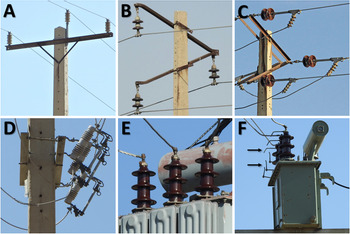
Identifying the power line components involved in outages allowed us to make inferences on the most dangerous power line components so we could make proactive retrofitting recommendations. We identified seven types of power line components: pin insulators, suspension insulators, strain insulators, fused cutouts, transformer bushings, transformer arcing horns, and mid-span conductors. Insulators are used to separate energized conductors and jumpers from the structure supporting them. Pin insulators project up from the structure, suspension insulators hang down from the structure, and strain insulators project laterally from the structure (Figure 1a through Figure 1c). In Iran, insulators are typically installed on grounded concrete pylons with grounded steel crossarms, creating phase-to-ground electrocution risk. Phase-to-phase electrocution risk can also be present when out-of-phase conductors and jumpers are situated near one another. The term “out-of-phase” refers to conductors at the same nominal voltage at different points in the alternating current cycle. Fused cutouts are used to disconnect equipment from circuits and to disconnect sections of circuits from one-another (Figure 1d). Transformers are used to step down voltage from higher voltages to lower voltages and are connected to conductors through bushings (Figure 1e), and arcing horns are used to protect transformers from lightning-caused power surges (Figure 1f). In the cases of bushing and arcing horns, out-of-phase energized components are in close proximity to one another and to the grounded case of the transformer, creating phase-to-phase and phase-to-ground electrocution risks.
A) Pin insulators projecting upward from tops of crossarm and pylon. B) Suspension insulators hanging below wishbone-configuration crossarms. C) Strain insulators projecting laterally from crossarm. D) Fused cutouts on crossarm below conductors. E) Transformer bushings on top of a transformer. F) Transformer arcing horns adjacent to transformer bushings (photos: Iran’s Birds and Power Lines Committee).

In addition to quantifying the number of incidents by equipment type and by species involved, we checked photos for evidence of fire ignitions, and we queried electric companies for estimates of financial impacts. We report a summary of fires and financial impacts below.
Statistical analysis
We used version 9.1 of SAS (SAS, Cary, NC, USA) statistical software to conduct ANOVA tests to assess relationships between bird body size and electrical components. We used version 13.0 of Statistica (TIBCO Software, Inc., Palo Alto, CA, USA) software to conduct Chi-square tests of independence between electrocutions and voltage levels.
Results
We received records of 222 avian-caused outages from throughout Iran, including 235 electrocuted birds (some outages involved multiple birds) and were supported by 1,065 photographs of birds and equipment in situ. Records were submitted from all 31 of Iran’s provinces, with approximately 62% from provinces in the north-west, 20% from provinces in the north-east, 14% from provinces in the south-west, and 4% from provinces in the south-east. The data spanned a range from January until December 2018 (
 $ \overline{x} $
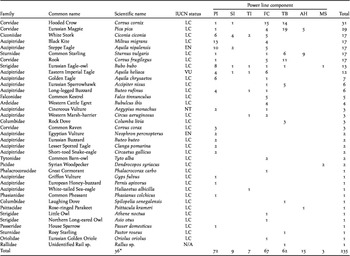
= 18.5/month ± 5.8). We identified birds to 36 species in 16 families, with one bird identified to genus level (7% of Iran’s total species; Table 1). Hooded Crows Corvus cornix and Eurasian Magpies Pica pica were the two most frequently electrocuted species, collectively accounting for 26% of electrocutions. Raptors were the most frequently electrocuted group, accounting for 43% of electrocutions. Two globally ‘Endangered’ species, Steppe Eagle Aquila nipalensis, Egyptian Vulture Neophron percnopterus, one globally ‘Near Tthreatened’ species, Cinereous Vulture Aegypius monachus and one globally ‘Vulnerable’ species, Eastern Imperial Eagle Aquila heliaca comprised a total of 15% of electrocutions. On one occasion, a bird was fully burnt due to a transformer explosion resulting from an electrocution and was only identifiable to genus level (Rallus sp.). In three separate incidents, two Common Kestrels Falco tinnunculus and a Rock Dove Columba livia were preyed upon by a Eurasian Eagle-owl Bubo bubo and both predator and prey were electrocuted simultaneously. We were unable to determine whether the prey died due to predation or electrocution, so we truncated the prey species from our data.
Species electrocuted, global IUCN status (LC = Least Concern, NT = Near Threatened, VU = Vulnerable, EN = Endangered) and power line component involved (PI = Pin Insulator, SI = Suspension Insulator, TI = Strain Insulator, FC = Fused Cutout, TB = Transformer Bushing, TA = Transformer Arcing horn, MS = Mid-Span) when avian electrocutions caused power outages.

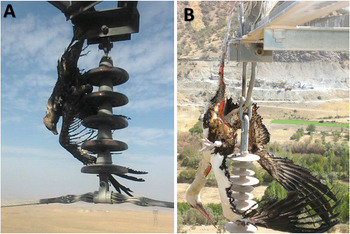
Six outages (3%) involved transmission voltages (66–400 kV). In these incidents, four White Storks, one Eastern Imperial Eagle and one Steppe Eagle were found hanging from transmission suspension insulators (Figure 2). We documented 214 outages on distribution voltages. Of these, 96% of incidents involved 97% of birds because all outages involving multiple birds occurring on the distribution lines. Only two outages (1%), involving one bird each, were identified on local voltage lines. In these two cases, a House Sparrow Passer domesticus and a Common Starling Sturnus vulgaris each perched on small pin insulators installed on the side of a concrete pylon. Based on the proportions of poles making up transmission, distribution, and local voltage systems, distribution voltages were significantly more likely to be involved in outages than other voltages (X2 = 252.58, df = 2, P < 0.0001; Table 2). Most outages (91%) were caused by phase-to-ground faults. The remainder were caused by phase-to-phase faults (Table 3).
A) Eastern Imperial Eagle (Aquila heliaca) and B) White Stork (Ciconia ciconia) hanging from suspension insulators following outages caused by their electrocutions on transmission lines in Iran (photos: Ali Akbar Basiri and Mohammad Sadegh Arshadi).

Numbers of avian-caused outages at various voltage levels. From data collected throughout Iran from January through December 2018.

Numbers of avian-caused outages by outage type. From data collected throughout Iran from January through December 2018.

Electrical components involved
Insulators were involved in 37% of outage-causing avian electrocutions, transformers in 33%, fused cutouts in 29%, and midspan collisions in 1%. Among insulators, pin insulators accounted for 82% of outage-causing avian electrocutions. Although pin insulators were the component involved in the greatest number of electrocutions, as pin insulators were present on almost every distribution pylon, they were involved in significantly fewer electrocutions than would be expected due to chance (X2 = 208.78, df = 4, P < 0.0001; Table 4). Suspension insulators were involved in 4% of outage-causing avian electrocutions. All avian-caused outages on transmission lines involved suspension insulators, but because suspension insulators were present on every transmission tower, and on some distribution pylons, suspension insulators were involved in significantly fewer electrocutions than would be expected due to chance. Strain insulators were involved in 3% of outage-causing electrocutions. Although strain insulators were involved in the fewest number of insulator-related outage-causing electrocutions, they were involved in significantly more incidents than would be expected due to chance because strain insulators occurred relatively infrequently within the electrical system.
Number of outages and electrocuted species on various power line components in Iran. Numbers of mid-span electrocutions were not included in statistical analyses (see text for detail).

a Transformer bushings and transformer arcing horns were pooled for analysis due to the small number of outages associated with arcing horns.
Transformer bushings and arcing horns on transformers together were involved in 35% of outage-causing avian electrocutions. This made transformers the most dangerous component within distribution systems given the relative infrequency of transformers. Although fused cutouts were present in only 11% of distribution structures, fused cutouts were involved in 29% of outage-causing electrocutions. Consequently, fused cutouts were involved in more incidents than would be expected due to chance and were the second most dangerous component within the distribution system overall. Mid-span electrocutions were the most infrequent (n = 3), and due to low sample sizes, were not included in statistical analyses.
Relationships between body size and electrical component involved
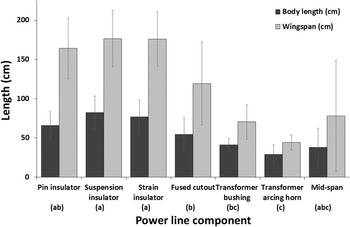
The average body size of electrocuted birds was largest for electrocutions involving suspension insulators (Figure 3). Average body sizes for birds electrocuted on strain insulators and pin insulators were slightly, but not significantly, smaller (F = 17.21, df = 2, P = 0.42). Average body sizes were significantly smaller for birds electrocuted on fused cutouts than for birds electrocuted on insulators. Outage-causing electrocutions on transformer bushings and transformer arcing horns involved the smallest average body size. Average body sizes for birds electrocuted mid-span ranged substantially. These patterns were true whether considering bird’s body lengths or bird’s wingspans (F = 2.15, df = 1, P = 0.23).
Mean body lengths and wingspans of birds electrocuted on various power line components in Iran. Power line components with the same letter(s) were not significantly different at α = 0.05 for either body length or wingspan. Error bars indicate standard deviations.

Cost of permanent faults
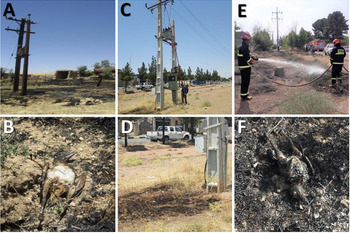
On average, the outage-causing avian electrocutions reported here caused economic impacts to electric companies of approximately 44M Iranian Rial per incident (roughly $400 USD depending on conversion rates) to re-establish electrical power, but not to modify structures to prevent future avian electrocutions. These electrocutions also cost power companies reimbursement expenses for factories’ lost production during outages, and reimbursement expenses for factories of 100–150 times the price of electricity that was unavailable during the outage. In addition to economic impacts, electric utilities incur negative electric reliability scores from Iran’s Ministry of Energy for each outage, and also incur negative public perceptions, especially for at least eight avian-caused outages on distribution lines that also resulted in fires (Figure 4). We were unable to quantify a definitive number of fires because not all reports included contextual photographs that could be evaluated for ignitions.
Examples of avian electrocution-caused outages that also resulted in fires. A) Wide view of a fire location. B) Close view of rook (Corvus frugilegus) carcass causing the fire in A. C) Power technician closing a fused cutout involved in an avian-caused outage and fire. D) Close view of burn at the base of the pylon in C. E) Fire fighters extinguishing a bird-caused fire. F) Close view of the bird carcass that ignited the fire in E (photos: Ali Akbar Basiri and Mehrdad Shahrokh).

Discussion
This study provides an evidence-based assessment of avian-caused outages affecting birds and power lines throughout Iran. Electrocutions involved a wide range of species, including species of global conservation concern. Outages occurred at an average rate of over 18/month, occurred in each of Iran’s provinces and involved substantial financial consequences for power companies. Given that most avian electrocutions do not cause outages (Harness and Wilson Reference Harness and Wilson2001, Dwyer Reference Dwyer2004, Kemper et al. Reference Kemper, Court and Beck2013, Kolnegari et al. Reference Kolnegari, Basiri, Hazrati and Dwyer2020), our findings likely indicate a much larger avian electrocution concern in Iran. For example, if the Kemper et al. (Reference Kemper, Court and Beck2013) report of 6% of avian electrocutions causing outages were extrapolated to our dataset, it would indicate nearly 4,000 avian electrocutions likely occurred in Iran during our 2018 study period. Considering findings by Kolnegari et al. (Reference Kolnegari, Basiri, Hazrati and Dwyer2020) reporting that none of 57 electrocuted birds in a study of nest box use on pylons in Iran in 2018 and 2019 caused an outage, even extrapolating from Kemper et al. (Reference Kemper, Court and Beck2013) may not generate an accurate indication of the high numbers of electrocutions likely to be occurring. This in turn may indicate a regionally important conservation and electrical reliability problem given the similarity of power line designs and bird populations in Iran compared to those adjacent countries (Kolnegari pers. obs.). Importantly, obtaining and analyzing this information was relatively easy and time efficient as electric utilities routinely collect detailed data on the causes of outages. Future research should apply this novel technique outside Iran to better understand the impacts of avian electrocutions and avian-caused outages on bird populations and electric power reliability. Our study did not consider the roles of weather, seasonal timing, or land cover in assessing outages and fires caused by avian electrocution. Future research using the novel data collection techniques described here could perhaps incorporate analytical techniques to search for weather-related, seasonal, and habitat patterns in avian electrocutions, and in related outages and fire ignitions.
The relationship we found between bird body size and power line components is similar to patterns reported in India (Harness et al. Reference Harness, Juvvadi and Dwyer2013) and Hungary (Demeter et al. Reference Demeter, Horváth, Nagy, Görögh, Tóth, Bagyura, Solt, Kovács, Dwyer and Harness2018) and where even small birds were frequently electrocuted due to the proximity of energized equipment to grounded crossarms and grounded pylons. In this study, consistent with Kolnegari and Harness (Reference Kolnegari and Harness2020), we also found patterns of electrocutions involving small birds and transformer arcing horns. The relationship between bird body size and power line components provides an evidence-based rationale for future mitigation strategies incorporating corrective measures for specific pylon types targeted to protect at-risk species in each habitat. For example, transmission lines with suspension isolators pose a risk to Steppe Eagles but do not appear to negatively impact smaller birds. Therefore, use of corrective measures installed on transmission lines could be limited to Steppe Eagle habitat. Previous experience in other countries has demonstrated that a selective evidence-based approach to prioritizing retrofitting can be both efficient in reducing mortalities and cost-effective for power companies (Tintó et al. Reference Tintó, Real and Mañosa2010, López-López et al. Reference López-López, Ferrer, Madero, Casado and Mcgrady2011, Hernández-Lambraño et al. Reference Hernández-Lambraño, Sánchez-Agudo and Carbonell2018). For example, Bedrosian et al. (Reference Bedrosian, Carlisle, Woodbridge, Dunk, Wallace, Dwyer, Harness, Mojica, Williams and Jones2020) incorporated Golden Eagle (Aquila chrysaetos) habitat models with power pole density models in a cross-disciplinary approach to prioritizing retrofitting. A similar approach could be used in our study area.
The distribution of avian mortalities in this study, in terms of species and of power line voltages and components involved, resembled those found in carcass survey-based studies conducted elsewhere (Ferrer et al. Reference Ferrer, Riva and Castroviejo1991, Ferrer and Hiraldo Reference Ferrer and Hiraldo1992, Ferrer Reference Ferrer2012, Harness et al. Reference Harness, Juvvadi and Dwyer2013, Demeter et al. Reference Demeter, Horváth, Nagy, Görögh, Tóth, Bagyura, Solt, Kovács, Dwyer and Harness2018, Dixon et al. Reference Dixon, Batbayar, Bold, Davaasuren, Erdenechimeg, Galtbalt, Tsolmonjav, Ichinkhorloo, Gunga, Purevochir and Lutfor Rahman2020). This helps resolve any concerns that might exist regarding the assumption that outage-causing avian electrocutions are representative of avian electrocutions that do not cause outages. This also supports findings in previous studies (summarized in APLIC 2006, Ferrer Reference Ferrer2012) that a relatively large proportion of avian electrocutions are attributable to a relatively small number of pylons supporting energized equipment. In Iran, as elsewhere, retrofitting measures should target these high-risk pylons.
To address avian electrocutions outside Iran, many electric utilities use retrofitting techniques intended to reduce avian contacts with energized components, thereby reducing electrocution impacts to birds, and outage impacts (and equipment damage and fires) to electric companies and their customers. Given the relationship between costs of retrofitting, and costs of responding to unplanned outages, effective retrofitting strategies can be a cost-effective mechanism of conserving wildlife and of meeting electric reliability goals.
Retrofitting strategies often focus on mitigating electrocution risk on the most dangerous components so that limited financial resources can be used to greatest effect. In this study, we found that strain insulators, fused cutouts, transformer bushings, and transformer arcing horns were involved in disproportionately large numbers (61%) of avian-caused outages. Each of these components can be modified to reduce avian contact risks. Specifically, strain insulators, fused cutouts, and transformer bushings can all be fitted with insulation. Transformer arcing horns can be addressed by insulating the upper and lower rod near each bushing or by redesigning the arcing horns to deter perching (Kolnegari and Harness Reference Kolnegari and Harness2020).
In anecdotal and experimental evidence, jumper wires have been regarded as a deadly component of overhead power lines (Ferrer et al. Reference Ferrer, Riva and Castroviejo1991, Mañosa Reference Mañosa2001, Demerdzhiev et al. Reference Demerdzhiev, Stoychev, Petrov, Angelov and Nedyalkov2009, Ferrer Reference Ferrer2012, Dwyer et al. Reference Dwyer, Harness and Donohue2014). Though jumper wires were not attributed to any avian-caused outages in our study, retrofitting jumper wires when addressing risks posed by strain insulators, fused cutouts, and transformers is likely to be the most cost-effective method of thoroughly protecting birds and electric systems. Failure to fully retrofit all dangerous locations on a power structure allows electrocutions to persist (Dwyer et al. Reference Dwyer, Harness and Eccleston2017b).
We recorded two types of relatively infrequently reported avian-caused outages: electrocutions on transmission towers, and electrocutions on local voltage pylons. The electrocutions on transmission towers could have been caused by birds making simultaneous contact or near-contact with energized conductors and grounded structures as they landed. Alternatively, birds may have perched safely, and been electrocuted when they released a stream of excrement above a conductor, allowing electric current to travel from the conductor, through the excrement, through the bird, and into the structure. These types of incidents can be prevented by installing fecal shields on conductors or by installing perch deterrents above conductors, rather than relying strictly on separation-based risk assessments such as the 100 cm of vertical separation recommended in APLIC (2006). Importantly, if perch deterrents are used, care should be taken to allow perching elsewhere on structures, and deterrents that do not encourage nesting by retaining sticks should be selected.
The electrocutions we documented on local voltage lines were inconsequential from a statistical perspective, however they did contribute to overall numbers of outages. These types of incidents can be addressed by thoroughly insulating local voltage conductors.
Some (at least eight of the avian-caused outages we documented caused fires when the plumage of the bird was ignited during electrocution and fell into dry grass at the base of the pylon. Though this is a statistically rare occurrence, it has been reported from Spain (Guil et al. Reference Guil, Soria, Margalida and Perez-Garcia2018), throughout the United States and from Australia, Europe, India, and New Zealand (Dwyer et al. Reference Dwyer, Harness, Gallentine and Stewart2019), and from South Africa (Hobbs and Ledger Reference Hobbs and Ledger1986). In one case in Chile, 15 people died in a fire ignited by an avian electrocution (Vargas Reference Vargas2016). Electricity companies should consider the risks of such fires when evaluating the entire economic impacts (short-term expenditures and long-term savings) of proactively retrofitting pylons to prevent avian electrocutions.
Acknowledgements
We would like to thank Mr. Etezad Moghimi and Mr. Mohammad Allahdad, from the National Committee of Environment and Power lines in Iran for supporting this work by securing data from electric companies throughout Iran. We are also grateful to the numerous power technicians working throughout Iran who contributed their photographs for our analyses, and are grateful to the power companies of Iran who supported these contributions. We thank two anonymous reviewers for comments which improved this work. All the avian mortalities described in this manuscript resulted from unplanned contacts with electrical systems. None were intentional. We are working to prevent additional avian electrocution mortalities in the future in Iran, and wherever similar power line construction practices are used.