Introduction
As sessile and slow-growing symbiotic associations in extreme environments, lichens face various unpredictable threats. To be successful, lichen mycobionts have evolved carbon-based secondary compounds (CBSCs) occurring as extrolites outside fungal hyphae. These compounds protect lichens from lichenivores and excess solar radiation (as reviewed by Solhaug & Gauslaa Reference Solhaug and Gauslaa2012). CBSCs may also protect lichens from other biotic and abiotic stressors and thus serve multiple functions (Lawrey Reference Lawrey2009).
There has been a growing interest in how abiotic factors regulate CBSCs in lichens (Rundel Reference Rundel1969; Bjerke et al. Reference Bjerke, Zielke and Solheim2003; McEvoy et al. 2006 Reference McEvoy, Solhaug and Gauslaab ; Nybakken et al. Reference Nybakken, Asplund, Solhaug and Gauslaa2007; Asplund & Wardle Reference Asplund and Wardle2014). UV-B induces CBSCs located in the upper cortex (e.g. usnic acid, atranorin and parietin) (Rundel Reference Rundel1969; Solhaug et al. Reference Solhaug, Gauslaa, Nybakken and Bilger2003; McEvoy et al. 2006 Reference McEvoy, Nybakken, Solhaug and Gauslaaa ), whereas medullary CBSCs are less responsive to light exposure (McEvoy et al. Reference McEvoy, Gauslaa and Solhaug2007; Nybakken et al. Reference Nybakken, Asplund, Solhaug and Gauslaa2007). Nevertheless, the concentration of both cortical and medullary CBSCs peak in summer (Bjerke et al. Reference Bjerke, Elvebakk, Domínguez and Dahlback2005; Gauslaa & McEvoy Reference Gauslaa and McEvoy2005; Gauslaa et al. Reference Gauslaa, Bidussi, Solhaug, Asplund and Larsson2013).
Few have investigated how temperature per se affects CBSCs. For instance, the widespread cortical compound usnic acid has been found to decrease with increasing temperature (Bjerke et al. Reference Bjerke, Joly, Nilsen and Brossard2004; Nybakken et al. Reference Nybakken, Sandvik and Klanderud2011). Bjerke et al. (Reference Bjerke, Zielke and Solheim2003) found higher concentrations of the medullary gyrophoric acid and methyl gyrophorate in the cyanolichen Peltigera extenuata in open-top chambers (OTCs) where warming, for example, was induced. Likewise, the medullary salazinic acid had higher concentrations in Ramalina siliquosa collected at warmer sites (Hamada Reference Hamada1982). By contrast, CBSCs in many other species did not respond to increased temperature (Nybakken et al. Reference Nybakken, Sandvik and Klanderud2011). However, because temperature affects water availability (Bjerke et al. Reference Bjerke, Joly, Nilsen and Brossard2004), there is a need for experimental studies which control confounding factors that may interfere with CBSC metabolism. Earlier studies on lichen CBSCs and temperature did not control important confounding factors such as light and humidity. For example, field-based experiments using OTCs or infra-red lamps artificially decrease the water potential of lichens and the soil (e.g. Allison & Treseder Reference Allison and Treseder2008; Johnson et al. Reference Johnson, Pypker, Hribljan and Chimner2013).
Relative humidity and water potential influence lichen growth (Čabrajić et al. Reference Čabrajić, Lidén, Lundmark, Ottosson-Löfvenius and Palmqvist2010; Gauslaa Reference Gauslaa2014). Many lichens are designed to utilize dew rather than rain as a source of hydration (Gauslaa Reference Gauslaa2014). Climate models at all latitudes (Allen & Ingram Reference Allen and Ingram2002) predict that relative humidity remains constant in the atmosphere over long timescales because the water holding capacity of the atmosphere increases with warming and nearby oceans function as water vapour pumps that can endlessly recharge the atmospheric water pool (Johnson et al. Reference Johnson, Pypker, Hribljan and Chimner2013). Recent observations support this and suggest that increasing precipitation and total atmospheric water corresponds with the rise in temperature over the past two decades (Wentz et al. Reference Wentz, Ricciardulli, Hilburn and Mears2007). In northern Sweden, precipitation is predicted to increase by 11% by 2100 with an associated warming rate of 4°C (Lind & Kjellström Reference Lind and Kjellström2008).
It is important to understand the regulation of lichen CBSCs because these compounds influence ecosystem processes such as lichenivory and decomposition, and thus carbon and nutrient cycling (Asplund & Wardle Reference Asplund and Wardle2013; Asplund et al. Reference Asplund, Bokhorst and Wardle2013). The mat-forming terricolous Cladonia stellaris, with usnic acid in the outermost layer and perlatolic acid in its medulla, often dominates well-drained inland habitats at high latitudes (Kershaw Reference Kershaw1977; Ahti & Oksanen Reference Ahti and Oksanen1990). Such mat-forming lichens contribute to ecosystem processes by, for example, providing the main winter fodder for reindeer/caribou (Scotter Reference Scotter1967; Gaare & Skogland Reference Gaare and Skogland1975; e.g. Danell et al. Reference Danell, Utsi, Palo and Eriksson1994; Storeheier et al. Reference Storeheier, Mathiesen, Tyler and Olsen2002).
Here, we studied the effects of +4°C warming on CBSCs in C. stellaris grown in two climate chambers without the confounding effects of decreased relative humidity, hydration, and altered levels of UV-B. By compensating for the greater air-water holding capacity of warmed mesocosms and by keeping the relative humidity constant, the capacity of the mesocosms to form dew was equal across treatments. By taking such precautions, we aimed to quantify the temperature effect per se on secondary metabolism.
Material and Methods
On 19 November 2011, a homogeneous mat (c. 4 dm2) of C. stellaris was collected from a Sphagnum fen in Lappmyran mire, 2·2 km from the Degerö mire experimental site, Vindeln, Sweden (64°09'54·91''N, 19°35'02·26''E). The mat was cleaned of debris and the partly senesced lowermost layer removed before it was air dried for 72 h and stored at −18°C until the start of the experiment. A small portion was dried at 70 °C to determine the dry bulk density.
On 4 December 2011, we placed 12 Sphagnum fen mesocosms (monoliths), taken from a homogenous fen lawn at the same location as the lichen material, in polypropylene boxes (54 cm×36 cm×25 cm) evenly distributed in two walk-in climate chambers (Karl Weiss, Giessen, Germany). Thirty 400 W metal halogen lamps (Powerstar HQI-TS, OSRAM, Munich, Germany) were set 110 cm above the top of the mesocosms. The light spectrum comprised the wavelength range 315 (UV-A) –800 nm. The photosynthetically active radiation (PAR) was programmed to follow the PAR under natural conditions at an hourly timescale. Lamps could generate a PAR up to 1075 µmol m−2 s−1 at the surface of the mesocosms. With these light sources, 96·2% of the hourly settings could match the in situ PAR levels of the entire growing season at Lappmyran. UV filters maintained the UV radiation below the maximum permitted thresholds to IEC 61167. A linear AccuPAR probe model LP-80 (Decagon, Pullman, USA) recorded PAR. Air temperature and relative humidity were monitored with a QFM3160 sensor (Siemens, Munich, Germany) and the chambers were continuously controlled to meet the hourly ambient settings. Two fans ensured mixing of the conditioned or heated air with the spray nozzle humidified air inside the chambers. The mean surface temperature of the substratum was 18·5±0·3°C and 20·9±0·2°C in the ambient and warming treatments, respectively (t=6·5, P<0·001, t test).
On 1 February, we placed one 5 cm×5 cm×5 cm C. stellaris mat fragment (0·4 g) on top of each Sphagnum fen mesocosm. The lamps and filters were pre-burned for almost two months before placing the lichens in the chambers. During the experiment, all mesocosms experienced the conditions of a 10-year average growth season-simulation. Six randomly selected mesocosms experienced 4°C warming. This warming corresponds to the land temperature projection in northern Sweden in summer for the year 2100 using SRES scenario A1FI (Randall et al. Reference Randall, Wood, Bony, Colman, Fichefet, Fyfe, Kattsov, Pitman, Shukla and Srinivasan2007; Lind & Kjellström Reference Lind and Kjellström2008). Lichens experienced nearly two months’ acclimation in 12/12 h night/day cycles in the in situ seasonal average daylight PAR (538 µmol m−2 s−1), 12° and 80% relative humidity. Then we set up the chambers on 26 March to simulate the 10-year-averaged hourly in situ measurements of air temperature (0·3–21·0°C), relative humidity (35–99%), PAR (0–1384 µmol m−2 s−1), rainfall occurrence (0 or 1) and rainfall depth (−3·5 to −19·1 cm) in the mesocosms. We simulated all growing season days, i.e. those >0°C, which were from 26 March to 26 September; 148 d in total. We kept the relative humidity equal between the two chambers. Thus, the absolute humidity was always higher with the 4°C enhanced air treatment, as warmer air holds more water vapour at a given relative air humidity. To simulate a natural precipitation regime, the mesocosms received variable amounts of water once during a watering day. To determine a watering day, we used the following watering criteria (WC) for each day: WCi=(1+MPi)2*MPOi where i=day of the year 122 to 270 (26 March–26 September), MPi=mean precipitation for dayi (mm d−1) averaged over 10 years and MPOi=mean precipitation occurrences (1–10) for dayi over 10 years. We watered the lichens on the 75 days with the highest WCi values. During these 75 days, corresponding in situ to the average number of daily precipitation occurrences during a mean season, we watered the mesocosms with a watering can fitted with a rose until the water level reached the predicted 10-year average water level for that day. The mesocosms always remained moist by watering every 1·97 days on average, but they received condensation water (dewfall) when the chamber temperature reached the dew point. The added water was a 9:1 mixture of deionized:tap water to mimic nutrients, conductivity and pH recorded in the fen’s pore water.
To avoid confounding effects of the within-chamber location, we switched the position of the mesocosms six times. To avoid confounding chamber effects, we exchanged the mesocosms and the treatment settings from one chamber to the other twice during the experiment. Air temperature and humidity were monitored simultaneously in the two chambers; mobile sensors were used to check the accuracy of the in-built chamber control sensors.
After harvest, thalli were air dried and weighed. The air-dry mass was converted to oven (at 70°C) dry mass by using the ratio between air-dry and oven-dry mass obtained from additional thalli. Growth was recorded as percent biomass change in relation to start mass. The upper 10 mm of each 50 mm high lichen mat was finely ground using a ball mill. Approximately 35 mg of the powder was extracted for three 45 min periods. These extracts were combined and evaporated to dryness and then dissolved in 1000–2000 µl acetone. The acetone extracted compounds were then quantified on an 1100 Series HPLC (Agilent Technologies, Waldbronn, Germany) including a 1040 M diode array detector (following Nybakken et al. Reference Nybakken, Asplund, Solhaug and Gauslaa2007). Separation was achieved on an ODS Hypersil 50×4·6 mm column. The injection volume was 10 µl and the flow rate was 2 ml min−1. Solvent A consisted of 0·25% orthophosphoric acid and 1·5% tetrahydrofuran in Millipore (Millipore, Billerica, Massachusetts, USA) water and solvent B was 100% methanol. The run started with 30% B. Within 15 min, solvent B was increased to 70% and further to 100% in the next 15 min, and then isocratically in 100% B for a further 5 min. At the end of the run, solvent B was reduced to 30% within 1 min, and the column was flushed with 30% B for 5 min before the next run. The detection wavelength was 245 nm. Usnic acid was quantified against the response curve of a commercial standard of (+)-usnic acid (Sigma Chemical Co, St. Louis, MO, USA). Different isomers of usnic acid were not separated. As no standard was available for perlatolic acid, we reported it in absorbance units mg−1. Perlatolic acid was identified by comparing our spectra with the UV-spectra reported by Huneck & Yoshimura (Reference Huneck and Yoshimura1996). The start concentration of both compounds was quantified from one composite sample of the start material. This value represents the concentration on the collection date.
Statistical analysis
The effect of warming on lichen growth rates, usnic and perlatolic acid concentrations was tested using a Welch’s t-test. One lichen mat fragmented during the experiment was excluded for growth measurements; thus n=6 for controls and n=5 for the warming treatment. In order to test whether concentrations of CBSCs changed during the growth period we calculated change in CBSCs relative to the bulk start value and performed one sample t-test on these values. All analyses were performed using the R 3.2.5 software (R Core Team 2016).
Results
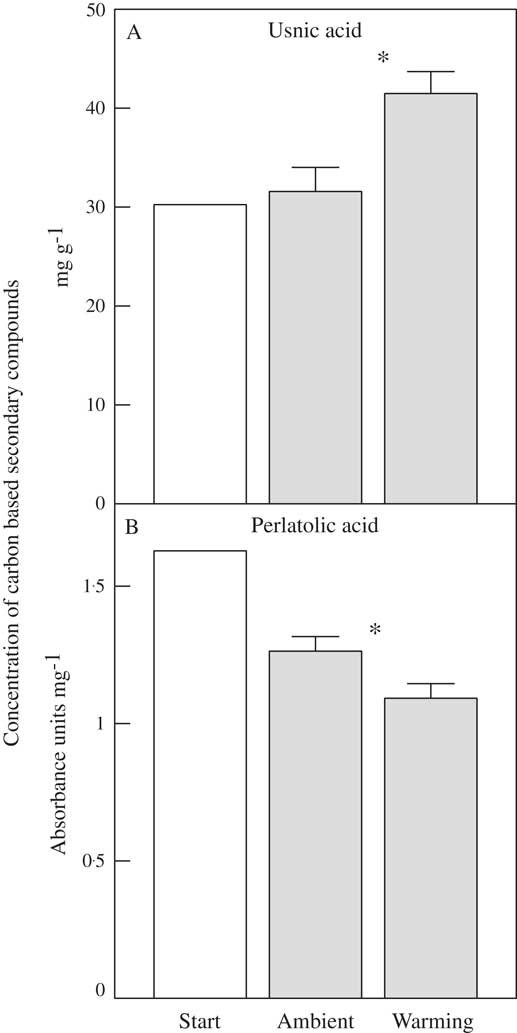
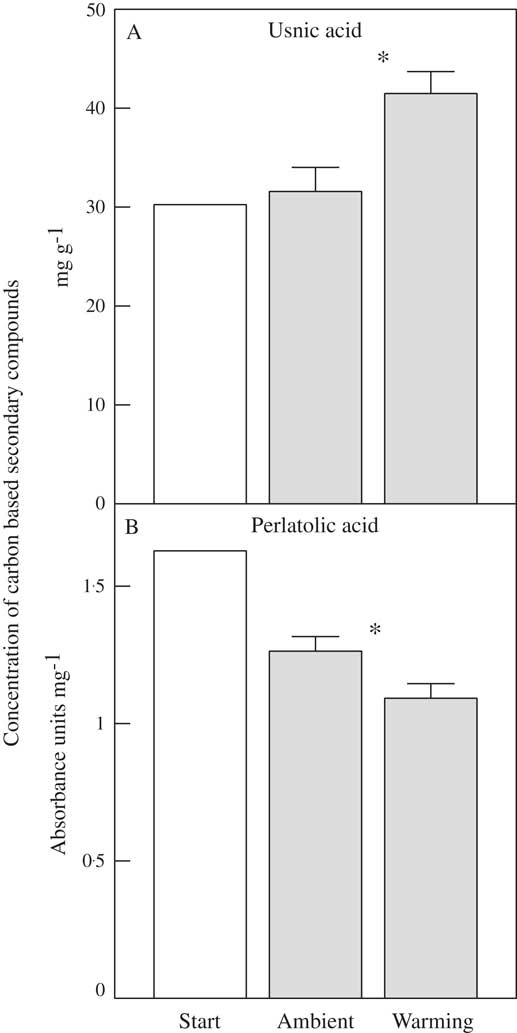
The lichens had a mean mass growth of 6·1±0·9% (pooled mean±1 S.E.), with no significant difference between treatments (t=0·86, P=0·423). Warming increased the concentration of usnic acid by 31% compared to thalli kept under ambient conditions (Fig. 1; t=2·92, P=0·021). As such, thalli maintained in the warming treatment significantly increased their usnic acid concentration compared to the start values (t=5·87, P=0·002). Meanwhile, thalli kept at ambient temperatures did not change their usnic acid concentration during growth (t=0·48, P=0·659). The concentration of perlatolic acid fell significantly during growth at both temperature regimes (Fig. 1; warming: t=5·69, P=0·002; ambient: t=6·40, P=0·003). Nevertheless, by the end of the experiment, lichens subjected to warming had a 14% lower concentration of perlatolic acid compared to those kept under ambient conditions (Fig. 1; t=2·32, P=0·049).
Concentrations (mean+1 SE) of usnic acid and perlatolic acid in Cladonia stellaris (per unit oven dried weight) grown under ambient or above ambient (warming,+4°C) temperatures. Unshaded bars represent the start value from a bulk sample. Asterisks denote a signficant difference between the two treatments at P<0·05.
Discussion
The usnic acid concentration increased during the warming regime, but remained constant in the ambient regime. Usnic acid was synthesized in both temperature regimes because of the net gain in biomass. Meanwhile, at the end of the growth period, the concentration of perlatolic acid was just 70–80% of the initial concentration. This could be consistent with dilution due to biomass growth and low or absent perlatolic acid synthesis under the growth chamber conditions. A low synthesis of perlatolic acid could also explain why we found only weak differences between the treatments for this compound.
In contrast to our findings, field studies report constant or lower concentrations of usnic acid at the higher temperature inside OTCs (Nybakken et al. Reference Nybakken, Sandvik and Klanderud2011). For example, C. arbuscula inside OTCs (raising air temperature by 1·5°C) had a lower usnic acid concentration than thalli outside, whereas that in Flavocetraria nivalis did not respond to this temperature treatment (Nybakken et al. Reference Nybakken, Sandvik and Klanderud2011). However, OTCs screen out UV-B levels and modify relative humidity and dewfall, strongly influencing poikilohydric organisms. Such associated effects may call into question the ecological relevance of OTC-data for lichens. In studies along natural environmental gradients, F. nivalis had a higher concentration of usnic acid in the coldest but also the most humid site (Bjerke et al. Reference Bjerke, Joly, Nilsen and Brossard2004). Because lichens need hydration for metabolic activity, and because photosynthates boost usnic acid synthesis (McEvoy et al. 2006 Reference McEvoy, Nybakken, Solhaug and Gauslaaa ), improved water availability could drive usnic acid synthesis (Bjerke et al. Reference Bjerke, Zielke and Solheim2003). Thus, earlier reported increases in usnic acid with decreased temperatures (Bjerke et al. Reference Bjerke, Joly, Nilsen and Brossard2004; Nybakken et al. Reference Nybakken, Sandvik and Klanderud2011) may have been driven by the confounding factor of relative humidity. Northern latitudes, where C. stellaris is common, are predicted to become warmer and wetter (Kirtman et al. Reference Kirtman, Power, Adedoyin, Boer, Bojariu, Camilloni, Doblas-Reyes, Fiore, Kimoto and Meehl2013). Here we maintained all other factors constant, meaning that the observed increase in usnic acid and decrease in perlatolic acid is attributed to increased temperature only.
Contrasting responses in cortical versus medullary compounds, such as those in Fig. 1, have also been reported in Parmotrema hypotropum which showed increased concentration of the cortical atranorin and decreased medullary norstictic acid with increasing temperature-to-water-potential ratio (T/Ψ) driven by solar irradiance in the field (Armaleo et al. Reference Armaleo, Zhang and Cheung2008). The authors argued that high versus low T/Ψ would activate cortex-specific polyketide synthases and medulla-specific polyketide synthases, respectively, causing such contrasting responses. Our results could be consistent with such a hypothesis, because the water potential should be fairly similar across our treatments at constant rainfall levels and relative humidity, resulting in higher T/Ψ in the warming treatment.
Mat-forming terricolous lichens with usnic acid dominate continental low alpine soil and forest floor on well drained, nutrient-poor terrain at high latitudes (Kershaw Reference Kershaw1977; Ahti & Oksanen Reference Ahti and Oksanen1990). In Canada alone, there is 4·4×106 km2 of lichen woodland (Auclair & Rencz Reference Auclair and Rencz1982). Given the large biomass of lichens containing usnic acid at high latitudes, climate-driven changes in their usnic acid concentration will result in large quantitative changes in usnic acid at the ecosystem level. Because lichen CBSCs play important roles in ecosystem processes, such as lichenivory and decomposition, such changes might profoundly affect lichen-dominated ecosystems (Asplund & Wardle Reference Asplund and Wardle2013, Reference Asplund and Wardle2016).
We thank Björn Erhagen, Andrés Peralta Tapia, Rose-Marie Kronberg and Daniel Metcalfe for help with the chamber maintenance or fieldwork, and Matthias Peichl for collecting the climatic data from the Degerö site. We thank anonymous reviewers for constructive comments on an earlier version of this manuscript. We are grateful to the Kempe Foundation for financial support.