

Emerging adults are preoccupied with romantic connection (Dhariwal, Connolly, Paciello, & Caprara, Reference Dhariwal, Connolly, Paciello and Caprara2009), and establishing romantic relationships is viewed as a key part of development (Arnett, Reference Arnett2000, Reference Arnett2004; Erickson, Reference Erickson1982). Intimate relationships facilitate the formation of a social identity (Meirer & Allen, Reference Meirer and Allen2008; Montgomery, Reference Montgomery2005) and are an important source of companionship (Haller & Hadler, Reference Haller and Hadler2006). These relationships are generally beneficial as they provide companionship, love, and social support (Sedikides, Oliver, & Campbell, Reference Sedikides, Oliver and Campbell1994; Waite & Gallagher, Reference Waite and Gallagher2000). Quality relationships are associated with subjective wellbeing (Kamp Dush & Amato, Reference Kamp Dush and Amato2005) and fewer mental and physical health problems (Braithwaite, Delevi, & Fincham, Reference Braithwaite, Delevi and Fincham2010; Ross, Reference Ross1995).
Most young adults have entered a romantic relationship by the time they are in their twenties. Data from the National Longitudinal Study of Youth (Wood, Avellar, & Goesling, Reference Wood, Avellar and Goesling2008) found that 60% of 21- to 25-year-olds had a romantic partner at the time of the survey. Relationship breakups and high partner turnover are common, especially among young adults (Connolly & McIsaac, Reference Connolly and McIsaac2009). In a survey of US university students, most (95%) reported having rejected someone who was in love with them, and 93% reported having been rejected by someone they loved (Tolman, Reference Tolman2002). Another study of US adults found that during the 20 months that participants were tracked, 36.5% had experienced at least one breakup (Rhoades, Kamp Dush, Atkins, Stanley, & Markman, Reference Rhoades, Kamp Dush, Atkins, Stanley and Markman2011). Of those who experienced breakups, 75% experienced one breakup, 20% experienced two, and 5% reported three in those 20 months (Baumeister, Wotman, & Stillwell, Reference Baumeister, Wotman and Stillwell1993).
Although most research on relationship breakups has examined divorce among adults (Imber-Black, Reference Imber-Black2007), breakups of dating relationships also are highly troubling (Cutler, Glaeser, & Norberg, Reference Cutler, Glaeser, Norberg and Gruber2001). Breakups often are associated with decreased wellbeing, such as psychological distress (Rhoades et al., Reference Rhoades, Kamp Dush, Atkins, Stanley and Markman2011), sadness and anger (Sbarra & Emery, Reference Sbarra and Emery2005), and increased risk for the onset of depression (Monroe, Rohde, Seeley, & Lewinsohn, Reference Monroe, Rohde, Seeley and Lewinsohn1999). Despite being dismissed or trivialised as a rite of passage, a breakup can be one of life's most difficult events (Priest, Burnett, Thompson, Vogel, & Schvaneveldt, Reference Priest, Burnett, Thompson, Vogel and Schvaneveldt2009) and is a leading cause of suicide among young people (Fordwood, Reference Fordwood2007; Monroe et al., Reference Monroe, Rohde, Seeley and Lewinsohn1999). Clearly, some breakups for some people are more difficult to move on from than are others.
Breakup Adjustment Difficulties
Duck (Reference Duck and Duck1982) developed a model to explain the process by which individuals emotionally and practically deal with the challenges of romantic breakups and adjust in the aftermath. He suggested that successful coping requires understanding why the relationship ended and ultimately letting go of the relationship. Some individuals have trouble letting go, which can result in excessive rumination until an explanation for the relationship dissolution is achieved (Weiss, Reference Weiss1975). A number of factors are likely linked to trouble adjusting, including how expected the breakup was, who initiated the breakup, the duration and type of the relationship, as well as breakup intensity.
Individuals who are more surprised by the breakup, or did not expect or intend to break up, may experience greater difficulty adjusting to the loss of that relationship. Past literature has shown that when an individual perceived his or her partner as having initiated the breakup, the breakup was associated with significantly more distress than when he or she initiated the breakup (Attridge, Berscheid, & Simpson, Reference Attridge, Berscheid and Simpson1995; Sprecher, Reference Sprecher1994). In addition, when an ex-partner initiated the breakup, individuals are more likely to engage in post-breakup contact and tracking behaviours (Davis, Ace, & Andra, Reference Davis, Ace and Andra2000; Lee & O'Sullivan, Reference Lee and O'Sullivan2014).
Factors that increase relationship investment are associated with more difficulty adjusting to a subsequent breakup and greater felt intensity of the breakup (Stanley, Rhoades, & Markman, Reference Stanley, Rhoades and Markman2006). Relationships of longer duration are associated with greater distress at breakup than are those of shorter duration (Rusbult, Reference Rusbult1980; Simpson, Reference Simpson1987). Cohabiting relationships are characterised by greater investment than are dating relationships and are associated with more barriers to leaving than are dating relationships (Rhoades, Stanley, & Markman, Reference Rhoades, Stanley and Markman2010). Greater commitment to a long-term relationship with one's partner is indicative of more emotional investment in the relationship and expectations that the relationship will continue (Wieselquist, Rusbult, Foster, & Agnew, Reference Wieselquist, Rusbult, Foster and Agnew1999), making the end of such a relationship that much harder to bear (Fine & Sacher, Reference Fine and Sacher1997; Sprecher, Felmlee, Metts, Fehr, & Vanni, Reference Sprecher, Felmlee, Metts, Fehr and Vanni1998). Research has found that investment is predictive of commitment, and that commitment predicted the emotional distress at breakup (Fox & Tokunaga, Reference Fox and Tokunaga2015).
Post Relationship Contact and Tracking
Some individuals may try to remain connected with their ex-partner while adjusting to a breakup, but most research in this area has focused on stalking and cyberstalking. There is not a unitary definition of stalking across various legal codes; however, stalking is typically defined as an intentional, but unwanted, pattern of behaviour towards an individual(s) that results in a subjective experience of fear (Spitzberg & Cupach, Reference Spitzberg and Cupach2007). Cyberstalking involves the use of electronic or internet-capable devices to engage in stalking behaviour (Reyns, Henson, & Fisher, Reference Reyns, Henson and Fisher2012). Half (50%) of stalking victims are stalked by an ex-partner (Langhinrichsen-Rohling, Palerea, Cohen, & Rohling, Reference Langhinrichsen-Rohling, Palerea, Cohen and Rohling2000; Spitzberg & Cupach, Reference Spitzberg and Cupach2007), and 35% of cyberstalking victims are cyberstalked by an ex-partner (Dressing, Bailer, Anders, Wagner, & Gallas, Reference Dressing, Bailer, Anders, Wagner and Gallas2014). A meta-analysis of 175 primarily Western nations found that 25% of participants had experienced stalking at least once in their lifetime (Spitzberg & Cupach, Reference Spitzberg and Cupach2007), and Dressing and colleagues (2014) found that 6.3% of participants had experienced fear-inducing cyberstalking. Stalking and cyberstalking often co-occur, with studies reporting that 25–48% of stalking targets also report cyberstalking experiences (Baum, Catalano, Rand, & Rose, Reference Baum, Catalano, Rand and Rose2009; Sheridan & Grant, Reference Sheridan and Grant2007), although they are not always clearly linked to breakups.
Post-relationship contact and tracking (PRCT) is a concept that has evolved from the literature on stalking and cyberstalking. PRCT refers to efforts to maintain or re-establish contact after a breakup, and incorporates both online and offline forms of contact and tracking, occasionally manifesting as unwanted pursuit behaviours, or stalking and cyberstalking at the more extreme end of the continuum (Lee & O'Sullivan, Reference Lee and O'Sullivan2014). Unlike the legal definitions of stalking and cyberstalking, PRCT does not require the victim's experience of fear. Lee and O'Sullivan (Reference Lee and O'Sullivan2014) found that 49% of Canadian emerging adults (18–25 years) reported engaging in online forms of PRCT targeting an ex-partner following a breakup, 78% reported engaging in offline forms, and 88% of all breakups were characterised by some form of contact or tracking. In a survey of 411 US college students, 67% reported engaging in more benign forms of cyberstalking (e.g., looking through ex-partners’ photos online, writing posts online), whereas some (18%) reported more severe forms (e.g., posting humiliating photos online; Lyndon, Bonds-Raacke, & Cratty, Reference Lyndon, Bonds-Raacke and Cratty2011). More extreme forms of harassment, threats, or violence are relatively rare, as might be expected, compared to more benign efforts to maintain contact and to monitor an ex-partner's activities or whereabouts (Catalano, Reference Catalano2012; Finn, Reference Finn2004). However, more trouble letting go (i.e., distress) might be related to a wider range or higher frequency of PRCT behaviours used. In fact, a recent study found that those who were more distressed after the breakup were more likely to monitor their ex-partner on Facebook (Fox & Tokanuga, Reference Fox and Tokunaga2015).
Although there is often extreme psychological distress, fear, and physical harm associated with stalking and cyberstalking (Amar, Reference Amar2006; Blaauw, Winkel, Arensman, Sheridan, & Freeve, Reference Blaauw, Winkel, Arensman, Sheridan and Freeve2002; Davis et al., Reference Davis, Ace and Andra2000; Dressing et al., Reference Dressing, Bailer, Anders, Wagner and Gallas2014; Kuehner, Gass, & Dressing, Reference Kuehner, Gass and Dressing2007; Sheridan, Blaauw, & Davies, Reference Sheridan, Blaauw and Davies2003; Spitzberg, Reference Spitzberg2002; Westrup, Fremouw, Thompson, & Lewis, Reference Westrup, Fremouw, Thompson and Lewis1999), the literature has far less to say about the impact of PRCT behaviours that are typically perceived to be more benign, such as monitoring an ex-partner's activities via social media. Bowe (Reference Bowe2010) found that individuals who engaged in Facebook surveillance of ex-partners perceive their behaviour to be relatively harmless. In contrast, Marshall (Reference Marshall2012) found that the surveillance of ex-partners via Facebook was associated with more distress regarding the breakup, as well as more negative feelings. Stalking and cyberstalking clearly have negative effects on the recipients of these behaviours (Dressing et al., Reference Dressing, Bailer, Anders, Wagner and Gallas2014; Spitzberg, Reference Spitzberg2002), yet Bowe (Reference Bowe2010) found that individuals perceived their own actions against a partner to be harmless. Parallel to studies of other forms of interpersonal violence, bullying and harassment (Espelage & De La Rue, Reference Espelage, De La Rue and Russell2013; Wegner, Abbey, Pierce, Pegram, & Woerner, Reference Wegner, Abbey, Pierce, Pegram and Woerner2015), we explored whether individuals dismiss or minimise the impact that their intrusive, inappropriate, or disruptive PRCT behaviours have on others following a breakup, that is, whether perceptions of the degree of impact on a target vary significantly as a function of being the User versus Target.
The Current Study
We examined characteristics of recent dating breakups and their aftermath among a sample of emerging adults (ages 18–25). Emerging adults were the focus here because it is a period when intimate relationships become central to identity (Erickson, Reference Erickson1982; Meirer & Allen, Reference Meirer and Allen2008) and when formation of relationship skills start to become entrenched and relationship turnover is very high (Connolly & McIsaac, Reference Connolly and McIsaac2009). This study in part redresses the notable dearth of research on the aftermath of romantic relationship breakups; we examined the extent and ways in which the respondent or his/her partner had ‘trouble letting go’ of the relationship, and how this trouble can manifest into forms of post-relationship contact and tracking, from more benign forms such as social media ‘creeping’, to more serious or intrusive forms that would constitute stalking or cyberstalking. In addition, to our knowledge, the literature has not yet examined how best to predict who engages in PRCT, nor its impact from the perspective of both users and targets.
Based on our review of the prior literature, we developed the following hypotheses:
-
H1: Individuals who report having engaged in post-relationship contact and tracking (i.e., users) after a recent breakup will report higher levels of commitment to the relationship at its peak, longer relationship duration, a partner who initiated the breakup, greater intensity of the breakup, and more surprise by the breakup than will those who report no PRCT behaviours.
-
H2: Individuals who report having experienced post-relationship contact and tracking (i.e, targets) after a recent breakup will report higher levels of commitment to the relationship at its peak, longer relationship duration, initiating the breakup, greater intensity of the breakup, and more partner surprise by the breakup than will those who report no PRCT experiences.
-
H3: Among those who report using PRCT behaviours, higher levels of use (i.e., a greater variety and number of behaviours) will be predicted by higher levels of commitment to the relationship at its peak, longer relationship duration, a partner who initiated the breakup, greater intensity of the breakup, and more surprise by the breakup than will those who report non PRCT behaviours.
-
H4: Targets of PRCT would report that these behaviours had a more negative impact on their life in terms of their social, work, family, romantic and school life than would users.
Method
Participants
A total of 271 emerging adults who reported being 18–25 years old and having experienced a relationship breakup in the previous year (66% female; M age = 21.4) were recruited from community sources into the study via a range of social networking sources (e.g., Facebook, Tumblr, Twitter) and online classified websites (Kijiji, Craigslist, Toronto Star, NOW Toronto, UsedPEI, Backpage). Much of the previous literature on stalking and related intrusive behaviours has sampled clinical populations or university populations (Spitzberg & Cupach, Reference Spitzberg and Cupach2007). Online sources, including social media, have the benefit of extended recruitment to more diverse samples, likely increasing representativeness. However, they still rely on fairly select volunteer samples who are willing to participate in surveys for minimal compensation. Online recruitment has become a preferred means of recruiting emerging adults as their uptake of new technologies is the highest among all age groups. We opted to use a cross-sectional design in this initial exploratory study, the data for which have informed design of a longitudinal study.
Participants were primarily of European descent (71%), followed by Asian (7%), Black (4%), or other (16.5%). The majority of participants identified as heterosexual (78%), while the remaining participants identified as bisexual (9%), gay/lesbian (4%) or other (8%). Most participants were single (56.4%) or in a monogamous dating relationship (26.4%), and remaining participants were cohabiting (8.8%), dating multiple partners (5.9%), or in other types of relationships (2.5%).
Measures
Demographics
Participants provided information about their age, gender, race/ethnicity, sexual orientation, and current relationship status.
Relationship and breakup history
Participants provided information about their most recent relationship breakup, including when the breakup occurred, the type of relationship it was at its peak (relationship type; i.e., casual sex, casual dating, steady dating, cohabiting, and married), relationship duration in months, number of past breakups, and intensity of this most recent breakup compared to any previous breakups (intensity) ranging from 1 (much less serious) to 5 (much more serious). Participants also were asked who initiated the breakup (initiator status; respondent, partner, mutual), how long they had expected the relationship to last at its peak (months/years), how surprised they were by the breakup and how surprised they thought their ex-partner was by the breakup on a scale from 1 (not surprised) to 4 (very surprised) to assess whether the breakup was expected.
Post-relationship contact and tracking
A survey designed and validated by Lee and O'Sullivan (Reference Lee and O'Sullivan2014) was used to assess participants’ experiences as both users and/or target of offline and online post-breakup contact and tracking behaviours. This measure consists of two parallel surveys that asks participants to indicate which contact and tracking behaviours they and/or their ex-partner had engaged in post-breakup (if any). These behavioural questions were worded neutrally to avoid sensitising participants to the topic in an effort to minimise socially desirable responding. Participants responded to the prompt, ‘When someone is having trouble letting go of an ex, they may do certain things to try get their ex's attention, to get back at their ex, or to try and fix the relationship. Which of the following did you (this ex) do after your breakup?’ Respondents responded based on a breakup they had experienced in the previous year. They then completed a checklist of 24 behaviours and the frequency with which each occurred. Levels of use were calculated by summing the number of behaviours used or experienced, with 24 being the maximum total number of behaviours.
Perceived impact
Those who reported using some form of PRCT post-breakup rated the impact that they perceived their PRCT actions as having on their ex-partner's social, romantic, school, work, and family life. Regardless of which PRCT behaviours they engaged in, they were asked: ‘How do you think your actions after your breakup affected the social life of this ex?’ This question was asked for each of the domains mentioned above. Those who were a target of an ex-partner's PRCT actions rated the impact those behaviours had on their life with a similar question: ‘How did this ex's behaviour after your breakup affect your social life?’ They responded to five questions, assessing the same domains as previously. Responses for each question ranged from 1 (very negative) to 5 (very positive).
Procedure
Participants completed an anonymous online survey regarding the breakup of a romantic relationship within the previous year. After reviewing the information about the study, participants selected a link to indicate their consent and continued to the survey. A total of 619 viewed the survey, 381 started the survey, and 271 (43.7%) met the screening criteria and completed the survey. The survey took between 20–25 minutes to complete. Upon completion, participants were directed to a page that provided information and resources relevant to post-breakup adjustment. They then were directed to a separate link to provide their contact information, to be entered into a draw for one of six $50 gift cards. All measures were piloted in full prior to administration. The study received our institution's ethics approval.
Data Conditioning and Analysis
Less than 5% of the data were missing, so mean substitution was used to replace missing values (Tabachnick & Fidell, Reference Tabachnick and Fidell2007). Descriptive analyses were conducted first to assess characteristics of recent breakups and to calculate scale scores. Those who reported PRCT use or experience versus those who did not were compared in terms of age, gender, and sexual orientation. Two separate logistic regressions were used to predict use or experience of post-relationship contact and tracking from relationship characteristics. Predictors were relationship duration, breakup intensity, relationship type, participants’ own and partners’ surprise by the relationship breakup, and initiator status. Multiple regression analyses were used to predict the extent (range) associated with use of PRCT using the same predictors. Finally, impact was assessed by examining the mean scores of emotional impact PRCT had on their on their social, romantic, school, work, and family life. A repeated-measures ANOVA was used to examine if the impact of PRCT differed based on the domain considered, from both the targets’ and users’ perspectives. In addition, t tests were used to compare between subject scores among participants who only reported using (‘users’) or experiencing (‘targets’) PRCT; t tests were also used to compare within-subject mean differences in impact scores of those who reported being users and targets of PRCT.
Results
Characteristics of Recent Breakups
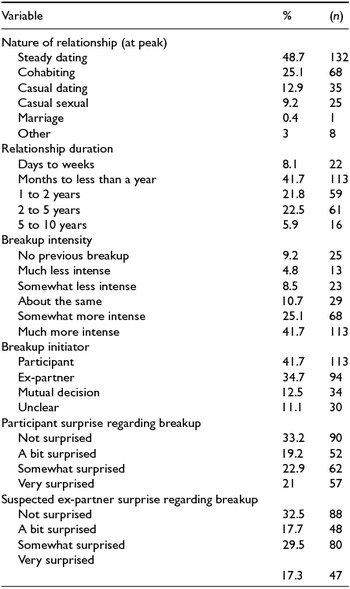
Participants were asked to describe the nature of their relationship with their ex-partner when their relationship was at its peak. Almost half of participants (48.7%) considered their relationship to be a ‘steady dating’ relationship. A quarter (25.1%) of participants classified their relationship as ‘cohabiting’, 12.9% viewed their relationship as a ‘casual dating’ relationship, and 9.2% of participants considered their relationship to be a casual sexual relationship. Only 0.4% of participants reported their relationship as a marriage, and 3% did not feel that their relationship fitted into the categories named above.
Breakups occurred regularly throughout the months of the year; however, there were two notable peaks in January (14.1%) and September (11.4%). Relationships lasted days to weeks (8.1%), months to less than a year (41.7%), 1–2 years (21.8%), 2–5 years (22.5%), and relatively few lasted 5–10 years (5.9%). At the peak of the relationship, 42% of people expected the relationship to last a lifetime, 19% expected their relationship to last a few months to under a year, followed by 15% expecting their relationship to last 1–2 years, and 16% expected it to last 2–5 years. A few participants (7%) expected their relationship to last 5–10 years, and 1% expected their relationship to last a few days to weeks. Only 21% of participants reported that they expected their relationship to last as long as it did.
Of all participants, 9.2% reported that this was their first breakup. Of those who had experienced prior breakups, 41.7% of participants indicated that this breakup was much more intense than previous breakups, 25.1% reported that this breakup was somewhat more intense than previous breakups, and 10.7% reported this breakup was about the same intensity as previous breakups. The remaining participants (13.3%) felt that this breakup was less intense than previous breakups.
Most participants reported that they initiated the breakup (41.7%), followed by their ex-partners initiating the breakup (34.7%). Twelve and a half percent of participants stated the breakup was mutual, and 11.1% stated it was unclear who initiated the breakup. Most participants (33.2%) reported not being surprised by the breakup, though 19.2% were a bit surprised, 22.9% were somewhat surprised, and 21% were very surprised. When participants were asked how surprised they suspected their ex was by the breakup, a third suspected that their ex-partners were not surprised (33.5%), though some were a bit surprised (17.7%), somewhat surprised (29.5%) and very surprised (17.9%). See Table 1.
Characteristics of Recent Breakups

Reports of Post-Relationship Contact and Tracking (PRCT)
Most breakups (91%) involved some use of post-relationship contact and tracking. The majority of participants (60%) were both targets and users of PRCT, followed by 20% who were only users, and 11% who were only targets of PRCT. Only 9% of participants reported neither being users or targets of PRCT after breakup.
On average, participants who used PRCT reported endorsing the use of approximately three different forms of PRCT (M = 3.33, SD = 2.95; range = 1–14). Of users, 20% reported not using PRCT, 40% reported using 1–3 forms, 30% reported using 4–6 forms, and 10% reported using 7 or more forms. Participants who reported experiencing PRCT reported an average of 4 forms (M = 3.93, SD = 4.5; range = 1–18). Twenty-nine percent of participants reported not experiencing any forms of PRCT, 31% report experiencing 1–3 forms, 18% report experiencing 4–6 forms, and 12% report experiencing more than 12 forms of PRCT.
Chi-square analyses of reports of the use post-relationship contact and tracking by gender did not reveal any significant differences by gender, χ 2 (1, N = 271) = 12, p = .73. However, chi-square analysis did reveal that women were twice as likely to report experiencing PRCT than were men, χ 2 (1, N = 271) = 5.32, p = .02. Chi-square analyses of sexual orientation (heterosexual as compared to non-heterosexual) did not find any significant differences in the use of PRCT, χ 2 (1, N = 271) = .36, p = .55, or experience of PRCT, χ 2 (1, N = 271) = 1.69, p = .19. There were no significant differences in use of, F(7, 263) = 1.85, p = .25, or experience of PRCT based on age, F(7, 263) = 1.77, p = .14.
Predicting PRCT Use and Experience From Relationship and Breakup Characteristics
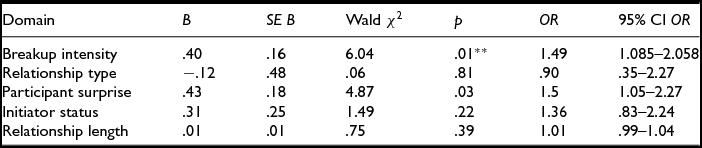
Two logistic regression analyses were conducted to predict use and experience of PRCT behaviours (yes/no) from relationship characteristics. Predictors were relationship duration, breakup intensity, relationship type, participants’ own and ex-partner's surprise regarding breakup, and initiator status. Initiator status was dummy coded into two variables: when the ex broke up with the participant, and when the participant broke up with the ex. When predicting the use of PRCT, the full model containing all predictors except ex-partner surprise was statistically significant, χ 2 (5, N = 227) = 23.43, p < .001. As shown in Table 2, two predictors made a unique statistically significant contribution to the model: breakup intensity and initiator status. The odds of using PRCT were more likely as breakup intensity increased (OR = 1.50), that is, for each one unit increase in the intensity rating of the breakup, respondents were 1.5 times more likely to report engaging in PRCT behaviours. The more surprised the participants were about the breakup, the more likely they were to use PRCT behaviours (OR = 1.54).
Predictors of the Use of Post-Relationship Contact and Tracking (PRCT)
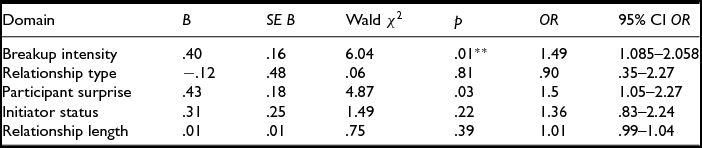
Note: N = 227. *p < .05; **p < .01; Nagelkerke R2 = .17; χ2(5) = 23.43, p < .001.
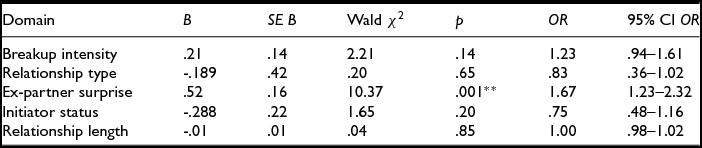
A logistic regression analysis of reports of the experience of PRCT was statistically significant, χ 2 (5, N = 227) = 22.04, p = .001. All of the predictors were used except participant surprise. As shown in Table 3, the odds of experiencing PRCT after relationship dissolution were increased almost 1.7 times with each 1-point increase in the rating of the ex-partners’ surprise regarding the breakup (OR = 1.69). No other predictors in the model were significant
Predictors of the Experience of Post-Relationship Contact and Tracking (PRCT)
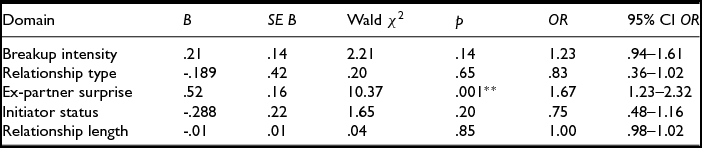
Note: N = 227. *p < .05; **p < .01; Nagelkerke R2 = .15; χ 2 (5) = 22.04, p = .001.
Predicting Range of PRCT Used or Experienced From Relationship and Breakup Characteristics
Two regression analyses were conducted to predict the range of post-relationship contact behaviours participants engaged in or experienced following a relationship breakup. Predictors were the same as above: relationship duration, breakup intensity, relationship type, participants’ own and ex-partners’ surprise of the relationship breakup, and initiator status (dummy coded).
The first regression analysis predicted the extent of, or range of contact and tracking behaviours used, F(6, 229) = 5.78, p < .001. The model was able to account for 13.2% of the variance (adjusted R2 ). There were two significant predictor variables: breakup intensity (β = .27, p < .001) and breakup initiator, specifically when the participant broke up with their ex-partner (β = -.19, p = .02). The number of forms of PRCT used increased with the intensity of the breakup as well as when the ex-partner initiated the breakup compared to when either: (a) the participant initiating the breakup, or (b) they mutually broke up.
A hierarchical multiple regression analysis predicting the increase in number of forms of PRCT experienced was statistically significant after controlling for gender, F(7, 228) = 7.28, p < .001. The total variance explained by the model was 14.8% (adjusted R2 ). Breakup initiator status was the only predictor in the model that was significant. When the participant broke up with their ex-partner, the number of forms of PRCT experienced increased, β = .22, p < .01.
Perceived Impact of PRCT on Well-being
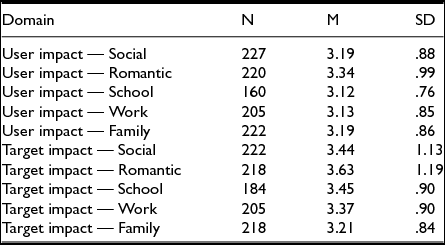
We also examined perceived impact of contact and tracking behaviours on wellbeing. Impact was assessed in five different domains: social, romantic, school, work, and family domains. When comparing among domains from the perspectives of users of PRCT, a repeated-measures ANOVA revealed significant differences for perceived impact. However, Mauchly's test indicated that the assumption of sphericity has been violated for the main effect of domain, χ 2 (9) = 50.62, p < .001. Therefore, degrees of freedom were corrected using Greenhouse-Geisser estimates of sphericity (ε = .92). There was a significant main effect of domain on the perceived impact of PRCT behaviours, F(3.7, 837.88) = 3.37, p = .011, η2 p = .01. Contrasts revealed that there was a significant difference between users’ perception of the impact that their actions had on their ex's romantic life and school life. Specifically, they perceived the impact of their actions to be more negative on their ex's romantic life when compared to their school life (p = .015). No other contrasts were significantly different (ps > .09). See Table 4 for means.
Impact of Contact and Tracking on Life Domains from the Perspective of Users and Targets
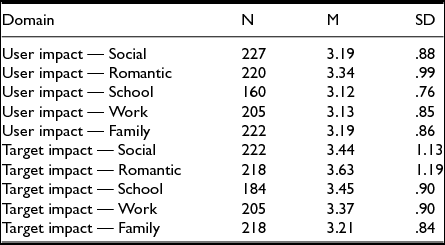
In addition, domains were compared from the targets’ perspectives. A repeated measures ANOVA was conducted; however, Mauchly's test of sphericity was violated for the main effect of domain, χ 2 (9) = 30.28, p < .001. Degrees of freedom were corrected using Greenhouse-Geisser estimates of sphericity (ε = .92). There was a significant main effect of domain on the impact of PRCT behaviours for targets, F(3.7, 610.60) = 4.06, p < .001, η2 p = .04. Contrasts revealed that there was a significant difference in the impact that targets reported regarding their romantic life and family life. They reported that the PRCT behaviours they had experienced had a more negative impact on their romantic life than family life. There were no other significant differences among domains (ps > .07). See Table 4 for means.
We examined whether there were discrepancies in reports of how an ex-partner's contact and tracking affected them, and how they perceived their PRCT had had an impact on their ex. Only participants who both used and experienced contact and tracking were included in the analysis. After Bonferroni adjustment, differences were found in three domains. Participants indicated that their romantic life, t(142) = −2.61, p = .01, school life, t(90) = -3.87, p < .001, and work life, t(124) = −2.82, p = .006, were more negatively affected by their ex-partner's use of PRCT than they perceived their use had an impact on their partner.
We further examined whether there were discrepancies in perceptions of impact if participants were exclusively either users or targets. Independent t-test analyses did not find any significant differences across groups on the five domains (ps > .090). This suggests that overall, users and targets do not differ significantly in their perception of the impact of PRCT on an ex-partner.
In sum, users and targets of PRCT perceive these behaviours to have a more negative effect on their romantic life when compared to other domains. Furthermore, when comparing perceptions of impact between those who were exclusively either targets or users, there were no significant differences in perceptions across groups. However, when comparing perceptions of impact among those who were both users and targets, they reported that their actions had less of a negative impact on their ex-partner's romantic, school and work life when compared to the impact their ex-partner's PRCT had on their own life.
Discussion
The current study examined breakup characteristics of the romantic relationships among emerging adults. This study also explored which individual and relationship characteristics were predictive of post-relationship contact and tracking (PRCT) behaviours used or experienced when an individual had ‘trouble letting go’ of the relationship. The impact of these post-breakup behaviours from the perspectives of users and targets was also examined. This study, to our knowledge, is one of the first to examine the predictors of a broad scope of post-breakup adjustment behaviours (ranging from benign, to disruptive, to potentially threatening) from the perspectives of individuals who have both used and experienced PRCT.
Breakups occurred regularly throughout the year, although interestingly, more breakups occurred in January and September. Participants also often reported expecting the relationship to last a lifetime, but in fact most relationships only lasted a few months to less than a year, with relatively few lasting 5–10 years. These findings support the view that emerging adults are preoccupied by and prioritise relationships, as others have noted (Dhariwal et al., Reference Dhariwal, Connolly, Paciello and Caprara2009), yet have relationships that are often characterised by instability (Arnett, Reference Arnett2005). The majority (63%) of participants reported being surprised by the breakup and most (71%) reported that this breakup was worse than previous breakups. This is consistent with previous literature indicating that breakups are distressing and viewed as extremely difficult interpersonal events in one's life (Cutler et al., Reference Cutler, Glaeser, Norberg and Gruber2001).
Over half (60%) reported having been both a user and a target of PRCT behaviours following a recent breakup, indicating that trouble adjusting to a breakup is common; and indeed, only 9% said they had not engaged in any PRCT behaviours. Aside from women being more likely to experience PRCT, there were no other gender or age differences in reports. This diverges from past research, which has found that gender was not related to post-relationship contact and tracking (Dutton & Winstead, Reference Dutton and Winstead2006; Tassey & Winstead, Reference Tassey and Winstead2014). Perceived breakup intensity and surprise at a breakup predicted use of PRCT. The single variable predictive of experiencing contact and tracking was how surprised the ex-partner was by the breakup: the more surprised they were, the more likely the participant was to experience PRCT. Thus, a difficult, emotionally charged and unexpected breakup appeared most difficult to adjust to among these emerging adults. Consistent with previous research of online surveillance after breakup (Fox & Tokunaga, Reference Fox and Tokunaga2015), individuals more distressed by their breakup were more likely to engage in PRCT (online and in-person).
The use and experience of a greater number of forms of contact and tracking was predicted by perceived intensity of the breakup, as well as when the other partner initiated the breakup. When the participant initiated the breakup, they experienced a greater variety of PRCT behaviours. Together, these findings suggest that individuals who are experiencing more distress after the breakup may put more effort into reconnecting, monitoring, or trying to stay in touch with their partner, and/or remain a part of their lives. They are likely to resort to other forms of contact and tracking if their initial attempts to get their ex-partner to respond or interact with them are unsuccessful. The use of more forms may increase the likelihood that their ex-partner will engage with them sufficiently, if nothing else other than to tell them to leave them alone. Further research could explore progression in the use of forms of PRCT and whether or not an escalation is related to distress, personal characteristics, or other factors associated with the breakup or subsequent exchange between ex-partners. For instance, hostile responses or encouraging leading-one-on behaviours might account for some escalation in PRCT from benign forms to more severe forms.
Contrary to our hypothesis, relationship type (at its peak) was not predictive of the use of or experience of PRCT, nor was it predictive of the greater number of forms of PRCT used or experienced. Although past research has suggested that factors such as commitment should be related to post-breakup adjustment difficulty (Stanley et al., Reference Stanley, Rhoades and Markman2006), we expected that the type of relationship that individuals were involved in would be related to commitment and thus a predictive factor. This finding suggests that in our particular sample, commitment was not related to post-breakup adjustment difficulty, or it suggests that relationship type is not an accurate characterisation of current commitment to the relationship. The latter is possible, given that it is likely the views of current relationship status may vary with commitment to the relationship. Thus, a more thorough assessment of commitment to one's relationship would be beneficial for future research.
Previous research supports that contact and tracking behaviours are common (Lee & O'Sullivan, Reference Lee and O'Sullivan2014), and our study suggests that even more benign forms of contact and tracking can have a negative impact on a target. Users perceive their behaviours to have a more negative impact on their partner's romantic life than on their school life, possibly because users are wanting to disrupt an ex-partner's subsequent relationship prospects out of jealousy and hurt. Consistent with this view, targets of PRCT reported that their experience had a more negative impact on their romantic life than on their family life.
In our between-subjects analysis, perceptions of impact did not differ when we compared those who had only used or experienced PRCT (not used and experienced). Interestingly, individuals who were both users and targets of PRCT behaviours perceived that their actions had less of a negative impact on their ex-partners’ life (specifically in the romantic, work, and school domains) when they used PRCT than it did on their own when targeted by an ex-partner. This indicates that there is a reporting bias at play for those who reported both use and experience, either to downplay the negative impact that their behaviour had on their ex or to emphasise the impact that their ex's behaviour had on them.
This study extends the research that exists on breakups by sampling more broadly than most studies relying on samples of university students. This sample should not be viewed as a representative sample of emerging adults generally as it was still quite a homogenous group (mostly White and heterosexual). In addition, this sample was a fairly homogenous sample of those aged 18–25 years who had experienced a breakup within the past year, thus restricting the generalisability to adults. Advertisements for this study were required to indicate that the content was related to romantic relationship breakups, possibly introducing selection bias. This is an important limitation for many studies in the field of intimate relationships (Saunders, Fisher, Hewitt, & Clayton, Reference Saunders, Fisher, Hewitt and Clayton1985). A further limitation is that these data were collected by self-report and were retrospective in nature. Self-report data are often subject to social desirability biases (Paulhus, Reference Paulhus, Robinson, Shaver and Wrightsman1991) in that individuals tend to want to present themselves in a favourable light, particularly when asked to report a socially undesirable behaviour such as PRCT (Crowne & Marlow, Reference Crowne and Marlowe1964). In light of this possibility, behavioural questions were neutrally worded so as to reduce response bias. However, it is still possible that individuals tempered their reports in socially desirable ways. Survey anonymity is known to reduce social desirability responding in users, which is linked to higher rates of self-disclosure overall (Booth-Kewley, Larson, & Miyoshi, Reference Booth-Kewley, Larson and Miyoshi2007; Joinson, Reference Joinson and Gackenback2007). Furthermore, online surveys have been associated with reductions in socially desirable responding and increased willingness to answer sensitive questions (Frick, Bachtiger, & Reips, Reference Frick, Bachtiger, Reips, Reips and Bosnjak2001; Tourangeau, Reference Tourangeau2004). Longitudinal research can better examine the pathway from a relationship breakup to the emotional distress and possible post-relationship contact and tracking that follows. Such a design would eliminate some of the distortion related to retrospective recall inherent in cross-sectional design, as well as provide a better understanding of what kinds of relationships and breakups lead to PRCT.
Future studies can explore additional relationship characteristics that may be related to, or predictive of either the use or experience of contact behaviours after breakup. Much of the past research has focused on predictors of unwanted pursuit, or stalking behaviours, most often in clinical or forensic samples (Meloy, Reference Meloy1998; Mullen, Pathé, Purcell, & Stuart, Reference Mullen, Pathé, Purcell and Stuart1999). Some of the research on unwanted pursuit behaviours in university and college students has found individual characteristics to be of importance. For example, Langhinrichsen-Rohling and colleagues (Reference Langhinrichsen-Rohling, Palerea, Cohen and Rohling2000) found that ex-partners who had been broken up with were more likely to report engaging in more severe pursuit behaviours if anxiously attached. An individual's level of jealousy at the time of the breakup is also positively associated with unwanted pursuit (Dutton & Winstead, Reference Dutton and Winstead2006; Tassey & Winstead, Reference Tassey and Winstead2014). Other individual factors to consider may be one's self-esteem, or whether an individual has a history of engaging in, or being a target of, PRCT. Future research could also consider a direct measure of commitment, or measures assessing an individual's need for closure. Other pertinent relationship factors may be the quality of the relationship prior to the breakup (e.g., history of interpersonal violence, infidelity). Thus, the inclusion of multiple measures of constructs (e.g., individual characteristics coupled with relationship characteristics) would likely yield a more complete and explanatory picture of the use and experience of PRCT, and help to explain more of the variance that we did here.
Although PRCT behaviours do not require the recipient of these behaviours to be fear-inducing as in the legal definition of stalking (Mullen, Pathé, & Purcell, Reference Mullen, Pathé and Purcell2009), our study demonstrates that targets of these behaviours still report that PRCT had a negative impact on various domains of their lives. Future research can examine in more detail how these behaviours affect functioning.
In conclusion, when individuals have trouble letting go of a relationship, they may engage in a range of behaviours designed to extend or renew contact with their ex-partner, or to monitor the whereabouts and activities of one's ex-partner. Previous research indicates that prolonged contact with an ex-partner delays the emotional recovery process (Marshall, Reference Marshall2012), and our study demonstrates that even seemingly benign PRCT can have a negative impact on targets. There is a surprising dearth of research on dating breakups given their potential for negative effects, and our study reinforces the need for further examination of these common life events and their aftermath. Romantic relationships and breakups will continue to be integral in the development of young adults, and understanding how individuals manage these breakups and the distress is vital. It follows that these experiences could be possible precursors for the management of later breakups, or they could represent opportunities for growth. These findings will be of use to those who are working to support young adults and couples, as well as educators and researchers who are studying relationship dynamics.
Acknowledgments
We gratefully acknowledge research support from a Canada Research Chair held by Lucia F. O'Sullivan.
Conflict of Interest
None.