Introduction
By the second half of the nineteenth century, the botanical gardens on Jamaica were well stocked with plants of economic, medicinal and ornamental value. Since the establishment of the island's first garden in 1774, there had been a regular supply of flora to the gardens, albeit with a few lulls. This resource enabled curators to forward introduced plants to other locations across the world. For example, both Kew Gardens, London and the Botanic Garden at Adelaide, South Australia requested the famous Victoria regia, which had itself been introduced to Jamaica from Kew and Demerara in 1849 and 1870, respectively.Footnote 1 In 1878 Kew and Adelaide Gardens reported that the seeds had produced ‘extra fine specimen[s]’, which had given ‘much satisfaction at both places’.Footnote 2 This global exchange network has been well documented (although studies remain geographically uneven in scope – with little consideration given to the Caribbean).Footnote 3 This article, however, looks inward and examines the work carried out in these gardens in distributing plants across Jamaica. As these botanical sites were government funded and backed institutions, they were all used for a perceived public good (that is various economic, medicinal and ornamental benefits). This remit was the main organising principle of those in charge, yet they each interpreted the role that the gardens played differently.
Local plant distribution became increasingly important throughout the nineteenth century as the failure of the plantation economy (predominantly based on sugar as an export commodity) encouraged some officials to take an interest in the diversification of the agricultural landscape. The previously enslaved Afro-Jamaicans led this dramatic change in the colony, as Barry W. Higman reports, ‘70,000 people owned freeholds of 50 acres or less by 1870, up from about 2,000 in 1838.’Footnote 4 Furthermore, by the turn of the twentieth century the men in charge of the gardens no longer had to vie for the attention of the Assembly and governor on Jamaica, or indeed the British government. Instead, the botanical department was generally entrusted to fulfil its duties as an institution in close contact with the colonial office.Footnote 5 In this article, I will outline the ways in which the distribution of plants developed in parallel to Victorian beliefs about free trade and control over colonial subjects. This article takes seriously Fae Dussart and Alan Lester's remark that:
It is undeniable that many governors and lower-level functionaries also considered themselves inclined towards humanitarian objectives, or to the exercise of ‘humanity’ as they would have put it, and yet there have been relatively few works examining the ways in which their ideals functioned as an intrinsic aspect of their governmentality.Footnote 6
I consider the work carried out in the Jamaican botanical gardens, which aimed to establish and/or control the colony's internal biotic networks, as a practical result of ‘humanitarian’ thinking. I focus on the work of ‘lower-level functionaries’, namely two superintendents and one director. Indeed, I take forward Angela Wanhalla's argument – in her work on Māori access to waterways and dispossession by settlers – that highlights the influence of local agents and networks, rather than imperial ones, on colonial processes of dispossession.Footnote 7 I suggest that the framing of imperial rhetoric in local contexts by minor officials in the Caribbean was an integral and understudied cog in the workings of colonialism. Yet rather than a focus on dispossession of land and territory, I link the work of such Europeans with their aims to alter colonial agriculture.
I turn to archival material to contextualise the decisions of the superintendents (subsequently, director) of the Jamaican botanical gardens.Footnote 8 A first section, below, outlines the wider context of this study and provides a brief historical overview of these sites. Following this, I consider the three men who ran the botanical gardens from 1846 to 1886. Next, these accounts are supplemented with a discussion on crop diversification and the political economy of Jamaica. I finish with some concluding thoughts about the management of empire. This article examines the importance of botanical gardens in the internal sundry dynamics of a colony. I note the wider importance of officials in playing a role in the changing nature of coloniality and, more specifically, their attempts to incorporate previously enslaved agriculturalists in the political economy of empire.
The Jamaican botanical gardens
Daniela Bleichmar observes that the local context often mattered more to colonial gardener-botanists than international exchange. ‘Although Europe always remained the ultimate frame of reference as the source of funding, prestige, and significance’, she claims, ‘Spanish and criollo naturalists were as involved in local agendas as they were in metropolitan ones, if not more.’Footnote 9 The distribution of plants across the colony from the botanical department on Jamaica was an important factor for those in charge of the gardens as it helped the white elite maintain power on the island.Footnote 10 Indeed, this article argues that the practice was an integral part of the social armamentarium that enabled Britain to occupy its hegemonic position. The provision of plants into the local political economy and the philosophy underpinning this process were subtle socialising aspects of what Michael Craton has termed ‘a colossal hegemonic trick’ that followed formal emancipation.Footnote 11 Critically, Patrick Bryan explains that, ‘the reality that the mass of rural workers constituted a race distinct from the employer class, the landowners, and the government itself, strengthened the ability of the ruling class to manoeuvre racial symbolism in order to achieve greater social control.’Footnote 12
Craton charts the aggressive policies of white landowners and the local elite to secure land and marginalise the Afro-Jamaican population from political discourse on Jamaica.Footnote 13 ‘The experience of the late-nineteenth century’, Bryan contends, ‘demonstrated that the plantation ethos had not died.’Footnote 14 So much so that in 1880 Governor Anthony Musgrave complained about the
astonishing want of sympathy on the part of the sugar planters in any project which, if successful, might result in raising prices of cattle which were required for the sugar plantations . . . And it is the fact that the passive opposition of the sugar planting section of the community, at one time dominant and still influential, especially in England, has impeded the development of any industries which seemed to create a demand for labour which would withdraw it from the sugar estates.Footnote 15
I argue here, however, that the work in the botanical gardens after abolition of slavery on Jamaica ran contrary to popular white thought in an attempt to ‘aid’ black agriculturalists. In doing so, those running the gardens sought to enrol the newly constituted peasant population in moral and political economies of the British Empire.Footnote 16
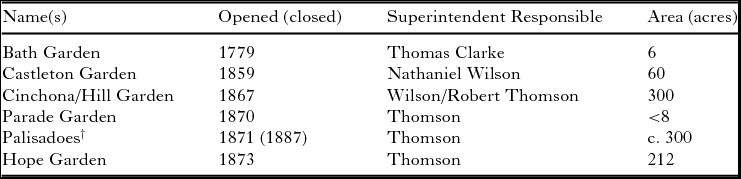
The Jamaican botanical gardens increased in number from the late-1850s to the mid-1870s (Table 1). Although each one was set up for different economic, social and medicinal uses and followed unique design principles, all assumed responsibilities of the wider botanical department. That is to say, the activity in these spaces conformed to contemporary fashion in botanical science alongside the demands of the island's governing bodies and suggestions from Kew Gardens and the colonial office.
Botanical gardens of Jamaica 1779–1873 (listed by foundation date, by whom and peak area covered).

Note: †This site was neither technically ‘opened’ to the public (the satellite garden was important for the Botanical Department not least as proof of the potential in Jamaica for ‘young’ ‘enterprising’ persons with a ‘little’ capital), nor sold (initially), but rented out for £50 a year (AR 1887).
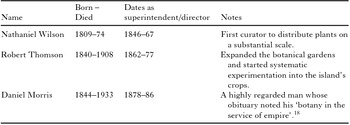
Three men headed the botanical institution from 1846 to 1886.Footnote 17 In this article I deal almost exclusively with their work and aims (Table 2). Nathaniel Wilson (1809–74) arrived on Jamaica in 1841 from Kew. His hard work to expand the international influence and increase the grandeur of the gardens, his efforts to inveigle himself into the upper social stratum of Kew along with the changing context of the colony established foundations for the rapid expansion of the department following his retirement. He was continually disappointed and indignant at the lack of progress during his tenure, but had occasional moments of triumph. The Kewite managed to appoint a European assistant, Robert Thomson (1840–1908), who succeeded him as the chief superintendent. From 1867 Thomson focussed all of his efforts in expanding the botanical department and was undoubtedly successful in this regard. His achievements meant that Daniel Morris (1844–1933), a higher-flying colonial official, replaced him. Morris, the first ‘director’ from 1878, consolidated efforts of the now rather swollen institution before leaving to become deputy director of Kew Gardens. In 1896 he returned to the Caribbean, specifically the Lesser Antilles, and in 1898 he took up the newly established position of Imperial Commissioner for Agriculture in the West Indies. I now turn to consider some of Wilson, Thomson and Morris's activity on the island over a forty-year period.
Two head ‘superintendents’ and ‘director’ of the Jamaican botanical gardens in the second half of the nineteenth century.

The superintendents and director from 1846 to 1886
Nathaniel Wilson
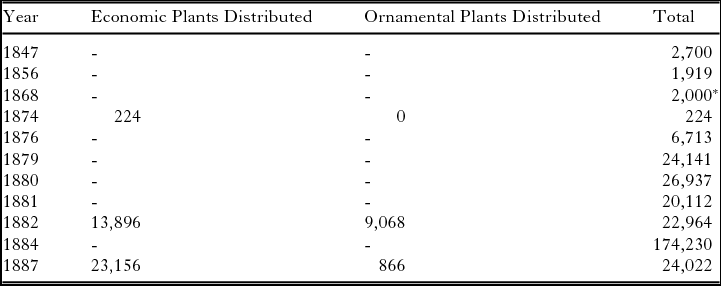
Prior to 1846, the Jamaican botanical gardens were used primarily for the accumulation of plant material for both scientific and aesthetic purpose. Little in the way of plants or seeds were given away or sold to the island's public.Footnote 19 Following Wilson's appointment, numerous plant species were sent across Jamaica (Table 3). Between 1846 and his retirement in 1867, each year around 2,000 plants were disseminated across the island.Footnote 20 This work set in motion a scheme that lasted well beyond his death. At this time, sugar plantations remained a dominant force in the economy, impacting upon all aspects of the island's society. The magnitude of sugar's importance to West Indian history and its relationship to slavery has been well documented.Footnote 21 This feature of the colonial Caribbean remained after abolition but under decreasingly remunerative conditions whilst smallholder production swelled. ‘The racist ideology articulated at mid-century’, Thomas C. Holt explains, ‘was based on the presumed incapacity of blacks to be independent economic agents . . . Yet, peasant production for export markets was by definition independent economic agency and presumably reflected a desire for material self-improvement.’Footnote 22
Number of plants distributed locally from the botanical gardens on Jamaica.

Notes: This operation expanded rapidly in the second half of the nineteenth century into the first decade of the twentieth century.
*Robert Thomson claimed that ‘nearly’ 2,000 were distributed from Castleton Gardens in 1868 without further details.
Information collated from annual reports for each year noted, with the exception of 1847, which is from MS12, 5th August 1847.
Why, by providing a stock of diverse economic plants, was Wilson therefore seemingly aiding the black farming population? This practice indicated an acceptance by the superintendent that the Afro-Jamaican population was economically productive even though it ran against the grain of contemporary popular white thought, not to mention Wilson's bigoted attitude. For example, he complained to John Smith, curator at Kew Gardens, that black workers were untrustworthy and lazy.Footnote 23 ‘Good taste is at a low ebb among a parcel of Niggers’, he reported on one occasion adding, ‘some of whom have got into the Assembly.’Footnote 24 This form of plant distribution therefore seems to reveal a contradiction between ‘racial’ claims prevalent within nineteenth century Tory ideology and the provision of social structures to help petty agriculturalists on Jamaica.
Various plants were sent across the island. In his second year as superintendent Wilson proudly stated that ‘[s]ince I came here I have had but very little time to collect specimens or plants, I have great demands for plants & have this year distributed 2700.’Footnote 25 He later claimed: ‘[t]he average number of plants distributed annually during that period [1846–55] being 2305, exclusive of many cuttings and seeds.’Footnote 26 During these years he distributed nutmeg, cinnamon, dyewood and fibre plants, alongside many ornamental plants.Footnote 27 Of the fibre plants, he was particularly taken with the Chinese Grasscloth (Boehmeria nivea): ‘The Boehmeria nivea you sent me, is thriving to admiration’ he wrote to John Smith at Kew, ‘one of its shoots attained the height of 6 feet in 14 days, it will be a weed here soon, I have sent plants of it all over the country, which will never be turned to good account.’Footnote 28 Furthermore, in 1860, when discussing the design and function of Castleton Gardens, he remarked that the main ‘object’ of the site was ‘the importation & rapid dissemination of useful plants’.Footnote 29 Wilson provided economic flora to black farmers, partly as they, unlike those running plantations, shared an interest in a wide array of crops. Wilson noted that with the local government's help, or ‘a few skilled hands in the first instance, native industry would be encouraged and brought out, and perhaps with the greatest success and rapidity through the medium of reformatory and industrial schools.’Footnote 30 In the mid-1850s, he was taken with ‘[t]he broom corn of America (sorghum dora)’. He thought it ‘deserves to be specially noticed, as it is likely to be as useful here as it is in America, or ought to be so, being as suitable for the climate as guinea corn, and which every person may grow in his patch of ground, however small.’Footnote 31
In spite of distributing potentially ‘useful’ plants throughout the rural population, Wilson's bigoted social outlook suggested that he would have aligned himself with the Conservative thinking of Thomas Carlyle.Footnote 32 In 1849 Carlyle commented,
If Quashee will not honestly aid in bringing out those sugars, cinnamons, and nobler products of the West Indian Islands, for the benefit of all mankind, then I say neither will the Powers permit Quashee to continue growing pumpkins there for his own lazy benefitFootnote 33
Carlyle evidently felt ‘Quashees’, the name he and others gave to West Indian blacks, had a role to play as an underclass of labourers within a larger imperial project. He argued that cultivation by peasants was an affront to Lockean land economy. That is, property rights and land consolidation should be pursued to ensure the maximisation of the ‘productive’ value of an area. Wilson's letters to Smith in some ways suggest a similar attitude.Footnote 34 Yet concurrently, the superintendent was sending his plants to Afro-Jamaican agriculturalists and thereby accepted their involvement in the island's economy as smallholders.
This work by the superintendent was carried out in the context of a colony whose officials displayed little sympathy towards the plight of black farmers.Footnote 35 Indeed white Jamaican animosity towards black smallholders and their unwillingness to accept the productive value of such petty agriculturalists should not be underestimated. Following abolition, the socio-political ideas embedded in a history of colonial plantocracy largely endured for the remainder of the century.Footnote 36 Taxation fell heavily on smallholders rather than larger plantations. The ‘racial democracy’ was partial, if not farcical. Exploitation of the petty agriculturalists by planters was also commonplace, for instance the planter class used their access to lawyers and courts to challenge or claim landownership. Further to this situation, and further to the relative difficulties faced by Wilson in trying to encourage diversification on the island, various restrictions were sometimes placed on what could be grown on rented land.Footnote 37 Still, in 1856, rather aggrandising his own efforts, he reported that the ‘distribution of so many plants of late years has awakened much attention, particularly among the small freeholders, and which proves most effectually the importance of the establishment.’Footnote 38
Wilson took on the role of superintendent at Bath Garden the same year as the 1846 Sugar Act was passed in British Parliament. Presumably as a result of discussions with his white peers, he faithfully reiterated a familiar cry of the planter class that bemoaned the unfair nature of duty placed on sugar. Britain no longer traded preferentially with the colonies, as policies that chased a free-trade doctrine were increasingly popular in the metropole. He took the pleas against the Sugar Act to Smith at Kew, but rarely elaborated much on the issue.Footnote 39 On one occasion, only a few days before the Morant Bay rebellion, he wrote to Smith concerned about the closure of estates.Footnote 40 Still, the lack of recurrence of these concerns in his reports and letters suggest they were more the result of occasional maintenance of his friendship network on Jamaica rather than a concerted effort to affect political will in London. Regarding plantation production, he more frequently described how the weather affected sugarcane in a particular season.Footnote 41 The superintendent's lack of interest in sugar was partly a result of his interest in unknown species and his desire to find ‘new’ plants for cultivation.Footnote 42
In the 1856 annual report of the Jamaican botanical garden Wilson discussed how ‘reformatory schools’ would instil the necessary knowledge about new economic plants:
One thing, however, is obvious, that whatever benefit society would derive by such establishments, the moral and intellectual condition of the rising generation would be vastly improved and the foundation of industrious habits would be laid on sound, practical, and natural principles; for success and the redemption of abandoned juveniles, I need only refer you to similar institutions in Europe.Footnote 43
In this way, Wilson was not wholly persuaded by claims that moral improvement of Afro-Jamaicans was impossible, the sort of assertion that characterised Carlyle's views. He reasoned that through correct stewardship young Afro-Jamaicans could adapt and improve. Further to this, he believed that, as Catherine Hall remarks, ‘[i]t was the English who could save the colonies.’Footnote 44 Thus the distribution of plants across Jamaica to black agriculturalists could become part of this wider moral project. Wilson hoped that through this scheme of plant dissemination, alongside the careful management and encouragement of colonial subjects, both the island and the empire would benefit. However, his aspirations never came fully to fruition during his employment since tensions over land ownership, political rights and conflicts with the local judiciaries boiled over and resulted in the Morant Bay uprising of 1865.Footnote 45
The colonial office interpreted the socio-political failures that led to the Morant Bay rebellion as yet more good reason to develop ‘beneficent guardianship’.Footnote 46 During the second half of the nineteenth century, this new governmental strategy meshed with an increasingly formalised discourse of ‘racial’ patriarchy and was the prevailing lens by which to analyse colonial events.Footnote 47 The expansion of the botanical gardens on the island was enabled by this style of governance. Indeed from 1865, the governors were effectively despots controlling the colony's affairs and consequently constitutional laws were enacted through their unprecedented powers to design the island government as they wished.Footnote 48 When Thomson took over from Wilson, the replacement gardener-botanist had the help of several receptive governors.Footnote 49 As Higman states, from 1870 to 1945 ‘the distribution of expenditure shifted from administration, justice, defence, and the church to education, health, public works, and social services’.Footnote 50 Many aspects of the previous style of colonial governance lingered on, however. Crucially, Higman highlights that ‘[t]he sources of revenue were not modernized but remained heavily dependent on customs duties, as before. Income tax was [only] introduced in Jamaica in 1920.’Footnote 51 Officials, and those concerned with the colony's budget, were therefore motivated to encourage an international, export based, economy.
Robert Thomson
Prior to 1865, Thomson, as Wilson's assistant, had been encouraging the distribution of certain cinchona species for ‘private enterprise’ amongst wealthier landowners. These trees were grown as part of an empire-wide scheme for the production of the malaria prophylaxis, quinine.Footnote 52 The ‘peasant revolt’ at Morant Bay had led to major institutional changes and fewer other plants (than cinchona varieties) were disseminated across the island. Wilson's retirement in 1867 also initially contributed to the lower numbers of plants distributed locally as he had personally pursued this activity more vigorously than his successor.Footnote 53 In the early 1870s, Thomson, his assistant and the garden workers focused their attention on the Cinchona Garden, Castleton Garden and Parade Garden. However, during this period they managed a slow increase in numbers of plants distributed. The department started to make good use of the colony's postal, steamer-services and (later on) trains to move flora. These were amenities they could use without charge.Footnote 54 In 1870 the superintendent commented that a ‘catalogue of the plants cultivated is a desideratum, which I hope to produce when the collection is named (which is now being done on large durable tallies), and augmented by the acquisition of many of our indigenous, useful and ornamental plants. This will be of great convenience to the island.’Footnote 55 Thomson hoped to distribute a list of potentially available flora to the islanders. Also in 1870, he commented on the relationship between the scientific and horticultural requirements of the garden. He argued:
Remembering that the staple products of Jamaica are extremely few, and that private enterprise in the development of new products can hardly be said to be improving, it therefore rests upon the government to take the initiative in experimenting and attesting for public benefit new and valuable products. In this way the garden is capable of rendering great service to the country[.]Footnote 56
It was this argument that led the superintendent to distribute plants from the botanical gardens on a more substantial scale. For Thomson, shifting demands for ‘utility and beauty’ drove his primary actions, rather than the study of systematic botany.Footnote 57 He stressed that this mandate was due to local requirements rather than personal preference. This conception of botany/practical agriculture, one that took physiological considerations seriously, was a relatively new approach.Footnote 58 By 1876 he organised the distribution of almost 7,000 plants, substantially more than in the first part of that decade (see Table 3). That said, most of these were cinchona seedlings and distributed to large plantations, rather than to the majority smallholder population. Thomson's work at the Cinchona Garden had a great influence on how he thought the government department should be run. Large estates were required to make quinine production from cinchona profitable and he thought that this was the case for most economic plants. The ‘peasant’ population, for Thomson, were best used as labourers and he had little time for smallholders.
Indeed, Thomson was overwhelmingly supportive of ‘private enterprise’, by which he meant estates that required paid labour to maintain them. When he discussed tobacco varieties, Thomson explained that ‘[t]he Latakia, which came from Kew a few years ago, I observe is already very generally cultivated by the peasantry in many Parishes, but, like most other cultivated plants in the island, in small patches.’ He then claimed that a ‘great impetus has been given lately throughout the country to the cultivation of Tobacco on a much larger scale than formerly’ and explained that he had distributed two hundred small packets of seeds annually.Footnote 59 His comments here, display his desire to up-scale the area given over to these minor agricultural products, yet they also show how he was inescapably aware of the diversification by black Jamaican petty agriculturalists.
There were few plants, however, that Thomson thought were suitable for growth by the ‘peasantry’. One in exception was the nutmeg tree. He believed that the island's petty agriculturalists could usefully cultivate the plant. ‘I consider that the cultivation of this tree deserves the utmost encouragement’, he remarked in 1871, ‘especially amongst the Peasantry, as I am strongly inclined to think that as a remunerative source of industry even Coffee would find in it a very formidable rival.’Footnote 60 Four years later he confirmed that ‘[t]he cultivation of this valuable plant continues to meet with general favour’ and went on to note that several hundred plants had been sold and one hundred given away free of charge.Footnote 61 His support of the nutmeg tree distribution, however, can be best understood in terms of its lack of suitability for plantation cultivation (as a spreading tree requiring seven years to reach maturity rather than a higher and more immediately yielding crop).
His consideration of racial capacity within these biotic networks is more difficult to judge than the likes of Wilson. He rarely used language that distinguished the ethnic background of who he was dealing with (not withstanding occasional name dropping and of course the ‘peasants’ he referred to were undoubtedly all Afro-West Indians). In the 1877 annual report, however, there was a striking exception. He remarked that the mango tree was spread through the ‘unconscious’ depositing of the seeds by ‘negroes’ and that this growth helped ameliorate widespread deforestation; a problem caused by, he alluded, unrestricted post-emancipation activity.Footnote 62 Of note, this comment was made after he had been on the island for well over a decade, conceivably signposting his changing attitude more in line with white planter society. To be sure, this singular case was not representative of his usual style. Yet, it provides a good example of his unwillingness to accept the potential of black agriculturalists to improve either themselves or the island and his related desire to be recognised as the centre of the coordination of the island's internal plant movement. That is to say, he believed the botanical gardens were the vessel through which agricultural improvement happened and was blinkered to any alternative methods. Other activity that ‘improved’ the island, for Thomson, was unintentional in nature and to convince his superiors in this case he mobilised contemporary racial ideas.
The expansion in the size and number of botanical gardens delivered during Thomson's tenure meant that the resources at his successor's disposal were ample. As a result the governor, in the search for a replacement, requested ‘the services of a man with the Education of a Gentleman’.Footnote 63 As the new director, Morris could effectively direct the distribution of a large number of diverse plants. The institution, as a result of its enlargement and civic governance changes (placed briefly under the remit of the Public Works Department headed by the Director of Roads), was subsequently termed the Department of Botanical Gardens and Plantations, reflecting the diverse land under its jurisdiction.
Daniel Morris
Morris arrived on Jamaica in 1878. Taking the colony's currency value into consideration, his pay of £600 per annum, with residence provided, was greater than any other curator or director of a colonial garden.Footnote 64 Upon arrival, the director extended the work carried out in the botanical gardens, substantially increasing the distribution of plants across the island (see Table 3) using the smaller gardens as local depots to aid this activity.Footnote 65 Morris's education and career history were key to his understanding of the colony and to the vision he had for the gardens. After studying at the Royal College of Science in South Kensington, the Welshman went on to read natural history at Trinity College, Dublin gaining a gold medal with first class honours and later a Doctorate of Science. It was presumably here that Morris became acquainted with William Thiselton-Dyer – future director of Kew – who was involved in the Royal College of Science in Dublin between 1870 and 1872.Footnote 66 The future Jamaican director graduated in 1876 before moving to Ceylon.Footnote 67 During this time, Morris was stationed at the Peradeniya Gardens and witnessed the devastating coffee disease on the island. Consequently, he considered agricultural diversity essential to the development of a resilient and sustainable economic model of development on the colonies. Indeed, this thesis shaped his botanical policies on Jamaica, in a large part through his pursuit of wide ranging plant distribution.
Morris came from a generation that ‘witnessed’ the Crimean War at home. As Hall explains, the ‘initial response to the Crimean War was to welcome it as a struggle against despotism which was likely to have good effects for oppressed nations’, but, she stresses, ‘as the war progressed, the reports on the state of the army aroused much criticism and an attack on administrative centralisation. Such criticisms gave a great impetus to ideas of local self-government and provincial responsibilities.’Footnote 68 Furthermore, as ‘race’ increasingly became a marker of difference by which people could be categorised and labelled, a process encouraged by Thomas Carlyle, Anthony Trollope and others, the mantra of the strong ruling over the weak took on a new malevolent form for colonial governance.Footnote 69 For Morris, his early career placed him firmly in locations where there was heated debate about the wisdom of departing from liberal economic policy towards a model based on some form of colonial exceptionalism. That is to say, he believed that the Jamaican economy should not be considered as an adjunct to Britain's fiscal policy and subject to the same rules, but rather the differing conditions required different levies and laws. This debate had several relevant impacts for the ‘public’ role of the botanical gardens and in particular the distribution of plants across Jamaica.
To further understand Jamaican political economy during this period we need to place it in its larger context where the liberal ideology of colonial rule in the preceding decades was undergoing transformation.Footnote 70 The population decrease in Ireland, for instance, during the 1845–9 Great Famine, as well as pejorative imagery of the Irish population, fitted conveniently into popular Malthusian theory and Tory ideology. Essentially, these political philosophies aimed to support the landowner class. Crucially, John Stuart Mill's reaction to this situation, at first radical and then more conservative in thrust, challenged this classical liberal doctrine in two ways.
First, his ‘embrace of peasant proprietorship’, writes Holt, ‘repudiated liberalism's most sacred tenet: the inviolability of property rights. Second, [Mill] suggested that principles deduced from the British experience were not universally applicable to peoples of different cultural and historical experience.’Footnote 71 Mill argued that the agricultural nature of the Irish economy was not compatible with absolute property rights since the landowners’ rent reflected population pressure rather than commodity value. Given the rise of the independence movement in Ireland – notably supported by Irish diaspora in North America – Prime Minister William Gladstone was prepared to depart from customary policy and support land reform. Mill's original polemics had changed the political landscape. This meant that without appearing to succumb to Whig dogma, Gladstone could adopt the political philosopher's later middle-of-the-road initiatives.Footnote 72 ‘The agitation in Ireland that led up to Gladstone's Land Act of 1870’, in principle, though certainly not in practice, established a legal and social precedent for tenants’ rights.Footnote 73 Despite the 1870 Act having little substantial impact on Ireland,Footnote 74 on Jamaica it altered official thinking away from the belief in the inevitable necessity of land consolidation.
Holt argues that reforms surrounding the ‘Irish question’ were not transported directly to Jamaica but were invoked indirectly later, through intercession by high-ranking officials.Footnote 75 ‘It is against this background’, he explains, ‘that the spectacle of a Conservative administration sending to the West Indies in 1896 a Royal Commission that was prepared to endorse peasant proprietorship makes sense.’Footnote 76 Similarly, more recent work by William K. Storey claims that the founding of the Imperial Department of Agriculture for the West Indies, one of the main recommendations of the commission led by Henry Norman, marked the birth of the ideology and practice of ‘development’ as we understand the term today. Storey essentially refines Richard Drayton's analysis of new imperialism focussing upon the design and publication of the 1897 Norman Commission.Footnote 77 This event created a new style of polity structured around the ‘coproduction of ideas of nature with ideologies of imperialism’.Footnote 78 Fundamentally, however, a longer institutional history was at work in the Jamaican botanical gardens.
The policies proposed by the commission mirrored closely the situation already at work in the botanical gardens. Morris in his role as director of the botanical gardens of the Caribbean colony (and indeed his predecessors) had already, eighteen years earlier (and before), started to implement changes that prefigured the commissioners’ recommendations. Indeed, like Wilson before him, the position that the peripatetic director backed, in supporting the petty agriculturalist on the West Indian island, was unusual for the period and confronted widely held beliefs of contemporary white creoles.Footnote 79 But, it was the ideas practised by Morris and his successor, William Fawcett, which the commissioners drew heavily upon. Of note, Morris's ‘subsidiary report’, appended to the final publication of the commission, was roughly the same length as the report itself.Footnote 80 Fortunately for the director his influence carried weight as a respected botanist, lecturer and close friend and confidant of Thiselton-Dyer. He did not have to kowtow to the dissenting opinions of the planter class on Jamaica, even clashing in a public lecture with one disgruntled sugar planter,Footnote 81 and he oversaw the substantial distribution of plants to smallholders as well as some larger landowners from the late 1870s onwards.Footnote 82
Years before the Norman Commission, Morris had achieved a three-fold increase in the number of plants distributed across Jamaica.Footnote 83 He worked on creating nurseries that could supply healthy numbers of economic plants (such as cacao, Liberian Coffee, vanilla and cardamoms), ‘Selected Fruit Plants’ (such as mangoes, limes, Jimbolins and Barbados Cherries), timber and ornamental trees (such as Juniper Cedars or Green Hearts) as well as ornamental shrubs (such as Acalyphas, Jasmines, Ixoras, magnolias, weeping willows and Triphasias).Footnote 84 He maintained this rate of supply throughout his time on the island. Correspondingly, in 1880 he produced a document ‘to facilitate the distribution of Plants’ in which he outlined conditions for those wishing to make use of the scheme.Footnote 85 A few years later he enthusiastically wrote that ‘[e]xchanges and the free distribution of seeds and plants in the Island have received special attention.’ In his 1882 annual he reported who was availing of the department's plant distribution:
I would here remark that there is much activity displayed even by the poorest peasants in obtaining and cultivating new plants; and I cannot but hope that, before many years have elapsed, this activity will result in the greater prosperity and wealth of the Island, and in placing it in the first rank as exporter of fruit and raw materials to the markets of England and America.Footnote 86
Bearing in mind that it was only in the 1880s that bananas and other fruit started to be planted as estate crops, Morris's comments reflect an appreciation that peasant proprietorship mattered beyond the confines of subsistence farming or the internal island economy.Footnote 87 Still, he often made claims about the capacity of white men to educate black Jamaicans in agriculture. For instance, in a lecture on West Indian vegetable resources he explained that for the ‘black population . . . [i]f habits of industry are inculcated in schools, and a suitable training provided for those whose lot it is to be concerned in agricultural pursuits, there is every hope of ultimate improvement.’Footnote 88 On another occasion he discussed cacao's potential as an export crop and emphasised the possibility of teaching the black population how to prepare it for the market. He claimed:
Most of the cacao shipped at present, from Jamaica is grown by settlers or small proprietors who are wholly unacquainted with the ‘sweating’ and curing processes, and hence the produce (simply washed and dried in the sun) is shipped in an inferior condition and the prices realized are only one-half of what they ought to be.Footnote 89
This acknowledgement, however qualified, needs to be considered in the context of prevailing colonial thought. Certainly, the general consensus of the white settlers was to be entirely dismissive of the economic potential of black petty agriculturalists.Footnote 90 Morris continued:
I know, it is very difficult to induce the peasants to change any habit or custom with which they have become familiar, but I have great hopes that if they are once shewn the advantages arising from a better preparation of their crops and are encouraged by better prices, they will prepare them as well as any settlers in the world.Footnote 91
Indeed in Holt's words, ‘independent economic agency’ and the ‘desire for material self-improvement’ challenged the view that black Jamaicans were incapable of rational thought and remunerative activity on their own terms.Footnote 92 For a popular writer like Carlyle, ‘the earth was “empty” until settled, farmed, and governed by the Anglo-Saxons’,Footnote 93 whereas for Morris he could turn the population into productive agrarian capitalists through his plant choice and tutelage.
Diversification and the changing political economy of Jamaica
Wilson, Thomson and Morris brought their own interpretations of how they could successfully help the colony, both economically and socially. The support they provided, of course, was never unconditional. Indeed, this article confirms Dussart and Lester's argument that
men occupying positions at varying levels within colonial governance conducted experiments not just in the more humane treatment of enslaved and otherwise exploited populations, but also in the ‘benevolent’ colonization of previously independent peoples.Footnote 94
All three men argued that diversification was necessary for an economically successful Jamaica. As this opinion countered that held by the elite on the island, the very activity of botanical gardening resulted in a tension between their acceptance of imperial rhetoric (whereby the black population were less able to assimilate ideas and practices than white colonial subjects) and their experience of an economically failing plantation society. The friction within racial categories reflected differences between immigrants to the island and a stubbornly narrow-minded planter class. The latter's judgment of the situation more reflected anger towards a perceived miscalculation in abolition, the resulting injustices by the British government's fiscal policy regarding payments for their previously enslaved workers and a concern about the availability of inexpensive labour.Footnote 95 Furthermore, as Woodville K. Marshall explains, ‘[t]he fact, therefore, of peasant land settlement would confirm their worst fears and disrupt their economy.’Footnote 96
Unlike Wilson or Morris, Thomson directed his efforts almost entirely towards diversifying plantation agriculture. He, like the plantocracy, was concerned about a supply of labourers.Footnote 97 Yet, as with his predecessor, he failed to find favour with these landowners. As he commented in 1870:
While regretting that there has been no very striking manifestation of an increased desire on the part of planters and settlers to follow the example set them by government of undertaking the cultivation of new and valuable products, I am confident that the ultimate result of government energy in this respect will induce many to turn their attention to what shall have eventually been proved remunerative works of enterprise.Footnote 98
Thomson believed that the ‘peasantry’ were only advantageous to his goals if they acted as labourers.Footnote 99 As a result he largely disregarded their significant presence in the changing economy of Jamaica. The planter class, however, remained inflexible with regards to crop diversification because it constituted a challenge to the role they believed the colonies should play in the wider economies of empire.
Newly constituted peasants displayed greater interest in taking part in such biotic networks. These three men treated this uptake as validation of their patriarchal role, but stopped well short of challenging the primacy of white elitism on the island. Whilst the actions of the superintendents and director challenged the sugar plantocracy's actions, these experiences were not used to discredit the logic of the planter class.Footnote 100 Rather, they were used to legitimise the attempts of the superintendents/directors to entrench Afro-Caribbeans into the political economy of the island. This work was part of a wider commitment to intensify international commodity exports with the aim of improving the prosperity of Jamaica and by extension the British Empire. A falling planter class and the Morant Bay rebellion, alongside shifts in global capitalism and racial discourses, directly shaped the orientation of their actions.
Crucially, Wilson, Thomson and Morris differently articulated claims of racial capacity. Not, that is to say, with regards to their categorisation of a number of ‘races’, which tended towards a bipolar white/black division. Rather they translated this division into their reports of their activity in a multitude of ways. Wilson was extremely disparaging of the wider black population, yet his attitude was mediated by an appreciation that Afro-Jamaican farmers were leading the way in diversifying Jamaica's agricultural produce. To this end, his interests aligned with the rural black population and he, whilst going through the motions of anger, antipathy and vitriol, would note the involvement of this ‘other’ group, albeit begrudgingly. Out of the three men, Wilson's understanding of ‘racial’ difference was changed most dramatically by Jamaican society. He increasingly aligned his failure to achieve the results that he had in mind when taking up the position as superintendent with a difficult black population. This rhetoric culminated in his comments about the Morant Bay rebellion, but was progressively accusatory over the 1850s and 1860s especially with regards to any potentially middle-class black Jamaicans. Indeed, in his final extant letter to his friend Smith at Kew in 1867, he made extensive use of common racial slurs when remarking about the events at Morant Bay. He explained that ‘I with my Family have survived the Bloody ordeal of Niggers thirst for blood of the white man Color for Color, Blood for Blood was the Hue and cry for 3 days.’ ‘The English people, are entirely ignorant of the Negroe character’, he continued before describing the hangings at Morant Bay and, writing in the vernacular, quoting one man's final words before his execution. He concluded with remarks about George William Gordon, a man wrongly accused of leading the rebellion, and his wife: ‘Mrs Gordon I may say had another person cohabiting with long ago, virtuous woman, good enough for the Nigger worshippers who will believe all she says.’Footnote 101 For Wilson a wealthy mixed-race politician-cum-businessman and his family acted as a synecdoche for the problematic black population, especially those who were economically successful, in a position of relative power, misconstrued by people in Britain and not interested in his economic crops.
Morris more directly linked his ideas of racial capacity with his plans for the island's biotic networks. For the director, humanitarian objectives were a pragmatic solution to ‘fixing’ a troubled colony. His approach to colonial management was more complex in design than his predecessors and, with respect to the colonial office, ahead of his time. He understood that Jamaica's revenue was substantially raised from export and land tax. The Welshman believed that by supporting smallholders he could enrol them in economies that were lucrative for the colony and provide altruistic encouragement that protected the ‘race’ from itself. The director's aim was to encourage a particular style of peasantisation, in which farmers were discouraged from growing subsistence crops and encouraged to cultivate particular plants with export potential.Footnote 102 Thereby he hoped to enrol the peasant class in the political economy of the British Empire.Footnote 103
Crucially, Morris considered the land practices of the black population inefficient, problematic and ‘backward’. He stated, for example, that if diversification was not encouraged on banana plantations, ‘and the land is allowed to lapse into “ruinate”, banana growing scarcely rises superior to the “provision growing” of the negroes.’Footnote 104 Whilst Morris accepted the economic agency of black farmers, it was informed by his belief that the current petty agriculturalists had been improved from previous years where ‘provision grounds’ were inefficient uses of plantations. He believed that if control and discipline was not maintained and rules clearly established there was a danger that the black population could relapse back into poor habits once again.Footnote 105 Tellingly, the director claimed:
Under the present conditions, such a system [‘provision ground’ planting] is most detrimental to the negroes themselves, as well as to the best interest of the islands. To allow the negroes to destroy acre after acre of the best woodland, even on a payment of a nominal rent is economically most disastrous.Footnote 106
He may have expounded this belief because of discussions he had had with Joseph Hooker, or vice versa, who was also greatly opposed to what he considered problematic ‘provision grounds’.Footnote 107 Indeed, conflicting aspects of agricultural Jamaica informed his actions as director. Morris disliked poor land management (as he perceived it) that he regularly equated with a process of racial degeneration. Evidently, however, he realised that smallholders made up a significant section of Jamaica's economic agents. As Tony Weis writes, ‘the resilience of the emergent peasantry was such that it became the “backbone” of post-slavery Jamaican society.’Footnote 108 Indeed, Morris's antipathy towards black Jamaicans guided his ‘humanitarian’ belief that he should involve – that is to say, regulate – this ‘other’ population in intra colony biotic networks.
Ideas about agricultural diversification and racial capacity impacted on, and were influenced by, the intra colony biotic networks and more broadly the perceived role of the ‘public’ botanical gardens. Indeed, the internal floral networks on Jamaica were shaped by who was in charge of the botanical gardens and their different understanding of racial capacity. This relationship, however, was never straightforward. Both Wilson and Morris contended that through their ideals they could save the black population. The former thought that his understanding of botanical science could ‘lift’ the black population out of poverty by providing economic crops. The success of these plants, he believed, would inculcate a desire to work and thereby civilise an otherwise problematic population. This plan, he claimed, was hampered by Afro-Jamaicans who failed to fit into the mould of the rural poor. Less so in terms of racial capacity, but more so in terms of making ‘two Jamaicas’ work,Footnote 109 Thomson believed that economic processes – instigated and supported by the state – could make useful labourers of the island's subalterns. Still, all three men directed their efforts towards actively embroiling the Afro-Jamaican's into the political economy of the island. In essence, whilst challenged by a number of actors, minor officials were critical in advancing practices of colonial governmentality to create economically productive (for the island's government) nationalistic subjects of petty agriculturalists. As evidenced here, mainstream economic arguments were used, alongside racialised discourses of patriarchy, to attempt to control the rural population.
Conclusion
This article shows that the work in the botanical gardens was directed by, and attempted with varying success to direct, the political economy of a colonial agricultural system. Wider imperial debates influenced – or perhaps more correctly, reacted to – activity by the newly constituted peasants. The three men discussed in this article held liminal positions between directing practical work and explaining their activity to their superiors under the scrutiny of various social groups. Minor officials hoped to establish themselves as useful colonial servants and bought into imperial rhetoric. They saw themselves as patriarchal figures that could improve the colony and, conspicuously, did not have direct family ties to the slavery business. As Hall concludes, ‘[s]lavery, dispossession and settlement were linked histories; linked not just by systems of colonial expropriation, but also by family stories.’Footnote 110 Without these familial connections, these men were less emotionally and economically attached to the island's traditional political economies.
Evidently, the relevance of the Jamaican botanical gardens in the nineteenth century lay mainly in their impact on the colony itself. They were sites in which discourse about the future of colonies’ agricultural portfolios was developed. This work happened as a result of a dialogue between social groups in these places and their willingness (or lack thereof) to engage in such internal networks. Of course, these ‘conversations’ were power-laden, not only in the sense of the markers of economic, social and political difference, but also in the collective influence of the smallholder on Jamaica, which displays something of the changing coloniality throughout the nineteenth century. More reflectively then, the turning around of the study of botanical networks away from the international flows (and centres of calculation) to look at intra colony flows is a useful change of focus and allows for questions about personal relationships, the use of imperial rhetoric away from the metropole and how technologies of governmentality developed.
This article has also offered a wider platform for thinking about colonial Jamaica than that of mainstream political or economic accounts. That is to say, I have sought to impress the importance of minor officials, or ‘lower level functionaries’, in influencing the role of colonies and colonial subjects in the wider capitalist system. Each of the superintendents/directors shaped, and was shaped by, imperial discourses of the time. It has been shown too, that there was no singular discourse or directed process of colonialism. Rather, these ethereal concepts were articulated in place, purposefully to different ends. Individuals in the colonies – shaped by their personalities, moral compass, social networks, experiences and educational backgrounds – helped develop the technologies of governmentality as the political economies of empire changed.