Introduction
The successful enrichment of poultry meat with long chain n-3 PUFAs has a great implication in increasing the consumption of these beneficial PUFAs, which are currently below recommendations. However, there is some concern that diets enriched with n-3 PUFAs may have immuno-modulation effects on the immune system. It is not clear whether this concern is justified as information in the literature is contradictory. Immuno-modulation effects of PUFAs in poultry should be highlighted in order to monitor the health status of the flocks.
Involvement in immune status and clinical problems
PUFAs are incorporated into the phospholipid layers of cellular membranes. This has a great effect on the robustness of living cells. N-3 PUFAs, eicosapentaenoic acid (EPA) and docosahexaenoic acid (DHA), are reported to compete with arachidonic acid (AA) for this incorporation. Since AA is responsible for up-regulation of eicosanoids such as leukotrienes, this competitive inhibition down-regulates inflammation responses related to many diseases and disorders such as cardiovascular disease, increased triglycerides, blood pressure, thrombosis, atherosclerosis, stress, mental problems, asthma and rheumatoid arthritis (Budowski, Reference BUDOWSKI1988; Connor et al., Reference CONNOR, NEURINGER and LIN1990; Volker, Reference VOLKER2000; Woods et al., Reference WOODS, BRULL, HUMPHRIES and MONTGOMERY2000; Leaf and Kang, Reference LEAF and KANG2001; Calder, Reference CALDER2002; Calder et al., Reference CALDER, YAQOOB, THIES, WALLACE and MILES2002; Ge et al., Reference GE, CHEN, CLUETTE-BROWN, LAPOSATA and KANG2002; Simopoulos, Reference SIMOPOULOS2002; Koller et al., Reference KOLLER, SENKAL, KEMEN, KONIG, ZUMTOBEL and MUHR2003; Nkondjock et al., Reference NKONDJOCK, SHATENSTEIN, MAISONNEUVE and GHADIRIAN2003; Prasad et al., Reference PRASAD, KUMAR, YAN, HANSON and COLE2003; Simopoulos, Reference SIMOPOULOS2003; Bavelaar et al., Reference BAVELAAR, HOVENIER, LEMMENS and BEYNEN2004; Sellmayer et al., Reference SELLMAYER, SCHREPF, THEISEN and WEBER2004; Schwalfenberg, Reference SCHWALFENBERG2006). The benefits of providing an optimal ratio of n-3/n-6 PUFAs on health are just a few examples of a wide range of clinical problems that are improved by consumption of long chain n-3 fatty acids.
Studies in the literature on the effect of dietary n-3 and n-6 PUFAs on lymphocyte subpopulations in mammalian and poultry are contradictory. This may be due to differences in species, basal diet, fat quantities used, the ratio of n-6 to n-3 PUFAs and different fatty acids of n-3 PUFAs (Wang et al., Reference WANG, FIELD and SIM2000).
Avian studies
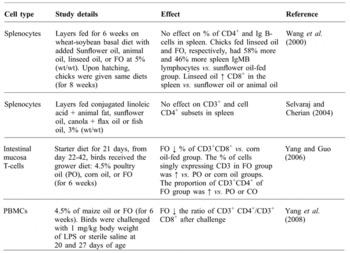
As with other animals, studies in chickens have reported inconsistent effects of dietary n-3 PUFAs on subsets of immune cells, including CD4+, CD8 +, CD3+ T-cells and B cells. One study showed that 5% fish oil (FO) increased spleen IgM+B- lymphocytes and had no effect on CD4+(Wang et al., Reference WANG, FIELD and SIM2000), another study showed decreased proportions of CD8+ and increased proportions of CD4+ and CD3+ T cells (Yang and Guo, Reference YANG and GUO2006 ), one showed no effect on any cell subset (Selvaraj and Cherian, Reference SELVARAJ and CHERIAN2004), and a fourth showed a decrease in the ratio of CD4+ /CD8+(Yang et al., Reference YANG, GUO, HE, YUAN, YANG and WANG2008) ( Table 1 ).
Wang et al. (Reference WANG, FIELD and SIM2000) fed laying hens on a wheat-soybean basal diet with added sunflower oil, animal oil, linseed oil, or FO at 5%. Upon hatching, chicks were given the same diets for eight weeks. There was no effect on CD4+ T-lymphocytes or IgM+ B- cells in the spleen. Chicks fed linseed oil and FO, respectively, had 58% more and 46% more spleen IgM+ B-lymphocytes relative to the sunflower oil-fed group. Linseed oil increased CD8+T-lymphocytes in the spleen of chicks relative to sunflower oil or animal oil, but was similar to that in the FO-fed group (49.6 ± 1.5, 40.4±2.4, 40.7 ± 2.7, 44.4 ± 0.7 for linseed oil-, sunflower oil-, animal oil-, and FO-fed group, respectively ( Table 1 ).
Effects of dietary n-3 PUFA on immuno-phenotypes of chicken immune cells ex vivo.

FO= Fish oil, CD= Cluster of differentiation, PO=Poultry oil, LPS= Lipopolysaccharides
However, Selvaraj and Cherian(2004) fed laying hens conjugated linoleic acid + animal fat, sunflower oil, canola + flax oil or FO, 3% (wt/wt) and reported no effect of n-3 PUFAs on the number of CD4+ CD8+ cells and IgM+ B-cells in the spleens of chickens. In the study conducted by Yang and Guo (2006 ), the authors fed chicks diets containing 4.5% poultry oil, corn oil, or FO for six weeks and showed that FO decreased the percentage of CD3+ and CD8+ relative to the corn oil-fed group (0.53±0.02 and 0.64±0.03). The percentage of cells singly expressing CD3 in the FO group was increased relative to the poultry oil or corn oil groups (0.20±0.01, 0.14±0.01, and 0.27±0.02 for poultry oil, corn oil and FO, respectively). The proportion of CD3+ and CD4+ of the FO group was increased relative to the poultry oil (PO) or corn oil groups (0.22±0.004, 0.18±0.02, and 0.14±0.01 for FO, PO, and corn oil, respectively). The authors concluded that FO increases the proportion of T-helper cells (i.e. CD4+) to promote acquired immunity which is essential for stimulating other elements of the immune response. In work by Yang et al.(2008) chicks were fed diets containing 4.5% maize oil or FO for six weeks. Birds were challenged with 1 mg/kg body weight of LPS or sterile saline at 20 and 27 days of age. The authors showed that FO significantly reduced the ratio of CD3+ and CD4+/CD3+ and CD8+ after challenge (1.3 vs. 2.0, s.e. =0.12, at 21 days of challenge and 1.6 vs. 2.42, s.e. =0.12, at 28 days of challenge for FO and corn oil, respectively).
The contradictory results obtained from different studies on the effects of dietary n-3 PUFAs on immune cell subset populations may be due to different species used (e.g. broilers or layers), the basal diet, the concentration and type of oils used, the immune status of the animals used, cell types, the ratio of n-6 to n-3 PUFAs and the different fatty acids of n-3 PUFAs used for the various studies.
Conclusions
The current review showed that dietary consumption of n-3 and n-6 PUFAs modulates the immune system by altering the phenotypes of immune cells. Care should be taken when feeding chickens on diets rich in PUFAs to keep the health status of the poultry flocks.