INTRODUCTION
Elizabeth Brumfiel was a pioneer in the study of gender in archaeology. Her work examined the many factors that affected Aztec women's work, including gender ideologies, class, geographical location, and historical contingencies (Brumfiel Reference Brumfiel, Gero and Conkey1991, Reference Brumfiel, Brumfiel and Feinman2008a). She studied the role of coercion and resistance in changing the intensity and conditions of women's work (Brumfiel Reference Brumfiel1996a). She examined the status of women in the past, and how it was shaped both by the actions and ideologies promoted by elites and people in urban areas, as well as commoners and people in rural areas (Brumfiel Reference Brumfiel and Wright1996b, Reference Brumfiel1997, Reference Brumfiel1998, Reference Brumfiel, Alcock, D'Altroy, Morrison and Sinopoli2001a, Reference Brumfiel, Brumfiel and Feinman2008b). Brumfiel's work on Aztec women has taken us beyond the often normative view of gender presented by historical documents, and shown us the historically and geographically varied experiences of women in the Aztec world and beyond.
Part of Brumfiel's research on the link between women's work and the changes in political domination took place in Xaltocan, a site in central Mexico where she worked for over twenty years. She conducted, commissioned, or supervised a series of chemical characterization studies of ceramics excavated in Xaltocan (Hodge and Neff Reference Hodge, Neff and Brumfiel2005; Nichols et al. Reference Nichols, Brumfiel, Neff, Hodge, Charlton and Glascock2002; Peters Reference Peters2002). Some of that work, especially a study conducted by her student Jennifer Peters (Reference Peters2002) focused on cooking vessels. Cooking was mostly associated with women in Aztec and colonial times, and these vessels used for cooking provide us with an opportunity to study trade in women's tools. Peters (Reference Peters2002:149) contributed to Brumfiel's ongoing research on changes in the political conditions in Xaltocan and its impact on local production by asking how political changes affected “the production of utilitarian plainware ceramics” at the site, focusing on pre-Aztec and Aztec contexts. In this paper we provide temporal continuity to Peters’ and Brumfiel's efforts by extending the chemical characterization of cooking pottery into the post-Conquest (post–1521) period. Comparisons between our study and the study published by Peters help us examine whether different empires affected trade in cooking pottery in different ways.
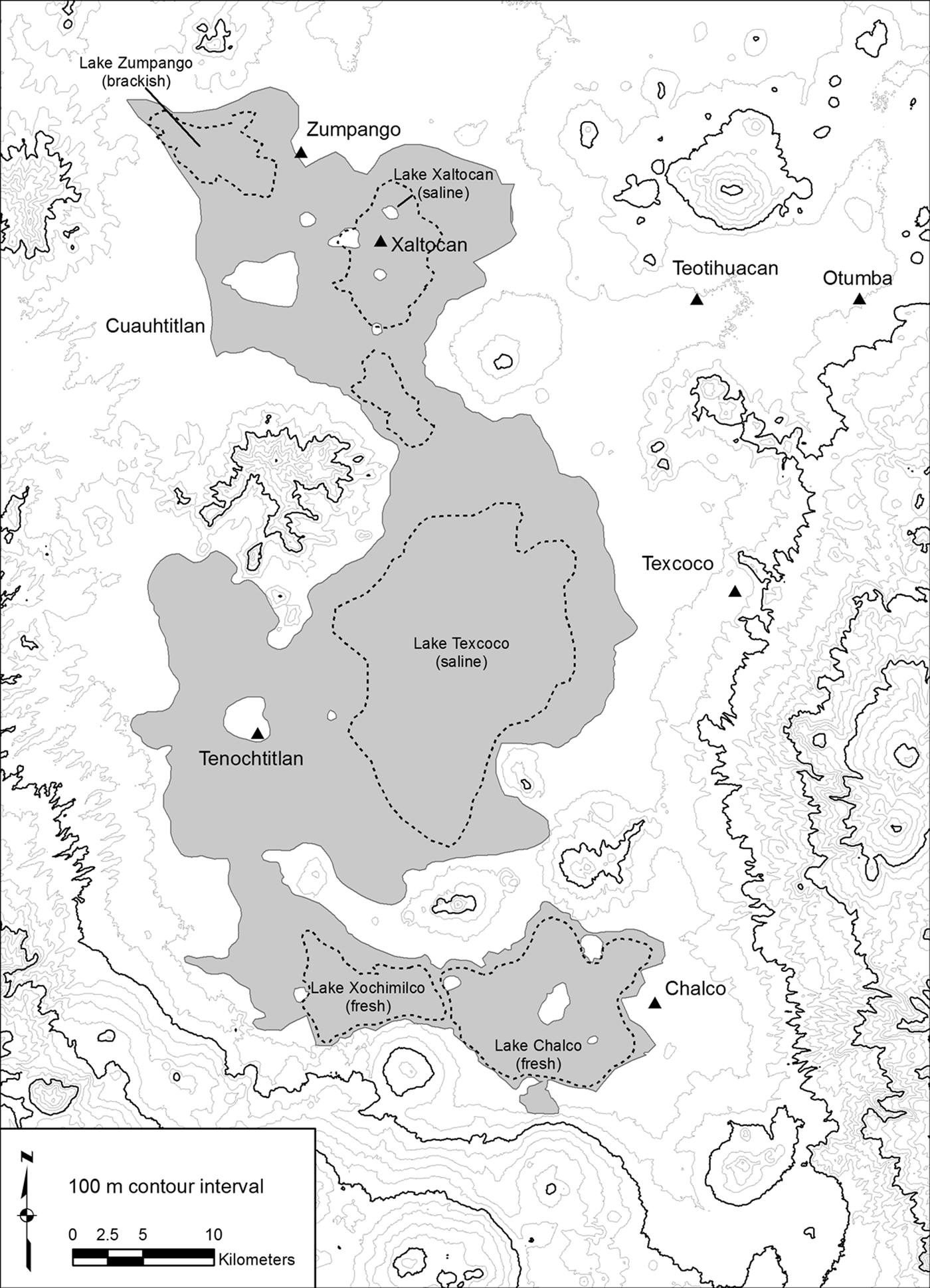
We present a chemical characterization study of 111 cooking (and perhaps storage) vessels from post-Conquest (1521) contexts in Xaltocan, Mexico (Figure 1). Our study includes plain jars and griddles (n = 82) and lead-glazed earthenware (n = 29) samples.
Map of the Basin of Mexico, showing the lake system and sites mentioned in the text.

The main questions that guide our research are: where were the plain and lead-glazed cooking vessels of Xaltocan made? Were they locally produced, or brought from a number of different sites? And is there any correlation between the changing conditions of domination (independence, conquest by the Aztecs, and conquest by the Spanish), and changes in trade in cooking pots? We begin by providing a brief description of women's work in Aztec Mexico with the goal of placing cooking tools in a rich social and cultural context. We then provide a summary of the findings in Peters’ study of changes in production and trade in cooking vessels and political changes in Xaltocan. Finally, we present and discuss the findings of our chemical characterization study of colonial plain and lead-glazed earthenware and assess the overall significance of patterns found in the two studies over the long term.
Women's Work and the Aztec Economy
Aztec women worked in a variety of contexts and occupations. They cooked and produced cloth. They worked in markets as vendors and administrators. They were healers, priestesses, prostitutes, and judges. They did agricultural work and tended animals. The list of occupations of Aztec women is long and varied. Ethnohistoric sources show that some of the most common occupations were weaving and cooking (Brumfiel Reference Brumfiel, Gero and Conkey1991, Reference Brumfiel, Brumfiel and Feinman2008b; Sahagún Reference Sahagún, Anderson and Dibble1950–Reference Sahagún, Anderson and Dibble1982:bk. 10, ch. 3). Both activities were partly done for household consumption, and sometimes also to sell items in the market. Cloth was an important product, used to fulfill the wide variety of functions of clothing for the family, from providing warmth and protection from the elements, to marking class, ethnicity, and gender (Anawalt Reference Anawalt1981; Brumfiel Reference Brumfiel and Klein2001b). Cloth was also a main form of currency among the Aztecs (Seeger Reference Seeger1978; Villanueva Reference Villanueva1985:20–21). It was rendered in large quantities as tribute to the Aztec king, and later to the Spanish (Brumfiel Reference Brumfiel1996a, Reference Brumfiel and Klein2001b; Villanueva Reference Villanueva1985:21). Women also sold cloth in the market (Villanueva Reference Villanueva1985), underscoring how difficult it can be to separate the domestic economy from the supra-household economy.
More germane to the present article is cooking. Aztec women were expected to “be a good cook, a preparer of good food” (Sahagún Reference Sahagún, Anderson and Dibble1950–Reference Sahagún, Anderson and Dibble1982:bk.10, ch. 3). They spent hours every day grinding maize and cooking a variety of foods for household consumption, for family members to take with them to agricultural fields and to work far from home, and for sale in marketplaces. The dishes prepared by Aztec women varied according to the needs of their household, their proximity to urban markets, and whether they cooked meals for the house, for religious festivities, for sale on the market, or to support men involved in tribute and agricultural labor far from their homes (Brumfiel Reference Brumfiel, Gero and Conkey1991). Women also participated in markets as vendors and administrators, along with men (Brumfiel Reference Brumfiel, Brumfiel and Feinman2008b).
Ceramic vessels were not objects of tribute. Their distribution took place mostly through market exchange, as indicated in ethnohistoric sources (Hodge et al. Reference Hodge, Neff, Blackman and Minc1993:132). The tools used by women involved them in market exchange when they purchased pottery, produce, and other ingredients needed for cooking. The products of women's work may have re-entered the market if they sold food whether for profit or to purchase items they needed to fulfill their tribute obligations (Brumfiel Reference Brumfiel, Gero and Conkey1991). Therefore, women's work was involved in the household economy, the market, and the tribute economy.
Cooking vessels
Aztec women worked with a variety of tools, and in this analysis we focus on ceramic containers for cooking and storage. The wares analyzed include plain and lead-glazed cooking and storage vessels. Plain Ware appears in the literature as “Plain Ware” (Tolstoy Reference Tolstoy1958), “Plainware” (Peters Reference Peters2002), “Plain Orange” (Parsons Reference Parsons1966:125, 133–137), as a plain variant of the “Orange Ware tradition” (Charlton et al. Reference Charlton, Otis Charlton, Fournier García, Kepecs and Alexander2005:58) and “loza anaranjada no decorada” (Fournier Reference Fournier1998:25). In spite of the varied terms used to refer to this ware, and the fact that most of the time authors do not present a description of the ware or types, scholars are rarely confused by these terms, and generally agree that they refer to earthenware with a fine to medium-coarse paste with 15–20 percent inclusions, and a surface color that ranges from orange to buff and brown, depending on the firing atmosphere. Orange is the modal surface color this ware, although other colors, including brown, and cream, are common. Parsons (Reference Parsons1966:133–137) provides a long list of the varied Munsell colors observed in this ware.
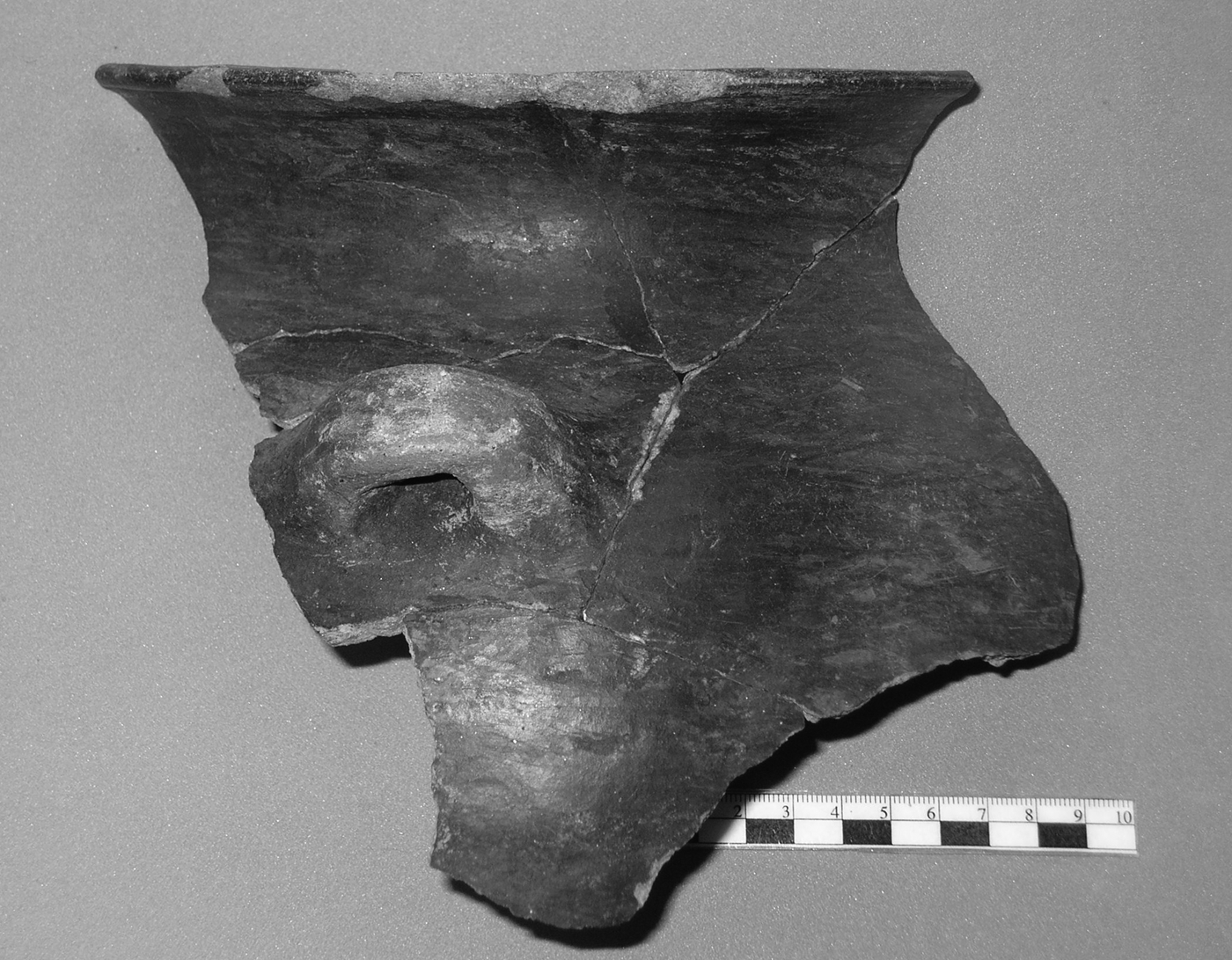
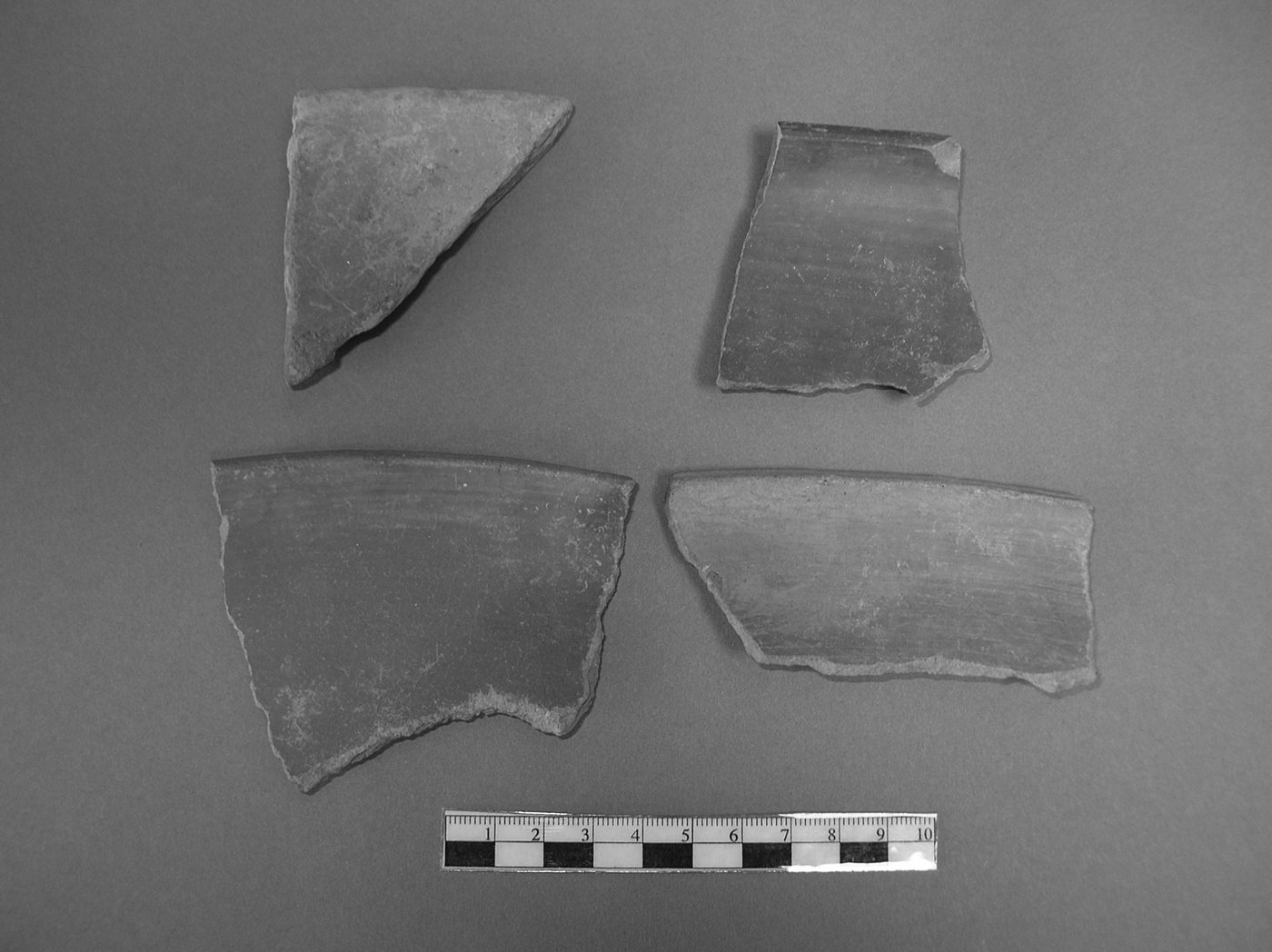
Plain ware was mostly made into jars and griddles. Jars are globular in shape with or without a neck (Figure 2). Ethnohistoric sources show that they were used for storing food, for cooking wet stews and tamales, to cook maize drinks, and for fermenting pulque, an alcoholic beverage made from maguey sap. Griddles (Figure 3), commonly known as comals, were flat round cooking vessels, sometimes with an upcurved rim, with a highly burnished upper surface. They were used to cook dry foods, including a variety of tortillas, pinolli (toasted maize), and toasted nuts and vegetables (Brumfiel Reference Brumfiel, Gero and Conkey1991; Fournier Reference Fournier1998). Jars and comals were often used together to cook different dishes in a meal, or even used in different steps of cooking one dish. For example, pots were used in the nixtamalization process, in which maize is soaked in warm water and mineral lime, in preparation for grinding. After soaking, the nixtamal, or soaked maize, could later be used to make tortillas and other dishes made with ground corn and cooked on comals (Biskowski Reference Biskowski2000; Brumfiel Reference Brumfiel, Gero and Conkey1991; Fournier Reference Fournier1998; Katz et al. Reference Katz, Hediger and Valleroy1974; Rodríguez-Alegría Reference Rodríguez-Alegría, Graff and Rodríguez-Alegría2012). Aztec sites typically yield an abundance of comal and jar sherds. We include jars and comals in our sample, giving continuity to Peters’ study of Aztec jars and comals. Colonial contexts in Xaltocan have yielded a total of 4,597 Plain Ware rims, making up 51.90 percent of the total rims from colonial units.
Plain jar excavated at Xaltocan.
Plain comals excavated at Xaltocan.
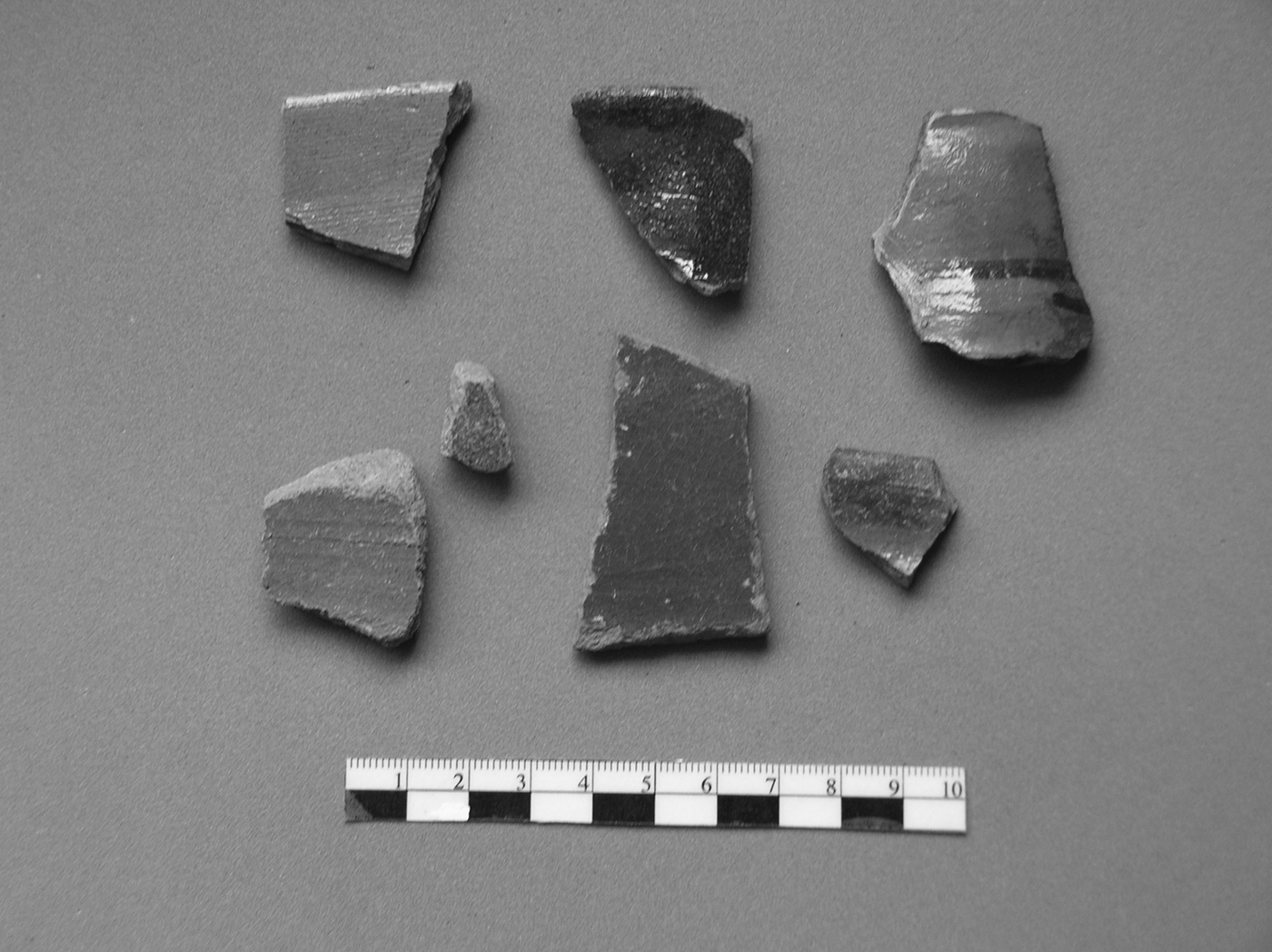
A second ware analyzed as part of this study is lead-glazed earthenware (Figure 4). It was made into a variety of cooking, storage, serving, and decorative forms, including jars, cazuelas or wide basins, bowls, dishes, cups, miniature jars, and a seemingly endless variety of forms and decorative treatments (Sodi Miranda Reference Sodi Miranda1994). The forms of lead-glazed earthenware do not typically include comals. One may also find glazed molcajetes or dishes with striated bottoms used mostly to grind chiles and other vegetables for making the hot sauces that have made Mexican food famous. We include jars, basins, and molcajetes in our sample. Colonial contexts in Xaltocan have yielded 653 lead-glazed earthenware rims, making up 7.37 percent of all rim sherds in colonial units.
Lead-glazed earthenware sherds excavated at Xaltocan.
Lead glazing was introduced by the Spanish, and it is found in post-Conquest contexts, whether Colonial (1521–1820) or Republican (1821–present) (Charlton Reference Charlton1976; Charlton et al. Reference Charlton, Otis Charlton, Fournier García, Kepecs and Alexander2005; Hernández Sánchez Reference Hernández Sánchez2012). The earliest contexts containing lead-glazed earthenware in Xaltocan have not been dated by radiocarbon, but they include Aztec III and Aztec IV pottery (associated with the sixteenth century) as well as sixteenth and seventeenth century tin enameled ceramics (Rodríguez-Alegría Reference Rodríguez-Alegría2009). We feel confident that the sample represents the material from the Colonial period, including the sixteenth and seventeenth centuries, with little or no modern material.
Sampling and Analysis
The current analysis focuses on 111 cooking and storage vessels excavated in Xaltocan during 2003 and 2007. It is part of a broader study of colonial ceramics in Xaltocan that included 251 pottery samples and three clay samples (Rodríguez-Alegría et al. Reference Rodríguez-Alegría, Millhauser and Stoner2013; Stoner and Glascock Reference Stoner and Glascock2011). The 140 samples not included in this article are either serving vessels of different types or lead-glazed earthenware body sherds that we could not classify as cooking or storage vessels, either because the fragment did not allow a classification by form, or because it was part of a serving vessel. Although all 251 samples form part of the statistics used in analysis, we only discuss the 111 cooking and storage vessel samples.
Our sampling strategy can be best described as a stratified random sample. We selected samples randomly within the types of interest. Sample selection began by identifying excavation contexts that date to the colonial period, based on the absence of modern ceramics and artifacts, as well as the absence of Aztec pottery. Selection of contexts was based on the relative chronology of the material, and not on whether the context was a feature associated with cooking activities. Given that the pottery chosen for the study is known to have been used as cooking pottery and associated with women's activities (e.g., Brumfiel Reference Brumfiel, Gero and Conkey1991; Fournier Reference Fournier1998), the choice of archaeological context would do little to alter our designation of this pottery sample as cookware. Once a context was identified as dating to the colonial period, a random sample of plain and lead-glazed earthenware was chosen for this study within the bag of pottery associated with the context.
The sample was not structured to reflect the proportion of different types in the assemblage. For example, Plain Ware rims make up 51.90 percent of all colonial rims excavated in Xaltocan, but it makes up 73.87 percent of the fragments included in the sample discussed in this article (83 out of 111 samples). Lead-glazed earthenware rims make up 7.37 percent of all rims in colonial contexts excavated in Xaltocan, but 26.12 percent (29 out of 111) of the fragments included in this article. It is not unusual for an NAA sample not to reflect the proportions of different types in an assemblage. Given that the sample was not entirely random the results of this analysis may not be representative of all colonial ceramics at Xaltocan. Nevertheless, the results can inform us of the relative proportions of samples within each ceramic type that were derived from different loci of production.
This sample includes a variety of contexts from excavations directed by Rodríguez-Alegría that targeted colonial occupations in Xaltocan, including PC1 (“PC” stands for Pozo Colonial), PC2, and PC4. These three units consisted mostly of post–1521 layers (Rodríguez-Alegría Reference Rodríguez-Alegría2009, Reference Rodríguez-Alegría2010, Reference Rodríguez-Alegría, Graff and Rodríguez-Alegría2012). The sample also comes partially from excavations co-directed by Brumfiel and Rodríguez-Alegría, including the units designated as Zoc A and Zoc B, where a large colonial trash pit intruded into domestic architecture (Brumfiel and Rodríguez-Alegría Reference Brumfiel and Rodríguez-Alegría2010). A smaller portion of the sample comes from several excavation units excavated by Brumfiel, including Operations G, H, I, T, and Z1 (Brumfiel Reference Brumfiel2005). All of these excavations were designed to sample Aztec households, and the colonial material was found in a variety of contexts. The contexts sampled are either trash pits or fill, but of course, it would be unusual to find large fragments of domestic pottery in primary use contexts. Given that the purpose of the study is to understand trade in Xaltocan in the colonial period, and that the archaeological context would do little to further our interpretation of these pots as cooking pots, the contexts sampled are appropriate for this study.
Methods
A thorough description of the ceramic analysis methods employed in this study can be found elsewhere (Glascock Reference Glascock and Neff1992; Neff Reference Neff and Neff1992, Reference Neff, Ciliberto and Spoto2000; Stoner and Glascock Reference Stoner and Glascock2011). All samples were prepared in the same way. Outer slips, glazes, paint, and contaminants adhering to the surfaces of the pottery sherds were removed with a silicon carbide burr. Samples were crushed in an agate mortar and weighed for short and long irradiations at the University of Missouri research Reactor. Thirty-three elements were measured, but nickel (Ni), arsenic (As), and antimony (Sb) were removed from most analyses due to missing values (in the case of the former) or contamination from glazes (in the case of As and Sb).
In general, the approach used to interpret the compositional data involved hierarchical cluster analysis (HCA) and principal components analysis to establish initial groupings within the sample. The initial chemical groups were then compared to the Basin of Mexico data to determine if any specimens could be assigned to established Basin of Mexico chemical groups. The first step of this procedure was to conduct a Euclidean distance search of the unknowns compared to the Mesoamerican NAA database housed at MURR, consisting of over 20,000 reference samples. Particular attention was given to samples from Xaltocan previously analyzed by this laboratory (Nichols et al. Reference Nichols, Brumfiel, Neff, Hodge, Charlton and Glascock2002; Stoner et al. Reference Stoner, Glascock and Ferguson2008). The Basin of Mexico reference groups have been distinguished based on principal components analysis and canonical discriminant analysis. The sample was projected onto the discriminant functions established for the Basin of Mexico groups, and minor adjustments were made to the initial groupings. Mahalanobis distance-based probabilities were also calculated for probability of group membership to any of the five major Basin groups. We summarize the results of the study of Plain Ware from pre-Hispanic conquests in Xaltocan by Peters (Reference Peters2002), followed by a presentation of the results from our study of colonial pottery in Xaltocan. This procedure in the past did not separate out major chemical reference groups for Xaltocan. Recent analyses, however, have identified two distinct chemical groups pertaining to Xaltocan based on elevated levels of sodium and potassium and low concentrations of transition metals and rare earth elements (REEs [Stoner et al. 2014]). These are included in the canonical discriminant analysis of the current study.
An anonymous reviewer observed “overlap” between Xaltocan 1a and Cuauhtitlan chemical groups. We refer the reader to Stoner et al. (2014) for a discussion of the creation and evaluation of the Xaltocan chemical groups. Indeed, there is chemical similarity between Xaltocan reference groups and those defined for Cuauhtitlan. The same could be said for all chemical reference groups in the Basin of Mexico as it is an interior drainage basin where chemical variability of sediments grade subtly over space. There are, however, significant chemical differences that are evaluated for each specimen using a combination of Mahalanobis distance–based probabilities, cluster analysis, principal components analysis, and bivariate chemical plots. It is possible that Cuauhtitlan and Xaltocan shared some of the same clay sources, but on average the pottery found at the two places chemically differs in a consistent and systematic manner. The source assignments presented in this study are allocated to the best chemical reference group. Source assignments were relatively conservative, which led to the high percentage of unassigned specimens in the current sample.
Peters’ study is limited in ways that are typical in NAA, but comparisons are possible, and at this point, our best option. The study was conducted over eight years ago and analysts were able to identify only pottery from Xaltocan and from Cuauhtitlan. As time passes and more pottery and clay samples from the Basin of Mexico have been characterized by NAA, the number of chemical groups and sources of pottery identified in the Basin of Mexico keeps growing. We expect that the more Plain Ware from Xaltocan gets analyzed in the future, the more chemical groups we will be able to identify for all time periods. The comparisons presented here respect Peters’ source attribution and focus on her conclusions, without incorporating our results with her results in any statistical treatment, and with the knowledge that results will likely change in the future as samples increase.
Production and Trade of Plain Ware before the Spanish Conquest
Peters (Reference Peters2002) did a chemical characterization study of Plain Ware in Xaltocan with the goal of understanding how political changes affected commoners and their work. The ceramic sample included four distinct phases of occupation at the site, each associated with different conditions of political domination (Brumfiel Reference Brumfiel2005). For each phase, she selected 20 comal and 20 jar fragments. The results reveal changes in cooking pot production and trade through time.
Phase 1 (a.d. 900–1100) is the first occupational phase at Xaltocan (Brumfiel Reference Brumfiel2005:349) and it corresponds to the period when Xaltocan was independent and self-sufficient. Population grew slowly during this period and reached approximately 4,200 inhabitants. Local production of maize and other crops thrived, in part due to the construction of 1,000–1,500 ha of chinampas in Lake Xaltocan (Morehart and Eisenberg Reference Morehart and Eisenberg2010). The local economy was diverse and included hunting, salt production, chipped-stone tool production, and ceramic production and exchange (Brumfiel Reference Brumfiel2005; Millhauser Reference Millhauser and Brumfiel2005). During this time period, most of Xaltocan's Plain Ware was made locally: 70 percent of the sample analyzed by Peters was made in Xaltocan, including 14 jar sherds and 14 comal sherds (Peters Reference Peters2002:152) (Table 1). The people of Xaltocan also used Plain Ware from Cuauhtitlan, west of Xaltocan, which accounts for 12.5 percent of the sample, including two comals and three jars. The loci of production of the rest of the sample from Phase 1 could not be identified.
Provenance of Plain Ware samples excavated in Xaltocan, divided by occupational phase. All percentages are row percentages. Data from Phases 1–4 from Peters Reference Peters2002
The pattern from Phase 1 reflects a greater reliance on local production of Plain Ware when compared to decorated serving vessels. In general, the people of Xaltocan made less than 50 percent of their decorated serving vessels during Phase 1 (Nichols et al. Reference Nichols, Brumfiel, Neff, Hodge, Charlton and Glascock2002:65), but made 70 percent of their plain cooking pots, indicating more trade in decorated serving vessels than in plain cookwares.
Phase 2 (ca. a.d. 1100–1300) shows much continuity in terms of population and the economy in Xaltocan. The economy remained as diverse during Phase 2 as it had been during Phase 1 (Brumfiel Reference Brumfiel2005:353). Beginning in Phase 2 there is a decrease in the percentage of locally produced Plain Ware in the sample studied by Peters, and also a decrease in reliance on Plain Ware from Cuauhtitlan: 60 percent of the sample is of local production (10 comals and 16 jars), and only 5 percent of the sample (two jar sherds) was produced in Cuauhtitlan. The rest of the sample consists of ten comals and four jars of unknown provenience (Peters Reference Peters2002). That comals were traded more than jars may relate to the easier transport of comals stacked on one another in canoes. This may also indicate that there was less interest in trading jars as containers for food in comparison with trade of comals as cooking vessels.
Chemical characterization of decorated serving vessels reveals that in Phase 2, six out of 17 Black-on-Orange sherds (including Aztec I and Aztec II pottery) were made in Xaltocan, a decrease in comparison with Phase 1. Most of the Red Ware analyzed by Nichols and colleagues (2002) came from the southern Basin of Mexico. Thus, the data indicate a trend of decreased reliance on local production of both, plain cooking pottery and decorated serving vessels between Phases 1 and 2 in Xaltocan.
In Phase 3 (a.d.1300–1430), Xaltocan's population grew and the site reached its peak in terms of population, economic prosperity, and political influence. Chinampa agriculture thrived (Morehart Reference Morehart2012a; Morehart and Eisenberg Reference Morehart and Eisenberg2010) and salt production expanded (Brumfiel Reference Brumfiel2005). The people of Xaltocan continued producing chipped-stone tools (Millhauser Reference Millhauser and Brumfiel2005) and other goods (Brumfiel Reference Brumfiel2005:359). During this time period, Brumfiel (Reference Brumfiel, Gero and Conkey1991) noted an important shift in the use of cooking vessels in Xaltocan. Comals became more common than in previous phases, suggesting that the women of Xaltocan cooked more dry portable foods (including tortillas and pinolli). The increase in production of dry portable food was likely to support agricultural labor in chinampas that were located far from the town's center, work in markets, and military campaigns (Brumfiel Reference Brumfiel, Gero and Conkey1991, Reference Brumfiel2005:359). During Phase 3 Xaltocan entered a long war with neighboring Cuauhtitlan. The people of Xaltocan lost the war and they were later incorporated into the Aztec empire in 1428 (Brumfiel Reference Brumfiel2005; Morehart Reference Morehart2012b).
During Phase 3, Plain Ware from Cuauhtitlan makes up 45 percent of the sample, whereas Plain Ware made in Xaltocan makes up only 35 percent of the sample. This is the first time period in which imported sherds from Cuauhtitlan outnumber sherds from Xaltocan. Of the Plain Ware samples produced in Xaltocan, nine are comals and five are jars. Of the samples produced in Cuauhtitlan, eight are comals and 10 are jars. Provenance could not be determined for the rest of the sample. The results of the study of Plain Ware are similar to the results of an analysis of decorated serving vessels. During Phase 3, 14 out of 17 Black-on-Orange sherds analyzed were from Cuauhtitlan, two from Tenochtitlan/Culhuacan, and one from Chalco (Nichols et al. Reference Nichols, Brumfiel, Neff, Hodge, Charlton and Glascock2002:67). Patterns for Red Ware were quite different. Half of the samples analyzed by Nichols et al. (Reference Nichols, Brumfiel, Neff, Hodge, Charlton and Glascock2002) came from Xaltocan, and the rest came from the southern Basin and Tenochtitlan, but not from Cuauhtitlan. The increase in Plain Ware and Black-on-Orange pottery from Cuauhtitlan is most likely an indication that trade and perhaps economic competition between Xaltocan and Cuauhtitlan increased through time. The two towns may have competed with each other until friction was enough to precipitate warfare between the two towns (Brumfiel Reference Brumfiel2005:361).
During Phase 4 (1430–1521), when Xaltocan was under Aztec domination, the economy of Xaltocan declined, the site was smaller than during Phase 3, and the population was impoverished. Economic activity and standards of living suffered during Phase 4 (Brumfiel Reference Brumfiel2005:361). Under Aztec domination, there was a significant increase in the use of Plain Ware from Cuauhtitlan. During this phase, locally produced Plain Ware makes up only 15 percent of the sample analyzed by Peters (3 out of 20 comals, and 3 out of 20 jars), and Plain Ware from Cuauhtitlan makes up 70 percent of the sample (14 out of 20 comals and 14 out of 20 jars; Peters Reference Peters2002). The provenience for the rest of the sample could not be determined. There were changes in the provenience of decorated serving vessels too: the source of Black-on-Orange shifted to Tenochtitlan/Culhuacan (eight out of 14 samples from Phase 4), and only three samples came from Cuauhtitlan. Red Ware, however, was mostly made locally. Eleven out of 16 samples analyzed were from Xaltocan, and only one was from the southern basin, whereas the other four remain unassigned (Nichols et al. Reference Nichols, Brumfiel, Neff, Hodge, Charlton and Glascock2002:68).
The increase in Plain Ware from Culhuacan is perhaps a reflection of more time spent in markets, especially the market at Culhuacan, selling food and obtaining the tools needed to cook more. Perhaps participation in the market at Culhuacan was forced directly or indirectly by the Aztecs, who depended on market participation to ensure movement of goods across the Basin and into their city. Or perhaps participation in the market at Culhuacan increased because the conquest of Xaltocan by the Aztecs dealt the town a severe economic blow and it may have obliterated the market in Xaltocan, and strongly affected local production of ceramics. It is unlikely that an increase in importation of ceramics is related to increases in agricultural production during Phase 4 for two reasons. First, Morehart (Reference Morehart2012a) has argued that the chinampas of Xaltocan were mostly abandoned after the conquest by Cuauhtitlan. We believe it is unlikely that agricultural production increased after that time. And second, people can schedule pottery production around agricultural work. There is no reason to believe that one would have competed with the other in Xaltocan. Regardless of the specific causes, the trend of an increase in use of Plain Ware from Cuauhtitlan through time, and a decrease in use of Plain Ware from Xaltocan is clear in the data.
Production and Trade of Cooking Vessels in Post–1521 Xaltocan
Xaltocan was conquered by the Spanish and burned to the ground in 1521 (Cortés Reference Cortés1970:118; Hassig Reference Hassig2006:142–143). At the time of the Conquest and during most of the sixteenth century, it was an impoverished town due to severe tribute demands from the Aztecs and to the attack by the Spanish (Brumfiel Reference Brumfiel2005:365; Montúfar Reference Montúfar1897:91–96; Rodríguez-Alegría Reference Rodríguez-Alegría2010, Reference Rodríguez-Alegría2016). Xaltocan became an encomienda, and provided tribute to the Spanish for a long time after the conquest (Bejínez Juárez Reference Bejines Juárez1999:97; Hicks Reference Hicks and Brumfiel2005). Based on historical documents, Gibson (Reference Gibson1964:366) has argued that Xaltocan's economy recovered during the Colonial period. The people of Xaltocan took advantage of new opportunities found in the colonial market and they exploited lake resources for commercial purposes. Participation in colonial markets may have led to a period of prosperity in the town, although archaeological evidence does not support the idea that Xaltocan was prosperous for a long time. A better interpretation of all the available data is that Xaltocan went through cycles of economic well-being and impoverishment during the colonial period (Rodríguez-Alegría Reference Rodríguez-Alegría2016; Rodríguez-Alegría et al. Reference Rodríguez-Alegría, Millhauser and Stoner2013).
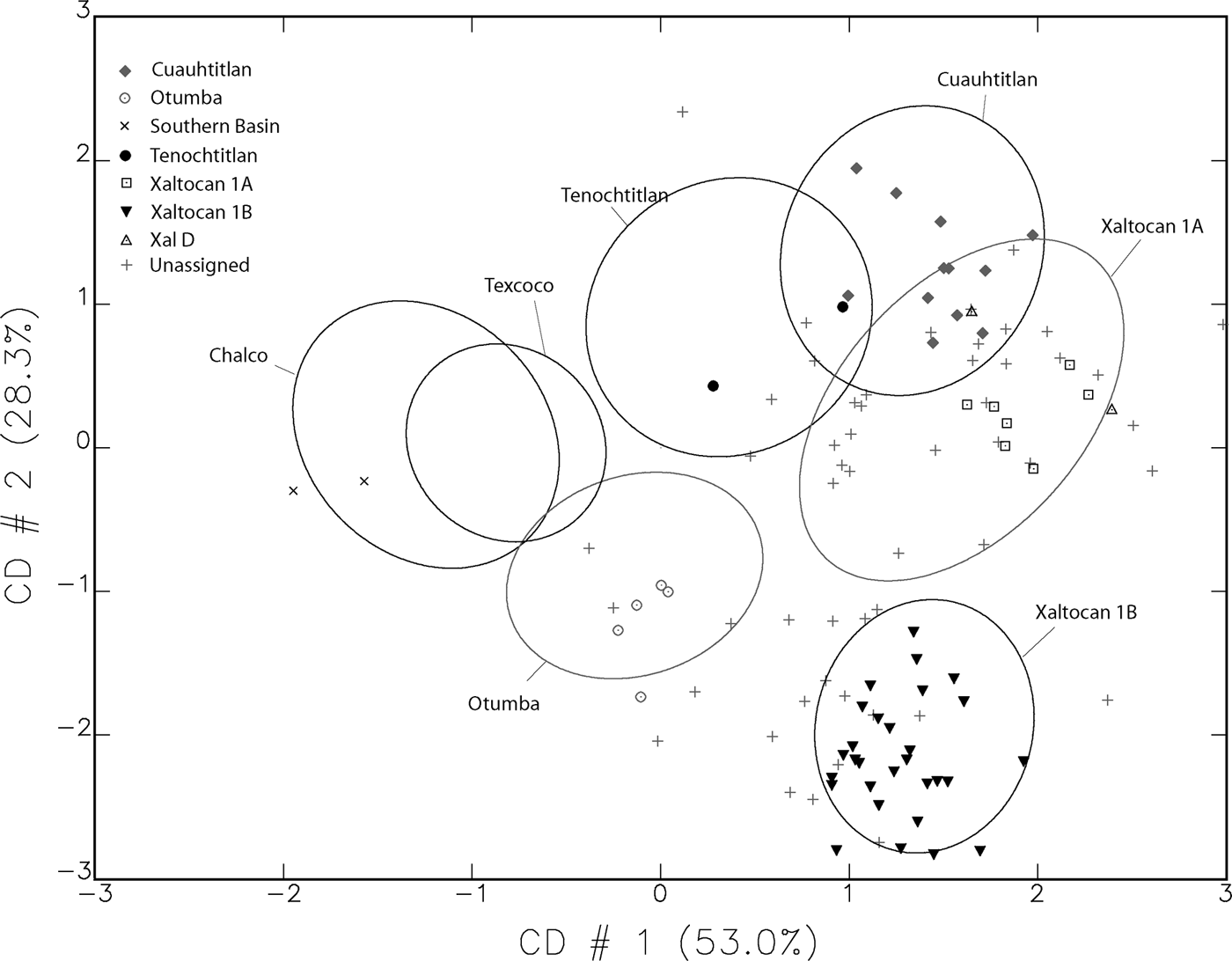
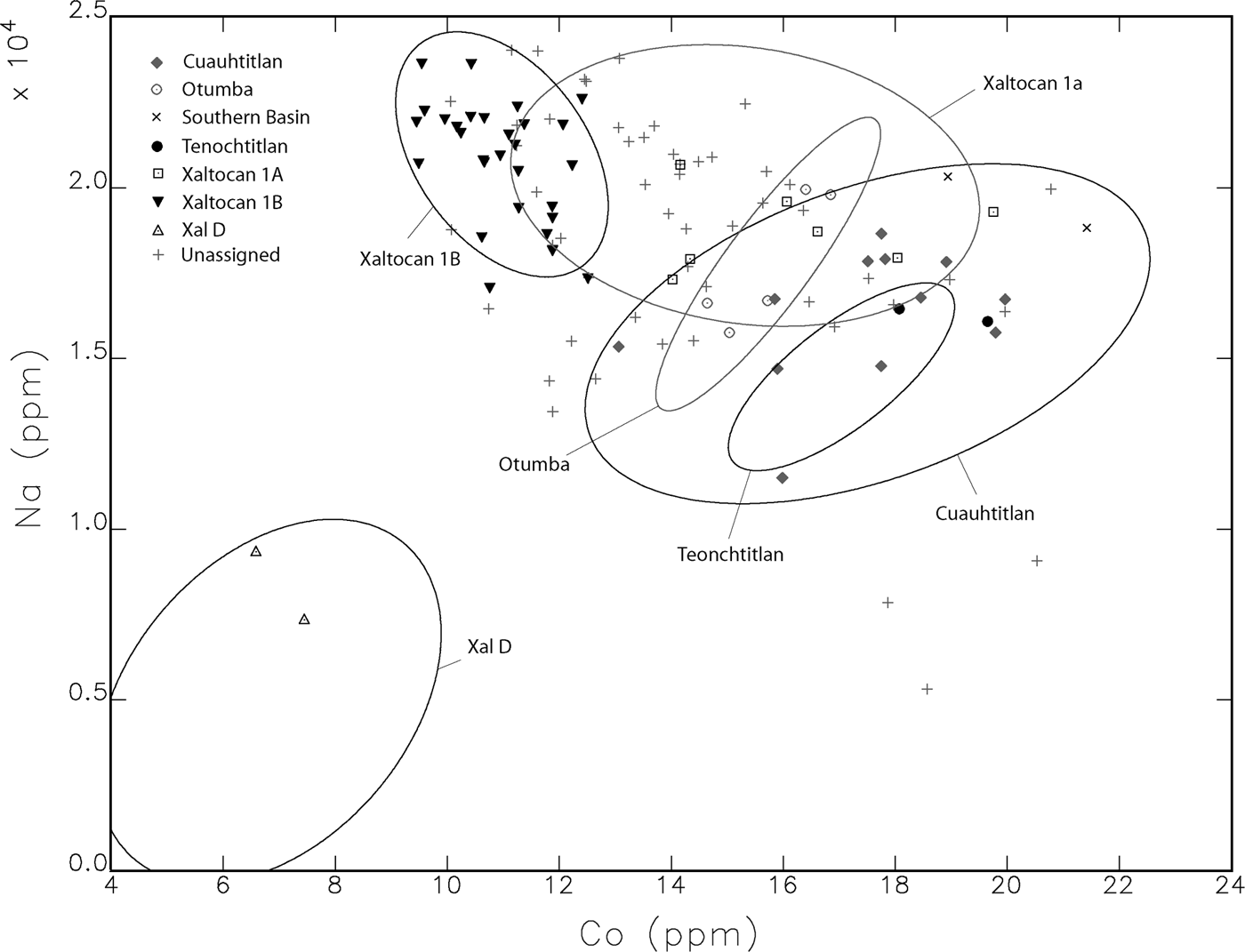
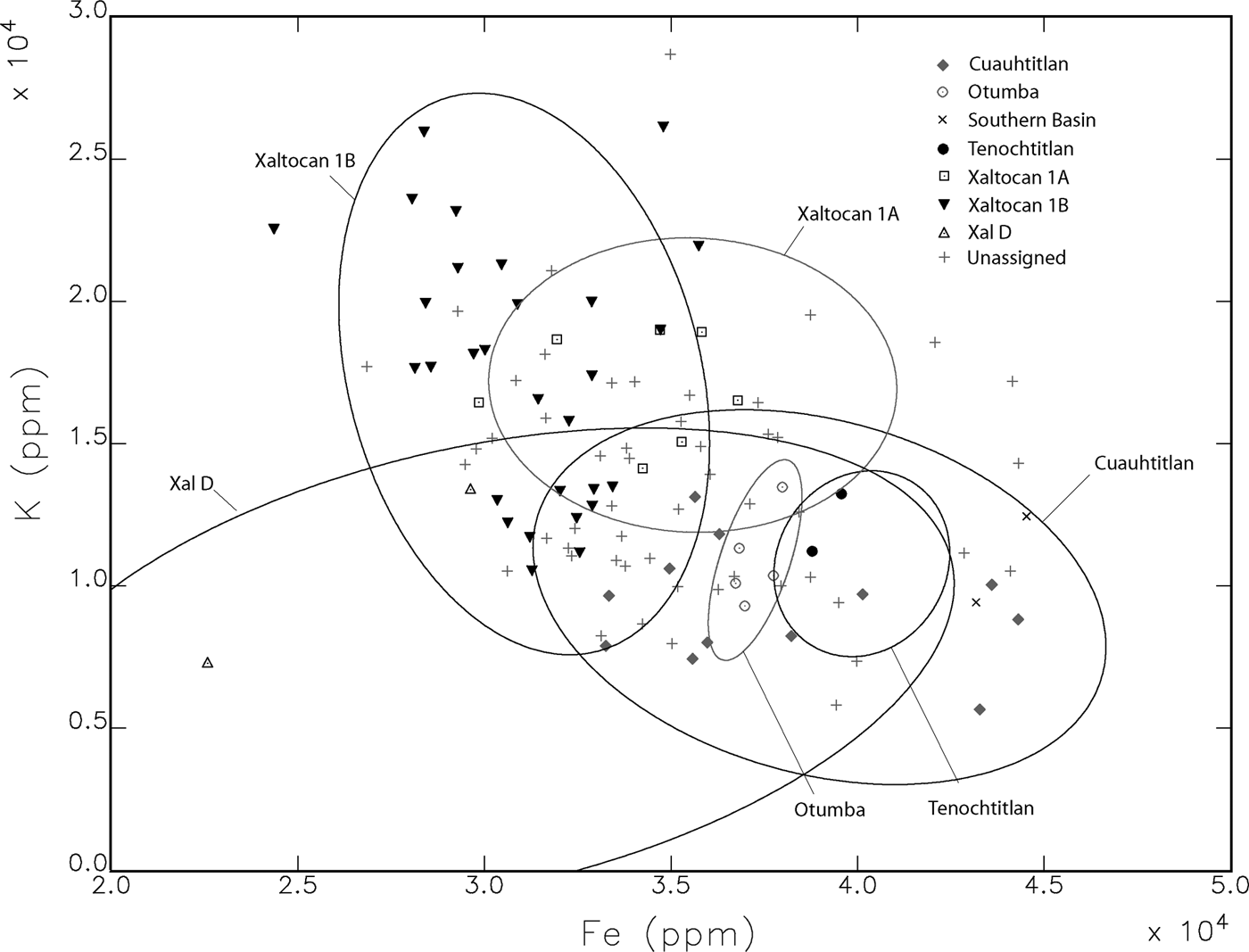
After the Spanish conquest, there were changes once again in the production and trade of cooking vessels at Xaltocan. The 111 cooking vessel samples submitted for analysis were classified into seven compositional groups, belonging to four sites and one general geographical area: 32 samples were made at Xaltocan (3 belong in the Xaltocan 1a group, and 29 in the Xaltocan 1b group), 19 were made at Cuauhtitlan, six were made at Otumba, three at Tenochtitlan, and two in the southern Basin of Mexico (1 in the Southern Basin-1 group, and 1 in the Southern Basin-3 group) (Figures 5, 6, 7). We note here that all samples in the Basin of Mexico assigned to the Xaltocan 1b chemical group were sampled from Xaltocan. It has not yet been identified outside the site. A total of 47 samples remain unassigned due to a relatively equal probability of membership in more than one of the compositional groups, and our conservative approach of group assignment. Unassigned specimens are most likely of local (Xaltocan) origin, as discussed below. In general, the colonial pattern at Xaltocan is of increased proportion of locally made Plain Ware compared to the proportion of Plain Ware from Cuauhtitlan, reversing the pattern seen during Phase 4. Most of the ceramics analyzed were produced in the northern Basin of Mexico. The patterns become more meaningful when examined by ware and form. Plain comals from the colonial period were made mostly at Xaltocan. Out of 43 comal samples analyzed, 19 were made at Xaltocan and 20 other samples remain unassigned but we believe they are of local origin because they show a high and relatively equal probability of membership in both Xaltocan chemical groups. If our assignment of these 20 comals is correct, that would make it 39 out of 43 comals made in Xaltocan. Only four of the comals analyzed were made at Cuauhtitlan. We analyzed 31 jar samples, and of those, eight belong compositionally in the Xaltocan groups, four were made at Cuauhtitlan, and two were brought from the southern Basin. Seventeen of the plain jar samples remain unassigned, and just as was the case with comal samples, they show a high but relatively equal probability of membership in both Xaltocan compositional groups. They are most likely of local production. Finally, we also sampled eight plain cazuelas, or wide basins with open necks. The plain cazuelas were made locally (n = 3), at Tenochtitlan (n = 1), and at Cuauhtitlan (n = 1), and three samples remain unassigned. The higher proportion of the sample that was made locally in comparison with imported Plain Ware during the colonial period is clear in the data for the three vessel shapes sampled, whether comals, jars, or cazuelas.
Canonical discriminant (CD) functions 1 and 2 of colonial ceramics from Xaltocan analyzed in this study. Ellipses represent 90 percent probability of membership in the named chemical groups.
Scatterplot of Co (ppm) and Na (ppm) of colonial ceramics from Xaltocan analyzed in this study. Ellipses represent 90 percent probability of group membership.
Scatterplot of Fe (ppm) and Co (ppm) of colonial ceramics from Xaltocan. Ellipses represent 90 percent probability of group membership.
The lead-glazed earthenware sample does not contain any comals, given that comals were not typically glazed, but it contains a small sample (n = 6) of molcajetes. Of the 29 samples analyzed, 16 were jars. They were made mostly at Cuauhtitlan (n = 7), and to a lesser extent at Xaltocan (n = 1), Tenochtitlan (n = 1), and Otumba (n = 1) (Table 2). Six of the glazed jars remain unassigned (discussed below). The sample of glazed cazuelas is too small to present any definite patterns, and we assigned one sample each to Xaltocan and Tenochtitlan, two to Otumba, and two to the chemically variable and distinctive Xaltocan D group, and one is unassigned. Finally, the molcajetes were made at Otumba (n = 3) and Cuauhtitlan (n = 3). None of the molcajete samples is of local production, which could indicate that it was not a form that was produced locally, or that the sample is too small to find them. Larger samples of molcajetes are needed to clarify whether they were made in Xaltocan at all.
Provenance of lead-glazed earthenware samples excavated in Xaltocan, by form. All percentages are row percentages
A major finding from this study is that there was production of lead-glazed earthenware at Xaltocan. If we take into account all forms, and not just cooking and storage vessels, the total number of samples of lead-glazed earthenware made at Xaltocan is four out of a total of 76 samples analyzed (Rodríguez-Alegría et al. Reference Rodríguez-Alegría, Millhauser and Stoner2013). We did not have any evidence of local production of lead-glazed earthenware prior to this study. Future excavations may enable us to locate the places where lead-glazed earthenware was produced, whether by identifying production facilities, raw materials, wasters, or other kinds of evidence. Production of lead-glazed earthenware required the usual raw materials used to make Plain Ware (clay, tempering materials, tools), as well as the ingredients necessary for glazing, primarily lead ore. The people of Xaltocan must have obtained these additional materials in markets, although we currently do not know where. Still, local production implied trade in additional raw materials, and also knowledge of the glazing process.
Lead-glazed earthenware came mostly from other towns, including Cuauhtitlan and Otumba. During Phase 4, as well as in the colonial period, Xaltocan did not import Plain Ware from Otumba, but it imported glazed pottery in the Colonial period. This pattern shows that Plain Ware and lead-glazed earthenware were not necessarily traded in tandem.
The two samples of lead-glazed earthenware that belong in the Xaltocan-D group are difficult to interpret. The group is named provisionally as Xaltocan-D until further research can help identify whether it belongs to a specific provenance or whether it is the result of contamination, differential leaching or weathering of these sherds, or some other taphonomic or behavioral process. The group has very high concentrations of REEs, but at the same time, the specimens in the group have a rather heterogeneous REE composition. Whereas some samples have REE concentrations similar to other samples in the study, other samples in the Xaltocan-D group have values that are four or even five times higher than those of samples that belong in other chemical groups. Furthermore, Xaltocan-D samples have the lowest concentrations of calcium and strontium in the study, and they have low concentrations of transition metals as well (Rodríguez-Alegría et al. Reference Rodríguez-Alegría, Millhauser and Stoner2013).
Lead glazing was one of the most widely adopted ceramic technologies in Mexico after the Spanish conquest (Fournier and Blackman Reference Fournier and Blackman2007; Hernández Sánchez Reference Hernández Sánchez2012:143). Given that an unknown number of towns adopted this technology, it is no surprise to find that seven of the lead-glazed samples remain unassigned, which is not an unusually high percentage of unassigned samples in chemical characterization studies anyway. The number of unassigned samples could mean that we have samples from a variety of production loci that remain unidentified, or that a limited number of production centers made these samples with clays that were obtained from different places and show a range of compositional differences as a result (e.g., Arnold Reference Arnold2008:226). Future studies may help clarify this issue.
CONCLUSION
We began by asking where the plain and lead-glazed cooking pots of Xaltocan were made, and whether there was a correlation between political change and changes in production and exchange of cooking pots. In all time periods in Xaltocan there were both local production and also trade in cooking pottery. There were also changes in the sources of cooking pots through time.
When Xaltocan began as an independent community, and its economy was diverse, locals made most of the Plain Ware jars and comals. They imported much less Plain Ware from Cuauhtitlan (Peters Reference Peters2002). This pattern fits the assumption that decorated serving vessels are more typically exchanged over long distances, whether because they are smaller and easier to transport than cooking vessels, or because they are considered more valuable as items for display. However, through time, the people of Xaltocan relied less and less on local production of both Plain Ware and serving vessels, even before the Aztec conquest. The increased reliance in Plain Ware from Cuauhtitlan can be seen during Phase 3, when for the first time the people of Xaltocan used more Plain Ware from Cuauhtitlan than from Xaltocan. The pattern continued into Phase 4. Even after Xaltocan lost the war, and after it was conquered by the Aztecs, the use of Plain Ware from Cuauhtitlan continued increasing relative to the use of local Plain Ware. After the Aztec conquest, the use of Plain Ware from Cuauhtitlan reached its peak, and the use of locally produced Plain Ware reached its nadir.
The trend of decreasing reliance on locally made pottery is striking in this case; a trend that survived the rise of Xaltocan as a regional political and economic power, major changes in production in the town (see Brumfiel Reference Brumfiel2005), and even the war with Cuauhtitlan and the Aztec conquest. It is possible that it is simply a matter of continuity in the pattern. But not all trends survived the effects of warfare and conquest in Xaltocan. Beginning in Phase 3, and into Phase 4, there was an increase in use of pottery from Cuauhtitlan. Perhaps the Aztecs exacerbated the old trend of increasing use of pottery from Cuauhtitlan by making the people of Xaltocan participate in the market of Cuauhtitlan, whether by commanding them to go or by making some products available to them only in Cuauhtitlan. The Aztecs are known for having used a variety of strategies to try to increase market participation among its subject communities in order to ensure the movement of provisions into the capital (Hassig Reference Hassig1985; Smith Reference Smith, Garraty and Stark2010:179).
Another possibility that deserves further scrutiny is that the increase in pottery from Cuauhtitlan may be related to immigration of people either from Cuauhtitlan or from places that had long-term market or social relationships with Cuauhtitlan. A DNA study by Jaime Mata Miguez and his colleagues (2013) suggests that in Phase 4 there was an influx of people into Xaltocan, and those people were genetically unrelated to the earlier population at the site. In other words, they were immigrants. The study further suggests that there was a population replacement in Xaltocan, in which locals abandoned the site and a new wave of immigrants moved in. The data from the DNA study is consistent with historical records that mention such a population replacement specifically (Alva Ilxtilxóchitl Reference Alva Ixtlilxóchitl1975–Reference Alva Ixtlilxóchitl1977:I:323; Bierhorst Reference Bierhorst1992; Morehart Reference Morehart2012b:273–274). If people moved into Xaltocan, they may have brought some pottery, and they also may have continued attending the same markets where they obtained their pottery previously, or even maintained social relations with potters or sellers who supplied them with pottery. The NAA data do little to clarify whether immigrants are responsible for changes in the sources of pottery or whether long-term market trends are responsible, or both. Regardless of the explanation, one thing is clear: political changes and conquest shaped patterns of trade in cooking vessels through time in Xaltocan. The reasons behind these changes can be several. Maybe the changes in trade in cooking pots were part of long term trends left alone by the Aztec empire. Maybe the changes were the result of attempts to shape trade and market participation by the empire. Maybe the changes were the result of population movements and the social connections of immigrants.
Even though the data we have provided are not enough to explain the causes behind the changes in trade patterns, expanding the temporal range of the study into the colonial period provides new data that suggest that the pattern seen in Phase 4 is due to the manipulation of market participation by the Aztecs. The Spanish conquest is chronologically associated with another change in production and trade of Plain Ware. After the Spanish conquest we see a dramatic decrease in the import of Plain Ware from Cuauhtitlan, and an increase in use of locally produced Plain Ware. Spanish colonizers were not generally interested in changing the domestic economy of the Aztecs. They were more interested in drafting indigenous labor for mining projects, urban development, and other kinds of work. Still, the conquest had an impact on trade of serving vessels. The causes for this impact are difficult to pin down. Perhaps the potters who lived in Xaltocan, freed from the tribute demands of the Aztecs, resumed or intensified production of Plain Ware, just as they resumed production of chipped-stone tools, and just as they diversified production in the town during the colonial period (Rodríguez-Alegría Reference Rodríguez-Alegría2008, Reference Rodríguez-Alegría2010, Reference Rodríguez-Alegría2016). Or perhaps there were few incentives (or obligations) for the people of Xaltocan to participate heavily in the market in Cuauhtitlan now that the Aztecs were no longer in power and their tribute system suffered many changes.
Another major change in the colonial period was the introduction of glazed earthenware. It is clear that trade in lead-glazed earthenware was independent of trade in Plain Ware. Lead-glazed earthenware from Otumba (a site that did not supply much, if any, Plain Ware to Xaltocan in any of the time periods studied), Cuauhtitlan, and Mexico City can be found in Xaltocan. Overall, the chemical composition of samples from this ware is much more varied than that of Plain Ware. With the data we have, we do not know whether both plain and lead-glazed earthenware were brought to Xaltocan from the same marketplaces, whether vendors brought lead-glazed earthenware directly to Xaltocan from many different places, or both. Understanding the variation in the chemical composition of lead-glazed earthenware will require further sampling of ceramics and raw materials, including clays and glazes, integrated with other lines of data that may aid in identifying its many sources.
This article contributes new ideas to the study of exchange of ceramics in Xaltocan. Expanding the study of trade of cooking pots temporally has allowed us to provide support to the idea that the Aztec manipulation of market participation was a strong factor in shaping the trade in cooking pots in Phase 4. With Aztec manipulation of market exchange, the people from Xaltocan were somehow forced or compelled to exchange more with Cuauhtitlan. When the Spanish ended the different techniques that the Aztecs used to manipulate market exchange, the people of Xaltocan reduced their participation in the market in Cuauhtitlan and increased local production of pottery, just like they increased or resumed local production of other goods in the Colonial period. Still, the data we provide are not direct proof, but rather suggestive of this explanation. Studies of gender and women's work, and more specifically studies of cooking, have shown that the domestic economy is not timeless or immune to change in political life (e.g., Brumfiel Reference Brumfiel, Gero and Conkey1991; Hastorf Reference Hastorf, Gero and Conkey1991; Joyce Reference Joyce2001; Peters Reference Peters2002). In this study we have shown how two different empires affected the trade in cooking pots even though it was not the goal or policy of the two empires to manipulate household economies directly.
The article also builds on previous studies on change and continuity in colonial Mexico. Scholars have argued that there was much continuity in daily life and material culture in colonial Mexico rather than a clean and complete break with life before the conquest (e.g., Charlton Reference Charlton1968; Charlton et al. Reference Charlton, Otis Charlton, Fournier García, Kepecs and Alexander2005). Although a glance at the cooking pots may make this seem true, chemical characterization of the pottery shows that patterns of exchange changed. Thus, change underwrote continuity in the use of cooking tools in colonial Mexico, echoing Brumfiel's (Reference Brumfiel2008a) observation that change has supported continuity in weaving practices in Mexico through time. Future studies of cooking pottery in different time periods in Mesoamerica will help examine further the different causes for change and continuity in the production and trade of cookwares and cooking practices.
RESUMEN
Elizabeth Brumfiel fue una pionera en los estudios del género en la arqueología, enfocándose en el trabajo de las mujeres, el género y el estatus social, y cómo los cambios políticos afectaron a éstos a través del tiempo. Presentamos una contribución arqueológica al estudio del comercio y el género, con un análisis químico de cerámica monócroma anaranjada (82 muestras) y vidriada (29 muestras). Ambos tipos los usaban las mujeres para cocinar y almacenar alimentos. Las muestras se analizaron mediante activación neutrónica para identificar de dónde se obtenían dichos tipos cerámicos a través del tiempo. Los resultados indican que desde que Xaltocan fue fundado alrededor de 900 d.C., se producía cerámica monocroma localmente y se importaba también de otros sitios, primordialmente de Cuauhtitlan. A través del tiempo, mientras Xaltocan crecía como sitio independiente y aun cuando fue conquistado por los Aztecas, hubo un patrón de aumento en la importación de cerámica monocroma de Cuauhtitlan, y una disminución relativa en el uso de cerámica hecha en Xaltocan. La conquista española rompió con este patrón, y en la etapa colonial se ve una reducción significativa en la proporción de cerámica monocroma hecha en Cuauhtitlan y un aumento en el uso de cerámica hecha en Xaltocan. Además, en la época colonial se comenzó a fabricar cerámica vidriada en Xaltocan, y también se importaba cerámica vidriada de otros sitios. Este trabajo muestra como dos imperios afectaron el intercambio de cerámica de uso cotidiano de distintas maneras, a pesar de que ninguno de los dos imperios afectó el intercambio de cerámica doméstica como parte de sus estrategias políticas ni económicas.
ACKNOWLEDGMENTS
Funding for Rodríguez-Alegría provided by the National Science Foundation (SES-0309796 and BCS-0612131), the University of Texas at Austin, a Big XII Fellowship, and a Howard Foundation Fellowship. Funding for the University of Missouri Research Reactor was provided by the NSF (grant 1110793). The authors thank the Instituto Nacional de Antropología e Historia in Mexico, which graciously facilitated permissions to export the samples for analysis. We thank the people of Xaltocan and the Casa de Cultura for their support for our research and their hospitality.