Over the past few decades, organizational citizenship behavior (OCB) has become one of the most extensively studied constructs in the organizational behavior literature because it can be treated as an important predictor of turnover (Chen, Hui, & Sego, Reference Chen, Hui and Sego1998; Chen, Reference Chen2005; Mossholder, Settoon, & Henagan, Reference Mossholder, Settoon and Henagan2005), individual performance appraisals (Podsakoff, MacKenzie, & Hui, Reference Podsakoff, MacKenzie and Hui1993; Allen & Rush, Reference Allen and Rush1998; Vilela, Varela Gonzalez, & Ferrin, Reference Vilela, Varela Gonzalez and Ferrin2008), and even organizational effectiveness or performance (Podsakoff & MacKenzie, Reference Podsakoff and MacKenzie1994, Reference Podsakoff and MacKenzie1997; Walz & Niehoff, Reference Walz and Niehoff1996; Sun, Aryee, & Law, Reference Sun, Aryee and Law2007; Jain, Giga, & Cooper, Reference Jain, Giga and Cooper2011). Therefore, understanding factors that may affect employee willingness to engage in OCB is imperative.
During the past few decades, a number of studies have identified the determinants of OCB. Two meta-analyses conducted by Organ and Ryan (Reference Organ and Ryan1995) and Podsakoff, MacKenzie, and Bommer (Reference Podsakoff, MacKenzie and Bommer1996) indicated that the antecedents of OCB can be categorized into employee characteristics, task characteristics, organizational characteristics, and leadership behaviors. This study postulates that matching perceptions held by individuals with the organizations may prompt those individuals to engage in extra-role behaviors. More specifically, the first research question this study is trying to answer is does an employee's perception of a higher P–O fit lead to greater OCB engagement?
Although there has been some work focusing on the relationship between attitude/affection and OCB engagement (Williams & Anderson, Reference Williams and Anderson1991; Murphy, Athanasou, & King, Reference Murphy, Athanasou and King2002; Messer & White, Reference Messer and White2006; Poon, Reference Poon2006), little is known about the impact of person–organization fit (P–O fit) on OCB (e.g., Cable & DeRue, Reference Cable and DeRue2002; de Lara, Reference de Lara2008). Therefore, this study is based on identity theory and focuses on the relationship between P–O fit and OCB. I submit that P–O fit may provide an explanation of why employees voluntarily make extra contributions to their companies. Previous studies indicate that P–O fit can encourage employees to go that extra mile for their organizations by being helpful, tolerating job-related inconveniences, supporting fellow co-workers, attending non-obligatory organizational functions, and helping to achieve organizational goals (Chatman, Reference Chatman1991; Vilela, Varela Gonzalez, & Ferrin, Reference Vilela, Varela Gonzalez and Ferrin2008).
OCB is defined as individual behavior that is not an enforceable requirement of the job or job description (Organ, Reference Organ1988). It is a type of personal choice because, as Organ (Reference Organ1988) explained, employees will not be punished if they ignore the extra-role behaviors. Everyone has a fixed 24 hours per day and people are bound to utilize their time cautiously, because spending more time on OCB engagement may deprive them of usable working time. Therefore, this study includes time as a potential situational factor to understand how time perspective influences OCB engagement. Time is generally regarded as an important issue in social science research. In several recent works, I found that Weeks and Fournier (Reference Weeks and Fournier2010) discussed individual time personality for predicting commitment and job performance; Joireman, Kamdar, Daniels, and Duell (Reference Joireman, Kamdar, Daniels and Duell2006) claimed that OCB engagement is depended on short- or long-term time horizon employees; DeVoe and Pfeffer (Reference DeVoe and Pfeffer2007) indicated that employees who have higher sensitivity to hourly payment will have greater willingness to trade more time for money. Thus, another research question of this study is: can the positive relationship between P–O fit and OCB be changed, if ‘time’ is evaluated as a different value from person to person?
P–O fit represents an individual's tolerance and liking of his or her specific organization. It can be anticipated that P–O fit is a predictor of OCB. However, the different perspectives with which people regard their time may cause them to take different approaches to using time. People with a long-term outlook and those who focus on immediate benefits set different priorities. This tendency further influences the positive effect of P–O fit on OCB. Therefore, this study argues that a future-orientation time perspective may help by improving the positive impact of P–O fit on OCB engagement, whereas present-orientation time perspective may reduce the positive relationship. Extending Joireman et al. (Reference Joireman, Kamdar, Daniels and Duell2006), DeVoe and Pfeffer (Reference DeVoe and Pfeffer2007), and Weeks and Fournier's (Reference Weeks and Fournier2010) works, the current study adopts time perspective to discuss the interaction of P–O fit and OCB.
Although many studies have investigated OCB, little is known about the predictive role of P–O fit on OCB; the time perspective remains unexplored. I attempt to include a time perspective variable (time perspective evaluation) and a psychological perception variable (P–O fit), both of which have received less attention in previous research, to explain the constant evolution of the psychological process of employee engagement in OCB. More specifically, the current work provides a concise but interesting model that illuminates the relationships among time perspective, P–O fit, and OCB. This study aims to (1) investigate the direct effects of P–O fit on OCB and (2) examine the accelerator role of time perspective on the relationship between P–O fit and OCB engagement.
LITERATURE REVIEW AND HYPOTHESES DEVELOPMENT
OCB can be defined as behaviors that are discretionary, not explicitly recognized by a formal job analysis and reward system, and capable of promoting the effective functioning of the organization (Podsakoff, MacKenzie, Moorman, & Fetter, Reference Podsakoff, MacKenzie, Moorman and Fetter1990). Over the last two decades, OCB has been extensively studied by organizational behavior scholars (e.g., Organ, Reference Organ1988; Podsakoff et al., Reference Podsakoff, MacKenzie, Moorman and Fetter1990; Niehoff & Moorman, Reference Niehoff and Moorman1993; Podsakoff, MacKenzie, Paine, & Bachrach, Reference Podsakoff, MacKenzie, Paine and Bachrach2000). Several employee attitudes and affection have proved to be critical predictors of OCB, such as job satisfaction (Williams & Anderson, Reference Williams and Anderson1991; Organ & Ryan, Reference Organ and Ryan1995; Podsakoff et al., Reference Podsakoff, MacKenzie, Paine and Bachrach2000; Murphy et al., Reference Murphy, Athanasou and King2002), organizational commitment (Williams & Anderson, Reference Williams and Anderson1991; Allen & Rush, Reference Allen and Rush1998; Podsakoff et al., Reference Podsakoff, MacKenzie, Paine and Bachrach2000), positive mood (Messer & White, Reference Messer and White2006), trust (Poon, Reference Poon2006), and perceived organizational support (Moorman, Blakely, & Niehoff, Reference Moorman, Blakely and Niehoff1998). Nevertheless, less attention has been paid to the P–O fit perception that is believed to be a precursor of OCB (Chatman, Reference Chatman1991; Vilela et al., Reference Vilela, Varela Gonzalez and Ferrin2008). Furthermore, previous studies (Joireman et al., Reference Joireman, Kamdar, Daniels and Duell2006; DeVoe & Pfeffer, Reference DeVoe and Pfeffer2007; Weeks & Fournier, Reference Weeks and Fournier2010) inspire me to involve time perspective in construction of a moderation model to further understand what type of time perspective can benefit the impact of P–O fit on OCB engagement. Thus, not only is the main effect of P–O fit and OCB explored but also the moderating effect of time evaluation on the relationship between P–O fit and OCB is examined in this study.
A two-category approach was provided by Williams and Anderson (Reference Williams and Anderson1991) for measuring OCB. They suggested that OCB could be divided into interpersonal OCB (OCBI), which primarily involves helping co-workers at work, and OCBO, which can benefit the organization in general. This approach provides the opportunity to examine whether P–O fit and time perspective have different effects on the two forms of OCB. In addition, some studies suggest that there may be different predictors for OCBI and OCBO (Brief & Motowidlo, Reference Brief and Motowidlo1986; Suazo & Stone-Romero, Reference Suazo and Stone-Romero2011). Therefore, following Williams and Anderson (Reference Williams and Anderson1991), I used this approach for hypotheses development and argument discussion.
P–O fit and OCB
Self-identity theory may help explain why P–O fit can shape individual behavior in an organization. P–O fit refers to employees’ subjective beliefs about how well their personal characteristics match the organizational culture (Kristof, Reference Kristof1996; Cable & Parsons, Reference Cable and Parsons2001; Cable & DeRue, Reference Cable and DeRue2002). In other words, P–O fit represents the compatibility with the workplace that a person perceives. When P–O fit is high, it shows that individuals believe that their values are similar to the atmosphere of the workplace (Kristof, Reference Kristof1996).
People need a sense of belonging. When individuals perceive that their company culture aligns with their personal values, personality, and career goals for the future, emotional reactions may ensue. The individuals naturally come to believe that they are an important insider in the work environment (Saks & Ashforth, Reference Saks and Ashforth1997). According to emotion theory, when emotional connections are formed between individuals and organizations extra-role behaviors, which can benefit the organizations, are easily developed.
More specifically, when individuals realize a strong match with the organization, they naturally have greater tolerance of people around them, including colleagues and supervisors. They also are more willing to put themselves in others’ shoes and voluntarily provide extra assistance to their co-workers. Because of the higher P–O fit, employees believe anything that is good for the organization will be also good for them. Higher P–O fit employees are more willing to help others than lower P–O fit employees, which may not be part of the former's job responsibilities. Therefore, I argue that the higher P–O fit may lead to greater engagement of OCB toward interpersonal relationships.
In a similar vein, when employees perceive a high fit with their organizations, they show higher level of adjustment with their jobs and work environment (Newton & Jimmieson, Reference Newton and Jimmieson2008) and build up a high organizational identification with their organizations (Cable & DeRue, Reference Cable and DeRue2002) and foster extra-role behaviors (Mayfield & Taber, Reference Mayfield and Taber2010). Furthermore, high P–O fit employees will keep in mind the importance of linking organizational interests with their own personal interests. To such employees, nothing about the organization can be treated as an independent event because they have a strong psychological connection with the organization. O'Reilly and Chatman (Reference O'Reilly and Chatman1986) have proved the positive relationship between value congruence and self-reported extra-role behaviors. Therefore, P–O fit employees will act as in-group members and put extra effort into their jobs, as well as engage in activities that benefit the organization, but which are outside the norm. In summary, I argue that P–O fit can be positively associated with OCBI and OCBO. Previous studies also provide direct and indirect evidence for this argument (Meglino, Ravlin, & Adkins, Reference Meglino, Ravlin and Adkins1989; Chatman, Reference Chatman1991; Blau, Reference Blau1993; Kristof, Reference Kristof1996; Lauver & Kristof-Brown, Reference Lauver and Kristof-Brown2001; de Lara, Reference de Lara2008). Thus, I hypothesize that:
Hypothesis 1a : The higher the P–O fit of employees, the greater is their engagement in OCBI.
Hypothesis 1b : The higher the P–O fit of employees, the greater is their engagement in OCBO.
Time perspective
Besides affection and perception variables, the values affecting peoples’ choices of how to utilize their time is a very important issue to discuss when considering OCB engagement. Bluedorn and Denhardt (Reference Bluedorn and Denhardt1988: 316) indicated that ‘time is as fundamental a topic as any that exists in human affairs.’ In particular, OCB is a type of extra-role behavior; thus, it may conflict with in-role behavior within the available time. Most people learn to save time, try to avoid wasting it, and always feel they never have sufficient time for executing their allocated tasks. Therefore, the time perspective is an interesting situational factor for exploring the above-predicted relationship in this study.
Following Gonzalez and Zimbardo (Reference Gonzalez and Zimbardo1985) and Keough, Zimbardo, and Boyd (Reference Keough, Zimbardo and Boyd1999), this study used future time perspective and present time perspective to present two different perspectives of time. People who have a higher future time perspective care about the future more than those who do so about the present, whereas those who have a higher present time perspective focus on immediate interests. According to time perspective (Gonzalez & Zimbardo, Reference Gonzalez and Zimbardo1985; Zimbardo, Keough, & Boyd, Reference Zimbardo, Keough and Boyd1997), human decision making and behavior is a temporally based cognitive process. Some psychologists have found that time evaluation can predict risky driving, alcohol consumption, tobacco smoking, and drug use (Smart, Reference Smart1968; Rothspan & Read, Reference Rothspan and Read1996; Keough et al., Reference Keough, Zimbardo and Boyd1999). Their argument is that a present time perspective will inflate perceptions of the benefits of the moment, while blinding individuals to potential harm and future risks. In other words, people who have a higher present time orientation are concerned about their short-term interests, whereas individuals with a higher future time orientation focus strongly on their future return.
Moderating role of time perspective
Recently, a new but helpful theoretical framework was proposed by Joireman et al. (Reference Joireman, Kamdar, Daniels and Duell2006) to enrich the understanding of motives for OCB from a time perspective. They indicated that time horizon impacts an employee's willingness to engage in OCB in such a way that employees who anticipate a short-term time horizon within their organization will be less likely to engage in OCB.
From an economic perspective, people will choose activities that can maximize their welfare (Larrick, Morgan, & Nisbett, Reference Larrick, Morgan and Nisbett1990), especially when anticipating a limited time frame. The only equity in human life is the 24 hours per day each individual has to achieve their objectives in life and work. Thus, maximizing their return from time invested is important for many workers. For this reason, even if engaging in OCB leads to a potential reward, employees have to consider the time frame of return from their extra-role behavior effort. This is similar to the suggestion by Joireman et al. (Reference Joireman, Kamdar, Daniels and Duell2006) that OCB reflects a social dilemma.
Social exchange theory (Blau, Reference Blau1964) and the norm of reciprocity (Gouldner, Reference Gouldner1960) are familiar and fundamental concepts used to interpret why employees engage in OCB. According to these theories, individuals will increase their willingness to engage in OCB if they believe they will obtain expected rewards or compensation from their supervisors. However, although OCB can be expected to be reciprocated from a prospective time point of view, no certain time frame can forecast for the reciprocity. Thus, from a time–cost perspective, engaging in OCB and seeking ways to improve job outcomes may conflict each other, since both of these take time.
Therefore, the current study claims that employee reactions to time value (time perspective) play a moderating role in the relationship of P–O fit and OCB engagement. As mentioned above, I argue that the P–O fit will enhance employee willingness to engage in OCB. In addition, future-orientation time perspective may enhance the positive prediction of P–O fit and OCB. Undoubtedly, time perspective is the type of value that will guide individuals to initially display a specific behavior. However, if the employees have higher future time perspective, they always pay a high degree of attention to the future value of the present, instead of being preoccupied with short-term interests. In particular, employees with a higher P–O fit indicate that they are likely to develop a long-term relationship with their organizations. Since it takes time to transform citizenship behaviors to reward, high P–O fit employees are willing to allot their time for producing long-term benefits not only to the organization but also to their co-workers. Therefore, a higher future time orientation will prompt individuals with a higher P–O fit to become more involved in extra-role behaviors, with the expectation of long-run returns.
On the contrary, employees concerned with present consequences are more likely to focus on job tasks for the predictable feedbacks of either compensation or promotion, particularly when they are low P–O fit employees. If employees feel they have a poor match with their organization, supervisors, and colleagues, the organization will be viewed as a negligible part of their lives. In other words, employees may reduce their willingness to engage in either OCBI or OCBO if they believe they can spend an equal amount of time doing things beneficial to their jobs or immediate wealth. Previous research has provided indirect evidence for our argument. Supporting the assertion by Joireman et al. (Reference Joireman, Kamdar, Daniels and Duell2006) that OCB represents a social dilemma, DeVoe and Pfeffer (Reference DeVoe and Pfeffer2007) found that hourly pay affects employee assessment of how they should spend their time in terms of monetary returns driving their decisions. When time is considered money, it almost inevitably makes salient an economic frame for time evaluation (Evans, Kunda, & Barley, Reference Evans, Kunda and Barley2004; DeVoe & Pfeffer, Reference DeVoe and Pfeffer2007). To summarize, this study argues that employee reactions to time value can be used to interpret the different benefits of P–O fit on OCB. The hypothesized relationships are addressed below.
Hypothesis 2a : The future-orientation time perspective will moderate the positive relationship between P–O fit and OCBI/OCBO in such a way that the relationship will be stronger when future-orientation time evaluation is high than when it is low.
Hypothesis 2b : The present-orientation time perspective will moderate the positive relationship between P–O fit and OCBI/OCBO in such a way that the relationship will be weaker when present-orientation time evaluation is high than when it is low.
METHOD
Sample and data collection
Data were collected from financial specialists working in Taiwan-based banks located in Taiwan. I chose this group as the sample for several reasons. First, focusing on a single industry avoids the issue of variation across industries. Second, the job duties of financial specialists comprise providing financial information and specialized advice, as well as managing money for customers. This specific job provides a control for between-job differences across banks because it is stable and homogeneous across different banks. Finally, financial specialists often have higher work pressure because a great part of their reward is based on personal performance. Hence, performance-oriented job characteristics reinforce the importance of time evaluation to their behaviors.
I randomly selected the branches from all Taiwan-based banks and asked financial specialists for participation by phone. To reduce the possibility of common method variance, I also asked the financial specialists’ supervisors (i.e., the manager of each bank branch) to evaluate their subordinates’ OCB. For this reason, I mailed survey packages, containing one questionnaire for the branch manager and several questionnaires for the financial specialists to each branch. Among the 680 distributed survey packages, I received responses from 151 supervisors and 280 financial specialists. After deleting incomplete questionnaires and records with unmatched supervisor–specialists dyads, I had 262 dyads, representing an effective response rate of 38.5%.
Sixty-three percent of the sample were females, reflecting the greater presence of females in the financial service industry. Roughly 60% of the respondents fell into the 29–38-year-old age group. The average firm-specific tenure of respondents was 96 months, and 77.4% of the respondents were educated to the college baccalaureate level or above. In addition, 51% of the supervisors were male, 61% were educated to the college baccalaureate level or above, and half of supervisors were more than 43 years old.
Measures
The survey questionnaire was originally developed in English. The translation/backtranslation method (Brislin, Reference Brislin1986) was used to translate the items from English to Chinese, and then translate them back into English. The two translators are bilingual and professional in the organizational management field. There were extensive discussions among the translators about dissimilar wordings. After minor changes, the final version was pre-tested by 15 financial specialists, who are independent of our final sample to ensure the clarity of all items.
P–O fit
I used the ‘fit to organization’ subscale of the job embeddedness scale from Mitchell, Holtom, Lee, Sablynski, and Erez (Reference Mitchell, Holtom, Lee, Sablynski and Erez2001) to measure P–O fit. Financial specialists were asked to rate six items on a 5-point Likert scale (1 = ‘strongly disagree,’ 5 = ‘strongly agree’). A sample item for this scale is ‘I feel like I am a good match for this company.’ The coefficient α was 0.89.
Time evaluation
To measure time evaluation, a 22-item scale was adopted from Keough et al. (Reference Keough, Zimbardo and Boyd1999). Financial specialists were asked to rate themselves, on a 5-point Likert scale, the extent to which they are used to thinking and acting in their life and work from present-orientation and future-orientation view. Items for this scale are, ‘Thinking about the future is pleasant to me’ (future orientation), and ‘I try to live one day at a time’ (present orientation). The confirmatory factor analysis (CFA) for the two-factor measurement model had a model χ2 of 241.089 (df = 118, p < .01; CFI = 0.89, NNFI = 0.87, RMSEA = 0.06); the coefficient α's for future orientation and present orientation were 0.71 and 0.58, respectively. Although the α of the present-orientation scale is below 0.7, it is consistent with the results of several studies with original scales (Zimbardo et al., Reference Zimbardo, Keough and Boyd1997; Keough et al., Reference Keough, Zimbardo and Boyd1999). In addition, two earlier studies verified the acceptably high test–retest reliability of the scale (Jourdan, Reference Jourdan1993; Keough, Reference Keough1993).
OCB
OCB was measured using 16 items adopted from Lee and Allen (Reference Lee and Allen2002). Supervisors were asked to rate on a 5-point Likert scale. Sample items for the scale are ‘Helps others who have been absent’ (OCBI), and ‘Defends the organization when other employees criticize it’ (OCBO). The confirmatory factor analysis also yielded acceptable fit indices for the two-factor model (χ2 = 226.081, df = 103, p < .01; CFI = 0.98, NNFI = 0.98, RMSEA = 0.07), and the coefficient αs for OCBI and OCBO were 0.91 and 0.91, respectively.
Analytic strategy
Hierarchical regression analysis was conducted to test all the hypotheses in the current study. The dependent variable is OCB engagement. In the first step of the regression model, I enter tenure and education for control. In the second step, I enter the P–O fit to test the first two hypotheses (H1a and H1b). In the last step, the P–O fit and time perspective by P–O fit interaction was entered into the regression model to test the remaining hypotheses (H2a and H2b). Confirmatory factor analysis also was used for assessing the discriminant validity of the constructs.
RESULTS
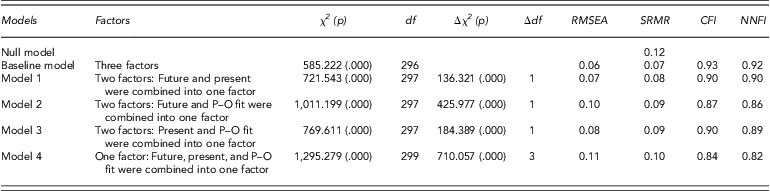
Table 1 shows the results of the confirmatory measurement models (Anderson & Gerbing, 1988). The baseline three-factor model fit the data well (χ2 = 585.222, df = 80, p < .01; RMSEA = 0.06, SRMR = 0.07, CFI = 0.93, NNFI = 0.92). Four nested models were tested against the baseline model. They included model 1, combining future orientation and present orientation into a single factor; model 2, combining future orientation and P–O fit into a single factor; model 3, combining present orientation and P–O fit into a single factor; and model 4, combining future orientation, present orientation, and P–O fit into a single factor. As indicated in Table 1, the χ2 values of model 1 (Δχ2 = 136.321, Δdf = 1, p < .05); model 2 (Δχ2 = 425.977, Δdf = 1, p < .05); model 3 (Δχ2 = 184.389, Δdf = 1, p < .05); and model 4 (Δχ2 = 710.057, Δdf = 3, p < .05) are obviously greater than the baseline model. The fit indexes are also not as good as the baseline model. It appears to show acceptable distinctiveness among the constructs.
Nested models of CFA results

Note. CFA = confirmatory factor analysis; P–O fit = person–organization fit.
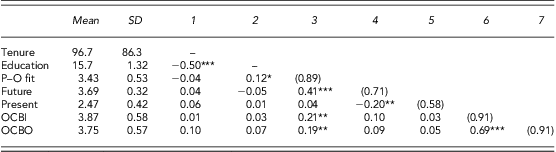
Table 2 presents the means, standard deviations, and correlations of all the studied variables. P–O fit is significantly correlated with OCBI (γ = 0.21, p < .01), OCBO (γ = 0.19, p < .01), and future-orientation time perspective (γ = 0.41, p < .001). There is a negative relationship (γ = –0.20, p < .01) between future and present time perspective measures. Furthermore, the relationship between OCBI and OCBO was highly correlated (γ = 0.69, p < .001).
Descriptive statistics and correlationFootnote a,Footnote b
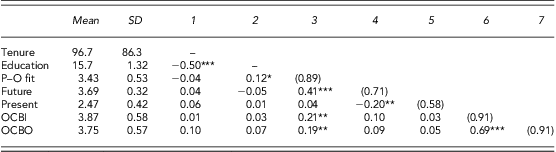
Note. a N = 262; reliability coefficients for the scales are in parentheses along the diagonal.
b Categorical variables coded as the measure of tenure was collected by months; education was collected by the years of formal education (kindergarten was excluded).
OCB = organizational citizenship behavior; P–O fit = person–organization fit.
*p < .05; **p < .01; ***p < .001.
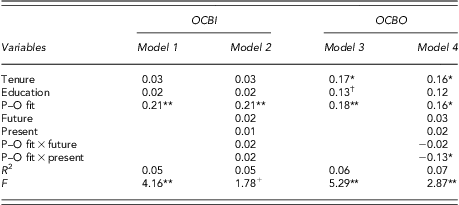
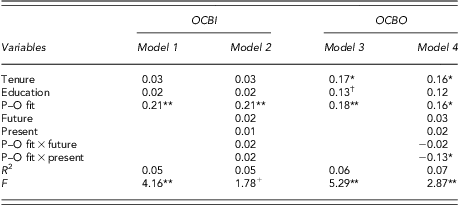
Table 3 includes the results of hierarchical regressions. In this study, Hypotheses 1a and 1b posit that P–O fit leads to not only more citizenship behaviors toward interpersonal relationships but also toward organizations. As shown in models 1 and 3 of Table 3, P–O fit is positively related to OCBI and OCBO. More specifically, financial specialists with a higher P–O fit have greater intentions to engage in OCBI (β = 0.21, p < .01) and OCBO (β = 0.18, p < .01). Thus, Hypotheses 1a and 1b are supported.
Results of multiple regressions
Note. The coefficients are standardized.
OCB = organizational citizenship behavior; P–O fit = person–organization fit.
†p < .10; *p < .05; **p < .01.
To test Hypotheses 2a and 2b, I added two types of time perspective and the interaction of time perspective and P–O fit into the regression. As expected, P–O fit still appears to predict OCBI and OCBO at the 99% and 95% confidence level, respectively. In addition, present-orientation time perspective moderates the relationship between P–O fit and OCBO (model 4: β = −0.13, p < .05). As shown in Figure 1, the positive relationship between P–O fit and OCBO is weaker for financial specialists who have a higher present-orientation time perspective than those who have a lower present-orientation time perspective. The possible explanation of insignificant interaction of future orientation and P–O fit is highly correlated between future and present-orientation time perspective (γ = −0.20, p < .01). Nevertheless, the moderating effects of future and present-orientation time perspective on the relationship between P–O fit and OCBI cannot be found in the current study. Thus, the results partially support Hypothesis 2b, but not Hypothesis 2a.
Moderating effect of present orientation
DISCUSSION AND CONCLUSIONS
The results of this study supported the concept that employees are more likely to be motivated to engage in both OCBI and OCBO if they feel they have a greater match with their organizations. In addition, present-orientation time perspective has a moderating effect on the relationships I proposed above, meaning that present orientation can shape high P–O fit employees’ behaviors and discourage individuals from engaging in activities beneficial to the organization.
Interestingly, this study provides evidence that present-orientation time perspective will moderate the relationship between P–O fit and OCBO, but not between P–O fit and OCBI. It suggests that the moderating effect of time perspective cannot cause the same influence for OCBI and OCBO. A possible explanation is that it is easier for present time perspective to weaken the positive effect of P–O fit than for future time perspective to do so, because it is more difficult to obtain actual rewards from OCB toward an organization than toward interpersonal relationships. Engaging in OCBI may obtain co-workers’ response in the next workday or assignment. From the present time perspective for people with great P–O fit, OCBI is a more valuable investment. Thus, the relationship of P–O fit and OCBI is less likely to be broken by present time perspective. Moreover, the potential reward of OCBO is embedded in organizations and their system, not in individuals. Therefore, employees who are uncertain about staying in an organization for a long time naturally reduce OCBO engagement after considering reward portability. In contrast, the relationship of P–O fit and OCBI is not easily mitigated because the potential reward produced from OCBI may be carried forward to the next organization and worked out elsewhere. Therefore, based on self-interest, the present time perspective is not necessary to significantly weaken the effect of P–O fit on OCBI.
Theoretical implications
This is one of the first empirical studies examining the motivators of OCB from a time perspective. In this study, I propose that the time perspective is a moderating role changing the relationship between P–O fit and OCB. The logic of this argument is that how individuals view their time may influence how they allot their time for their jobs and helping others, even though they may greatly fit with their organizations. As anticipated, time perspective was determined to shape the positive effect of P–O fit on OCB toward the organization, meaning that higher the present-orientation time perspective, lesser the positive relationship between P–O fit and OCBO will be. In other words, for employees with a high present time perspective, this point of view will impair the benefits that can be delivered from P–O fit. People who focus on short-term interests may ignore links of affection with their high-match organizations, and may decrease the engagement of OCB toward the organization.
This study also found that factors that affect the relationship of P–O fit and OCBO may not have the same impact on the relationship of P–O fit and OCBI. These two types of OCB are both welcomed and worthy for organizations, but they serve different purposes for individuals in organizations. Thus, the situational factors that can prompt employees to engage in OCBO differ from those that encourage OCBI. This confirms that OCB has multiple dimensions and encourages future researchers working on related studies.
Most previous studies focus on affection or attitude factors for predicting OCB. They conclude that individuals would involve themselves in citizenship behaviors on the basis of the reciprocal principle, so long as they like the environment they work in. The results of this study further prove that one should not anticipate the same OCB outcome from P–O fit in all situations. Thus, this study provides another viewpoint for understanding why employees engage in OCB. Furthermore, this study echoes the research suggestion of prior works (Joireman et al., Reference Joireman, Kamdar, Daniels and Duell2006; DeVoe & Pfeffer, Reference DeVoe and Pfeffer2007; Weeks & Fournier, Reference Weeks and Fournier2010).
Finally, the research results provide evidence allowing for further understanding the antecedents of OCB. The predictor of OCB in this study, P–O fit, is listed outside of the four categories of OCB antecedents – individual characteristics, task characteristics, organization characteristics, and leadership behaviors – which were comprehensively reviewed by Podsakoff et al. (Reference Podsakoff, MacKenzie, Paine and Bachrach2000). Hence, the findings of this research echo Podsakoff et al. (Reference Podsakoff, MacKenzie, Paine and Bachrach2000) call for future research to put more effort into identifying factors that further explain the reasons why employees engage in OCB. The findings of this study can offer direction for future research and model construction for understanding OCB.
Managerial implications
The results of this study offer two important practical implications. First, employers should avoid selecting and hiring employees with higher present-orientation time perspective, because they may focus on short-term interests that are linked to their own personal interests. They may also overlook the interests of their organization and even cause damage. Moreover, according to the findings of this study, present time perspective will reduce the benefit of P–O fit. Thus, setting up a time perspective test in the selection stage may be a considerable selection strategy for organizations to avoid hiring high-level present-orientation people.
Second, if an employer needs diverse employees with different time perspectives for task- and contextual-performance balance in the organization, then they should make use of proven human resource management practices and organizational mechanisms for improving the P–O fit of their employees. Overall, OCB is widely considered to be both critical and beneficial to organizations. Thus, academic efforts that explore how to encourage and motivate employees to more fully participate in OCB may provide substantial implications for management practitioners.
Limitations and suggestions
The main limitation of this study relates to the collection of all data at the same period. To prevent common method bias, I invited supervisors to assess the dependent variable and employees completed the measure of the remaining constructs. However, the data were cross-sectional leads to limit causality. Thus, future research should be performed using longitudinal data to replicate these findings.
Second, the reliability of present-orientation time perspective is on the low side. Despite the fact that the time perspective scale was adopted from an established inventory, this may have an impact on the analytic results. In view of its disputable reliability in this study and prior work, future researchers who are interested in time perspective should first focus on the reconstruction of this construct measurement.
Finally, collecting data from a single industry and a specific job potentially limits the generalizability of the findings to other industries and jobs, even though this design can control for industrial and job variation of the hypothesized relationship. To enhance external validity, obtaining data from different industries or jobs is encouraged for future research.
To summarize, contrary to most research testing the direct effects of attitude variables on OCB, findings from this study signal that a remarkable view of these relationships may be required. Specifically, time perspective enriches the understanding of OCB engagement. The results of this study contribute to the academic literature on P–O fit, OCB, and moderators of this relationship and provide insight for organizations regarding the conditions under which employees are likely to engage in OCB. Our results suggest that researchers who wish to conduct further OCB research should consider involving time perspective, and that more research is needed on the moderating role of situational variables, given their implications for OCB.
Acknowledgements
The author is grateful for the sponsorship by the Social Science Research Center, National Science Council in Taiwan. The author would also like to thank the participants at the 2nd Bangkok International Forum on Indigenous Management Practices in 2011 for their suggestions on an earlier version of this article.