Edward MacDowell's eight years in Boston (1888–96) are often considered the happiest, most productive period of his career.Footnote 1 He was certainly poised for success in the autumn of 1888, when he and Marian Nevins, his bride of four years, settled in Boston's Beacon Hill neighborhood rather than his native New York City. Educated from the time he was a teenager at conservatories in Paris, Stuttgart, Wiesbaden, and Frankfurt, he claimed three mentors: Carl Heymann, a brilliant if idiosyncratic piano pedagogue; Joachim Raff, an internationally renowned composition teacher; and Franz Liszt, who had heard MacDowell perform several times during the early 1880s and had arranged for MacDowell to present his Erste moderne Suite, op. 10 at a meeting of the Allgemeiner Deutscher Musikverein in Zurich on 11 July 1882. But despite promising successes in equally prestigious venues, MacDowell decided to return to the United States after having spent twelve years abroad, motivated on the one hand by his perennially unstable finances and the loss of his three mentors between 1880 and 1886, and on the other by assurances from multiple American acquaintances that opportunities and obligations awaited him in promoting the development of the arts on the other side of the Atlantic.Footnote 2
After an initial period of adjustment, MacDowell duplicated most of his European achievements in Boston. His earlier piano works, already championed by his former teacher Teresa Carreño during her tours of Europe and the Americas and presented by other artists of international repute in Boston and New York, continued to draw accolades from prominent critics.Footnote 3 His own performances as a recitalist, chamber player, and soloist in his piano concertos likewise met with enthusiastic reception. He supplemented a burgeoning studio of well-to-do piano students with orchestration and composition pupils. And American and foreign publishers vied for the rights to his scores, both old and new. These multifaceted activities culminated in 1896 with an invitation to accept a professorship and establish a music department at Columbia University, whose regents echoed critical consent in dubbing him “the greatest musical genius America has produced.”Footnote 4
Two important aspects of MacDowell's compositional orientation nonetheless changed after he returned to the United States. First, during his European years, much of his work in large-scale genres had focused on symphonic poems, all but one of which he revised after several German spa-town orchestras (especially one in Wiesbaden) had rehearsed them.Footnote 5 Their successful performances elsewhere in Germany had enhanced MacDowell's growing European notoriety, but when Kurhaus rehearsals became unavailable to him in the United States he essentially stopped writing for orchestra. He later explained his reluctance to compose orchestral music to his Bostonian student and close friend, T. P. Currier: “It's one thing to write works for orchestra, and another to get them performed. There isn't much satisfaction in having a thing played once in two or three years. If I write large works for the piano I can play them myself as often as I like.”Footnote 6 Second, as MacDowell's reference to “large works for the piano” indicates, he shifted his attention from the small-scale piano genres he had almost exclusively cultivated in Europe to virtuosic etudes that exploited his technical prowess as an increasingly active recitalist and to grand sonatas that fulfilled his large-scale compositional ambitions.Footnote 7
In both cases MacDowell was, at least to outward appearance, abandoning strongly programmatic genres. His symphonic poems—Hamlet, Ophelia, Lancelot and Elaine, The Saracens, The Lovely Aldâ, and Lamia—exhibit forms that are fundamentally shaped by their respective narratives, unfold episodically, and often graphically represent specific narrative events.Footnote 8 Many of MacDowell's European piano works likewise cultivate narrative strategies, tracing an increasingly programmatic arc over the course of his sojourn abroad from abstract suites, preludes, and fugues, through evocative Schumannesque miniatures, to wordless settings of some of the composer's favorite poems.Footnote 9 And in fact, as closer study of MacDowell's complete piano music ultimately reveals, his Bostonian etudes and sonatas perpetuate his strong programmatic inclinations, despite the more abstract nature of their genres.
Indeed, to an extent much greater than previously suspected, at least one of the sonatas utilizes the closely narrative, characteristically episodic, and explicitly representational tactics of MacDowell's symphonic poems. This assertion is supported by evidence in the Library of Congress's holographs of the Sonata No. 2 in G Minor, op. 50, the Sonata Eroica, composed in Boston beginning in 1893 and published in 1895. Evaluating this evidence involves three tasks: first, assessing MacDowell's own program for the Eroica and its influence on later commentators; second, reexamining his stance on programmaticism in general and graphic musical pictorialism in particular; and third, demonstrating that the Eroica's autograph offers programmatic insights that differ completely from prevailing views, and yet remain entirely compatible with MacDowell's professed aesthetics. Most importantly, this tripartite investigation demonstrates that the Eroica relies heavily on conventional musical mimesis and familiar musical topics—a reliance evinced throughout much of MacDowell's earlier and later piano music, notwithstanding protests to the contrary lodged by the composer, his contemporaries, and his later critics.
MacDowell's Fourfold Program for the Eroica
MacDowell imparted the following synopsis of the Eroica's program to Lawrence Gilman, who published it in the composer's first full-length biography in 1906:
While not exactly programme music, I had in mind the Arthurian legend when writing the work. The first movement typifies the coming of Arthur. The scherzo was suggested by a picture of Doré showing a knight in the woods surrounded by elves. The third movement was suggested by my idea of Guinevere. That following represents the passing of Arthur.Footnote 10
The composer's remarks, though somewhat more detailed than the evocative titles or literary epigraphs commonly encountered in his earlier European piano scores, still raise two thorny issues: first, a cautious stance toward program music in general; and second, an avoidance of naming a specific literary source for the Eroica's program in particular.
MacDowell's guarded phrase, “while not exactly programme music,” plainly seeks to distance the Eroica from the “graphic” or “realistic” type of “tone painting” that some prominent American critics censured on general principle, and some of MacDowell's advocates and adversaries castigated specifically in works by Wagner, Strauss, and Debussy.Footnote 11 Although MacDowell had embraced such literalism in his early symphonic poems, he sometimes expressed aversion toward it during his Boston years. After MacDowell gave a recital in Chicago in February 1896, for example, the critic W. S. B. Mathews claimed, “The motive of Mr. MacDowell's music seems to be poetic rather than primarily musical. Hence it is necessary to have a sort of program in hand before one knows exactly where he is ‘at.’ A mere title does not seem to be enough.”Footnote 12 MacDowell felt strongly enough about this verdict to counter it in an interview with the critic's son, John Lathrop Mathews, exhorting the prospective listener not to “imagine something according to [a] title,” but rather to enjoy “the composition musically” by “interpreting it in his own way, in terms of his own experience.”Footnote 13 Thus MacDowell espoused a balance between purely musical and liberally individual interpretations, a balance that later commentators have uneasily maintained.
Two early critics of lasting influence, Gilman and William H. Humiston, respectively declared that the composer “occupied a middle ground” or “position half way between” absolute and program music.Footnote 14 They also arrived at similar conclusions regarding explicit musical pictorialism: Gilman determined that MacDowell “avoided shackling his music to a detailed program,” arguing that the piano limited programmatic representation; Humiston essentially agreed, stating that MacDowell “seldom indulged” in “realistic tone painting” and “never intended his poetic titles to be taken with absolute literalness.” Their opinions have been recently espoused by Dolores Pesce: “Most of MacDowell's titles denote a source, a setting, an atmosphere. His music, however, rarely attempts to ‘represent’ the ostensible subject.”Footnote 15
Such views, though prevalent, admit exception. Rupert Hughes attributed MacDowell's proclivity for “poetic and fantastic and programmatic elements” to the influence of Raff, a prolific program symphonist.Footnote 16 John Porte discerned “some definitely suggested content” in all of MacDowell's “moods.”Footnote 17 Pesce has likewise conceded that MacDowell's works “can be understood only if one takes into consideration the programmatic element, however elusive it may be”—apparently qualifying her assessment of MacDowell's rare “attempts” at representation.Footnote 18
Qualifications have also tempered opinions of MacDowell's sonatas. Henry T. Finck, characterizing them as “a sort of compromise between absolute and program music,” embraced the “middle-ground” view Gilman and Humiston held toward MacDowell's programmaticism in general.Footnote 19 Gilman inserted a proviso, declaring that the “four sonatas belong undeniably, though with variously strict allegiance, to the domain of programme music.”Footnote 20 John Tasker Howard likewise ambivalently remarked that the Eroica was “admittedly program music,” but it was “less an actual depiction of the subject than a commentary.”Footnote 21
Other authorities, however, have scarcely equivocated. Eschewing programmatic interpretation, Paul Rosenfeld, A. E. Keeton, and William S. Newman, respectively, claimed that the sonatas were “more abstractly treated” than MacDowell's “confessedly poetic” character pieces, that they “revealed MacDowell's beautifully perfected, strictly musical side,” and that they were “fueled by considerations primarily musical.”Footnote 22 With comparable circumspection, E. Douglas Bomberger recently adopted Pesce's outlook on MacDowell's oeuvre: “Each of [the sonatas] has a descriptive title, but . . . any programmatic connotations are evocative rather than explicitly descriptive.”Footnote 23
Nevertheless, several endorsements of a programmatic element are equally vigorous. Gilbert Chase considered the sonatas “the most characteristic expression of [MacDowell’s] late Romantic aesthetics, including programmatic content.”Footnote 24 Charles Horton, opposing Gilman's assertion regarding the piano's representational limitations, maintained that the sonatas captured “the intensity and breadth of tone painting . . . and programmatic span of the tone poem.”Footnote 25 William Loring concurred, finding the Eroica “far richer in fuller tone pictures” than MacDowell's symphonic poem Lancelot and Elaine.Footnote 26 Bomberger, despite his cautious attitude toward descriptive titles, deemed the Eroica “the most overtly programmatic of MacDowell's abstract works,” but still privileged its “masterly manipulation of musical materials.”Footnote 27
Thus, although commentators have proffered modestly varied opinions when assessing programmaticism in MacDowell's works in general and in his sonatas in particular, they have remained largely disinclined toward programmatic interpretations. Even if they concede the sonatas are programmatic, they typically limit or qualify such evaluations. Their reticence plainly correlates with MacDowell's strained protest that the Eroica is “not exactly programme music,” but instead comprises little more than four character sketches—the coming of Arthur, a knight's encounter with elves, an idea of Guinevere, and the passing of Arthur. MacDowell's broad, fourfold synopsis has consequently proliferated in leading studies of his works,Footnote 28 usually without or sometimes with merely perfunctory acknowledgement that he derived three of his four descriptive phrases directly from a single literary work, Alfred Lord Tennyson's Idylls of the King. The first Idyll's title, translated into Latin, became the published sonata's only epigraph (“Flos regum Arthurus”). The eleventh Idyll offered MacDowell a detailed narration of the knight's interaction with elves. And the composer concluded his synopsis with “the passing of Arthur,” a verbatim quotation of the twelfth Idyll's title. The lone remaining phrase, MacDowell's “idea of Guinevere,” is shorter in Tennyson, whose eleventh Idyll simply bears the queen's name.
MacDowell's widely accepted synopsis is most thoroughly developed by Pesce, who probes connections between several of the Eroica's disruptive formal processes and events in or broad aspects of Tennyson's poems. She thus amplifies earlier, cursory remarks by Finck, Gilman, and MacDowell's German eulogist Paul Frey, who respectively noted that programmaticism “influenced,” “altered,” and “abrogated” substance and form in the sonatas.Footnote 29 Even so, Pesce analyzes individual movements as multi-dimensional character portraits, and she cautiously concludes that the composer “continued to be drawn toward a kind of writing with at least some representational component.”Footnote 30 A sharper and notably more sinister perspective, however, emerges by reviewing MacDowell's published lectures on program music, evaluating new evidence in the Eroica's manuscript sources, and integrating the resultant findings with close readings of Tennyson's Idylls.
MacDowell's Stance on Programmaticism and Imitation
In posthumously published lectures originally delivered at Columbia University, MacDowell subscribed to views common among middle and late nineteenth-century European composers of program music.Footnote 31 Like Liszt and Wagner, who respectively considered the symphonic poem and music drama pinnacles of music's historical evolution,Footnote 32 MacDowell deemed program music the culmination of compositional impulses emanating from the seventeenth century. As examples of keyboard pieces that marked “the beginnings of that higher order of programme music which deals directly with the emotions,” MacDowell cited Kuhnau's Biblical Sonatas, J. S. Bach's Capriccio on the Departure of His Most Beloved Brother, and works by Froberger, Couperin, Rameau, and C. P. E. Bach.Footnote 33 “Little by little,” MacDowell declared, “composers became more ambitious and began to attempt to give expression to the emotions by means of music; and at last, with Beethoven, ‘programme music’ . . . reached its climax.”Footnote 34 The goal of an “ambitious,” Beethovenesque type of programmaticism rooted in emotional expression, he argued, was to induce “the hearer to go beyond the actual sounds heard, in pursuance of a train of thought primarily suggested in this music.”Footnote 35 And as MacDowell avowed, “To my mind, it is in the power of suggestion that the vital spark of music lies.”Footnote 36 Thus he granted program music's suggestive power preeminence in his aesthetics, joining Liszt, Raff, and other New Germans in their efforts to infuse program music with greater substance than its earliest manifestations had supposedly evinced, to raise it from a low, descriptive genre into an elevated, affective-poetic venture.Footnote 37
Nevertheless, music had imitative or representational capacities, as MacDowell illustrated with strikingly material examples of musical mimesis. “As we know,” he presumed, “music is a language which may delineate actual occurrences by means of onomatopoetic sounds. By the use of more or less suggestive sounds, music may bring before our minds a quasi-visual image of things which we more or less definitely feel.”Footnote 38 Evoking visual impressions for MacDowell were passages in Beethoven's “Pastoral” Symphony, Tchaikovsky's “Pathétique” Symphony, Raff's Symphony No. 3 (“Im Walde”), and Goldmark's Overture to Sakuntala: “This music suggests, . . . and there is a certain potency in its suggestion which makes us see things.”Footnote 39 Conversely, the visual symbol for water in Egyptian hieroglyphics, parallel wavy lines, had a concrete audible counterpart, although three examples MacDowell presented required the contextualization of operatic settings or attached titles: the oscillating “figure in Wagner's ‘Waldweben’ means in that instance waves of air”; and “the swaying figure of the ‘Prelude to Rheingold’ is as plainly water as is the same figure used by Mendelssohn in his ‘Lovely Melusina.’” Further, MacDowell asserted, Wagner and Mendelssohn “recognized the definiteness of musical suggestion,” because both adopted “the same figure to indicate the same things.”Footnote 40 Multiple composers also exploited similar methods of representing physical movements: repetitive, arpeggiated accompaniment patterns evoked a turning wheel in spinning songs by Mendelssohn, Schumann, Wagner, and Liszt (Schubert is curiously overlooked); and music's ability to suggest “stately, deliberate, hasty, or furious” motion was “very obvious.”Footnote 41
Equally unquestionable, MacDowell maintained, was music's aptitude for imitating “any rhythmic sounds or melodic figure occurring in nature,” as he illustrated with representations of birdsongs, thunderstorms, and galloping horses.Footnote 42 Such effects, however, comprised “the most primitive form of suggestion in music” because they evoked either no specific emotional response (birdsongs) or an excessively wide range of reactions depending on the auditors’ personalities and prior experience (thunderstorms). More meaningful for MacDowell were various types of imitation that elicited closely circumscribed psychological associations. An increase in a sound's intensity, for example, intimated “vehemence, approach, . . . and growth,” whereas a decrease implied “withdrawal, dwindling, or placidity.”Footnote 43 Pitch, deemed “one of the strongest” means of musical suggestion, created “a well-defined suggestion of light” when high, an “impression of ever increasing obscurity” when lowered.Footnote 44 Similarly, a phrase's upward or downward tendencies could respectively imply exaltation or depression, the intensity of which depended on the intervals used.Footnote 45 Harmony, a “potent factor in suggestion,” could impart, among numerous effects, a “sense of confusion or mystery” if a chord foreign to the prevailing key were introduced.Footnote 46 But regardless of any qualitative distinctions that MacDowell espoused, he willingly “made use of all the suggestion of tone-painting in [his] power,” as he admitted in a letter to his Detroit advocate, Newton J. Corey, notably concerning one of his supposedly abstract sonatas, the Keltic, completed in 1901.Footnote 47
MacDowell and Liszt—in addition to positing that program music achieved a position of supremacy over the course of history and endorsing or exploiting a vocabulary of “suggestive” musical gestures in their compositions—shared a perspective on the function of a written program. Liszt (and ostensibly his co-author, Princess Carolyne von Sayn-Wittgenstein) believed that a program could bridge a gulf between artistic genius and public understanding by allowing for “the possibility of the precise definition of the psychological moment that prompts the composer to create his work and the thought to which he gives outward form.”Footnote 48 Similarly, but erroneously, MacDowell maintained that Beethoven “wrote every one of his sonatas with definite subjects, and, at one time, was on the point of publishing mottoes to them, in order to give the public a hint of what was in his mind when he wrote them.”Footnote 49 Such hints appear in numerous MacDowell scores, usually taking the form of mottoes or complete poems (some of them his own), but rarely consisting of the philosophical prose programs that Liszt attached to some keyboard works and several of his earliest symphonic poems. In other cases, both composers sought to convey programmatic associations merely with titles. Both men, but especially MacDowell, became reticent about the hints that the titles provided only when such clues were misinterpreted by publishers, performers, audiences, and critics.Footnote 50
MacDowell's practices in using titles and poems are illustrated by two vividly programmatic works that his repeated readings of Tennyson's poetry inspired long before he delivered his Columbia lectures.Footnote 51 Based on Tennyson's seventh Idyll, the symphonic poem Lancelot and Elaine, op. 25 (1886) bears only a title, but as Pesce has demonstrated, its structural breaks and overtly representational music can be easily matched to the poem's changes of literary mood and specific narrative events: fanfares herald the beginning of a jousting tournament; the development section depicts knightly combat; and, as Pesce puts it, a “raucous shrieking by the upper strings” equates with the tournament's prize, a cache of diamonds, being hurled out a window into a stream below.Footnote 52The Eagle, the first of the solo piano pieces published as Four Little Poems, op. 32 (1888), likewise mirrors events in Tennyson's poem of the same name. In this case, the entire poem appears on the score's first page, conspicuously suggesting correlations between the music and literary descriptions or narrative events: high, eerily spaced chords evoke the atmosphere of the bird's windswept domain; high-pitched chromatic fragments and a deep, slower moving bass line portray the bird's flight above rocky mountaintops; a dramatic eruption corresponds to the eagle's sudden outcry; and an ensuing cascade of descending scales imitates the bird's plummet from the sky.Footnote 53 Like these two works, the Sonata Eroica illustrates MacDowell's affinity for vibrant Tennysonian representations, but manuscript evidence provides a new “hint” regarding the thoughts that inspired it.
A New Inscription and a New Program for the First Movement
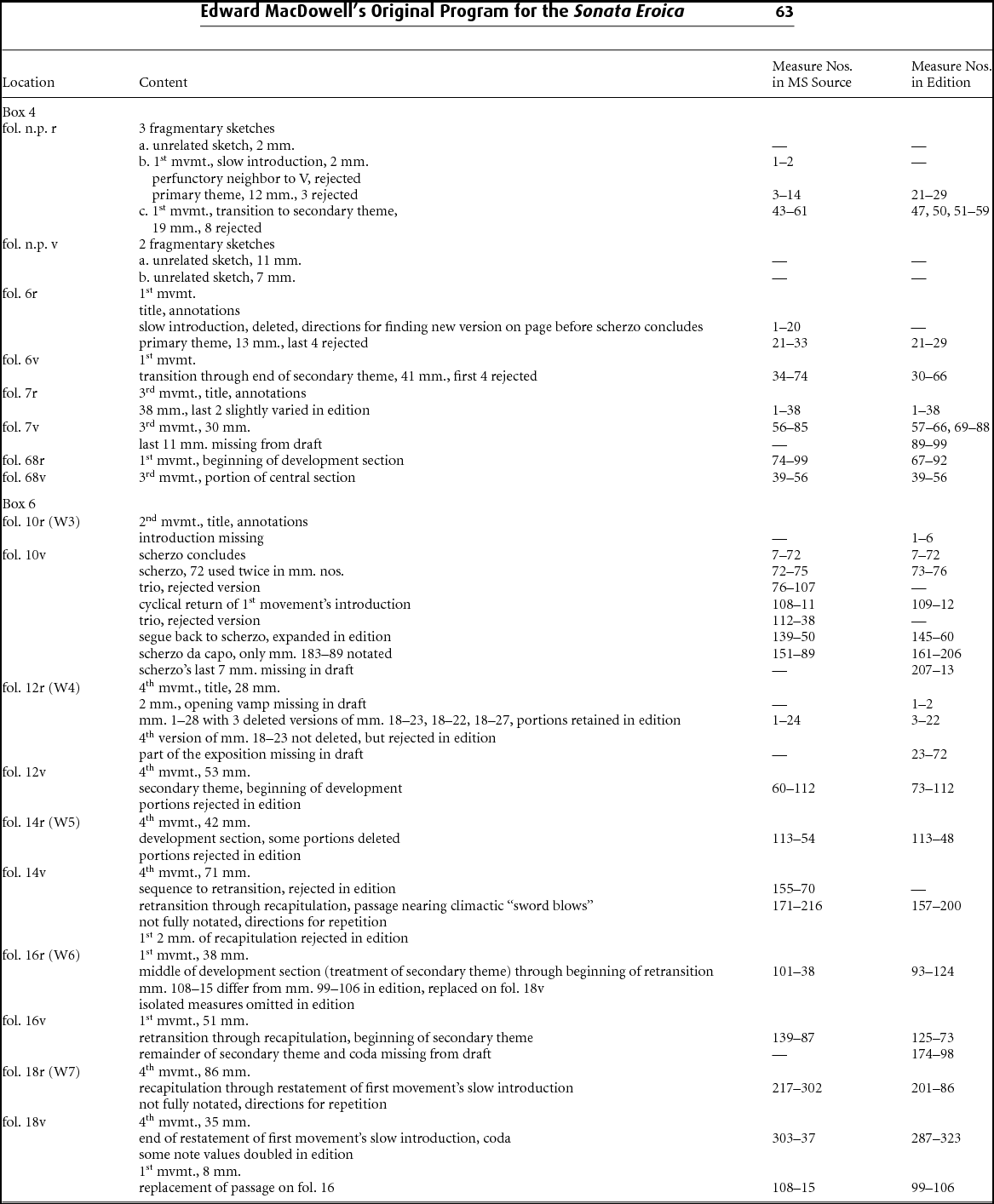
The Sonata Eroica's manuscript sources are preserved in two of the many boxes of compositional materials held in the Edward and Marian MacDowell Collection at the Music Division, Library of Congress, in Washington, D.C. (see Appendix 1). They essentially comprise a continuity draft, albeit one that contains many deleted passages and their revisions. MacDowell's autograph measure numbers appear throughout all four movements, revealing that five short excerpts and one longer passage remain missing.Footnote 54 The draft nevertheless accounts for 732 of the published score's 833 measures, a tally permitting close evaluation of several revisions and their programmatic implications. MacDowell likely undertook these revisions in a fair copy that is apparently no longer extant, as is indicated in a letter he sent to Breitkopf & Härtel on 7 September 1895.Footnote 55
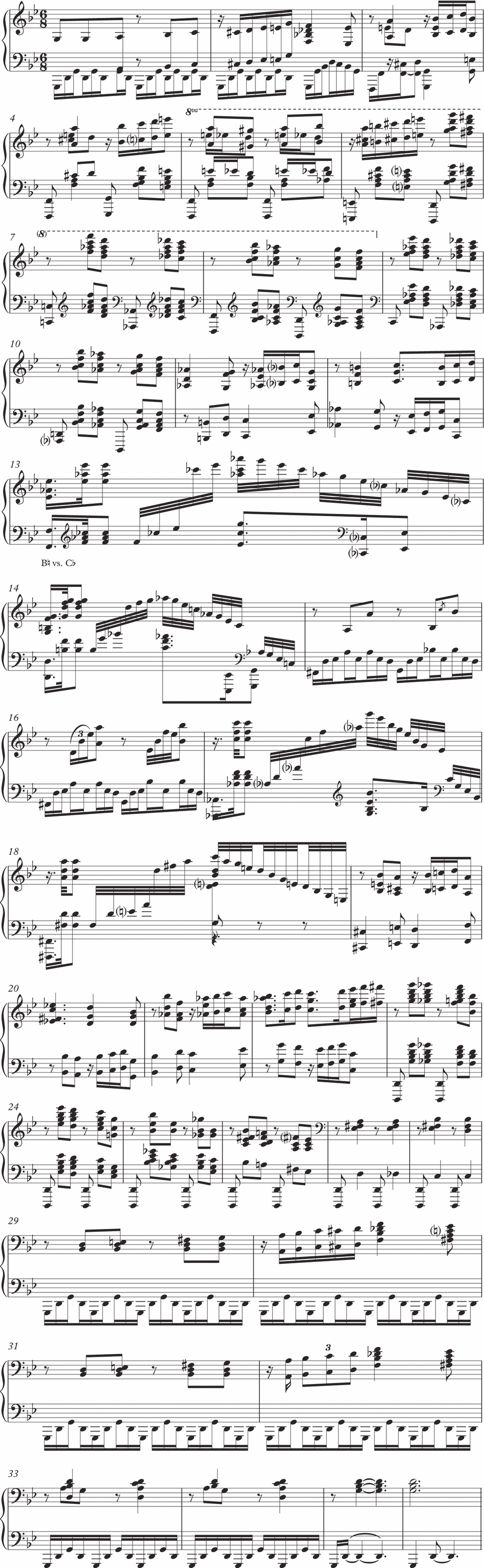
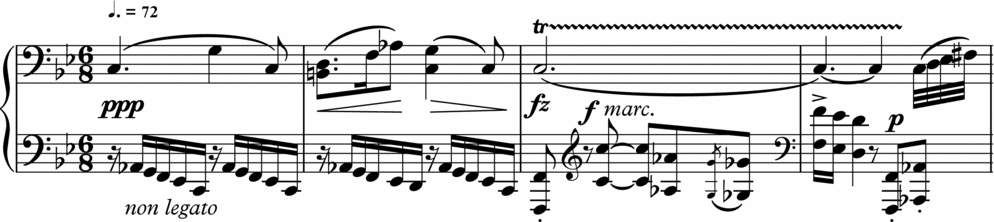
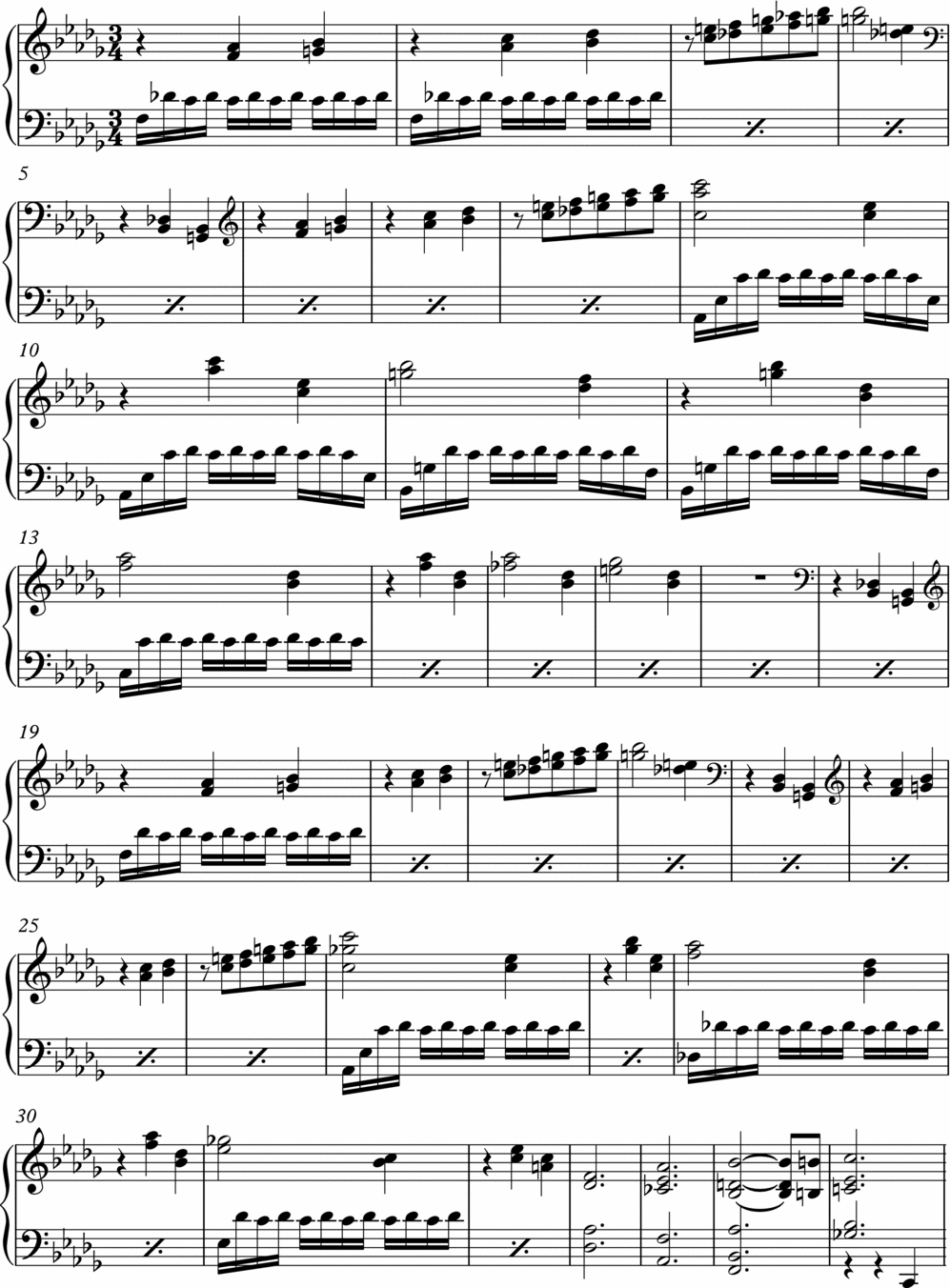
Two partially deleted inscriptions in the upper margin of the continuity draft's first page are especially illuminating (see Figure 1). The first, “Opening to Ballade, Op. 51,” is generic in nature, but nonetheless fosters a programmatic interpretation. It indicates that MacDowell originally conceived the opening movement not as part of an abstract, four-movement sonata, but rather as a large-scale character piece whose type is endowed with long-recognized narrative affinities.Footnote 56 Thus, as an independent ballade, the movement would be intrinsically prone toward programmaticism.
Edward MacDowell, Sonata Eroica, First Movement, mm. 1–32
Continuity Draft with Ballade as Original Title and Epigraph from Merlin and Vivien
Edward and Marian MacDowell Collection, Papers of Edward MacDowell, Music: Holographs, Manuscripts of Edward MacDowell, Box 4, Folder 20, Music Division, Library of Congress, Washington, D.C.

The second inscription offers insights of a more specific nature. Although MacDowell's fourfold synopsis and the edition's Latin epigraph both refer to the title of Tennyson's first Idyll, The Coming of Arthur, the draft divulges that another poetic source provided the initial impetus for composing the first movement. In the center of the top margin MacDowell wrote and identified the first five lines of Merlin and Vivien, Tennyson's sixth Idyll:
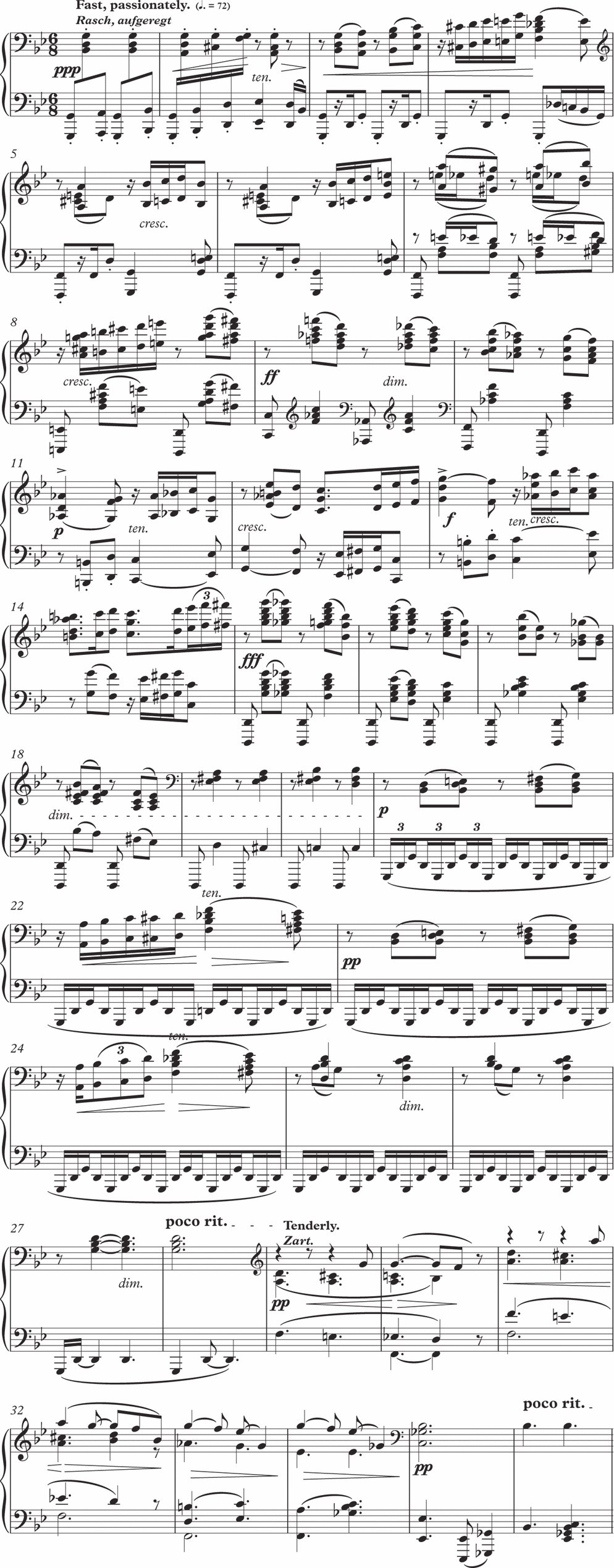
The first movement's principal theme sonorously embodies these five lines by observing the conventions of a standard nineteenth-century topic: storm music (see Example 1a). Established in numerous eighteenth-century operas and characteristic symphonies and often tailored to suit nineteenth-century pianos,Footnote 58 storm music typically entails the minor mode, ominous diminished seventh chords, the rise and fall of sinuously chromatic lines or arpeggios that imitate tempestuous winds or waves, low tremolos portending distant thunder, and long ascents toward climaxes followed by abrupt collapses—a trajectory representing a storm's approach and eventual outbreak. All of these traits are readily apparent in the principal theme, but they are even more pronounced in the draft, where the rumbling, tremulous accompaniment explicitly signifies thunder, than in the published score, where a dactylic, arpeggiated motive replaces all but the last six measures of tremolos (compare Examples 1a and 1b, noting mm. 1–3, 15–16, and 29–34 in 1a, and mm. 21–26 in 1b).Footnote 59 The draft's cascading arpeggios (mm. 13–14, 17–18) also fortify the storm topic, but were again omitted in the edition. MacDowell accordingly cultivated “the most primitive form of suggestion in music,” to recall his own words, but he doubtless resorted to such “tone painting” in order to deal “directly with the emotions” and encourage listeners “to go beyond the actual sounds heard, in pursuance of a train of thought,” one suggested by the sixth Idyll's actions.
MacDowell, Sonata Eroica, First Movement, mm. 19–54 (here numbered 1–36 to facilitate comparison with Figure 1 and Example 1b). Principal Theme, Transcribed from the Continuity Draft.
MacDowell, Sonata Eroica, First Movement, mm. 19–54 (here numbered 1–36 to facilitate comparison with Example 1a). Principal Theme, Breitkopf & Härtel, Plate 21004 (1895).
Merlin and Vivien, like many romantic literary works, invokes the storm as a clichéd symbol for sexual activity or psychosexual turmoil. As the poem's overtly erotic fifth line discloses, Vivien lies at Merlin's feet, poised to conclude the aged wizard's seduction. A retrospective narration then begins in line 6 and consumes most of the sixth Idyll.Footnote 60 Vivien had once enjoyed favor at the Cornish court, where King Mark scorned the Round Table's chaste, chivalric form of love because his queen, Isolt, and his most trusted knight, Tristram, had betrayed him through adultery.Footnote 61 Thus identified as infidelity's personification, Vivien had infiltrated Camelot to avenge her father's death in battle against Arthur's army. Vainly she had flirted with Arthur before setting her sights on Merlin, who had formerly sheltered his king from widespread awareness of Guinevere's adultery with Lancelot. After pursuing Merlin to Broceliande, she had conducted his protracted seduction, consecutively resorting to sarcasm, doleful pleas, bitter accusations, guilt, sexual arousal, anger, and tears to extract the secret of a charm that would give her power over him. Vivien's final gambit, forcing Merlin to acknowledge Guinevere's and Lancelot's unfaithfulness, elicits a return to the poem's initial setting: Merlin joins her in seeking refuge from the storm inside the hollow oak, reveals the charm's secret, succumbs to its power as the storm expires in a “burst of passion,” and falls into a lifeless sleep, leaving Arthur's court without its mystical protector. The storm consequently marks a pivotal juncture in Tennyson's Idylls as a whole, for soon Arthur will learn of Guinevere's deception, Lancelot's treachery, the Round Table's resulting division, and Camelot's inevitable ruin. (As we shall see, these facets of Tennyson's narrative comprise the programmatic subjects of later movements.)
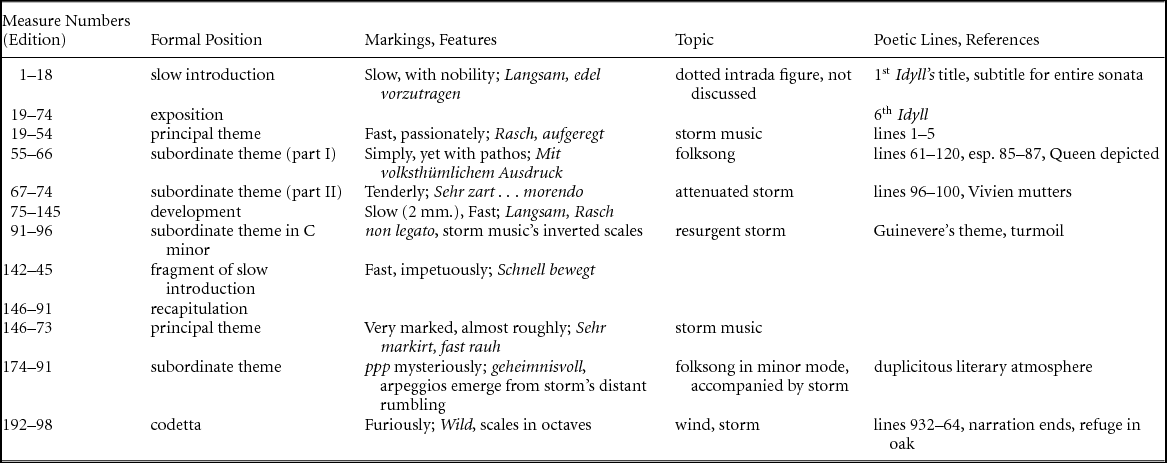
Although the draft's five-line inscription proves Merlin and Vivien originally inspired the first movement's composition, MacDowell's pianistic storm is no mere indulgence in tone painting. It instead exemplifies the “ambitious” type of program music that expresses particular emotions, in this case, the poem's psychosexual agitation, as the principal theme's German expressive marking stipulates (rasch, aufgeregt; fast, agitated). The close literary-musical correspondence and its attendant emotional expression are noteworthy for two reasons. First, they offer an ingress for exploring “a train of thought primarily suggested in this music,” one guided by additional resonances between the sixth Idyll and the first movement's salient features. Second, MacDowell achieved them by exploiting a nineteenth-century topic's conventional mimetic gestures, a strategy he would employ throughout the sonata. Table 1 correlates the first movement's formal junctures, other salient features, and topical references with passages in Merlin and Vivien.
Correlations of Form, Topics, and Poetry in the Sonata Eroica's First Movement
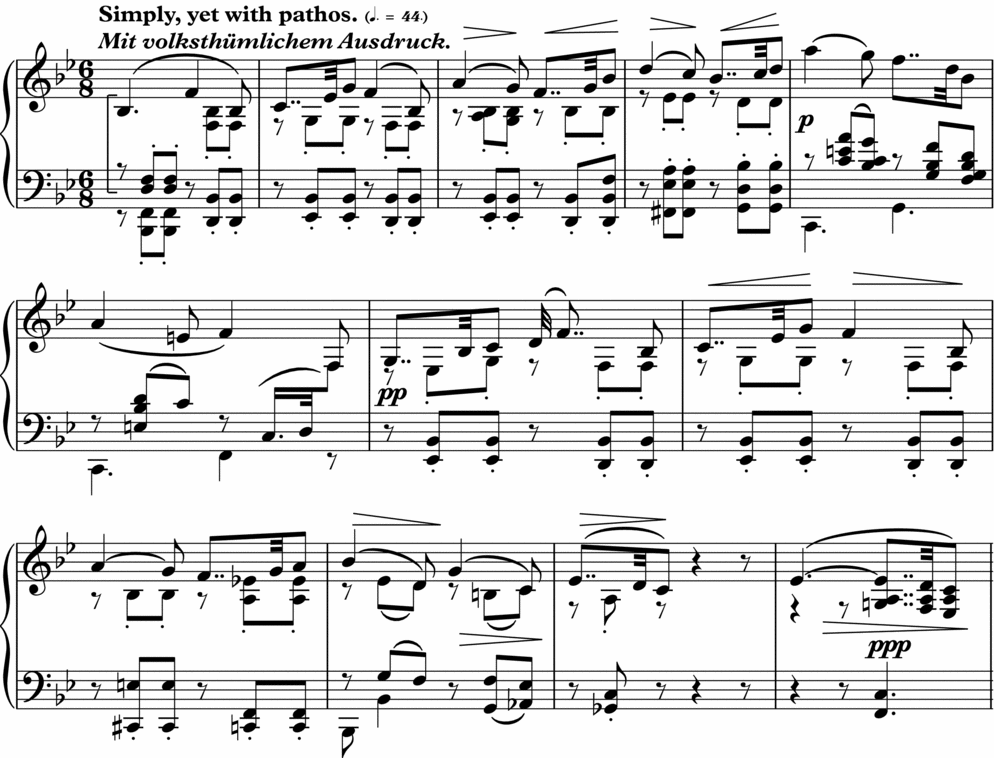
Advancing the Tennysonian program, the first movement's subordinate theme is tacitly invested with an extramusical association that it explicitly acquires when it recurs cyclically in the third movement. There it is linked with the “idea of Guinevere,” not only in MacDowell's fourfold synopsis, but also in his draft, where an inscription partially reads, “Sonata Eroica: Guinevere.” It accordingly embodies the same regal subject in the first movement and also fulfills its sonata-form function as a subordinate theme by cultivating a topic that contrasts markedly with earlier turbulence: the folksong (see Example 2). Verified by MacDowell's German expressive marking (Mit volksthümlichem Ausdruck; with folk-like expression), the theme's folk-like character derives from multiple stylistic traits: largely diatonic harmonies in the relative major key, B-flat, are modestly embellished by several secondary dominants; two melodic arcs share the same six-measure length (though not an identical phrase structure); regular, off the beat chords evoke strumming in the manner of Chopin's Ballade No. 1 in G Minor, op. 23; and pervasive dotted rhythms include a prominent instance of the “Scotch snap” that routinely surfaces in MacDowell's “Celtic” scores. The theme's character, its potent contrast with earlier material, and, as later discussion shows, its cyclical recurrences all invite a programmatic interpretation rooted in Tennyson's narrative.
MacDowell, Sonata Eroica, First Movement, mm. 55–66. Subordinate Theme, Breitkopf & Härtel, Plate 21004 (1895).
Merlin and Vivien could have easily shaped MacDowell's conception of the first movement's subordinate theme because the poem's retrospective narration imparts a vital episode involving Guinevere.Footnote 62 After leaving King Mark's court and arriving in Camelot, Vivien had remained inconspicuous until a festival day, when she had prostrated herself before Guinevere, “who stood all glittering like May sunshine on May leaves in green and gold, and plumed with green.” Tennyson's luminous description of Guinevere finds a broadly plausible musical counterpart in MacDowell's transparent subordinate theme, furnishing at least minimal justification for “pursuing a train of thought” based on the sixth Idyll. (Ensuing poetic actions, as we shall presently observe, likewise accord with the subordinate theme's subsequent treatment.) Bidden to speak, Vivien had deceitfully claimed her father had died fighting for Arthur instead of against him, thereby gaining Guinevere's sympathy and receiving the queen's peaceful entreaty to join the court as a lady in waiting. Then, muttering a thankless reply, Vivien had observed Guinevere and Lancelot together, perceived subtle signs of their relationship's illicit nature, and soon thereafter spread damaging rumors that went unchallenged.
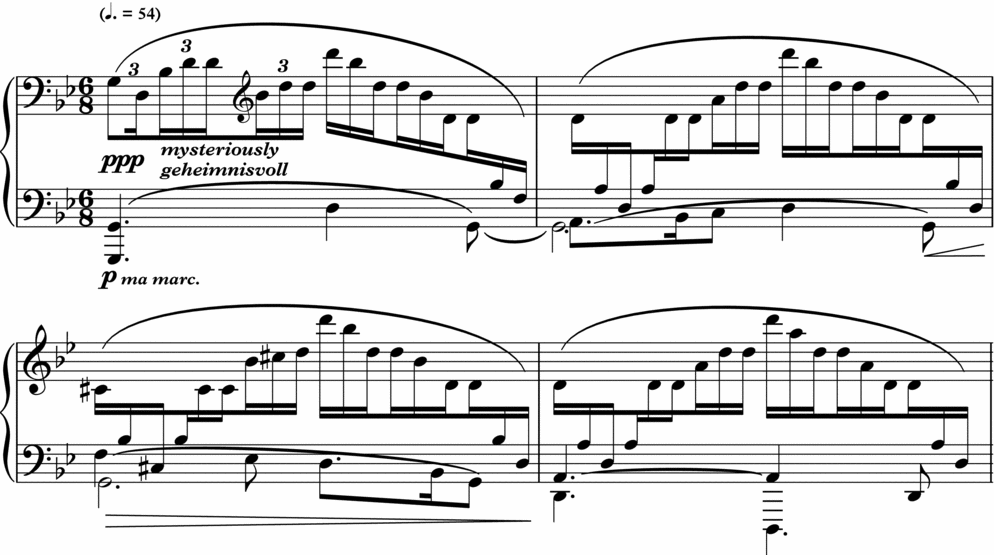
Vivien's tainting interaction with Guinevere finds a parallel in the treatment of the subordinate theme in each of its three main appearances in the first movement. First, in the exposition, the folk-like melody dissolves into a brief, pianissimo reminiscence of the storm music, just as Guinevere's peaceful entreaty dissipates into Vivien's ungrateful muttering. The storm, recurring in the relative major and marked “tenderly (sehr zart),” is admittedly attenuated, but its modifications seemingly correlate with Vivien's surreptitious vilification of Guinevere. Second, during the theme's statement midway through the development, sinister elements regain their agitated, turbulent character (see Example 3). Transposed a seventh lower than in the exposition, the theme recurs in C minor, moves much faster,Footnote 63 and is accompanied by detached, descending scales whose distinctive rhythm identifies them as inversions of the storm music's ascents, all immersing Guinevere's melody in pianistic turmoil.Footnote 64 Third, similar manipulations in the recapitulation transpose the theme another fourth lower into the tonic, as sonata-form principles dictate (see Example 4). Its accompaniment, however, consists neither of Chopinesque strummed chords nor of descending scales, but rather of widely ranging arpeggios that periodically descend into the melody's deeper register. These arpeggios emerge from the immediately preceding measures, where comparable figuration rumbles beneath the subsiding principal theme like receding thunder. Enhancing the passage's ominous character is MacDowell's German expressive marking, geheimnisvoll (given in English as mysteriously, but also translated as secretively), a term that aptly reconciles with Tennyson's atmosphere of duplicity.
MacDowell, Sonata Eroica, First Movement, mm. 91–94. Subordinate Theme's Recurrence in the Development Section, Breitkopf & Härtel, Plate 21004 (1895).
MacDowell, Sonata Eroica, First Movement, mm. 175–78. Subordinate Theme's Recurrence in the Recapitulation, Breitkopf & Härtel, Plate 21004 (1895).
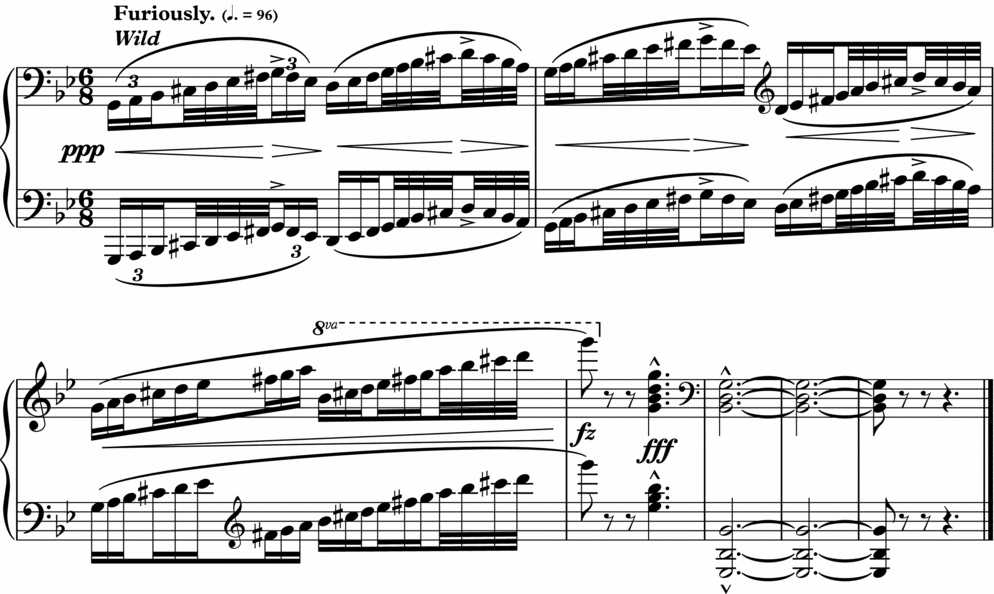
After the subordinate theme's third presentation ebbs away in sustained chords, an altogether unusual codetta suggests another correspondence in Merlin and Vivien (see Example 5). In a manner recalling the finale of Chopin's Sonata No. 2 in B-flat Minor, op. 35, MacDowell's first movement concludes with chromatically inflected scales in octaves whose wave-like contours are intensified with dynamic swells that culminate in two fff tonic chords.Footnote 65 Renowned pianists, some within MacDowell's Lisztian circle, have purportedly likened Chopin's scales to wind blowing over the grave of the victim who is mourned in the funeral march of op. 35.Footnote 66 MacDowell's scales similarly represent a last, unambiguous resurgence of windblown storm music and thus ostensibly equate with the sixth Idyll's ending, when the retrospective narration returns to the poem's initial setting and Merlin and Vivien take refuge from the storm's violent outbreak in the hollow oak.Footnote 67
MacDowell, Sonata Eroica, First Movement, mm. 193–99. The Coda's Windblown Scales, Breitkopf & Härtel, Plate 21004 (1895).
All three statements of the subordinate theme are directly juxtaposed or contrapuntally combined with manifestations of storm music, strongly suggesting MacDowell's “idea of Guinevere” was closely linked with the psychosexual tensions of Merlin and Vivien. Recognition of these transparent structural and programmatic bonds has naturally eluded previous interpreters who view the first movement as a depiction of Tennyson's first Idyll. Indeed, most commentators merely repeat MacDowell's assertion that the first movement represents The Coming of Arthur, avoiding any reference to Guinevere and all discussion of the music's potential relationship to the poem. Rare exceptions include Hughes, who finds counterparts to Arthur's character traits in the “ferocious and warlike” principal theme and the “old-fashioned and unadorned folk tune”; Alan Levy, who likewise detects a “ferocious warrior” and “Arthur's tender side” in the principal and subordinate themes; and perhaps Gilman, who regards the first movement's “nobility” and “emphatic aptness” as Arthurian attributes.Footnote 68
Pesce alone consults The Coming of Arthur to justify the first movement's programmatic allusions to Guinevere, finding several excerpts in which Arthur thinks of his prospective queen, their bright future together, and his certain unhappiness without her precisely when he is coming to power.Footnote 69 Pesce's account, however, omits two unsettling aspects of Tennyson's portrayal of the earliest stages in the royal couple's relationship. First, in The Coming of Arthur, Guinevere does not see or admit that she sees the unprepossessing Arthur when he first rides to battle as a simple knight among more richly armed peers; and second, in the eleventh Idyll, Guinevere recalls she had instead admired Lancelot when he had escorted her to the victorious king's new court—a preference she had maintained upon meeting Arthur, whom she had regarded as “cold, high, self-contain’d and passionless, not like him, ‘not like my Lancelot.’”Footnote 70 Tennyson thus sows seeds of adulterous doubt at Guinevere's earliest encounters with Arthur and Lancelot. Pesce's optimistic outlook consequently seems less viable than the more sinister perspective that emerges when Merlin and Vivien supplies a context for the subordinate theme's treatment throughout the first movement. Moreover, the theme's successively lower presentations accord less well with optimism than with MacDowell's idea of pitch producing “an ever-increasing obscurity” when lowered. Comparable shadows may be discerned in ensuing movements when further manuscript evidence, MacDowell's reliance on topics, and associations with episodes in Tennyson's poetry are closely examined.
New Evidence for Reassessing the Scherzo's Program
Published remarks, the draft, and the edition basically agree on the second movement's extramusical associations, in contrast to their divergence regarding the first movement's program. As MacDowell's fourfold synopsis has already revealed, “The scherzo was suggested by a picture of Doré showing a knight in the woods surrounded by elves.” An epigraph in the continuity draft, “Elves after Doré, light and swift throughout,” verifies that the pictorial source of MacDowell's inspiration was a steel engraving the French illustrator Gustave Doré (1832–83) prepared in 1867 for frequently reprinted editions of Tennyson's Idylls.Footnote 71 The expressive marking in the published score affirms elfish associations, but it avoids mentioning Doré, and its wording differs slightly, reading, “Elf-like, as light and swift as possible.” Nevertheless, MacDowell's synopsis and the draft's inscription connect the second movement to the specific literary episode that Doré's engraving vividly illustrates. This episode, along with the scherzo's topic and additional evidence in the draft, will be crucial in reassessing the second movement's sylphic program.
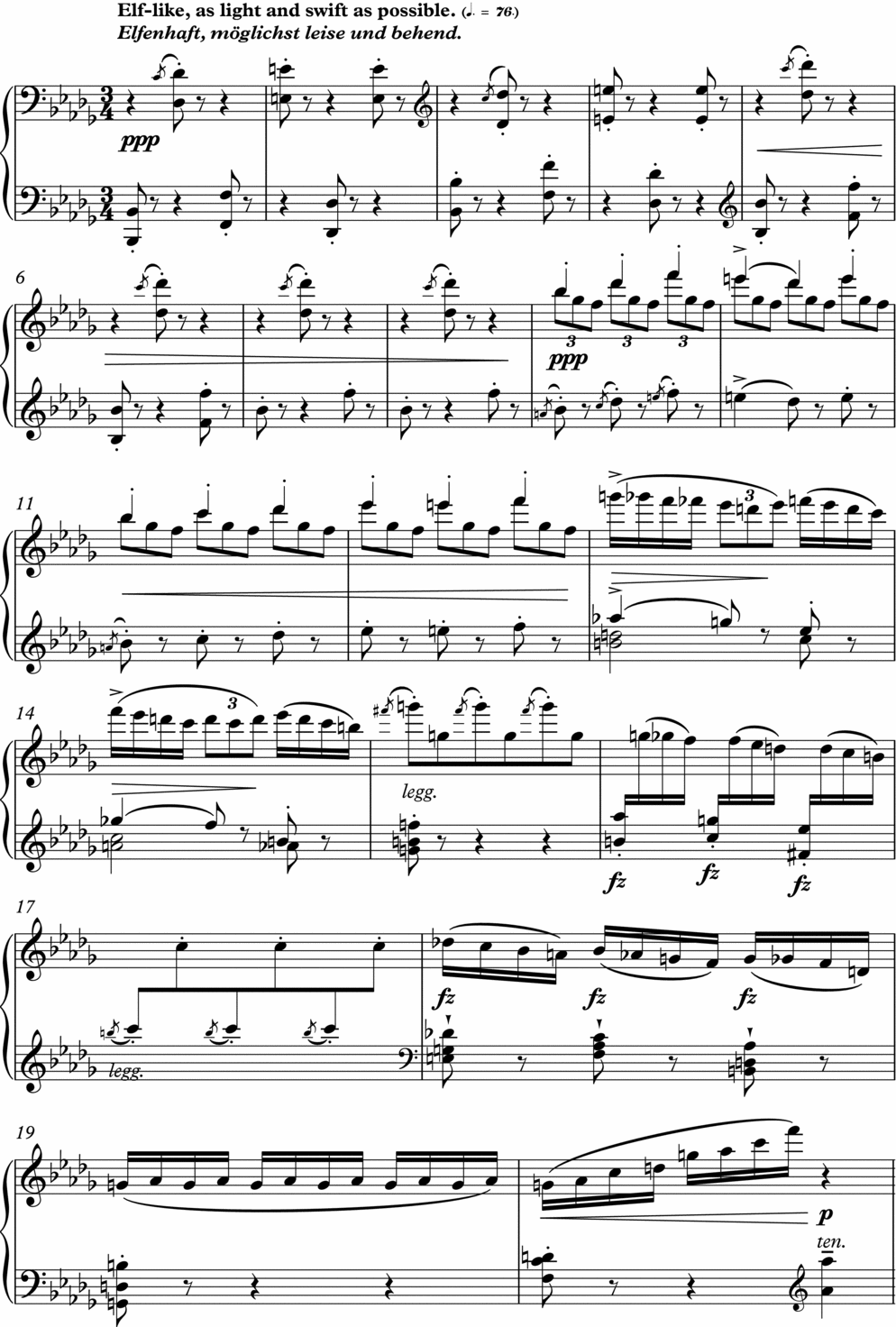
MacDowell's musical realization of Doré's imagery predictably employs another established nineteenth-century topic: the elfin scherzo. Typically delicate and mercurial, though sometimes disjointed and grotesque, such ersatz dance movements are epitomized orchestrally by several numbers in Mendelssohn's Incidental Music to A Midsummer Night's Dream, Berlioz's portrayal of Queen Mab in Roméo et Juliette, and Saint-Saëns's Danse macabre. Notable pianistic incarnations include pieces by Liszt, Schumann, Heller, Grieg, Raff, and MacDowell himself.Footnote 72 Regardless of the instrumental medium, the topic is fundamentally mimetic, imitating small, presumably fast physical motions of tiny beings with repetitive, rapidly executed motives, pervasively light articulation disrupted occasionally by irregular accents, lithe ornaments such as grace notes, soft dynamics, and swaths of underlying harmonic stasis that Francesca Brittan has dubbed “chromatic hovering.”Footnote 73 The Eroica's scherzo lavishly displays these features (see Example 6).
MacDowell, Sonata Eroica, Second Movement, mm. 1–20. Elfin Figuration in the Scherzo, Breitkopf & Härtel, Plate 21004 (1895).
The second movement's literary associations are equally straightforward, but their general neglect has obscured another disquieting aspect of the Eroica's program. Doré's engraving of a knight's encounter with petite, winged elves illustrates lines 229–68 in Guinevere, Tennyson's eleventh Idyll. At the poem's outset, the queen's liaison with Lancelot has been exposed, and she has fled Camelot to find refuge at a convent in Almesbury. Her identity remains unknown to her only companion, a young novice who prattles thinly veiled parables that incriminate the remorseful queen. One of the novice's allegories narrates her knightly father's journey to Camelot, where he had helped found the Round Table. As the novice recounts, on successive evenings during her father's travels, he had heard strange music, seen mermaids and tritons, and been surrounded by “a flickering fairy circle”—the episode Doré's engraving depicts. In such romantic-era interactions, mortal senses typically succumb to confusion, deception, or supernatural seduction, as the novice slyly intimates.Footnote 74 Upon arriving at Camelot, the novice's father had been equally bedazzled by “a wreath of airy dancers”—a second circle plainly related to the first through assonance (fairy-airy) and the flickering of a lantern that illuminated a banquet hall where every knight ate and drank excessively. From this fable the novice unwittingly draws a conclusion that devastates Guinevere: “So glad were spirits and men before the coming of the sinful Queen.” Thus the knight's supernatural encounter pinpoints sensual indulgence as the source of the Arthurian court's corruption. MacDowell's scherzo is accordingly no mere foray into illustrative tone painting, but rather an embodiment of a disturbing emotional undersurface that lies beneath the novice's tale. This perspective again accords with MacDowell's expectation for “the hearer to go beyond the actual sounds heard, in pursuance of a train of thought,” one suggested by his music, his synopsis, and his suppressed inscription.
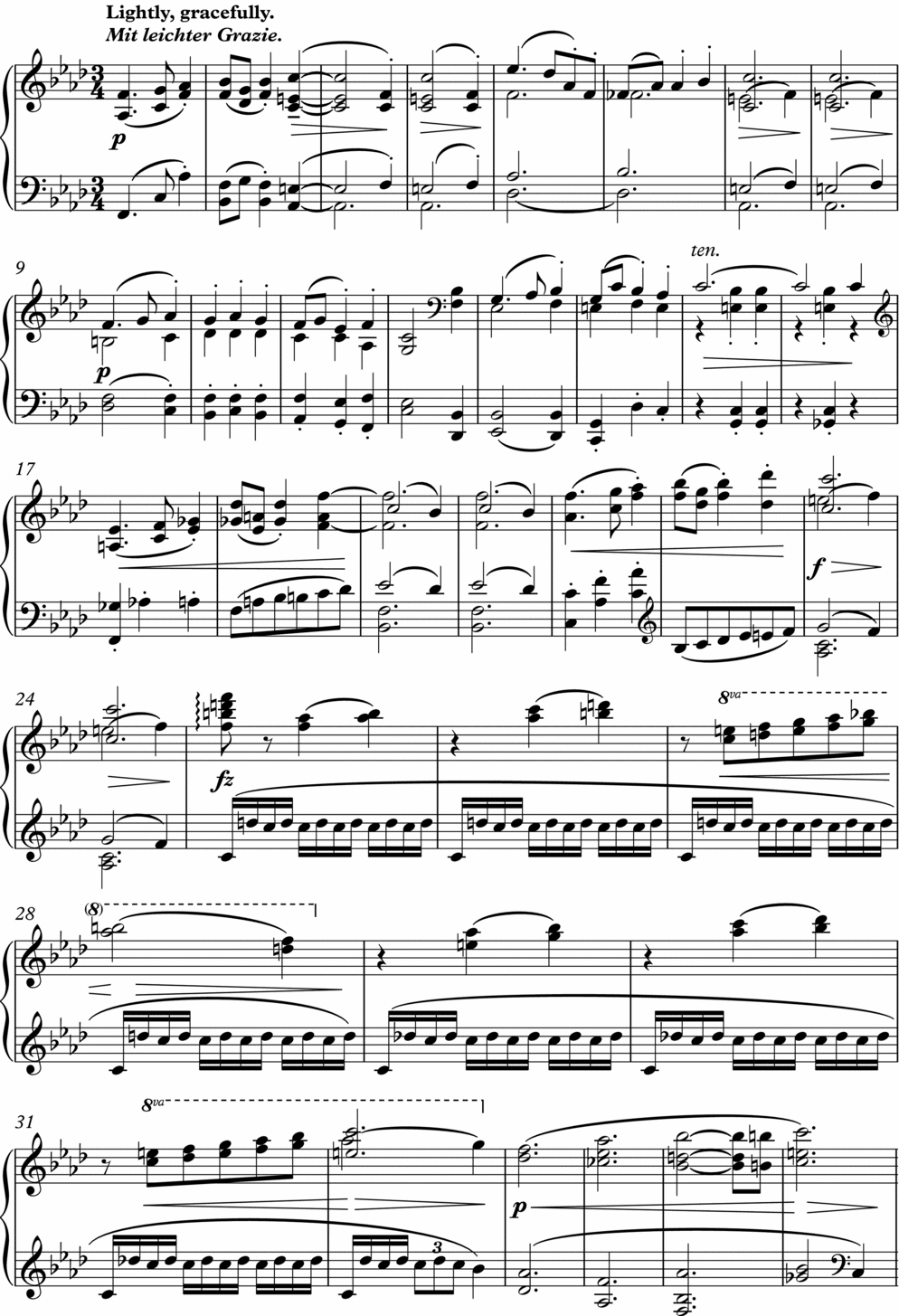
The movement's shadowy subtext is darker in the continuity draft, where the trio section differs completely from the published version (see Example 7a). In the draft, the trio is tightly integrated with other parts of the sonata: the left hand's continuous sixteenth notes perpetuate the scherzo's mercurial figuration, while the right hand's repeated crossings of the left produce a registral dialogue based on the wave-like motive of the first movement's stormy principal theme, now doubled in parallel thirds. The registral dialogue's first statement lasts for thirty-two measures, establishing a strong cyclical bond with the first movement's principal theme and its attendant psychological turmoil. This link is reinforced when the initial phrase of the first movement's slow introduction (mm. 33–36) seamlessly emerges from the trio's modulations away from the tonic (F minor) to the relative major (A-flat, m. 9) and the submediant (D-flat, m. 29).Footnote 75 Following the slow introduction's recurrence, an abbreviated registral dialogue ends with a segue that smoothly anticipates the scherzo's reprise.
MacDowell, Sonata Eroica, Second Movement, mm. 76–111 (here numbered 1–36 to facilitate comparison with Example 7b). Original Version of the Trio, Transcribed from the Continuity Draft.
The published trio favors contrast over integration (see Example 7b). Its theme may share a fleeting rhythmic similarity with the dactylic, arpeggiated motive that replaced much of the tremulous accompaniment to the first movement's principal subject (see Example 1b above). However, the theme's disparate melodic contour and quirky hemiola dispel impressions of a genuine resemblance. All the more unexpected, then, is the disruptive encroachment of the first movement's principal theme (mm. 25–32) and its slow introduction's initial phrase (mm. 33–36) at the trio's midpoint, where their insertion seems abrupt compared to the draft's seamless connection between the prolonged allusion to storm music and the cyclical return of the first movement's slow introduction. Thus, the original trio seems more successful than the published rendition, not only in terms of thematic integration with the scherzo and the first movement, but also in terms of sustaining the Tennysonian program's turbulent undercurrents.
MacDowell, Sonata Eroica, Second Movement, mm. 77–112 (here numbered 1–36 to facilitate comparison with Example 7a). Published Version of the Trio, Breitkopf & Härtel, Plate 21004 (1895).
Any one of several factors may explain the original trio's rejection. Perhaps MacDowell believed its prolonged repetition of motives from the first movement's principal subject overbalanced recurrences of other themes within the sonata's complex network of cyclical relationships. This supposition nonetheless seems unlikely because the principal theme does not return in later movements and consequently contributes less to the sonata's cyclical design than other highly persistent materials, namely, the opening movement's slow introduction and subordinate theme. Moreover, the principal theme still appears in the published trio, although its cyclical recurrence lasts for only eight measures.
Alternatively, large-scale tonal relations may partially explain the original trio's elimination. Both versions are cast in F minor, but the draft's trio fluently modulates to A-flat and D-flat major, keys removed from the sonata's tonic, G minor, falling respectively on the Neapolitan and lowered fifth scale degrees. The published trio, by contrast, continuously embellishes a stable F minor with altered seventh and ninth chords. F minor is also the key used (in both the draft and the edition) near the end of the third movement, where the opening theme is restated, unusually, in a key other than the tonic. MacDowell may have accordingly sacrificed the original trio's thematic integration in order to cultivate a tonal bond between the revised trio and the third movement.
A third possible reason for discarding the original trio is pragmatic in nature. MacDowell may have anticipated that the control required to play a movement comprised entirely of elfin filigree, interrupted just once by terse cyclical recurrences, would have been fatiguing in performance.Footnote 76 Indeed, Marian recounted that after he had given the Eroica's Boston premiere, he had not met her afterward, as was their custom. He instead had gone directly home, where she and two friends had found him cowering in a corner, “as if he were guilty of some crime.” When they had entered the room, he had acknowledged the sonata's taxing demands, exclaiming, “I can play better than that. But I was so tired!”Footnote 77 The revised trio's homophonic texture doubtless afforded relief from the movement's otherwise pervasive filigree, suggesting practical performance considerations influenced the original trio's rejection.
Long after the sonata's premiere and publication, MacDowell still expressed doubt regarding its second movement, though his reservations concerned programmaticism rather than the thematic, tonal, or pragmatic issues described above. As he informed Corey, he had originally planned to include the draft's inscription, “after Doré,” in the edition, but he changed his mind because the epigraph “seemed to single it [the scherzo] out too much from the other movements.”Footnote 78 His unease about the second movement had far-reaching effects: his third and fourth piano sonatas lack scherzos. Thus MacDowell presumably thought he had successfully integrated a scherzo into a multi-movement sonata only in his first effort in the genre, the Sonata Tragica, whose second movement never caused him to express reservations.Footnote 79
Another Suppressed Inscription: The Third Movement as a Serenade
In the continuity draft, the third movement's complete prefatory inscription reads: “Serenade Sonata Eroica: Guinevere.” Omitted in the edition, the epigraph verifies that the movement embodies MacDowell's “idea of Guinevere,” in accordance with his fourfold synopsis. The movement's designation as a serenade, however, is new evidence that strengthens an existing identification of a musical topic and further illuminates the sonata's program.
The third movement's explicit association with Guinevere, as previously noted, also tacitly applies to the first movement's subordinate theme (Example 2 above). Similarly, the third movement's designation as a serenade reinforces the subordinate theme's earlier characterization as “folk-like,” because serenades typically involve simple tunes, straightforward accompaniments, and performance by lovers or admirers who are amateurs rather than trained singers. In the third movement, the folk-like melody conspicuously appears in the two outer sections of a large ternary form, where it is notated in 6/4 rather than 6/8 meter, supported by a pedal tone of throbbing repeated notes instead of strummed chords, and juxtaposed with an alla breve passage in chorale-like, homophonic style. Programmatic insights into the bifocal thematic division of the outer sections and the turbulence of the ternary form's central section again derive from a specific literary context.
Tennyson's Idylls contain many musical interludes and spoken references to diverse musical activities. Knights sing of victory, carol as they embark on quests, and hear heavenly music in the Holy Grail's presence. Maidenly ballads inspire one knight to victory in a tournament, but taunt another. Various characters also demonstrate musical aptitude: Vivien enters the narrative warbling a tune about pagan fires that will consume Camelot; the little novice tortures Guinevere by singing the Parable of the Wise and Foolish Virgins; and Tristram's harp playing entertains a fool. But only one of Tennyson's musical episodes is a genuine serenade, and only one involves Guinevere. It appears in Merlin and Vivien, the poem that originally inspired the first movement's composition, at the juncture when Vivien tearfully reproaches Merlin for withholding the secret charm that would place him in her power. She asks Merlin to trust her “not at all or all in all,” quoting a rhyme she overheard “the great Sir Lancelot sing”:
Lancelot's rhyme, invoking the serenade's archetypal lute accompaniment, is obviously a song of seduction, one in which he urges Guinevere to maintain unwavering faith in their love and in him. Even the slightest uncertainty—the little rift within the lover's lute—would destroy their relationship. His serenade and Vivien's recollection of it function identically: just as Guinevere yields to Lancelot, so Merlin believes Vivien to be true. MacDowell's inscription accordingly signifies the third movement is an adulterous serenade comprising another disquieting chapter in the sonata's Arthurian program.
Musical events again reconcile well with the literary context. The first section's thematic duality implies an interaction: the homophonic utterance initiates an exchange in the movement's tonic, E-flat major, whereupon the folk-like melody responds in the dominant and grows restless, as MacDowell's expressive marking (cresc. ed agitato) indicates. This discourse, easily imaginable as a dialogue between Lancelot and Guinevere, continues later in the movement. As the ternary form's turbulent central section ends, the homophonic utterance's vehement, marcatissimo restatement in F minor surges toward a climactic, fff transformation of Guinevere's melody. The themes are reversed in the movement's third section, where the homophonic passage interrupts the folk-like melody's abbreviated restatement. And finally, the evanescent coda faintly recalls both themes, grafting the folk-like melody's compound rhythms onto the homophonic utterance's melodic contours. Thus the movement, marked “tenderly, longingly, yet with passion,” imparts a conversation between voices that become more fervent, reverse order, and mingle in various ways until they fall silent.
This dialogue, through its peripheral formal positions and its implicit interaction or verbal communication between two characters, suggests exteriority, an outward orientation toward words, actions, or events that Lancelot and Guinevere shared or experienced together. By contrast, the central section (marked con anima) more closely resembles an interior monodrama, illuminating the psychological state of an individual through a single-minded focus on fragmented motives that derive loosely from the homophonic utterance and are interwoven with sinuous, chromatically inflected scales that gradually expand into widely spaced arpeggios.Footnote 81 As Pesce perceptively observes, the derivative motives, sinuous scales, and arpeggios repeatedly rise and fall, closely illustrating MacDowell's belief “that the upward tendency of a musical phrase can suggest exaltation, and that a downward trend may suggest depression, the intensity of which will depend upon the intervals used.”Footnote 82 Plainly consistent with the central section's turbulence and increasingly precipitous rises and falls is the eleventh Idyll's depiction of Guinevere, a woman tormented by memories of her affair, wracked with guilt, and mocked by the little novice. The exterior reason for the queen's interior anguish is nonetheless made more explicit by correlating MacDowell's description of the movement as a serenade with Tennyson's reference to Lancelot's adulterous plea, as overheard by Vivien.
Vivid Representation: Revisiting the Finale's Program
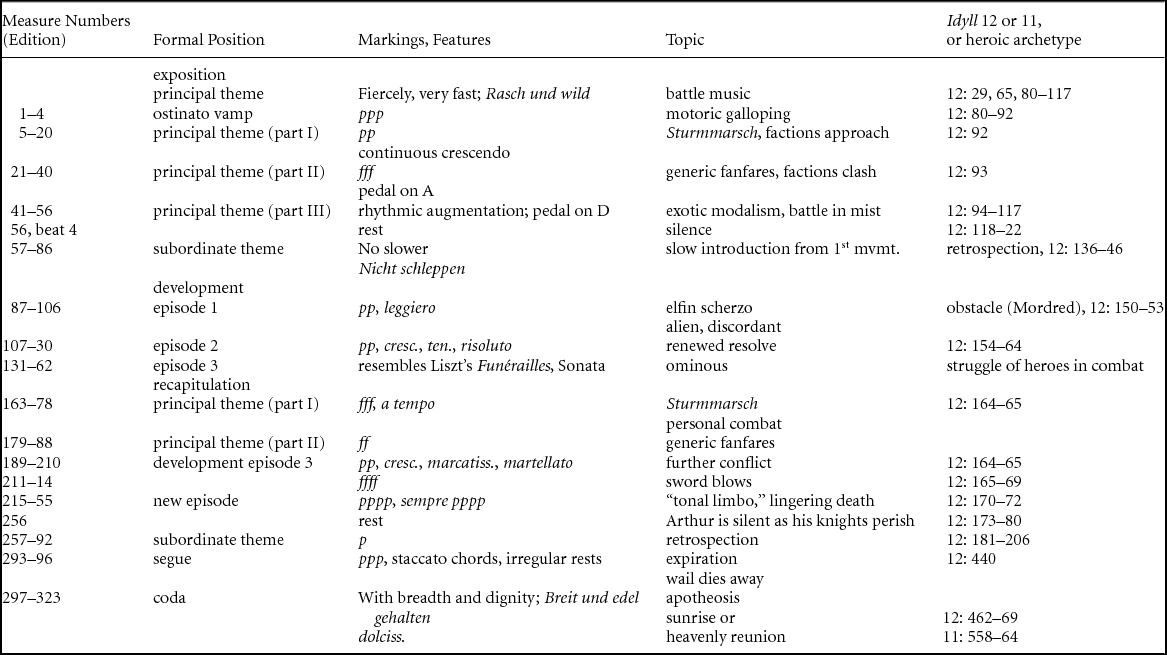
The fourth movement's draft offers no new programmatic insights, merely bearing the epigraph, “Sonata Eroica.” Paradoxically, however, the finale contains some of the score's most overtly representational music, as commentators have generally agreed.Footnote 83 For Hughes it presented a “picture” of the “Morte d’Arthur, beginning with the fury of a storm along the coast,” and even evoked line 93 from Tennyson's twelfth Idyll (“On the waste sand by the waste sea they closed”).Footnote 84 Pesce likewise discerned the “death of Arthur after battle with Mordred,” a perception Levy echoed.Footnote 85 This critical consensus reflects not only MacDowell's remark that the finale “represents the passing of Arthur,” a phrase duplicating the twelfth Idyll's title, but also an undeclared recognition of the movement's principal theme as an incarnation of battle music. Indeed, this standard topic broadly suits the twelfth Idyll's dynamic actions, namely, the cataclysmic combat between Arthur's and Mordred's forces and the fatal confrontation between the two kinsmen. Specific episodes within this scenario are depicted in a virtually uninterrupted series of vivid topics (see Table 2).
Correlations of Form, Topics, and Poetry in the Sonata Eroica's Fourth Movement
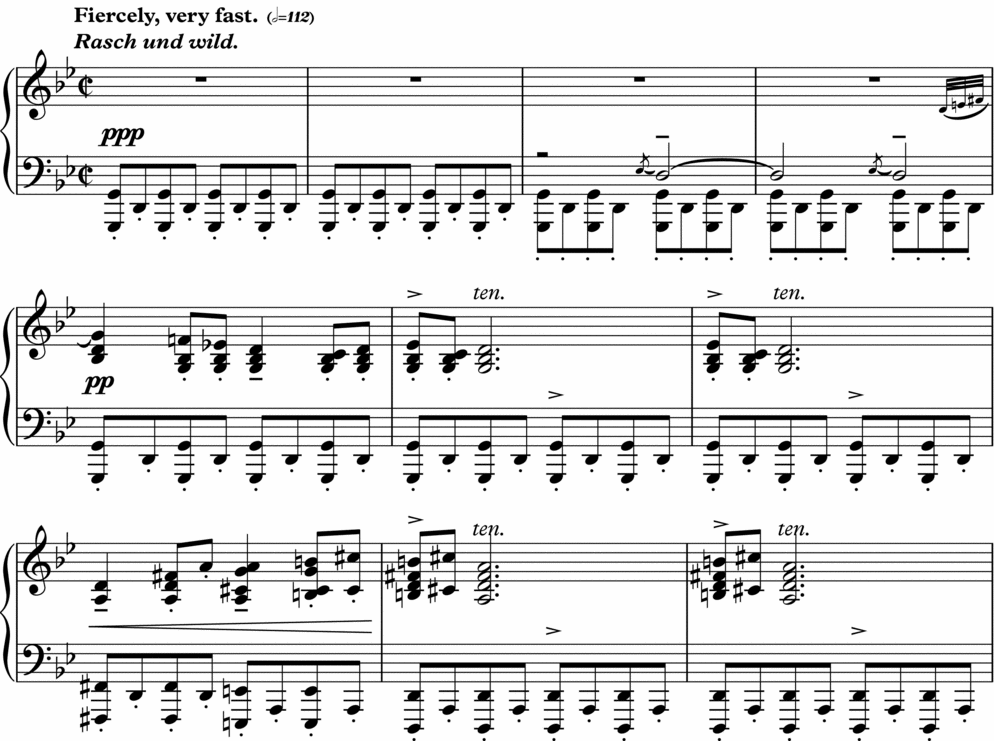
During the era of European and colonial revolution (1756–1815), composers enacted battles in hundreds of orchestral, chamber, and keyboard works, establishing numerous topical conventions that endured in nineteenth-century program music.Footnote 86 MacDowell's finale exploits many of them, beginning with a Sturmmarsch, the rapid double-time march that typically concluded a battle piece by representing one faction's charge toward final victory (see Example 8). The accompanimental ostinato's generic galloping figure supports phrases that adhere to topical convention because they are short, of equal length, accented, and mono-motivic (comprising two dactyls and their reversed anapest). A twenty-measure crescendo quintessentially implies a gradual approach of separate factions toward open conflict, whereupon topical disruptions of musical regularity imitate combat's disorderly, unpredictable incidents: the principal theme's initially restricted range expands widely into a registral dialogue's angular leaps; a systematic tonic-dominant alternation incorporates chromaticism that anticipates the secondary key; and triadic fanfares—battle music's emblematic figuration—congest the texture with recollections of the dactylic accompaniment of the first movement's revised principal theme.
MacDowell, Sonata Eroica, Fourth Movement, mm. 1–10. Principal Theme, The Embodiment of a Sturmmarsch, Breitkopf & Härtel, Plate 21004 (1895).
Unlike earlier storm marches that habitually ended in triumph, however, the finale's principal theme area dissipates as diminuendos accompany the fragmented fanfares’ gradual descent into the bass register. Two statements of the principal theme, likewise attenuated by slurs and rhythmic augmentation, engender an exotic atmosphere, the first by instating the minor dominant in a major-mode context (F-natural), the second by raising the fourth scale degree to produce an augmented second (G-sharp). Following a ritardando, one beat of silence affords the first respite from the finale's tumult.
The finale's principal theme area cultivates battle music's traits, but eschews strict, one-to-one correspondences with the twelfth Idyll's actions. In the poem Arthur and his knights pursue Mordred's forces to the distant western coast, a chase feasibly associable with MacDowell's twenty-measure crescendo. Thereafter, however, Tennyson describes “the last, dim, weird battle” quite impressionistically: it occurs in a mist so dense that foes cannot see each other, but merely hear clashing weapons, shrieking combatants, and moaning casualties.Footnote 87 These events lack affinities in the principal theme's exotically tinged statements and prolonged diminuendo, although the “foreign” modal color conveys MacDowell's “sense of confusion or mystery” and could be fancifully connected to the misty battle's “dim, weird” setting. Additional parallels nonetheless exist between the literary and musical works as both unfold.
As Pesce observes, the cyclical recurrence of the first movement's slow introduction as the finale's subordinate theme disrupts classical sonata processes and consequently invites programmatic interpretation: it wrenches listeners “out of the present mode of expression” and revives earlier extramusical associations.Footnote 88 For Pesce these associations relate back to “the coming of Arthur,” the phrase MacDowell borrowed from the first Idyll's title and included in his fourfold synopsis and the edition. The return of earlier material is accordingly a pathos-laden reminder “of what was (and perhaps what could have been),” an idea Pesce finds especially compelling as an explanation for the slow introduction's later appearance in the recapitulation.Footnote 89
But Pesce's idea applies equally well to the introduction's first statement in the exposition and, just as notably, again correlates with a specific literary context. In The Passing of Arthur, the battle is followed by a dead hush filled only with the sound of ceaseless ocean waves that serve as “the voice of days of old and days to be.” Arthur then reviews for his ever-faithful Sir Bedivere the circumstances that sealed their fate—his knights’ loyalty, his confusion when he was betrayed, and Mordred's treachery.Footnote 90 Thus Tennyson's three-stage sequence of combat, silence, and retrospection broadly parallels MacDowell's succession of battle music, a brief rest, and cyclical recurrence. A comparable sequence spans the finale's development section and recapitulation, thanks partly to sonata form's exigencies, though important musical variants suggest further Tennysonian correspondences.
Sonata-form battle pieces often achieve their strongest climaxes in development sections, as the excruciatingly dissonant capstone of the first movement of Beethoven's “Eroica” Symphony famously illustrates.Footnote 91 The development of MacDowell's finale, however, employs another familiar tactic, building toward the moment of recapitulation throughout three distinct episodes. In the first, rapid triplets that recall the scherzo's elfin figuration, pianissimo dynamics, and leggiero articulation embellish another registral dialogue between the fragmented principal theme and the dactylic fanfares. Episodic scherzos in nineteenth-century programmatic works, particularly those of Liszt, often imbue important themes with “discordant,” “alien,” or “bizarre” qualities that oblige reintegration within a recognizable but transformed guise.Footnote 92 Reintegrative procedures govern the rest of the development and the recapitulation.
Initiating the reconstitutive process, the second developmental episode is bifurcated. In its first part, crescendos intensify the bass line's rising sequential statements of a chromatically inflected scale that climbs toward repetitions of the principal theme's anapestic motive. The second part's texture becomes increasingly animated, but its thematic materials remain fragmentary or nondescript, comprising precipitous leaps in the bass line, arpeggios that span three octaves in the right hand, and fleeting anapestic motives and dactylic fanfares.
Momentum rebuilds inexorably during the third episode, bolstered by transparent thematic references. The subordinate theme's rhythmically augmented statements are accompanied by increasingly virtuosic octaves that retain the principal theme's vestiges, but bear stronger affinities to ominous passages in Liszt's Funérailles and Sonata in B Minor.Footnote 93 A final surge, strengthened by a steady crescendo and a brief resumption of the second episode's nondescript figuration, then culminates in the recapitulation. There the complete principal theme is marked fff, not the ppp of the opening ostinato, nor the pianissimo of the theme's original presentation. Thus the battle theme, having endured dissipative scherzo-like treatment and fragmentation throughout the development, attains reintegration precisely when the recapitulation begins.
The development's generic processes of dissolution and reintegration discourage close programmatic interpretation. Nevertheless, they reproduce a quintessential sequence of heroic narratives and heroic program music, whereby protagonists encounter obstacles that demand new perspectives on past events or renewed resolve toward impending actions.Footnote 94 In the twelfth Idyll, Bedivere reports that Mordred has survived the battle unharmed, prompting Arthur to mount his final assault.Footnote 95 Their personal combat, however, does not merely elicit a straightforward repetition of the exposition's events. Following the battle music's fff restatement and the dactylic fanfares’ recurrence, the principal theme's exotic, modal, dissipative statements are omitted. Instead, an unrelenting resurgence of the development's second episode anticipates the passage's culmination. After a flurry of Lisztian interlocking octaves, ffff block chords in both hands leap repeatedly across the keyboard's entire range to pitches four octaves below—a graphic representation of the sword blows that slay Mordred and mortally wound Arthur, as verified by multiple commentators and the ensuing passage in the movement.Footnote 96
As the ffff dynamics plunge to pppp, the climactic block chords and cavernous leaps yield to forty-two measures that Pesce has called a “tonal limbo.”Footnote 97 In stark unison octaves, two-note motives outline tonally ambiguous intervals that begin each time on E-flat and descend to F-sharp, G, D-flat, and C. As the two-note motives continue in the left hand, their upper and lower voices produce a nebulous succession of parallel thirds, punctuated occasionally by a fourth, fifth, or tritone. Meanwhile, the right hand's tremulous figuration generates an equally directionless stream of descending, parallel major thirds, augmented triads, and unstable six-four chords. Pesce equates this passage with “Arthur's gradual weakening and death after his battle with Mordred,” a lingering demise that lasts over a day in Tennyson.Footnote 98 Indeed, the compositional practice of representing the approach of death or death-like states with ambiguous harmonies has deep roots in Florentine opera and remained a viable topic on the nineteenth-century stage.Footnote 99 The piano literature nonetheless furnishes an excerpt more closely resembling MacDowell's “limbo,” namely, the central section of Baba-Yaga from Mussorgsky's Pictures at an Exhibition, where similar two-pitch motives and tremolos descend in parallel motion through a series of murky harmonies. MacDowell's use of strikingly similar figuration illustrates his reliance on another typical ploy of nineteenth-century program music, enlisting harmonic ambiguity to represent a macabre subject, in this case, Arthur's lingering death.
After the octaves and several fragmentary tremolos expire in one last descending diminished seventh, the recapitulation resumes its duplication of the exposition's events. A fermata over a measure-long rest expands the earlier one-beat pause, and the first movement's slow introduction returns in the tonic, G minor, although it begins on second-inversion chords that intentionally prolong the “tonal limbo,” as a manuscript annotation confirms.Footnote 100 This predictable repetition is attributable to sonata-form conventions, but it again relates to the twelfth Idyll's actions. After Arthur is mortally wounded, he remains silent until all his knights have perished and Bedivere has carried him to a nearby chapel. There he reminisces about chivalric fellowship, Camelot's daily pleasures, a prophecy of Merlin, and the time before he became king, when he received his sword Excalibur from a numinous hand that rose from a lake, “clothed in white samite, mystic, wonderful.”Footnote 101 Thus the recapitulation's sequence of battle music, silent fermata, and cyclical return not only reproduces the exposition's basic outline, but also mirrors Tennyson's chief literary actions, specifically, Arthur's personal combat, prolonged silence, and retrospection.Footnote 102
Final instances of graphic imitation and thematic recollection conclude the movement. Linking the subordinate theme's climax to the coda, a segue separates four ppp, staccato, cadential chords with rests of irregular length—a musical expiration begging interpretation as Arthur's last, quiet moments before death. Then the coda's dolcissimo reminiscence of Guinevere's folk-like theme, marked “with breadth and dignity,” rises into the piano's highest register, accompanied by extravagantly thick chords and chromatically inflected scale fragments that tenuously recall the first movement's storm music. Repeated, fully voiced tonic triads end the sonata, interspersed with diatonic scale fragments. The coda accordingly comprises an apotheosis, a typical ending for nineteenth-century, multi-movement, cyclical works that entails grandiose thematic transformations and sometimes implies religiosity with sustained, rising figures, chorale-like textures, and plagal cadences. Indeed, two early MacDowell advocates recognized the coda's familiar topic: Gilman asserted that MacDowell wrote “nothing more elevated and ecstatic than the apotheosis which ends the work”; and Hughes professed that “the death and apotheosis of Arthur are hinted with daring and complete equivalence of art with need.”Footnote 103
Less straightforward than identifying the coda's topic, however, is determining its literary associations. As Pesce notes, the folk-like theme's recurrence constitutes a departure from Tennyson because Guinevere makes no appearance in the twelfth Idyll.Footnote 104 The poem does allude to her as “the one lying in the dust at Almesbury,” where Arthur left her in the convent, groveling at his feet and begging for forgiveness, as the eleventh Idyll discloses.Footnote 105 But Arthur's allusion is uttered before his forces assault Mordred and consequently offers little insight into the finale's conclusion. The eleventh Idyll nonetheless supplies Pesce with a plausible reading of the coda: upon leaving Guinevere, Arthur prophesies their reunion “in that world where all are pure . . . before high God.”Footnote 106 The coda's reminiscence of Guinevere's music and soaring ascent into the highest register certainly resonate with a heavenly reconciliation, albeit one that Tennyson postpones until after Guinevere has long outlived Arthur as Almesbury's renowned abbess. Pesce alternatively correlates the coda's high tessitura with the final lines in The Passing of Arthur, in which Bedivere recounts how he had climbed to the highest point he could find to witness the king's funeral bier pass into the distance and “vanish into light” as the sun rose.Footnote 107 The sonata's conclusion may accordingly illustrate MacDowell's previously mentioned association of high pitch with bright light. More broadly, the literary contexts evoked by the coda's cyclical recurrence, high range, and thick chords are plainly compatible with the archetypal nineteenth-century heroic apotheosis.
Conclusions and New Directions
As new manuscript evidence and reassessments of previously recognized programmatic associations clearly indicate, the Sonata Eroica frequently cultivates standard musical topics that relate to specific, disquieting episodes in Tennyson's Idylls of the King. The first movement, originally conceived as a narratively inclined ballade, utilizes storm music to embody Vivien's seduction of Merlin and taints the folk-like style to represent Guinevere's corruption through adultery. An elfin scherzo illustrates the little novice's parable of a Golden Age lost through courtly sensual indulgence. The third movement's seemingly folk-like serenade is actually an adulterous dialogue that induces an agitated, guilt-ridden outburst. And the finale observes battle music's conventions, equates cyclical recurrence with literary reminiscence, evokes death with harmonic ambiguity, and ends in a transformational apotheosis. Some of these topics are mimetic, employing overtly imitative music to depict natural phenomena, as in the first movement's storm, or physical movements and actions, as in the scherzo's elfin filigree, the slow movement's call-and-response dialogue, and the fourth movement's battle. Others more abstractly link specific musical idioms with stereotyped extramusical associations, including the folk-like style, the correlation of death with tonal ambiguity, and the categorical features of the apotheosis.
Additional graphic representation occurs throughout the score. The first movement's concluding rush of scales corresponds to stormy winds that close Tennyson's sixth Idyll. Fatal sword blows equate with ffff chords that leap across the keyboard's entire compass. And in the segue to the finale's coda, rhythmically irregular, pianissimo, staccato chords ostensibly denote Arthur's expiration. Further instances of explicit programmaticism illustrate MacDowell's correlation between pitch and psychological states or light. The first movement's subordinate theme descends into a lower range at each recurrence, suggesting depression. In the slow movement's central section, increasingly precipitous, arpeggiated descents and ascents reflect Guinevere's escalating, remorseful agitation. And the high tessitura of the finale's coda intimates the regal couple's heavenly reunion or the disappearance of Arthur's funeral bier into a luminous sunrise. MacDowell thus “made use of all the musical suggestion of tone painting in his power” to deal “directly with the emotions” in a “higher order of program music” that follows “a train of thought” suggested by inscriptions in his draft and his fourfold synopsis. His cultivation of topics and graphic representation accordingly imbue the Sonata Eroica with stronger, more overt, and more cohesive programmatic associations than formerly suspected.
MacDowell's extensive utilization of mimesis and familiar semiotic conventions is scarcely limited to the Sonata Eroica, despite numerous claims that graphic representation is rare in his music. In addition to his symphonic poems, elfin scherzos, and Tennysonian portrayals, other vivid evocations abound, including many that resort to what MacDowell considered “the most primitive form of suggestion in music.” Myriad works depict the sounds or motions of flowing water or waves, often equating nature's stasis with psychological peace.Footnote 108 MacDowell's illustrations of windblown topics, by contrast, reflect inner disturbances.Footnote 109 Manifestations of other acoustic phenomena include bell tones, shepherd's piping, flute playing, bird songs, and hunting clichés.Footnote 110 Simulations of human movements, gestures, speech, and song are especially prolific.Footnote 111 These depictions span MacDowell's career and cross generic boundaries, confirming that he used standard topics and typically attendant mimesis habitually. Moreover, deeper investigation of the foregoing cursory list of topics and the rich array of his literary inscriptions would doubtless help place MacDowell more squarely in the camp of two of his New German mentors, Liszt and Raff, as frequent comparisons in the preceding discussion suggest. MacDowell nonetheless adapted their methods to suit subjects of personal interest, most notably nineteenth-century English literature, especially the works of Tennyson, Byron, and Shelley, and—eventually and increasingly—the American themes he adopted in piano miniatures beginning in the mid 1890s with Woodland Sketches.
A final question regarding the Sonata Eroica may inevitably remain answerable only in speculative terms: why did MacDowell suppress the first and third movements’ inscriptions and discount Doré's role in the second? A facile rejoinder could be that he simply wanted to ensure consistency between his compositional practice and one tenet of his multifaceted aesthetics, that is, he may have genuinely hoped every listener would enjoy “the composition musically by interpreting it in his own way, in terms of his own experience,” even without a program, or, as Marian once asserted, that a mere “title or a bit of poem” would suffice to allow the interpreter's imagination free play.Footnote 112 If so, condensing each movement's program to an aphoristic character description or eliminating annotations entirely may be included among the last stages in a compositional process that ranged from replacing entire formal sections to minutely altering performance markings.Footnote 113
Another equally plausible factor was a critical climate that was often hostile toward material imitation, which had been a derisive subject from the Enlightenment until MacDowell's lifetime, as commentaries by authors extending from Jean-Jacques Rousseau to Friedrich Nietzsche attest.Footnote 114 Although MacDowell practically courted controversy in matters such as concerts devoted exclusively to American music, he may have wished to avoid providing further grist for the critical mill at a time when even his advocates favored his supposedly “evocative, atmospheric” form of programmaticism over the “graphic, realistic” type.
The preceding possibilities attempt to account for MacDowell's reluctance to furnish detailed programs for his compositions in general, but two additional issues pertain specifically to the Sonata Eroica. Publishers may have declined to print MacDowell's epigraphs, though several factors belie the notion of editorial interference: it is undocumented in extant correspondence; MacDowell himself deleted his draft's Merlinesque inscription; and other published works include poetic prefaces. More tellingly, members of MacDowell's closest circle and contemporary critics recorded his strong aversion to sexual or erotic subjects. His mother was relieved upon meeting Marian in 1880 to see that she was “a true lady” without “a single trait of the harem-scarem American girl so disgusting to Eddie.”Footnote 115 He expressed great discomfort and distaste over his closest friend Templeton Strong's adulterous affair in 1891.Footnote 116 He confessed to Currier that he was shocked in 1895 upon encountering “nudities” in Parisian salons and at the Opéra.Footnote 117 He was “absolutely temperate” in all matters except work and led a life of “spotless purity,” as Hamlin Garland, a friend from the Boston years onward, asserted in 1905.Footnote 118 Later Porte declared that “the love impulse in [MacDowell] was always noble and restrained,”Footnote 119 an opinion seconded by Rosenfeld, who affirmed that MacDowell “fondly” dwelled on “the sexual sternness of Puritan days.”Footnote 120 Others have more recently noted that MacDowell was “a little overly-refined and prudish,” and his music was “curiously free from the fevers of sex.”Footnote 121
If MacDowell indeed held such attitudes, they would have been difficult to reconcile with the disclosure of a disquieting Arthurian program that emphasized a bona fide “harem-scarem girl’s” tempestuous seduction of Merlin and her secretive vilification of Guinevere, an elfish parable of courtly excess, an adulterous dialogue between Arthur's wife and his most trusted knight, and the resulting battle that ended Camelot's promise—so difficult, perhaps, that MacDowell withheld the first five lines of Tennyson's sixth Idyll from publication, articulated misgivings about Doré's engraving, omitted the third movement's identification as a serenade, and instead merely prefaced the entire sonata with a solitary Latin epigraph. Perhaps, too, Tennyson's eroticism caused MacDowell to abandon a symphonic poem entitled Merlin and Vivien, a subject that interested him more than once, but whose attractions he never publicly acknowledged.Footnote 122
But regardless of MacDowell's reasons for suppressing his inscriptions, both his original impetus for composing an Arthurian ballade and his subsequent pursuit of a related train of thought in a large-scale sonata were motivated by specific lines and readily identifiable episodes in Tennyson's Idylls of the King. The impetus and its attendant train of thought, definitively revealed in the Sonata Eroica's manuscript sources, offer new insights into the fundamentally representational nature of MacDowell's programmaticism, linking his practices to the more radical tendencies of the New Germans. These new insights in turn suggest promising lines of investigation for understanding MacDowell's compositional process, reassessing many works that bear literary inscriptions or fanciful titles, and helping to revitalize interest in a man who was, for a brief period in his tragically short life, widely considered “the greatest musical genius” the United States had until then produced.
Contents of the Sketches and Continuity Draft for the Sonata Eroica, Edward and Marian MacDowell Collection, Music Division, Library of Congress (US-Wc), Papers of Edward MacDowell: Music, Holograph Manuscripts of Edward MacDowell