INTRODUCTION
Given that religious affiliation, beliefs, and attitudes have been found to be significant determinants of political behavior for both whites and African Americans, an examination of the role that religion plays in the political life of Latinos represents a pressing question in the field of public opinion and political behavior (Layman Reference Layman2001; Smith Reference Smith2008; McKenzie and Rouse Reference McKenzie and Rouse2010). The nature of this relationship is all the more consequential given the increasing clout of Latinos in American politics and their perception as a malleable voting bloc (Abramson et al. Reference Abramson, Aldrich and Rohde2010), and thus the role of religion in Latinos' political decision-making process has substantial implications for the American political landscape. While demographic and SES factors generally place Latinos on the left side of the political spectrum, religious affiliation and depth of religious commitment may either serve as a counterbalancing, conservatizing role, or alternatively serve to push Latino political attitudes further to the left. We examine how and under which conditions religiosity influences Latino political behavior, the study of which will be crucial to a richer understanding of the political contours of the Latino community in the United States.
For white Americans, greater personal religiosity translates to significantly greater general and specific political conservatism (Kelly and Morgan Reference Kelly and Morgan2008; McDaniel and Ellison Reference McDaniel and Ellison2008). Because Latino Americans maintain relatively high levels of religiosity and connect the importance of their religious faith to both their lives and their political decision-making process (70% of Latinos agree that “faith and morals are relevant to vote choice” and 69% say that their religion provides them a “great bit” or “quite a bit of guidance in daily life,”) it would seem that such a linkage between religion and politics found for whites would be shared by Latinos (Pantoja et al. Reference Pantoja, Barreto, Anderson, Heyer, Rozell and Genovese2008). However, for Latinos, this relationship is substantially less direct, being complicated by socioeconomic status (SES) factors, racial and ethnic minority identity and group consciousness, and the Catholic Church's dispersed positions on issues on the political spectrum: to the left on issues of social and economic justice and to the right on many “culture war” issues like abortion and gay marriage (DeSipio Reference DeSipio and Wilson2007; Streb and Frederick Reference Streb, Frederick, Heyer, Rozell and Genovese2008; Kelly and Morgan Reference Kelly and Morgan2008; McDaniel and Ellison Reference McDaniel and Ellison2008).
For Latinos, though ethnicity and other SES factors generally trump religious factors in affecting political behavior, religiosity is not insignificant in determining the political attitudes and choices of Latinos; it is simply that heightened religiosity has a different and generally weaker effect on Latino political behavior than it does on Anglo political behavior, even though Latinos have high levels of religiosity and report that religion is important in their lives (Barvosa-Carter Reference Barvosa-Carter and Avalos2004). The reasons for this are twofold: first, non-religious factors like class, gender, and race, ethnicity, and national origin are generally the most significant variables in shaping Latino political behavior (Alvarez and Bedolla Reference Alvarez and Bedolla2003; Barvosa-Carter Reference Barvosa-Carter and Avalos2004; Heyer and Rozell Reference Heyer, Rozell, Heyer, Rozell and Genovese2008; Masuoka Reference Masuoka2008). Accordingly, ethnic, racial, class, and group identification and consciousness factors must be included in any examination of Latino political behavior (Fraga et al. Reference Fraga2006). Second, greater group consciousness of ethnic, racial, and national origin also has a significant effect in increasing political participation (Stokes Reference Stokes2003), and research has shown that group consciousness and identity is similarly high among Latinos as it is among African Americans (Barreto and Pedraza Reference Barreto and Pedraza2009; de la Garza, Reference de la Garza2004; Shaw, de la Garza, and Lee Reference Shaw, de la Garza and Lee2000). Given the import of nonreligious factors, the effect of religiosity on political attitudes and ideology must be understood in these contexts (Cohen et al. Reference Cohen2009).
However, because religious beliefs and teachings are central to the lives of Latinos, and given the increasing departure of Latinos from the Catholic Church to Protestant denominations or away from any religious affiliation (Kelly and Kelly Reference Kelly and Kelly2005), under certain circumstances the faith tradition and level of religious commitment of Latinos may have an important impact on political behavior. Keeping the importance of the ethnic context of Latinos in mind, we control for demographic and SES factors in studying the effect of religion on the general and specific political attitudes of Latino committed Catholics, Latino evangelicals, and Secular/Unaffiliated Latinos to determine if their respective worldview orientations play a significant role in shaping their political ideologies and positions. We want to know if religion has an effect on Latino political behavior that traces or departs from that of other demographic groups like whites and African Americans.
THE CULTURE WAR PROFILE AND LATINO RELIGIOUS TRADITIONS
Since James Hunter's (Reference Hunter1991) “culture war” thesis, which states that American political behavior is strongly driven by conservative and progressive divisions in social, cultural, and religious values and worldviews, research has consistently found a linkage between religiosity and cultural (if not necessarily political) conservatism (Layman Reference Layman2001). However, Hunter's (Reference Hunter1991) “culture war” thesis emphasizes the divisions the culture war creates not only in political society, but also in faith traditions, as well. For example, traditional Catholics and evangelical Protestants share an opposition to abortion, while liberal Protestants and progressive Catholics both emphasize issues of social and economic justice and egalitarianism in society (Fowler et al. Reference Fowler, Hertzke, Olson and Dulk2010). Supplementary to the “culture war” thesis is Bolce and De Maio's (Reference Bolce and De Maio1999, Reference Bolce, De Maio and Wilson2007) finding that secularism or lack of religious affiliation can itself serve as a powerful orientation in affecting political behavior and attitudes on “culture war” issues.
Thus, the linkage between religiosity and politics under the paradigm of the “culture war” is a complex one, and the addition of racial, ethnic, and SES factors further complicates this relationship. Indeed, in comparing this linkage in general across racial groups, even after controlling for standard SES factors, religiosity still has the greatest effect in translating to political conservatism for whites, followed by Latinos, and has no such effect on African Americans (McDaniel and Ellison Reference McDaniel and Ellison2008). This is due largely to the consideration that different religious communities in divergent racial, ethnic, socioeconomic, and cultural contexts connect religious values with political attitudes in different ways (McDaniel and Ellison Reference McDaniel and Ellison2008).
Latino Catholics are further conflicted in the “culture war,” as Republican Party positions correlate more strongly with Church doctrine on traditional social “culture war” issues, but Catholic Social Teaching also emphasizes the role of Catholics in social and economic justice, and can even go so far as to embrace tenets of liberation theology (Streb and Frederick Reference Streb, Frederick, Heyer, Rozell and Genovese2008). The changes brought about by Vatican II had a profound effect on the linkage between the religious and political lives of Catholics, most importantly in placing greater emphasis on individual conscience and the role of Catholics and the Catholic community to assert the values of their faith and religion in the political arena (Mockabee Reference Mockabee and Wilson2007). For Latinos, this linkage has historically taken on a personal element, as the Catholic Church has often served as a mechanism of social justice, from the United Farm Worker pilgrimages to the Sanctuary Movement and political activism in the immigration reform debate of 2006 (Wilson Reference Wilson2008; Espinosa Reference Espinosa2007). The side of the Church that stresses more liberal political positions is closely linked with Latino efforts for social justice, and the Latino community has historically connected religious teachings and organization to political action, using their collective faith as a vehicle for political, economic, and social empowerment in the United States (Espinosa et al. Reference Espinosa, Elizondo and Miranda2005). For example, studies of Mexican American political thought and the Chicano movement have found a distinct religious and specific Catholic element in “a consciousness and a commitment to achieving social justice and the common good for Mexicans in the United States. These themes of social justice and the common good with respect to labor, wages, education, and the dignity of Mexicans as human beings complemented and resonated directly and indirectly with Catholic social doctrines” (Garcia and Casarella Reference Garcia, Casarella and Gómez1998, p. 311). Partly because the Catholic Church is divided between right and left on “culture war” issues, Latinos as well as white Catholics haven't transitioned to the Republican Party to the extent that their protestant and evangelical counterparts have (Mockabee Reference Mockabee and Wilson2007; DeSipio Reference DeSipio and Wilson2007).
Thus, while religiosity is a factor in determining Latino political behavior, it is tempered by SES and the role of churches in minority communities (and, specifically, the Catholic Church both in general and in Latino communities) in translating religious teachings into political attitudes differently than for whites. To a lesser extent, the weak relationship between religiosity and political behavior is due to the relatively low level of political participation in the Latino population, which exists even when controlling for standard SES factors (although this does shrink the gap) (DeSipio Reference DeSipio, Tienda and Mitchell2006; Shaw, de la Garza, and Lee Reference Shaw, de la Garza and Lee2000). Some blame this on a failure of the Catholic Church to actively promote skills related to political and civic activism (Verba, Schlozman, and Brady Reference Verba, Schlozman and Brady1995), however, Jones-Correa and Leal (Reference Jones-Correa and Leal2001) find that Catholicism can actually increase Latino political participation.
In assessing the controlled impact of religiosity on Latino political behavior, past research has generally focused on either type of religious affiliation of depth of religious commitment, but there is a gap in the literature on the combined effect of affiliation and commitment for Catholic, evangelical, and secular Latinos for general and specific measures of political behavior. In general, differences in religious affiliation have differing effects on the political behavior of Latino Catholics and Latino Protestants, with religious Latinos other than Catholics 40% more likely to self-identify as Republicans and 37% less likely to self-identify as Democrats (DeSipio Reference DeSipio and Wilson2007). Indeed, religious non-Catholic Latinos are more likely to share the socially conservative positions of the GOP and self-ID as Republicans; among Latino Catholics, however, ethnicity and tradition continue to trump religiosity in affecting political behavior (DeSipio Reference DeSipio and Wilson2007). In addition, Kelly and Kelly (Reference Kelly and Kelly2005) also find that secular Latinos are the most Democratic, evangelical and Protestant Latinos are the most Republican, and Latino Catholics are in between the two. Kelly and Morgan (Reference Kelly and Morgan2008) find that their measure of religious traditionalism can increase specific conservatism for both Latino Catholics and Latino evangelicals, but unlike their white counterparts, religious traditionalism has no effect on the likelihood of Latino Catholics and evangelicals to identify themselves as Republicans.
Though existing literature reaches conflicting findings on the degree to which religiosity affects the political attitudes and behavior of Latinos, it also suggest that under certain conditions it can play a significant role, and this role varies across Latino religious traditions. The aim of this research is to examine how the combined influence of religious affiliation in tandem with the intensity of religiosity among Latino Catholics, evangelicals, and seculars affect those populations' linkage between religion and politics, particularly on “culture war” issues. In doing so, we will gain a better understanding of how Latinos adopt their respective churches positions in the “culture war” at the ballot box. We will conclude by comparing these results to how religiosity affects the political behavior of their white and African American counterparts at the nexus of religion, politics, and the “culture war.”
HYPOTHESES, DATA, AND METHODS
If religion is of no political consequence to Latinos, then we should find that our religious variables lose their significance in the presence of other traditional determinants of political attitudes (including demographic and socioeconomic status factors and political orientation). But if religion matters to ordinary citizens and in this case Latinos, the following three hypotheses should be supported in the analyses:
H1: Religiosity will have a rightward effect on the political behavior of Evangelical Latinos
First, we expect that the relationship between religiosity and political behavior for evangelical Latinos will be similar to that shared by their white evangelical counterparts, moving them strongly to the right on the “culture war” issues of abortion and gay marriage, as well as to the right on the foreign policy issues of Iraq and Israel (given evangelical attitudes on dispensationalism and the Middle East) (Wald and Calhoun-Brown Reference Wald and Calhoun-Brown2007, p. 280; Fowler et al. Reference Fowler, Hertzke, Olson and Dulk2010, p. 129). We also expect that Latino evangelicals' religiosity will increase their political conservatism in both ideology and partisanship, as it does for white evangelicals. Because the vast majority of the Latino community is affiliated with the Catholic Church, the conversion to evangelical Protestantism is principally an active choice, one that should indicate a willing acceptance of the political implications of evangelicalism.
Second, because the Latino experience with the Catholic Church is one shaped by distinct historical, cultural, and socioeconomic forces, we expect that the relationship between religion and political behavior will diverge more for committed Catholic Latinos than is the case for white Catholics (DeSipio Reference DeSipio and Wilson2007). We are compelled to entertain competing hypotheses regarding Latino Catholics based on a review of the extant literature:
H2a: Catholicism will have a significant and conforming effect on the political behavior of Catholic Latinos on issues on which the Catholic Church has taken a major advocacy role
Unlike what appears to be the case for white Catholics, the more liberal positions of the Catholic Church on economic and social justice issues, in addition to the more conservative positions on other “culture war” issues like gay marriage and abortion, have a stronger footing in the Latino community (Lopez in Alba et al. Reference Lopez, Alba, Raboteau and DeWind2009; Wald and Calhoun-Brown Reference Wald and Calhoun-Brown2007). In addition, survey data reveal that a strong majority of Latinos indicate that their faith is relevant to their vote choice and want their church to become more involved in political affairs (Pantoja Reference Pantoja, Barreto, Anderson, Heyer, Rozell and Genovese2008). Third, the Catholic Church can be an important source of political information and socialization (and to a lesser extent empowerment and mobilization) for Latinos, particularly foreign-born Latinos (Jones-Correa and Leal Reference Jones-Correa and Leal2001; Pantoja et al. Reference Pantoja, Ramirez and Segura2001). Finally, even though we control for SES, the level of group consciousness is high in the Latino community, and Latino Catholics have lower income levels than white Catholics, who have increasingly deserted their historical identity as Democrats and support for social welfare policies as they have moved up the socioeconomic scale (Mockabee Reference Mockabee and Wilson2007). Based on these factors, we would expect to find that Latino Catholics' Catholicism will increase support for political positions taken by the Catholic Church on issues in which the Church has played a significant advocacy role — toward the left on social justice issues like the death penalty, universal health care, Iraq, and collective responsibility; to the right on the traditional “culture war” issues of abortion and gay marriage, and a more minor role on issues like Israel where the Church has been either silent or ambiguous. Because of this divergence of Church positions along the political spectrum, we do not expect to find a relationship between the level of religious commitment (measured by frequency of mass attendance) of Latino Catholics and their general political ideology and partisanship, as the absence of such a direct relationship on general political measures is found for Catholics in general (predominantly white) (Smith Reference Smith2008). Further, as is the case with white Catholics, this effect should be greater for older Latino committed Catholics of the pre-Vatican II and Vatican II generations, members of which more closely align themselves with Church teachings and positions (Mockabee Reference Mockabee and Wilson2007).
H2b: Catholicism will have a muted effect on latino political behavior in framing catholic latino attitudes in conformity with vatican teaching
Despite the factors which suggest that Catholicism may be a more potent force in shaping political behavior for Latinos than whites, the unique role of the Catholic tradition in the Latino community may instead serve a more ambiguous role in influencing Latino political behavior, muting the effects of religion in the political sphere for committed Catholic Latinos. As DeSipio (Reference DeSipio and Wilson2007, p. 164) notes, the “roots of and tensions in Latino Catholicism” include the dual roles of the Latino Catholic Church as both a highly influential social, cultural, and a religious center of Latino communities, and a historically weaker and less politically involved institution within the larger American and European Church hierarchy (DeSipio Reference DeSipio and Wilson2007; Pantoja et al. Reference Pantoja, Barreto, Anderson, Heyer, Rozell and Genovese2008). As a result, Latino Catholicism has developed its own set of traditions, practices, and applications of Church teachings. Thus, while Latino Catholics are highly religious, “their political attitudes have distanced more from Church teachings than have those of other churchgoing Catholics” (DeSipio Reference DeSipio and Wilson2007, p. 167). Based on this reasoning, we would expect to find that Catholicism plays less of a role in shaping Latino attitudes in accordance with Vatican teachings on all of these political measures other than ones in which Church teachings are unequivocal and resonate among the cultural conservatism of Latinos, specifically abortion and gay marriage (Pantoja et al. Reference Pantoja, Barreto, Anderson, Heyer, Rozell and Genovese2008).
H3: Religiosity will have a leftward effect on the political behavior of secular latinos
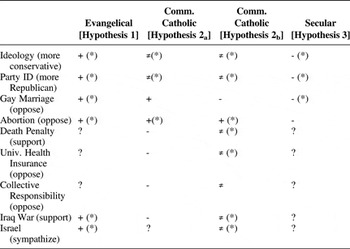
Our final hypothesis posits that secular and unaffiliated Latinos should also move in a direction similar to that of their white counterparts on political issues — toward the left on the “culture war” issues of abortion and gay marriage, and also to the left on general measures of political ideology and partisanship. As is the case for evangelical Latinos, the decision to move away from the Catholic Church to self-identity as religiously secular or unaffiliated is an active choice, and we expect to find that secular Latinos will also be moved by their attitudes about religion, as is the case with whites, to the left on “culture war” issues (Bolce and DeMaio Reference Bolce, De Maio and Wilson2007 and Reference Bolce and De Maio1999). In testing each of these hypotheses, we seek to determine if the worldview orientations of Latinos, be it secular, evangelical, or Catholic, has an isolated, similar, and predictable effect on Latino political attitudes. We provide a summary table of these expected relationships in Appendix D.
To study this effect, we utilized data from a 2007 joint survey conducted by the Pew Forum on Religion & Public Life and the Pew Hispanic Center. The survey was conducted from a sample of 4,016 Hispanic adults who were interviewed between August and October of 2006. Respondents had the option to complete the survey in English or Spanish, and the survey screened respondents through an initial ethnic screening question: “Are you, yourself, of Hispanic or Latino origin or descent such as Mexican, Puerto Rican, Cuban, Dominican, Central or South American, Caribbean or some other Latin American background?” The interviews were conducted nationally, with 32.9% of respondents living in the Northeast census region, 4.4% in the Midwest region, 37.0% in the South region, and 25.7% in the West region. While the sample is skewed toward those born outside the United States (949 respondents or 23.6% of the sample were born in the United States), the Pew dataset represents the most recent and comprehensive survey of Latinos which asks extensive questions on both religious and political behavior.Footnote 1
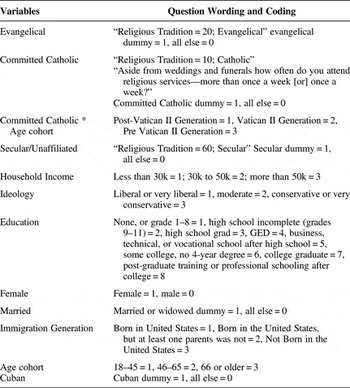
The three religious variables of interest — Evangelical, Committed Catholic, and Secular — were operationalized through religious self-identification questions. “Committed Catholics” included those who self-identified as Catholics and responded that they attended mass on a weekly or more frequent basis. We also added an interaction term — Committed Catholic * Age cohort — to study the effects of generational differences within the Catholic Church which center around the reforms created by Second Ecumenical Council of the Vatican, or Vatican II. Accordingly, this interaction term utilizes the same methodology as Mockabee (Reference Mockabee and Wilson2007, pp. 95–96) and divides Latino Committed Catholics into three generational cohorts: Pre-Vatican II (born before 1941), Vatican II (born between 1941 and 1960), and post-Vatican II (born after 1960). Together, we think the performance of these religious variables will demonstrate how Latinos from different faith traditions think politically on different kinds of political issues and they will allow us and others to contrast Latino religious adherents with the political behavior of their white and black counterparts.Footnote 2
In our analysis, we include the standard controls for household income, education, gender, marital status, and age. We also add controls that other scholars of Latino political behavior customarily include in their analyses: Immigration Generation (to control for the effects of being foreign-born, first generation native-born, or second generation native-born) and, like Jones-Correa and Leal (Reference Jones-Correa and Leal2001), we control for the effects of national origin through a Cuban dummy variable (given the unique nature of the Cuban population's traditional affinity for the Republican Party and political conservatism relative to other Latinos). Finally, to control for the effects of political orientation and isolate the impact of religiosity, we include an ordinal measure of political Ideology, which utilized as self-identification question where respondents were re-coded as ‘1’ for “liberal” or “very liberal,” ‘2’ indicating “moderate,” and ‘3’ indicating “conservative” or “very conservative.” Both political Ideology and Party Identification are also included as dependent variables. As with Ideology, Party Identification was coded through a self-ID question which asked respondents which political party they identified with or leaned closer to, and were re-classified on an ordinal scale, ‘1’ indicating “Democrat,” ‘2’ indicating “Independent,” and ‘3’ indicating “Republican.”Footnote 3
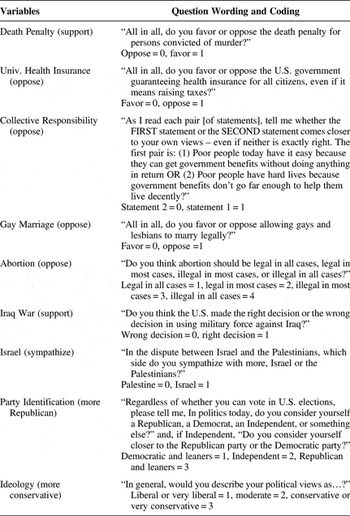
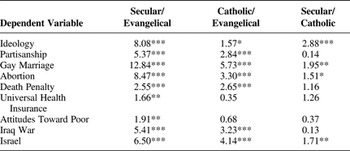
Respondents' attitudes on specific issues were operationalized through a series of questions on seven political topics, some of which are issues on which the positions of the Catholic Church are rather clear but likely diverge with positions expressed by evangelical leadership (we call these ‘Catholic Issues,’ and include universal health care, the death penalty, and attitudes on the poor and collective responsibility); and others on which the social theological positions of both Catholics and evangelicals are virtually aligned (we call these ‘Manhattan Issues,’ and include opposition to the legalization of gay marriage and abortion).Footnote 4 We also include two questions on foreign policy issues: views on the Iraq War and sympathy with Israel or Palestine. All of these general and specific measures (nine in total) of political attitudes and behavior are coded so that higher values indicate the conservative position. To study the determinants of Latino political behavior, we utilize ordered probit multivariate analysis to study Political Ideology, Party Identification, and attitudes on abortion, since these three dependent variables are measured on an ordinal, non-binary scale. We use logit multivariate analysis for the remainder of these political measures, since each are measured on a binary scale. In addition, we report the results of Gujarati and Porter's (Reference Gujarati and C. Porter2009, pp. 246–248) tests of equality of regression coefficients between our religious variables to determine the extent of the political cleavages between these groups, measured as t-scores, in Appendix E.
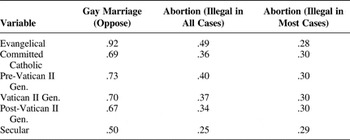
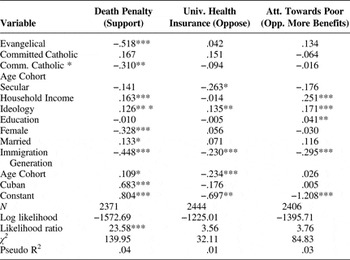
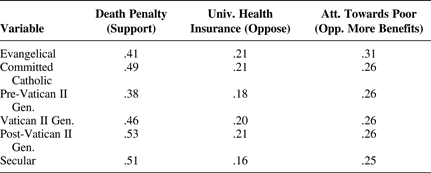
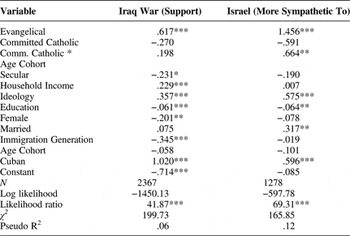
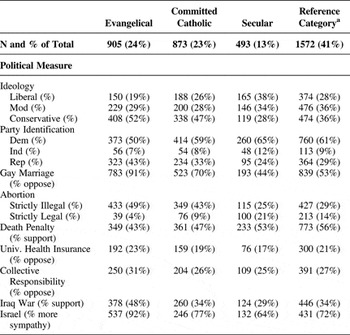
More precise coding of our independent and dependent variables can be found in Appendices A and B. Appendix C provides summary statistics and crosstabs for the religious variables of interests and the dependent measures of political behavior. In our sample, fully 23% of Latinos are regularly attending Catholics, followed by evangelicals (24%) and then seculars (13%). It also appears on the surface that there are clear fault lines of the “culture war” for Latinos, with Latino evangelicals on the right, Latino seculars on the left, and committed Latino Catholics dispersed along the political spectrum. However, the summary statistics suggest that among Latinos, more regularly attending Catholics are closer to church teachings on these political items than our reference category, as a greater percentage of committed Catholics oppose gay marriage, oppose the legality of abortion, hold a more generally politically conservative ideology, and espouse views in opposition to the death penalty. Of course, to establish a causal connection between Latino religiosity and political attitudes, multivariate analysis is necessary, which we provide in Tables 1–4. In addition to utilizing logit or ordered probit multivariate analysis for each of our nine dependent variables, we also report predicted probability values in Tables 1–4. The predicted probability values represent the overall probability that a member of each faith tradition will correspond with the highest value of the dependent variable (which represents a political measure), with that faith tradition set at ‘1,’ the other faith traditions set at ‘0,’ and all other variables set at their statistical mean.
RESULTS
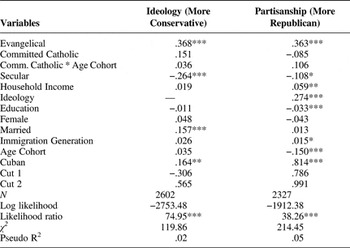
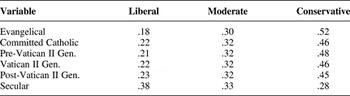
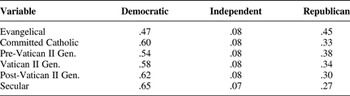
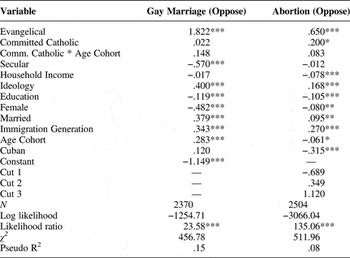
These models test the determinants of Latino political behavior operationalized through two measures of general political ideology and partisanship (Tables 1A–1C), as well as measures of attitudes on seven specific political issues. Those seven issues were divided into three categories in Tables 2–4: Tables 2A and 2B include the ‘Manhattan’ issues of gay marriage and abortion, on which Catholic and evangelical advocacy converge, unlike ‘Catholic’ issues (in Tables 3A and 3B), on which the Catholic Church, unlike the evangelical community, has advocated unambiguous political stances (the death penalty, collective responsibility for the poor, and universal health care). Finally, Tables 4A and 4B provides determinants of Latino attitudes on two foreign policy issues: support for Israel and the Iraq War. As a diagnostic measure of our analyses, we employ and report likelihood ratio tests. The results of these tests indicate that our models generally perform well, as the likelihood ratio in seven out of nine of our models is statistically significant at the .01 level.
The Determinants of Latino Political Ideology and Partisanship (Ordered Probit Models)

Notes: *, **, *** denotes significance at the .10, .05, and .01 levels (one-tailed tests).
The Determinants of Latino Political Ideology (Predicted Probabilities)

Notes: Values may not total 100 due to rounding.
The Determinants of Latino Political Partisanship (Predicted Probabilities)

Notes: Values may not total 100 due to rounding.
The Determinants of Latino Attitudes on ‘Manhattan Issues’ (Logit and Ordered Probit Models)

Notes: *, **, *** denotes significance at the .10, .05, and .01 levels (one-tailed tests).
The Determinants of Latino Attitudes on ‘Manhattan Issues’ (Predicted Probabilities)

Notes: Values may not total 100 due to rounding.
The Determinants of Latino Attitudes on ‘Catholic Issues’ (Logit Models)

Notes: *, **, *** denotes significance at the .10, .05, and .01 levels (one-tailed tests).
The Determinants of Latino Attitudes on ‘Catholic Issues’ (Predicted Probabilities)
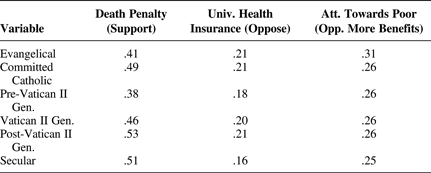
Notes: Values may not total 100 due to rounding.
The Determinants of Latino Attitudes on the Iraq War and Israel (Logit Models)

Notes: *, **, *** denotes significance at the .10, .05, and .01 levels (one-tailed tests).
The Determinants of Latino Attitudes on the Iraq War and Israel (Predicted Probabilities)

Notes: Values may not total 100 due to rounding.
Among Latinos, controlling for SES factors and political ideology, religiosity has the greatest political impact on evangelicals, followed by those who are secular or unaffiliated and committed Catholics. The religious tradition of evangelical Latinos is a statistically significant factor in both of our measures of general political behavior (ideology and partisanship) and in five of our seven measures of specific attitudes on political issues. Utilizing predicted probabilities for our ordered probit models on political ideology and partisanship, evangelical Latinos are 24% more likely than secular Latinos, and 6% more likely than committed Catholic Latinos, to identify themselves as ideological conservatives, and are 12% more likely than committed Catholic Latinos and 18% more likely than secular Latinos to be Republicans. The partisan and ideological cleavages between evangelical Latinos and both committed Catholic Latinos and secular Latinos is statistically significant, and on these general measures of political attitudes, evangelicals are moved significantly to the right. Conversely, secular Latinos are moved to the partisan and ideological left relative not only to evangelical Latinos, but also to the reference category. As seen in Table 1A, secular Latinos, even in the presence of demographic, socioeconomic, and political controls, are more Democratic and ideologically liberal. Such an effect is not found for committed Catholic Latinos in general or for either Vatican II age cohort, as neither variable is significant in affecting political ideology or partisanship. However, relative to their secular counterparts, committed Catholic Latinos are more ideologically conservative, though no more Republican (Table 1C).
The pattern we find between Latino religiosity and general political attitudes largely continues in our analysis on seven specific political measures, as evangelical Latinos are moved to the right on five and secular Latinos to the left on three, while the effects of Catholicism (operationalized through both general commitment and the generational effects of Vatican II on committed Catholics) has a rightward effect on two political items and a leftward effect on one such item. On the central “culture war” issues of gay marriage and abortion, which we label ‘Manhattan’ issues, we find in Tables 2A–2B that religious orientation is a significant factor in affecting Latino political attitudes. Evangelical Latinos diverge substantially from secular Latinos on both of these issues, as evangelical Latinos are 42% more likely to oppose gay marriage and 24% more likely to oppose legal abortion in all cases than their secular counterparts. While committed Catholic Latinos are unaffected on the issue of gay marriage relative to the reference category (which consists primarily of less committed Catholics), they are statistically distinct from secular Latinos on both of the ‘Manhattan’ issues, in adherence with the “culture war” thesis. Committed Catholic Latinos are 19% more likely than their secular counterparts to oppose gay marriage, and 11% more likely to believe that abortion should be illegal in all cases. While committed Catholic Latinos are also moved to the right on abortion relative to the reference category, this effect is weaker than is the case for their evangelical counterparts, as committed Catholic Latinos remain 13% less likely than evangelical Latinos to espouse a view in opposition to legal abortion in all cases.
If Catholicism were to have a greater effect than evangelicalism on Latino political behavior, we hypothesized that it might occur on the ‘Catholic’ issues of the death penalty, universal health insurance, and collective responsibility attitudes, measures on which Church teachings are less ambiguous and receive more emphasis in the Catholic church (particularly in the Latino community) than in the evangelical community. However, our analysis produces contrary results (as seen in Tables 3A–3B). On these three specific issues, religion is a less robust factor, with evangelical Latinos moved in opposition to the death penalty, secular Latinos moved in support of universal health insurance, and committed Catholic Latinos who are members of the pre-Vatican II and Vatican II generations moved in opposition to the death penalty. This result supports Mockabee's (Reference Mockabee and Wilson2007) finding that older Catholics, particularly those of the pre-Vatican II generation, are more adherent to Church positions on political issues. In our analysis, committed Catholic Latinos who are members of the Vatican II generation are 7% more likely than their post-Vatican II counterparts to oppose the death penalty, while pre-Vatican II committed Catholic Latinos are 8% more likely than their counterparts in the Vatican II generation to oppose the death penalty.
Finally, we examine how Latino religiosity affects political attitudes on two foreign policy issues — Israel and the Iraq War — in Tables 4A–4B. Almost to the same extent as found regarding ‘Manhattan’ issues, we find a major divergence between evangelical and secular Latinos in their attitudes on both foreign policy issues. Evangelical Latinos are 20% more likely than secular Latinos to support US involvement in Iraq, and 21% more likely to sympathize more with Israel than Palestine. Evangelicalism is also a robust factor in our combined model of Latinos (Table 4A) in boosting support for the Iraq War and sympathy with Israel. This finding provides evidence that evangelical Latinos, like their white counterparts, are perhaps influenced by dispensationalism, which emphasizes the unique role of Israel in biblical prophecy as well as US intervention in the Middle East on behalf of Israel (Wald and Calhoun-Brown Reference Wald and Calhoun-Brown2007, p. 280; Fowler et al. Reference Fowler, Hertzke, Olson and Dulk2010, p. 129). Evangelical Latinos are unique among Latino religious groups on this point; indeed, committed Catholic Latinos behave more like secular than evangelical Latinos on these foreign policy issues, as committed Catholic Latinos are 16% less likely than evangelical Latinos to support the Iraq War, and 13% less likely to sympathize more with Israel than Palestine. Secular and committed Catholic Latinos are virtually statistically indistinguishable groups on their support for the Iraq War. However, in examining committed Catholic Latinos along generational lines, we find that older committed Catholic Latinos, especially those of the Pre-Vatican II generation, are more likely to sympathize with Israel.
Overall, these results strongly support our first hypothesis, that we should find the religiosity of evangelical Latinos should move them to the political right to a significant degree in accordance with the “culture war” thesis. In six of our nine political measures, we find such a relationship exists for evangelical Latinos, and that these relationships are in the expected direction (to the political right on ideology, partisanship, gay marriage, abortion, the Iraq War, and Israel). Conversely, our findings reveal a major consequence of being secular or unaffiliated in five out of nine of these items, moving them to the left on all five (ideology, partisanship, gay marriage, universal health care, and the Iraq War), supporting our third hypothesis. However, secularism was not a robust factor in our abortion model, as we hypothesized. Further, we found that the political cleavage between evangelical and secular Latinos exists not only relative to the reference category, but also between the two groups. Our tests of equality of regression coefficients between evangelical and secular Latinos on these political items measures reveal statistically significant differences between these two groups all of our nine measures (see intergroup t-scores reported in Appendix E). Thus, our findings indicate that the shared religious or irreligious affiliation of white and Latino evangelicals and seculars have a common political effect across racial and ethnic lines.
We divided our second hypothesis regarding Latino Catholics into two parts, one (H2a) emphasizing congruence between Latinos and the Catholic Church, based on strong Latino Catholic religious practices, and the other (H2b) emphasizing incongruence between Latinos and the Catholic Church based on historic tensions between the two, and positing a null effect between religiosity and political behavior for committed Catholic Latinos. Overall, our results find more support for H2b than H2a, as the effect of religiosity on political behavior is more muted for committed Latino Catholics than for either their evangelical or secular counterparts. In our combined model of all Latinos (Tables 1A–4A), we find that Catholicism has no effect on either of our general political measures of ideology and party identification. On our specific political measures, religiosity does have an effect for committed Catholic Latinos on their abortion attitudes, which is not surprising given the Catholic Church's substantial and sustained emphasis on abortion as a moral and political issue. Like Mockabee's (Reference Mockabee and Wilson2007) analysis of white Catholics, we find that generational differences — based on proximity to the changes in the Catholic Church brought about by Vatican II — between committed Latino Catholics have political implications. We find that Vatican II generational cohort matters for attitudes on the death penalty and Israel, with older committed Catholic Latinos more likely to oppose the death penalty and sympathize more with Israel than Palestine. The religiosity of committed Latino Catholics, however, has no effect on attitudes about universal health insurance or collective responsibility for the poor; two issues on which the Catholic Church has made a clear stance as well as positions which we hypothesized in H2a would resonate more strongly with Latino Catholics than white Catholics given different socioeconomic, ethnic, and theological contexts. On these issues, however, this is not the case.
However, while we find important political cleavages between committed Latino Catholics and both their evangelical and secular counterparts, it is important to note that their intergroup differences with evangelicals are primarily differences of amplitude, while for seculars it is a difference of direction. In essence, regarding abortion, gay marriage, and ideology, committed Catholic and secular Latinos have placed themselves in the orthodox and progressive camps of the so-called culture war, although this rightward effect is far more substantial for evangelical than committed Catholic Latinos. Testing for equality of regression coefficients between all three faith traditions, we see that evangelicalism matters more than Catholicism and secularism in explaining Latino political behavior. Indeed, there is always a statistically significant difference between the marginal impact of evangelicalism and that of secularism and almost always a significant difference between the marginal impact of evangelicalism and Catholicism for Latinos (see Appendix E).
For Latinos, then, we find that evangelicalism is far more effective in translating religious values, teachings, and beliefs into a substantial factor of the political behavior of its affiliated members than Catholicism on these shared political positions. This is true even on issues like the death penalty, on which evangelical Latinos are 8% less likely to support the death penalty than committed Catholic Latinos despite the Catholic Church's body of teachings on “culture of life” issues. These findings also suggest that Catholicism has a similar effect on the political behavior of Latinos as it does for whites. Among Catholics in general, Smith (Reference Smith2008) found that frequency of mass attendance was a factor in increasing specific conservatism on abortion, stem cell research, and birth control (but not gay marriage); increasing specific liberalism on the death penalty and health care (but not the Iraq War); and, as with their Latino counterparts, their Catholicism failed to have an effect on either political ideology or partisanship. Thus, for Latino Catholics, we find that religiosity does not have a “spillover” effect (Peterson Reference Peterson1992) either to the degree or in the direction as is the case for Black Protestants, for whom religiosity has a leftward effect on general and specific political behavior (McDaniel and Ellison Reference McDaniel and Ellison2008). Further research utilizing standardized survey measurements for both white and Latino Catholics will be needed to explore this question in greater depth, but our findings indicate that the religious differences between white and Latino Catholicism in the United States do not — at least yet — create differences in political behavior.
CONCLUSION
The influence of religiosity on political behavior is an immensely complex relationship, and this is no less true in studying Latino evangelicals, Catholics, and seculars. The role of religious or irreligious worldviews is but one determinant of Latino political behavior in addition to standard SES factors and racial and ethnic components, but this article has found that it is not only a significant factor, but a factor which varies dramatically in both direction and size based on religious tradition and commitment. From a review of existing literature, we expected to find varying effects on the political behavior of Latinos based on their religious or irreligious views. Accordingly, this article presented three hypotheses: first, religiosity should increase the general and specific political conservatism of evangelical Latinos; second, either Catholicism should move Latino political attitudes in greater congruence with the positions of the Catholic Church — positions which diverge between left and right on the political spectrum (H2a), or Catholicism should have a muted political effect given the incongruous tradition between Latinos and the hierarchy of the Church (H2b); and third, the irreligious views of secular/unaffiliated Latinos should decrease their general and specific political liberalism. This article's findings confirmed the first and third of these hypotheses and found mixed results in support of the latter part of our second hypothesis (H2b). This in itself is an interesting finding, as our results support the claim that Latino Catholicism, despite its distinctiveness, has not “spilled over” into substantially altering the political behavior of its adherents in a direction either closer to or away from Vatican teachings. Despite an added emphasis on social justice issues within Latino Catholicism, our models found no significant relationship between religiosity and support for universal health care, collective responsibility, the death penalty, or the Iraq War for committed Catholic Latinos (although Latinos who were members of the Vatican II and pre-Vatican II generations were more likely to oppose the death penalty, in line with Church teachings). However, despite Catholicism's minimal effects for Latinos, committed Catholic Latinos remain distinct from their secular counterparts because secularism, in our models, has a substantial leftward effect on the political behavior of Latinos. Thus, in comparing intergroup differences between secular and committed Catholic Latinos, we found an important “culture war” division between Hunter's (Reference Hunter1991) orthodox and progressive camps, respectively. Our finding that secular Latinos are driven by their irreligious identity to the left on at least five of the items we studied supports and expands Bolce and DeMaio's claim (Reference Bolce and De Maio1999 and Reference Bolce, De Maio and Wilson2007) that secularism is itself an identifiable and additive factor rivaling and surpassing other religious affiliations over the thinking and behavior of people. In comparing the rival effects of all of our faith traditions, the relationship between religiosity and political behavior was far stronger — both in the number of measures in which there existed a statistically significant relationship and in degree of meaningfulness — for evangelical Latinos than for secular/unaffiliated Latinos and committed Catholic Latinos. Evangelicalism is the most potent worldview force in conservatizing Latino political attitudes, with secularity and Catholicism influential to a lesser degree as well. Finally, we find that religiosity has a diminished and alternate effect on political behavior for Latino Catholics than is the case for Black Protestants. Religiosity has a minimal “spillover” effect for Latino Catholics, moving them to the political right on abortion, while religiosity has both a leftward effect on general and specific measures of political behavior for Black Protestants.
Further research will be needed to study how alternate measures of the depth of religious commitment in each of these traditions affects Latino political attitudes and ideology, but this research confirms the general relationship between religiosity and political behavior for Latinos, but adds that both the category of religious tradition and the depth of commitment to that tradition matters a great deal in the Latino community. Perhaps the most important implication of our findings is that, while political commentators often paint Latinos with a broad brush, i.e., “the Latino vote,” Latino political behavior may not be nearly as cohesive as conventional wisdom holds. Indeed, fractures within the bloc of Latino voters may exist primarily along religious lines, and given the departure of Latinos from the Catholic Church (Kelly and Kelly Reference Kelly and Kelly2005), the influence of religion on political behavior will expand as a key factor in understanding Latino political behavior.
Variable Measurement (Dependent Variables)

Variable Measurement (Independent Variables)

Descriptive Statistics for Religious Variables

Notes: Percentages for each religious tradition on specific political measures are derived from the N of valid responses, not the total N.
aThe reference category is composed of survey respondents of all other religious affiliations (1152 non-Committed Catholics, 203 Mainline Protestants, 141 from another Christian denomination, and 76 from non-Christian religions). The 173 respondents who answered “don't know,” “refused,” or were ambiguous in their responses were excluded from our analysis.
Expected Direction of Relationships between Dependent and Religious Variables

Notes: (*) indicates that the expected relationship is supported by our results.
“ + ” indicates that a positive relationship was expected.
“-“ indicates that a negative relationship was expected.
“ ≠ ” indicates that no relationship was expected.
“?” indicates that there were no expectations regarding the relationship.
Tests of Equality of Regression Coefficients between Religious Affiliation Groups

Notes: *, **, *** denotes significance at the .10, .05, and .01 levels (utilizing one-tailed tests). All values represent the t-scores of group comparisons between the two corresponding variable. To determine these t-scores, we conducted tests of equality of regression coefficients using Gujarati and Porter's (2009, pp. 246–248) equation: