“I thought science wasn’t for me, until I discovered political science.” This is a sentiment I often hear in the classroom. I empathize with students who belatedly stumbled into a niche of science, technology, engineering, and math (STEM) where they feel at home. I, too, once gritted my teeth through the customary biology, physics, and calculus offerings in high school—courses that, for whatever reason, did not inspire me. However, conducting political science research in college unexpectedly showed me how to apply the principles of STEM to questions about politics that fascinated me. It has done the same for many of the students that I now mentor.
Political science as a whole is methodologically and epistemologically pluralistic, but empirical subfields of political science can reasonably be classified as science. This is the official stance of the National Science Foundation (Gonzalez and Kuenzi Reference Gonzalez and Kuenzi2012, 2) in light of ongoing trends toward more “scientific” social science. At the same time, political scientists continue to negotiate various methodologies and epistemologies (e.g., quantitative, qualitative, positivist, and constructivist) (Lowndes, Marsh, and Stoker Reference Lowndes, Marsh, Stoker, Lowndes, Marsh and Stoker2018). This diversity and self-reflection enrich the discipline. In advocating for broader STEM education, I do not deny the value of interpretivist and theoretical curricula. Scientists’ quest to explain objective reality can occur alongside humanists’ efforts to interpret actors’ subjective meanings.
Like other STEM disciplines, empirical social science increasingly is concerned with drawing valid inferences from evidence. More and more, political scientists strive for (and top journals demand) rigorous explanations that are consilient, meaning that they conform with verified knowledge in other scientific disciplines and aim to capture all of the plausible events operating across different levels of causality (Wilson Reference Wilson1998). Like a biologist who understands the behavior of ants by studying the chemistry of pheromones, or a medical researcher who links a patient’s symptoms to cellular processes, it is no longer unusual for a political scientist to trace macro phenomena to fundamental tenets of evolution and psychology. For example, Homola, Pereira, and Tavits (Reference Homola, Pereira and Tavits2020) traced xenophobia in present-day Germany to cognitive dissonance among people who were directly exposed to Nazi institutions and who then transmitted their psychology to later generations. Using “hard” science, experiments, and statistics to elucidate the basic underpinnings of political phenomena by now is commonplace. This is a natural progression in our discipline because the human behaviors and institutions that occupy political scientists ultimately reflect epigenesis, which is a concept from biology referring to how an organism develops under the joint influence of heredity and environment (Wilson Reference Wilson1998, 210). Although pessimistic philosophers of science occasionally have doubted the possibility of bridging the natural and social sciences (Wilson Reference Wilson1998, 227), social scientists are clearly up to the task. Political science, in particular, has never been more scientific and mathematical in both the technical and the epistemological sense while keeping one foot firmly rooted in normative-philosophical traditions.Footnote 1 This has profound implications not only for advances in scientific knowledge but also for science education because it opens a new doorway to learning STEM.
Yet, undergraduate students frequently major in political science because they view it as an alternative to hypothesis testing, data analysis, and other aspects of STEM. In teaching a compulsory research methods course, I meet a cross section of those students who decided to quit math and science after high school and who admit that they would never study methods if it were not mandatory. These students represent the “leaky pipeline” in STEM education, a metaphor describing how people—notably girls, women, and minorities—drop out of STEM fields at each successive stage of the educational system (van den Hurk, Meelissen, and van Langen Reference van den Hurk, Meelissen and van Langen2019). The leaky pipeline is a problem insofar as it excludes groups from lucrative career paths and from enjoying human values that science reinforces—“integrity, diligence, fairness, curiosity, openness to new ideas, skepticism, and imagination” (Rutherford and Ahlgren Reference Rutherford and Ahlgren1990, 185). A voluminous literature examines how educational institutions might “patch” the leaks, from anti-bias training for STEM instructors to extracurricular enrichment programs (e.g., Gray and Albert Reference Gray and Albert2013; van den Hurk, Meelissen, and van Langen Reference van den Hurk, Meelissen and van Langen2019).
This article proposes a novel complement to those initiatives: promoting undergraduate research in political science can help to patch the leaky pipeline in STEM education. I am not insinuating that political science students will become biologists or chemists but rather that empirically minded political scientists are scientists in practice and in spirit. Undergraduate research in political science teaches a scientific skillset and mindset to students who might not access them by other means.
I am not insinuating that political science students will become biologists or chemists but rather that empirically minded political scientists are scientists in practice and in spirit.
My core argument is as follows: STEM advocates have overlooked political science as a way to promote STEM education, even though contemporary political science increasingly overlaps with other STEM disciplines. Nudging students who initially seem disinterested in STEM toward political science—a relatively diverse branch of STEM—is an untapped solution to the leaky pipeline. This article also addresses a caveat to my central argument: for political science students to enjoy the full benefits of a STEM education, political science curricula must provide opportunities for undergraduates to engage in hands-on research, not only passive learning. Political science departments can best patch the leaky pipeline by investing in more undergraduate research programs. This may take the form of recruitment drives, scholarships, curricular reforms, the creation of collaborative labs, and incentives for faculty to supervise research projects. Enhancing engaged learning in political science can solve a wider issue in STEM—namely, the challenge of attracting and retaining more numerous and diverse students.
Political science does not suffer from the same problems of getting students in the door as other STEM fields because college is a politically activating period that attracts many students to political science classrooms (Gismondi and Osteen Reference Gismondi and Osteen2017). Scholars have noted how colleges and universities animate social movements (Van Dyke Reference Van Dyke1998), nurture effective citizens later in life (Gismondi and Osteen Reference Gismondi and Osteen2017), and lend young adults social capital (Loader et al. Reference Loader, Vromen, Xenos, Steel and Burgum2015). To my knowledge, none of these scholars considered how a collegiate political awakening can fuel students’ desire to explain the political world and, as a byproduct, prime them for learning concepts foundational to STEM. This article contributes a template for harnessing undergraduate students’ natural curiosity about politics to get them excited about building theories, writing statistical models, evaluating evidence, practicing computer skills, and other facets of STEM.
Most undergraduate students did not encounter political science in high school. Political science, therefore, can “catch” students who opted out of traditional STEM fields before college. I draw on the thinking of John Dewey (Reference Dewey1910) and testimonials from former undergraduate studentsFootnote 2 to illustrate how conducting original political science research under supportive conditions may spark a deferred passion for scientific exploration.
Undergraduate research in political science has the potential to positively affect not only the enterprise of STEM education but also students’ experiences during and after college. It can accomplish this via two mechanisms: (1) by instilling intrinsically valuable habits of mind (e.g., diligence, curiosity, and open-mindedness); and (2) by imparting instrumentally valuable skills (e.g., critical reading, numeracy, data manipulation, computer programming, technical writing, and project organization) for students to apply in the workplace and postgraduate studies. This article concludes that participating in research is both a philosophically and a practically important part of a student’s intellectual development in college.
INCREASING POLITICAL SCIENCE ENROLLMENTS CAN DIVERSIFY STEM
Anxiety about the leaky STEM pipeline relates less to the overall number of STEM students than to the underrepresentation of women and racial minorities (van den Hurk, Meelissen, and van Langen Reference van den Hurk, Meelissen and van Langen2019). Political science faculty can address this concern with two related strategies: (1) by recruiting more students into a subfield of STEM that already is relatively diverse; and (2) by using undergraduate research labs to retain diverse students in political science.
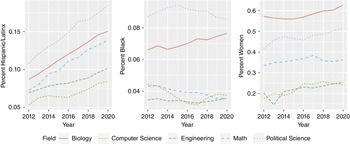
Political science is more diverse than other branches of STEM, notwithstanding continued roadblocks to diversity, equity, and inclusion in the discipline (Nonnemacher and Sokhey Reference Nonnemacher and Sokhey2022). Figure 1 displays data from the Integrated Postsecondary Education Data System (Mueller Reference Mueller2022) on bachelor’s degrees awarded between 2012 and 2020 in political science as well as four other subjects representing each element of STEM: biology (representing science), computer science (representing technology), engineering, and math. I chose biology instead of another natural science (e.g., chemistry or physics) because it was the most diverse. This allowed me to compare political science to the best-case scenario in terms of racial and gender diversity in the natural sciences. The first two panels in figure 1 show the annual percentage of degrees conferred to two historically underrepresented groups: Hispanic/Latinx students (left panel) and Black students (center panel). The third panel shows the percentage of degrees awarded to women at the five institutions that graduated the most degrees in a given field and year.
Diversity Trends in Undergraduate STEM Degrees
Data are from the Integrated Postsecondary Education Data System (Mueller Reference Mueller2022).

Hispanic/Latinx, Black, and women graduates are consistently better represented in political science than any other field (although absolute minority representation remains low), with the exception that women are better represented in biology. The percentage of Hispanic/Latinx and women political science graduates is climbing steadily but the percentage of Black graduates is not. Combined, these patterns imply that political science attracts more diverse students than other STEM disciplines and that adding more political science undergraduates may be a low-friction way to prevent STEM from “leaking” women and minorities. Of course, there may be reasons to be concerned about low diversity within individual STEM fields, which the literature on diversifying “STEM” in the aggregate tends to overlook.
Simply recruiting more students into political science classrooms does not prevent attrition. To retain diverse students, Nonnemacher and Sokhey (Reference Nonnemacher and Sokhey2022) suggest using a cornerstone of STEM: the research lab. The functional definition of “laboratory” has evolved from its strict etymological meaning of “labor” (from the Latin laboratorium) and its early use in reference to medieval workshops. Today, scholars of all stripes commonly say “lab” when referring to any “space of knowledge which primarily [serves] to establish new scientific facts” (Schmidgen Reference Schmidgen2021, 1). Social science labs are not stereotypical spaces with expensive instruments and staffed by researchers clad in white coats. They even can be virtual spaces for collaboration among scholars and students honing their research skills and seeking answers to overlapping questions, whether or not using experimental methods (Cetina Reference Cetina1999, 35). Although labs are associated more with the natural sciences, they increasingly are recognized in the social sciences as spaces that “foster community through professionalization and socialization events that encourage students to form personal connections with one another and faculty” (Nonnemacher and Sokhey Reference Nonnemacher and Sokhey2022, 414). Political science faculty can help to patch the leaky STEM pipeline by recruiting more students into already diverse classrooms and then using labs to keep them engaged. Some institutions, including the Political Physiology Laboratory at the University of Nebraska, are leading the way in this collaborative model of political science research (McDermott and Hatemi Reference McDermott and Hatemi2010, 51).
COLLEGE PRIMES STUDENTS TO THINK LIKE (POLITICAL) SCIENTISTS
Although children evince political orientations as early as primary school (van Deth, Abendschön, and Vollmar Reference van Deth, Abendschön and Vollmar2011), higher education exposes young people to unprecedented political stimuli (Crossley and Ibrahim Reference Crossley and Ibrahim2012). Colleges and universities facilitate communication among students of diverse backgrounds and offer a variety of voluntary civic organizations, from debate teams to student newspapers. They are notorious “hotbeds of activism” (Van Dyke Reference Van Dyke1998).
However, institutions of higher learning also engender less conspicuous forms of political consciousness and involvement that prime students for studying political science. The attitudes, values, and feelings that students absorb by discussing politics with their classmates and professors manifest not only externally (e.g., at a protest or in the voting booth) but also internally, as a hunger for explaining empirical variation in political phenomena. Undergraduate students may begin to question with greater urgency than earlier in their life: “Why do some people vote whereas others do not? What policies can effectively reduce income inequality?” Social science students exhibit pronounced “political attentiveness” compared with students in other majors (Hillygus Reference Hillygus2005, 28). Such attentiveness, forged in the context of first-hand political experiences and political material in the classroom, can motivate undergraduates to wield scientific tools for “scratching an intellectual itch.” Any personal question about how politics works is a possible research question.
Any personal question about how politics works is a possible research question.
Curiosity alone does not make a scientist. Students also need encouragement from faculty to channel their political interests into research projects. Undergraduate political science courses consist predominantly of dissecting secondary texts as opposed to analyzing primary data. Scanning syllabi that are available online reveals that exams and response papers vastly outnumber original research assignments. Conventional pedagogies still may have their place in a curriculum, but conducting primary research modeled on the scientific method is essential if political science is to serve as a back door to STEM—that is, because science blends innate curiosity with “principles of logical reasoning” (Rutherford and Ahlgren Reference Rutherford and Ahlgren1990, 5).
Completing an ambitious research project transforms an undergraduate student from a consumer to a producer of knowledge. A former student described this metamorphosis as follows:
I think my research helps my work as I’m able to formulate questions, find answers, and back up arguments with evidence to be persuasive and oriented toward results that are sound…. Focusing so intently on the research methods I employed for my thesis has allowed me to readily call to mind those same methods when I find myself in positions or conversations that present an opportunity for comparison.
Producing knowledge demands a different toolkit from taking an exam or composing a typical term paper. Some students find the scientific method constraining at first, but many come to embrace it; breaking down a project into steps can be less overwhelming than writing a lengthy paper with no prescribed roadmap. It also can be liberating for students to hear that the goal of science is uncovering “truth,” not being right.
Alumni recall how research taught them to push their cognitive limits and to welcome the discomfort of uncertainty as an opportunity to learn. One former student said, “Knowing that I’ve taken on a large challenge in the past, and saw it through successfully to the end…is one of the data points that to me lends legitimacy to my daily mantra that I can still do hard things.” Another chimed in, “What keeps me motivated is continual learning, and I learn more when I’m unfamiliar with the terrain but able to bring in processes or facts that support or oppose the new knowledge or scenario I’m presented with…. I learn best by being able to be engaged, ask questions, and identify pitfalls and solutions in the projects and places I’m moving through.”
College is great at making students think about politics; research experiences build on that foundation by helping them to think like (political) scientists. The following section elaborates on the importance of research in political science and STEM more broadly.
RESEARCH IS THE KEY INGREDIENT OF A STEM EDUCATION
John Dewey was among the fiercest advocates for infusing more science into school curricula. Although he conceded that all students should not be expected to master “specialized scientific matters,” he insisted that they leave school with “some idea of the kind of evidence required to substantiate given types of belief” (Dewey Reference Dewey1910, 126). He distinguished science as subject matter (i.e., information that scientists have already discovered) from science as method (i.e., tools for making new empirical discoveries). Only the latter, he asserted, could help students grow into high-functioning adults. Dewey’s contention relates to this current article because it highlights how a political science education must involve research if it is to patch the leaky STEM pipeline in a meaningful way. It is not enough for students to memorize the capitals of countries, recite the Gettysburg Address, or write down five different definitions of “democracy” on a final exam. Becoming a (political) scientist requires participating—however modestly and incrementally—in discovering fresh truths.
Dewey maintained that conducting research was a necessary component of students learning how to discern fact from “mere opinion or guess-work or dogma” (Dewey Reference Dewey1910, 125) and that the scientific method should not be confined to the natural sciences (Dewey Reference Dewey1910, 127). The volume of learnable information is boundless, and students have localized informational needs. As a result, educators tend to “oscillate, helpless, between arbitrary selection and teaching a little of everything” (Dewey Reference Dewey1910, 123). The only solution, Dewey held, was to teach students how to think original thoughts instead of drilling them on a jumble of facts.
Recent studies defend Dewey by confirming that a curriculum based on “science as method,” especially in collaborative lab-like environments, sets up students for lifelong interests in math and science and access to jobs in STEM fields. One longitudinal study found that underprivileged students who took project-based, active math classes demonstrated better mathematical comprehension and professional achievement as adults compared with students who experienced more passive curricula (Boaler and Selling Reference Boaler and Selling2017). Replicating such engaged learning in political science classrooms can open up the same long-term benefits of STEM education to students who have “slipped through the cracks” of orthodox STEM schooling.
More than a century after Dewey penned his reflections, US high school students who want to learn science as method still must generally take classes in the natural sciences. Curricular designers in the early twentieth century segregated the study of science from “social studies” (US Bureau of Education 1916). This decision made sense at a time before political science took its behavioralist turn in the 1950s and 1960s (Adcock Reference Adcock, Adcock, Bevir and Stimson2007), but it inadvertently sent students the message that scientists study a narrow set of questions about chemical reactions and planetary orbits rather than a more expansive set of questions about society. As a legacy of reformers writing political science out of secondary-school curricula, college often is the first time a student uses science, technology, and math to solve empirical puzzles about political behaviors and institutions. Undergraduate research in political science, therefore, is a late opportunity to expose nontraditional students to science as method.
As a legacy of reformers writing political science out of secondary-school curricula, college often is the first time a student uses science, technology, and math to solve empirical puzzles about political behaviors and institutions.
Colleges and universities can patch the leaky STEM pipeline by funding summer research grants not only in chemistry and physics but also in political science. This might involve giving political science faculty teaching credit for supervising independent projects or helping political science departments to set up labs for collective research. These options are not limited to large research universities. For example, Haverford College counts the supervision of senior theses toward the faculty teaching load,Footnote 3 and the Collaborative Summer Research Program at Macalester College provides stipends and project expenses to students who are working on research with their professors.Footnote 4
CONCLUSION
Few of my students go on to become professional scholars, yet many express gratitude for their enduring ability to think like scientists. One said, “I do not consider myself a scientist but I do consider myself an empiricist…because I believe in utilizing the scientific method the best we can to understand the world and because I believe that any conception of truth or understanding about the world must come from evidence.” This alumnus is now a policy analyst working on projects that are substantively unrelated to his senior thesis on the Libyan arms trade. It is not the information that he learned in college that paid the biggest dividends personally and professionally but rather the mental agility. In vindicating Dewey, Google and Wikipedia obviate the need to remember lists of facts, and in-demand job skills change by the minute as a result of innovation and automation. Modern economies thus reward advanced technical dexterity and the capacity to quickly learn difficult material, whereas knowing a lot of information is less important.
It is trite to tout STEM education as a career advantage. I hope to convey, moreover, that a scientific life is personally fulfilling because it cultivates “highly regarded human values” (Alberts Reference Alberts2022, 149) such as awe, industry, healthy skepticism, and intellectual humility. All of these instrumental and intrinsic benefits are available to political science students without requiring that they pursue advanced methodological training in graduate school. However, passive learning does not grant full access; only hands-on research does. As Dewey (Reference Dewey1910, 127) quipped, “When our schools truly become laboratories of knowledge-making, not mills fitted out with information-hoppers, there will no longer be need to discuss the place of science in education.”
DATA AVAILABILITY STATEMENT
Research documentation and data that support the findings of this study are openly available at the PS: Political Science & Politics Harvard Dataverse at https://doi.org/10.7910/DVN/596TQ4.
CONFLICTS OF INTEREST
The author declares that there are no ethical issues or conflicts of interest in this research.