The nature of the relationship that a group maintains with the object of representation seems to be a valid operator for reporting the processes associated with constitution, functioning, dynamics and regulation of social representations (SR). Such relationship was explored particularly through the concept of social practices (Abric, Reference Abric1993, Reference Abric1994; Guimelli, Reference Guimelli1994, Reference Guimelli1998a). The latter would condition the constitution itself of SR (Flament, Reference Flament and Jodelet1989; Flament & Rouquette, Reference Flament and Rouquette2003; Sà, Reference Sà1994). Social practices play a fundamental role in the dynamics of SR. For instance, Guimelli (1998) demonstrates that the development of social practices constitutes a way for SR to be modified.
Some definitions associated with social practices put in evidence that they are action systems or behaviours that need to be considered in association with their impregnation in the social (Flament, Reference Flament and Moliner2001; Jodelet & Moscovici, Reference Jodelet and Moscovici1990). In fact, this approach suggests that the system is more than the addition of its elements as social practices are socially influenced and anchored. They thus constitute a “structure of reason” (Sà, Reference Sà1994, p. 44). In his critical work on the relationship between social representations and social practices/behaviours, Abric (1994, p. 220) argues that there's necessity to take into account (1) an “active subject” that contributes to the construction of the reality, who pre-decodes the reality, who anticipates and produces his expectations with the help of representations (Abric, Reference Abric, Deaux and Philogène2001a); (2) the cultural context of knowledge and behaviours - with the help and by the “cultural matrix of interpretations” (Grize, Vergès, & Silem, Reference Grize, Vergès and Silem1987); (3) the fact that the behaviours of individuals can't be separated from the value system that produces the meaning's for action.
Relationships between social representations and practices are extremely complex and the product of numberless factors far from being unequivocal and unidirectional (e.g., Abric, Reference Abric1994; Guerin, Reference Guerin1994; Miguel, Valentim, & Carugati, Reference Miguel, Valentim and Carugati2013; Sà, Reference Sà1994; Wagner, Reference Wagner1993).
Nevertheless, the notion of social practices – usually used as a synonym of behaviours – fails to contain a more global perspective concerning the relationship between object and individual (or groups) in the context of SR studies (Dany & Abric, Reference Dany and Abric2007). To overcome this inherent limitation of the single consideration of social practices, it appears necessary to develop a more global perspective beyond the role of social practices to explain the socio-cognitive regulation of the social representations contents. One heuristic option is to delimitate how different symbolic positions of individuals and social groups are anchored in specific socio-cognitive dynamics. In this line, we need to elucidate the social positions that individuals occupy in the social space (cf. Doise, Clémence, & Lorenzi-Cioldi, Reference Doise, Clémence and Lorenzi-Cioldi1992; Miguel, Valentim, & Carugati, Reference Miguel, Valentim and Carugati2012).
Different perspectives have been developed to explore the role of psychosocial factors in the regulation (differential activation of the components of SR), and transformation of SR. Some of these perspectives have centred their approach toward the role of permanent modification in which behaviours take place (Guimelli, Reference Guimelli1994), the role of personal involvement (Gruev-Vintila & Rouquette, Reference Gruev-Vintila and Rouquette2007); the level of knowledge (Lo Monaco & Guimelli, Reference Lo Monaco and Guimelli2008), or the degree of proximity (Miguel et al., Reference Miguel, Valentim and Carugati2012).
A recent theoretical option, called “distance to the object” - DO (Abric, Reference Abric2001b; Dany & Abric, Reference Dany and Abric2007), has been developed to explore the role of certain psychosocial factors in addition to the study of behaviours and social practices. DO is constituted by 3 components: Knowledge: more or less adequate identification of the social object; involvement: the degrees of concern, thru social participation, toward the social object; level of practice: behaviours regarding the social object. Knowledge refers to the more or less good identification of the object by the individual. Involvement could be compared with the relationship the individual has with the object or the extent to which he feels concerned about it, or his positioning on an “observer”/“actor” axis with regards to the object. The development of this variable requires a preliminary analysis of relevant psychosocial factors that permit to account for the higher involvement vis-à-vis of the object. An individual measure of the involvement is not be sufficient, we also need a social perspective to measure the involvement (e.g., social regulation and stakes associated to the object). Finally, the level of practice is associated to the practices (considered as behaviors) developed vis-à-vis the object. The fact of looking at the object from the point of view of distance can enable to operationalize “the nature of social integration of the group in a given context” (Abric & Tafani, Reference Abric and Tafani1995, p. 31). DO allows for considering actualization of cognitive functioning in respect of social regulations operating in a given context (cf. Doise, Reference Doise, Doise and Palmonari1986). It permits to “contextualize” the relation to an object by revealing the specific social regulations operating at a given level as well as the actualization of cognitive functioning at that level.
The concept of DO has various implications. It first supposes that each individual can be positioned regarding his own degree of distance with the social object, it then underlines that each position can be regulated by social and psychosocial variables and it finally stresses that the relationship with the SR object is contextualized. Each potential position specifies the relationship that individuals (or groups) have with the social object. This position has implications on the social representation associated with the object because position produces different activations of the contents of SR. This perspective varies from others who define the “proximity” or the position of individuals or groups a priori (Miguel et al., Reference Miguel, Valentim and Carugati2012). In this sense, DO can constitute a way to analyse “segmentation” (Bauer & Gaskell, Reference Bauer and Gaskell1999). In other words, DO can elucidate, “how do we specify appropriate social segments for the study of social representations” (p. 176). This segmentation can be realized ex-post facto in taking into account the outcome of the study, and propose to “look beyond the traditional forms of social segmentation” and could “defined social milieu that would offer possibilities for the comparative analysis of common sense” (Bauer & Gaskell, Reference Bauer and Gaskell1999, p. 176) Footnote 1 .
Adopting this conceptual proposition, a first research on SR of cannabis (Dany & Abric, Reference Dany and Abric2007) empirically validated this theoretical proposition by demonstrating that DO can mobilize different SR dimensions. In this study we can observe specific and oriented regulations of SR dimensions depending on DO orientation. Orientation can be viewed as a continuum, ranging from maximum to short distance (from close to distant). People who are close to cannabis activate more the elements of the representation that relate to the effects expected from cannabis. These effects are related to personal experience and to sociability (e.g., cannabis permit to “forget problems”, “have fun”, “relax” or “meet friends”). People who are considered as distant to the cannabis activate more the elements associated to the pharmacological and social dangerousness of the cannabis (e.g., “Cannabis is a dangerous drug for health”, “You can become addict to cannabis”).
To resume, these results highlight that people considered as distant activated more normative SR components (i.e., linked to values, norms or stereotypes highly salient within the group, components issued from the value system of individuals that determine judgments and taken positions related to the social object), and people who are close rather activated the functional SR components (i.e., concerns the instrumental relations individuals maintain with the object of representation, components associated with descriptive characteristics and with the inscription of the social object in social or operatory practices), thereby consolidating earlier findings (Abric & Tafani, Reference Abric and Tafani1995; Guimelli, Reference Guimelli1994, Reference Guimelli1998b).
This representational construction can be interpreted as the indicator of a “defensive” attitude (Apostolidis & Dany, Reference Apostolidis and Dany2012; Dany & Abric, Reference Dany and Abric2007; Dany & Apostolidis, Reference Dany and Apostolidis2002) to mitigate the negative social stigmatization of the cannabis use (e.g., cannabis use as a deviant and dangerous practice, sociopolitical problems produces by the cannabis use). More generally, this representational construction of the cannabis can be considered as a sociocognitive strategy that permits to neutralize the risks of social stigmatization (association to the image of the drug's addict).
This study aims to validate the structuring role of DO in SR regulation by replicating the research conducted by Dany and Abric (Reference Dany and Abric2007). We chose to work on SR of cocaine, because cocaine is a social object that can be considered close to cannabis with a greater level of normative issue. The differences concerning this normative issue can be apprehended, for example, by taking into account that cannabis is the most used illicit drug. Nearly 13.4 million of French (aged 11–75 years) have experienced the cannabis (Tovar, Reference Tovar2013). The experimentation of cocaine is about ten times smaller than cannabis. A large proportion of French (85%) believe that cocaine is a dangerous drug from its first use (Tovar, Reference Tovar2013). They are only 54% for cannabis. Six out of ten French believe that use of cannabis could be authorized under certain conditions (Tovar, Reference Tovar2013). In addition, more than eight in ten French (83%) believe that cocaine users are dangerous to their family and friends and are responsible of their consumption (cf. they are not agree to taking into account the pretext of illness or difficult family history to explain this behaviour). Indeed, despite similar characteristics (illegal status, influence of social thinking in the definition of these products as ”drugs”), in comparison with cannabis in France the consumption of cocaine is more apprehended as deviant practice than cannabis consumption.
We hypothesize that distance to cocaine should exert a differential role concerning adhesion to SR dimensions of cocaine. Our hypothesis is that the distance to the object should engage regulation processes differentiated from the elements of the representation of cannabis. These differences must be explained - in the sense that they contribute to find meaning - by the very nature of this distance and the underlying psychosocial stakes for groups positioned vis-à-vis this object. Furthermore, it can be expected that individuals “close” to cocaine primarily activate the functional elements of the representation and that individuals “distant” from cocaine would rather activate the normative elements.
Method
The sample of the current study is made up of 200 university students (66.8% girls) that are between 18 and 48 years old (M = 21.8). Less than a quarter of students (22%) have a job. The data for this study came from a questionnaire completed by university students. We have chosen University students because it’s not a socially homogeneous group (there be social variation across university students) and because the experimentation of the cocaine is more important in young adult population (cf. Tovar, Reference Tovar2013).
The questionnaire included 34 opinions about cocaine presented on 6 point rating scales. Participants were invited to express their agreement degree with those opinions (from 1: totally disagree to 6: totally agree). At a first step, we kept the set of opinions. These opinions were derived from a content analysis conducted on structured interviews (n = 31). In a second step we explored the organization of these opinions with statistical analyses (cf. Results).
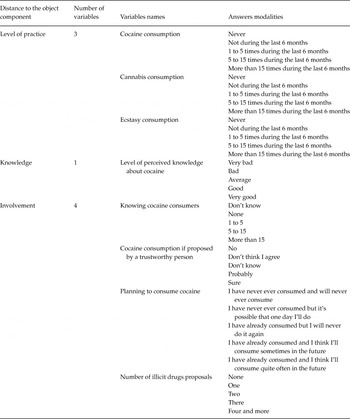
The questionnaire also included DO items: 3 of them concerned the level of practices and were linked to illicit drug consumption. The choice of the experimentation of psychoactive drugs other than cocaine is related to the multifactorial reality of psychotropic substance consumption. This reality imposes not to take into account an atomized behaviour but rather a range of behaviours that are able to report the dynamic and signification of practices (Dany & Abric, Reference Dany and Abric2007) Footnote 2 .
Besides, consuming a kind of psychoactive substance can influence the way of representing and categorizing other kinds of psychoactive substances (Aquatias, Maillard, & Zorman, Reference Aquatias, Maillard and Zorman1999; Dany & Apostolidis, Reference Dany and Apostolidis2002; Ingold & Toussirt, Reference Ingold and Toussirt1998). The knowledge item was represented by a self-reporting question evaluating not the level of objective or objectivized knowledge, but one’s own perception of the level of appropriation of the object. Finally, four variables were selected to represent involvement toward cocaine. One variable concerns the fact of knowing cocaine consumers as some researches demonstrate that contact with consumers pushes to renegotiate the signification lent to substances (Beck & Peretti-Watel, Reference Beck and Peretti-Watel2000; INSERM, 2003). The second variable deals with probability of cocaine consumption if proposed by a trustworthy person. Planning to consume cocaine is the third variable due to the unavoidable temporal inscription of the object that could testify an important commitment toward it. The last variable is the number of illicit drug proposals (Table 1).
The different variables that constitute the cocaine distance to the object variable

Regarding data analysis, the procedure adopted by Dany and Abric (Reference Dany and Abric2007) was reproduced: (1) creating distance to the object variable and verifying their one-dimensionality aspect; (2) bringing to light the different dimensions that organize the representational field of cocaine; (3) assessing the effect of distance to cocaine on the representational dimensions.
Results
One-dimensionality of the distance to the object construct
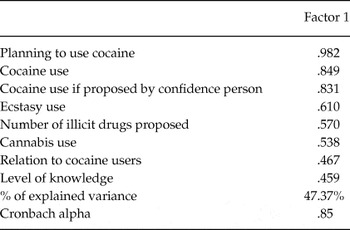
In order to test the one-dimensionality of the construct, we carried out a factorial analysis based on maximum likelihood estimation of the whole DO items (Table 2). The analysis led to the extraction of a unique factor with a proper value that is superior to 1 (Kaiser Criterion). The factor explains 47.937% of the variance. The Kaiser-Meyer-Olkin measure of sampling adequacy (.848) indicated satisfactory factorability of the correlation matrix. Four components attained eigenvalues > 1.0, although examination of the scree plot (Cattell, Reference Cattell1966) indicated that a one-factor solution was optimal. Cronbach's alpha coefficient (Cronbach, Reference Cronbach1951) was used to examine the internal consistency (ideally, α should range between 0.7–0.9) of the total scale. In this sample, the Cronbach’s alpha was.85. Analysis confirms the one-dimensionality of the distance to the object construct (M = 15.97, σ = 6.38, [8, 36]).
Factorial matrix (maximum likelihood estimation) for the distance to the object variables

There are no significant correlation between the DO score and age (r = .12) but a significant difference was observed with regard to gender (M male = 18.91 vs. M female = 14.53; t(198) = –4.81, p < .001). Concerning the situation in relation to employment we can observe that university students with a job are more close to cocaine than students without a job (19.52 vs. 14.97; t(198) = –4.35, p < .001).
Factorial analysis of the opinions
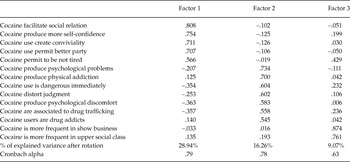
The answers on the opinions about cocaine were submitted to a principal component analysis (PCA) in order to highlight the principles generating the observed variance within the representational field (Doise et al. Reference Doise, Clémence and Lorenzi-Cioldi1992). Frequency distributions were conducted to identify items/opinions with extremely skewed response distribution or low variability. Intercorrelations between opinions were examined to ascertain that variables correlated with a sufficient number of other variables, but not too strongly. Item-total statistics were analyzed to detect and remove items showing low correlations with the overall score of the questionnaire (i.e., lower than .30). A principal component analysis (PCA) was performed to examine the underlying factor structure among the remaining items. The rotated factor structure was investigated to find opinions with weak factor loadings (lower than .40) or cross loadings (second loading higher than .30). The sample’s suitability index is satisfactory (KMO = .801). Three components attained eigenvalues > 1.0, although examination of the scree plot (Cattell, Reference Cattell1966) indicated that a three-factor solution was optimal. These factors explain 54.28% of the observed variance (Table 3). Upon the first factor (28.94% of the explained variance), were saturated elements illustrating cocaine as a “social facilitator” and performance drug (e.g., “Cocaine facilitates social relation”). The second factor (16.26% of the explained variance) gathers elements reported to addiction and social dangerousness of cocaine (e.g., “Cocaine produces physical addiction”). The third factor (9.07% of the explained variance) includes elements describing cocaine as a “jet set” drug (e.g., “Cocaine is more frequent in show business”). The reliability coefficients of the three scales identified as the structure of the opinions are satisfactory (from α = .63 to α = .79).
Factor analysis of opinions concerning cocaine

Regression analysis
In order to test the effect of distance to cocaine on the different principles organizing SR, the factorial scores of the distance degree were entered into several models of simple regression, one model for each representational dimension. The aim was to check the possibility of having a prediction of the scores on the representational dimensions based on distance degree. While the latter was entered as the supposed predicator, the factorial scores obtained by the PCA were entered as the dependant variables.
The regression analysis on the dimension “social facilitator” reveals a significant effect of the distance variable (β = .480, t(199) = 7.69, p < .001). In other words, the more the individuals are close to cocaine, the more their scores on that dimension are high. On the dimension “addiction and social dangerousness”, the regression analysis shows a significant effect of the distance variable (β = –.350, t(199) = –5.25, p < .001). In other words, the more individuals are close to cocaine, the less their scores on that dimension are high. However, there is no significant effect of distance degree on the dimension “cocaine as a jet set drug” (β = –.025, t(199) = –0.34, p = .72).
Discussion
The current study succeeded in elaborating a one-dimensionality variable illustrating DO of cocaine. This variable is more than the simple social practices, classically considered in the studies of the link to the SR objects (Flament, Reference Flament and Moliner2001; Jodelet & Moscovici, Reference Jodelet and Moscovici1990). It also includes involvement and knowledge degree. The results confirm earlier conclusions regarding SR objects in general and more specifically SR of cannabis (Dany & Abric, Reference Dany and Abric2007). That is, the more individuals are close to the object, the more they activate functional elements and the more they are distant from the object, the more they activate normative elements. It is important to note that these components (functional vs. normative), although different in nature, can express common values concerning the object studied. Indeed, the opinions expressed about practices or dangers of cocaine are potentially anchored in a set of common values that guide the individual’s positions on these dimensions (sharing, conviviality, self-performance vs. harm reduction).
Conforming to theoretical propositions, for SR of cannabis as for cocaine, the three DO categories are the same. But the variables included into each category are not the same as each object activates specific stakes according to the psychosocial situation of individuals and implications that each social object could activate in a specific social context.
More specifically, the distance specifies the psychosocial stakes associated with the positions of individuals vis-à-vis cocaine. Distance is in relation to the transformation of social reality in which individuals are located. The process of activating elements of the representation allows for moderating the evaluative dimensions of the object (addiction, health risks, social dangerousness). This differential activation of SR components (dependant on the distance of individuals) is based on a process of risk negotiation. This process of risk negotiation is particularly relevant when groups need to deal with and express their risk behaviours and their counter-normative experiences (Apostolidis & Dany, Reference Apostolidis and Dany2012; Peretti-Watel, Reference Peretti-Watel2003). The differential activation of dimensions of representation serves the interests of the defence of individuals close to cocaine, as is the case for individuals who are close to drug users (Echebarria, Guede, Guillen, & Garate, Reference Echebarria, Guede, Guillen and Garate1992).
The difference between our results and those obtained with the study on cannabis social representation is the fact that one representational dimension of cocaine (“cocaine as a jet set drug”) is “insensitive” to the distance to the object. The absence of link between a representational dimension and distance construct needs to be discussed. The distance to the object takes into account the particular relation that people can have with the social object. This relation is marked by stakes of different nature particularly the identity stakes (Dany & Abric, Reference Dany and Abric2007). Our sample is not representative of people associated with this dimension. There are fewer identity stakes concerning this particular dimension of SR. In other words, we hypothesize that the “jet set class” dimension does not have so much psychosocial importance for our sample (university students) and could be considered as a stereotypical content of SR of cocaine.
In the field of prevention it is counter intuitive that drug users declare high level of knowledge concerning the drug consumed and some prevention actions are based on the development of drug knowledge as a way to prevent consumption. But in our perspective, this knowledge is not an “objective” one. Confronted with polemical social objects such as drugs, the question of “objective knowledge” is not relevant for social representation perspective. For example, scientific knowledge concerning drugs is not consensual (e.g., dangers of cannabis, alcohol or cocaine) and implies different legal frameworks in different countries (e.g., prohibition, decriminalization, legalization). Our proposition is to take into account what we can call a “perceived knowledge” or “self-evaluated knowledge” (Green & Clémence, Reference Green and Clémence2008). We consider that this knowledge could be conceptualized as “experiential knowledge” binding direct experience and personal identity stakes with the positions adopted by respondents. This conception is distant from some works who specifically study the diffusion of scientific knowledge (objective knowledge) with and toward SR components (Courvoisier, Clémence, & Green, Reference Courvoisier, Clémence and Green2013). Further development of DO research could take into account that “self-evaluated knowledge” is likely to be an individual modulation of a common frame of reference. Departing from this idea, one possible way to assess level of knowledge could be to refer the participants to a common frame. In other words, one way to measure the knowledge degree might be to ask participants if they think that they have less, more, or the same level of knowledge than others (others would be the reference group considered in the research).
The term of “proximity” was used by different researchers (Dany & Abric, Reference Dany and Abric2007; Miguel et al., Reference Miguel, Valentim and Carugati2012; Molinari & Speltini, Reference Molinari and Speltini1998). So was the term of “distance” (Dany & Abric, Reference Dany and Abric2007; Flament & Milland, Reference Flament and Milland2010), and as for “proximity” we can observe that this terminology includes different theoretical and/or methodological orientations. The utilization of different terminologies can contribute to certain confusion. For us, the term of “distance” compared to the term “proximity” constitutes a more interesting option to describe the processes implied. Indeed, the term of “proximity” can give the impression of unidirectional perspective, and suggests a movement toward the social object. The term of “distance” more than the term of “proximity” implies the presence of two points separated by an interval without precision concerning the label or the “nature” of the direction (close to, far-off). We think that the term “distance” is more neutral and holistic and permits to envisage the possible different positions.
Taking into account the notion of distance to the object suggests a more diversified and comprehensive relationship between the individual and the represented social object. In this perspective, distance to the object considers social practices but participates in relativizing their role, because other elements (involvement, knowledge) are important to understand the links that individuals and groups have with the social representations. The variables that constitute “involvement” are more akin to what we might call “involvement in situation” (Dany & Abric, Reference Dany and Abric2007). Thus, the term “in situation” here refers to the analysis of the psychosocial situation of individuals in their relation to the object. In other words, involvement in our view, must be considered as a proximal variable and a dynamic construction of which requires a ad hoc contextualisation work.
The different modalities of relation to the object are as many realities (thoughts and/or actions) which ought to be questioned as significant contents of the link with the object and as signifying process of this link, process that engages not only the psycho-social component of the individual and the group in their relationship with the object but also the characteristics themselves of the object. Many works on the social representations of intelligence and its development (Miguel et al., Reference Miguel, Valentim and Carugati2012; Miguel, Valentim, & Carugati, Reference Miguel, Valentim and Carugati2013; Mugny & Carugati, Reference Mugny and Carugati1989) have produced some results that confirm the non-unequivocal and complex relationships between social representations and the practices. For example, these studies highlight that opinions/representations expressed regarding intelligence are modulated by a large number of psychosocial variables (e.g., shortage of information regarding the object, the familiarity with the object, the necessity of decision making, maintenance of a positive social identity).
DO is liable to constitute a relevant indicator for the apprehension of the different “facets” of the change introduced by the external conditions the individual and the group have to face and in which they participate. For example, distance could be understood as a sequence of “levels” contributing, each in its own way, to the reconstruction of the object for the individual with respect to the influence exerted by the new psycho-social environment. Accordingly, we can mention what is in the sphere of the gradual change of the view on and by the object. This formulation wants to assert the existence of the object outside the mental representations of the subject. Considering the active role of the object and working in this direction consists in giving oneself the means of inserting it into the core of the relations and transactions individuals and groups experience with social reality and others. This can also lead us to consider representational functioning as partly dependent on the social object and specificities.
The distance to the object interrogates the nature of reality constituted by the representational process by seeing it as a “whole” in which the individual is immersed. Thus, we are close to proposals from phenomenology (e.g., Schutz, Reference Schütz1987), in the sense that commitment (intentional or not) of the individual in the world and his relation to this world (and thus the object) determines the phenomena of organization and construction of the relation to the social object. The sense of the experience does not only vary according to the individual’s social practices of the object, it develops in a larger context subject to influence levels exceeding the frame of the subject’s perception. Hence, “the history of the object” escapes the will of the subject. The proposition of a “phenomenological perception” of distance is due to the possibility of integrating the comprehension of the link to and of the object. In this perspective the object itself creates links. So this formulation highlights the dialectical dimension of the subject’s relation to the object and allows for thinking the object as active agent of this bond.
Furthermore, the object can be considered the substrate of social relations (Apostolidis & Dany, Reference Apostolidis and Dany2012). It enables to problematize the self/others dimension that represents a central dimension of the psychosocial approach to the development of social knowledge. For example, the experience of an “other” whose perspective on the world is different constitutes a condition of reflexivity (Bauer & Gaskell, Reference Bauer and Gaskell1999). On other words, “it’s through the contact with conflicting social representations that human beings begin to reflect on their own views and realise what is distinctive about the representations they hold” (Voelklein & Howarth, Reference Voelklein and Howarth2005, p. 438). In addition, some theoretical propositions point out the potential role and strength that the group identification should play in the representational processes (Lo Monaco, Apostolidis, & Dany, in press; Wachelke, Reference Wachelke2012). To contribute to this reflexion, we have evocated, during our introduction the potential role of the DO in the segmentation process (cf. identification of the appropriate social segments for the study of social representations). From our point of view, future works will need to contribute to elucidate this important theoretical and methodological issue in the field of social representations.
To conclude, we have to consider the relations individuals and groups have with objects of SR and the inclusion of this relation in a social reference context (e.g., in an a-social perspective, the problem of drugs could be seen as the relation an individual has to a psycho-active substance without reference to his social participation and social anchoring). To summarize, with the DO, the social inclusion and social participation of individuals and groups with the physical, psychological and social environment constitute the initial matrix that permit to analyze the relation with the object of the representation, and the contribution of this object. Further investigations are necessary to develop and precise the methodological aspects associated with the construction of the distance to the object variables, if we want to explore the role of DO with regard to other social objects which entail fewer normative stakes, and precise the particularity of stereotypical components of social representations.