

INTRODUCTION
From a historical perspective, nursing actions have often been based on practicing nurses’ opinions or habits with very little scientific evidence available to guide practice. Approximately three decades ago, the nursing process was widely employed in basic nursing education programmes and asserted to be the profession's way forward. Today, nursing students are taught an updated version of the nursing process as a pathway to organise patient information and make relevant clinical decisions [Castledine, Reference Castledine2011]. The addition of critical thinking into the nursing process enables the practitioner to apply reasoning and formulate appropriate judgments about his/her patient's needs. Further, critical thinking comprises ‘the cognitive skill of asking the core question that is relevant to the major issue’ [Huckabay, Reference Huckabay2009, p. 75] leading to identification of the problem to be solved. When considered in totality, these various elements of practice provide a perfect segue to the application of evidence-based practice (EBP) into nursing care delivery.
Most nurses would have little difficulty explaining the nursing process as it relates to making assessments that lead to clinical nursing diagnoses and care delivery decisions. For many who received basic nurse training in decades past, there is sense of comfort because the nursing process is fundamental to previously learnt behaviours. Currently the profession is charged to adopt EBP, and for nurses whose basic educational platform lacked research instruction, this mandate can be rather off-putting. According to Scott and McSherry [Reference Scott and McSherry2008] the challenge of incorporating evidence into nursing practice can only be resolved by offering a simple system for implementation that both informs and engages practitioners to yield evidence-based clinical practice results. The aim of the article is to present EBP in a way that helps inexperienced nurses to think of its application in more readily adoptable and achievable manner.
A long habit of not thinking a thing wrong, gives it a superficial appearance of being right. ~Thomas Paine
PUTTING EVIDENCE INTO PRACTICE
Simply said, when reflecting on clinical practice applications of the past, we in nursing very often ‘didn't know what we didn't know’. This can certainly be attributed to the relatively brief existence of a global body of high level nursing research. This very research bank serves to guide EBP in nursing. For over a decade, our colleagues from the American Society of PeriAnesthesia Nurses (ASPAN) have actively pursued generating more scientific evidence and expanding its nurse members’ EBP skill set to guide anaesthetic and recovery (i.e. perianesthesia) nursing practice. While accomplishing this task remains a work in progress, ASPAN's enduring EBP goal remains to translate research findings into clinical practice in order to advance quality and safety throughout this speciality [Mamaril, Reference Mamaril2005]. Advocacy for such advancements is critically important to patient care because fiscally strained global governments are increasingly relying on practicing nurses and professional specialty groups to generate the body of scientific evidence and develop safe practice recommendations [Institute of Medicine, 2010]. This mandate cannot be fully realised until individual nurses become more confident and capable to perform and apply research in practice.
The primary goal of EBP is to combine the best available evidence with skilled professional opinion to achieve optimal patient outcomes. Best practice is accomplished through the deliberate process of identifying a clinical curiosity or problem in the form of question, collecting and ranking pertinent evidence, understanding the needs and preferences of the patient population to be served and then incorporating clinical interventions having the most chance of achieving a successful outcome [Leufer and Cleary-Holdforth, Reference Leufer and Cleary-Holdforth2009]. Because some aspects of anaesthetic and recovery nursing care have a paucity of research to back up specific nursing actions, one might think of EBP as the best of both worlds in that new scientific knowledge and retrospective expert opinion are melded into the nurse's treatment plan.
THE STEPS TO EBP
Nurses commonly respond to the topic of research and EBP with trepidation and confusion. This is totally understandable given the history of nursing education and the more recent evolution of research synthesis; yet, by keeping an open mind and embracing the willingness to grow one's skill set, any nurse receiving proper instruction and guidance can become capable of adopting EBP at the bedside. In fact, nurses working at the bedside are particularly tuned in to patient problem trends and newly emerging interventional therapies, rendering his/her clinical enquiry a daily occurrence. This is precisely where nurses at varying educational levels can unite and collaborate to better support growing the body of evidence.
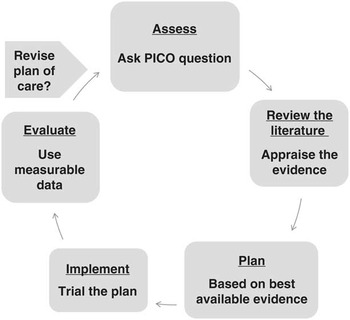
Frontline nurses are in the perfect position to stimulate and impact adoption of EBP in practice. A simple overview is being provided in this article to demystify EBP and stimulate beginning knowledge about its application within nursing practice, with a goal of allaying fear and encouraging anaesthetic and recovery nurses to venture into this important aspect of professional practice. Recently, while presenting education to a group of colleagues unfamiliar with the EBP process, and simultaneously offering a proposal for an EBP-implementation project involving our hospital's anaesthetic and recovery units, I included EBP as one of the sequential steps in the nursing process (see Fig. 1). The nursing process was already understood by the nurses present, and because a logical progression can be shown with the inclusion of a review and ranking of the nursing literature, the nurses in the audience expressed enthusiasm and the desire to learn this new skill with the support of an experienced mentor.
Incorporating evidence-based practice into the Nursing Process.

Remember, many of us ‘didn't know what we didn't know’, but every nurse has the capacity to be taught ways in which application of best evidence can shape safe and sound nursing practice. As you review the steps involved in the EBP process, think about some issues commonly encountered in your practice area. Next, identify a question that touches your practice and then consider ways in which you could apply the EBP-implementation process to answer that question and potentially make a difference in patient care outcomes.
Cullen and Adams [Reference Cullen and Adams2010] outlined sequential steps followed in the EBP process:
1. Identify the practice issue: this can emerge from a problem-focused trigger (a clinician recognises a patient care problem needing attention) or a knowledge-focused trigger (acquisition of new knowledge makes the nurse question a standard practice on his/her unit).
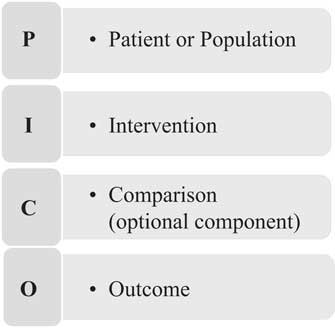
2. Identify the PICO question: once the issue has been identified, a researchable question is developed. This question includes specific elements as outlined in Fig. 2. A comparison comprises the only optional component of the PICO question because you might examine only one intervention without exploring alternatives, or in some cases, an alternative may not exist. The identified outcome should be measurable and specify the result(s) of what you plan to accomplish, affect or improve.
Elements of a PICO question.

Sample PICO question: How long after receiving IV opioids should the postoperative patient with obstructive sleep apnoea be maintained in a continuous monitored care environment?
Deconstruction of components of the question:
P = postoperative patient with obstructive sleep apnoea
I = IV opioid administration
C = none
O = patient maintained in a continuous monitored care environment
3. Once the question is identified, explore available organisational support: e.g. support may be found in a manager, administrator, interdisciplinary service line and librarian services.
4. Form a team: the members should represent all disciplines and roles that may be involved in the practice change, and should include staff members with diverse and advanced skills.
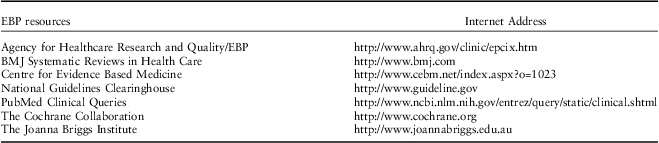
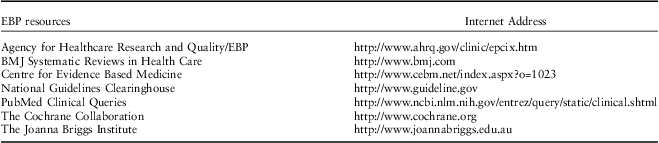
5. Search and critique the literature: once the PICO question is formulated and keywords have been identified, a systematic review and appraisal of the literature is performed. This part of the process requires a specialized skill set and must include formal instruction and mentoring for any novice participating in the project. Some helpful EBP resources are listed in Table 1.
EBP resources
EBP = evidence-based practice
6. Determine whether sufficient evidence exists to guide practice or whether more research needed: when sufficient research or recommended practices exist, the team then collaborates to develop a proposal for a change in practice. When evidence to support the question is lacking, the team may elect to abandon the question for reinvestigation at a later time.
7. Implement a test project: a small trial or pilot project will help to determine whether the proposed change in practice is effective or requires revision.
8. Evaluate the changes: measurable results are analysed to determine whether the practice change should be continued or revised.
BREAKING DOWN BARRIERS
The utilisation and transfer of evidence into nursing practice remains a challenge [Scott and McSherry, Reference Scott and McSherry2008]. In fact, a good deal of information can be found in the literature concerning the benefits of and need for nurses to understand EBP, as well as numerous potential barriers to EBP implementation. Barriers include, but are not limited to: little access to quality information; lack of funding or time needed to perform EBP; weak critical literature appraisal skills; prior traditions and belief structures; and lack of managerial direction, motivation and/or leadership [Leufer and Cleary-Holdforth, Reference Leufer and Cleary-Holdforth2009]. Ross [Reference Ross2010] conducted research to identify American perianesthesia nurses’ individual barriers to EBP. The study participants most frequently reported barriers included a lack of: skills required to understand research articles and critique or synthesise the literature; understanding electronic database structure/organization; access to research materials; and knowledge about research.
The reality is that nurses must possess information literacy in order for the EBP process to occur. Key components of information literacy are an ability to recognise the critical information sought and development of skills necessary for finding, evaluating and successfully using applicable evidence in nursing practice [Ross, Reference Ross2010]. For those who have taken a formal research course this process may be a bit less daunting. A most important thing to remember is: every experienced nurse understands how to practice nursing and clearly possesses the capacity to learn this information!
It has been demonstrated that the provision of education and support to direct care nurses thereby empowers his/her behaviour to seek, critically evaluate and incorporate research findings into patient care delivery [Staffileno and Carlson, Reference Staffileno and Carlson2009]. Learning is enhanced when one is interested in the topic and taught by a knowledgeable individual. Practicing nurses who lack the confidence to engage in the EBP process and/or those who have not yet experienced a formal nursing research course, can engage with an experienced mentor during PICO question formation and the literature search and review process. When partnering with a nurse mentor who understands the EBP process, he/she can assist with the development of skills needed to read, critically appraise and understand the results of the research – one small step at a time. Self-motivation and applied learning must also be present for this type of learning to occur.
MAKING THE EBP CONNECTION
Nurses at the bedside are in the perfect position to identify patient-related problems and pose meaningful questions regarding current clinical practice. This article was intended to provide a simple overview of the EBP process and demystify the steps involved in its implementation; it also aims to encourage anaesthetic and recovery nurses to venture into this very important aspect of evolving professional practice. Although research review and appraisal can be a challenging task for many, it is a skill that most definitely can be learned and developed over time. The best place to commence learning and stimulate new knowledge about EBP application in nursing practice is at the beginning of the process, perhaps within the context of the nursing process, and under the guidance and support of an experienced mentor.