


%20--%3e%3c!DOCTYPE%20svg%20PUBLIC%20'-//W3C//DTD%20SVG%201.0//EN'%20'http://www.w3.org/TR/2001/REC-SVG-20010904/DTD/svg10.dtd'%3e%3csvg%20version='1.0'%20id='Layer_1'%20xmlns='http://www.w3.org/2000/svg'%20xmlns:xlink='http://www.w3.org/1999/xlink'%20x='0px'%20y='0px'%20width='64px'%20height='64px'%20viewBox='5.5%20-3.5%2064%2064'%20enable-background='new%205.5%20-3.5%2064%2064'%20xml:space='preserve'%3e%3cg%3e%3ccircle%20fill='%23FFFFFF'%20fill-opacity='0'%20cx='37.785'%20cy='28.501'%20r='28.836'/%3e%3cpath%20fill='%23595959'%20d='M37.441-3.5c8.951,0,16.572,3.125,22.857,9.372c3.008,3.009,5.295,6.448,6.857,10.314%20c1.561,3.867,2.344,7.971,2.344,12.314c0,4.381-0.773,8.486-2.314,12.313c-1.543,3.828-3.82,7.21-6.828,10.143%20c-3.123,3.085-6.666,5.448-10.629,7.086c-3.961,1.638-8.057,2.457-12.285,2.457s-8.276-0.808-12.143-2.429%20c-3.866-1.618-7.333-3.961-10.4-7.027c-3.067-3.066-5.4-6.524-7-10.372S5.5,32.767,5.5,28.5c0-4.229,0.809-8.295,2.428-12.2%20c1.619-3.905,3.972-7.4,7.057-10.486C21.08-0.394,28.565-3.5,37.441-3.5z%20M37.557,2.272c-7.314,0-13.467,2.553-18.458,7.657%20c-2.515,2.553-4.448,5.419-5.8,8.6c-1.354,3.181-2.029,6.505-2.029,9.972c0,3.429,0.675,6.734,2.029,9.913%20c1.353,3.183,3.285,6.021,5.8,8.516c2.514,2.496,5.351,4.399,8.515,5.715c3.161,1.314,6.476,1.971,9.943,1.971%20c3.428,0,6.75-0.665,9.973-1.999c3.219-1.335,6.121-3.257,8.713-5.771c4.99-4.876,7.484-10.99,7.484-18.344%20c0-3.543-0.648-6.895-1.943-10.057c-1.293-3.162-3.18-5.98-5.654-8.458C50.984,4.844,44.795,2.272,37.557,2.272z%20M37.156,23.187%20l-4.287,2.229c-0.458-0.951-1.019-1.619-1.685-2c-0.667-0.38-1.286-0.571-1.858-0.571c-2.856,0-4.286,1.885-4.286,5.657%20c0,1.714,0.362,3.084,1.085,4.113c0.724,1.029,1.791,1.544,3.201,1.544c1.867,0,3.181-0.915,3.944-2.743l3.942,2%20c-0.838,1.563-2,2.791-3.486,3.686c-1.484,0.896-3.123,1.343-4.914,1.343c-2.857,0-5.163-0.875-6.915-2.629%20c-1.752-1.752-2.628-4.19-2.628-7.313c0-3.048,0.886-5.466,2.657-7.257c1.771-1.79,4.009-2.686,6.715-2.686%20C32.604,18.558,35.441,20.101,37.156,23.187z%20M55.613,23.187l-4.229,2.229c-0.457-0.951-1.02-1.619-1.686-2%20c-0.668-0.38-1.307-0.571-1.914-0.571c-2.857,0-4.287,1.885-4.287,5.657c0,1.714,0.363,3.084,1.086,4.113%20c0.723,1.029,1.789,1.544,3.201,1.544c1.865,0,3.18-0.915,3.941-2.743l4,2c-0.875,1.563-2.057,2.791-3.541,3.686%20c-1.486,0.896-3.105,1.343-4.857,1.343c-2.896,0-5.209-0.875-6.941-2.629c-1.736-1.752-2.602-4.19-2.602-7.313%20c0-3.048,0.885-5.466,2.658-7.257c1.77-1.79,4.008-2.686,6.713-2.686C51.117,18.558,53.938,20.101,55.613,23.187z'/%3e%3c/g%3e%3c/svg%3e)
%20--%3e%3c!DOCTYPE%20svg%20PUBLIC%20'-//W3C//DTD%20SVG%201.0//EN'%20'http://www.w3.org/TR/2001/REC-SVG-20010904/DTD/svg10.dtd'%3e%3csvg%20version='1.0'%20id='Layer_1'%20xmlns='http://www.w3.org/2000/svg'%20xmlns:xlink='http://www.w3.org/1999/xlink'%20x='0px'%20y='0px'%20width='64px'%20height='64px'%20viewBox='5.5%20-3.5%2064%2064'%20enable-background='new%205.5%20-3.5%2064%2064'%20xml:space='preserve'%3e%3cg%3e%3ccircle%20fill='%23FFFFFF'%20fill-opacity='0'%20cx='37.637'%20cy='28.806'%20r='28.276'/%3e%3cg%3e%3cpath%20fill='%23595959'%20d='M37.443-3.5c8.988,0,16.57,3.085,22.742,9.257C66.393,11.967,69.5,19.548,69.5,28.5c0,8.991-3.049,16.476-9.145,22.456%20C53.879,57.319,46.242,60.5,37.443,60.5c-8.649,0-16.153-3.144-22.514-9.43C8.644,44.784,5.5,37.262,5.5,28.5%20c0-8.761,3.144-16.342,9.429-22.742C21.101-0.415,28.604-3.5,37.443-3.5z%20M37.557,2.272c-7.276,0-13.428,2.553-18.457,7.657%20c-5.22,5.334-7.829,11.525-7.829,18.572c0,7.086,2.59,13.22,7.77,18.398c5.181,5.182,11.352,7.771,18.514,7.771%20c7.123,0,13.334-2.607,18.629-7.828c5.029-4.838,7.543-10.952,7.543-18.343c0-7.276-2.553-13.465-7.656-18.571%20C50.967,4.824,44.795,2.272,37.557,2.272z%20M46.129,20.557v13.085h-3.656v15.542h-9.944V33.643h-3.656V20.557%20c0-0.572,0.2-1.057,0.599-1.457c0.401-0.399,0.887-0.6,1.457-0.6h13.144c0.533,0,1.01,0.2,1.428,0.6%20C45.918,19.5,46.129,19.986,46.129,20.557z%20M33.042,12.329c0-3.008,1.485-4.514,4.458-4.514s4.457,1.504,4.457,4.514%20c0,2.971-1.486,4.457-4.457,4.457S33.042,15.3,33.042,12.329z'/%3e%3c/g%3e%3c/g%3e%3c/svg%3e)
%20--%3e%3c!DOCTYPE%20svg%20PUBLIC%20'-//W3C//DTD%20SVG%201.0//EN'%20'http://www.w3.org/TR/2001/REC-SVG-20010904/DTD/svg10.dtd'%3e%3csvg%20version='1.0'%20id='Layer_1'%20xmlns='http://www.w3.org/2000/svg'%20xmlns:xlink='http://www.w3.org/1999/xlink'%20x='0px'%20y='0px'%20width='64px'%20height='64px'%20viewBox='5.5%20-3.5%2064%2064'%20enable-background='new%205.5%20-3.5%2064%2064'%20xml:space='preserve'%3e%3cg%3e%3ccircle%20fill='%23FFFFFF'%20fill-opacity='0'%20cx='36.924'%20cy='28.403'%20r='28.895'/%3e%3cpath%20fill='%23595959'%20d='M37.442-3.5c8.99,0,16.571,3.085,22.743,9.256C66.393,11.928,69.5,19.509,69.5,28.5c0,8.992-3.048,16.476-9.145,22.458%20C53.88,57.32,46.241,60.5,37.442,60.5c-8.686,0-16.19-3.162-22.513-9.485C8.644,44.728,5.5,37.225,5.5,28.5%20c0-8.762,3.144-16.343,9.429-22.743C21.1-0.414,28.604-3.5,37.442-3.5z%20M12.7,19.872c-0.952,2.628-1.429,5.505-1.429,8.629%20c0,7.086,2.59,13.22,7.77,18.4c5.219,5.144,11.391,7.715,18.514,7.715c7.201,0,13.409-2.608,18.63-7.829%20c1.867-1.79,3.332-3.657,4.398-5.602l-12.056-5.371c-0.421,2.02-1.439,3.667-3.057,4.942c-1.622,1.276-3.535,2.011-5.744,2.2%20v4.915h-3.714v-4.915c-3.543-0.036-6.782-1.312-9.714-3.827l4.4-4.457c2.094,1.942,4.476,2.913,7.143,2.913%20c1.104,0,2.048-0.246,2.83-0.743c0.78-0.494,1.172-1.312,1.172-2.457c0-0.801-0.287-1.448-0.858-1.943l-3.085-1.315l-3.771-1.715%20l-5.086-2.229L12.7,19.872z%20M37.557,2.214c-7.276,0-13.428,2.571-18.457,7.714c-1.258,1.258-2.439,2.686-3.543,4.287L27.786,19.7%20c0.533-1.676,1.542-3.019,3.029-4.028c1.484-1.009,3.218-1.571,5.2-1.686V9.071h3.715v4.915c2.934,0.153,5.6,1.143,8,2.971%20l-4.172,4.286c-1.793-1.257-3.619-1.885-5.486-1.885c-0.991,0-1.876,0.191-2.656,0.571c-0.781,0.381-1.172,1.029-1.172,1.943%20c0,0.267,0.095,0.533,0.285,0.8l4.057,1.83l2.8,1.257l5.144,2.285l16.397,7.314c0.535-2.248,0.801-4.533,0.801-6.857%20c0-7.353-2.552-13.543-7.656-18.573C51.005,4.785,44.831,2.214,37.557,2.214z'/%3e%3c/g%3e%3c/svg%3e)
%20--%3e%3c!DOCTYPE%20svg%20PUBLIC%20'-//W3C//DTD%20SVG%201.1//EN'%20'http://www.w3.org/Graphics/SVG/1.1/DTD/svg11.dtd'%3e%3csvg%20version='1.1'%20id='Layer_1'%20xmlns='http://www.w3.org/2000/svg'%20xmlns:xlink='http://www.w3.org/1999/xlink'%20x='0px'%20y='0px'%20width='64.000977px'%20height='64px'%20viewBox='0%200%2064.000977%2064'%20enable-background='new%200%200%2064.000977%2064'%20xml:space='preserve'%3e%3cg%3e%3ccircle%20fill='%23FFFFFF'%20fill-opacity='0'%20cx='32.064453'%20cy='31.788086'%20r='29.012695'/%3e%3cg%3e%3cpath%20fill='%23595959'%20d='M31.943848,0C40.896484,0,48.476562,3.105469,54.6875,9.314453C60.894531,15.486328,64.000977,23.045898,64.000977,32%20s-3.048828,16.457031-9.145508,22.513672C48.417969,60.837891,40.779297,64,31.942871,64%20c-8.648926,0-16.152832-3.142578-22.513672-9.429688C3.144043,48.286133,0,40.761719,0,32.000977%20c0-8.723633,3.144043-16.285156,9.429199-22.68457C15.640137,3.105469,23.14502,0,31.943848,0z%20M32.060547,5.771484%20c-7.275391,0-13.429688,2.570312-18.458496,7.714844C8.381836,18.783203,5.772949,24.954102,5.772949,32%20c0,7.125,2.589844,13.256836,7.77002,18.400391c5.181152,5.181641,11.352051,7.770508,18.515625,7.770508%20c7.123047,0,13.332031-2.608398,18.626953-7.828125C55.713867,45.466797,58.228516,39.353516,58.228516,32%20c0-7.3125-2.553711-13.484375-7.65625-18.513672C45.504883,8.341797,39.333984,5.771484,32.060547,5.771484z%20M44.117188,24.456055%20v5.485352H20.859863v-5.485352H44.117188z%20M44.117188,34.743164v5.481445H20.859863v-5.481445H44.117188z'/%3e%3c/g%3e%3c/g%3e%3c/svg%3e)
Introduction
Candidozyma auris (C. auris) has rapidly emerged as a serious nosocomial pathogen. Among the six known clades, clades I and III (both common in the United States) are typically resistant to azoles and amphotericin. Reference da Silva, Lucini and Dos Santos1,Reference Lyman, Forsberg and Sexton2 Echinocandin resistance is also an increasing problem in clades I, III, and IV, with rates approaching 3% in some regions. Reference Lyman, Forsberg and Sexton2
C. auris possesses unique adhesins that have allowed it to become a formidable nosocomial pathogen. Reference Santana, Anku and Zhao3 These adhesins, along with biofilm formation, allow prolonged survival of C. auris on cutaneous and abiotic surfaces. Reference Horton, Holt and Nett4–Reference Lionakis and Chowdhary6 Prolonged skin colonization and extensive environmental contamination enhance transmission in healthcare settings; this appears to be especially problematic in long-term acute care and ventilator-capable skilled nursing facilities. Reference Sansom, Gussin and Schoeny7
Because negative surveillance cultures do not reliably predict clearance of cutaneous colonization, Reference Pacilli, Kerins and Clegg8,Reference Arenas, Persad and Patel9 it is recommended patients with C. auris be placed on “lifelong” contact precautions while in healthcare facilities. In this report we compare outcomes of patients with C. auris with patients with two candida species intrinsically resistant to azoles, Candida glabrata and C. krusei, and the impact of lifelong contact precautions on patient care.
Methods
The NYC Health and Hospitals System includes 11 acute care hospitals that serve patients primarily of low socioeconomic status in the boroughs of the Bronx, Brooklyn, Manhattan, and Queens. All have major academic affiliations.
Line listings of patients from the 11 hospitals that had cultures positive for C. auris, C. glabrata, and C. krusei were obtained from January 1, 2021 through December 31, 2025. Additional chart review was conducted on select patients to determine discharge destination, and the presence of mechanical ventilation and/or hemodialysis upon discharge. Patients discharged to long-term care facilities or acute/subacute rehabilitation centers were considered to be discharged to a skilled nursing facility.
Student’s-test was used to compare continuous variables, and Fisher’s exact test and χ2 analysis were used to compare categorical values. Propensity score matching was used to establish a control group of patients with C. glabrata/C. krusei to match those with C. auris. Multivariate regression analysis was used to determine factors correlating with the length of stay. Propensity score matching and regression analysis were performed using SPSS®.
This study was approved by the Brany IRB services and the NYC Health+Hospitals Systems to Track and Approve Research program.
Results
From 2021 through 2025 there were 119 unique patients with a clinical culture positive for C. auris. During that same time period there were 871 patients with C. glabrata and 172 patients with C. krusei. Compared to the patients with C. glabrata/C. krusei, those with C. auris had similar age (64.8 ± 15.2 vs 66.4 ± 16.1 yr) and BMI (25.8 ± 8.2 vs 26.8 ± 8.2 kg/M2), but a lower likelihood of a diagnosis of diabetes mellitus (48% vs 51%, P = .03). Among the patients with C. auris, 36% had positive blood cultures, compared to 23% (P = .002) of patients with C. glabrata/C. krusei. The percentage of patients with positive urine cultures was similar, 34% versus 37% (P = .47), for the patients with C. auris and C. glabrata/C. krusei, respectively. However, positive respiratory tract cultures occurred in 7% of C. auris cultures, compared to 18% (P = .003) of C. glabrata/C. krusei cultures. Susceptibility testing for caspofungin was performed for 33 isolates of C. auris, 342 isolates of C. glabrata, and 25 isolates of C. krusei. All of the isolates of C. auris were susceptible; by comparison, nine (3%) the C. glabrata isolates were intermediate and one (0.3%) was resistant. Among the C. krusei isolates, 7 (28%) were intermediate and none were resistant to caspofungin.
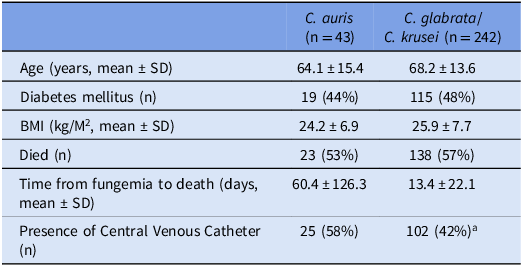
Overall, 46% (55 of 119) patients with C. auris cultures did not survive hospitalization, compared to 40% (412 of 1,043, P = .16) of patients with C. glabrata/C. krusei. Looking only at patients with candidemia (Table 1), mortality rates were again similar between those with C. auris (23 of 43, 53%) and C. glabrata/C. krusei (138 pf 242, 57%, P = .67). The time from candidemia to death was also similar between the two groups.
Comparison of patients with candidemia with C. auris and C. glabrata/C. krusei

a P = .05 compared to patients with C. auris.
Among the patient discharged to a home residence or shelter, the length of hospital stay from time of culture to discharge was not significantly different between those with C. auris versus C. glabrata/C. krusei (41.4 ± 52.6 vs 20.0 ± 29.9 d, P = .11) and C. auris versus C. krusei (41.4 ± 52.6 vs 30.9 ± 44.9 d, P = .49).
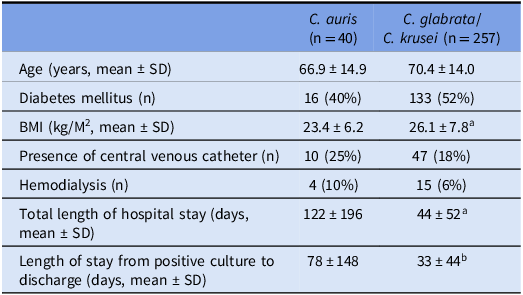
A total of 40 patients with C. auris and 257 patients with C. glabrata/C. krusei survived hospitalization and were ultimately discharged to a skilled nursing facility (Table 2). Patients with C. auris had longer hospital stays, including from the time of the positive culture to the time of discharge. The percentage of patients located in an intensive care unit, were on hemodialysis, or had a central venous catheter at the time of the culture was similar for both groups (Table 2). For the patients with C. auris, sites of positive culture included urine (48%), blood (28%), wound (17%), and respiratory tract (5%). Similarly, sites of positive cultures in patients with C. glabrata/C. krusei included urine (46%), blood (21%), wound (12%), and respiratory tract (19%; P = .03 compared to patients with C. auris). Multivariate regression analysis was performed to correlate length of hospital stay from the positive culture with the following variables: culture positive for C. auris, age, presence of diabetes mellitus, BMI, and site of positive culture, location in an intensive care setting, presence of a central venous catheter, and hemodialysis. Two variables correlated with length of hospital stay: presence of C. auris (P < .001) and receipt of hemodialysis (P = .051).
Comparison of patients with C. auris and C. glabrata/C. krusei discharged to skilled nursing facilities

a P =.02 compared to patients with C. auris.
b P =.06 compared to patients with C. auris.
Patients requiring mechanical ventilation and/or hemodialysis may face challenges for discharge planning to skilled nursing facilities. To assess the potential impact of these conditions, their frequency was determined in closely matched patients with C. auris and C. glabrata/C. krusei. Propensity score matching, controlling for age, presence of diabetes, site of positive culture, and hospital length of stay, was performed to create closely matched cohorts of patients with C. auris and C. glabrata/C. krusei. Overall 30 patients with C. auris were matched with 30 patients with C. glabrata/C. krusei. As expected, compared to the patients with C. glabrata/C. krusei, those with C. auris had similar age (69.4 ± 13.6 vs 70.5 ± 10.7 yr), length of hospital stay (49.6 ± 43.3 vs 42.2 ± 40.5 d), and incidence of diabetes (40% vs 40%). The distribution of patients according to the site of infection was similar between the two groups: urine 50% versus 43%, blood 30% versus 27%, wound 17% versus 23%, and respiratory tract 3% versus 3%. Eight of the patients with C.auris were located in an intensive care unit at the time of the culture, compared to 7 patients with C. glabrata/C. krusei. Central venous catheters were present in 7 of the patients with C. auris and 9 of the patients with C. glabrata/C. krusei. Of the 30 patients with C auris, 15 were discharged on mechanical ventilation, compared to 12 patients (P = .6) with C. glabrata/C. krusei. Similarly, four patients with C. auris required hemodialysis, compared to none with C. glabrata/C. krusei (P = .06).
Discussion
Patients with C. auris versus other Candida species infection share several acquisition risk factors, including advanced age, diabetes, indwelling devices, renal failure, and recent surgery. Reference Wasylyshyn and Stoneman10 However, patients with C. auris are more likely to have had prior surgery, intensive care unit admission, and prior antifungal exposure. Reference Sayeed, Farooqi, Jabeen and Mahmood11–Reference Rudramurthy, Chakrabarti and Paul13 Because of its ability to persist on the skin for prolonged periods, blood stream infections are more common in patients with C. auris when there are intravascular devices present. Reference Horton, Holt and Nett4,Reference Sayeed, Farooqi, Jabeen and Mahmood11 As observed in our report; compared to patients with C. glabrata or C. krusei, patients with C. auris were more likely to have bloodstream infection and central venous catheters.
Mortality rates for bloodstream infections appear to be similar for patients infected with C. auris versus other Candida species. Reference Salmanton-García, Nóbrega de Almeida and Colombo5,Reference Sayeed, Farooqi, Jabeen and Mahmood11,Reference Simon, Li and Silver14 Crude mortality rates of approximately 30%–50% have been noted for bloodstream infections for patients with either C. auris versus other candida species. Reference Salmanton-García, Nóbrega de Almeida and Colombo5,Reference Lionakis and Chowdhary6,Reference Simon, Li and Silver14,Reference Benedict, Forsberg, Gold, Baggs and Lyman15 In our report mortality rates between patients with C. auris versus C. glabrata/C.krusei were similar, including those with bloodstream infections. While the attributable mortality rate from C. auris bloodstream infection is unknown, it appears to be low, given the rather prolonged time between the positive blood culture and death of the patient.
A consistent finding is, when compared to patients with other candida infections, patients with C. auris have longer hospital stays. Reference Fan, Li and Zhao12,Reference Rudramurthy, Chakrabarti and Paul13 This is likely multifactorial, given patients with C. auris typically have multiple co-morbid conditions, intensive care unit stays, and prior surgeries. Reference Sayeed, Farooqi, Jabeen and Mahmood11–Reference Rudramurthy, Chakrabarti and Paul13 However, the length of stay from the time of the positive culture to discharge is also prolonged. Reference Sayeed, Farooqi, Jabeen and Mahmood11 In our report, among patients discharged to a skilled nursing facility, those with C. auris stayed an average of 45 days longer in the hospital compared to patients with C. glabrata/C. krusei. This increased length of stay could not be explained by an increased number of patients requiring mechanical ventilation or hemodialysis, often barriers to discharge.
The unique capability of C. auris to colonize environmental surfaces and skin, increasing the risk for catheter-related bloodstream infection, is well recognized. However, C. auris does not appear to be more virulent than other candida species. Also, although concerns of increasing resistance have been raised, overall echinocandin resistance was low (as noted in our study). Reference Lyman, Forsberg and Sexton2
The implementation of lifelong contact precautions was intended to limit the spread of C. auris in healthcare facilities. However, the requirements of a single room, gown and glove usage, and enhanced environmental cleaning for the lifetime of a patient pose an obstacle for discharge planning, particularly to skilled nursing facilities. If the average cost of a hospital stay in New York is $3700 (https://nchstats.com/average-cost-of-hospital-stays-in-us/), the increased length of stay for the 40 patients with C. auris (compared to patients with C. glabrata/C. krusei) in this study amounted to over $6.5 million dollars of increased hospital expenditure.
Proposals have been made to develop more effective patient antiseptic techniques and environmental cleaning methods, including development of longer acting disinfectants and antimicrobial surfaces. Reference Salmanton-García, Nóbrega de Almeida and Colombo5,Reference Sansom, Gussin and Schoeny7 If alternative strategies are found to be effective in reducing transmission, perhaps the stigma of lifetime contact precautions can be avoided.
Financial support
None to declare.
Competing interests
None to declare.

 Open access

