Introduction
The developmental origins of disease hypothesisReference Ozanne and Costancia 1 was developed to explain the impact of the environment experienced during early human development on later life health and disease. The long-term effects of the environment experienced by developing organisms on phenotypic expression has long been known in diverse species from plants to vertebrate animals.Reference Pigliucci 2 , Reference West-Eberhard 3 The term phenotypic plasticity is commonly used to describe the property of a given genotype to produce different phenotypes in response to different environmental conditions.Reference Pigliucci 2 , Reference Via and Lande 4 Developmental plasticity is a form of phenotypic plasticity, in which the environment experienced during development influences the phenotype expressed.Reference West-Eberhard 3 Virtually all organisms display some form of developmental plasticity, which is now recognized as an important effector of evolutionary change.Reference Pigliucci 2 , Reference DeWitt and Scheiner 5 – Reference Pigliucci, Murren and Schlichting 7
Developmental plasticity may generate adaptive morphological, physiological or behavioural traits that promote survival during embryonic or early post-embryonic life. For example, the presence of invertebrate or vertebrate prey can induce dramatic changes in cranial and jaw morphology of amphibian larvae, which allow them to capitalize on the protein-rich diet, and may thus enhance fitness (discussed below). Experiences during early life stages that cause, or are independent of, discrete plastic responses during these stages can influence traits expressed in the juvenile or adult stage of the life cycle. Such influences are complex and can be difficult to isolate since the sets of traits may be co-dependent, complementary, co-specialised or compensatory.Reference DeWitt and Scheiner 5 Furthermore, the consequences of some developmental experiences may not be recognizable until the juvenile or adult stage, perhaps being exposed by the physiological, social or environmental factors experienced during these later life stages; for example, early life exposure to stressors (elevated glucocorticoids) can cause long-term stable changes in physiology and behaviour that are only seen in juvenile/adult animals, and their expression may depend on the nutritional, physiological or social context.Reference Denver 8 Such phenomena are called ‘carry-over’ effects, or developmental ‘programming’ – experiences during one life history stage (generally during early development) that affect phenotypic expression in a subsequent life history stage.
There are many examples of developmental plasticity in diverse taxa, far too numerous to describe here. The reader is referred to the book, Developmental Plasticity, by Mary Jane West-EberhardReference West-Eberhard 3 for a comprehensive discussion of this topic. Here we focus primarily on amphibians as case studies for organismal responses to environmental change that lead to variable phenotypic expression at different stages of the life cycle. Where appropriate, we draw parallels with mammals, including humans. Most amphibians have complex life cycles (discussed below), with a free-swimming larval stage that undergoes a metamorphosis to the juvenile adult. The amphibian larva, which is a post-embryonic feeding stage, is exposed to diverse environmental conditions that can impact its morphology, behaviour, timing of metamorphosis and subsequently the juvenile/adult phenotype. Hormones play central roles in mediating environmental effects on development; the endocrine system of tetrapod vertebrates is evolutionarily conserved, and recent findings show that hormone action during amphibian development causes similar phenotypic outcomes to those observed in mammals. Therefore, we discuss the endocrine and molecular mechanisms that underlie developmentally plastic responses in amphibians, and describe how amphibian model systems can contribute to the study of developmental plasticity and programming in vertebrates.
Modes of animal development
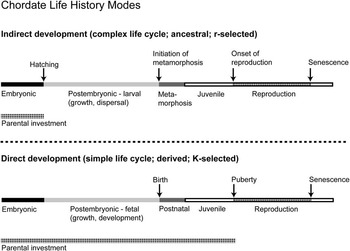
Animals have two basic modes of development (life history modes), direct and indirect (Fig. 1). The major difference between these developmental modes is that species with direct development do not have a larval phase, which is a growth and dispersal life history stage. Amniotes, which include the reptiles, birds and mammals, all have direct development. Many extant fishes and most extant amphibians have indirect development, although there are also examples of species in these classes that have direct development. Paleontological and phylogenetic evidence supports that the ancestral chordate mode of development was indirect, and that direct development evolved multiple times in different lineages.Reference Hall and Wake 9
Comparison of the two general chordate life history modes, indirect and direct development. Species with indirect development have complex life cycles with a free-living larval phase, which is a growth and dispersal life history stage. The larvae then undergo a metamorphosis to the juvenile adult, which is the reproductive life stage. Some species become reproductively mature while retaining larval characteristics (neoteny or paedomorphosis). Indirect development represents the ancestral life history mode of chordates. Species with complex life cycles are generally r-selected, that is, they have high fecundity, offspring are often dispersed widely, parental investment is often limited to the deposition of yolk in the eggs, among other characteristics. Species with direct development are said to have simple life cycles characterized by the lack of a larval stage. This developmental strategy was derived evolutionarily from indirect development. Species with simple life cycles are generally K-selected, that is, they produce fewer offspring that require extensive parental care until they mature, among other characteristics. For both indirect and direct development, the arrows indicate significant life history stage transitions. The indicated durations of each life history stage is not to scale and varies widely among species.

Animals with indirect modes of development are said to have complex life cycles, with a larval stage that is commonly a feeding stage of variable duration, and then metamorphosis to the juvenile adult form. Animals with direct development have a simple life cycle. Because larvae often exploit different ecological niches from adults they can avoid competition for resources. The complex life cycle, which generates a ‘sequential polymorphism’,Reference Werner 10 may have evolved to match the body plan to the physical environment (e.g. water v. air, limnetic v. benthic) throughout an individual’s lifetime, thus allowing species to exploit different habitats at different life history stages. The ability to change form and/or function across life stages allows pre- and post-metamorphic body forms to specialize in growth, dispersive or reproductive roles when those components of fitness are concentrated in a particular life stage.Reference Moran 11
For organisms in which juvenile and adult phenotypes are not independent, phenotypes exhibited in one stage may reflect the action of selective pressures in the other stage.Reference Ebenman 12 Extreme differences in habitat and lifestyle in different stages of a life cycle may even result in opposing selective pressures and thus some conflict in phenotype. For example, among Darwin’s finches, which have a simple life cycle, juveniles experience selection for small body size while adults are selected for large body size; as body size is correlated through development, adaptive change in one stage may be accompanied by maladaptive responses in another stage.Reference Ebenman 12 , Reference Price and Grant 13 As organisms with complex life cycles often experience dramatic niche shifts in subsequent life history stages, individuals are expected to experience increasingly dissimilar selective regimes across the metamorphic boundary, and thus the existence of phenotypic correlations between character states in subsequent stages would have important consequences for both individual fitness and life cycle evolution. Although some phenotypic correlations among stages of a complex life cycle may be the result of pleiotropy or linkage disequilibrium, such carry-over effects may also arise when an environmentally induced phenotype influences the development of other characters. Research on different taxa with complex life cycles has shown that larval history can substantially impact post-metamorphic traits.Reference Pechenik, Wendt and Jarrett 14
Environmentally induced phenotypic correlations between stages of a complex life cycle can arise through direct effects on phenotypic expression, for example, direct influence on the development of cells, tissues and organs, leading to long-term changes in form and function.Reference Nicieza, Alvarez and Atienza 15 For example, in wood frogs, predator-induced changes in tadpole body allometry correspond with changes in juvenile traits such as leg length.Reference Relyea 16 Exposure to stressful environmental conditions may affect neural circuits or metabolic pathways in the larva (perhaps mediated by stress hormonesReference Hu, Crespi and Denver 17 ) that lead to long-term programming of behaviour or metabolism expressed in the juvenile adult. Alternatively, the environment can indirectly affect post-metamorphic phenotype by altering larval life history traits such as developmental timing that can affect size at transformation.Reference Blouin and Brown 18
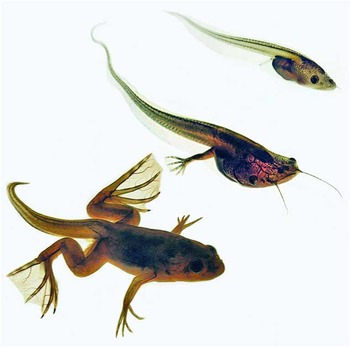
Most amphibians have complex life cycles, and the aquatic larvae of anuran amphibians (frogs and toads; tadpoles) are perhaps the best-studied chordates with indirect developmental modes. Environmental conditions experienced during the larval stage, such as conspecific density, food availability, pond drying and predation risk, affect metamorphic timing, body size and morphology of the tadpole and can also lead to variation in adult phenotypic expression. On reaching a species-dependent minimum body size, tadpoles develop competence to undergo metamorphosis, characterized by dramatic morphological, biochemical and physiological transformation into the terrestrial juvenile adult (Fig. 2). The timing of the initiation of metamorphosis is strongly influenced by the external environment, and is controlled by the production of hormones by the thyroid gland (iodothyronines; thyroxine – T4; 3,5,3′-triiodothyronine – T3). Iodothyronines are necessary for the metamorphosis of amphibians,Reference Brown and Cai 19 flatfishesReference Dejesus, Hirano and Inui 20 and echinodermsReference Chino, Saito and Yamasu 21 – Reference Heyland, Reitzel and Hodin 23 and they play essential roles in the development of direct-developing vertebrates such as humans, in whom thyroid deficiency during foetal or neonatal life causes profound mental retardation and skeletal malformation (cretinism).Reference Porterfield and Hendrich 24 On account of their external, free-living post-embryonic stage of development, amphibians are ideal for investigating environmental effects on early development, the roles of hormones in mediating these effects and impacts on future phenotypic expression and fitness.
(Colour online) Metamorphosis of the South African clawed frog Xenopus laevis. Shown are tadpoles in premetamorphosis (top), prometamorphosis (middle) and metamorphic climax (bottom). The tadpole is a growth stage in the anuran amphibian life cycle (premetamorphosis). The first external sign that metamorphosis has begun is the growth and differentiation of the hind limbs (prometamorphosis). Metamorphic climax is a period of rapid and dramatic tissue transformations that involve cell proliferation (e.g. the limbs), cell death (e.g. the tail) and tissue remodelling (e.g. the intestine and brain). Metamorphosis is controlled by thyroid hormone, and thyroid hormone is controlled by the stress neuropeptide corticotropin releasing factor that stimulates the release of pituitary thyroid-stimulating hormone.Reference Denver 31 Photos by David Bay.

Developmental plasticity that promotes survival to metamorphosis
Environmental conditions experienced during the tadpole stage can have profound effects on tadpole behaviour, metamorphic timing, body size and morphology, which can influence survival to metamorphosis.Reference Wilbur and Collins 25 – Reference Relyea 30 Under deteriorating environmental conditions (i.e. limited resources, high predation pressure and habitat desiccation) growth is generally reduced, and if experienced early in development, the rate of development may be slowed. However, after a minimum body size and developmental stage is reached, when the animals have become competent to upregulate thyroid hormone production, tadpoles may respond to adverse environmental conditions by accelerating metamorphosis.Reference Denver 31
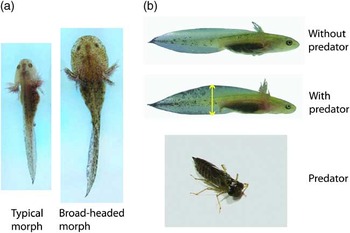
Amphibian larvae have a remarkable capacity for behavioural and morphological plasticity, which are often adaptive responses to variations in the developmental habitat.Reference Chipman 32 , Reference Newman 33 For example, prey presence and type of prey can have profound effects on larval morphology. In tadpoles of some spadefoot toad species, the presence of fairy shrimp in the larval habitat leads to the generation of a carnivorous morphology characterized by dramatic changes in jaw musculature, and mouth and beak morphology.Reference Pfennig 34 , Reference Pfennig 35 In the larvae of the Hokkaido salamander the presence of prey (tadpoles) induces the broad-headed morphologyReference Michimae and Wakahara 36 , Reference Michimae and Wakahara 37 (Fig. 3a). Remarkably, this morphology can be induced in salamander larvae simply by exposing them to the rhythmic water currents generated by the flapping motion of tadpole tails in their environment.Reference Michimae, Nishimura and Wakahara 38
(Colour online) Phenotypic plasticity caused by the presence of prey (a) or predators (b) in larvae of the salamander, Hynobius retardatus. In panel a the typical and broad headed morphs are shown at the same scale. Note the larger body size and head shape of the broad-headed morph.Reference Newman 33 , Reference Crews 78 In panel b, salamander larvae were raised without (top) or with (bottom) caged predators (dragonfly larvae) for 28 days. Typical morphs responded to predation threat by developing deeper tail fins than in the absence of predators (the arrow shows the increased tail height in larvae raised in the presence of predatorsReference Michimae and Hangui 109 ; photos courtesy of Hirofumi Michimae).

The presence of predators influences tadpole behaviour, morphology and rates of growth and development. A common behavioural response of tadpoles (and many other animals) to the presence of predators is to freeze. While the acute effects of predators are to inhibit swimming, chronic predator presence causes increased tail height (and in some species tail colour) and changes in body shapeReference McCollum and Leimberger 39 – Reference Van Buskirk and Mccollum 41 (Fig. 3b). The increased size of the tail may serve to lure predators away from the more vulnerable body, and may improve escape behaviour through enhanced burst locomotion.Reference Van Buskirk and McCollum 42 Chronic predator presence also causes complex and variable effects on the timing of metamorphosis (development rate) and size at transformation.Reference Relyea 30 , Reference Benard 43 – Reference Fraker, Cuddapah and McCollum 45
The most important environmental variable for an aquatic organism such as an amphibian tadpole is the presence of water (indeed, the mammalian foetus is an aquatic organism, bathed in amniotic fluid until the transition to the terrestrial environment at parturition). Drying of the natal pond accelerates metamorphosis in many amphibian species, a form of developmental plasticity that affects the timing and size at transformation.Reference Newman 27 , Reference Denver 46 Developmental acceleration in response to pond drying is adaptive for amphibians that live in arid environments since it can increase the probability of survival to reproduction.Reference Newman 27 , Reference Denver, Mirhadi and Phillips 29 However, there are trade-offs to accelerated metamorphosis such as smaller body size at transformation, which may be associated with future fitness costs. For example, small post-metamorphic frogs may incur costs such as slower growth rates under natural conditions in which resources are limited; although they may have significant potential for catch-up growth when sufficient resources are available.Reference Hu, Crespi and Denver 17 Larger juvenile amphibians have been shown to resist desiccation better, and travel through disturbed, open land with greater success.Reference Mazerolle and Desrochers 47 – Reference Thorson 49 In addition, larger metamorphs may have higher stored lipids,Reference Scott 50 which could allow them to better survive the high-density conditions immediately surrounding a pond. Behavioural measures also suggest that larger metamorphs are not as active on the terrestrial surface, perhaps due to a reduced need to forage, which would decrease their exposure to predators.Reference Morey and Reznick 51 Small size at metamorphosis in nature may also lead to inferior locomotor ability, greater susceptibility to starvation and higher mortality.Reference Goater 28 , Reference Scott 50 , Reference Semlitsch, Scott and Pechmann 52 – Reference Relyea and Hoverman 59 The body size disadvantage at metamorphosis may be retained through the age at first reproduction, thus compromising reproductive fitness.Reference Goater 28 , Reference Scott 50 , Reference Semlitsch, Scott and Pechmann 52 , Reference Berven 53 , Reference Altwegg and Reyer 58
Developmental plasticity that leads to variable phenotypic expression in the juvenile/adult stage
From arthropods to humans, it is clear that experiences during early development can carry over to subsequent life history stages affecting phenotypic expression in the juvenile adult.Reference Pechenik, Wendt and Jarrett 14 , Reference Matthews 60 , Reference Meaney 61 – Reference McMillen and Robinson 63 As discussed earlier, there are two ways by which environmentally induced phenotypic correlations between stages of a life cycle can arise: through direct effects on phenotypic expression, or through indirect effects on traits such as body size at life history transitions caused by alterations in the timing of development. As an example of a direct effect, exposure to predation risk during the larval stage has been shown to generate longer limbs in several frog species,Reference Nicieza, Alvarez and Atienza 15 , Reference Relyea 16 , Reference Van Buskirk and Saxer 56 and hind limb morphology is an important determinant of jumping distance in frogs, as longer legs increase leverage and greater muscle mass increases power.Reference Emerson 64
The timing of metamorphosis can indirectly affect traits expressed later in life through effects on body size at metamorphosis. Smaller metamorphic frogs tend to have lower rates of dispersal from the natal pond and survival to first reproduction compared with larger animals.Reference Chelgren, Rosenberg and Heppell 62 , Reference Smith 65 Frogs show a positive relationship between body size and fecundity such that larger females reach reproductive maturity earlier, and produce larger eggs and larger clutch sizes.Reference Scott 50 , Reference Prado and Haddad 66 , Reference Girish and Saidapur 67 Changes in the age of first reproduction can have important demographic effects, as an earlier reproductive maturity increases the proportion of individuals that will survive to reproduce at least once. Earlier reproductive onset can thus substantially increase the population growth rateReference Birch 68 , Reference Cole 69 as well as individual fitness (greater lifetime fecundity) in species that reproduce multiple times.Reference McGraw and Caswell 70
It is now well established that experiences during early development can affect phenotype, and thus individual fitness in amphibians. However, the effect on fitness may be either negative or positive, depending on the context and informational content of the early experiences. In some cases, carry-over effects may be beneficial to the animal, such as when early-life cues convey information about the conditions likely to be encountered later. In such instances, it is useful for the animal to respond to those cues in such a way that modifies its behavioural repertoire, morphological characteristics or decision-making processes in preparation for the anticipated environment. However, in many cases the adaptive value of carry-over effects may be more complicated. For example, Benard and FordyceReference Benard and Fordyce 71 showed that the outcomes of larval experiences may be context-dependent. In western toads, juveniles that developed under larval predation risk produced a higher concentration of toxins found in the skin of adult toads that repel predators.Reference Benard and Fordyce 71 Such a carry-over effect in predation response is intriguing, given that the aquatic predation rate has no predictive value for subsequent terrestrial predation risk. In addition, these animals showed reduced survival with a toxin-resistant predator,Reference Benard and Fordyce 71 suggesting that there is a cost to producing the toxins. Thus, larval predator induction produces juvenile toads with greater protection against toxin-sensitive predators, but these animals had reduced capacity to defend themselves against predators that do not respond to toxins, meaning that the fitness outcome will depend on the type of predator encountered.
Hormones mediate genotype–environment interactions
Variation in organismal form, function and life history traits leads to variation in Darwinian fitness. Hormones have widespread and diverse actions in coordinating the expression of suites of phenotypic traits, and thus play a key role in determining fitness. In the words of Mary Jane West-Eberhard,Reference West-Eberhard 72 hormones ‘…link environmental, genetic and phenotypic variation to selection and evolution through their mediation of gene expression’ (see also Gilbert and EpelReference Gilbert and Epel 73 ). The central roles of hormones, especially stress hormones, in amphibian developmental plasticity was recently reviewed.Reference Denver 8 Here we summarize some of the key concepts and their broader implications.
The neuroendocrine stress axis (the hypothalamo–pituitary–adrenal or HPA axis; in amphibians the hypothalamo–pituitary–interrenal axis) plays a central role in mediating physiological and behavioural responses to environmental change.Reference Denver 74 The major hormones produced within the HPA axis, which are evolutionarily conserved among vertebrates, are corticotropin-releasing factor (CRF) and related peptides produced in the hypothalamus, pituitary adrenocorticotropic hormone (ACTH; also known as corticotropin) and glucocorticoids produced by adrenal cortical cells (e.g. cortisol or corticosterone). The end effectors of the HPA axis, the glucocorticoids, function by binding to nuclear receptors (NRs) that regulate gene expression. The NRs cause epigenetic changes in the chromatin structure (e.g. histone methylation, acetylation, phorphorylation and ubiquitination) and possibly DNA methylation,Reference Gilbert and Epel 73 but do not affect the DNA sequence (i.e. the definition of epigenetic). The epigenetic changes alter gene expression, which drive phenotypic expression, and the changes may be stable and persist through later stages of the life cycle,Reference Szyf, Meaney and Weaver 75 , Reference Meaney, Szyf and Seckl 76 or even be passed on to subsequent generations (i.e. transgenerational effects).Reference Anway, Cupp and Uzumcu 77 – Reference Morgan and Whitelaw 80
Hormones control tadpole metamorphosis
Thyroid hormone controls tadpole metamorphosis and stress hormones (glucocorticoids) synergise with thyroid hormone to promote tissue morphogenesis.Reference Denver 8 , Reference Bonett, Hoopfer and Denver 81 The functioning of the tadpole thyroid axis is regulated at multiple levels, and the rate of thyroid secretion and potency of thyroid hormone action on target tissues determines when larvae enter metamorphosis and the rate at which metamorphosis progresses. Thyroid secretion is controlled by neurohormones produced in the hypothalamus that control the secretion of thyroid-stimulating hormone (TSH) by the anterior pituitary gland. In mammals, the tripeptide amide thyrotropin-releasing hormone (TRH) controls TSH release. Although tadpoles synthesize TRH in their brains, TRH has no effect on TSH secretion from the tadpole pituitary. Instead, the 41 amino-acid peptide, CRF, is the primary TSH-releasing factor in tadpoles, and also functions in controlling the release of ACTH, which controls glucocorticoid production by adrenocortical cells. Glucocorticoids synergise with thyroid hormone, and thus promote thyroid hormone action on target tissues. Thus, tadpole metamorphosis is controlled centrally by CRF, which has a dual role in controlling TSH and ACTH, and peripherally by thyroid hormone and glucocorticoids, which synergise at target tissues to control organogenesis and tissue remodelling.
As CRF neurons show sensitive and robust responses to environmental change, and CRF controls both thyroid and adrenocortical secretion in tadpoles, the neurohormone is ideally positioned to mediate environmental effects on the timing of metamorphosis. The developmental response to pond drying depends on the upregulation of the hypothalamo–pituitary–thyroid axis, and the function of CRF in mediating stressor-induced early metamorphosis has been shown in tadpoles of the western spadefoot toad, which respond to habitat desiccation by accelerating metamorphosis.Reference Denver, Mirhadi and Phillips 29 , Reference Denver 82 – Reference Boorse and Denver 84 This is not a response to osmotic stress, as the animals do not desiccate (i.e. they accelerate metamorphosis before the water disappears – see Denver et al.Reference Denver, Mirhadi and Phillips 29 ), but is likely caused by restricted locomotion that reduces foraging.Reference Denver 82 Corticotropin-releasing factor may be a phylogenetically ancient developmental cue that vertebrates use to assess changes in their habitat and to mount an appropriate developmental/physiological response.Reference Denver 8 The broader significance of this finding is that in mammals, CRF of foetal and/or placental origin controls the timing of the length of gestation and may shorten the gestational period under conditions of foetal stress.Reference Smith, Mesiano and McGrath 85 , Reference Challis, Bloomfield and Bocking 86 Thus, a neuroendocrine stress pathway regulated by environmental input controls the timing and character of animal development, that is, developmental plasticity.
Exposure to stressors during larval life causes activation of the neuroendocrine stress axis and elevations of glucocorticoids. Glucocorticoids reduce the growth of tadpoles, which if elevated before metamorphosis is initiated will slow the process of development. This can decrease the likelihood that animals will survive to metamorphosis, and generally leads to reduced body size at metamorphosis. However, the actions of glucocorticoids are complex, being generally inhibitory to growth and development if present before metamorphosis is initiated, but accelerating development once metamorphosis has begun.Reference Denver 31
Hormones and developmental programming
Stress neurohormones acting to accelerate developmental processes can have a survival value by allowing a tadpole to escape a drying pond, or a mammalian foetus to escape an adverse intra-uterine environment, although with important trade-offs such as immature organ systems or small body size. In these examples, environmentally induced phenotypic correlations between stages of a life cycle may be due to the indirect effects stemming from the effects on body size at metamorphosis or birth. Elevation in stress hormones during the larval or foetal stage can also have direct effects on cells and organ systems, and is implicated as a mechanism for developmental programming that underlies carry-over effects among life stages. Elevated glucocorticoids during early development may programme the phenotype expressed in the juvenile/adult stage of amphibians, birds and mammals.Reference Denver 8 For example, a stressful environment experienced during development can alter later life reactivity to stressful stimuli.Reference Meaney, Szyf and Seckl 76 The long-term consequences of early-life stressful experience may include changed behaviour, such as increased neophobia and altered social interactions that influence dominance hierarchies and mating success;Reference Knuth and Etgen 87 , Reference Spencer, Wimpenny and Buchanan 88 such changes could have a significant impact on lifetime fitness. Some changes could have adaptive value; for example, developing European starling chicks exposed to elevated glucocorticoids during embryogenesis subsequently exhibit enhanced flight performance, which could increase survival in a harsh environment.Reference Chin, Love and Verspoor 89 In humans, exposure to elevated cortisol in utero late in gestation may accelerate or enhance neurological development.Reference Amiel-Tison, Cabrol and Denver 90 , Reference Davis and Sandman 91
The effects of early life stress on later life phenotypic expression and susceptibility to disease are well documented in mammals.Reference Meaney, Szyf and Seckl 76 , Reference Weinstock, Matlina and Maor 92 – Reference Bloomfield, Oliver and Giannoulias 95 Much less is known about such effects in non-mammalian species. It is hypothesized, although not yet directly tested, that glucocorticoids act at critical periods during brain development to cause permanent changes in the functioning of the stress axis, which then alters physiology and behaviour later in life. In mammals, exposure to stressors early in life often leads to a ‘hyper-responsive’ neuroendocrine stress axis,Reference McCormick, Smythe and Sharma 96 – Reference Meaney 98 greater anxiety and fearful behaviourReference Meaney 98 , Reference Smythe, McCormick and Meaney 99 and increased food intake that can increase chances of becoming obese and developing metabolic syndrome.Reference Barker, Osmond and Kajantie 100 , Reference Breier, Vickers and Ikenasio 101
The hyper-reactivity of the HPA axis may result from reduced glucocorticoid negative feedback, as shown by the simultaneous elevation in basal plasma glucocorticoid concentration and CRF expression in the paraventricular nucleus of the hypothalamus, prolonged elevations in plasma glucocorticoid concentration after a stress response and reduced glucocorticoid receptor (GR) expression in the hippocampus.Reference Meaney 98 , Reference Welberg and Seckl 102 , Reference Weaver, Diorio and Seckl 103
In amphibians, food restriction during the tadpole stage caused increased food intake, catch-up growth and elevated basal corticosterone in juvenile frogs.Reference Hu, Crespi and Denver 17 As food restriction increases corticosterone in tadpolesReference Glennemeier and Denver 104 , Reference Crespi and Denver 105 the phenotypic effects of food restriction may have been caused by elevation in stress hormones. Corticosterone stimulates feeding in juvenile frogs;Reference Crespi and Denver 106 therefore, the elevated corticosterone could be causal for the increased food intake. The treatment of tadpoles with corticosterone for 5 days reduced body weight at metamorphosis (growth inhibition mentioned above), but juvenile frogs showed catch-up growth, reaching similar body size as controls 2 months after metamorphosis.Reference Hu, Crespi and Denver 17 These frogs had higher basal plasma corticosterone concentration, suggesting increased HPA axis activity. In addition, treatment with corticosterone as a tadpole decreased the number of GR-immunoreactive (GR-ir) cells in the brain and pituitary gland, particularly in regions of the brain involved in stress responses.Reference Hu, Crespi and Denver 17 The decreased GR expression may underlie the altered negative feedback reflected in the elevated plasma corticosterone concentration. Therefore, in frogs as in mammals, exposure to elevated glucocorticoids during early development leads to altered neuroendocrine gene expression and elevated HPA axis activity in later life stages.Reference Meaney, Szyf and Seckl 76 Such changes could have long-term fitness consequences.
The molecular developmental mechanisms by which GR expression is altered by early life exposure to glucocorticoids may involve epigenetic changes at the GR locus. In mammals, it is known that early life experience can influence the degree of DNA methylation at CpG islands located in the promoter region of the GR gene.Reference Szyf, Meaney and Weaver 75 , Reference Szyf, Weaver and Champagne 107 , Reference Szyf, Weaver and Meaney 108 The methylation state of the promoter is hypothesized to influence the expression level of the gene, with greater methylation causing lesser gene expression. A similar mechanism may occur in the frog as the frog GR gene has conserved CpG islands that may be modified by DNA methylation (Y. Kyono and R. J. Denver, unpublished data), and may account for the decreased GR-ir observed in juvenile frogs following exposure to corticosterone as a tadpole.Reference Hu, Crespi and Denver 17
Relevance to human biology and directions for future research
There are many parallels between the effects of environmental stress on tadpole growth and development and the effects of intra-uterine stress on foetal growth and development in mammals. Maternal malnutrition or exposure to stressors can lead to intra-uterine growth retardation and pre-term birth,Reference Weinstock, Matlina and Maor 92 – Reference Bloomfield, Oliver and Giannoulias 95 which are associated with elevated stress hormones in both the mother and the foetus.Reference Matthews 60 , Reference Weinstock 97 , Reference Welberg and Seckl 102 Similarly, tadpoles reared in suboptimal nutritive conditions exhibit small body size at transformation, and the resultant frogs have elevated corticosterone. As in frogs, mammals born at a small size often show catch-up growth. Although this is likely an adaptive response that evolved to allow animals to achieve reproductive maturity sooner given favourable growth conditions, it can have negative consequences in many modern human societies in which food may be abundant, and overconsumption leads to obesity and associated health problems. In mammals, exposure to stress in utero or neonatally is associated with reproductive dysfunction and increased susceptibility to disease later in life.Reference Weinstock 97 , Reference Barker, Osmond and Kajantie 100 The activation of the stress axis leading to elevations in plasma glucocorticoid concentrations occurring during critical periods of development has been shown to permanently alter the functioning of the stress axis, the expression of behaviours throughout the life of the animal and metabolic pathways that may predispose to metabolic disorders, obesity and type 2 diabetes (although, exposure late in gestation can have positive effects on neurological development – see Davis and SandmanReference Davis and Sandman 91 ). Similar findings in frogs suggest that the basic developmental mechanisms whereby glucocorticoids ‘programme’ the phenotype are phylogenetically ancient and evolutionarily conserved.
Due to their complex life cycles, amphibians are ideal for investigating environmental effects on development, the roles of hormones and the impact of early life experience on future phenotypic expression and fitness. Mammalian model systems are hampered by the inaccessibility of the foetus, which makes it very difficult to distinguish specific effects of elevated foetal or neonatal stress hormones from maternal influences. Post-embryonic development of amphibians is external, so that one can directly test for the roles of specific hormone signalling pathways in developmental outcomes. One can study hormone action in development in the absence of confounding maternal effects by manipulating a tadpole’s rearing environment leading to elevations in glucocorticoids, or non-invasively increase or block the production or actions of glucocorticoids simply by adding hormones, hormone synthesis inhibitors or hormone antagonists directly to the aquarium water. The structure and function of the amphibian neuroendocrine stress axis are evolutionarily conserved with mammals,Reference Denver 74 and the genome sequence and associated molecular tools are now available, providing for a powerful model system to investigate the mechanisms of the developmental origins of health and disease.
Acknowledgements
Basic research conducted by the authors and reported in this paper was supported by grants from the National Science Foundation IBN 9974672 and IOS 0922583 to R. J. Denver.
Statement of Interest
None.