Introduction
Hereditary haemorrhagic telangiectasia is an autosomal dominant condition, characterised by mucocutaneous telangiectasia, aneurysm and arteriovenous malformations.Reference Franchini, Frattini, Crestani and Bonfanti1 It has an incidence of around 1–2 in 10 000, and epistaxis is the most common clinical presentation, starting around the age of 20 years.Reference Merlo, Yin, Hoag, Mitchell and Reh2, Reference Pasculli, Resta, Guastamacchia, Di Gennaro, Suppressa and Sabba3 Many affected patients undergo multiple medical and surgical treatments to manage refractory bleeding. However, these treatments generally only offer a temporary solution, and subsequently these patients report poor quality of life scores.Reference Pasculli, Resta, Guastamacchia, Di Gennaro, Suppressa and Sabba3
Recent studies have shown around 96 per cent of hereditary haemorrhagic telangiectasia patients have a genetic mutation of either endoglin or activin-like-kinase.Reference McDonald, Wooderchak-Donahue, Webb, Whitehead, Stevenson and Bayrak-Toydemir4 These are two important genes, expressed on endothelial cells, which aid normal angiogenesis. In hereditary haemorrhagic telangiectasia, mutation within endoglin and activin-like-kinase 1 determines whether hereditary haemorrhagic telangiectasia is type 1 or type 2, respectively. These genes are part of a growth factor signalling pathway, which enhances vessel stability. In hereditary haemorrhagic telangiectasia, the tumour growth factor beta 1 signalling pathway is downregulated. This results in an increase in vascular endothelial growth factor, and subsequent excessive endothelial cell proliferation and migration, leading to increased vessel permeability.
Thalidomide, known for its anti-angiogenic properties, gained immense popularity in the late 1950s for the alleviation of nausea and vomiting in pregnancy. Its use resulted in one of the biggest tragedies in the history of drug development, and an estimated 10 000 children were born with birth defects.Reference Franks, Macpherson and Figg5 Thalidomide upregulates a separate platelet-derived growth factor beta pathway, which in turn directly inhibits endothelial cell proliferation and migration, and increases mural cell coverage. In 2010, Lebrin et al. demonstrated the ability of thalidomide to induce vessel maturation, which could be used as a therapeutic strategy in patients with hereditary haemorrhagic telangiectasia and refractory epistaxis.Reference Lebrin, Srun, Raymond, Martin, van den Brink and Freitas6
This study set out to examine the evidence for using thalidomide in the management of refractory epistaxis in hereditary haemorrhagic telangiectasia patients, and to consider the implications for its use in clinical practice.
Materials and methods
A comprehensive literature search of Medline, Embase, Cochrane Library and NHS Evidence databases was performed, from inception to December 2017, to identify all English-language studies relevant to the question of interest. The following search terms were used: hereditary haemorrhagic telangiectasia (HHT), Osler-Weber-Rendu syndrome, epistaxis, haemorrhage and thalidomide. Additional studies were identified from the references of retrieved articles.
Inclusion and exclusion criteria
Criteria for the inclusion or exclusion of studies were specified prior to the literature search. All studies reviewing the use of thalidomide for refractory epistaxis only in hereditary haemorrhagic telangiectasia patients were included. Studies on other types of systemic bleeding, including gastrointestinal or pulmonary bleeding, were excluded.
Studies identified
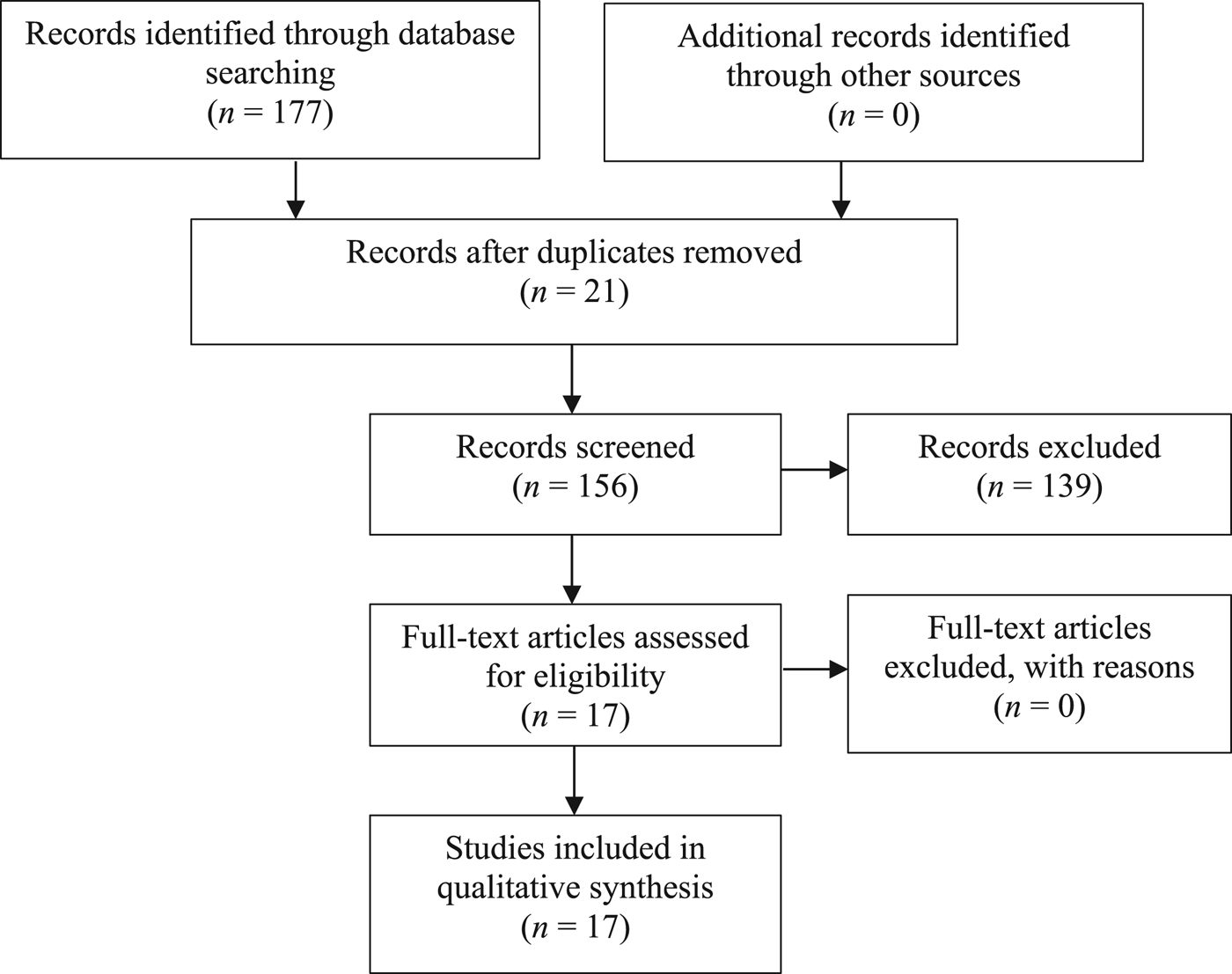
The electronic search initially resulted in the identification of 177 publications. The title and abstracts from these studies were then examined, and 17 relevant studies were reviewed in full manuscript form (Figure 1).
Preferred Reporting Items for Systematic Reviews and Meta-Analyses (‘PRISMA’) flow chart showing the identification of studies.

Evaluation method
The outcomes examined in this systematic review were those of any study investigating the use of thalidomide for treating refractory epistaxis. A meta-analysis was not possible because of the limited number of studies available and variations in the length of follow up.
Results
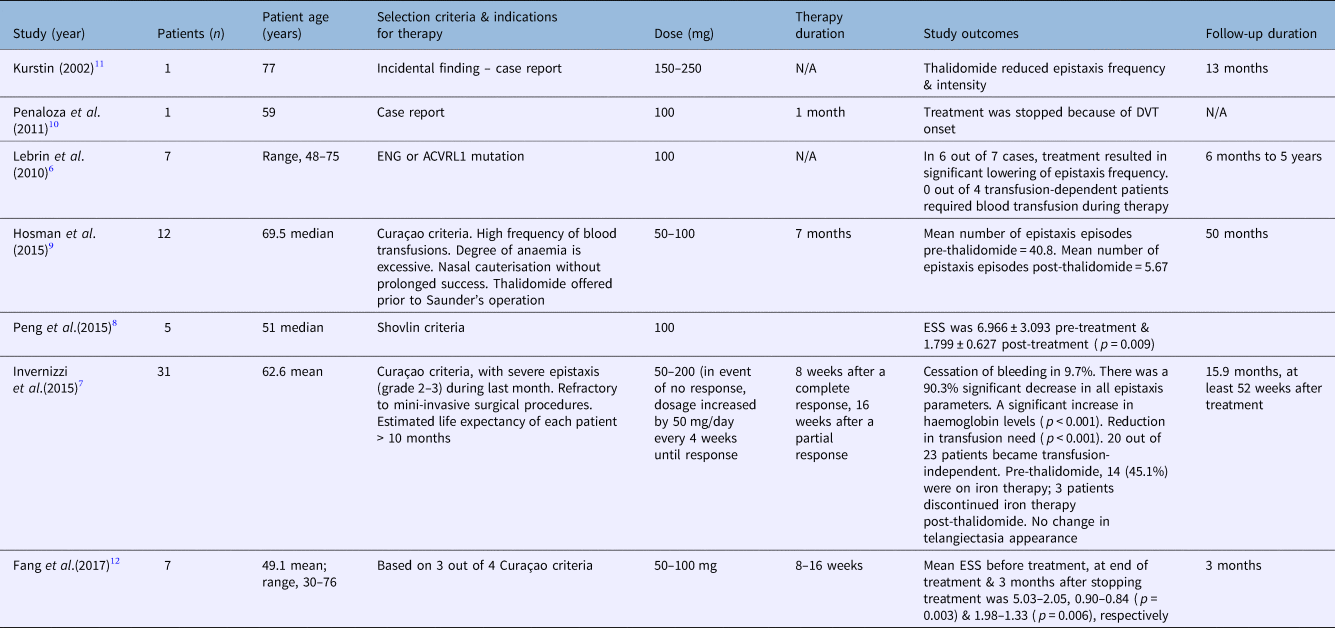
The search yielded 177 abstracts, of which 17 studies were identified following the removal of duplicates and inclusion of only those studies relating to use of thalidomide for refractory epistaxis. The highest available evidence for thalidomide therapy for refractory epistaxis in hereditary haemorrhagic telangiectasia was level III. Sixty-four patients were represented in the seven case series identified in the review (Table 1).Reference Lebrin, Srun, Raymond, Martin, van den Brink and Freitas6–Reference Fang, Chen, Zhu, Ye, Zhang and Guan12 There was one non-randomised, single-centre phase 2 study, one case–control study, three observational studies, one systematic review and two case reports.
Summary of main studies using thalidomide therapy for refractory epistaxis in hereditary haemorrhagic telangiectasia patients

N/A = not available; DVT = deep vein thrombosis; ESS = Epistaxis Severity Score
All patients in the articles identified were diagnosed with hereditary haemorrhagic telangiectasia using the Curaçao or Shovlin criteria, or genetic testing. Genetic testing included identification of the two main genes implicated in hereditary haemorrhagic telangiectasia: ENG and ACVRL1. Patients’ ages ranged from 30 to 76 years. In three studies, the severity of epistaxis was evaluated using the Epistaxis Severity Score. The Epistaxis Severity Score assesses the frequency, intensity and duration of epistaxis and anaemia episodes, the need for medical attention, and transfusions required for epistaxis and anaemia; the calculated number is then multiplied by a co-efficient.
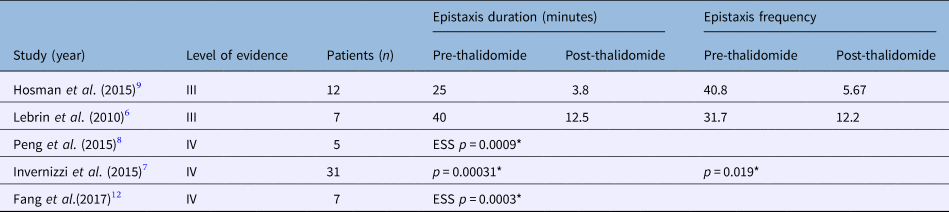
All studies showed a reduction in the frequency and duration of epistaxis episodes with thalidomide therapy. In two of the studies, this was shown by a significant difference in the Epistaxis Severity Scores before and after thalidomide therapy. In the study by Invernizzi et al.,Reference Invernizzi, Quaglia, Klersy, Pagella, Ornati and Chu7 there was a significant reduction in the duration (p = 0.00031) and frequency (p = 0.019) of epistaxis episodes (Table 2).Reference Lebrin, Srun, Raymond, Martin, van den Brink and Freitas6–Reference Hosman, Westermann, Snijder, Disch, Mummery and Mager9, Reference Fang, Chen, Zhu, Ye, Zhang and Guan12 Symptom improvements were detected as early as four weeks after starting thalidomide therapy. Peng et al. also showed a significant improvement in Epistaxis Severity Scores (p = 0.0009) at six months after thalidomide therapy (Table 2).Reference Peng, Yi, Zhou, Xie and Zhang8 Lebrin et al. reported improvement in the frequency of epistaxis in six out of seven patients (p < 0.05).Reference Lebrin, Srun, Raymond, Martin, van den Brink and Freitas6
Reduction in duration and frequency of epistaxis episodes in each case series

*Pre- versus post-thalidomide. ESS = Epistaxis Severity Score
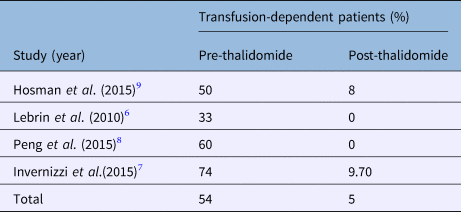
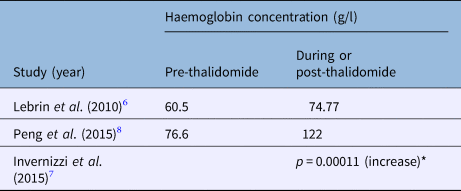
There was also a reduction in the number of transfusions in four of the case series. An average was taken across all four case series, which shows that 54 per cent of patients were dependent on blood transfusions prior to thalidomide therapy and only 5 per cent were dependent following therapy (Table 3).Reference Lebrin, Srun, Raymond, Martin, van den Brink and Freitas6–Reference Hosman, Westermann, Snijder, Disch, Mummery and Mager9 Invernizzi et al. found that the number of transfusions was reduced by 1.77 units per month post-therapy.Reference Invernizzi, Quaglia, Klersy, Pagella, Ornati and Chu7 Lebrin et al. reported that four patients did not require additional blood transfusions in a six-month to five-year follow-up period after thalidomide therapy.Reference Lebrin, Srun, Raymond, Martin, van den Brink and Freitas6 Haemoglobin concentration during or after thalidomide therapy increased in the three studies where this was reported (Table 4).Reference Lebrin, Srun, Raymond, Martin, van den Brink and Freitas6–Reference Peng, Yi, Zhou, Xie and Zhang8
Reduction in blood transfusion dependence in each case series

Average haemoglobin concentration pre- and post-thalidomide treatment

*Pre- versus post-thalidomide
Tolerance of thalidomide therapy
The starting dose of thalidomide varied between all the studies, from 50 mg to 200 mg. All patients responded to thalidomide eventually, but symptom improvement appears to be dose-dependent. The largest study, by Invernizzi et al., conducted in 2015, showed that a complete or partial response was achieved at only four weeks of treatment in 81 per cent of patients who received 50 mg thalidomide per day.Reference Invernizzi, Quaglia, Klersy, Pagella, Ornati and Chu7 Five patients achieved a partial response with 100 mg thalidomide per day, and one patient with 150 mg thalidomide per day.
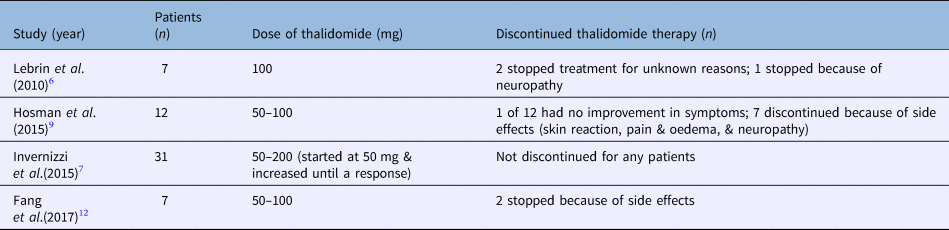
Only four of the case series reported adverse effects associated with thalidomide. The most frequent side effects were gastrointestinal tract symptoms, followed by dizziness, drowsiness and lethargy. Overall, 17.5 per cent of patients in whom side effects were reported had to discontinue thalidomide therapy secondary to side effects.
Thalidomide treatment is limited by the adverse effects associated with its use. In the study by Hosman et al.,Reference Hosman, Westermann, Snijder, Disch, Mummery and Mager9 published in 2015, 9 out of 12 patients reported that they would recommend thalidomide to other hereditary haemorrhagic telangiectasia patients, despite 58 per cent discontinuing therapy secondary to side effects (Table 5).Reference Lebrin, Srun, Raymond, Martin, van den Brink and Freitas6, Reference Invernizzi, Quaglia, Klersy, Pagella, Ornati and Chu7, Reference Hosman, Westermann, Snijder, Disch, Mummery and Mager9, Reference Fang, Chen, Zhu, Ye, Zhang and Guan12 Thirty patients completed 16 weeks of thalidomide therapy in the study by Invernizzi et al.Reference Invernizzi, Quaglia, Klersy, Pagella, Ornati and Chu7 In the Hosman et al. study, four patients were still using thalidomide therapy at 3, 27, 30 and 50 months.Reference Hosman, Westermann, Snijder, Disch, Mummery and Mager9 A case report by Penaloza et al. reported a deep vein thrombosis following one month of thalidomide therapy.Reference Penaloza, Vekemans, Lambert and Hermans10
Adverse reactions with thalidomide therapy and discontinuation of treatment

Discussion
The patients in the studies identified by this systematic review are those in whom traditional treatments lost efficacy over time and management options were exhausted. These patients are often blood transfusion dependent and require repeated hospital admissions.
Mechanisms and genetics
The development of vascular malformations in hereditary haemorrhagic telangiectasia has been attributed to decreased tumour growth factor beta and increased vascular endothelial growth factor.Reference Lebrin, Srun, Raymond, Martin, van den Brink and Freitas6, Reference Thalgott, Dos-Santos-Luis and Lebrin13 Peng et al. showed that tumour growth factor beta-3 and vascular endothelial growth factor were downregulated following thalidomide therapy.Reference Peng, Yi, Zhou, Xie and Zhang8 In a mouse model by Lebrin et al., thalidomide was shown to increase the number of smooth muscle cells around vessels.Reference Lebrin, Srun, Raymond, Martin, van den Brink and Freitas6 Lebrin et al. also sampled human nasal mucosa from patients with hereditary haemorrhagic telangiectasia receiving thalidomide therapy.Reference Lebrin, Srun, Raymond, Martin, van den Brink and Freitas6 They found that thalidomide stimulated the expression of platelet-derived growth factor beta and there were increased smooth muscle cell layers around the blood vessels. In addition, thalidomide therapy may target mural cells directly to stimulate vessel maturation independently of platelet-derived growth factor beta.Reference Lebrin, Srun, Raymond, Martin, van den Brink and Freitas6 No difference has been observed in patients with ENG or ACVRL1 mutations within these studies;Reference Invernizzi, Quaglia, Klersy, Pagella, Ornati and Chu7 however, some studies have shown that ENG mutation carriers suffered more severe epistaxis than ALK1 carriers.Reference Berg, Porteous, Reinhardt, Gallione, Holloway and Umasunthar14
Thalidomide dosage
A model of excessive angiogenesis in mice showed that thalidomide had a dose-dependent effect on retinal angiogenesis. High doses of thalidomide were shown to reduce vessel sprouting and lower doses promoted vessel maturation by enhancing pericyte and vascular smooth muscle cell coverage in a mouse model.Reference Lebrin, Srun, Raymond, Martin, van den Brink and Freitas6
All patients within the studies responded to thalidomide eventually, but symptom improvement appears to be dose-dependent. In the study by Invernizzi et al., remission was achieved: in 25 patients (80.7 per cent) with 50 mg/day of thalidomide, in 5 patients (16.1 per cent) with 100 mg/day and in 1 patient (3.2 per cent) with 150 mg/day.Reference Invernizzi, Quaglia, Klersy, Pagella, Ornati and Chu7 Furthermore, no patients in that study discontinued thalidomide therapy secondary to side effects. One could speculate that titrating the dose according to individual needs may prevent higher rates of adverse side effects. Lebrin et al. used a starting dose of 100 mg thalidomide daily, comparable to that prescribed in the 1960s for nausea in pregnancy.Reference Lebrin, Srun, Raymond, Martin, van den Brink and Freitas6 They showed a significant reduction in the frequency of epistaxis (p < 0.05) within one month of administration of the first dose; only one patient discontinued therapy secondary to side effects in that study, because of peripheral neuropathy.Reference Lebrin, Srun, Raymond, Martin, van den Brink and Freitas6
Side effects appear to be a limiting factor for thalidomide use in practice, but these can be attenuated by reducing the dose.Reference Teo, Stirling and Zeldis15 Minor side effects, such as mild constipation, limb oedema, drowsiness and lethargy, are common in the majority of cases, particularly at doses above 100 mg per day.Reference Invernizzi, Quaglia, Klersy, Pagella, Ornati and Chu7 In 2008, Chaudhry et al. reported neuropathies in up to 30 per cent of patients and sedation in up to 50 per cent.Reference Chaudhry, Comblath, Polydefkis, Ferguson and Borrello16 In one case report, toxic epidermal necrolysis was reported with a daily dose of 50 mg thalidomide.Reference Colagrande, Di Ianni, Coletti, Peris, Fargnoli and Moretti17 A case series by Boey et al., who used thalidomide for angiodysplasia-related bleeding, reported no adverse effects in seven patients who received a dose of 50 mg thalidomide per day.Reference Boey, Hahn, Sagheer and McRae18 One recent study investigated thalidomide in the form of nasal powder as a complementary anti-epistaxis therapy, with the goal of sustaining the effect following oral thalidomide after its discontinuation for adverse effects, with positive results.Reference Colombo, Bortolotti, Chiapponi, Buttini, Sonvico and Invernizzi19
There is one reported case of deep vein thrombosis induced by thalidomide at one month of therapy.Reference Penaloza, Vekemans, Lambert and Hermans10 Hereditary haemorrhagic telangiectasia patients carry a higher risk for venous thromboembolism compared to the general population.Reference Livesey, Manning, Meek, Jackson, Kulinskaya and Laffan20 Although the precise reason(s) for this are unknown, one recent study of 609 hereditary haemorrhagic telangiectasia patients identified an association of deficient iron stores with high coagulation factor VIII levels and increased thromboembolic risk.Reference Shovlin, Sulaiman, Govani, Jackson and Begbie21
Implications for approval
Thalidomide has been approved by the National Institute for Health and Care Excellence as an option for the initial treatment of myeloma in patients not considered suitable for high-dose chemotherapy or stem cell transplantation. This is supported by the pregnancy prevention programme in the UK, and by the Thalomid Risk Evaluation and Mitigation Strategy programme in the USA and other countries. These programmes ensure that patients taking thalidomide consent appropriately to starting thalidomide and, importantly, take appropriate pregnancy prevention measures.22, 23
The natural evolution of hereditary haemorrhagic telangiectasia is that epistaxis starts in the majority of patients by age 20 years and then progresses in severity.Reference Gallitelli, Pasculli, Fiore, Carella and Sabba24–Reference Assar, Friedman and White26 Folz et al. described an increase in epistaxis intensity and frequency in two-thirds of patients with increased age.Reference Folz, Tennie, Lippert and Werner25 As epistaxis severity progresses with age, and hence most patients suffering with intractable epistaxis will be post-childbearing age, a significant proportion of patients may benefit from a trial of thalidomide therapy.Reference Berg, Porteous, Reinhardt, Gallione, Holloway and Umasunthar14
Conclusion
There is some evidence to suggest that low-dose thalidomide is effective in transiently reducing epistaxis that is refractory to medical and surgical management in hereditary haemorrhagic telangiectasia patients. This systematic review summarises the potential use of thalidomide in a cohort of patients with very limited treatment options. Continuous treatment with further reduced dosages might be effective without significant side effects. Undoubtedly, thalidomide cannot be offered to patients planning on starting a family, but for others the reported adverse reactions are reversible. Thalidomide should only be considered when all other options have been exhausted. This alternative management option could improve quality of life in those hereditary haemorrhagic telangiectasia patients who are transfusion-dependent and affected by debilitating refractory epistaxis.
Competing interests
None declared