INTRODUCTION
Much research has focused on the study of intra-specific interactions that enable cooperative hunting, yet inter-specific interactions are rarely considered (Bshary et al., Reference Bshary, Hohner, Ait-El-Djoudi and Fricke2006). Recent evidence has found that such inter-specific cooperative hunting (based on true coordination) that had previously only been reported for a small number of species (most of which are mammals or birds) extends to cooperation between the reef grouper Plectropomus pessuliferus (Fowler, 1904), and the giant moray eel, Gymnothorax javanicus (Bleeker, 1859) (Bshary et al., Reference Bshary, Hohner, Ait-El-Djoudi and Fricke2006). An additional example of cooperative hunting exists between banded sea kraits and trevallies (Attenborough & Fothergill, Reference Attenborough and Fothergill2006). Such relationships serve to provide both species with food provision.
The present study reports evidence that such behaviour is not limited to the reef grouper Plectropomus pessuliferus, and potentially exists as an inter-phyla relationship between the highfin grouper (Epinephelus maculatus Bloch, 1790) and the common reef octopus (Octopus cyanea Gray, 1849) on the Great Barrier Reef, Australia.
Octopus cyanea and Epinephelus maculatus are found as adults on coral reefs throughout the Pacific Ocean, with E. maculatus specifically known to frequent isolated coral heads of lagoon and seaward reefs and feeds mainly on sand-dwelling fishes and crustaceans (Froese & Pauly, Reference Froese and Pauly2012). The reef inhabiting Octopus cyanea feeds on sessile molluscs or crustaceans hidden under corals and rocks (Forsythe & Hanlon, Reference Forsythe and Hanlon1997). Studies of their foraging behaviour find them to spend 28% of daylight hours solitarily hunting (Forsythe & Hanlon, Reference Forsythe and Hanlon1997).
Given the widespread degradation of marine systems, particularly coral reef environments, and the known impacts of this on animal behaviour (Feary et al., Reference Feary, Almany, Mccormick and Jones2007), this research on behavioural interactions is of importance to the study of undisturbed marine ecosystems. In addition, both species are of high fisheries-based economic value throughout the region (Guard & Mgaya, Reference Guard and Mgaya2002; Unsworth et al., Reference Unsworth, Powell, Hukom and Smith2007) therefore an understanding of their behaviour is of interest to those concerned with managing their stocks.
MATERIALS AND METHODS
A unique opportunistic observation was made of a non-random association between Octopus cyanea and Epinephelus maculatus on the eastern side of an isolated large coral bommie (Steve's Bommie) in amongst the Northern Ribbon reefs of the Great Barrier Reef Marine Park, Australia. The site is due west of Cooktown (Latitude:–15.4917; Longitude: 145.8027) within a Green Zone (no-take area) of the marine park. The present study, although based on a chance observation (N = 1) is of sufficient novelty to be recorded within the academic literature. There exists no previous evidence of such a behavioural interaction that the authors are aware of.
This observation was made at approximately 3 pm at a depth of 27 m during April 2010 and was observed by two SCUBA divers experienced in making underwater behavioural observations of fish. The grouper was approximately 60 cm in length indicating it was a mature adult whilst the octopus was of a similar size and presumably also an adult. The two species were followed for approximately 10 minutes; photography and videography footage were taken with a Panasonic Lumix underwater camera.
RESULTS AND DISCUSSION
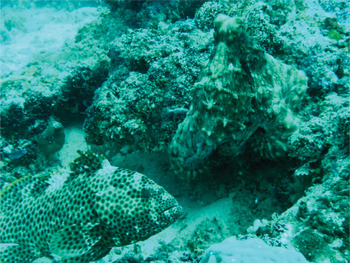
We observed what we surmise to have been a non-random association between these two species. The grouper and octopus appeared together. In a similar manner to that described for P. pessuliferus in the Red Sea (Bshary et al., Reference Bshary, Hohner, Ait-El-Djoudi and Fricke2006), the grouper was observed to gesture by moving its body in the direction of the octopus. Whether this was to initiate the cooperation is not clear. The grouper was then observed to wait outside a small crevice within a coral head, whilst the octopus then looked inside. The grouper then waited for the octopus to fully emerge from the crevice (Figure 1), at which point they moved off together side by side along the reef to another crevice, where the octopus then entered the reef whilst the grouper sat outside.
Epinephelus maculates waiting for the reef octopus (Octopus cyanea) on Steve's Bommie in the Great Barrier Reef, Australia.

Successful hunting and feeding was not observed, but we hypothesize that the observed non-random interaction is based upon the mutual benefits of increased hunting success similar to the interaction observed between P. pessuliferus and G. javanicus (Bshary et al., Reference Bshary, Hohner, Ait-El-Djoudi and Fricke2006). These observations are also of interest given that E. maculatus has been documented to sometimes feed on octopuses (Froese & Pauly, Reference Froese and Pauly2012) and that Octopus cyanea have only previously been observed to hunt as solitary individuals (Forsythe & Hanlon, Reference Forsythe and Hanlon1997). It may be the case that such feeding of E. maculatus on octopus is on juvenile and/or sub-adult octopus rather than adults or that this association is location specific.
Given that the sample size of this study is limited to only one the discussion of this observation is clearly speculative, however given the unique and highly novel nature of this observation more information is clearly needed on the inter-specific interaction between top predators on the reef. Given the geographical and species variation between the present observation and that of Bshary et al. (Reference Bshary, Hohner, Ait-El-Djoudi and Fricke2006) there are probably many more such interactions present on Indo-Pacific coral reefs. Details of how such interactions develop, how they are influenced by the availability of resources and how such potentially delicate associations are affected by the current levels of environmental change on coral reefs, remain to be seen.
The unusual behavioural observation reported here was within a highly protected and well managed reef area, where marine life potentially exists in an environment closer to its ‘natural’ state. Behavioural observations of marine fauna in other such unexploited and ‘near pristine’ environments have also produced unexpected behavioural results. A research study in the remote Pacific Wake Atoll observed extraordinary aggressive behaviour between males of the giant coral reef fish, Bolbometopon muricatum; such behaviour had previously never been observed (Muñoz et al., Reference Muñoz, Zgliczynski, Laughlin and Teer2012).
The unique nature of our observation supports the view of the importance of conducting behavioural studies of animals in relatively undisturbed environments.