Over the past few decades, intellectual historians and political theorists have begun to uncover the immense influence Auguste Comte's Positivist ideology exerted on Victorian culture, which attracted sympathisers such as John Stuart Mill, George Eliot, Beatrice Webb, and William Morris (Bevir 57; Varouxakis 100–18; Wright 135, 175–220). Until recently, scholars believed that, within Comte's prolific society of British followers, Vernon Lushington was merely a sympathiser of the movement's aesthetic and literary culture. While many will appreciate that recent accounts of Lushington's life have revealed that he was a “complete” Positivist, or adherent to the Religion of Humanity, few have had an opportunity to examine his position in relation to Comte's prototype for civic reconstruction (Taylor 339–40; Vogeler 163–69). In his four-volume System of Positive Polity (1848–1854), Comte referred to this scheme for pan-European peace as the “Republic of the West.” The extent to which Lushington's work may be read as disseminating this republican city-state system as an inevitable, if not realisable, edifice has remained less clear than others within the circles of British Positivism.
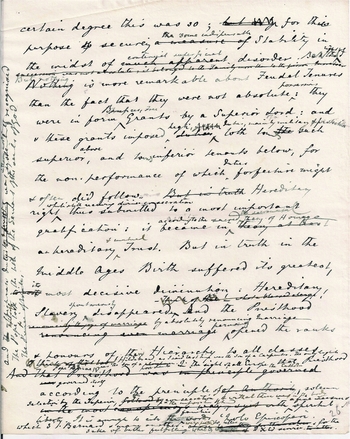
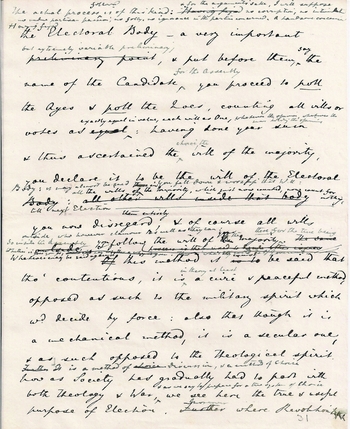
Lushington's “The State” (Figures 18 and 19) offers the nearest approximation of his views on Comte's system. It formed a portion of a political lecture series he delivered in the spring of 1889 at the Positivists’ Newton Hall, London, which was a school aiming to inculcate the working classes with the noble sentiments of civic virtue associated with life within the ancient polis. Within this setting, Lushington taught that religious historicism could introduce an era of class cooperation and “universal morality,” inaugurating a new “social economy” (Comte 3: 523; Harrison 190). He aimed to situate Positivism as a response to the ruthless and debasing effects of laissez faire economics and the international militancy of the large state, which failed to benefit the common good at home or abroad. Lushington emphasised that world peace and economic prosperity was only possible within the scale of autonomous industrial city-states. His vision paralleled the influential urban-regional theory of Positivist sociology developed by Richard Congreve, Frederic Harrison, Charles Booth, and Patrick Geddes among others (Booth 8–9, 95–98; Claeys 112–23; Himmelfarb 79–85; Vogeler, Victorian Writers 91–112).
Manuscript page, “The State” by Vernon Lushington, from the personal library of Dr David Taylor.

Manuscript page, “The State” by Vernon Lushington, from the personal library of Dr David Taylor.

Comte's multiphase system of social reconstruction entailed dissolving the British Empire and the rest of Western nations into city-states. It began with a call for the separation of powers to achieve a state of spiritual centralisation and temporal decentralisation. The superstructure of this social organisation was similar to that of medieval Catholicism. A Positivist republican elite would serve as the scientific capacity of centralisation, linking a confederation of city-states through a single bond: a scientific education (Comte 4: 329; Congreve 470; Pickering 358–59, 366). Each republic, led by a local triumvirate of responsible capitalists serving as the temporal capacity, would organise industrial life in decentralised communities forming “eutopia” (Geddes vii, 331, 365).
Significantly, Lushington applies Comte's theory of the three stages to substantiate this political organisation. In other words, he uses a historical survey of the “theological” and “metaphysical” eras to forecast the mode of governance for the incipient “positive” era. The first two stages of political organisation – by birth and democratic election – lead him to estimate that the political leaders of the positive era will be chosen by “systematic choice by the superior.” This Positive era practice of “sociocratic succession” would mean that, within each social institution, the outgoing leader chooses his successor based upon merit alone, thus substituting the volatile nature of democracy for a political organisation that acts quickly and efficiently for the commonweal. This, Lushington ensured his auditors, was the surest path to a peaceful industrial society.
A transcript of Lushington's lecture “The State,” of 14 April 1889, follows.1
How could communities, Degrees in schools & brotherhoods in cities, Peaceful commerce from dividable shores, the primogeniture and due of birth, Prerogative of age, crowns, sceptres, laurels, but by degree stand in authentic place? Take but degrees away, untune that string, and hark, what discord follows! Each thing meets in mere oppugnancy: the bounded waters should lift their bosoms higher than the shores, and make a sop of all this solid globe. Strength should be lord of imbecility, and the rude son should strike the father dead: Force should be right: or rather right & wrong, Between whose endless jars justice resides should lose their names, and so should justice too.Footnote 2
In my two previous lectures I endeavoured to bring before you in outline the Positivist ideal of social reorganisation, towards which we believe we are moving, and towards the preparing of which our efforts shd. be steadily & systematically directed.Footnote 3 We seek on the one hand the constitution of a modern Spiritual Power, to make by spiritual means a human piety[,] the Religion of Humanity, plenarily useful, in politics, in industry, in family and personal life, – moderating material power in every sphere: on the other hand we look forward to Republics of limited size, under vigorous civic but not parliamentary rule.Footnote 4 In that exposition, I could not help commenting on the deep decay of the Elder Powers, the Hereditary & Theological [illegible], & on the revolutionary activity of Parliamentary assemblies, which is the spectacle today in Western Europe.
Tonight I continue the subject by reviewing the history of three principles of Political Organisation, which as instruments have largely helped to operate the development of the Human Story. These principles are: 1[st] Birth[,] which has been continually consecrated by theology: 2[nd] Election by Inferior[,] a revolutionary method that feeds on the metaphysical idea of a semi divine will in the People: 3rd Systematic Choice by the Superior, which because it reorganises existing authority and follows a simply human doctrine I call the principle of human authority[.]
I shall try to show you that these form a connected series, of which the first and last are alone united to be regarded as really organising principles, & the second however [illegible] prolonged is merely intermediate & transitional, just as in the province of belief[,] as metaphysics are transitional between Theology and the Religion of Humanity. I shall show you how Birth prevailed in antiquity under Theological sanction: how the human principle, Choice by the Superior, though it dates back, like Positive Reason itself to earliest times, was like Positive reason long treated as subordinate because it was merely human. Now notwithstanding it has always been developing and must eventually rule future polity: & receive full human consecration: how between these as a necessary but revolutionary transition intervened the revolutionary principle of election of Superiors by Inferiors. And as some evidence that the Elective principle of inferior choice is merely transitional I would have you observe at once that it is never found subsisting by itself. Always revolutionary in its purpose, you find it for a long time after its appearance merely qualifying the elder rule of Birth, often with forms of official deference: such for instance was the early action of the tribunes at Rome: at last you find the principle of popular will arrogantly claiming supremacy tho’ never really attaining it: at the same time it cannot help employing or patronising the ever growing principle of human authority as a useful subordinate & ally against its adversary Birth, or any rival factions in its ranks. Such is the position today.
Before however I describe the chief development of Birth as an organising principle, I must speak of the part played by the fundamental and perpetual forms of birth distinction: Sex & Age. You will remember what I said last Sunday that Material force always rules. In accordance with this law from the earliest time the Male sex has qualified for rule, the Female sex disqualified and not alone in matters of war or general government, but of course in the family also. There too the Man ruled: in antiquity, the Woman was his slave, she is still his dependent. This universal subordination of the Female to the Male was inevitable, & naturally came to be everywhere reinforced by theological sanction the main office of which has ever been to consecrate authority. For the average woman is inferior to the average man in stature and bodily strength; she is also inferior to him in those qualities of intellect and character wh. make for rule. Were it otherwise history wd. have opposite record to show to the record we have: we shd. find that Men had been everywhere enslaved to Women, this we never do find.
In fact the experiment was tried out in millions of households, & was so conclusive there, that probably it never came to be attempted on any very wide stage. Unquestionably however Women have been tried in war, & their inferiority there demonstrated enough. There is a historical example of deep interest tho’ in itself quite inconclusive. Gaius Marius was in his earlier career honoured as the third founder of Rome because he saved the Republic from destruction by his overthrow of the terrible Cimbrians and Teutons – barbarians – who may in part be considered our ancestors. Well in both of his great battles the barbarian Women took part. They were warriors, but even in their own lost [illegible]. Plutarch thus describes one scene. The Barbarians were smitten by the Romans [till] they reached their camp & the waggons in their flight. There the Women meeting them with swords & axes, with horrid furious yells, attempted to drive back both the fugitives as traitors & their pursuers, the fugitives as traitors, & the pursuers as their enemies, [illegible] among the combatants, & with their [illegible], laying hold of their swords & enduring wounds & gashes till they fell, in spirit unqualified.
Ah! Surely Mankind & Womenkind are right in their now unanimous conclusion that War is not for women; tho’ observe in mere numbers this reduces fighting by one half. But we regard the disqualification to the Female Sex for authority as moral, not only in Antiquity, where Order was the paramount interest in the house, & warfare was the paramount social concern, but not less normal in these ambiguous times, & in the Centuries of truly peaceful unity, still afar, which we trust are to come.
On the other hand not slavery but a beautiful & satisfying function, was always preparing for the weaker sex: it was fully announced in Catholic Feudalism that did so much for all the Weaker members of Society; as the picture behind me bears external [illegible], it now forms one of the most exalted & precious features of the Religion of Humanity.Footnote 5 By virtue of her superior affection, cultivated as it has been by a thousand generations of family life, Woman becomes the Spiritual Power in the home. As such she rises higher in dignity than the man, altho’ such office is not in the least inconsistent with the humblest domestic duties, for each one of these may be & in truth rendered as a personal service of love.Footnote 6 This beautiful position whose aim is religious harmony woman has in fact already in large measure attained, mainly by the affectionate habits transmitted from the Middle Ages. To appreciate it you shd. contrast it with her former bondage.
So holding, how deeply must regret the inquiry, which this admirably ordained relation of the sexes so honourable and delightful to both has temporarily suffered thro’ the fallacies & temptations of modern anarchy? Under the false pretences of equality, independence, and individual right, Women are urged to undo this happy relation, to abandon their affectionate duties, to leave the shelter of the home, & step into public arenas to wrestle for gain against man who are stronger than they, while men are called by the same scepticism, & they want less and less calling, to cease their protecting services, and let the women shift for themselves.
The latest step on the political side of this degradation is the proposal wh. I see a conservative Prime Minister patronises, – to give Women the Parliamentary suffrage. It looks very much like selling the conservative heritage for a mess of pottage. But the most serious degradation needs no Prime Minister's patronage: it is that for which we all are responsible, which goes on increasing recklessly, year after year in modern industry, where tender girls, & young wives & mothers are to be seen engaged all day long in gang labour away from their homes. Lack of Affection is here the obvious symptom: the simplest cause is the failure of all religion, the temporary loss of all Religion.
The Religion of Humanity will recall order in the Family. It will consecrate the authority of the Man & demand of him in every rank the performance of his manlike duties: Woman it will enthrone in the high delightful spiritual offices in which they have served so long and faithful. As in the lovely medieval Vision, so in the cottage then in real life, not least the man will crown the Woman.
I next say a few words on Age. It is most interesting to recall that Age was the earliest title to Spiritual Power in society. In the most primitive communities indeed the old perished prematurely, were starved or were killed[,] sometimes eaten, because the general means of subsistence for the people were so scanty: but as social efforts succeeded in improving the material condition, Age made its moral & religious claim felt, resting in truth on the very human ground of past services & gathered experience. Old men were not only permitted to live: they were revered, and became more or less sacred personages: they performed sacrifices, to the gods, they acted as advisors & judges, and we may be sure generally in the interest of peace. In these official duties they were afterwards superseded by a regular Priestly class, whose characteristic distinction, as of every true Priesthood was superior knowledge.
On the other hand mature age has necessarily been at all times a condition of official temporal power. It is the men of mature age who command, as not only daily experience shows but such ancient Political titles as Senator & Alderman may remind you. Social interests imperiously require the exclusion from real admiration alike of youth and senility. Ulysses goes to the war: his youthful son Telemachus is nursed at home in the palace: the old grandfather he is basking in the garden. But more is wanted than voluntary submission to natural fact. Natural order has to be both guarded and improved. In the Past[,] which consecrated absolutely the claims of birth, society often suffered cruelly from the turbulent government of a too youthful sovereign, or the strife occasioned by the succession of an infant prince: at the present time we are more apt to suffer from the excessive age of our governors. I mean our true governors, Prime Ministers and the like. The Positivist scheme, valuing both the prudence and the energy of governing will, takes good heed of both these dangers: Comte proposes to extend the time of political non-age from 21 to I think 28; and names 63 as the normal age for retirement from temporal office, even the direction of industrial operations.Footnote 7
At the same time he wd. recall the free consultative office, which naturally belongs to the old. All classes of Society now draw much less than they might from this natural source of practical wisdom: the wealthier classes because the old cling to their wealth and to their possessions & admire tradition even till they go down into the grave, [illegible] thus usurping upon the mature generation under them: the poorer because in the country at least the aged are often sundered from their families and are left to spend their declining years in the Workhouse.
I now come to consider the principle of Birth in its more systematic form, which human Wisdom in the Past made such a potent political and moral instrument for the ordering of Society. Birth as the agency for transmitting qualities from generation to generation, was early observed as a great fact in natural economy: [illegible] it presupposes the family, which was instituted by our earliest social ancestors, the Fetichists.
Theocracy took up this creation of its predecessor, confirmed, developed, and consolidated it in a most remarkable and stately manner. On the principle of birth the whole society was now organised: at its head a hereditary priesthood, claiming to be descended from the highest of gods, wielding overall spiritual authority, and in a general way temporal authority also. Under them were kingly, military and industrial castes, strictly parted, one from the other all hereditary. It was the rule of Caste. This system existed & prospered for thousands of years in the secluded vallies of the Nile, the Euphrates & the Ganges. Every thoughtful person must feel that this Theocratic civilisation was an extraordinary achievement of the antique world, but modern inquiry & Positive Theory could alone demonstrate its commanding consequences on the destinies of Humanity. It was the most completely ordered state of society, which the human record shows [illegible].
The principle of consecrating birth secured peaceful continuity: which is one of the most characteristic attributes of Humanity. [A]ll offices from the highest office of government down to petty services of Industry were hereditary. How well devised was this arrangement to safeguard social transmission not only of authority, but of intellectual, practical results and methods, and especially to meet the occasions [illegible], which generally provoke lawless adventure! [illegible] Every other man was born to appointed peaceful duties, morally to his contemporaries, and to his ancestors and his posterity: all regarded as a high religious obligation. Provision was also made for passive life – Each Caste & family had to relieve their needy and aged. To this day there is no poor law in India.
The more you contemplate this wonderful phenomenon of Theocracy, the more you will feel how congruous are Theologism & Birth: each spontaneously and systematically supported the other. In very diminished form we see the same thing still in the hereditary Monarchies and Aristocracies that yet remain: they claim a kind of Theological consecration, & in turn Theological Churches such as they now are lean upon them. In the Theocratic regime both principles attained the highest degree of force & the closest co-operation. Never was the family bond so sacred & permanent: never was a priesthood so powerful from generation to generation: they had authority & they had wealth both transmitted on one principle: their superior knowledge also was so transmitted, nay even Darwin would say of them as Comte has said, that they were the chosen breed.
Birth being thus the supreme & consecrated principle[.] Little room was there for the principle of Equality, or election of Superiors by Inferiors. That would have been regarded as [illegible] revolutionary, accursed. A typical example is the familiar story of Korah[,] Dathan and Abiram[.] There man seems to have tried it on[.] Did they not rise up with certain of the children of Israel, & gather themselves together against Moses & Aaron & say onto them [“]Ye take too much upon you, seeing all the congregation are holy every one of them and the Lord is among them: wherefore then lift you up yourselves above the congregation of the Lord?” – Did not Moses, when he heard this fall flat upon his face: – & was not the end of it that the earth opened its mouth & swallowed up Korah[,] Dathan and Abiram? swallowed them up quick? So was the revolutionary principle treated.
I call special attention to this: But another principle, the appointment of Inferiors by the Superiors was always quickly in operation amid this world of Caste: each class had its hereditary duties, but for all subordinate duties at least and sometimes for higher, the superior could choose any individual of the class, whom he pleased, as in India you must choose your Bearer from the bearer caste but within that caste you may choose whom you will, and often without any divine consecration. I have already cited the instance chosen by Moses. Growing up spontaneously, quietly, subordinately, supreme & universal, this principle destined we say to be finally systematic in human affairs, & to receive systematic human consecration was not specially noticed, it was only spontaneously acted upon; [illegible]. It must have been so continually whether in sacerdotal, in military, in civic, or household affairs. [illegible] Caste was always more or less tempered by the principle of mere human authority, but in an absolute form.
It wd. be absurd as well as ungrateful to say that Theocratic or Caste Societies were not progressive. The mere list of their contributions to Civilisation, in domestic arts, agricultural improvements, intellectual methods, social institutions, habits & feelings, must excite in us deep gratitude. But it is true that after lasting for ages, societies so constituted showed an inevitable tendency to stagnate & become stereotyped, because the mysteries blocked out choice too much, and starved the disposition to choose. This is so familiar that I do not enlarge upon it. Human progress then had to be carried forward by Societies that had never been in the full grip of a Theocratic regimen.
Now I wish to trace briefly the fate of the hereditary principle in these Societies. On a wide view of them it becomes clear that the Hereditary principle, which was strongly marked in their early stages, suffered more and more diminution under a series of successive revolutionary movements. I say revolution [illegible] in their kind, because they were directed both against the form of government and religion also.Footnote 8 – In Greece & Italy amid some traces of an earlier but very imperfect priestly domination, you find at the first warrior Kings arrogating to themselves priestly functions, while claiming a right to rule by virtue of divine birth, and also by virtue of some confirming election, or approval by their subjects, a mixed title. In both lands you find such Kings [illegible] set aside by family aristocracies, electing & elected: and these were gradually superseded by Democratic assemblies, which less & less recognised any birth right or any appeal to theological principle, and more & more relied on popular election [and] popular will.Footnote 9 Nevertheless in both Greece and Rome thro’ all their career, the hereditary principle played a commanding tho’ an ever diminishing part: above all in the history of Rome, the stability, the tenacity: the military achievements of the Republic are bound up with certain illustrious families and at the same time with the severity in all ranks alike of family and military discipline: for must we forget that the ground basis of Roman as of Greek society was hereditary slavery. To every free man there were at least three slaves.
Yet, family privilege, & hallowed authority were however with the old religion always declining, & growing weak & corrupt: weak authority always is corrupt. The Roman Senate in its later days is the most flagrant example of a corrupt government. Most justly was it overthrown by the great Julius Caesar, who installed the empire. In that system birth had a most subordinate place: & popular election as little: the governing principle was appointment by the superior: it accomplished most memorable results attempting no less than the peaceful rule of the world: it finally failed because the huge military empire could find no help in the decaying fragments of the older beliefs, & was incompatible, quite incompatible with gentle and yet authoritative [illegible] Catholic Monotheism that was arising: – the two powers were divided.
Continuing the story of heredity into the Middle Ages, you might think that the principle of Birth received a marked renewal in the Feudal Nobilities & Feudal Knights. And in a certain degree this was so for the purpose of securing of measure [illegible] of stability in the midst of continual superficial disorder.Footnote 10 [illegible] But nothing is more remarkable about feudal tenures than the fact that they were not absolute possessions: they were in form beneficent, free grants by a superior lord: and these grants imposed high duties, mainly military and protective, both towards such superior above, and towards inferior tenants below, for the non-performance of duties, forfeiture might and often did follow. Hereditary right, which still meaning divine consecration[,] thus submitted to a most important gratification: it became according to the sacred theory of homage[,] a hereditary and mutual trust. But in truth in the Middle Ages Birth suffered its greatest, its most decisive diminution: Hereditary Slavery spontaneously disappeared. And the Priesthood, by absolutely renouncing marriage, permanently opened the ranks & honours of their Hierarchy to all classes. Hildebrand, as I said last time, was the son of a Carpenter. The only English pope Adrian IV was the son of a poor man. The sight of all Europe the Catholic priesthood governed [illegible] according to the principle of a solemn selection by the Superior, [illegible].Footnote 11
Coming down to Modern Times you know the principle of birth has suffered more & more. I need not tell the story. Kings having decimated & subdued their feudal nobles & humbled the church[,] tried to claim a diviner right than ever but it wd. not do. The fall on the scaffold of the head of the man Charles Stuart, & then the head of Louis Capet with all Europe looking on finally announced the coming disappearance of the privileged Caste. Today the Sovereigns that yet survive in Europe still claim some divine consecration. Our own Sovereign is crowned by the Archbishop in Westminster Abbey: the Emperor of Germany takes the Crown with his own proud hand from the altar: but here & there & everywhere in modern Europe, hereditary Kings & Hereditary Aristocracies, whether powerful or otherwise, whether doing their duties or neglecting them, whether personally beloved or despised, necessarily represent the mere dwindling end of the once mighty all-embracing dominion of Caste, which has been declining for ages. They do not I suppose themselves look forward to a long line of successors. So much then for the principle of Birth, which I have traced from the beginning down to our time. Its authoritative, its absolute career is now nearly run, but not its relative career, but morally and spontaneously. Family feeling, which rests in truth on our deepest natural instincts, will always exercise a happy stabilising influence on every form of social command & social activity, which Positivism duly recognises and honours, but will systematically control by higher claims[.]
I now come to a much more difficult, because a much more complex part of any subject, Election by Inferiors. The view to which I wd. lead you as I have already said is that this method of appointing political Officers is revolutionary & transitional. I do not use these words in a merely disparaging sense. If I fail to satisfy your feeling of justice in this matter, I fail altogether and deserve to fail. To begin with an elementary example: the ancient German Tribes, before the war began, used to choose their leader. This we all feel was natural and legitimate. Probably it was revolutionary against the authority of their Priests, but it was necessary, it was also spontaneous & passing [illegible] systematic, – it was a mere prelude to a temporary rule of military command, – in a word the appointment of a Military Dictator. But we have to face the important case where a system of Elective Government arises out of radical rebellion, – a rebellion against the very form of the Established Order. As we Positivists recognise that since the fall of Theocracy Progress has been revolutionary, we of course have no difficulty in acknowledging that in the long Past there have been legitimate revolutions, often issuing in Elective Government. They are among the most striking passages in history. Useful in their time elective arrangements have always proved unstable. Let us see why.
What is the essence of Election? What is it that corresponds to Birth in the Theocratic System? It is Number & Will: – Both most fluctuating things. And what corresponds to theology, which consecrated birth? Answer me that if you can. I have been floating ideas that there is something semi divine in Popular Will. In histories Popular Will is often treated as divine, conclusive, imperious, beyond discussion, or strangely enough as a false oracle, inspired of the devil, to be rejected and revisited even by force. Such a view of Popular Will can best be understood by comparing it with protestant belief or rather Protestant Beliefs, each of them claiming to be divinely true, each anathematised all the others all in turn.
The actual process followed is of this kind: & for augment's sake, I will suppose no corruption, no undue partisan passim: no folly, no ignorance in the parties concerned. A handsome concession having fixed the Electoral Body – a very important but extremely variable preliminary, and put before them, say the name of the Candidate for the Assembly you proceed to poll the Ayes & poll the noes, counting all wills or votes as exactly in value, each will as one, whatever the opinion: having done your sum and [thus ascertained the choice, the will of the majority, you declare it to be the will of the Electoral Body: it may almost be said you fall down and worship that Will: all the wills of the minority, which just now counted, now count for nothing till the next Election. You now disregard them entirely and of course all wills outside whom however clamour as well as they can. So inside the assembly you follow the will of the majority there for the time being. What ever may be said against it,] this method it must be said tho’ contentious, it is in theory at least a civic & peaceful method, opposed as such to the military spirit which wd. decide by force: also that though it is a mechanical method, it is a secular one & as such opposed to the Theological spirit.Footnote 12 It is a method of discussion and a method of choice. Now as Society has gradually had to part with both Theology & War, and as we say to prepare for a true system of choice we see here the true and useful purpose of Election. Moreover where Revolution ushered in new forms of Progress: such progress has been often ostensibly presided over, with great renown, by an elected government: – for example intellectual Progress in republican Greece, active progress in republican Rome, scientific and material progress in parliamentary England. Some glory must unquestionably in such cases be attributed to the Elective Method for its liberating service. I say some glory, but Parliamentary Government generally claims a great deal too much.
For Two points have to be noticed here, 1st that neither the destructive nor the liberating office can be claimed as the sole property of an Elective Government. None have broken down obstructive priesthood or lawless militarism more effectively than Dictators, whether in ancient or modern times: none have presided over more brilliant progress: witness Roman Emperors, French Monarchs, Frederic the Great. There is really an intimate bond of likeness between such Dictators and Elected Governments, good or bad, widely as they apparently differ in form. This bond is their metaphysical doctrine and the revolutionary character. They all rest essentially on will – without any general organic policy. Will, in the one case of the Electoral Body, Aristocratic or Democratic, in the other, the will of the Dictator: as you know in unquiet times these have often conclusively alternated with one another, the people, the civilisation remaining the same. So it was in the Greek Republic, so in the medieval and it is clearly connected with the former.
The other point, and it is closely connected with the future, is that the valuable progress gained, and even the suppression of the old obstructive authorities, shd. not be set down principally to the action of any Government at all. Since the function of Govt. is mainly one of external compulsion, and these changes go far deeper than compulsion can reach; we must assign this to the natural growth of Society's own powers, old and new. Society is much more than Government, immeasurably more. Change in the form of government does not make a new Society, witness the varied dynasties that have ruled over France in this century: the old powers often remain in subordinate place, & sometimes do admirable work there, the old religions especially, and the new forces that came forward. It is a point of the first important that you shd. adequately appreciate [illegible] this vital power of the new social elements both to get rid of the old and to develop themselves, to which there are so many analogies in nation.Footnote 13 What brings the old leaves off the Trees every year? Rain, frost, tempest? Yes but more than these the thrust of the new shoots. Some years ago there was a heavy fall of snow in October when the Trees were in full leaf, many boughs were broken, and hung down from their shanks with their leaves on. I watched them, then autumnal snows came, but those leaves continued on through the winter[.] From the living boughs in time every leaf fell, thrust off by the young shoots, the storms of course helping and seeming to be the chief agents. So the hen may seem to hatch the eggs, and she does good, but a patent incubator will do the same and service, the real motor is the vital power of the chick who will come out if he has the chance.
What I hope is more cogent, for it is much more than an illustration, is this: Theological Belief so far as it has given final place, has given place to Scientific Belief rather than to Metaphysical Scepticism wh. has only played the part of the Storms on the old leaves. And it is most interesting to observe that as Metaphysical scepticism and even material science cannot get rid of Theology, so neither can revolutionary Election get rid of caste feeling and caste attempts, as we see in France, where notwithstanding all that has happened, Monarchical and Antimonarchical sympathies survive and decrepit as they are from a constant source of discord and danger. Religion can only be finally superseded by a greater Religion; and consecrated authority only by a greater and more consecrated authority.
Having now pointed out the nature and limits of the services rendered by the Elective System let me now look to the other side. The spirit of Revolution is expressed not in the words attributed to Korah, which I have already quoted, but let me quote them again “Ye take too much upon you, seeing all the congregation are holy, every one of them and the Lord is among them. Wherefore then lift you up yourselves above the congregation of the Lord”. With little observation, such might have been the long wage of the Gracche of Cromwell of Danton. But it is also the language of the envious, & the selfishly ambitious, both of classes and individuals. We see there the sense of wrong, the expression of disaffection not only towards present rulers but to the very form & principle of the existing rule, – we see the assertion of universal equality, a vague and sacred equality, and fierce vague will, but no social doctrine, and no definite principle of reorganisation. Are not these after all our experience the sentiments & aims of Modern Democracy with the necessary result, extreme instability? For Election by Inferiors soon proceeds upon distrust of all governors, not least of those that have been elected, as I showed you last time by the example of the English Parliament today. Its spirit is negative, discordant and destructive. Destruction may be needed, but Construction is also. The Destroying Angel himself wd. be insufficient. His sword wd. not be enough. And for construction you need a real consistent and effective Doctrine. Now see the fundamental inconsistency of elective system. To take one point only is most remarkable. Elective Aristocracies, and Democratic Assemblies, maintaining equality in their ordained circles, have been rigorously exclusive to all without: many have enforced a ground basis of abject slavery none more significantly then America in our own day. Does not this show that the Electoral Body worships its own Will, too often its own. Moreover all, & this I say in praise of their good sense while profuse in denouncing authority, have in practise recognised some value in authority in subordinate relations. John Bright did not suffer his carpet factory to be ruled by popular suffrage, he ruled it himself dictatorially – & ruled it well.
But above all Elective Authority is injurious to continuity, and the sentiment of affectionate veneration. The very purpose of Election is innovation, to break down the past piece by piece. It starts indeed with claiming some sanction from the Religion of the Country, but as it advances, it claims less and less, and it concludes by renouncing all Religion. The dogma of Equality gradually extending tends to deny all authority, Spiritual or Temporal. All men are declared equally fit to decide in politics upon the highest questions of belief and policy, to say yea or nay to the appointment of the highest ministers the Prime Minister, of the Dictator himself! – It looks like Madness, thus it is madness when fully developed, – a malady of the brain, as Comte often calls it: in speculation it sometimes reaches the point of sheer nihilism, I thank them for the word: in practice it can't go that length, it is not allowed to do so, but it tends to bring government to such a deadlock that often force has to open a way! Not in England happily yet, where we have had powerful traditions & useful outlets, but elsewhere often.
It should temper our fears, & guide us to a sober & hopeful judgement that, after all, this obnoxious & loud sounding democracy is only a secondary phenomenon. It is not the primary phenomenon. It is not the principal phenomenon. The principal phenomenon is human civilisation: the free benign & also irresistible gift of the entire past, which must & will be accepted. Unconsciously our modern democrats, and they are not confined to one party; they belong to all, do largely accept this gift of the past & submit to it, even tho’ in general terms they may blaspheme against it & often work against it. Day by day in thought & word & deed, they follow myriad traditions of human inheritance and especially without thinking whence it comes, & whether it goes, they do act upon the principle of human authority. Surely the administrative department of the State, commercial establishment, every shop & every household testifies everyday to this.
Now I wish I had time to illustrate these assertions, as I had designed from Greek, Roman, Medieval & Modern History. Certainly they one and all testify to the instability of Elective Arrangements, and even to the most terrible social disorders occasioned thereby. You may, I fully allow, justly credit them with some share in breaking down Theology & Military caste, which had to be broken down, and some share too in arousing the new forces whether of intelligence or activity, which produced such glorious, tho’ always imperfect results: but the main credit you must give to those forces themselves spontaneously operating; and as regards the brilliant Art, which formed one of the chief distinctions of Ancient Greece, Medieval Italy, you cannot in either case deny the paramount impulse to Theistic Religion, which amid all the political disorder could blend with new intelligence, and inspire calm and happy creations. That source is now dried up; one may say wholly for Art purposes, and almost for moral purposes too. We are now in full Revolution. But the means of reconstruction have been gradually forming, & in Comte's, mastermind as I tried to show in former lectures, a regenerating Doctrine, a real Program are before us.
There remains but happily I have in large part anticipated it, the method of selection by the Superior. This is the final method, Choice in the highest form, and agreeably with a comprehensive doctrine; hitherto such choice has been spontaneous and subordinate and confined because the overweening claims of consecrated birth or democratic assumption have stood in the way. Yet the method is as old as civilisation and has always been increasing. Like every other element of Order, it arose first in the Family, & in subordinate place[.] Everywhere we see the head of the Family distributing the tasks of the household & appointing his officers & servants. In ancient times he did so by sheer command, everyone in his household was in his power, in his hand: gradually that bond of force has been transmuted into a voluntary one, capable of indefinite improvement. From the Family the method extended to the earliest form of combined activity, Warfare. It became a military principle, largely prevailing in every armed host, ancient or modern. You know it obtains now, on absolute terms, in every military organisation. A stray exception like that of the London Artillery Company the other day only accentuates the rule. But the rule prevails & on gentle terms in modern civil organisation, it prevails in public. Look at the civil service in every country in all its branches. Nowhere have you election by inferiors, everywhere, & this as an axiom undisputed in theory or in practise, selection by the Superior. So in industry in its thousands forms with a very few exceptions, – but does the principle extend to Political Administration? Certainly it does even in democratic governments. Our Prime Minister chooses his Colleagues in the Cabinet and their political assistants in the Departments. The President of the United States nominates his minister. Often too Senators & Legislative Counsellors are appointed from above. But can the principle be conveniently applied to Supreme Governors? Happily, we have a most signal demonstration in the succession of the best Roman Emperors each nominated by his predecessors. That series from Nerva to Marcus Aurelius compassing nearly a century stands out as perhaps the finest recorded example of prolonged good Government. It illustrates too the rule of order that no formal provision shd. be made for the removal of Supreme Authority.
This Roman Example leads to a very important point. Choice by the Superior Officer by no means implies choice by the highest Superior. In a few cases it does mean that, but only because in those cases he is the appropriate superior. In general the appropriate superior we think will be the outgoing Officer. This is the rule of what Comte calls Sociocratic succession. The outgoing office is the fittest to choose. He must know the function of the office, & he may best learn the qualification of the candidate: but to further secure organic harmony, Comte suggests that his nomination shd. be subject to the approval of the next immediate superior, & moreover that if possible, the choice be announced before-hand, in order that the nominee may prepare himself for the office, & his worthiness may be maturely considered by all interested, whether above or below. This was the course followed in the case of the imperial nominee in the Roman Empire. As you know, it is frequently taken with great advantage in family & commercial concerns.
Looking forward as we must to a time when Theology & Warfare will disappear, & States will voluntarily adopt limits consistent with patriotism & in all ways pursue a more open policy than now may we not say that this system of free Sociocratic Succession will then systematically favour merit in every rank? And yet it may give due consideration to family, & to special qualities of every kind. To energetic [illegible] Authority it must be favourable. Yet it will be capable of due separation of function, will admit of deliberative Councils, permanent or occasional, & of Judges duly independent. Finally it is compatible with liberty, the best Liberty, & the best Liberty we must have. The legal guarantees for Liberty will be those guarantees of personal property, publicity & free speech which already form the common law of the West, being inscribed on many constitutions, & in the founding & maintaining of which our country may claim a just pride. Yet these negative & material safeguards wd. be insufficient for Liberty & much less for affection, & all wd. fail unless they were positive & spiritual guarantees also: in a word under them were religion to consecrate all. Common convictions, a common exalting education, a common worship, a universal spiritual power, – these long forming & already announced, will be indispensable, as necessary to human order and progress, to authority and liberty as the all surrounding and all penetrating air is to the Earth, to purify it, to gladden it with refreshing showers, to sustain upon its best happy multitudinous life[.]
To conclude, none can say that Positivism is timid in speculation. We seek a total regeneration in religion, in government, in art, science, education, in industry, in social, domestic and personal life. These high objects we avow: we wd. do our best to keep them constantly before you, urging ourselves & you to strenuously prepare the way for them. Yet none, I think, can charge us with advocating imprudent action. Politically our anxiety is to stay gradually the torrent of lawlessness, low or high, to maintain as far as possible, that Status quo, as a working basis for improvement. Obviously such is our Foreign Policy. We want peace: we want no new wars, no fresh colonisations, no new invasions on weaker races: we want no extension or abrupt change of responsibilities, but the better administration by each of what each has with a just feeling for others for the past, the present & the future. But it is the same in domestic policy. Against us are two camps, the theological and the metaphysical, the retrogrades & the revolutionists, bitter internecine rivals: any precipitate action against one, come from what quarter it may, helps not us, but throws power into the hands of the other. Let us take warning from the error of our Master. Though the lesson not to expect radical relief from immediate action was his own, and a necessary conclusion of his creed, yet he fell into the deplorable mistake, so we must think it, of approving the Coup d'État of Louis Napoleon, because that adventurer put a summary stop to the Parliamentary System in France. We know now in part what that was to cost France and Europe. Let us have nothing to do with adventurers and adventures. We more than others shd. be able to be patient, since we have what to be patient upon, old or new. We more than others recognise the duty of reasonable loyalty to imperfect authority. By all means let us deal energetically with urgent political problems, such as Ireland: but political problems which are not urgent, let us systematically adjourn; because in the present distracted condition of opinion no true construction is possible. Politics we must watch, and from time to time interpose in, but the present weapon of Positivist energy is in intellectual and moral action, & its true field is Opinion, Opinion in all its provinces. There we can concurrence at once: there we have a boundless field ever before us. To order our own hearts and minds & habits, to set forth the Religion of Humanity, & make others see it, feel it, understand it, and mind by mind, family by family accept it, – there is our chief field now & for long years to come. It is by no means so ripe for the harvest, as our master in his exalted & too generous ardour conceived, – yet it is ripening.