The human brain grows rapidly and differentiates extensively during the late fetal period and the first 3 postnatal years (Thompson & Nelson, Reference Thompson and Nelson2001). While brain development continues across the life span and its form and function is modified by experience, the opportunity to influence its later function appears to be far greater during early life than in adulthood. The concept of neural plasticity is necessarily interwoven into the discussion of how malleable the brain is during different times of life. While multiple definitions of neural plasticity exist, fundamentally it can be thought of as how readily the brain responds to either positive or negative stimuli and, as a consequence, whether long-term effects remain after the stimulus is removed.
Many external factors affect early brain development. Among those factors, nutrition is key for two reasons. First, neurodevelopment is a highly metabolically taxing process. The brain consumes 60% of the energy utilized by the newborn human, a figure far greater than other mammals (Kuzawa, Reference Kuzawa1998). Thus, optimal brain development is dependent on key nutrients such as glucose, branched chain amino acids, oxygen, and iron that directly support cellular metabolism and ultimately cell differentiation (Wullschleger, Loewith, & Hall, Reference Wullschleger, Loewith and Hall2006). Second, nutrition is a factor that can be willfully altered. Thus, there is a golden opportunity to improve human brain formation and development outcome by leveraging knowledge about which nutrients to provide at which particular time(s).
Before embarking on a discussion of neural plasticity as it relates to nutrition during brain development, this paper will first consider the interactions among three concepts: critical/sensitive periods, neural plasticity, and developmental origins of adult (mental) health and disease. The biology of critical/sensitive periods and their influence on enhancing or reducing neural plasticity will then be discussed in order to anchor the discussion of nutrient effects on neural plasticity in neuroanatomy and neurometabolism. The preclinical and clinical evidence for critical periods for nutrients in early brain development will be presented and followed by a deeper probing of two nutrients, iron and choline, and their roles in neural plasticity and long-term brain function.
Critical Periods and Sensitive Periods as Opportunities in Child Neurodevelopment
Critical and sensitive periods during brain development are salient opportunities for environmental stimuli to shape the child's brain. These periods are typically characterized by a high degree of neuronal plasticity, which contributes to the saliency of that opportunity (Hensch, Reference Hensch2004). They occur early in life, apparently spanning fetal and early postnatal epochs and the events that occur during these periods influence brain function across the life span and perhaps transgenerationally; a concept now referred to as developmental origins of adult (mental) health and disease (Gluckman & Hanson, Reference Gluckman and Hanson2004).
What is the biological advantage of critical or sensitive periods? One might argue teleologically that they provide the opportunity for the appearance of new phenotypes emanating from an otherwise relatively common genetic background, thus giving an opportunity for evolution and species development. At an individual level, what happens during these periods differentiates us as individuals and can, to a great extent, determine how resilient or rigid we are across the life span.
Much has been made of the terms critical or sensitive periods (Bronfenbrenner & Morris, Reference Bronfenbrenner, Morris and Lerner2006; Lerner, Reference Lerner2011; Plato, Reference Waterfield1993). There is general agreement that critical periods refer to time periods when the brain's response to environmental stimuli (either the presence/absence of necessary stimuli or exposure to noxious stimuli) results in irreversible long-term neurobehavioral effects (Bornstein, Reference Bornstein1989). One thinks of the classic experiments where lack of visual stimulation results in failure of ocular dominance columns to form properly during development, resulting in permanent visual impairment (Weisel & Hubel, Reference Wiesel and Hubel1963). No amount of later stimulation (outside of the critical period) could restore normal vision (although see below for newer thinking about the biology of this phenomenon). Similarly, normal bird song does not evolve unless the fledgling is provided with the father's song during a critical time period (Balmer, Carels, Frisch, & Nick, Reference Balmer, Carels, Frisch and Nick2009). The harsh reality is that such defined critical periods exist and seem particularly present during the embryologic and anatomic development of the fetal and early postnatal brain. Critical periods appear less prominently in the older developing organism, to some extent replaced by sensitive periods.
Sensitive periods can be conceptualized as a “softer version” of critical periods (Armstrong et al., Reference Armstrong, Brunet, He, Nishimura, Poole and Spector2006; Bornstein, Reference Bornstein1989; Colombo, Reference Colombo1982; Johnson, Reference Johnson2005; Michel & Tyler, Reference Michel and Tyler2005). Rather than the more strict concept of critical periods where failure to construct the brain normally is irrevocable, sensitive periods describe epochs where the brain is particularly receptive to stimuli usually over a broader period of time. This enchanced receptivity represents an opportunity to construct a “better” (or worse) brain during a time period where one gets more effect for a given stimulus than in other time periods. Nutrient and social stimulation effects operate largely within the sensitive period conceptualization, although there are examples of nutrients early in fetal life that obey critical period laws. Neural plasticity is greater during a sensitive period than before or after the period, but the system remains malleable throughout development. Thus, sensitive periods can be conceptualized as an “enhanced opportunity” for neural plasticity during development as opposed to critical periods, which act with greater determinism with respect to long-term neurobehavioral outcomes.
It is important to maintain definitional integrity when discussing the role of critical or sensitive periods and their role in modulating neural plasticity. Most commonly, critical periods are thought of in terms of the timing of brain events (e.g., neurogenesis or differentiation; Hensch, Reference Hensch2004). As is discussed in the next section, the brain is not a homogenous organ; rather, it consists of multiple regions, each with differently timed developmental onsets, trajectories, and maturational completion (Thompson & Nelson, Reference Thompson and Nelson2001). Thus, critical or sensitive periods of growth and differentiation will vary by brain region, by age, and by neuronal process (including plasticity). Because environmental factors clearly mold the brain differentially across the life span, they can also be conceptualized as demonstrating sensitive (and possibly, critical) periods where they exert more influence. Nutrition, social stimulation, and stress are all important environmental molders of the brain that exhibit critical or sensitive periods of effects (Wachs, Georgieff, Cusick, & McEwan, Reference Wachs, Georgieff, Cusick and McEwan2014).
The Cellular and Molecular Neurobiology of Critical Periods in the Brain: Early Life Mechanisms That Inform Adult Neural Plasticity
It has been 20 years since Cicchetti and Tucker (Reference Cicchetti and Tucker1994) published the landmark issue on neural plasticity in Development and Psychopathology. That forward-looking issue summarized many of the important biobehavioral concepts known at the time regarding developmental plasticity and the role of sensitive periods in shaping short- and long-term behavioral outcomes. An explosion of research subsequent to that issue has provided substantive cellular and molecular proof of the cellular underpinnings of neural plasticity and provided mechanisms of neurobiologial plasticity. This section discusses the findings and demonstrates that the seminal observations reported 20 years ago are grounded in a solid and tractable biology.
Development is a time of rapid growth and differentiation. Because the brain is not a homogenous structure, the requirements for metabolites/nutrients that support development are distributed regionally to the areas of most rapid growth at a given time in life. Brain regions (e.g., hippocampus or prefrontal cortex) begin as highly undifferentiated, but pluripotent regions. In their nascent form, they have low efficiency and poor specificity of function, but are more capable of recovery from insults than the older, more highly differentiated brain (Hensch, Reference Hensch2004). This capacity for recovery has been utilized as one definition of plasticity. As development of a brain region progresses, it becomes more specialized functionally but loses a large amount of its ability to recover from insults. This loss of recoverability can be characterized as a loss of potential plasticity. The period of rapid development during which the region undergoes this maturational process and is most malleable (positively or negatively) is often defined as a critical or sensitive period (see above).
Specifically, the greater potential inherent in phases of early cell determination and early neuronal connectivity confers greater need for appropriate energy substrates, environmental stimuli, and gene expression. A developing area is at risk when any of these three aspects are compromised. The opening of a critical or sensitive period of regional brain development is often marked by an uptick in metabolic demand because of the high energy cost of growth. Cellular signaling pathways such as the mammalian target of rapamycin pathway act as sensors of critical substrate availability and subsequently modulate the neuron's fate (Wullschleger et al., Reference Wullschleger, Loewith and Hall2006). The fate ranges from autophagy/apoptosis at the negative end of the spectrum to complexity of neuronal structure on the other end (Jaworski, Spangler, Seeburg, Hoogenraad, & Sheng, Reference Jaworski, Spangler, Seeburg, Hoogenraad and Sheng2005). The synaptic efficacy of a hippocampal CA1 neuron is defined (generally) by the complexity of its dendritic structure. The mammalian target of rapamycin signaling senses the availability of critical nutrients such as specific amino acids, iron, oxygen, and growth factors and uses this information to regulate actin polymerization and protein translation rates (Knox et al., Reference Knox, Ge, Dimitroff, Ren, Howe and Arsham2007). For example, the period from Postnatal Days 15 to 25 in the rodent hippocampus is a period of rapid dendritogenesis (Fretham, Carlson, & Georgieff, Reference Fretham, Carlson and Georgieff2011; Pokorny & Yamamoto, Reference Pokorny and Yamamoto1981) and is heralded by increased energy utilization (Dallman & Schwartz, Reference Dallman and Schwartz1964), iron transporter expression (Siddappa et al., Reference Siddappa, Rao, Wobken, Leibold, Connor and Georgieff2002), growth factor expression (Tran, Carlson, Fretham, & Georgieff, Reference Tran, Carlson, Fretham and Georgieff2008), and maturation of its electrophysiology (Bekenstein & Lothman, Reference Bekenstein and Lothman1991).
The understanding of the biology of critical periods and neural plasticity has undergone a tremendous metamorphosis in the past 10 years. Much of the classic work on critical periods has been done in the visual system (Wiesel & Hubel, Reference Wiesel and Hubel1963). However, the general principles are likely similar across other brain areas; therefore, much of the following refers to general critical period plasticity with supporting examples drawn from the visual system where there has been more research.
Formation of ocular dominance columns requires plasticity for appropriate function, yet greater plasticity during development also makes this and other systems more vulnerable to potential insults that occur during this period of increased responsiveness. This general principle of increased vulnerability, but also recoverability will be discussed in the context of early iron deficiency and neural plasticity in the latter section of this article.
What neurobiological qualities does a sensitive or critical period have during normal development? How does a developing system compare to an adult system in terms of plasticity? How does early environmental deprivation (including nutrient deprivation) alter plasticity? Neural circuit refinement and onset and duration of critical periods are dependent on electrical activity (both experience independent and experience dependent), cross-talk between diverse molecular signaling cascades, and inhibition. Structural consolidation also occurs during critical periods but eventually leads to closing of the critical period (Hensch, Reference Hensch2004). The general connections between populations of neurons to connect various brain areas are made early in development. Therefore, structural plasticity in adults generally is characterized by relatively subtle refinements of dendrite branching and synapse modulation when compared to earlier in development.
Plasticity is not limited to the developing organism. Adult plasticity may also use similar mechanisms to those used in early development, but it is often conceptualized separately from early life plasticity in the literature. New discoveries investigating adult plasticity in the visual system of rodents show reopening of early critical period plasticity with pharmacologic or genetic modification, suggesting that more remains to be elucidated regarding limits and properties of adult plasticity (Sugiyama et al., Reference Sugiyama, Di Nardo, Aizawa, Matsuo, Volovitch and Prochiantz2008).
The visual system has been studied extensively as a model of early life critical period-dependent neural plasticity. Comparisons to this model system have led our group to the postulate that similar neurobiologic events occur during early life iron deficiency and that these events alter hippocampal plasticity during early development with residual changes extending into adulthood.
During development of the visual system, spontaneous action potentials from cholinergic neurotransmission begin to shape the system with electrical and chemical activity (Wong, Reference Wong1999). Even when the eyes of newborn animals are closed, in the absence of relevant stimuli, development continues. Based on lack of light stimuli, it could be argued that the neurons of the visual system are programmed, through time-dependent (vs. activity- or experience-dependent) activation of early gene expression, to begin producing neurites, generating action potentials, and receiving chemical and electrical input. However, it is important to realize that previous events have shaped these actions in a kind of internal “experience.” These previous events include expression of genes that determine the anterior/posterior axis of the nervous system, homeobox gene gradients signaling populations of cells to become more specialized and to connect to other specific populations, and neurogenesis of cells bound for proximal or distal locations (as determined by their expression of specific external receptors and the internal and external milieu of signaling molecules). Cell to cell surface receptor interactions help shape cell fate (Artivanis-Tsakonas, Rand, & Lake, Reference Artavanis-Tsakonas, Rand and Lake1999). Prior to “determination, the input these cells receive includes varied levels of delta/notch signaling produced by interaction with surrounding cells. Cell “fate” becomes determined due to location-specific interactions, and many of the new cells will become support cells for the sensory neurons.
When a given cell migrates and reaches its target area and is committed to becoming a neuron, it must send out neurites to connect with other neurons. Migration and stop signals for reaching and identifying the target location are controlled by growth factors such as brain-derived neurotrophic factor (BDNF) and guidance cue gradients such as stromal cell derived factor 1 (SDF1; Wong & Ghosh, Reference Wong and Ghosh2002). After reaching the target location, activity-dependent refinement of connections begins. The response to activity may include new gene expression for and relocalization of proteins such as transmembrane receptors, actin binding proteins, and postsynaptic density elements such as Calcium calmodulin Kinase IIα, and postsynaptic density 95, all of which will lead to functional changes (Wong & Ghosh, Reference Wong and Ghosh2002). Early refinement often includes pruning back of exuberant axon and dendrite growth. In the case of the visual cortex, the ocular dominance columns are formed with light-stimulated activity to result in segregated and biased (greater) input from one eye (Hensch, Reference Hensch2004). As will be discussed later, the expression of BDNF, SDF1, calcium calmodulin kinase IIα, and postsynaptic density 95 are acutely and chronically altered by early life iron deficiency (Carlson, Stead, Neal, Petryk, & Georgieff, Reference Carlson, Stead, Neal, Petryk and Georgieff2007; Tran, Fretham, Carlson, & Georgieff, Reference Tran, Fretham, Carlson and Georgieff2009). BDNF is of particular interest because it is a gene that is epigenetically modifiable by early life events (Roth, Lubin, Funk, & Sweatt, Reference Roth, Lubin, Funk and Sweatt2009).
The balance between excitatory and inhibitory tone is an important determinant of the receptivity of the brain to external events during development. For example, the balance is altered during the beginning of the critical period for formation of ocular dominance columns, classically observed by Wiesel and Hubel (Reference Wiesel and Hubel1963). In the visual system, inhibitory neurotransmission (GABA) increases as the system consolidates and matures functionally (Isaacson & Scanziani, Reference Isaacsom and Scanziani2011). Eventually, closure of the critical period is accompanied by the appearance of consolidating perineuronal nets, an extracellular matrix that wraps around parvalbumin-secreting basket cells (Celio, Spreafico, De Biasi, & Vitellaro-Zuccarello, Reference Celio, Spreafico, De Biasi and Vitellaro-Zuccarello1998; Markram et al., Reference Markram, Toledo-Rodriguez, Wang, Gupta, Silberberg and Wu2004; Morishita & Hensch, Reference Morishita and Hensch2008; Sugiyama et al., Reference Sugiyama, Di Nardo, Aizawa, Matsuo, Volovitch and Prochiantz2008). Thus, the maturity of GABAergic interneurons and the presence of perineuronal nets correspond with the closure of the critical period. The presence of neurite inhibitors in the extracellular milieu, such as myelin-associated glycoprotein and Nogo, secreted by glial cells also contribute to closing the critical period and prevent reestablishing plasticity in the adult, such as regrowth after injury (Morishita & Hensch, Reference Morishita and Hensch2008; Sugiyama et al., Reference Sugiyama, Di Nardo, Aizawa, Matsuo, Volovitch and Prochiantz2008; Yiu & He, Reference Yiu and He2006). In experiments using monocular deprivation and reexpression of Otx2, a homeoprotein, which plays a role in parvalbumin cell maturation, reactivation of ocular dominance column neural plasticity in adulthood occurs (Sugiyama et al., Reference Sugiyama, Di Nardo, Aizawa, Matsuo, Volovitch and Prochiantz2008). If visual ocular dominance critical periods can be manipulated to reopen in adulthood, restoration of proper ocular dominance after impaired development is the next logical step.
The idea of reinducing plasticity levels similar to those observed in early life in adult animals has profound implications (Donato, Rompani, & Caroni, Reference Donato, Rompani and Caroni2013). These include a potential major therapeutic role in rescuing abnormal development and age-related deterioration, as well as reorienting how we conceive of experiments using adult animals. Classical adult plasticity, where the animal shows changes in learning paradigms, mostly involves dendritic spine changes that may or may not be accompanied by electrical long-term potentiation changes based on activity of glutamatergic receptors, with strengthening or weakening in a Hebbian manner (Hebb, Reference Hebb1949). Traditionally, by adulthood, the potential for dramatic change is very small. Many recent studies suggest there may be more to adult plasticity than previously thought, particularly in terms of long-term changes in gene expression.
Epigenetic modifications of genes involved in synaptic plasticity (e.g., BDNF) are another set of mechanisms that underlie greater or lesser neuronal plasticity beyond manipulation of critical period openings and closings (Huang et al., Reference Huang, Kirkwood, Pizzorusso, Porciatti, Morales and Bear1999). Epigenetic modifications include DNA methylation (e.g., of cytosine and guanine separated by a single phosphate [CpG] islands), histone methylation, and histone acetylation. These changes can occur as a result of early life environment stress (Meaney et al., Reference Meaney, Diorio, Francis, Weaver, Yau and Chapman2000), but recently have been shown to be induced by learning paradigms in adult animals (Lubin, Roth, & Sweatt, Reference Lubin, Roth and Sweatt2008). These studies demonstrate a view of adult plasticity driven by methylation and acetylation of DNA and histones that alter gene expression in the adult rat hippocampus following contextual fear conditioning (Lubin et al., Reference Lubin, Roth and Sweatt2008). Early adverse maternal care remodels chromatin of the offspring well into adulthood, and the altered maternal care behavior is passed on to the next generation, presumably due to permanently altered gene expression (Roth et al., Reference Roth, Lubin, Funk and Sweatt2009).
The classic example of an early life event that causes effects on the developing brain through epigenetic mechanisms is perinatal stress (Meaney et al., Reference Meaney, Diorio, Francis, Weaver, Yau and Chapman2000). Chronic stress during sensitive developmental periods alters the regulation of the stress response as an adult. Dams will lick and groom their pups less if under severe stress, and this mothering style is passed on to female offspring, presumably through epigenetic modification of genes encoding glucocorticoid receptor (GR) genes in the original generation of offspring (Silveira, Portella, Goldani, & Barbieri, Reference Silveira, Portella, Goldani and Barbieri2007). Rat mothers who show higher licking and grooming of their pups confer on them a less reactive stress response (Liu et al., Reference Liu, Diorio, Tannenbaum, Caldji, Francis and Freedman1997), making them more resilient to stress and often passing on the high licking and grooming parenting behavior to their offspring. It is thought that this maternal care activates serotonergic pathways that increase growth factors that act to increase the GR promoter activity. Increased GR promoter activity results in a more efficient negative feedback and less reactive pups (Meaney et al., Reference Meaney, Diorio, Francis, Weaver, Yau and Chapman2000; Silveira et al., Reference Silveira, Portella, Goldani and Barbieri2007). Increased histone acetylation and demethylation may underlie this upregulation of GR genes by facilitating the binding of transcription factors at their promoters (Carvin, Parr, & Kladde, Reference Carvin, Parr and Kladde2003; Encío & Detera-Wadleigh, Reference Encío and Detera-Wadleigh1991). It is interesting that the hippocampus, particularly CA1 pyramidal neurons, expresses a high concentration of GR receptors (deKloet, Vreugdenhil, Oitzl, & Joels, Reference deKloet, Vreugdenhil, Oitzl and Joels1998); dysregulation of the stress response could have effects on hippocampal function, potentially altering learning and memory (Bagot et al., Reference Bagot, van Hasselt, Champagne, Meaney, Krugers and Joels2009). Adult offspring from low licking and grooming mothers have decreased branch lengths and spine density in CA1 hippocampal neurons and reduced long-term potentiation, a cellular basis of learning and memory, under basal conditions (Champagne et al., Reference Champagne, Bagot, van Hasselt, Ramakers, Meaney and deKloet2008).
In the same way that the neonatal brain is more vulnerable to the positive or negative effects of nonnutritional factors (e.g., stress and social support; for a review, see Wachs et al., Reference Wachs, Georgieff, Cusick and McEwan2014), it may also be more responsive to nutritional manipulation. High cell proliferation during the fetal–neonatal period means these new cells will benefit from supplements or increased substrate as they grow, or be negatively affected by substrate deficits. These positive or negative effects appear to affect neural plasticity through three, likely interrelated, mechanisms: direct effects, for example, on the complexity of dendritic arbors, which in turn correlate with greater neural capacity and greater synaptic plasticity; modulation of the timing of onset and closure of critical periods of regional brain development; and epigenetic modification of genes involved in synaptic plasticity. The following section discusses which nutrients exhibit one or more of these characteristics in early life, while the final section discusses two nutrients, iron and choline, where there are substantial mechanistic data to support the idea that early life nutrient deficits (e.g., iron deficiency) or supplements (e.g., choline) regulate adult neural plasticity capacity.
In summary, basic cellular and molecular mechanisms modulate the degree of neural plasticity in developing neural systems. Some of these mechanisms remain active into adulthood, albeit at a lesser activity level. The ability to reactivate these mechanisms in adulthood holds great promise to reverse long-term insults that occurred due to abnormal events during fetal and early postnatal life. Utilization of these principles may prove useful to rescue other long-term developmental deficits, such as altered hippocampal dendrite plasticity induced by early life malnutrition. Understanding the basic biology of how neural plasticity is modulated during critical or sensitive periods likely will lead to innovative (and previously unconsidered) solutions to solve previously unsolvable long-term deficits. For example, if an early life environmental event reduced neural plasticity through epigenetic mechanisms (see below), there is no guarantee that simply restoring the specific environmental stimulus will result in a full reversion. This is observed with early life iron deficiency, where prompt treatment after diagnosis does not prevent all long-term disabilities. However, treatment of the underlying epigenetic modifications with agents that modify DNA methylation (e.g., choline) or histone acetylation patterns has shown promise in restoring adult neuronal plasticity and behavioral phenotype (Kennedy et al., Reference Kennedy, Dimova, Tran, Gewirtz, Siddappa and Georgieff2014; Lucassen et al., Reference Lucassen, Naninck, van Goudoever, Fitzsimons, Joels and Korosi2013).
Nutrients That Exhibit Sensitive or Critical Periods
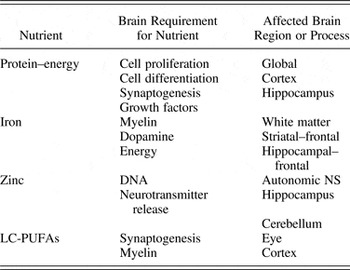
All nutrients are important for brain development, but some exhibit far more influence than others during late fetal/neonatal life and early childhood. These nutrients affect fundamental processes of early brain development (Table 1). The fetal and early postnatal brain in particular has high nutritional requirements because of its high metabolic rate. The neonatal brain's oxygen consumption rate is 60% of the body's total (Kuzawa, Reference Kuzawa1998). Substrates that support this high basal metabolic rate include glucose, amino acids, iron, zinc, and oxygen (Fretham et al., Reference Fretham, Carlson and Georgieff2011). Thus, a constant flow of these particular nutrients is critical for normal brain development, and interruption of this flow typically results in acute, and often chronic, brain dysfunction. Because the brain is not a homogenous organ, but a set of different regions and processes all with different developmental trajectories, the nutrient requirements are not homogenously distributed across the entire brain. At any given time, regions (e.g., hippocampus, striatum, and prefrontal cortex) are differentially sensitive to the positive or negative effects of a given nutrient based on the regions' need for the nutrient at that point in development (Rice & Barone, Reference Rice and Barone2000). The effect of a nutrient on brain regional development is a function of the timing of supplementation/deficit of the nutrient and the dose/duration of the perturbation (Kretchmer, Beard, & Carlson, Reference Kretchmer, Beard and Carlson1996). Dose/duration in this context can be thought of as a single entity in the form of an area under the curve.
Examples of nutrients that affect early life brain development

Note: NS, Nervous system; LC-PUFAs, long chain polyunsaturated fatty acids.
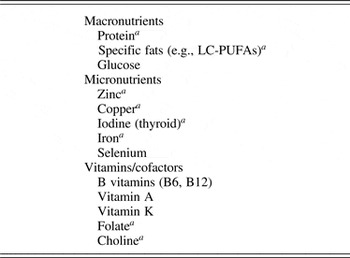
While it should not be surprising that deficits of nutrients that support fundamental brain metabolism result in acute brain dysfunction, it is the occurrence of long-term brain/behavior deficits in spite of treatment of the underlying nutrient deficiency that supports the idea of sensitive or critical periods for particular nutrients and particular brain areas. A number of nutrients demonstrate this property early in life in humans and in preclinical models (Table 2). The cost to society of missing critical periods of nutrient administration on long-term brain health is not trivial (Walker et al., Reference Walker, Wachs, Gardner, Lozoff, Wasserman and Pollit2007). Fully 2 billion people (one-third of the world's population) are iron deficient. This most common nutrient deficiency has a particular tropism for pregnant women, their fetuses, and their young offspring. Rates of deficiency in low- and middle-income countries approach 80%. Iron deficiency also induces a hypothyroid state, compounding the potential damage to the developing brain. Similarly, zinc deficiency affects an extraordinary number of people; by some estimates, close to 1.8 billion people. This nutrient deficiency is usually comorbid with protein deficiency, again resulting in a compounding effect. Finally, iodine deficiency affects at least 600 million people worldwide and is the cause of cretinism.
Nutrients that particularly affect early brain development and demonstrate a critical or sensitive period

Note: LC-PUFAs, Long chain polyunsaturated fatty acids.
aNutrients that meet the principles for demonstrating a critical or sensitive period during development.
All of these nutrients are particularly at risk for deficiency in the fetus, young infant, and child because of the enormous requirements of the developing brain (for review, see Fuglestad, Ramel, & Georgieff, Reference Fuglestad, Ramel, Georgieff and Packer2010). Elimination of these micronutrient deficiencies has been estimated to have the potential to increase the world's IQ by 10 points, with the consequent shift of job potential in the positive direction (Walker et al., Reference Walker, Wachs, Gardner, Lozoff, Wasserman and Pollit2007). Beyond neurocognitive effects, early deficits of several of these nutrients have been associated with significant adult psychopathology. For example, the risk of adult-onset schizophrenia in offspring of iron-deficient mothers is directly proportional to the degree of maternal iron deficiency in pregnancy (Insel, Schaefer, McKeague, Susser, & Brown, Reference Insel, Schaefer, McKeague, Susser and Brown2008). Early life iron deficiency also results in greater anxiety and depression in adulthood with consequent loss of job potential (Lukowski et al., Reference Lukowski, Koss, Burden, Jonides, Nelson and Kaciroti2010).
Attribution of temporally distal neurobehavioral outcomes to early nutritional deficits (thus confirming a critical or sensitive period effect on neural plasticity) remains a difficult problem in human populations. The main concern is the lack of certainty that a behavioral abnormality documented some years after the nutritional deficit is truly due to the nutrient and not to other confounding variables that are comorbid with the deficit (e.g., poverty or stress) or that occurred subsequent to the deficit but before the assessment. Common early life nutrient deficiencies are rarely fatal, and thus demonstration of an effect at the brain tissue level is not possible. A layered, multidisciplinary approach utilizing developmentally appropriate preclinical models is used to provide a plausible biological proof of long-term effects because anatomic, spectroscopic, or functional neuroimaging techniques are typically not sensitive enough to detect specific nutrient deficits in the developing brain. An example of this multilayered approach confirming the effect of early life iron deficiency on the developing declarative learning and memory system is provided later in this paper.
With that caveat in mind, studies of young humans that suggest critical periods for nutrients exist can be sorted into two groups: prevention/supplementation trials and observational/interventional trials. The latter are far more common than the former. Prevention/supplementation trials involve randomization of a nutritionally at-risk population to receive a nutrient supplement or placebo. While some of these trials show positive results in the supplemented group (Christian et al., Reference Christian, Murray-Kolb, Khatry, Katz, Schaefer and Cole2010), others do not (Christian et al., Reference Christian, Morgan, Murray-Kolb, LeClerq, Khatry and Schaefer2011). The temptation to dismiss the possibility that early nutrition affects long-term brain development in the face of null studies is great. However, when considered carefully, the reasons that intervention studies can produce null results often provide support for the concept of sensitive/critical periods for nutrient–brain interactions (Cusick & Georgieff, Reference Cusick and Georgieff2012; Wachs et al., Reference Wachs, Georgieff, Cusick and McEwan2014).
Assessment of outcomes in interventional nutritional trials must follow certain developmental biological principles to be valid (Wachs et al., Reference Wachs, Georgieff, Cusick and McEwan2014). First, the nutritional intervention must occur at a time when the brain or selected brain region has a high demand for the nutrient being supplemented. Mistiming of the intervention, for example, provision of the nutrient during a low demand state, will not result in a detectable effect. Second, the target population must have a reasonable risk of being deficient of the supplemented nutrient. There is little evidence that supplementation of an already sufficient individual achieves superior brain development (an exception may be choline; see below). Conversely, a population that is extremely nutrient deficient may not benefit from a small increase in nutrient delivery. The dose must match the proposed deficit, a fact rarely factored into supplementation trials. Third, the outcome behaviors to be tested must map onto the proposed neural structures that are influenced by the nutrient. Because many nutrient effects are highly specific in their effects, general neurodevelopmental assessments typically used in large-scale studies because they are the lowest common denominator that can be performed across all the sites, lack the sensitivity to identify those effects. The behavioral effect size should be of the scale seen behaviorally and anatomically in developmentally appropriate preclinical models. Fourth, the assessments should be administered within a reasonable time frame of the intervention in order to reduce the possibility of postintervention confounding variables. However, herein lies the conundrum with respect to plasticity. Many early developing systems, while highly vulnerable to nutritional insults, demonstrate a remarkable degree of plasticity and functional recoverability (Riggins, Miller, Bauer, Georgieff, & Nelson, Reference Riggins, Miller, Bauer, Georgieff and Nelson2009; Townsend, Georgieff, & Nelson, Reference Townsend, Georgieff and Nelson2005). While this is good news for the developing child, the problem becomes one of a moving target for assessment and intervention. In the case of fetal iron deficiency, hippocampally based abnormalities of declarative memory are prominent at birth (Siddappa et al., Reference Siddappa, Georgieff, Wewerka, Worwa, Nelson and deRegnier2004) and at 3.5 years of age (Riggins et al., Reference Riggins, Miller, Bauer, Georgieff and Nelson2009), but they disappear by 5 years (Townsend et al., Reference Townsend, Georgieff and Nelson2005). In early adolescence, learning and memory problems are not seen, but prefrontally based planning and inhibition abnormalities appear. The etiology of this shift in domain over time is unclear, but the phenomenon certainly influences how investigators consider their choices of long-term assessments. Failure to choose the correct domain may lead to erroneous conclusions about critical periods, nutritional effects, and developmental plasticity.
In spite of these caveats, the importance of nutritional timing and its relationship to critical or sensitive periods for growth and nutrition has been supported by multiple positive prevention/supplementation studies in humans (Cusick & Georgieff, Reference Cusick and Georgieff2013; Walker et al., Reference Walker, Wachs, Gardner, Lozoff, Wasserman and Pollit2007). From a macronutrient perspective, growth velocity prior to 1 year of age is a strong predictor of IQ at 9 years of age (Pongcharoen et al., Reference Pongcharoen, Ramakrishnan, DiGirolamo, Winichagoon, Flores and Singkhornard2012). Consistent with other literature on the relationship between linear growth (or its inverse condition, stunting) and outcome (Ramel et al., Reference Ramel, Demerath, Gray, Younge, Boys and Georgieff2012), linear growth at birth and in the first year had a stronger association with 9-year IQ than weight gain. In contrast, growth between 1 and 9 years had no relationship to IQ. Similarly, a trial of fetal supplementation of iron improved working memory, inhibitory control, and fine motor abilities at 7–9 years (Christian et al., Reference Christian, Murray-Kolb, Khatry, Katz, Schaefer and Cole2010), but supplementation between 12 and 36 months had no effect when given to the group that received placebo in the fetal supplementation trial and had no additional positive effect in the group that received fetal iron (Murray-Kolb et al., Reference Murray-Kolb, Khatry, Katz, Schaefer, Cole and LeClerq2012).
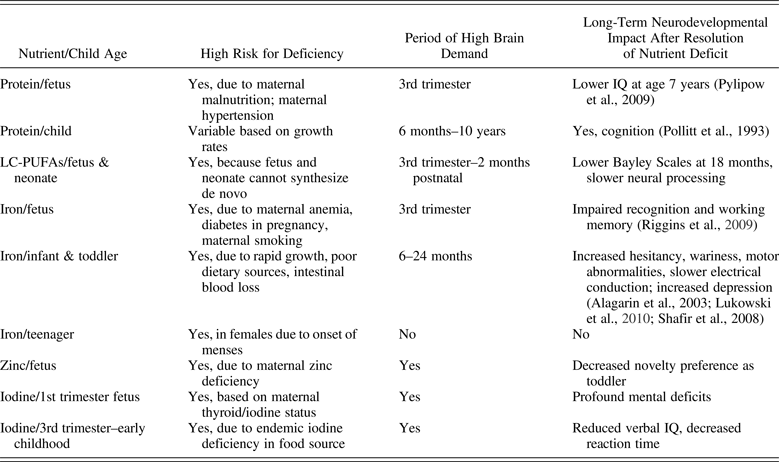
Given the high prevalence of nutrient deficiencies in children worldwide, it is not surprising that a very large number of observational/interventional trials document their negative effects on brain development and their response to therapy (for a summary, see Walker et al., Reference Walker, Wachs, Gardner, Lozoff, Wasserman and Pollit2007). This literature as a whole has been criticized for the inability of investigators to control known and unknown potential confounding variables (e.g., poverty and toxic stress). Nevertheless, the sheer number of studies on each nutrient that documents consistent changes in populations from around the world makes it difficult to ignore their conclusions. Table 3 provides examples of long-term outcomes drawn from these trials for a number of salient early life nutrients. For each nutrient and time, developmentally sensitive preclinical models provide a biological plausibility for the underlying biology of the long-term effects on adult synaptic plasticity (for a review, see Fuglestad et al., Reference Fuglestad, Ramel, Georgieff and Packer2010).
Examples of the importance of timing of nutrient deficits on long-term neurodevelopmental outcomes
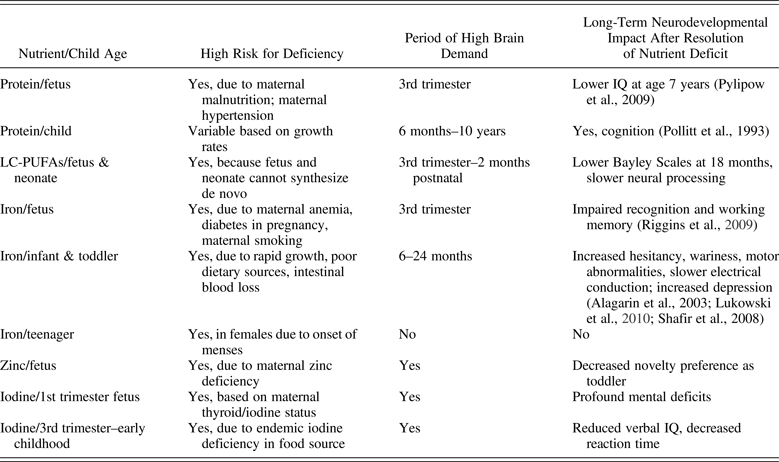
Note: LC-PUFAs, Long chain polyunsaturated fatty acids.
Iron and Choline as Paradigms of Nutritional Modulation of Neural Plasticity
Iron as a paradigm of the effects of nutrient deficiency during development
There are two fundamental mechanisms by which a nutrient's status early in life can affect neural plasticity during development and have an impact on long-term brain function. Early life iron deficiency serves as a good paradigm to explore both (Georgieff, Reference Georgieff2008).
The first mechanism is that structural deficits induced during development may persist into adulthood (Brunette, Tran, Mobken, Carlson, & Georgeiff, Reference Brunette, Tran, Wobken, Carlson and Georgieff2010). The synaptic efficacy and plasticity of hippocampal neurons is a function of the complexity of its dendritic arbors, particularly in area CA1. Fetal/neonatal iron deficiency significantly compromises the integrity of the arbor accompanied by reduced expression of synaptic plasticity genes that regulate actin polymerization such as Profilin 1 and 2, Cofilin-1, BDNF, and SDF1 (Brunette et al., Reference Brunette, Tran, Wobken, Carlson and Georgieff2010; Carlson et al., Reference Carlson, Stead, Neal, Petryk and Georgieff2007). Subsequent to treatment, the formerly iron-deficient hippocampus in the adult rodent has a 14% loss in volume, a truncated dendritic arbor, persistent changes in synaptic plasticity and structural genes, and astrocytic gliosis (Brunette et al., Reference Brunette, Tran, Wobken, Carlson and Georgieff2010; Carlson et al., Reference Carlson, Stead, Neal, Petryk and Georgieff2007; Fretham et al., Reference Fretham, Carlson, Wobken, Tran, Petryk and Georgieff2012; Rao, Tkac, Schmidt, & Georgieff, Reference Rao, Tkac, Schmidt and Georgieff2011). In short, the lack of iron during a period of rapid dendritogenesis early in life results in a poorly constructed hippocampus that underperforms because of its abnormal structure in spite of treatment (Fretham et al., Reference Fretham, Carlson, Wobken, Tran, Petryk and Georgieff2012). The formerly iron-deficient hippocampus generates less long-term potentiation in slice culture preparations (Jorgenson, Sun, O'Connor, & Georgeiff, Reference Jorgenson, Sun, O'Connor and Georgieff2005; Pisansky et al., Reference Pisansky, Wickham, Su, Fretham, Yuan and Sun2013) and has reduced expression of multiple synaptic genes/proteins (Brunette et al., Reference Brunette, Tran, Wobken, Carlson and Georgieff2010).
If gene expression important for structural growth and plasticity is altered short term, this disrupted regulation would inhibit learning, but not prevent it entirely. The decreased transcript levels for actin regulatory genes suggest a decreased plasticity in the actin cytoskeleton. These molecules are needed in early development to grow and remodel the apical arbor as well as for spine development and maintenance. Their acute reduction changes inherent structural capabilities in addition to possibly altering their regulation long term (see below). Proteins affecting actin polymerization and depolymerization include the RhoGTPases RhoA, Rac1, and Cdc42 and their downstream effectors Cypin, Proflin-1, Profilin-2, and Cofilin-1. Collapsin response mediator protein1 (Crmp1) expression is also decreased by early iron deficiency anemia. It is an upstream effector of neurite guidance localized to dendrites acting in the semaphorin pathway (Bretin et al., Reference Bretin, Reibel, Charrier, Maus-Moatti, Auvergnon and Thevenoux2005; Brunette et al., Reference Brunette, Tran, Wobken, Carlson and Georgieff2010; Tang, Reference Tang2003). It is small wonder that the formerly iron-deficient animal performs poorly on hippocampally dependent spatial memory mazes (Felt & Lozoff, Reference Felt and Lozoff1996; Kennedy et al., Reference Kennedy, Dimova, Tran, Gewirtz, Siddappa and Georgieff2014; Schmidt, Waldow, Grove, Salinas, & Georgeieff, Reference Schmidt, Waldow, Grove, Salinas and Georgieff2007).
The second more intriguing hypothesis is an induction of permanent dysregulation of synaptic plasticity genes by early life iron deficiency through epigenetic chromatin modifications. Evidence for this possibility comes from the documented suppression on adult rat BDNF gene and protein expression and their downstream effectors by early life iron deficiency (Blegen, Kennedy, Thibert, Tran, & Georgeieff, Reference Blegen, Kennedy, Thibert, Tran and Georgieff2013; Brunette et al., Reference Brunette, Tran, Wobken, Carlson and Georgieff2010; Tran et al., Reference Tran, Fretham, Carlson and Georgieff2009). The evidence supporting the epigenetically driven dysregulation hypothesis includes the finding that BDNF is epigenetically modifiable by early life events (Lubin et al., 2010; Roth et al., Reference Roth, Lubin, Funk and Sweatt2009), a set of iron containing proteins (JARIDs) that regulate histone methylation status of BDNF are altered in adulthood by early life deficiency (Blegen et al., Reference Blegen, Kennedy, Thibert, Tran and Georgieff2013), and provision of the methyl donor choline in the maternal diet reverses these abnormalities and rescues behavior (Kennedy et al., Reference Kennedy, Dimova, Tran, Gewirtz, Siddappa and Georgieff2014).
Both potential mechanisms strongly support developmental origins of adult mental health pathogenesis. Both mechanisms speak to a sensitive period where proper nutrient supply is critical to hippocampal development. The two mechanisms, of course, are not mutually exclusive.
As noted above, gestational and early postnatal iron deficiency cause multiple long-term effects in spite of prompt iron repletion in infancy, implying a critical or sensitive period for iron-dependent neuronal processes. Plasticity is necessary for rescue treatments (e.g., iron) to work in order to develop a fully intact organism at maturity. However, it should also be noted that adverse events (e.g., iron deficiency) generally have a greater impact when they occur early in development compared with later in life because of the rapidity and scale of change occurring during neurodevelopment. The impact of an early insult might also trigger adaptive responses important for short-term survival or for reaching reproductive maturity even though the insult will also result in long-term deficits. The specific deficits that occur (especially in response to limited resource availability) will be dependent on which developmental processes were occurring at the time of iron deficiency and how each process was prioritized to receive the limited amount of iron available to the brain.
Altered adult plasticity due to early life iron deficiency may be influenced by a developmental sensitive period. A recent study shows that fetal/neonatal iron deficiency alters the cellular and molecular dynamics of critical period opening and closure for dendrite growth and differentiation in the hippocampus, thus potentially explaining the altered dynamics of neural plasticity observed in electrophysiology and behavioral experiments (Callahan, Thibert, Wobken, & Georgeieff, Reference Callahan, Thibert, Wobken and Georgieff2013; Gewirtz, Hamilton, Babuh, Wobken, & Georgeieff, Reference Gewirtz, Hamilton, Babuh, Wobken and Georgieff2008; Jorgenson et al., Reference Jorgenson, Sun, O'Connor and Georgieff2005; Tran et al., Reference Tran, Carlson, Fretham and Georgieff2008). These experiments demonstrate that iron deficiency that occurs at the time of rapid hippocampal dendritic arborization in the rodent (Postnatal Days 7–30) delays the appearance of parvalbumin positive GABAergic cells, effectively causing a developmental delay in hippocampal maturation and specification. This “shift to the right” of the time line, however, can also be viewed as a potential opportunity for maintaining the plasticity of the system by extending the time window. Theoretically, if iron were to become available during this time extension, long-term effects may be attenuated or abrogated. The electrophysiologic evidence that supports this concept with iron deficiency is that the iron-deficient Postnatal Day 30 hippocampus has the long-term potentiation maturity pattern of the Postnatal Day 15 iron-sufficient hippocampus (Jorgenson et al., Reference Jorgenson, Sun, O'Connor and Georgieff2005). A similar retention of a more immature pattern is seen in fear-potentiated trace conditioning, a hippocampally mediated behavior (Gewirtz et al., Reference Gewirtz, Hamilton, Babuh, Wobken and Georgieff2008).
The unfortunate aspect of early life iron deficiency with respect to critical period dynamics and neural plasticity is that, although the opening is delayed, the closure occurs more abruptly and more completely (Callahan et al., Reference Callahan, Thibert, Wobken and Georgieff2013). Perineuronal nets, which herald the closure of the critical period, are more abundant in the hippocampus of the formerly iron-deficient young adult, a finding that implies a less plastic adult system (Callahan et al., Reference Callahan, Thibert, Wobken and Georgieff2013). Electrophysiology experiments demonstrate less long-term potentiation in the adult (Jorgenson et al., Reference Jorgenson, Sun, O'Connor and Georgieff2005; Pisansky et al., Reference Pisansky, Wickham, Su, Fretham, Yuan and Sun2013) accompanied by poorer performance on hippocampus-mediated behavioral tasks such as the Morris water maze (Felt & Lozoff, Reference Felt and Lozoff1996) and the win-shift radial arm maze (Schmidt et al., Reference Schmidt, Waldow, Grove, Salinas and Georgieff2007). Nevertheless, restoration of neuronal iron in a prompt manner during the proposed critical period in a genetic mouse model with isolated, reversible hippocampal iron deficiency results in preservation of parvalbumin expression, BDNF expression, and adult neuronal plasticity (Fretham et al., Reference Fretham, Carlson, Wobken, Tran, Petryk and Georgieff2012). This finding demonstrates that the system remains malleable during its critical period, preserving the potential of normal adult synaptic plasticity.
Understanding the timing and mechanisms involved in the onset and offset of critical periods would inform the type and timing of clinical treatments for nutrient-deficient infants. Altered regulation of the excitatory and inhibitory tone throughout development suggests a potential target for treatment or prevention of deficits due to iron deficiency. Administration of fluoxetine, which increases BDNF expression, and infusion of BDNF itself have been demonstrated to increase excitation and cause a corresponding shift in the critical period in the visual cortex (Huang et al., Reference Huang, Kirkwood, Pizzorusso, Porciatti, Morales and Bear1999; Sugiyama et al., Reference Sugiyama, Di Nardo, Aizawa, Matsuo, Volovitch and Prochiantz2008). Therefore, the decrease in BDNF at Postnatal Day 15 in the iron-deficient rat indicates a loss of excitatory tone during differentiation, which remains depressed long after iron repletion. This decrease during a period of high growth may disrupt the development of the circuitry used to create plasticity for learning and memory, causing the deficits observed after iron repletion. It is plausible that alteration of the excitatory and inhibitory balance due to early iron-deficient anemia may significantly disrupt plasticity and prevent full maturation of the learning circuitry, resulting in long-term cognitive and behavioral deficits.
In summary, functional deficits that have been previously described in humans and preclinical models of iron deficiency may be due to loss of neural plasticity through regulation of actin filament remodeling factors. An example of this deficit using Hebb's (Reference Hebb1949) model of synaptic potentiation would show a less responsive system overall. Specifically, if synapses that were supposed to be pruned were not completely eliminated, only reduced in strength, and those that were supposed to be strengthened were not as responsive to electrical activity, there would be less efficient synapses overall. This reduced synaptic efficacy demonstrated in electrophysiology experiments by Jorgenson et al. (Reference Jorgenson, Sun, O'Connor and Georgieff2005) inspires future experiments examining maintenance and molding of the synapses during iron deficiency. Overall, we postulate that there are less efficient synapses with less mature spines in iron-deficient rats during development, as determined by decreased spine head diameter during early differentiation (Brunette et al., Reference Brunette, Tran, Wobken, Carlson and Georgieff2010). The altered dendrite branches may be less able to respond to growth and guidance factors and maintain their appropriate structure into adulthood. With decreased availability of actin and tubulin binding proteins important for cytoskeletal regulation during adulthood, dendrites and spines may be less capable of dynamic responses to activity, further reducing plasticity dependent learning as adults in spite of complete iron repletion (Jorgenson et al., Reference Jorgenson, Sun, O'Connor and Georgieff2005; McEchron, Cheng, Liu, Connor, & Gilmartin, Reference McEchron, Cheng, Liu, Connor and Gilmartin2005; Schmidt et al., Reference Schmidt, Waldow, Grove, Salinas and Georgieff2007).
Ultimately, structural changes seen in CA1 apical dendrites are likely to result in altered connectivity within the hippocampus and among circuits that depend on hippocampal integrity (e.g., the ventral tegmental area loop). The latter circuit is particularly interesting given the epidemiologic data demonstrating a relationship between the degree of maternal–fetal iron deficiency during pregnancy and the later risk of schizophrenia in the offspring (Insel et al., Reference Insel, Schaefer, McKeague, Susser and Brown2008). Paired-pulse inhibition is heavily dependent on hippocampal activity modulating parts of the ventral tegmental area loop and is considered a surrogate for neural gating in preclinical models of schizophrenia. Paired-pulse inhibition is markedly abnormal in the isolated hippocampal iron-deficiency mouse (Pisansky et al., Reference Pisansky, Wickham, Su, Fretham, Yuan and Sun2013).
Reduced transcript and protein expression of genes involved in actin and microtubule dynamics are associated with altered branching distribution and spine morphology. It remains unclear if there is an effect of iron deficiency on promoter regions for these genes, or if the effect is mediated through modification of growth factor expression, such as decreased BDNF. In humans and preclinical models, iron treatment to the iron-deficient anemic individual at the equivalent time of human term birth is not sufficient to rescue the structural, genomic, or behavioral phenotype, suggesting a very early sensitive period. Future work should determine if stimulating growth factors, specifically BDNF, during gestation and early postnatal life can positively affect dendritogenesis. Increased BDNF may contribute to an increased ability to maintain the systems during early iron-deficient anemia and allow the system to remain more plastic after repletion. Future work could also focus on critical period modulation, the role of GABAergic maturation, and the excitatory and inhibitory balance of electrical activity in maintaining optimal neural plasticity during development. The findings suggest that the consequence of early life alteration of transcripts for structural growth reduce plasticity in adulthood and result in reduced synaptic efficacy and poorer learning in adulthood. If restoration of the proper excitatory and inhibitory balance can be achieved during development or the critical period reopened as Sugiyama et al. (Reference Sugiyama, Di Nardo, Aizawa, Matsuo, Volovitch and Prochiantz2008) have done with the visual system, long-term plasticity deficits may be rescued.
The intriguing case of choline: Can neural plasticity be enhanced by a nutrient?
Most studies in humans and preclinical models determine the role of a nutrient in long-term brain health by assessing deficit states at specific times of development. Studies are designed in this way because for most of human existence and for many human populations currently, food deficits have been the dominant issue (Walker et al., Reference Walker, Wachs, Gardner, Lozoff, Wasserman and Pollit2007). Recently, there have been trials to determine whether any nutrients provided early in life can truly enhance neurodevelopment beyond the expected normative outcome. This is an enormously difficult task because traditionally any improvement with a nutrient supplement has been used as prima face evidence of a previously unrecognized underlying deficiency. Nevertheless, studies on the role of early life choline have provided some interesting insights and food for thought regarding early life nutrient supplementation and adult brain health, particularly because this compound is essential for early brain development (Fisher, Zeisel, Mar, & Sadler, Reference Fisher, Zeisel, Mar and Sadler2002) and demonstrates distinct critical period effects (Meck, Williams, Cermak, & Blusztajn, Reference Meck, Williams, Cermak and Blusztajn2008).
In the late 1980s, Meck, Smith, and Williams began a series of studies investigating whether early life choline supplementation affects hippocampal development in rats (Meck, Smith, & Williams, Reference Meck, Smith and Williams1988, Reference Meck, Smith and Williams1989). Choline is an interesting nutrient that could potentially affect neurodevelopment through at least three mechanisms. It is a substrate for the neurotransmitter acetylcholine. More acetylcholine may be available in the synaptic compartment, increased acetylcholine responses to electrical stimulation are present and less acetylcholinesterase is produced, suggesting that neurotransmission is affected by prenatal choline supplementation (Meck et al., Reference Meck, Smith and Williams1989). It is also a component of the myelin compounds phosphotidylcholine and phosphotidylethanolamine. However, the most intriguing role from a neural plasticity/critical period perspective is that it can act as a methyl donor for epigenetic modification of chromatin (Zeisel, Reference Zeisel2010). As such, it has the potential to modify the methyl status of CpG islands as well as histones. The three mechanisms are not mutually exclusive and can be difficult to disentangle when positive effects are found after supplementation.
Through a carefully timed supplementation regimen where the pregnant and lactating rat dam was exposed to short periods of choline, Meck et al. determined that Embryonic Days 13–18 and Postnatal Days 15–25 were particularly effective in improving the electrophysiology, biochemistry, and brain morphology in the hippocampus of the offspring (Meck et al., Reference Meck, Smith and Williams1988). The exposure during gestation was more effective than during lactation, suggesting that earlier exposure was better. The specific timing was of interest because Embryonic Days 13–18 coincides with a period of rapid neurogenesis (proliferation) in the hippocampus (Glenn et al., Reference Glenn, Gibson, Kirby, Mellott, Blusztajn and Williams2007). Choline provided in this time frame to rodents increases hippocampal cell proliferation and reduces apoptosis. Postnatal Days 15–25 are the middle of the period of peak dendritogenesis (differentiation). Choline provided in this time frame increases dendritic arbor complexity in the hippocampus. Either or both may account for the improved learning and memory performance in the early life supplemented rats when they became adults.
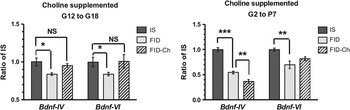
While the data might have been interpreted as having discovered that pregnant rats were not normally receiving enough choline during pregnancy, the studies that followed suggest otherwise. Data from our laboratory demonstrated that continuous choline supplementation throughout pregnancy and lactation had worse outcomes with respect to BDNF gene expression than control and far worse than targeted supplementation at Embryonic Days 13–18 (Figure 1). These data strongly suggest a critical period of efficacy.
The effect of (left) targeted versus (right) universal maternal choline supplementation during pregnancy and lactation on hippocampal brain-derived neurotrophic factor (BDNF) gene expression in the iron-sufficient adult offspring. Note that choline supplementation from Gestational Days 12 to 18 (FID-Ch) resulted in preserved BDNF levels in the offspring in adulthood compared to animals whose mothers were not treated with choline (FID). Levels of BDNF gene expression were similar to always iron-sufficient animals. In contrast, nontargeted supplementation of the mother resulted in suppression of adult BDNF expression in the offspring. *p < .05.

Moreover, studies across multiple species (e.g., rats and mice) and multiple lesions (e.g., environmental and genetic) showed efficacy using the targeted timing discovered by Meck et al. (Reference Meck, Smith and Williams1988). Rats with fetal alcohol exposure performed better on hippocampally dependent spatial memory tasks with either prenatal or postnatal targeted choline administration compared to animals not receiving choline (but not as well as non-alcohol exposed controls; Ryan, Williams, & Thomas, Reference Ryan, Williams and Thomas2008). The MeCP2 knockout mouse, that phenotypically resembles Rett syndrome, has improved memory capability when treated with prenatal or postnatal choline (Ricceri, De Filppis, & Laviola, Reference Ricceri, De Filippis and Laviola2013). Similarly, the genetic mouse model of Down syndrome with early cognitive decline performs better on learning and memory tasks if treated with prenatal choline (Moon et al., Reference Moon, Chen, Gandhy, Strawderman, Levitsky and Maclean2010). Recently, we found a similar behavioral effect in adult rats that had been iron deficient as fetuses and neonates (Kennedy et al., Reference Kennedy, Dimova, Tran, Gewirtz, Siddappa and Georgieff2014).
What could account for such robust effects across multiple species and conditions? The hypothesis is that choline modifies something fundamental in the biology of these animals. A good candidate is epigenetic modification of synaptic plasticity genes whose chromatin can be modified by environmental factors (e.g., BDNF). BDNF gene expression can be modified by rearing practices through methylation of CpG islands (Roth et al., Reference Roth, Lubin, Funk and Sweatt2009). This effect has been shown to cross generations (Roth et al., Reference Roth, Lubin, Funk and Sweatt2009), lending further support to the idea. In our studies, specifically timed prenatal choline supplementation not only partially rescued adult learning and memory behavior in fetal/neonatal iron-deficient rats but also significantly elevated adult hippocampal BDNF gene expression (Kennedy et al., Reference Kennedy, Dimova, Tran, Gewirtz, Siddappa and Georgieff2014).
Why are these findings important with respect to neural plasticity? The previous dogma based on 40 years of human and preclinical model studies was that early life iron deficiency always led to long-term behavioral dysfunction in spite of diagnosis and treatment (Lozoff & Georgieff, Reference Lozoff and Georgieff2006). Similarly, the neurodevelopmental effects of fetal alcohol syndrome, Down syndrome, and Rett syndrome appeared to be severe and relatively nonmutable. These three syndromes have the following in common: removal of the primary condition (alcohol or gene mutation) is not possible and thus direct treatment of the condition is not in the therapeutic arsenal (unlike iron deficiency where iron could be provided as a treatment that directly assess the problem).
Nevertheless, individual variations in the behavioral phenotypes of these syndromes exist. While one could argue that this may be a function of the degree of alcohol exposure in fetal alcohol syndrome (i.e., a dose response to an environmental stressor), this argument is more difficult in the genetic syndromes. One then has to ask the question whether host factors or host–environment interactions (e.g., epigenetic modifications of synaptic plasticity genes) may be in play in determining the amount and quality of neural plasticity in any given individual with the syndrome.
The new thinking is that neural plasticity may be restorable through understanding the basic biology underlying the loss of plasticity (e.g., chromatin modification or closure of critical periods) and providing therapies (e.g., targeted methyl diets and pharmacologic or genetic dissolution of perineuronal nets) that resolve that biology and function as “work-arounds” of the primary condition. Specific nutrients play an important role in mediating optimal neural plasticity in developing brains, and it is a therapy that is readily at hand.