


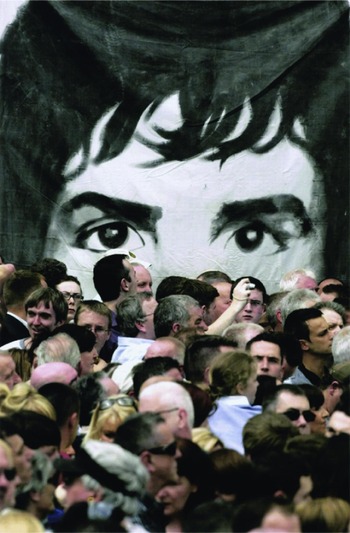
On Bloody Sunday, January 30, 1972, British soldiers in Derry, Northern Ireland, opened fire on a civil rights march, shooting to death 13 unarmed civilians. One of those victims was Kevin McElhinney, a shop clerk, age 17, killed shortly after 4:00 P.M. In the moment of his death, McElhinney became someone with only a past. Over the years, his absence and death became intertwined with a related kind of distance, that of being historical, of belonging to a time very different from the present. Thirty-eight years later, on June 15, 2010, the Bloody Sunday Inquiry, led by Lord Saville, published its findings. The wounded and dead, it concluded, were shot without cause; their names were cleared of any taint of wrongdoing. Prime Minister David Cameron spoke before Parliament, accepting the Report and apologizing on behalf of the British Government. Family and community members, some carrying photographs of the dead, gathered in central Derry to hear the Prime Minister's statement. There they witnessed McElhinney receiving his measure of justice: some 21 words, not to attempt to mend the irreparable but to acknowledge him, and to say that he was innocent and wronged. “We are sure,” the Saville Inquiry stated, that he “was posing no threat to soldiers when he was shot. He was simply trying to crawl to safety” (Lord Saville et al. 2010, vol. 5, chap. 86, para. 461). Above the crowd was a large image of McElhinney, his eyes looking out over the throng of people gathered in central Derry (see Figure 1). This banner suggested a kind of presence, as though the absent victim was there: a persisting member of a community of justice, demanding recognition and receiving at last what was owed him. His image and those of the other Bloody Sunday dead also pointed to the central place of the absent victims, as if to say that doing justice was principally about them and the wrongs they suffered. The dead were distant but not therefore nullities.
“Derry Rally,” June 15, 2010

Death, the passing of time, and judicial marginalization of the victim combine to challenge the idea that we can address the absent dead of historic injustices. So, for example, the changes since Bloody Sunday: The war in Ulster, then in full flower, now ended; the Unionist political dominance that was a principal target of the civil rights march that day, a thing of the past; many of those immediately concerned, family members and others, dead; evidence lost and eyewitness memories faded; the concerns of the past now less weighty. In that sense, the shooting of Kevin McElhinney is a historic injustice, and dealing with it involves difficulties common to that class of phenomena. At the same time, and relatedly, there is another distance, more radical still, a pastness not of calendar time but one introduced by death, that seems to make doing justice to those victims impossible. For the Catholic faithful at the funeral Mass there was the certainty that McElhinney and the other Bloody Sunday dead would in fact confront their killers in the next life. In the words of Hebrew Scripture (Wisd. of Sol 5:1ff), read at Mass that February 1972 day, “The upright will stand up boldly to face those who had oppressed him. . ..” But how are we to understand such a calling to account from a this-worldly perspective? What would it mean to say that the Saville Inquiry gave a measure of justice to the dead of January 30, 1972? What is it to do justice to the dead who, though once persons and thus capable of demanding and receiving justice, are now (it appears) nullities? Perhaps addressing historic injustice is simply a gesture on the part of the present and living, who—it might be urged—constitute the only real subjects in this drama, and whose interests and perspectives alone steer these dealings with the past. And with that, we might conclude that “doing justice to the past” is in the end just a manner of speaking, the real meaning of which lies elsewhere, in the present or future. “The dead are honored with tears that flow only for the living” (La Rochefoucauld [1678] Reference La Rochefoucauld1991, 118 [Reflection 233]).
Answering historic injustice involves a struggle against absence. What follows is a reflection on the foundations of that struggle, on absence and justice, and in particular on the cluster of issues raised by our efforts to deal with injustices where absence has opened a seemingly unbridgeable distance. This topic embraces a wide swath of events of interest to students of politics. Some of these are as recent as the genocidal violence in Rwanda or ethnic cleansing in the former Yugoslavia; others are historical and as old as slavery in antebellum America. All have in common that they and their victims are marked by distance from us, a separation that makes doing them justice deeply perplexing. That distance, as I suggested, is of two principal kinds. The flow of time creates one; death another. Yet they overlap: The passing of the years, the process of becoming historic rather than contemporaneous, eventually yields the absence of death, and thus the latter becomes willy-nilly part of the former. Death, in its turn, seems to consign its victim to a pastness, shut off entirely from the present and future. Pastness is “born of absence” (Darwish Reference Darwish and Shaheen2010, 30).
Key problems in addressing historic injustices participate in this broad and core issue: The absent victims of injustice—whether those of the historic past or the dead of more recent crimes—dwell in profound separation from us. That crucial facet of absence and doing justice can be seen in Orestes’ ancient question (which gives this article its title), “What thing can I say, can I accomplish from this far place where I stand to mark and reach you there in your chamber?” (Aeschylus Reference Smyth1971b, lines 315–17). How, from the “far place” of the present and living, can he bring justice to his murdered father, Agamemnon? The distance created by the killing of his father is that of the apparently unbridgeable pastness to which death has consigned him. Death yields that once-and-for-all separation. The long duration of passing time also results in distance, though it admits of degrees in a way that death does not. In both cases, it is absence that is central to the aporia shaping our reflection on what it is to reach distant victims of injustice, those who seem to be so much “dust and nothing” (Sophocles Reference Grene and Lattimore1992, lines 245–50).
Some aspects of this have been well canvassed, especially in the voluminous literature on the Holocaust and on the aftermath of the Second World War. Those parts of it that consider the question of duties of remembrance parallel some of the themes of the present article. Recent studies analyzing the role of past injustices in the transitions to democracy in South Africa, Central and Latin America, and Eastern Europe have deepened our understanding of the issues involved in dealing with the past.Footnote 1 However, much of this latter work, because of its focus on transitions, is oriented toward the present and future of those societies, and hence only obliquely (if at all) to the status of the absent victim.Footnote 2 There the problem of what it means to do justice to the absent dead gives way to a concern with the role of trials, truth commissions, and so on in building a democratic future. Still other analyses look to the historical roots of current injustices, but with a view to addressing present, not past wrongs. Although I will touch on some of this work, my question here is different: What does it mean to recognize and answer the absent victims of injustice, given the distance that separates us from them?
In this article I sketch an argument that the absent victims of injustice are not “dust and nothing” but retain a status and a presence as claimants on justice that gives rise to and shapes our efforts to address the wrongs done them. That presence calls on us to notice or recognize them as persons and not mere nullities owed no such acknowledgment (Spaemann Reference Spaemann and O'Donovan2006, 180ff). Their presence, though not that of a living subject endowed with voice, interests, hopes, and a will, is nevertheless that of persons, not things, and it is the basis of our further duties to them, including answering the injustice done them. Failing that, there would be no relevant subject, no one to whom a response was due. To say then that Kevin McElhinney was owed the justice given him by the Saville Inquiry is to accept that he had such a presence, calling on us to notice, to recognize, him and then to address him as a wronged person: “All obligation [Sollen] is grounded in such noticing.”Footnote 3 At the same time, his standing as a claimant on justice is by no means unproblematic. The intractable boundaries of that ambiguity are captured in the following pair of questions. Adapting Robert Spaemann's phrasing, we could argue that giving justice “to the dead is . . . the meeting of a claim. And if there is a claim, how can the one who makes the claim no longer exist?” (Spaemann Reference Spaemann and O'Donovan2006, 162). But then as Paul Ricoeur writes, “Someone has disappeared. A question arises, and obstinately arises again: Does he still exist? In what other place? In what form, invisible to our eyes? . . . What sort of beings are the dead?” (Ricoeur Reference Ricoeur2007, 36).
Here is how I proceed: In “Distance,” I map out in more detail the opening theme of distance or absence and the basic problems to which it gives rise. I then turn, in “Aeschlylus on Absence, Persistence, and Justice,” to tragedy, with a view to gaining another vantage point on the argument that the absent victim of injustice, despite being in a “far place,” nevertheless remains a central and enduring (and problematic) presence. The section titled “Representing the Absent” and its opening subsection outline an understanding of enduring claimants on justice and their place, even in death, in a mesh of relations of justice. And because the nullification of the victim as a party to justice is the work not only of time or death but also of the displacement of her as the center of institutionalized justice, I consider—in “Decentering the Victim”—some contemporary writing on criminal trials that engage with that issue. This material I also use to underline the claim that it is not a general public good but answering the victim's need for a response that is crucial to doing justice. This section concludes—in “Representation and Doing Justice to the Past”—with a discussion of representation and recognition of absent victims as central to our (limited) capacity for answering the injustices done them. Finally, in the Conclusion, I draw these strands together and offer some final observations.
DISTANCE
Distance inflects our efforts to do justice. The changes that accompany the passing of events and persons into the historic past call into question the continuity of responsibility across time and the meaning of restoring a status quo ante under radically changed circumstances. The distance brought by death overlaps with that of the past but raises other issues, bound up with the status of the dead, the absent victims of injustice, and whether they are nullities or claimants. This manifold character of distance and absence requires that we first set out some basic ideas.
Death and the passing of time are both central to addressing historic injustice. Consider an individual's relationship to her own past; a historian's efforts to know another era; a detective dealing with a crime so old that it has become a “cold case”; our attempts to respond to historical injustices. These bring to light the types of distance that the passage of time creates. The spatial language of distance, applied to relations across time, evokes the separateness of the here and now and what resides in the past. Thus the person I was in my youth may seem almost another self to me now, with different values, behaviors, and so on. The passing years can render an unresolved crime “cold,” i.e., remote, less pressing, and more difficult to act upon given the erosion of memories, loss of witnesses, corrupted physical evidence, and so forth. So too the pastness of historic injustices means that acting on them involves addressing persons and events that belong to a place distant from that which we occupy in the present. Even when that temporal distance is not great, and there are still living perpetrators and surviving victims, the corrosive effects of distance can be seen. The old man who in 1961 appeared in the glass defendant's booth in Jerusalem, “middle-aged, with receding hair, ill-fitting teeth, and near-sighted eyes,” might almost have seemed a different person from the young Nazi officer, Adolf Eichmann, whose crimes were being prosecuted in that court (Arendt Reference Arendt1992, 5). Distance in time had given Eichmann a commonplace presence quite unlike that of his earlier years. Does such distance also annul what one was and did, and one's accountability for it? “For what length of time is a man identical with himself?” asked Michel Zaoui (Reference Zaoui2009), in relation to the trial of the Vichy collaborator Maurice Papon (12–13).Footnote 4 Time, he continued, seemed to have separated Papon from his crimes and to have kept him from acknowledging those wrongs and victims. In this and a myriad other ways, the passing of the years threatens to undermine the work of justice: “Time erases everything” (Aeschylus Reference Smyth1971a, line 286; translation modified).
I turn now to that other form of separation, also intimately related to historic injustice, the absence of the dead. Death, like the historical past, is a distance between its denizens and those here and present. It too is a kind of being past. “The moment of death is that in which we are only the past and no longer in any sense the future . . .” (Theunissen Reference Theunissen, Winau and Rosemeier1984, 118–19). If historical distance sometimes admits of degrees of separation, the dead belong (it seems) wholly to the past. The depth of their exile is the result not just of the fading and forgetting of the passing years but of a departure with no return, a destruction of the self, rendering them nonpersons to whom no recognition or duties are owed (Theunissen Reference Theunissen, Winau and Rosemeier1984, 119). Whether they died yesterday or decades ago, the dead, on this view, are entirely of the past and beyond “our reach” (Certeau Reference Certeau1970, 168). The core and common property of the historical and the dead is the fact of absence, of their profound distance from us. The former picks out the passage of time as the root of distance; the latter, death, whether recent or remote, as the sealing in the past tense of an absent subject. For my purposes here, it is the radicalness, the apparently unbridgeable distance of absent victims of historic injustice, that is central. The possibility of doing justice to them will turn on whether that absence amounts to the nonexistence of the dead, their being “dust and nothing,” or if in fact the absent remain present and demand justice. It is this relationship between the conflicting claims of presence and absence that frames the question of our ability to address the absent victims of historic justice (Ricoeur Reference Ricoeur2000, 474).
One of the principal thematic voices in this dialectic of presence and absence holds that the absent victims, the dead, are nullities: Death is a final kind of separation, a departure without return, indeed—as we said—the abolition of the (departed) self. The dead person, it is argued, belongs entirely to the past; his or her distance is final and without return (Theunissen Reference Theunissen, Winau and Rosemeier1984, 117–19). If “the non-existence of the subject [began] with death,” (Feinberg Reference Feinberg1984, 80) then the idea of answering to the absent victims of injustice would lose its anchor point. The dead, irredeemably other and absent, would lie beyond justice. A second voice in this counterpoint suggests that the nullity thesis runs counter to the experience of the absent dead as a lingering presence, and a source of obligations weighing on the living. This is familiar especially in rituals of familial mourning and remembrance. We have only to enter a family living room, and see photographs of the beloved dead, to understand that they still do have a kind of represented presence (Blustein Reference Blustein2008, 257; Macé Reference Macé1993, 25). The title of Camille Laurens's (Reference Laurens2004) account of death and loss, “That Absent One There,” conveys the sense of absence, but of someone still there in a way and not a mere handful of dust; a presence that calls out to be noticed, to be recognized.
The dead and the living, in that view, share a porous border, and are sustained in their ongoing relationship by the love of the enduring familial community of which they are a part (Jeudy Reference Jeudy1997, 80; Spaemann Reference Spaemann and O'Donovan2006, 162–63; Urbain Reference Urbain1998, 25). That relationship of love “is the exception to nothingness” [the nothingness of death and absence] because it “makes [the absent] visible” (Laurens Reference Laurens2004, 15, 19). Recognizing the absent, and in that sense making them visible, is the basis of the obligations we feel to our familial dead. Something similar, we might speculate, holds in the case of historic injustice and the relations of justice that call on us to act. Like the more intimate illustrations just mentioned, those victims retain a presence, and a standing in relation now to a community of justice, from which arises the imperative to close the gap between the original wrong and what justice owes them. Making sense of that possibility leads us to search for a language to express the standing of the absent dead, a vocabulary to underpin our intuition that the fact of distance transforms but does not abolish the reality of the wronged person, or of our duty to acknowledge her and to answer the injustice done her.
Without such an understanding, the absent victims are of no intrinsic interest to doing justice (Blustein Reference Blustein2008, 158–59, 160, 219–20, 291; Cockburn Reference Cockburn1997, 153–54, 298–99, 317; Hampshire Reference Hampshire1989, 146–47; Scarre Reference Scarre2003, 237). Of course we could still do justice to those in the present who are linked to them in some way. And their stories would be part of a repository of lessons for the future, or among “the political-cultural resources” needed for resistance to injustice in the here and now.Footnote 5 Much work has been done along those lines, sketching possible avenues that might overcome or at least circumvent the dialectic of distance and presence. One such path allows for the importance of past wrongs where the latter are causally related to present-at-hand, actionable, injustices and where there are continuity criteria—stringent or relaxed—between past and present groups (Ivison Reference Ivison2000, 365, 369; Posner and Vermeule Reference Posner and Vermeule2003, 691, 700, 704–5; Sher Reference Sher2005, 191–92). Spinner-Halev (Reference Spinner-Halev2007), for example, suggests that the injustices that matter most are those that afflict persons in the here and now. The idea of “status harm” is a variant of this. Slavery and segregation profoundly harmed the status of the African American community, not only then but into the present as well. Although the initial victims and their injuries now belong to the past, the status (identity) harm they set in motion endures into the here and now. This approach authorizes us to bypass the thicket of issues concerning absence and justice, given that the relevant harms are those that, though distant in origin, are suffered by persons today (Herstein Reference Herstein2008, 5, 9–10, 49–50; Spinner-Halev Reference Spinner-Halev2007, 575–76, 587–88, 592). Broadly characteristic of these analyses is—in Thomas McCarthy's (Reference McCarthy2004) words—their “forward-looking argument” for dealing with the past (755–56). They treat the past not as a locale of obligations but as something at most causally or instrumentally related to the present and future (Cockburn Reference Cockburn1997, 317). Their question therefore is different from the one guiding this article.
AESCHYLUS ON ABSENCE, PERSISTENCE, AND JUSTICE
Greek tragedy brilliantly addresses issues of absence and acting on injustice (Romilly Reference Romilly1995, 11, 14–15), and I will now turn to one part of it for help in framing the argument. My focus will be on Aeschylus, for nowhere is this thematic concern more central than in his Oresteia trilogy (Agamemnon, The Libation Bearers, Eumenides). That trilogy, we might recall, recounts the story of Orestes, son of the murdered Agamemnon, who, together with his sister Electra, avenges him by slaying his killer (and their mother) Clytaemestra. Subsequently, Orestes is pursued by the dead Clytaemestra's Furies (Erinyes), who seek vengeance on her behalf for his act of matricide.Footnote 6 The cycle ends with Orestes’ trial and acquittal and the displacement—on one standard reading—of the Furies and their vengeful, violent, and private justice by the deliberative, institutionalized, public justice of the city. Interpreting the unity of the Oresteia is made particularly challenging by the multiple tensions that shape its dramatic action: ancient and new conceptions of justice, the old and new gods, gender, and the complex mesh of revenge killings in which justice is arrayed against justice, with no truly clean hands (Gagarin Reference Gagarin1976, 70). My concern here will be on a smaller scale, with a focus on one moment in the trilogy's treatment of absence: the confrontation between Clytaemestra's eidōlon or image/shadow, the Furies representing her, her killer Orestes, and the city's justice that ends the Eumenides.
If doing justice to the absent dead is central to the drama of the Oresteia, the relationship between the Athenian audience and the play offers another facet of that same engagement, now shaped by historic distance. In the Eumenides’ closing scene, perhaps uniquely in the Greek tragic corpus, past, present, and future are brought together (Gagarin Reference Gagarin1976, 58; Grethlein Reference Grethlein2003, 220, 221 note 78, 222–23, and note 85; Müller Reference Müller1833, 115; Seaford Reference Seaford and Goff1995, 212). The play does this by setting out the remote origins of the Athenian homicide court, the Areopagus, and some have speculated that this convergence of time past, present, and future would have been dramatized on the ancient stage by the audience participating in the final procession.Footnote 7 In the Eumenides, the Athenian audience witnessed the acquittal of a killer as the original act of their Areopagus. How did they respond to this theatrical portrait of their past? Did they applaud the use of rhetoric, even sophistry, in securing that outcome, and see themselves as unsullied by those origins? Did the audience see the consigning of the Furies’ justice to the underground as a victory for the city or (as some have suggested) as a corruption at the root of their democratic institutions and rejection of the voice of justice? How they understood the killing of Clytaemestra and the acquittal of Orestes is now lost to us. It is nevertheless possible to see that ambiguity itself as pointing to one of the ways in which the dialectic of distance and presence shapes how we think about justice.
Clytaemestra's status as an absent presence, a dead claimant on justice, and its attendant difficulties, makes her an exemplar of that dialectic. Crucial to the drama is the thought that the “far place” of death and absence may indeed lie beyond justice. But the dead resist that nullification and struggle to retain a presence, demanding recognition and justice. This they do through their helpers: Agamemnon's children who will not allow their dead father to be exiled to that “far place” beyond the hands of justice; the Furies who will not permit Clytaemestra's killer his rest. Their care is for the victims and the injustice done them, a concern unaltered by the distance of death and time (Sewell-Rutter Reference Sewell-Rutter2007, 130–31; Simondon Reference Simondon1982, 197). So long as the victims’ fate is not acknowledged, their claims remain restless and unrequited. They dwell in, and struggle against, a kind of absence from justice and from those who share in a community of justice (Ramnoux Reference Ramnoux1959, 113).
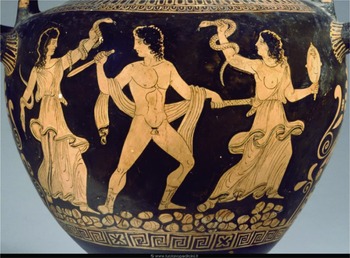
Here I use a panel from a classical era (380–360 BCE) Lucanian vase (see Figure 2) interpreting the Eumenides’ conclusion to show the outlines of an Aeschylean understanding of the central importance of the presence of the dead victim to doing justice. That image makes clear in a particularly striking way the core theme of justice and the presence–absence of the victim.Footnote 8 We see Orestes confronted by two Furies. These “helpers of justice” and “upright witnesses” for the murdered victim hold a mirror reflecting the crowned head of the dead Clytaemestra, her accusing glance turned directly toward Orestes (Aeschylus Reference Smyth1971a, line 318; Laks and Most Reference Laks, Most, Laks and Most1997, 11, 94 col. IV). In the Eumenides, Clytaemestra is indirectly present in the form of a shadow, an eidōlon;Footnote 9 on this vase, she is shown as a reflection. Her mirrored image is not a portal or window through which Orestes can see his victim in the “far abode” of her utter pastness/death. On the contrary, it is her actualization, making her present to confront him in justice and in the here and now. She is both present and absent: a presence but not of the ordinary kind; shadowlike, an image in a mirror; an absence yet not a nullity. The dead, as Nicole Loraux writes in another context, are in a way still among the living (Loraux Reference Loraux1999, 81). Like the picture of Kevin McElhinney looking out over the crowd in Derry, the mirror's reflected face insists on her standing as a wronged subject, and so on her centrality to justice.
Brooklyn–Budapest Painter

Images in mirrors convey an obliqueness, the presence of something not seen directly but represented to us in polished metal or glass. In ancient Greece, mirrors were a common feature of death cults and suggested a kind of overcoming of distance in the context of the relationship of the living and the dead (Dreger Reference Dreger1940, 96; Herrmann Reference Herrmann and von Lücken1968, 669; Kossatz-Deissmann Reference Kossatz-Deissmann1978, 111). That overcoming of absence is always ambiguous, however. Jean-Pierre Vernant writes that the image of the deceased on the classical Greek grave marker substituted for and was the equivalent of the formerly living person. At the same time it gestured to “a new mode of being, different from the old one, that is the status of being dead that the deceased acquired in disappearing forever from the light of the sun” (Vernant Reference Vernant1983, 36). As I noted, the mirror portrayed on the vase shows Clytaemestra to be there, a represented image, shadowlike but demanding a response from the living. Here we see underscored the two principal voices of the counterpoint of justice and absence: her centrality to doing justice and her unstable status as an absent presence.
If the victim's reflection in the mirror points to the ambiguities of her status, the act of holding the mirror up so that others will see her tells us something of what it is to do justice. That act does not create her presence but rather notices or acknowledges it (Spaemann Reference Spaemann and O'Donovan2006, 184, 237, 241). In so doing, it also recognizes her as a possible claimant on justice. The Furies who hold the mirror represent Clytaemestra to the here and now, bring killer and victim face to face once more, the victim now not dust and nothing in her blood-spattered chamber but a claimant acting under the auspices of justice. The Furies have a special affinity for the unjustly dead—especially those within a family—and in their turn those absent victims have a particular need for the representation that these friends of justice offer. Neither personifications of the dead nor justice itself, they nevertheless play a crucial and related role as the “helpers” of both. By making visible the presence of the absent victim, the Furies represent those who otherwise would remain in the shadows, and in so doing they “suppress the distinction between the space of the dead and the space of the living.”Footnote 10 They thus venture a response to one of the Oresteia's central questions: Can the dead victims of injustice be recognized as present and as claimants still on justice, their distance from us overcome? The Furies answer this with their mirror, by means of which they overcome what had appeared to be the unbridgeable pastness of death (Améry Reference Améry1977, 116, 123; Garapon Reference Garapon and Barret-Ducrocq1998, 113).
The Lucanian vase's interpretation of the Eumenides invites the following observations: (1) The absent victim retains a presence. (2) This presence is made known to her community only in an oblique way, in her reflected face. That is, she must be represented, disclosed by the “helpers of justice,” to a present all too inclined to grant reality and weight only to the near at hand. (3) The victim is central to doing justice. The encounter portrayed here is between the victim and the perpetrator, and it is her claims—and not a public good or an instrumental end—that are advanced against Orestes. (4) The mirror points to her presence and to the relational dimension she insists on: she is there, wronged, and demanding justice from the living. The Furies’ holding the mirror is a way of bringing her to her tormentor and to others. Without the mirror and the Furies carrying it, she would remain invisible to them, silent and overshadowed by the present. She would be, in the words of Hélène Cixous (playwright, and translator/producer of Aeschylus for the contemporary stage), “the victim who has never spoken” in the place where justice is done (Cixous Reference Cixous1995, 72). Aeschylus, Cixous says, responds to that silence by becoming the guardian of these dead as claimants on justice (Cixous Reference Cixous1995, 20; Cixous and Fort Reference Cixous and Fort1997, 445).
Doing justice is in part the struggle to overcome, to invert those absences by showing that what seems nonexistent and distant in fact retains a presence, one demanding a response. The Oresteia is a story of duties to the dead who, though distant and unreachable in one sense, still remain present to justice and who therefore can be further wronged by the failure to do justice on their behalf. The victims need a response because, even in death, they remain claimants on justice. Though their presence is not a confection of the present, they themselves are powerless to secure the justice that is their due. It is the living and present that are the agents of this completion of justice. The Furies urge them to do that and this commitment to representing the victim is a vital part of doing justice. In representing the dead victim, they thus “stand firmly on the side of dikē [justice]” (Cixous Reference Cixous1992, 1; Gagarin Reference Gagarin1976, 71–72, 78; Johnston Reference Johnston1999, 121, 127; Mace Reference Mace2002, 47; Vellacott Reference Vellacott1984, 44). A failure to respond to that would be a rent in the fabric of justice. When Karl Schlögel (Reference Schlögel2008) describes the forgetting of the victims of the Stalin dictatorship in the USSR as their “second death,” we take him to be speaking metaphorically: Plainly, the dead cannot die again (18). Yet we also grasp the underlying thought: That such forgetting would be a wrong, an injustice, not (only) because their living and present descendants would be hurt, or because lessons for the future would be lost, but primarily because it would be a failure to respond to the wronged subjects and in that sense a further injury to them.
REPRESENTING THE ABSENT
Enduring Relational Presence
What does it mean to represent the dead as claimants on justice? On one view, there is nothing to represent. They have no interests, no continuing stake in the world, and so no pain or harm to suffer (Callahan Reference Callahan1987, 341–42, 346; Feinberg Reference Feinberg1984, 79; Partridge Reference Partridge1981, 244, 248). Aeschylus (Reference Sommerstein2008) himself wrote that “if you want to do good to the dead, or again to do them harm, it makes no difference; for [the lot of] mortals [when they die is to have no sensation] and feel neither pleasure or pain” (267). They have no ties to us that would bind their fates to a claim on us. There is thus no common mesh, no enduring relational status between us and them. However, another tradition of philosophical reflection asserts that the dead remain in a skein of relations to us, and can in that context suffer harm and injustice.Footnote 11 One variant of this argument holds that although the dead as postmortem entities are indeed dust and nothing, the person viewed as antemortem does have enduring interests that can be thwarted after death. The interests, harms, and injustices are ascribed to the once living person, not to the dead (Feinberg Reference Feinberg1984, 83–84, 89, 91; Levenbook Reference Levenbook1985, 162; Pitcher Reference Pitcher1984, 183–84). When we say, for example, that we owe recognition to the victims of a mass crime, we do not mean to the dead persons as they now are. Rather, what we intend is that we owe it to them (in the present), as the living persons they were, together with those of their interests that can persist after their deaths. Those interests can be harmed even when the injuries are outside the boundaries of my physical person or awareness, and so I never experience or even know of them (Nagel Reference Nagel1970, 78; Pitcher Reference Pitcher1984, 185–86).
Here I want to outline another kind of relational persistence, tied not to the interests of the dead but to their status as claimants on justice, their belonging to an enduring mesh of relations of justice characteristic of a political community. We attribute to political communities an identity understood as a cross-generational enduringness of some broadly normative aspects of their existence: for example, a shared perception of justice, a constitution to express it, and its correlated institutional arrangements. That persistence makes a community the bearer of its past and the steward of its future, and gives it an enduring relationship to the absent denizens of both domains. (We do not consider antebellum America, or America a century from now, to be other countries unrelated to our political community.) This suggests that we might think about the enduring claimant status of absent victims (making demands on us in the present) as embedded in those relations of justice that belong among the features of an enduring political community (Blustein Reference Blustein2008, 221). The underlying relations of justice are among those features, meaning that, for example, when we say that “the American slave system was wrong,” we understand it as a proposition for an enduring community (America), one that in the present recognizes the long-gone victims of this grave injustice. Inflected and qualified by the practical limits that our temporal location imposes, we acknowledge past enslavement as our wrong, something on our ledger, and its absent victims as claimants owed recognition and whatever other justice can be given them.
Separation does not exclude them as claimants. Their distance changes the perspective from which we view them and limits the range of possible responses. But it does not diminish the fact of what happened, or our ties and debts in justice to them. It does not reduce the victims to nullities, to whom no recognition or response is owed. Their status has this enduring relational dimension, grounded in their being persons and, within the framework of this enduring political community, claimants on justice. When we speak about their demanding persistence, we do not mean the particularity of their interests, plans, wishes, and so on. Rather, what is intended is that the distance created by time and death does not erode that relational coexistence in justice. People do not become less subjects of justice as their distance from the present increases. Doing justice to the absent dead is—in part—a way to make that persisting relational status visible to the community, to have the living and present see the dead as subjects still among them. The Furies’ mirror shows both the presence of the dead and their relational status as demanders of justice, addressing their living, present-time community. The refusal to recognize victims, on the other hand, severs that relationship. For the wronged victim, that is a second death, a rendering invisible of her relationship in justice to the community. For the community, it is a failure to acknowledge the ties of justice that are a core part of its identity across time.
Decentering the Victim
Time, death, and the weight of the present threaten to exile the absent victim from the place of justice. There is, however, yet another form of displacement that touches the living and the absent victim equally. This is a conception of doing justice that creates a distance between the victim and those institutions where she might seek an answer to the wrong done her, or better which decenters or makes her secondary in relation to them. It rejects the demanding centrality of the victim reflected in the Furies’ mirror. Much contemporary legal theory sees this as a welcome move away from the victim and his or her backward-looking vengeful gaze, and thus a turn from a barbaric to a civilized justice aiming at the public's good and not the thirst for private retribution.Footnote 12 The result is the primacy of a public good steering the administration of justice and a resistance to the retrospective and private character of the retributive victim-centered view. Some advance this case from utilitarian premises; others emphasize the public character of justice. That latter approach can be seen in the words of Telford Taylor, the chief U.S. prosecutor at the Nuremberg trial: “A crime is not committed only against the victim but primarily against the community whose law is violated.”Footnote 13 This suggests that even if we bridged the distance between us in the present and the victim in the far place of death and the past, he or she would not (under this conception of doing justice) remain among its central subjects. The victim's “far place” is then one created then not only by death and distance in time but also by an expropriation of her “ownership” of, or even her defining presence in, the process of justice. This displacement affirms a variant of the absence of the victim. Reflection on this offers an occasion to underscore the centrality of the victim and her need for a response. It also illuminates the relational dimension of the victim's status. For as we said, in marginalizing the victim in this way, her relationship to us in the present, as subjects sharing in justice across time, is made secondary. That is, first of all, a further injury and also a weakening of the persisting bonds of justice in which we are all embedded.
Here again the Eumenides and the uneasy tension of its conclusion help us to frame the issue. The Furies resist not only the oblivion that time and death threaten to bring to the victim but also—at least initially—the city's effort to make itself and its good (and not the victim's demand for repayment) the center of justice. Their mirror represents the victim in resistance not only to the corrosive effects of death but to the displacement under way at the hands of the political community. In the conclusion to the play, the authority of the city's laws and judicial institutions over the Furies is established. The Furies are, it seems, doubly defeated: Their role as representatives of the victim, “champion(s) of dead men,” is superseded by the institutionalized authority of the city's trials under law. And Clytaemestra, who was to be made present through their representing mirror, is left silent and invisible, her ties in justice to those around her brushed aside.
There is much debate over Aeschylus's argument about justice in the Eumenides. Perhaps the most familiar interpretation is the whiggish one: that he concluded the trilogy with a defense of a legal state-governed system of justice, to replace the archaic victim-centered world of familial justice, self-help, and blood vengeance.Footnote 14 On that reading, the victim and the Furies, her helpers in justice, are both displaced or at the least domesticated. The state, its laws and sanctions, take over the task of doing justice, thereby decentering the victim and her family, elevating the public good over the particularizing passion for retribution, and substituting persuasion for violence. Others see a victory for rhetoric and sophistry. The court's first act—with Athena's assistance—is the acquittal of Orestes (“having slain his own mother, [and] confessing the fact”) aided, as Apollo says, by “speech of persuasive charm” and “devices” (Aeschylus Reference Smyth1971a, lines 81–82; Demosthenes Reference Vince1935, 74, 265). Still other commentators resist the whiggish reading, and interpret the conclusion not as a vanquishing of the victim and of her pursuit of vengeance but as their sublimation in the city's legal institutions.Footnote 15
In that thicket of interpretations, the following point deserves to be underscored as a caution against overstating the degree of change in conceptions of justice charted in the Eumenides. Even in this transition from private to public justice the victim's place, though transformed, remained (at least partially) intact. The Furies—vengeful and focused on the family—are made subordinate but they are not banished, and Aeschylus makes plain that as representatives of the victim they have a central position in the city's justice, something (nonmetaphorically) true of the practice of Athenian law as well. The state, in claiming for itself the power to administer justice, nevertheless allows the victim's presence—represented by her kin—as a subject of justice and pursues vengeance in her name.Footnote 16 It was the dead victim who was understood to have suffered an injustice, and the court was there to exact vengeance on his or her behalf (Burnett Reference Burnett1998, xvi, 2, 54; Cohen Reference Cohen, Cohen and Gagarin2005b, 171; Hunter Reference Hunter1994, 129; MacDowell Reference MacDowell1963, 1, 8; Müller Reference Müller1833, 127; Phillips Reference Phillips2008, 20, 62). In Antiphon's court speeches, for example, the accusing voice speaks (much as the Furies had) as the representative of the murdered victim. The victim, brought back now not in the Fury's mirror but by the private initiative of his family in the court, is to get his measure of justice. The legal proceeding is understood in the first instance as the fulfillment of a debt owed to the victim, though other goods—deterrence, and freeing the city from the taint of an unanswered crime—were also part of these court speeches (Burnett Reference Burnett1998, 54; Cohen Reference Cohen, Cohen and Gagarin2005a, 215, 224, 228; Reference Cohen, Cohen and Gagarin2005b, 172; Courtois Reference Courtois and Courtois1984b, 101; MacDowell Reference MacDowell1963, 3, 141; Winnington-Ingram Reference Winnington-Ingram1954, 23). The principal harm is thus not a generalized public injury but the crime the victim suffered. In the play, Clytaemestra does not get her retribution, her killer is freed, and the Furies are subordinated to the workings of the city's justice. Only public vengeance is now tolerated and thus the political community alone—not the Furies or family members—can punish legitimately (Allen Reference Allen2000, 23–24). Perhaps in this unresolved tension, Aeschylus meant to show us the limits both of the Furies’ exclusively (blood-related) victim-centered approach to justice and of an institutionalized conception of justice that puts a generalized public good (e.g., the peace of the city) above the need of the absent victim for recognition and retribution.Footnote 17
Who speaks on behalf of the absent, whether the Furies, the victim's family (in Athenian law), or the contemporary trial prosecutor, is less crucial to this article than the centrality of the victim's represented voice. Controversy about that is by no means foreign to the modern period (Fletcher Reference Fletcher1998, 80). Consider the Jerusalem trial of Adolf Eichmann. There the Israeli prosecutor, Gideon Hausner, introduced “six million accusers. . .. Their blood cries out, but their voice is not heard. Therefore I will be their spokesman and in their name I will unfold the awesome indictment” (“The Attorney General's Opening Speech” 1992–1994, 62). His dead victims had a represented presence in the courtroom with which to confront their executioner. This expression of a Fury-like victim-centered prosecutor's role could be criticized for its reversion to a world in which justice was a matter between victims, their families, and the perpetrators. It gave substance, Hannah Arendt wrote, to the “chief argument against the trial, that it was established not in order to satisfy the demands of justice but to still the victim's desire for and, perhaps, right to vengeance.”Footnote 18 Trial and punishment are not proxies for a settling of accounts between victims and perpetrators but ways to restore “the general public order.” In that sense, justice involves the “displacement” of the victim (Gardner Reference Gardner2007, 214). The relevant actors are the state, the public (not the victim) it represents, and the accused. The victim ceases to be the “owner” of the grievance, and her voice is not a guiding one in the process of doing justice. Indeed, in Gardner's account (paralleling the whiggish reading of the Eumenides), one of the defining purposes of the criminal trial is precisely to remove the victim from the doing of justice. Law-governed justice has “confiscated” her grievances and her standing in the process (Courtois Reference Courtois and Courtois1984a, 10; Gardner Reference Gardner2007, 213, 216, 235–36, 238; Hénaff Reference Hénaff2002, 297; Jaudel Reference Jaudel2009, 46–48; Marshall Reference Marshall and Matravers2005, 109; Smith Reference Smith, Christodoulidis and Veitch2001, 55).
“Where are the voices,” Darwish asks, “of those who were killed, in the past and more recently, who are demanding an apology . . .?”Footnote 19 The victim, a person having suffered an injustice, is key. The crime is first and foremost a wrong against the victim, though of course there are also resulting losses to the public. The prosecutor's voice is shaped by the centrality of the wronged victim (Fletcher Reference Fletcher1998, 39, 80, 171; Garapon Reference Garapon1985, 194). Punishment is at least in part a correction of that wrong, a retributive act, and a recognition of the victim as unjustly harmed and not simply (as in the utilitarian account) a vehicle for general or specific deterrence and reform or incapacitation of the criminal.Footnote 20 The trial on that view is a “calling to account,” a locale of answering and condemnation for the harm done the victim (Duff Reference Duff2007, 176, 191; Duff et al. Reference Duff, Farmer, Marshall and Tadros2007, 3–5, 61–63, 86, 91, 134, 137). It is a public event in the sense that it expresses the enduring relations of justice between persons present and absent, and it cannot therefore marginalize or dispossess the victim. Like the Furies, the prosecutorial voice pursues the victim's grievance “with her and for her” (Duff Reference Duff2001, 60–61; Reference Duff2007, 141–42; Duff et al. Reference Duff, Farmer, Marshall and Tadros2007, 9–10, 134, 137, 213–14; Günther Reference Günther, Christodoulidis and Veitch2001, 13; Marshall Reference Marshall and Matravers2005, 110). In classical Athens, that pursuit was the responsibility of the family, based on its particular ties to the victim, and the court was its instrument. Here the public character of that pursuit expresses the victim's shared status with us, related to us as a community of justice, one and all. The Bloody Sunday (Saville) Inquiry, mentioned on the opening page of this article, may have had many political effects in the present and many strategic motivations for its initial creation. And family members of the dead, with their intimate bonds to the victims, were long-standing advocates of a judicial response to the killings. But in the end, its work had to do neither primarily with general social goods nor with the families and their private relations to the dead but rather with the thirteen dead persons, wronged and therefore owed a response.
Representation and Doing Justice to the Past
If absent victims remain claimants on justice despite the distance of death, time, and judicial decentering, what is it to act in response to the wrongs they suffered? In discussing the Oresteia, I have been concerned with its insistence on the enduringness of the (represented) past/absent victim as a person owed justice. Yet as I have also said, absence, death, and distance in time limit the ways in which we can respond to them. Ancient tragedy already recognized this: Justice, in its response to the absent victim, cannot restore her whole. Justice therefore has limits to what it can repair: some “evil knows no deliverance,” for as the Chorus tells Electra, “from the all receptive lake of Death you shall not raise him [Agamemnon]” (Sophocles Reference Grene and Lattimore1992, lines 138ff, 143ff). Here I want briefly to sketch a case that, within those limits, judicial representation–remembrance does a core part of the work of justice in responding to the wronged absent.Footnote 21 Recall again the vase image of the climatic scene of the Eumenides. Clytaemestra's representation in the Fury's mirror (in a limited way) nullifies distance and allows her to confront her killer. In that manner, she is recognized as a claimant on justice. Her reflection in the mirror represents her to us, and in its obliqueness tells us of her absence. The place of justice in that image is found in her demanding presence, represented to the here and now in the Furies’ mirror, confronting her tormentor and insisting on a response. It is the moral “inversion” that overcomes the distance of time and death. It is an “inversion” in the sense that the enduring quality of her status as a claimant, and of the obligation to answer the wrong done to her, are made present and insisted on against the view which sees them in their distance from us as having no—or only diminished—reality (Garapon Reference Garapon and Barret-Ducrocq1998, 116–18, 122; Reference Garapon2002, 58, 199, 240, 250, 255–56).
Memory, Aristotle (Reference Sorabji1972) writes, is “of the past” (449a9), but like the Furies’ mirror, it can act not only as a window into an unreachable past but also as the re-presentation of the absent to the living. When political communities do this, they invert or close the distance between absence and presence, the past and the present, the dead and the living, and in so doing function as a counterpoise to the perspectival weight of the present. In particular they insist on the enduring status of the victim as a subject of justice. Antoine Garapon, a French jurist, argues that trials (and comparable judicial or quasi-judicial proceedings) are among the ways in which we try to master distance (his focus is on temporal distance), to deny it its countermoral effects. The trial witnesses a public recalling of the absent, an actualization and representation, making possible the restoring of a balance between victim and perpetrator (Garapon Reference Garapon1985, 62–64; Reference Garapon and Barret-Ducrocq1998, 113, 115–18; Reference Garapon2009a, ix).
Their status as persons is freestanding in relation to the present: The “place [of the dead] is not kept clear by others who remember them” (Spaemann Reference Spaemann and O'Donovan2006, 162). But the act of recognizing is always uncertain: perhaps because the mirror-reflected face has been rejected as a party to justice, or simply because it is dismissed as phantasmal. These distant persons then depend on the present, on us in the here and now, to acknowledge their status as wronged fellow subjects (Blustein Reference Blustein2008, 257; Certeau Reference Certeau1970, 169). This is already implicit in the vase painting discussed above. The mirror and those holding it are needed not to create Clytaemestra (as if by their inaction she would be reduced to a nullity) but to represent her to the present, to have her status and her demand for justice recognized. So the dead of a political community have a relationship to us, one expressed in the persistence of their demands that justice be done them. And they need representation to have those ties and claims (faint as they may be in the distance of death and the passing years) made visible to their community. The absent victim, then, is dependent on the present. At the same time, however, her (represented) presence acts as an imperative, a form of resistance to the here and now, to its easy forgetting and its characteristic view of the absent as nonexistent (Certeau Reference Certeau1970, 169).
We can bring these threads together by saying that the continuity of the victims as sharing with us in a community of justice across time imposes a duty of recognition of that undiminished and still present status, and of the relationship of solidarity among citizens that it invokes. Institutions of justice as sites for the making present of the absent are the locale of this recognition. Not to acknowledge them, or to exclude them from the locales where justice is done, is to overturn their relationship in justice to us (Blustein Reference Blustein2008, 238 [note 95], 220–21; Cockburn Reference Cockburn1997, 153–55, 158–59, 297, 299, 317; Fletcher Reference Fletcher1998, 38). It is perhaps for this reason that statutes of limitation and amnesties, which in their different ways put an end to the presence of the absent victim of injustice, are so deeply controversial, especially in relation to grave violations of human rights.Footnote 22 Seeing the absent victim of injustice in this way suggests that her enduring presence under justice is central, and not derivative from the relationship of her fate to present harms or to the status of the living inheritors/victims of those wrongs. The injustice done endures as a matter calling for a response, then, not principally because it has downstream effects on those who are present and alive (though it often does of course) but rather because the victim persists as an injured subject of justice (Feinberg Reference Feinberg1984, 94–95; Levenbook Reference Levenbook1985, 162–63; Partridge Reference Partridge1981, 260–61). She is not dust and nothing, but is present even in our “far place,” a claimant on justice whether in her (represented) presence in the trial, that small stage of doing justice, or in the grander processes by which we deal with gross historic injustices.
Still, distance and separation set the outer boundaries of this presence. To acknowledge the dead as enduring claimants on justice is not to consider them as “repatriated” whole to the world of the living (Urbain Reference Urbain1998, 25). They are not bearers of the panoply of traits and interests they had ante mortem, nor does our relation to them have the fullness it had in that time when they were alive and here. Their presence, whether represented in Clytaemestra's voice heard in the Eumenides, in her face reflected in the Fury's mirror, or in the images of the Bloody Sunday victims in Derry, is not of the whole persons they were before death, but rather that of claimants awaiting a response, bound in relations of justice to those around them, whose status as that kind of subject does not cease with their death or the passing of the years. We fully understand that in many humanly important ways they are indeed irretrievably absent, yet when we come to do justice we accept them as present, if only on a small stage. From this follow the limits on what can be addressed, and which harms repaired. At one level, this is straightforward: The full status quo ante cannot be restored. There is no possibility of that kind of “repayment” (Cowen Reference Cowen and Elster2006, 25; Garapon Reference Garapon2009b, xii). At another level, these limits are a function of what does endure of the victim's person: neither “dust and nothing” nor a presence endowed with the panoply of the hopes, needs, and desires of a living person, but rather a claimant on our recognition and justice. Public acknowledgment of the victim as a person owed justice saves her, not from all, but from a certain kind of oblivion (Garapon Reference Garapon2002, 166). That recognition of the absent victim as present nevertheless, and not as a bearer of interests or as a claimant on restorative compensation or revenge, but as someone owed justice, is what remains (Garapon Reference Garapon2002, 161, 214; Kutz Reference Kutz2004, 280).
CONCLUSION
Facing historical injustices means answering the call to respond to the victims, a call and a response that are fraught with perplexities related to the victims’ distance. I have suggested that we can understand the continued and central presence of the victim as seeking, and owed, a response. That enduringness confronts us with the imperative to answer historic injustices. It also tells us of the limits of any such calling to account across time. The victim in all that she was is no longer present; there is much that cannot be repaired. The image of Clytaemestra's reflected face, confronting her killer and demanding to be recognized in the present despite her radical distance, tells us something of what it means to address absent victims of injustice. Theirs is a demand for recognition, that the absent be represented as claimants on justice. This image speaks both to the fragility of that act of representation, which depends squarely on us in the present, and to its centrality to doing justice. The subjectivity of the victim, his place in a community of justice, and his standing in relation to his attacker are here brought back into the order of justice (Hill Reference Hill2002, 393–94; Kutz Reference Kutz2004, 284; Ridge Reference Ridge2003, 40). Now I draw these elements together.
That imperative to recognize the dead victim (and with that to acknowledge the relations of justice that bind us to her) places a responsibility on the political community not to seal her absence, not to deny her continued presence as one among us, a wronged member of a community of justice. Discussing the Argentinian transition to democracy, George Fletcher (Reference Fletcher1998) argues that one function of the judicial response to mass violations of human rights “is to express solidarity with the victim,” i.e., to acknowledge both her presence as a claimant and our common ties in justice. Not to do so is to make society complicit in the “victim's state of subservience” (38). Perhaps that is the meaning of Antiphon's (Reference Maidment1941) remark that the city is polluted, or stained, if it does not act on a murder charge before it (2.1.3) The city's relations of justice over time, and the status of its members as subjects of justice embedded in that community, are defiled by such failures.
The acknowledgment of that presence is a cornerstone of doing justice across time. It is one form of the “moral inversion” of absence characteristic of the work of justice. This may often be the most that we can do by way of repair of the worst historical injustices, and it may be sufficient as well. It may be sufficient, that is, from the standpoint of justice if not that of the victim's family, co-religionists and so on, for whom he or she was much more than a claimant on justice. Recognizing the victim and perpetrator, and granting that these crimes came from within our midst, is one facet of answering the call of the victim. Addressing historic injustices in this manner permits us to see the absent victim as (in a way) distant from us, and therefore to accept that absence limits the possible range of repair. It also allows us to see that the victim is not a nullity: If in Camille Laurens's words (quoted earlier), love in a family is an “exception to the emptiness” of death, so here justice is an exception to the closed pastness that death brings to victims of historic injustice. In brief, it permits us to see the victim as present not, as I said, in the manifold of what she was as a flesh and blood human being but nevertheless as one among us, a continuing subject of our shared relations of justice.
That locale of justice, whether a courtroom or a truth commission hearing, is also in a way the terminus of their presence as claimants on justice. There the recognition of the victim, the determination of her fate, and whatever repair or punishment is possible draw a final line under her presence. Perhaps this is why judicial engagement with absent victims sometimes evokes concern: After they receive their answer, they disappear (as claimants on justice) and a thick line is drawn between them and the present.Footnote 23 For their families, co-religionists, and so on, for whom they were more than such claimants, that judicial closure is not the end of the absence that their loss brings. On the other hand, for the community of justice of which they were a part, the Furies’ mirror is now put down. Once answered, the victim–claimant has no further standing in justice.
In the end we have an answer to Electra's challenge: Are the dead mere “dust and nothing,” irrevocably distant from us in “this far place” we inhabit? They are not, we can now respond, for they remain a presence, a shadow cast over our world until their appeal for justice is answered. That answer, always troubled and incomplete, rests on their presence, the annulling of their absence, and the recognition of the status they share with us in the present. The twenty-one words given to Kevin McElhinney by the Saville Inquiry, the prosecutor's speech representing the murdered Jews of Europe to the Jerusalem court trying Eichmann, and other efforts to address the absent victims of injustice are perhaps best understood in Michel Zaoui's (Reference Zaoui2009) observation about the trial of Maurice Papon for crimes against humanity. “The work of justice,” he wrote, “is to give a response, one not unworthy of the irreparable” (5).



Comments
No Comments have been published for this article.