Introduction
Ring-necked pheasants are usually held in aviaries, although there are some farms where the birds are kept in cages during the reproductive period, which results from economic factors. In the case of pheasants, it should be emphasised that the results of artificial hatchings have not been quite satisfactory (Deeming and Wadland, Reference DEEMING and WADLAND2001; Kirikçi et al., Reference KIRIKÇI, GUNLU, CETIN and GARIP2003). Studies indicated that the age of the females, quality of the egg (especially the shell), and conditions and duration of egg storage before incubation may affect hatchability (Ipek and Sahan, Reference IPEK and SAHAN2002; Farooq et al., Reference FAROOQ, DURRANI, SARBILAND, KHURSHID and MANZOOR2004; Krystianiak et al., Reference KRYSTIANIAK, KONTECKA, NOWACZEWSKI and ROSIŃSKI2007; Kożuszek et al., Reference KOŻUSZEK, KONTECKA, NOWACZEWSKI and ROSIŃSKI2009b). Similarly, the results of certain experiments suggested a relationship between the colour of eggshells and their quality and the hatchability of chickens (Mróz and Pudyszak, Reference MRÓZ and PUDYSZAK2000; Krystianiak and Kontecka, Reference KRYSTIANIAK and KONTECKA2002; Silversides and Budgell, Reference SILVERSIDES and BUDGELL2004; Kożuszek et al., Reference KOŻUSZEK, KONTECKA, NOWACZEWSKI, LEŚNIEROWSKI, KIJOWSKI and ROSIŃSKI2009a; Ristić et al., Reference RISTIĆ, MARKOVIĆ, KOVAČEVIĆ, NAD, MATEJEVIĆ and JOVANOVIĆ2013). Moreover the results obtained by Nowaczewski et al. (Reference NOWACZEWSKI, SZABLEWSKI, CEGIELSKA-RADZIEJEWSKA and KONTECKA2013) confirmed the existence of a relationship between pheasant eggshell colour and its biochemical composition and microbiological contamination.
Eggshell cuticle and lysozyme found in the shell membranes and egg albumen prevents the penetration and reproduction of microorganisms inside the egg (Solomon, Reference SOLOMON1994). This is particularly important in the case of reproductive pheasants kept in aviaries on the ground. Such ground contact exposes eggs to a number of pathogenic microorganisms and intermediate endoparasite hosts (Nowaczewski and Kontecka, Reference NOWACZEWSKI and KONTECKA2005; Krystianiak et al., Reference KRYSTIANIAK, KONTECKA, NOWACZEWSKI and ROSIŃSKI2007). Thus, eggs laid on the ground are more susceptible than in other housing systems (cages) to infections with various pathogens (bacteria, microscopic fungi, and yeast). The studies conducted in hens have shown that significantly higher number of bacteria and fungi are observed in the air and on the surface of the eggshell when the birds are maintained in an aviary or on litter, compared to caged birds (De Reu et al., Reference DE REU, MESSENS, HEYNDRICKX, RODENBURG, UYTTENDAELE and HERMAN2008; Vučemilo et al., Reference VUČEMILO, VINKOVIĆ, MATKOVIĆ, ŠTOKOVIĆ, JAKŠIĆ, RADOVIĆ, GRANIĆ and STUBIČAN2010).
Other than the morphological and physical features of the eggs, the biochemical content of the eggs is equally important considering embryogenesis. The embryo must be provided with adequate amounts and proportions of various nutrients that are essential for its proper development. Lipids, which are the source of energy essential for embryogenesis, play a significant role (Noble and Cocchi, Reference NOBLE and COCCHI1990). Polyunsaturated fatty acids are the main components of the phospholipid membranes of certain tissues. Analysing the chemical composition of eggs from laying hens, Zanon et al. (Reference ZANON, BERETTI, SUPERCHI, ZAMBINI and SABBIONI2006) found a higher share of crude ash in brown-shelled eggs compared to white eggs. The study performed on ostriches demonstrates the importance of the appropriate content of elements in eggs, in terms of the proper hatchability results of birds (Perelman et al., Reference PERELMAN, FUCKS, HELLER and SCHONFELD2001). The authors observed that the birds laying eggs containing lower amounts of Ca, Mn, Se, and P had poor indices of hatchability and the increased embryo mortality at the end of the incubation period.
Egg biochemical composition
Examining the pH of albumen from pheasant eggs, Kożuszek et al. (Reference KOŻUSZEK, KONTECKA, NOWACZEWSKI, LEŚNIEROWSKI, KIJOWSKI and ROSIŃSKI2009a) observed highest average values in dark-brown eggs, while the lowest value was observed in blue eggs. The results concerning the basic chemical composition of these birds' eggs content obtained by Nowaczewski et al. (Reference NOWACZEWSKI, SZABLEWSKI, CEGIELSKA-RADZIEJEWSKA and KONTECKA2013) are similar to those presented by Mangiagalli et al. (Reference MANGIAGALLI, SCANDOLARA, MARELLI, GIULIANI and GUIDOBONO CAVALCHINI2003). Slightly lower fat and crude ash content in the eggs of these birds (by 0.5 to 2.0 percentage points) compared to the research of Nowaczewski et al. (Reference NOWACZEWSKI, SZABLEWSKI, CEGIELSKA-RADZIEJEWSKA and KONTECKA2013) were observed by Song et al. (Reference SONG, CHOI and OH2000). Although the eggs examined by Nowaczewski et al. (Reference NOWACZEWSKI, SZABLEWSKI, CEGIELSKA-RADZIEJEWSKA and KONTECKA2013) did not differ with respect to weight, differences in the chemical composition, depending on the shell colour and housing system were found. The highest amount of water was found in the blue and light-brown eggs. The latter, in turn, were characterised by a significantly lower total protein content (by 0.53 percentage point on average) compared to the other eggs. Fat content in the eggs with blue, light-brown, and dark-brown colour of the shell was similar and significantly lower compared to the olive eggs. The highest level of crude ash was noted in light-brown and dark-brown eggs.
The fatty acid profile and cholesterol content of pheasant's egg yolk, taking into account the colour of the shell, were analysed by Nowaczewski et al. (Reference NOWACZEWSKI, SZABLEWSKI, CEGIELSKA-RADZIEJEWSKA and KONTECKA2013). Generally, the highest share of the following fatty acids was found in yolk lipids: C18:1, C16:0, and C18:2. These results are similar to those obtained in pheasants by Choi et al. (Reference CHOI, SONG and OH2001) and Mangiagalli et al. (Reference MANGIAGALLI, SCANDOLARA, MARELLI, GIULIANI and GUIDOBONO CAVALCHINI2003). Significant differences between eggs of different shell colours were demonstrated in the case of five fatty acids (Nowaczewski et al., Reference NOWACZEWSKI, SZABLEWSKI, CEGIELSKA-RADZIEJEWSKA and KONTECKA2013). Blue eggs had a higher share of C17:0 and C17:1 than the other eggs, by 0.12 and 0.13 percentage points, respectively. The highest level of C18:0 was seen in dark-brown eggs, and the lowest level was found in blue eggs. Dark-brown eggs had a significantly higher content of C20:0, compared to the other egg colours. Lack of reports of other authors concerning fatty acid share in pheasant eggs prevents wider interpretation of the results obtained. Cholesterol content in pheasant eggs reported by Nowaczewski et al. (Reference NOWACZEWSKI, SZABLEWSKI, CEGIELSKA-RADZIEJEWSKA and KONTECKA2013) was similar to that reported in the same species by Choi et al. (Reference CHOI, SONG and OH2001), which was about 19.0 mg/g of yolk and 180 mg/egg. In turn, Kaźmierska et al. (Reference KAŹMIERSKA, JAROSZ, KORZENIOWSKA, TRZISZKA and DOBRZAŃSKI2005) reported a lower cholesterol level in these eggs (6.82 mg/g of yolk). It is thus difficult to determine unequivocally the range of this sterol level in pheasant eggs. In the study of Nowaczewski et al. (Reference NOWACZEWSKI, SZABLEWSKI, CEGIELSKA-RADZIEJEWSKA and KONTECKA2013), lower cholesterol content per gram of lipid was found in the dark-brown and olive eggs compared to the light-brown or blue ones. This difference was 4.45 mg on average. It is possible that just higher cholesterol content in the lipid of the egg with a light coloured shell colour contributes indirectly to the poor hatchability results obtained from them. Dikmen and Sahan (Reference DIKMEN and SAHAN2007) reported a significant negative correlation between the cholesterol content in the eggs of broiler breeders, and eggs' fertilisation and hatchability (r=−0.345 to −0.637). This relationship was seen in the results obtained by Elkin and Yan (Reference ELKIN and YAN1999), who observed a decrease in the hatching rates in the laying hens when the level of cholesterol in the eggs exceeded 185 mg.
Analysis of the level of chemical elements in the content of pheasant eggs showed that the eggs with dark-brown shells had the highest amount of K, Cu, and Mg (Nowaczewski et al., Reference NOWACZEWSKI, SZABLEWSKI, CEGIELSKA-RADZIEJEWSKA and KONTECKA2013). Furthermore, they contained higher levels of Ca and Na, by 128.97 and 151.90 mg/l on average, than the light-brown and olive eggs. In case of heavy metals, potentially toxic to the organism (e.g., Cd, Pb, or Cr), no differences between the eggs of different shell colours were found.
Blue eggs had the highest lysozyme content and activity in albumen, while the lowest values were found for dark-brown eggs (Nowaczewski et al., Reference NOWACZEWSKI, SZABLEWSKI, CEGIELSKA-RADZIEJEWSKA and KONTECKA2013). This is consistent with the results of previous studies conducted on this species of birds. Kożuszek et al. (Reference KOŻUSZEK, KONTECKA, NOWACZEWSKI, LEŚNIEROWSKI, KIJOWSKI and ROSIŃSKI2009a) found a significantly higher content (by 0.06 percentage points on average) and activity (by 12 824 U/ml on average) of lysozyme in the eggs with light coloured shells, i.e. blue and light brown, compared to the others. The results of the studies conducted may thus indicate that higher contents of lysozyme and its increased activity was observed in the albumen of the eggs with the light coloured shell (including blue), which usually demonstrate poor hatchability results. It therefore seems that high lysozyme content in the egg albumen can be a kind of natural protective barrier in eggs of a potentially poor shell, which is more easily penetrated by pathogens.
Egg microbiological contamination
Microscopic fungi and their toxic metabolites (mycotoxins) significantly affect the quality of eggs, often resulting in deterioration in hatchability results. They cause, inter alia, mycosis of embryos, and mycotoxins can cause embryos defects, increased mortality, and even infertility of adult birds (Tangni et al., Reference TANGNI, WAEGENEERS, VAN OVERMEIRE, GOEYENS and PUSSEMIER2009; Jacobsen et al., Reference JACOBSEN, GROSSE, SLESIONA, HUBE, BERNDT and BROCK2010). An analysis of the content of shell and egg contamination with microscopic fungi was conducted in pheasants (Nowaczewski et al., Reference NOWACZEWSKI, STUPER, SZABLEWSKI and KONTECKA2011). The ERG content, which is a provitamin D2 included in the cell membranes of fungi, was applied as a quantitative fungi indicator in the egg. The analysis of this sterol demonstrated its presence in the shell and albumen of the examined pheasant eggs; however, its presence was not detectable in the egg yolk. The highest content of ERG was found in eggs with blue and light-brown shells, both not stored (fresh) and stored for seven days prior to incubation. Similar trends were obtained when evaluating ERG content in the albumen of these eggs. The difference between the eggs with blue and light-brown shell and the other colours was about 0.95 mg/kg. Similarly, the difference between the ERG content in the albumen of the fresh eggs and after seven days storage was 0.80, 1.63, 1.91, and 0.85 mg/kg for blue, olive, light-brown, and dark-brown eggs, respectively. Qualitative evaluation of pheasant eggshell microflora indicates the important contribution of the moulds of the Aspergillus genus, and single occurrence of the colonies of Penicillium and Rhizopus genus (Nowaczewski et al., Reference NOWACZEWSKI, STUPER, SZABLEWSKI and KONTECKA2011). The only yeasts found by these researchers on the shells surface belonged to the Rhodotorulla genus.
In a later trial comparing the microbiological contamination of pheasant eggs with different shell colours, Nowaczewski et al. (Reference NOWACZEWSKI, SZABLEWSKI, CEGIELSKA-RADZIEJEWSKA and KONTECKA2013) found that dark-brown and olive eggs had similar and statistically significantly higher TBC values (1.03 log CFU/shell on average) in the shell compared to blue eggs. In turn, these eggs demonstrated a lower ERG content in the shell compared to the blue eggs. This was probably the result of an antagonistic interaction between these microorganisms, since certain mycotoxins produced by moulds have antimicrobial activity.
Fertility, hatchability results and performance
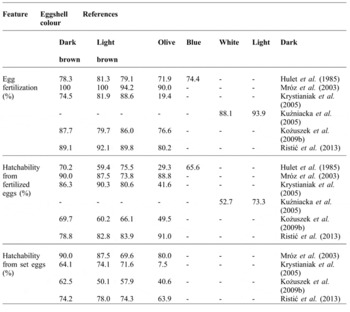
It seems that the results of egg fertilisation and hatchability in pheasants are highly variable and often unsatisfactory ( Table 1 ). According to Kożuszek et al. (Reference KOŻUSZEK, KONTECKA, NOWACZEWSKI and ROSIŃSKI2009b), the highest fertilisation percentage in pheasants was noted for dark-brown eggs, and the lowest for blue eggs. Similar results were obtained by Hulet et al. (Reference HULET, FLEGAL, CARPENTER and CHAMPION1985), Mróz and Pudyszak (Reference MRÓZ and PUDYSZAK2000), Krystianiak et al. (Reference KRYSTIANIAK, KOŻUSZEK, KONTECKA and NOWACZEWSKI2005), Kuźniacka (Reference KUŹNIACKA2005), and Kuźniacka et al. (Reference KUŹNIACKA, ADAMSKI and BERNACKI2005) indicating that pheasant eggs with dark-coloured shells had a higher fertilisation rate compared to light coloured eggs. In the study of Kożuszek and Kontecka (Reference KOŻUSZEK and KONTECKA2005) and Kożuszek et al. (Reference KOŻUSZEK, KONTECKA, NOWACZEWSKI and ROSIŃSKI2009b), blue-shelled eggs had hatchability results that were poorer than the other eggs. This was also noted by Hulet et al. (Reference HULET, MARQUEZ, MOLLE and FLEGAL1978; Reference HULET, FLEGAL, CARPENTER and CHAMPION1985). These authors showed that the best hatching rate from set and fertilised eggs was found for dark-brown and olive eggs, while the light-brown and blue eggs showed a lower hatching rate. Mróz and Pudyszak (Reference MRÓZ and PUDYSZAK2000), Kuźniacka (Reference KUŹNIACKA2005), and Kuźniacka et al. (Reference KUŹNIACKA, ADAMSKI and BERNACKI2005) demonstrated improved hatchability in pheasants from eggs with a darker shell colour. These observations were confirmed by Ušćebrka et al. (Reference UŠĆEBRKA, STOJANOVIĆ, ŽIKIĆ and KANAĆKI2013). The authors reported that the smallest percentage of hatchability was from green-blue-shelled eggs, and the percentage of unfertilised eggs and dead embryos were also highest in these eggs. The lowest hatchability from fertilised and incubated eggs was observed in eggs of blue shell colour (Krystianiak et al., Reference KRYSTIANIAK, KOŻUSZEK, KONTECKA and NOWACZEWSKI2005). It should be emphasised that these eggs had the highest weight loss up to the 21st day of incubation, which was over 20%. Thus, a poor hatching rate of chickens from blue eggs would have been caused by an increased water evaporation from them, which in turn lead to an excessive weight loss of the eggs during incubation. According to Ar and Rahn (Reference AR and RAHN1980), the total egg weight loss during incubation to ensure the highest chance of survival of the embryo should not exceed 15%.
Fertilization and hatchability results of ring-necked pheasant.

Borzemska (Reference BORZEMSKA2005) found that the death of the blastodermal cell (BC) in the oviduct of female birds, and thus their lower number after laying may be caused by diseases, exogenous toxins entering the egg, abnormal environmental conditions, incompetent nutrition as well as various lethal genes. Kożuszek et al. (Reference KOŻUSZEK, KONTECKA, NOWACZEWSKI and ROSIŃSKI2009b) studied how the number of BCs in pheasant embryos varies with different colour shells depending on the length of their storage time. They demonstrated that, immediately after laying, pheasant eggs differed in the advancement depending on the shell colour. They reported that the lowest number of BCs was demonstrated for blue eggs, however, this decreased with extended storage periods of the eggs, regardless of the shell colour. It should be noted that the rate of BCs' decay was higher in the eggs with the dark-brown and olive shell. Due to the deterioration of the hatchability results with storage time of pheasant eggs before the incubation, it is recommended that they be stored for no longer than seven days. The study conducted by Kożuszek et al. (Reference KOŻUSZEK, KONTECKA, NOWACZEWSKI and ROSIŃSKI2009b) confirmed once again that blue eggs should not be hatched due to the poor (compared to the eggshells with other colours) results of hatchability, especially when they are stored for over three days before incubation. One of the latest studies carried out on pheasants indicates a relationship between the colour of the shell and the muscle structure of the birds (Žikić et al., Reference ŽIKIĆ, STOJANOVIĆ, KANAČKI, JOJKIĆ and UŠĆEBRKA2015). Pheasants hatched from blue-green eggs had smaller diameter of leg muscle cells compared to birds obtained from eggs with other shell colours. The authors emphasised that it may indicate a weaker development of muscle tissue in these pheasants.
Conclusions
The results of many studies confirm the hypothesis of an existence of a relationship between the colour of pheasant eggshells and their biochemical composition, and microbiological contamination of eggs. As was shown in part I of the review, pheasant eggs with blue shell colour are of poorer quality and their shell ultrastructure has improper construction that negatively affects hatchability results. Furthermore, a poor shell in these eggs facilitates the penetration of pathogenic microorganisms (mainly fungi) into the eggs, and increases the risk of mortality of embryos. At the same time, the defence mechanisms in place, i.e. higher lysozyme content in the blue-shelled eggs, is not sufficient to prevent this happening. The higher cholesterol level in the yolk of pheasant eggs with a blue shell may additionally be a reason for poor hatchability results. In summary, it seems that from an economic point of view the start of breeding in ring-necked pheasant should be considered and the eggshell colour should be considered in the selection index. Additionally, it is worth considering environmental factors and nutritional modification in order to improve the hatchability parameters for breeding pheasants.