INTRODUCTION
For various reasons, the date and nature of the Roman occupations after the destruction/dilapidation of the sanctuary at Kommos in the later first century bc were not fully discussed in the definitive publication of the site (Shaw and Shaw Reference Shaw and Shaw2000, chapter 4 in particular). Since the time this was written, however, three important works have appeared, which help to throw light on this elusive period. The first presents the Roman pottery from above the Unexplored Mansion at Knossos (Sackett Reference Sackett1992). The second concerns an early Augustan (or to be more precise a late Octavianic) earthquake destruction at Gortys, dated to the years around 30 bc on the basis of the abundant numismatic evidence (Papadopoulos Reference Papadopoulos, Allegro, Ricciardi, Garraffo and Papadopoulos1999, passim). The third is the magisterial opus on Hellenistic and Roman Cretan transport amphorae by A. Marangou-Lerat (Reference Marangou-Lerat1996). In addition, I have been studying the Roman and Hellenistic pottery from the Little Palace North excavations at Knossos and have become more sensitive to the vagaries of the problematic period marking the transition from Greek to Roman ceramic traditions. In consequence I felt it appropriate to present a fuller exposition at this point. This reinterpretation not only has some bearing on the reuse of various sanctuary structures, but can also throw new light on the nature and date of the uppermost levels of the main sanctuary dump. At times the new evidence may seem tenuous and the stratigraphic control exiguous, but my arguments can at least be said to do no violence to the archaeology of the site as a whole, or for that matter of Crete in general. This report should be read in conjunction with Kommos IV (Shaw and Shaw Reference Shaw and Shaw2000), since many of the data cited there have not been republished here. It is an informed view of archaeological events and patterns of deposition gleaned from personal observation over thirteen years at the site; those vases with only a C number attached are here published for the first time.
I. THE END OF THE MAIN PHASE OF THE SANCTUARY
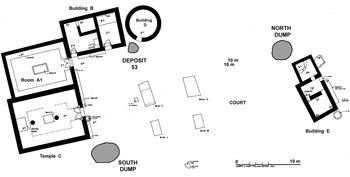
At some point in the second half of the first century bc many of the buildings associated with the sanctuary either were destroyed or fell into a state of dilapidation (Fig. 1). In the definitive report a date of the first half of the reign of Octavian/Augustus was suggested for this momentous and catastrophic event (Shaw and Shaw Reference Shaw and Shaw2000, 720). This was reflected not only within the buildings themselves but also in the main sanctuary dump (Deposit 48 in Shaw and Shaw Reference Shaw and Shaw2000, 278–91), where, in phase 4 of the build-up, articles of temple furniture were jettisoned from within Temple C. Thereafter, the patterns of deposition change. Masses of transport amphorae appear as well as new types of votives: small saucers with a single hairpin handle and miniature bowls of truncated conical profile, which were thought to be degenerate successors of the earlier Hellenistic flaring rim bowls (Shaw and Shaw Reference Shaw and Shaw2000, pl. 4:35). The truth is somewhat different, rather more interesting, and chronologically precise, as we shall see below.
Kommos: the sanctuary.

The dump itself, being in a matrix of wind-blown sand and, moreover, excavated in horizontal spits which cannot truly reflect the actual stages of deposition, only gives an impression of the grossest developments on the site (Shaw and Shaw Reference Shaw and Shaw2000, 278). In addition the topmost layers appear to have been mined for bench packing, creating stratigraphical chaos and a juxtaposition of types which stratigraphically elsewhere on the site prove to be sequential. The purpose of this article is to suggest a more precise history of events founded on more controlled and stratified contexts in the sanctuary.
The end of the Hellenistic use phase can be related, I believe, to events elsewhere in the Messara. About 30 bc an earthquake at Gortys, scarcely twenty kilometres away as the crow flies, was strong enough to demolish at least part of the Hellenistic enceinte (Papadopoulos Reference Papadopoulos, Allegro, Ricciardi, Garraffo and Papadopoulos1999, 191–241). To date, several towers of the wall have been excavated and these present us with groups of pots identical in morphological development to those found in the destruction layers at Kommos. A mass of coins at Gortys date this major seismic event to the years around 30 bc, giving indisputable chronological precision to this catastrophic upheaval. At Kommos a contemporary destruction led to the abandonment of some of the sanctuary's buildings and a reduced presence continuing in others (Shaw and Shaw Reference Shaw and Shaw2000, 719–21). This is accompanied by a change in ritual behaviour and an attenuated and metamorphosed continuation of cult. The following pages seek to track these developments and to provide a more chronologically precise framework for them.
II. THE FIRST ‘SQUATTERS’
To use the term ‘squatters’ is perhaps to do them an injustice, although if we define them as a group of people insinuating themselves into what had been an official religious establishment, the term seems apt. However, far from being a degenerate and non-productive element in the history of the site, they did their best to make do. Indeed, their structural alterations, based on the needs of the cult in reduced circumstances, are more extensive than was implied in Shaw and Shaw Reference Shaw and Shaw2000, 51–5.
At the time of the catastrophe the prime victim was the Hestiatorion (Building A1). With its relatively thin walls and wide roof span, apparently without internal supports, it is hardly surprising that it failed to withstand the shock. The argument for a collapse of Building D rests mainly on the nature of its superstructure, if any. A deposit of greenish clay is localised in this area both within and outside the structure. It overlies the floor of the final use phase and it has been surmised, with reason, to be the decayed residue of mud brick walls (Shaw and Shaw Reference Shaw and Shaw2000, 60 for a contrary opinion). No pottery was noted to date such a collapse, but it was already present when Deposit 53 (Shaw and Shaw Reference Shaw and Shaw2000, 295–7) was built up. A new interpretation for this small dump will be offered below. Building E collapsed and burned. Temple C survived structurally intact though not undamaged, while Building B suffered some damage though part, at least, was put into reuse. All this pattern of differential dilapidation or collapse certainly suggests an earthquake rather than human agency, and the Gortynian event outlined above remains the prime candidate.
III. BUILDING B
There was a clear differentiation of function between the West Rooms and that to the east during the Hellenistic period, although both were used primarily for the storage of the crockery necessary to service the needs of the communal feasts characteristic of that time.
A. The West Rooms
It is clear that the smaller shapes, cups, ladles, plates and saucers were stored here, and cross-joins with the north dump indicate that almost the entire contents were disposed of there after the catastrophe. The clean-up was not very thorough and many vessels were left in situ. One amphora seems also to have stood here, and its rimless neck was retained, possibly as a stand. One article of furniture in the inner room also seems to have survived or, more likely, to have been stored there during the Early Roman period. Its ghostly presence may be inferred from the discovery of a group of tacks all bearing the imprint of a Maltese cross on their undersides (Shaw and Shaw Reference Shaw and Shaw2000, 383). A stool or table seems most likely, and its continued existence in the room after the clean-up implies either that it was a survivor or that it was placed there by the squatters and therefore rightly belongs to the next phase of use.
This reoccupation or reuse is clearly stratified. After the desultory clean-out of both West Rooms a thick deposit of wind-blown sand covered the remaining pot fragments of the main Hellenistic use phase and effectively sealed them from what lay above. At all events, no pottery was noted in this layer. The first phase of the squatter occupation is represented by the pottery from the tile fall, an event which is dated by the latest sherd from this context:
-
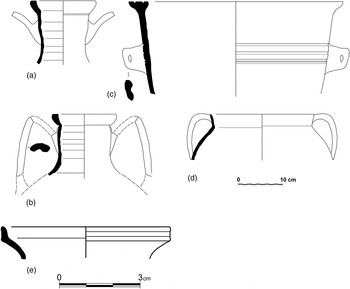
1. C8903. Fig. 2e . Jug, rim fragment. Diameter at rim 6.5 cm, maximum preserved height 1.2 cm. Fine ware 2.5YR 6/6. Matt brown paint. The hollowed rim and collared moulding resembles a Tiberian example from Knossos (Sackett Reference Sackett1992, 191 no. B1,15, pl. 136:15). Definitely post-Augustan.
-
2. C8902. Fig. 2c . Tub. Profile from rim to below handle. Diameter at rim c.45.5 cm, maximum preserved height 21 cm. Five fragments including a floating handle. Gritty coarse ware 5YR 6/8 with thin grey core. Slipped. A deep shape with ledge rim decorated with two incised grooves; three incised horizontal grooves on body and two horizontal handles, deeply grooved on the inside. It does not resemble any of the numerous tubs noted for the main Hellenistic use phase (cf. especially Shaw and Shaw Reference Shaw and Shaw2000, 273 nos. 617–18), but does seem to belong to the Roman series (Sackett Reference Sackett1992, pls. 127:25, 134:91, 149:111–12). Date: Early Roman by context. Augustan/Tiberian.
-
3. C8900. Fig. 2d . Chytra. Profile rim to handle zone. Diameter at rim 23 cm, maximum preserved height 10.5 cm. Four body fragments and two floating vertical handles. Cooking ware 5YR 6/6. This example is surprisingly large for an ordinary domestic vessel, but still much smaller than the outsized cauldron ubiquitous in the Hellenistic use phase. As a general rule of thumb, vertical handles of this shape should be a Roman feature, but there are some examples from the period before c.30 bc in the Kommotian assemblage (Shaw and Shaw Reference Shaw and Shaw2000 , 275 nos. 625–6, 284 no. 742, 285 no. 748, 288 no. 811, 295 no. 890). The complete lack of other distinguishing features means that it cannot be dated with any precision other than by context: Augustan/Tiberian.
-
4. C8899. Fig. 2a . Transport amphora. Diameter at rim c.14 cm. Rim and neck with handle stumps. Amphora (semi-fine) fabric 5YR 6/6. Echinoid rim with groove between it and neck. High swung handles attached halfway down neck; probably not sharply angled. This type was found as a minority group in the post-destruction pails of the main temple dump (Shaw and Shaw Reference Shaw and Shaw2000 , 288 no. 812 and 289 no. 819). Its position in the Kommotian sequence will be more fully discussed in the section on amphorae below. Date by context: Tiberian.
-
5. C8901. Fig. 2b . Transport amphora. Profile rim to shoulder with detached button base. Diameter at rim c.14.5 cm, maximum preserved height 14.8 cm. Amphora (semi-fine) fabric 5YR 7/6 at core. Echinoid rim with fillet below; broad button base. The profile of the rim is somewhat stiffer than the previous entry and was obviously progressing toward examples with a ‘cyma reversa’ type which followed (see below). Date by context: Tiberian.
Kommos: pottery from the first ‘squatter’ occupation in Building B.

B. Deposit 53 (Shaw and Shaw Reference Shaw and Shaw2000, 295–7)
In Shaw and Shaw Reference Shaw and Shaw2000, 295–7 (Deposit 53) the chronological position of this small dump in the constricted space between Buildings B and D was left in something of a state of limbo. My preconception that the deposit dated to about the time of the catastrophe led to a chase after later first century bc parallels which, on reflection, remain rather unconvincing. The dump had been infiltrated and covered by a greenish clay deposit localised to the area above and around Building D. This probably represented the decayed mud brick walls of the structure and its presence persuaded me that the pottery group had been laid down before 30 bc. I discounted the fact that tile fragments were scattered throughout the deposit, a sure sign of post-destruction deposition on the site. In the face of some shapes clearly post-dating the Hellenistic use phase at Kommos, I hedged my bets and sought to explain away this anomaly. Since the East Room of Building B was not put into reuse, it seems justified to regard this deposit as representing the primary squatter occupation of the West Rooms which lie quite close by – there being no other structure in the vicinity which was occupied during this period.
Below is a revised description of this important group. The publication numbers are retained and the illustration notations refer to their appearance in Shaw and Shaw Reference Shaw and Shaw2000. This list is not exhaustive, only covering datable vases.
-
1. Shaw and Shaw Reference Shaw and Shaw2000, 295 no. 893 (C675). Low bowl or plate with vertical upper wall and sharp carination below. The form copies Dragendorff 17A types: Enciclopedia dell'arte antica 1985, pl. LIX.5 (ad 20 to 110). Since it pre-dates the wall fall in Building B this should date to ad 20–30. The base ring is identical to 2 and the two pots are obviously contemporary, giving a Tiberian date for at least part of this deposit.
-
2. Shaw and Shaw Reference Shaw and Shaw2000, 296 no. 894 (C670). Hemispherical footed bowl. The bevelled ring-base with channel on body above foot obviously copies a sigillata form: Enciclopedia dell'arte antica 1985, pl. LXIII.16, Ritterling form 8 which dates from the Augustan/Tiberian period to the end of the second century ad. The date of our example should be as 1 above, i.e. ad 20–30.
-
3. Shaw and Shaw Reference Shaw and Shaw2000, 296 no. 895 (C669). Cylindrical cup; half profile. Since this shape is rigidly excluded from the main Hellenistic assemblage its presence here adds weight to the assumption that this deposit post-dates the destruction of c.30 bc.
-
4. Shaw and Shaw Reference Shaw and Shaw2000, 296 no. 897 (C671). Lekane. Rim and handles. Close to Hellenistic types. Dated by context: Augustan/Tiberian.
-
5. Shaw and Shaw Reference Shaw and Shaw2000, 296 no. 898 (C667). Lamp with double nozzle. Similar to examples in the main use phase of the sanctuary and probably does not long post-date the final Hellenistic catastrophe. Augustan?
-
6. Shaw and Shaw Reference Shaw and Shaw2000, 296 no. 899 (C668). Lamp. The high neck represents a transitional stage between our Hellenistic examples and the ‘teapot’ lamps which help to date the uppermost reoccupation of Building B. Augustan/Tiberian. A virtual twin for this lamp was found in pail 15 of trench 34A (Shaw and Shaw Reference Shaw and Shaw2000, 281, pl. 4:30); as noted in that volume this is almost certainly an intrusion, having rolled down the side of the dump from depositional events higher up the mound.
-
7. Shaw and Shaw Reference Shaw and Shaw2000, 296 no. 904 (C674). Saucer rim with hairpin handle.
-
8. Shaw and Shaw Reference Shaw and Shaw2000, 297 no. 905 (C5974). Saucer rim with hairpin handle. These two examples are of a type which is first found on the main dump in pail 5 (stage 4) associated with transport amphorae possessing echinoid rims identical to those found in the first reoccupation of Building B (Shaw and Shaw Reference Shaw and Shaw2000, pl. 4:35 no. 820). The type was absent from the main floor of that structure, nor was it found in the north dump which (as noted in Shaw and Shaw Reference Shaw and Shaw2000, 291–2) represented the dumped material from the West Room (Deposit 49). The stratigraphy thus indicates that this small votive type belongs to the first squatter occupation of Building B, which can now be dated 30 bc to ad 30. The pottery indicates that it was basically domestic in character but with a small complement of votive material.
C. The East Room of Building B (Shaw and Shaw Reference Shaw and Shaw2000, 271–3 Deposit 44)
In Shaw and Shaw Reference Shaw and Shaw2000, 271 it was emphasised that there were very few rim sherds among the mass of cooking pot fragments (personal observation) once stored in this room. My working hypothesis was, and is, that there had been a partial clear-out of the unit before a minor tile fall, probably as a result of an aftershock, led to a decision not to put the space into reuse. Some tile fragments actually on the floor of the East Room support this notion (Shaw and Shaw Reference Shaw and Shaw2000, pl. 1:129 top). Here I go further and suggest that the drinking cups, which make up the vast majority of the catalogued pots in Deposit 44, are intrusive. They may have been dumped there in an opportunistic fashion rather than being carried all the way from the West Room of Building B to the north dump. That some material from the East Room had been cleared out and deposited on this dump is amply demonstrated by the presence there of the small unpainted saucers and by a complement of sherds from the outsized chytrai which had both been once stored in that space. We might note also the fact that the north dump also contained several large serving platters, which likewise are almost invisible in the West Room but present in some quantity in the East Room.
The reason for emphasising such a pattern of roughly contemporary sequential events, almost invisible stratigraphically, will become obvious when we examine the modifications made inside Temple C at exactly this time, modifications whose chronological position is not otherwise supported by the retrieved ceramic assemblages.
In summary, there is no other material evidence for an early squatter phase occupation in the East Room, in sharp contrast to the situation elsewhere in the building.
D. Building B East and West Rooms: the second squatter occupation
The first squatter occupation in this structure was brought to an abrupt end during the reign of Tiberius by a massive tile fall in both rooms, effectively sealing the pottery of this phase from what lies above. An earthquake is the probable culprit and there is evidence from Knossos for a Tiberian earthquake destruction (Sackett Reference Sackett1992, 190–3), whose effects, as felt at the distance of Kommos, need not have been overly devastating to bring down the roof of a building already structurally weakened by the events of c.30 bc. The secondary occupation was itself sealed by wall fall when the building collapsed.
No attempt was made to lay a new floor above the fallen tiles, but several shoddy walls and a hearth indicate some desire to modify the building for renewed occupation. The structure either remained unroofed or was provided with one of perishable material – perhaps tree branches or rushes. The pottery, found in the wall fall, is consistent with a later Tiberian to Claudian date for this phase.
-
1. Shaw and Shaw Reference Shaw and Shaw2000, 329 no. 77 (C241). ‘Tea pot’ lamp. Local fabric. Suggested date: before ad 30?
-
2. Shaw and Shaw Reference Shaw and Shaw2000, 329 no. 78 (C242). ‘Tea pot’ lamp. Local fabric. Date as 1 above.
-
3. Shaw and Shaw Reference Shaw and Shaw2000, 315 no. 11 (C283). North Italian sigillata flat-based bowl. Ettlinger Reference Ettlinger1990, form 29. Mid–late first century ad.
-
4. Shaw and Shaw Reference Shaw and Shaw2000, 323 no. 19 (C478). Lamp. Mid-first century ad.
-
5. Shaw and Shaw Reference Shaw and Shaw2000, 323 no. 20 (C257). Lamp. Date as 4 above, but somewhat larger.
-
6. Shaw and Shaw Reference Shaw and Shaw2000, 318 no. 43 (C245). Jug. Profile rim to lower belly. Brown slip covering exterior and rim. The date in the publication is noted as uncertain, but parallels may be found in Claudian and Neronian deposits at Knossos (Sackett Reference Sackett1992, pls. 146:61 and 162:43). One published by Hayes (Reference Hayes1971, 267, fig. 16:32) is of the same type and, although it was suggested that it may be Augustan, the context could just as easily be Neronian, since the pottery from this well was not stored by level and the Augustan and ‘Claudian’ material was inextricably mixed together. At all events, our jug is definitely post-Hellenistic and thus it is impossible for it to be part of the fallen wall packing.
-
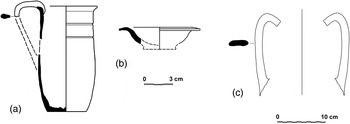
7. C8910 (10A/2:12). Fig. 3b . Votive flaring rim bowl. Profile rim to lower body. Diameter at rim c.8.7 cm; maximum preserved height 1.8 cm. This form copies full-sized bowls of the Hellenistic period but the stratigraphy of the main dump indicates that the type belongs to the first half of the first century ad (Shaw and Shaw Reference Shaw and Shaw2000, 289 nos. 815–16 [34A/6], 824 [34A/2], 290 no. 835 [34A/1]). The absence of the type from purely Hellenistic levels serves to emphasise its Early Roman date. Once again we may dismiss any notion that it served as part of the wall packing. The patterns of the main dump, where the bowls are associated with transport amphorae possessing stacked moulded rims (as here below, 8 and 9), support a general contemporaneity and a Claudian date for this example. P. Warren (pers. comm.) informs me that a flaring rim bowl was found during the Stratigraphical Museum Excavations in a Neronian context, and another two examples from the Unexplored Mansion are Claudian (Sackett Reference Sackett1992, pl. 145:45–6). Together these indicate that full-sized versions of the shape were still being produced at the same date as our deposit.
-
8. Shaw and Shaw Reference Shaw and Shaw2000, 319 no. 44 (C141). Transport amphora, rim to shoulder. The rim with twin stacked mouldings conforms to the ‘Matala’ type. Note the handles with their gentle curve, unlike the Neronian angular profile of one published by Hayes (Reference Hayes1971, pl. 39:52). Neronian, too, is an amphoroid jug from Warren's excavations with similar sharply angled handle. Our amphora conforms to the most common type in the upper levels of the main dump (pails 1 and 2), where the rims are associated with button bases and curved handles (Fig.3c here). As here, a Claudian date is indicated.
-
9. Shaw and Shaw Reference Shaw and Shaw2000, 319 no. 45 (C455). Transport amphora. As 8 above.
-
10. C8904 (10A/2:14). Fig. 3a . Cylindrical cup. Profile restored. Diameter at rim 8.7 cm; at base 4.2 cm; restored height 11.2 cm. Fifteen fragments allowing restoration of profile. Gritty fine ware 7.5YR 5/4. Unpainted. Based on a Hellenistic shape, this vase in no way resembles the examples from that period. It is far more slender and possesses two horizontal incisions on the upper body wall. At Knossos the type survives in the Early Roman period (Sackett Reference Sackett1992, pl.131:58; Hayes Reference Hayes1971, 267, fig. 16:33, a vase which is potentially Claudian or Neronian). The survival of the shape into the first century ad is almost certainly to be ascribed to the existence of a comparable type in Eastern Sigillata B (Enciclopedia dell'arte antica 1985 , pl. XIII.11 and 61), to be dated to the first century ad. A similar shape is to be found in Italian thin-walled ware. Note especially the horizontal incision on the body (Enciclopedia dell'arte antica 1985, pl. LXXXIX.10–11). In Çandarli ware the type continues to c. ad 25 (Enciclopedia dell'arte antica 1985, pl. XVI.13 and 74). Somewhat similar shapes, but with a slightly convex body wall, can be found in Italian sigillata (Enciclopedia dell'arte antica 1985, pls. LXVIII–LXIX), again belonging to the early Imperial period.
-
11. C8905. Cylindrical cup. Diameter at base 4.8 cm; maximum preserved height 4.2 cm. Eight non-joining fragments of an unpainted vase. Of the same type as 10 above.
-
12. Not catalogued. Cylindrical cup. One small vitrified fragment, perhaps indicating kiln activity nearby.
-
13. C8911 (10A/2:8). Cup with everted rim.. Diameter at rim 9 cm; maximum preserved height 1.9 cm. The channel under the rim and the general proportions find ready parallels among the vessels of this type in the main temple dump during the Hellenistic period (Shaw and Shaw Reference Shaw and Shaw2000, 283 no. 715, 285 no. 757, 282 nos. 702–3, and 279 no. 661). All these belong to the first century bc. A survival of the type into the first century ad is more problematic than for the cylindrical cups noted above and has found no support from Knossos up to the present. However we might note that a bronze version of the shape occurs in the main temple dump, where it is associated with Early Imperial amphora types (Shaw and Shaw Reference Shaw and Shaw2000, 397, pls. 5:55 and 5:52). The developmental stage of our cup proves it to be too late to be part of the wall packing.
-
14. C8908 (10A/2:13). Cup with everted rim. Unpainted fine ware 5YR 6/6. As 13 above. The fact that two examples of this shape were found in the wall fall increases the likelihood that both really do belong in the Claudian period.
-
15. Shaw and Shaw Reference Shaw and Shaw2000, 323 no. 19 (C478). Ivy-leaf lamp, dated by Hayes to mid-first century ad.
Thus we have in this deposit a well-stratified group, isolated and closed by a cordon sanitaire both above and below. Moreover, it is comparatively well dated to the later Tiberian and later Claudian periods. The stratigraphy of the main temple dump to which we now turn supports such a dating and delivers us a precision in control which is unimagined in the published Kommos volume.
Kommos: pottery of the second ‘squatter’ occupation of Building B.

IV. THE SOUTH DUMP: DEPOSIT 48 (SHAW AND SHAW Reference Shaw and Shaw2000, 278–91)
The drawbacks of placing too much reliance on the ‘stratigraphy’ of this locus were emphasised in Shaw and Shaw Reference Shaw and Shaw2000, 278. It was excavated in horizontal spits which cannot truly reflect the actual depositional history of the dump. It is true, however, that those shapes found lower down usually pre-date those higher up. There must have been a ‘roll down’ effect, but it is usually possible to isolate the intruders.
The dump differs considerably from that to the north. In particular, we might isolate the massive deposition of transport amphorae, whose stratigraphic position in the dump in general mirrors the situation in Building B: echinoid rims below, and rims with stacked moulding above. The few exceptions to this rule can be explained by assuming that a small number of the latter type rolled down the mound as they were thrown on the top.
The beginning of amphora deposition cannot be ascertained with certainty since the earliest examples co-exist with the detritus of the main Hellenistic period of use. Conversely, hundreds of the tulip cups from that phase proved to be heavily eroded by wind-blown sand, suggesting a hiatus of some little time before the first amphorae were deposited. This would support my contention that the echinoid wine jars in the first squatter occupation in Building B belong to the first quarter of the first century ad. Further, we might surmise that some attempt was made early on to keep the courtyard close to the temple free of sand build-up, whereas on the north dump, slightly further removed from the centre of ritual activity, there was no erosion of the pots on the mound, suggesting that it was quickly covered by drifting sand dunes.
On the main dump, the echinoid-rimmed amphorae were associated with the small saucers with hairpin handle, confirming that the small dump between Buildings B and D belongs to the first phase of squatter occupation. Higher up, the amphorae with stacked mouldings are juxtaposed to votive miniature flaring-rimmed bowls (Shaw and Shaw Reference Shaw and Shaw2000, 289–90 nos. 815–6, 824, 835), amplifying the situation noted in Building B during the second squatter period. At Knossos a similar survival of flaring-rimmed bowls is apparent for the reign of Claudius (Sackett Reference Sackett1992, pl. 145:45–6), validating my dating both for the Building B example and now for the topmost material on the main dump.
The end of amphora deposition in Deposit 48 can be estimated also. In pail 1 (i.e. at the very top of the mound), eight mould-made lamps have been catalogued (C2650–7). These are all described as belonging to the period ad 50–100 (Shaw and Shaw Reference Shaw and Shaw2000, 313) and are quite rightly said to be associated with the Matala-type amphorae (i.e. those with stacked mouldings at the rim). If, however, the amphora type is to be dated to the reigns of Claudius and Nero using the evidence from Building B, the juxtaposition is illusory: the lamps belong to the subsequent period when wine jars were no longer in evidence throughout the sanctuary in such overwhelming numbers. In other words, the lamps date the end of massive deposition on the temple dump and the beginning of the final phases of the temple's life.
The amphora period does have a complement of votive material indicating that some attenuated form of worship was still being carried on, but, in the absence of other pottery from the first two-thirds of the first century ad (Shaw and Shaw Reference Shaw and Shaw2000, 313), another explanation must be sought. Kommos beach is a locus classicus for amphora workshops in Roman Crete. The combination of abundant water, fuel and clay sources, together with a comparatively sheltered harbour, suggests that a confraternity of potters made use of the area. The presence of wasters probably confirms this hypothesis. Such activities within a sacred precinct find a ready parallel in the Cave of the Nymphs at Kafizin in Cyprus (Mitford Reference Mitford1980), whose importance for the functional identification of many of our sanctuary shapes has been repeatedly noted in Shaw and Shaw Reference Shaw and Shaw2000. Such associations or syntechniai are commonplace during the Roman period, and it is clear that they ‘had a significant social and religious significance for the associated craftsmen’ (Poblome Reference Poblome, Briese and Vaag2005, 29–33). Kommos has once again provided information to elucidate the religious platform of these organisations, which could only be guessed at hitherto on the basis of the epigraphic evidence alone, given that none of the other manufacturing sites in Crete has been excavated.
As for the end of our putative potters' tenure, there is ample epigraphic evidence from central Crete indicating Nero's involvement in territorial arbitration in this area. We might especially note Guarducci Reference Guarducci1935, 288–9 no. 2, where the proconsul L. Turpilius Dexter restored public lands to the Gortynians in ad 60, lands which had been occupied by private individuals. From Rhytion, also within the territory of Gortys, an original Neronian decree demarcated the land borders of a sanctuary of Zeus Skyllios (Guarducci Reference Guarducci1935, 304–5 no. 1). The fact that the measures had to be repeatedly validated by successive emperors gives some idea of the war of attrition, suffered by both public and sanctuary possessions, which was a constant feature of land ownership in the Roman period. That sanctuaries themselves were not immune to aggrandisement at public expense is proven by Guarducci Reference Guarducci1935, 80 no. 49. Here the sanctuary of Asklepios at Knossos was the transgressor. Under Nero a parcel of five iugera, which had been usurped by the shrine, was returned to public ownership, even though the usurpation had been condoned by both Augustus and Claudius.
The stratigraphy at Kommos would support a Neronian date for the alleged eviction of the potters and a return to state ownership, a transition which is amply mirrored in the archaeological record. They may have moved to Matala, where the latest Kommotian type treated here was found in some abundance with evidence of kiln activity (Shaw and Shaw Reference Shaw and Shaw2000, 318–19).
Thus the archaeology of the sanctuary at Kommos augments this epigraphical evidence. It delivers us material patterns for the effect of the Neronian measures in Gortynian territory. The Rhytion stele invokes a similar interest in protecting the territorial interests of a shrine. If two areas connected with the capital were affected by Imperial interventions to codify the interests of the city, it is inherently unlikely that a glaring usurpation of the potters would have escaped the attentions of the Roman authorities.
V. TEMPLE C
For most of its existence the cella of the temple was kept scrupulously clean. Soundings behind the benches provide almost the only evidence we have of modifications of the space to suit the needs of a changing congregation. Nevertheless there is some slight evidence to elucidate the furnishings of the naos even in its earliest form.
In its first phase of existence, c.350 bc, the temple was provided with a slab floor covering the whole area except for a strip about 50–60 cm wide along the southern side (Shaw and Shaw Reference Shaw and Shaw2000, 50). It was surmised that some feature, possibly a wooden bench, occupied this space. Indeed, if great things might be compared to small, the unpaved section could be seen to correspond to the undecorated borders of dining rooms provided with a patterned mosaic floor during the Classical and Hellenistic periods.
Fortunately, there is a small piece of evidence enabling us to reconstruct a feature built of perishable materials whose continued survival is little short of miraculous. In the East Room of Building B a small bronze disc was discovered on the primary floor (Shaw and Shaw Reference Shaw and Shaw2000, pl. 5.48:18). Its decoration consisted of a series of concentric rings in repoussé surrounding a central boss. It was provided with a short flange at its outer edge. At some point in its history a nail hole pierced the surface close to its outer edge (Shaw and Shaw Reference Shaw and Shaw2000, 393 no. 18, pl. 5.48:18). This has been interpreted as a miniature shield, phiale or cymbal (Shaw and Shaw Reference Shaw and Shaw2000, 393). We might immediately rule out the first option. Shields did not possess a flange at their outer edge. The second alternative is also erroneous: there is no depth to the ‘bowl’ and the omphalos is on the wrong side. Finally, cymbals were possessed of handles and needed a broad sounding-surface in order to make the necessary notes. A fourth possibility is more attractive: that these discs decorated furniture.
Coldstream identifies similar discs from the Demeter sanctuary at Knossos as cymbals (Coldstream Reference Coldstream1973, 143 ff.), but this is certainly erroneous, although, if my conclusion is correct, the sheer number of examples implies a large group of furnishings or, possibly, a frequent replacement of damaged items.
Klinai and thrones both possessed terminals of circular form on the legs and, in the case of the latter, on the arm rests. These bosses are amply illustrated in the iconographic record and will be treated by me in a forthcoming article on Greek furniture. Suffice to say at this point that the Knossian examples are of the fifth-century style, on the whole, implying that they decorated furniture contemporary with the construction of the Temple of Demeter. Our Kommotian example, however, seems to conform to the fourth- or early third-century type, with its concentric ridges and small central boss implying that it too is contemporary with the construction of Temple C. Examples at both sites have a very short flange which fitted over the lathe-turned wooden bosses. Later, the flange becomes even longer, until by the Roman period they could just as easily be described as sleeves. The short flange, of course, has its drawbacks. Whatever method of adhesion was applied (and the evidence in the absence of nail holes suggests a glue of some sort), the minuscule surface involved probably meant that the attachment would have been somewhat defective and liable to damage. This may explain why Hellenistic and Roman flanges are so much deeper. Our example seems to have had a history of repair when a nail was driven through it as a rough and ready attempt to reattach it to the wooden frame of the furniture. The Knossian examples seem not to have undergone a comparable history of repair, though the existence of fourth-century examples (Coldstream Reference Coldstream1973, 144, fig. 33:108,111,113) possibly indicates that damaged items had been replaced in the later Classical period. The sheer number of examples implies a well-furnished sanctuary.
The question remains, are we dealing with thrones or couches? Both could be provided with bosses of this type. The existence of thrones is attractive, for there is space for ten along the south wall of the cella. Since Cretan cities possessed ten Kosmoi, a communal gathering of the whole college of magistrates is attractive. Here we reach an impasse, however. A platform was erected south of the statue base some time in the Hellenistic period. It respected the existence of the feature along the south side of the cella, and would have effectively blocked access to one of the hypothetical thrones. No such difficulty arises if we are in fact dealing with couches, though there is only space for five along the south side. I do not believe in a corresponding number opposite in the later Classical period since the slab floor continues all the way to the wall here.
The reasons for this long digression are twofold: the first is to correctly identify the function and date of the disc; the second to examine its context. This has already been discussed at length in section IIIC of this paper. There it was surmised that the East Room of Building B, where it was found on the floor, had been so badly damaged by the events of c.30 bc that it became a dump for discarded objects whose continued use after the earthquake had been rejected. There is some stratigraphic evidence that this happened soon after the catastrophe, since the pottery in question as well as the disc lay below a deep build-up of sand which could have been blown in only a short time after the building had been damaged. At both Knossos and Pitsidhia there are modern examples of partial reuse of earthquake-affected structures. In both villages the derelict sections of the houses have become convenient dumping grounds for rubbish and building materials.
For similar reasons we might reject the notion that a kline had been stored in the East Room prior to the earthquake. The couch should date to the fourth century bc, the building to the Middle Hellenistic period at the earliest. In addition, the East Room had been used to store an unknown, but not inconsiderable, number of outsized chytrai. It is difficult to envisage the temple personnel manoeuvring something as large as a couch into and out of the space, and far easier to envisage someone throwing a broken leg into the room as part of a general clean-up of the sanctuary.
If my reconstruction of events is accepted, we might assume that the internal fittings of the temple had suffered some damage during the earthquake. Certainly the temple discards on the main dump point in that direction. All this indicates a likely date of c.30/25 bc for the construction of the first stone benches inside the cella. Soundings behind these produced no clear evidence of date, so we are left with the necessity of reconstructing the chronology of these features virtually in vacuo, although the use of broken tiles as bench packing suggests a period post-dating the partial destruction of the sanctuary c.30 bc. The most that we can surmise is that they were built before the Trajanic period, the date of the second bench phase. But the stratified position of the disc suggests that they should date to the amphora phase of the main temple dump.
In a wide-ranging seminal paper on pottery collegia or syntechniai, J. Poblome (Reference Poblome, Briese and Vaag2005, 29 ff.) points to the widespread existence of these associations mainly in Hellenistic and Imperial Asia Minor ‘providing a religious platform for its members’ (Poblome Reference Poblome, Briese and Vaag2005, 29). In addition, their patrons provided the funds for the building and upkeep of the ‘club house’ and for holding banquets or feasts. These associations tended to be under the patronage of local notables, a system which would provide the mechanism for such a group to insinuate itself into the badly dilapidated temenos at Kommos. Certainly some sort of permission must have been granted by a powerful patron.
At Kafizin on Cyprus (Mitford Reference Mitford1980, passim) we have the best parallel for this type of organisation. Dated to the later second century bc, we have evidence for a college of potters meeting in a cave sanctuary sacred to the nymphs. The pottery suggests communal dining from tableware whose inscriptions (sometimes in Cypro-Syllabic script) inform us of the names of the vessels, their function and the fact that they were dedicated to the tutelary goddesses. The analogy with Kommos is overpowering, with one glaring exception: there is no domestic pottery during the amphora period in our sanctuary anywhere but in Building B. Obviously either feasting did not take place or the evidence remains invisible to us.
The new benches in the temple provided room for at least ten people reclining. The probably contemporary benches in the courtyard would have accommodated even more. If the worshippers sat upright this number is augmented even further, giving us a minimum count for our putative college. Their activities are less clear, however. Given that there is no evidence for feasting, the proceedings within the cella must have been purely religious – a fact indicated by the presence of the votive saucers and bowls which characterise this period.
The next phase is loosely dated to the Flavian/Antonine period and indicates a renewed use of the temple for religious feasts. It is possible that the potters had been evicted (for the epigraphic evidence concerning land reforms during the reign of Nero, see Bowsky Reference Bowsky2012, 327–8) – certainly deposition of amphorae on the main temple dump ceases in the reign of Nero.
It is not my intention here to examine every modification to the plan of the cella in the succeeding periods. Suffice it to say that every construction should date to before the reign of Antoninus Pius at a time when the slab floor was clear of build-up. Various enclosures remain as opaque in terms of function as their exact date is problematic. Rather, I will concentrate on the major reconfigurations of the interior of the temple in this period in an attempt to elucidate the activities which took place there.
It is clear that the ‘domestic’ pottery consumption in the temple began again in earnest c. ad 60. In the naos the benches along the north and south walls were widened. In the bench fill were two conical votive bowls (Shaw and Shaw Reference Shaw and Shaw2000, pl. 4.25:565 and 566). In the final publication I erroneously identified these as degenerate descendants of Hellenistic flaring-rimmed bowls, but the truth is rather more interesting. They are Roman and find ready parallels on the topmost levels of the main dump (Shaw and Shaw Reference Shaw and Shaw2000, 289–90 nos. 825–6, 832), whose broad context is the later first century ad. Conical bowls are not rare in the repertoire of Roman pottery but most are too early to be germane here. Two possible candidates as the putative models can be examined at this point: the first are Eastern Sigillata A bowls (Enciclopedia dell'arte antica 1985, pl. XV:4,7–8, forms 72, 74B and 75); the second conical bowls (Enciclopedia dell'arte antica 1985, pl. VII:10–11, forms 57 and 58). The first date to the Flavian/Trajanic period and would prove a continuity of cult, but they are rare in the eastern Mediterranean. The second are very common in the first half of the second century ad and are encountered everywhere. They also more nearly resemble the Kommos derivatives. I am inclined to favour the second alternative, though this would mean that there are no observable architectural modifications in the naos, mirroring the resumption of use of ‘feasting’ pottery during the reign of Nero. At all events, the widening of the benches gives, for the first time, evidence that they were used for reclining, probably by two people abreast, since they are far too wide for comfortable seating. That they were indeed widened at this time is proven by the nature of the fill, which consists basically of amphora body-sherds implying the pre-existence of the amphora dump (personal observation). Even if we allow an overlap between the bowls found in the bench fill and the ‘late first century ad’ lamps on top of the bench, we are left with an almost unimaginable chronological control for the widening of the bench at c. ad 100. In view of this we might remember the stele from Rhytion where Trajan revalidated the territorial possessions of the shrine of Zeus Skyllios, indicating an interest in Cretan sanctuaries. Somewhat later, but still while the slab floor was clear of debris, the benches were widened further. During this phase the usual method of bench construction was not used. Instead, at least 11 supports were arranged in front of the benches. These were rather rough and ready, being composed of stacks of stones and reused temple furnishings. They would have been surmounted by wooden boards giving a width of 1.6–1.8 m. This converted the naos into an approximate facsimile of a Roman triclinium, where diners reclined across the couch rather than along it in the Greek fashion. A continuous series of household crockery and post-Pompeiian glass belongs to this period. The small votive conical bowls indicate that there was a continuation of worship, though communal feasting on the scale of the Hellenistic period is not in evidence.
At some time during or after the reign of Antonius Pius the western column of the naos collapsed, obviously bringing the roof down, at least in the rear half of the temple. The tiles were left where they had fallen and there was a rapid build-up of detritus above the slab floor, indicating a continuous use of the space for dining. The bone eye of one of the cult statues in this level (Shaw and Shaw Reference Shaw and Shaw2000, 197–9) probably indicates that they had been destroyed or at least badly damaged in the roof fall.
There is no substantial evidence for continuity of cultic activities at this time except, perhaps, for the votive conical bowls and the series of lamps dating to the second century ad, though most of the latter seem earlier (Shaw and Shaw Reference Shaw and Shaw2000, 320–9).
Thus, under reduced circumstances, ritual continued at Kommos long after the disaster in c.30 bc, which had brought such ruin to the site. A combination of geopolitical and practical circumstances meant that this period was a pale reflection of its Hellenistic predecessor. It is tempting, though, to empathise with this sadly depleted band of devotees as they continued to worship at a site consecrated for over a millennium on the shores of the Libyan sea.
VI. THE AMPHORAE
It may seem otiose to reintroduce the Kommos transport amphorae at this point, but our site has produced the first stratified sequence of a common type. Its description and analysis have relied until now on surface finds. Both archaeological and epigraphic evidence, however, provide a firm basis for taxonomic control, not only for Kommos but for Crete as a whole.
When Marangou-Lerat published her examination of the evidence for Cretan amphora production during the Hellenistic and Roman periods, Kommos was still in a pre-publication stage. Strangely, the Unexplored Mansion evidence was ignored. Possibly this was because the volumes appeared after the submission of her manuscript, or possibly because the stratified transport jars there are of little help. There were, however, sporadic finds from Knossos, mainly from uncontrolled contexts. These will be treated in detail here. My re-examinations of the evidence will only concentrate on the material from the Augustan and Julio-Claudian periods, since that is precisely the time when modifications to Marangou-Lerat's schema are necessary. I will apply new appellations to the type, since their histories are discrete and synchronous. However, I will append the Marangou-Lerat identifications for ease of identification and comparison, even though I regard her groups as heterogeneous.
i) Gortys I
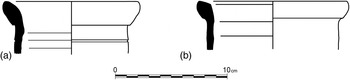
Papadopoulos Reference Papadopoulos, Allegro, Ricciardi, Garraffo and Papadopoulos1999, 236 no. 244, figs. 197–8. Found in a context c.30 bc, this is our earliest datable example of the type (Marangou-Lerat Reference Marangou-Lerat1996, 67 Amphore crétoise 7 and 82–4 Amphore crétoise 3 for later examples). The body is rather globular, the handles gracefully curved and the tall neck set off by a squared broad collar. Another example from Gortys (Rendini Reference Rendini and Di Vita1988, 266, nos. 270–2) is quite similar, though the everted lip is somewhat narrower. The proffered date of the end of the fourth century bc to the beginning of the third seems impossibly high, and in fact the closest parallel is from the Unexplored Mansion Deposit H33 (Sackett Reference Sackett1992, 9), which I now date to the end of the third quarter of the first century bc (see here Fig. 4b ). Also from Knossos are Callaghan et al. Reference Callaghan, Catling, Catling, Smyth, Spawforth and Wall1981, 93, fig. 6:308–9, from an uncontrolled level which arguably post-dates 25 bc. The latter has a rounded rim almost identical to another amphora whose sharply angled handles should date to the reign of Nero (Marangou-Lerat Reference Marangou-Lerat1996, pl. XVII fig. 67:A117). Also Neronian is a jar from Knossos (Banou Reference Banou, Di Vita, Livadiotti and Simiakaki2000, 886, pl. 1:2), once again provided with angled handles, a button base and a slightly convex rim. Similar is an example from Loutro (Marangou-Lerat Reference Marangou-Lerat1996, pl. XVII:A117). At Kommos the amphorae from the main temple dump all have curved handles. They date to the Julio-Claudian period, up until the reign of Nero (see above) and provide a control for the progression of handle types anchored by both the archaeological context and substantial epigraphic evidence. The Kommotian examples all seem also to have been provided with a button base, suggesting that this epi-Hellenistic feature survived until c. ad 60. Another example, from Pompeii (Marangou-Lerat Reference Marangou-Lerat1996, pl. XVIII fig. 68b), takes the history of this type even further. This vase possesses a nippled base, a first for the form. Hayes Reference Hayes1983, 142, fig. 20:A18–19 probably indicates an independent survival of the form into the second century ad.
Knossos: amphora rims from above a Late Hellenistic house.

ii) Kommos I
In part Amphore crétoise 3; in part Amphore crétoise 7. This form has a long history in Crete and, for the first time here, we are able to follow its development using the archaeological evidence from Kommos and Knossos. The naissance of the type lies in the period 50–25 bc, the context of a progenitor at Knossos:
-
1. Unexplored Mansion, Deposit H33 (Sackett Reference Sackett1992). Amphora with echinoid rim. Fig. 4a . I now date this deposit to the third quarter of the first century bc on the basis of the bevelled feet on the cylindrical cups. This feature was only just present at Kommos after 30 bc and occurs on one example from Gortys of the same date.
A similar stage of development may be observed on an amphora from the kiln site on the slope of Monastiriako Kefala (Hood and Smyth Reference Hood and Smyth1981, 178) illustrated in Coldstream, Eiring and Forster Reference Coldstream, Eiring and Forster2001, fig. 3:19:C), where it is said to adhere to Marangou-Lerat's ‘Hellenistic’ type Amphore crétoise 7. I do not see the resemblance and, moreover, would now date the fragments from Keratokambos West in Marangou-Lerat's volume to the Neronian period due to the presence of sharply angled handles. At all events, the Unexplored Mansion vase, Deposit H 33 no. 1, proves that the canonical Kommos type post-dates c.25 bc.
At Kommos, the echinoid-rimmed amphora probably belongs to the period when the main dump of the sanctuary witnessed a massive deposition of transport jars during the tenure of the Syntechnitai (Shaw and Shaw Reference Shaw and Shaw2000, pl. 37:812 and 819). It was also present in Building B in a Tiberian context (Fig. 2a–b and section IIIA above). In general, on the main dump it was stratified below amphorae of Kommos type III, indicating a progression from one form to another. The inception date of the type is more difficult to determine; perhaps a broad date bracket of c.25 bc – ad 25 is called for. The apparent demise of the type at Kommos may be a chimaera, since evidence from elsewhere in Crete proves that it survived until at least the reign of Nero. An example of the type was found in a rescue excavation at Knossos and published in Callaghan et al. Reference Callaghan, Catling, Catling, Smyth, Spawforth and Wall1981, 93, fig. 6:310. Unfortunately, it is not from a controlled level and must only be assigned to a date after c.25 bc. The closest comparandum is Marangou-Lerat (Reference Marangou-Lerat1996, pl. XVII fig. 67:A116), where she assigns it to her Amphore crétoise 3 category. We might note, however, the sharply angled handles, a feature suggesting a late date: Augustan to second century ad.
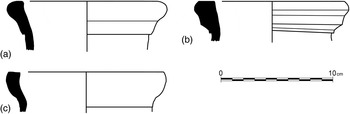
Kommos: Kommos II amphora rims.

Among the surprisingly varied amphorae from Augustan levels above the Unexplored Mansion at Knossos is one example of the Kommos I type (Sackett Reference Sackett1992, pl. 135:103). Its date might be in the period 25–1 bc, though the excavator allows the possibility that the pottery might cover the whole of the reign of Augustus. The survival of the button base is indicated (Sackett Reference Sackett1992, 106–7), a situation in agreement with Kommotian stratigraphy, as is the possibility of a genesis for this group dating soon after the catastrophe of c.30 bc.
Before we proceed to a discussion of other Kommos I jars we might pause to examine an apparent flaw in my argument. The present orthodox view is that the Amphore crétoise 3 series originated during the reign of Augustus and its earliest manifestation is represented by an amphora from Well KW/51/13 at Knossos (Hayes Reference Hayes1971, pl. 39b52). This jar has sharply angled handles, a feature which would negate the Kommos evidence for a Neronian introduction of this treatment. The retrieved pottery from this well, however, included groups from the reign of Augustus and others which dated to approximately that of Claudius. None of the sherds was stored by level, however, and I would suggest that the date of the amphora in question should be emended to c. ad 60. In support of this contention I should mention two jars from Warren's Stratigraphic Extension excavation: not only do these share the same rim profile, but one of them also has the same sharply angled handle. They both come from a floor level which has been independently dated to the reign of Nero.
With this difficulty removed, we can now redate several other fragments from Crete. The first group was retrieved from a production site at Keratokambos West (Marangou-Lerat Reference Marangou-Lerat1996, pl. I figs. 24–5). Two types of rim were present. The first descends from amphorae of Gortys type I; the second belongs in the group characteristic of Kommos I. These were dated to the Late Hellenistic period and baptised as amphorae type Amphore crétoise 7; the button bases were thought to be a diagnostic feature of that era. We might note, though, the sharply angled handles collected on the survey of the site. I need no longer emphasise that these indicate a far later date than that suggested.
At an underwater site at Loutro (Marangou-Lerat Reference Marangou-Lerat1996, pl. XVII fig. 67:A114–A117), we again find a sub-Gortynian type juxtaposed to an example possessing an echinoid rim. These are described as Amphore crétoise 3 jars. Their sharply angled handles should indicate a date in the period ad 60–100.
Finally, we might note two examples which at first sight appear to belong later than the chronological limits which I have set myself. They come from a Hadrianic deposit above the Unexplored Mansion at Knossos (Sackett Reference Sackett1992, pl. 181:74–5). Both look far earlier, and in this regard we might note the detailed examination of amphorae in reuse by J. Th. Peña, who describes the final deposition of this shape at an astonishingly long period after their manufacture (Peña Reference Peña2007, especially chapters 5 and 6). I would place our examples in Nero's reign.
iii) Kommos II
Fig. 5a–c . This form possesses a rim with a ‘cyma reversa’ moulding. At Kommos it occurs in the upper dump 4. It dates post-c.30 bc. None was found in the uppermost pails, however, suggesting that the type had a short existence. One fragment was excavated in the sand near Altar C and so is virtually without context. The type was not represented in either of the squatter occupations of Building B, nor was it found in Temple C. I have not been able to confirm its existence at other sites in Crete, but the foreign fabric of 2 (below) suggests that this was not a purely local development.
It would be easy to view the type as a transitional stage between Kommos I and Kommos III, with its stacked moulding, were it not for the fact that the former has a long history taking us forward to at least the reign of Nero. In other words, no replacement took place and we should probably regard our catalogued entries as an independent byform whose history cannot be reconstructed from the known archaeology of Crete.
-
1. C8923 (34A/1:4). Fig. 5a . Diameter at rim 14.5 cm, maximum preserved height 4.5 cm. Amphora fabric 2.5YR 6/6. The rim consists of a ‘cyma reversa’ moulding slightly offset from the neck below. There is a slight hollowing behind, suggesting a date coeval with the amphorae of Kommos I described above.
-
2. C8924 (34A/1:8). Fig. 5b . Diameter at rim c.14 cm, maximum preserved height 3.5 cm. The fabric is pink 5YR 6/6. Rim moulding as 1 above but with a more emphatic hollowing behind. A foreign type, possibly Knossian, certainly not Gortynian.
-
3. C8925 (10A1/1:20). Fig. 5c . Diameter at rim c.14 cm, maximum preserved height 3.5 cm. Gritty amphora fabric 5YR 6/6. Found in the sand build-up of courtyard. This vase indicates an elaboration of the rim moulding, making it more analogous to the amphorae of type III.
As to date, the most likely chronology, based on the occurrence of the type on the main temple dump, would confirm a date bracket of c.25 bc to c. ad 25. At the moment these three sherds exist in magnificent isolation, though not all were from the same production centre. It is to be hoped that future excavations on Crete will throw more light on its shadowy existence.
iv) Kommos III
With this type, characterised by stacked mouldings at the rim, we are again on firm chronological ground. Multiple examples were found in the uppermost pails of the main temple dump, where it was described as the normal type in that context (Shaw and Shaw Reference Shaw and Shaw2000, pls. 4.35:830 and 4.37:790). A date before the later first century ad is indicated, and the occurrence of the type in the second squatter occupation of Building B, along with other pottery dating to the reign of Claudius, merely reinforces the evidence of the dump stratigraphy. The first squatter occupation of that structure contained amphorae of Kommos type I and dates, probably, from c.25 bc to c. ad 25. If the classification types are sequential, a date for Kommos III jars of c. ad 25 to the early reign of Nero is indicated. We might note at this point that the handles of one example from Building B describe a graceful curve (Shaw and Shaw Reference Shaw and Shaw2000, pl. 4.67:44), implying a date earlier than later Neronian developments.
CONCLUSIONS
Suffice it to say that the amphora period dates probably from after 30 bc to c. ad 60, ending long before the final destruction of the sanctuary. If we were not to postulate an occupation by potters, it is difficult to propose any other scenario, even though my thesis rests mainly on the presence of wasters on the main temple dump. This, combined with a dearth of associated table wares, rules out any move to identify the amphorae as part of a sympotic assemblage. The unexcavated area to the south of the site seems to suggest a terrace of some sort – the answer to our conundrum probably lies there. If the nature of the amphora period is still unclear, what is certain is that it dates from the later first century bc until some time in the reign of Nero: a mere interlude in the long history of the site, and one whose patterns of deposition clearly mark it off from what preceded and what followed.
Marangou-Lerat repeatedly laments the lack of closed and datable excavated deposits in her study of Cretan transport amphorae of the Hellenistic and Roman periods. Kommos provides, for the first time, a sound archaeological sequence for local types. The wide variety of forms from above the Unexplored Mansion at Knossos, many mimetic of foreign models, does little to help the classification of Cretan types. Conversely, Kommos provides a sound progression from c.30 bc to the reign of Nero. This has led to a revolutionary reappraisal of the dates suggested in her seminal work. It is to be hoped that future excavations on Crete will add to our corpus of controlled contexts and allow further emendations to take place.
ACKNOWLEDGEMENTS
First and foremost I wish to thank Joseph and Maria Shaw, who encouraged me to study the Roman pottery from Kommos as part of the ‘throw out’ policy at that site. Both have been firm friends and colleagues throughout my time at Pitsidhia. Caroline Jeffra typed up the main draft of this article; Doniert Evely did the tracings of the pottery examined here and further editing. The Knossian pottery included in this paper was made available by permission of the British School at Athens and the unrivalled facilities of the Taverna at Knossos provided me with the resources to complete my studies there.