Introduction
Close family members are commonly involved in medical decision making for a decisionally incapacitated relative confronted with a serious illness. In a recent study (Torke et al., Reference Torke2014), 68% of hospitalized adults aged 65 years and older faced at least one major decision in the first 48 h of hospitalization. Surrogate decision makers were involved in these decisions for nearly half of the patients. All decisions were made by a surrogate in 23% of cases. Surrogate decision making was even more common in the ICU, where half of patients relied solely on a surrogate. Yet, the widespread practice of relying on surrogates for medical decision making has been called into question by studies showing that surrogates’ predictions of treatment preferences often disagree with their loved ones’ preferences in the context of hypothetical scenarios. Combining the results of studies published up to 2005, Shalowitz et al. (Reference Shalowitz, Garrett-Mayer and Wendler2006) estimated at 68% the overall accuracy of surrogates in predicting patients’ preferences for specified life-sustaining interventions. Accuracy was highest for scenarios involving the patient's current health (79%) and lowest for those involving stroke and dementia (both at 58%). Similar conclusions were reached in subsequent studies (Moorman and Carr, Reference Moorman and Carr2008; Zettel-Watson et al., Reference Zettel-Watson, Ditto, Danks and Smucker2008).
In an effort to better understand this phenomenon, investigators have studied patient and surrogate characteristics that may be associated with prediction accuracy. Characteristics investigated included surrogate's relationship to the patient, frequency of contact, sociodemographic characteristics of both parties involved (e.g. gender, age, and education), and prior communication of treatment preferences. Results were not consistent across studies and associations were typically weak (Ditto et al., Reference Ditto2001; Pearlman et al., Reference Pearlman, Starks, Cain and Cole2005; Barrio-Cantalejo et al., Reference Barrio-Cantalejo2009; Kirchhoff et al., Reference Kirchhoff, Hammes, Kehl, Briggs and Brown2010; Bravo et al., Reference Bravo2016a). Other investigators have focused instead on potential causes of inaccuracy. These have included instability of patients’ preferences regarding life-sustaining treatments, and projection bias (Fagerlin et al., Reference Fagerlin, Ditto, Danks, Houts and Smucker2001; Fagerlin and Schneider, Reference Fagerlin and Schneider2004). The latter refers to surrogates’ difficulty in distinguishing their own preferences from those of the patient (Punchno et al., Reference Pruchno, Lemay, Field and Levinsky2005; Moorman and Carr, Reference Moorman and Carr2008). This leads surrogates to make recommendations for care that reflect what they would want for themselves rather than the patient's preferences. Here again, though, the percentage of variation in accuracy explained by this bias was small.
The findings briefly summarized above suggest that additional factors play a role in biasing surrogates’ judgments. We posited that surrogates’ inaccuracy in predicting patients’ preferences for life-sustaining interventions in hypothetical health states may in part be due to discordance in patients’ and surrogates’ judgments of what quality of life would be like in those states. Healthcare preferences formulated in anticipation of incapacity are believed to be partly based on quality-of-life considerations (Schwartz et al., Reference Schwartz2002; Pearlman et al., Reference Pearlman, Starks, Cain and Cole2005; Gifford et al., Reference Gifford, Husain, Dinglas, Colantuoni and Needham2010; Winter and Parks, Reference Winter and Parks2012). We have recently shown that quality-of-life ratings are indeed correlated with older adults’ desire to be treated in several scenarios, involving cognitive decline (Bravo et al., Reference Bravo, Sene, Arcand and Dubois2016b). For instance, controlling for confounders, older adults who rated quality of life as unbearable, should they be suffering from severe dementia, were 2.7 times (95% CI from 1.3 to 5.4) more likely to opt for comfort care only rather than life-prolonging care when compared to older adults who rated quality of life in severe dementia more positively. In the aforementioned study, older adults selected a surrogate whom we asked to predict older adults’ quality-of-life ratings and desire for specific life-sustaining interventions in the same scenarios. These data provide a unique opportunity to test the hypothesis that surrogates’ inaccuracy in predicting preferences can in part be explained by discrepant quality-of-life assessments. This paper reports the results of testing this hypothesis. Discrepancy in quality-of-life appraisal may be amenable to intervention. Uncovering whether it influences prediction accuracy is important, as this could help healthcare professionals better prepare surrogates for the task of making decisions on behalf of their loved ones.
Methods
The data used to test the stated hypothesis come from a randomized trial that was designed to assess the efficacy of an intervention in improving the accuracy of substitute decision making. The trial, which was approved by our institutional Research Ethics Board, has been described in detail elsewhere (Bravo et al., Reference Bravo2012). Briefly, it was conducted among 235 community-dwelling, decisionally competent adults aged 70 years or older. As a condition for entering the trial, participants had to designate a surrogate; defined as the person they would choose to make healthcare decisions for them should they lose the capacity for decision making. As previously reported (Bravo et al., Reference Bravo2016a), the older adults were 77 years old on average (range: 71–91 years) and included similar proportions of men and women (54% and 46%, respectively). Designated surrogates were slightly younger (70 years old on average, ranging from 21 to 85) and predominately women (70%). The surrogate was the spouse of the older adult in two-thirds of cases (67%) and his or her child in 19%. Older adults and surrogates were relatively well-educated, with an average of 13 years of schooling (range: 4–25 years). Prior to study enrollment, 46% of the older adults reported having discussed their healthcare preferences with their surrogate.
The data used for this paper were collected between April 2011 and June 2013 during face-to-face interviews conducted at baseline by specially trained research nurses. Dyad members were interviewed simultaneously in separate rooms of our institution to avoid cross-contamination. After signing the consent form and providing some descriptive information about themselves, older adults rated their quality of life in their current health state and then in the context of three hypothetical states implying progressive cognitive decline: mild to moderate stroke, incurable brain cancer, and severe dementia. These states were chosen to place older adults in situations where a surrogate would increasingly be needed to guide medical decision making. Quality-of-life ratings were made on a 5-point Likert scale ranging from excellent (coded 1) to unbearable (coded 5). Clinical vignettes were then used to elicit older adults’ desire to undergo each of four life-sustaining interventions (intravenous antibiotics, gallbladder surgery for cholecystitis, tube feeding, and cardiopulmonary resuscitation) in their current health state and in the three hypothetical states. Vignettes were drafted from those developed in past research on substitute decision making (Bravo et al., Reference Bravo2012). The proposed interventions are not of direct interest. Rather, they constitute a sample of a wider set of life-sustaining procedures that could have been used to achieve the trial objective. To foster understanding and ensure consistency across interviews, health states and interventions were described briefly by the interviewers using written materials handed out during training. For illustrative purposes, the appendix gives the wording used to describe one of the health states (severe dementia) and one of the proposed treatments (intravenous antibiotics). Desire for treatment was measured on a 4-point Likert scale ranging from definitely not (coded 0) to yes definitely (coded 3). Using identical response scales, surrogates were asked to predict the older adults’ decisions on each of the 16 separate scenarios – four health states (including current state) crossed with four medical interventions – in addition to the quality-of-life ratings made for each of the four states.
Statistical analysis
Analyses aimed at testing whether inaccuracy in surrogates’ prediction of older adults’ desire to be treated was in part explained by discrepancy in quality-of-life ratings between older adults and their surrogates (the predictor of main interest). The predictor was defined by the difference in quality-of-life ratings between the older adult and the surrogate. A negative value implies that the surrogate rated quality of life more poorly than did the older adult. The four dependent variables, one for each proposed intervention (intravenous antibiotics, gallbladder surgery, tube feeding, and cardiopulmonary resuscitation), were defined similarly as the difference between the older adult's desire to undergo the proposed intervention and the surrogate's prediction of the older adult's answer. A negative value implies that the surrogate overestimated desire for treatment. Linear mixed models were fitted with SAS Proc MIXED (SAS Institute Inc., Cary, NC, version 9.4) to account for potentially correlated answers across treatment modalities (McCulloch and Searle, Reference McCulloch and Searle2001; Verbeke and Molenberghs, Reference Verbeke and Molenberghs1997). Estimation was based on restricted maximum likelihood. An unstructured covariance structure was selected based on the AIC and BIC indices (Akaike, Reference Akaike1974; Schwarz, Reference Schwarz1978). Two models were estimated for each health state. The first included only the predictor of main interest, while the second incorporated eight potential confounders suggested by past research. These captured four characteristics of the older adult (age, gender, education, and prior discussion of healthcare preferences with the surrogate) and four of the surrogate (age, gender, education, and whether he or she was the spouse of the older adult). No outliers were found at the subject level following residual analyses. However, of the 940 observations (235 dyads × 4 interventions), 24 were identified as potentially influential. Regression models were re-fitted without these observations. As removing the 24 observations from the database did not affect the conclusions, we report only the results derived from the full sample. All statistical tests were interpreted at the 0.05 significance level.
Results
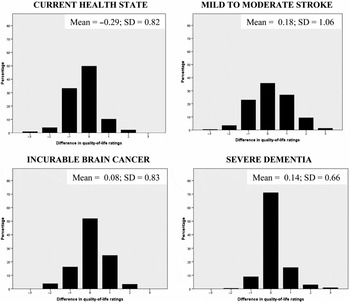
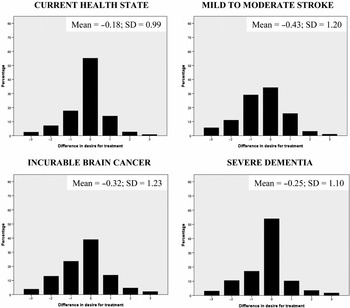
Figure 1 shows the distribution of the differences in quality-of-life ratings between older adults and their surrogates for each of the four health states. Distribution means are close to 0, slightly negative for the current health state (reflecting surrogates’ tendency to rate quality of life more poorly than did older adults), and slightly positive for the three hypothetical states. The dispersion around the mean is smaller for severe dementia, reflecting greater concordance in ratings within dyads for that health state. Figure 2 shows analogous results for the desire to be treated, combining the four proposed interventions. Means are close to 0 (especially for the current health state and severe dementia scenario) and all negative (reflecting surrogates’ tendency to slightly overestimate desire for treatment). Variability is similar across health states.
Discrepancy between an older adult's quality-of-life rating and his or her surrogate's prediction of that rating, for the older adult's current health state and in the context of three hypothetical states implying worsening cognitive functions. Theoretical range from −4 to +4. A negative value implies that the surrogate underestimated the older adult's quality of life.

Discrepancy between an older adult's desire to be treated and his or her surrogate's prediction of that desire, for the older adult's current health state and in the context of three hypothetical states implying worsening cognitive functions. Theoretical range from −3 to +3. A negative value implies that the surrogate overestimated the older adult's desire to be treated.

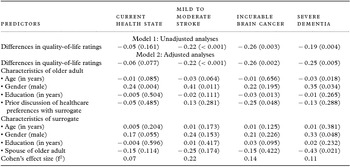
For each of the four health states, Table 1 shows the results of testing whether discrepancy in quality-of-life ratings between the older adult and surrogate is a significant predictor of surrogates’ inaccuracy in predicting older adults’ desire for treatment. Univariate analyses (Model 1) reveal a significant association for all three hypothetical health states but not for the older adult's current state. Regression coefficients are all negative implying that the more the surrogate overestimates quality of life compared to the older adult, the more he or she overestimates the older adult's desire to be treated. Adjusting for potential confounders (Model 2), the effect of discrepant quality-of-life ratings remained significant for the three hypothetical health states, while a borderline result was obtained for the current health state. Effects of covariates are not consistent across health states. Model effect sizes are relatively small.
Linear mixed models linking differences in quality-of-life ratings to surrogates’ inaccuracy in predicting older adults’ desire to be treated, stratified by health state (n = 235)*

*Data shown are regression coefficients with p values in parentheses, except for the last line, which reports Cohen's effect size based on model R2 (Selya et al., Reference Selya, Rose, Dierker, Hedeker and Mermelatein2012).
Discussion
Using data collected for another purpose, we tested whether discrepancy in quality-of-life ratings between an older adult and his or her self-selected surrogate could explain, at least in part, family members’ well-documented difficulty in predicting a relative's desire for treatment in hypothetical scenarios. Results suggest that it does in the three hypothetical health states that we investigated and perhaps also in the older adult's current state, for which the association is of borderline significance. Adjusting for potential confounders had little effect. Confirming prior research, this last finding underscores the limitations of relying on older adult and surrogate characteristics to predict surrogate predictive accuracy.
In our sample, surrogates’ accuracy in predicting older adults’ quality-of-life ratings, which can be computed from Figure 1, ranged from 36% for the stroke scenario to 71% for the hypothetical state of severe dementia. We know of no study in which dual quality-of-life ratings were obtained for a non-clinical elderly population in hypothetical scenarios and hence cannot compare our percentages with those of others. Surrogates’ tendency to underestimate a relative's quality of life has been repeatedly reported in the literature (Sneeuw et al., Reference Sneeuw, Sprangers and Aaronson2002; Banerjee et al., Reference Banerjee2009; Moyle et al., Reference Moyle, Murfield, Griffiths and Venturato2011; Bravo et al., Reference Bravo, Sene and Arcand2017). This phenomenon has been attributed in part to the “disability paradox,” which describes people's ability to adapt to a deterioration of their health condition (Albrecht and Devilieger, Reference Albrecht and Devilieger1999; Evans and Huxley, Reference Evans and Huxley2005; Banerjee et al., Reference Banerjee2009). Quality of life in severe dementia was rated similarly within most dyads, with 96% of differences lying within 1 point on our 5-point response scale. This high level of concordance can in part be explained by the fact that both older adults and surrogates were “older adults,” i.e. members of the same population with respect to age (Bravo et al., Reference Bravo, Sene and Arcand2017).
Surrogates’ accuracy in predicting older adults’ desire for treatment, deducible from Figure 2, is highest for the current health state and severe dementia scenario, at 54% and 55%, respectively. As detailed elsewhere (Bravo et al., Reference Bravo2016a; Bravo et al., Reference Bravo, Sene and Arcand2017), higher levels of agreement for these two health states follow in part from participants’ strong tendency to opt for the proposed interventions in the older adult's current health state, while refusing all interventions in the hypothetical state of severe dementia. Levels of accuracy observed in our sample are somewhat lower than those reported by Shalowitz et al. (Reference Shalowitz, Garrett-Mayer and Wendler2006) (see Table S1, available as supplementary material attached to the electronic version of this paper at www.journals.cambridge.org/jid_IPG). Direct comparisons must be interpreted with caution, however, given differences in sampled populations and in how data were collected, analyzed, and reported across studies.
Figures 1 and 2 suggest that the scenarios that we chose to measure surrogate predictive accuracy provided the variability necessary to study whether discrepant quality-of-life ratings influence surrogates’ difficulty in predicting desire for treatment. While our results confirm this influence, model effect sizes are relatively small (cf. Table 1) even after including covariates that may carry some influence themselves. Clearly, other factors are at play. One factor that we did not investigate is projection bias (Fagerlin et al., Reference Fagerlin, Ditto, Danks, Houts and Smucker2001; Fagerlin and Schneider, Reference Fagerlin and Schneider2004). Researchers investigating surrogates’ accuracy in predicting desire for treatment have often asked surrogates to answer from two perspectives: first as they thought the older adult would answer and second as they would answer themselves should they need the proposed treatment. In our study, we only asked surrogates to answer from the first perspective. Collecting ratings from both would have enabled us to determine the influence of discrepant quality-of-life ratings over and above that of the projection bias. Future studies are warranted to determine whether adding this covariate in our statistical models would increase model effect sizes to a significant degree and modify the associations we found between discrepant quality-of-life ratings and surrogates’ accuracy in predicting older adults’ desire to receive the proposed treatments.
Pending such studies, our results have important implications for healthcare professionals involved in advance care planning (ACP) activities. These generally aim at helping individuals clarify and communicate their preferences for medical care in the event of decisional incapacity (Hickman et al., Reference Hickman, Hammes, Moss and Tolle2005; Sudore and Fried, Reference Sudore and Fried2010). Ideally, such activities are conducted in the presence of a potential surrogate who would then be better informed to make substitute decisions should the need arise. Our results indicate that some time should be devoted during ACP activities to discussing anticipated quality of life under diverse scenarios that could deprive the individual of the capacity to make healthcare decisions for him- or herself. Perhaps a rating exercise modeled on the one we asked of our study participants could help the individual engaging in ACP and his or her potential surrogate realize that their views differ on what makes life worth living. Subsequent discussions would then aim at reducing this gap.
Limitations of this study include a sample of relatively healthy, well-educated older adults in which minorities were not well represented. Future studies could investigate whether, and the extent to which, discrepancy in quality-of-life assessments influences surrogate accuracy among ill populations, less-educated elderly adults, younger adults, or minority ethnic groups. Future studies could also investigate other health states that impair cognitive functioning and other treatment modalities. Last, our findings are based on a cross-sectional design and need to be confirmed through experimental studies. A randomized trial, testing whether discussing views on anticipated quality of life does indeed improve surrogates’ accuracy in predicting desire for treatment, is warranted.
In conclusion, this study showed that discordant views on quality of life in hypothetical health states influence surrogates’ ability to accurately predict an older adult's desire to undergo specific interventions. This finding could guide healthcare professionals in designing more effective interventions, aimed at improving substitute decisions makers’ ability to predict and honor the wishes of individuals who have lost the capacity to make decisions on their own.
Conflict of interest
None.
Description of authors’ roles
G. Bravo formulated the research hypothesis and wrote the paper. She and M. Arcand designed the randomized trial on which this work is based, obtained funding from the Canadian Institutes of Health Research, and supervised its implementation. M. Sene was responsible for carrying out the statistical analyses. M. Arcand and M. Sene both assisted with writing the paper and approved its final version.
Acknowledgments
The study was funded by an unrestricted grant from the Canadian Institutes of Health Research (Grant #200809MCT-190832-RSA). The funding agency approved the trial design, but played no role in data collection, statistical analysis, interpretation, or dissemination of study results. The authors thank two anonymous reviewers for their comments on the first version of this paper.
Supplementary material
To view supplementary material for this article, please visit http://doi.org/10.1017/S1041610217000254
APPENDIX
Imagine that you have severe dementia. You are not aware of what is going on around you, you don't know what period of the year it is and you no longer recognize those around you. You have difficulty understanding people when they speak to you and you can no longer express yourself verbally. You can no longer have a conversation with your loved ones. You can no longer walk by yourself. You are incontinent. You need assistance with all your day-to-day care (dressing, hygiene, and so on). There is no hope that your condition will improve. Because of your condition, you live in an institution. At this stage of the disease, your cooperation with medical interventions and care is very low, because you cannot understand why interventions are being performed or the discomfort related to them (e.g. taking of a blood sample).
Now imagine that you need intravenous antibiotics. Doctors use these drugs to treat serious infections, such as severe pneumonia. Without antibiotic treatment administered into the veins, a serious infection can trigger a series of complications and ultimately cause death. In such cases, a catheter (a small tube) is installed in a vein, most often in the forearm, to administer the antibiotic. Generally, the person must be hospitalized to receive this type of treatment. It causes mild discomfort at the site where the catheter is inserted.
If you had severe dementia and you developed a serious infection, would you want to receive antibiotics intravenously to treat your infection?