The bishop of Rome in the year 476 was Simplicius. When in that same year the military leader Odoacer deposed Romulus Augustulus, the sixteen-year-old puppet emperor of the West who had reigned for a mere ten months, Simplicius had already been bishop for eight years; he held the see for a further seven years thereafter. Simplicius's biography in the text known as the Liber pontificalis, first compiled in the 530s, records that it was he who dedicated the church of San Stefano Rotondo on the Caelian hill, as well as some other churches, and that he instituted the ‘weekly turns’ (i.e. regular liturgical observance) at the basilicas of Saint Peter, San Paolo fuori le Mura and San Lorenzo fuori le mura. On receiving a report from Acacius, bishop of Constantinople, that Peter, bishop of Alexandria, was a ‘Eutychian heretic’, and given that the church of Rome was the ‘first apostolic see’, Simplicius condemned Peter, ‘awaiting the time of his repentance’. In addition to gifts of gold and silver to Roman churches, Simplicius also ordained fifty-eight priests and eleven deacons and consecrated eighty-eight bishops; he was buried in St Peter's.Footnote 1
There is not a whisper in this Life concerning imperial politics in Italy, not even in the form of a dating clause, still less of the event in 476 regarded as so momentous as to be dubbed subsequently, however misleadingly, as the ‘Fall of Rome’. Simplicius's successor Felix III, moreover, who held the see between 483 and 492, is simply described, in a matter of fact statement, as ‘bishop in the time of King Odoacer until the time of king Theodoric’.Footnote 2 This is the only allusion to Odoacer's period of rule, Theodoric the Ostrogoth's ruthless takeover as ruler of Italy and recognition by the Eastern emperor Zeno, and Odoacer's assassination at a ‘reconciliation banquet’ held by Theodoric in Ravenna in 493.Footnote 3
Such a lack of comment on the part of the narrator(s) of Pope Simplicius's life might be regarded as similar to the lack of immediate recognition among contemporaries of the significance of Christopher Columbus's first voyage and his discovery of the New World. In manuscript additions made in Deventer for the years from 1482 to 1513, for example, at the end of a composite volume from the Florencehuis comprising the 1483 edition of Eusebius-Jerome's Chronicle and the 1513 edition of the Chronicle of Sigebert of Gembloux (Athenaeum Bibliotheek 111.E.13), 1492 is recorded as the year the Jews were expelled from Spain. Even though Columbus's letter of 1493 about his achievement was printed and reprinted widely throughout Europe, it was many years before the full significance of his discovery began to be extrapolated.Footnote 4
Nevertheless, the lack of reaction by the authors of the Liber pontificalis to the events in Ravenna in 476 acts as a warning not to assume that the Byzantine historians’ representation in the sixth century of the ‘fall of Rome’,Footnote 5 still less what subsequent ideologues and imperial and papal apologists made of the relationship between Church and empire, whether in the West or in the East, are the only ways to understand the transformations of the fifth, sixth and seventh centuries. Contemporaries, whether of the ‘deposition of the last Roman emperor in the West’ or of the ‘discovery of the New World by Christopher Columbus’ apparently did not attach the same significance to these events as more recent commentators have done. Even acknowledging this, however, the Liber pontificalis author deliberately constructed the history of the early popes with a very specific agenda and audience in mind, as will become clear in what follows. The interpretations of the significance of the conquest of the Lombard kingdom and coronation of Charlemagne as ‘emperor of the Romans’, or the issues raised by the Investiture Controversy concerning the right of rulers to confer the symbols of office on bishops or abbots, are yet further extrapolations, too often understood in the terms set by nineteenth- and twentieth- (even twenty-first-) century historians rather than those of contemporaries.Footnote 6 The silence about Odoacer's deposition of Romulus in the Liber pontificalis, therefore, is a prompt to look further at the relationship between the bishop of Rome and the Roman emperors, whether of the West or in the Eastern portion that became known in due course as the Byzantine empire. Further, the degree to which the rule, or even the style, of the bishops in Rome had any imperial elements should be explored.Footnote 7 Above all, we need to look at the aftermath of 476 from the perspective of the bishops of Rome. What will emerge is an enriched and rather different understanding of the complex early history of the papacy, which has tended to offer too simplistic an emphasis on apostolic primacy and the cult of St Peter.
Let me start, therefore, with the Liber pontificalis itself. The title is an eighteenth-century one; early medieval manuscripts, such as Paris, BnF lat. 13729, from the early ninth century, refer to it as Liber episcopalis or acta or gesta pontificum urbis Romae.Footnote 8 The narrative is improbably credited to Pope Damasus, writing at the prompting of Jerome, in two prefaces at the beginning of the text and present in all the earliest complete manuscripts, though none of these is earlier than the late eighth century.Footnote 9
The distinctive narrative structure of the Liber pontificalis takes the form of serial biographies from St Peter in the first century to Pope Stephen V at the end of the ninth century, 112 Lives in all, numbered in sequence in most of the earliest manuscripts. The biographies were written piecemeal, the first stage of which is usually dated c.535 (the exact date is disputed) and contains the biographies of the fifty-nine or sixty popes from Peter to either Agapitus or Silverius.Footnote 10 Although the sixth-century portion drew on contemporary knowledge, the biographies covering the centuries before that appear to have been based on earlier and ever scrappier information, such as martyr acta, the papal letter and estate registers, the Liberian catalogue with consular dates framing the list of the popes included in the Calendar of 354,Footnote 11 extant inscriptions and the like,Footnote 12 mostly dating from the third and fourth centuries onwards. Subsequent sections of the Liber pontificalis were added in the seventh century (Lives 60–71) and thereafter on a mostly Life-by-Life basis to the end of the ninth century (Lives 72–112). This can be schematized in a way that reflects the indications of the phases of manuscript transmission, as follows:
LP I (1st redaction – surmised from the existence of early Epitomes F and K),Footnote 13 c.530: Lives 1–56, Peter to Felix IV (d. 530)
LP I (2nd redaction), c.535: Lives 1–59/60, Peter to Agapitus (d. 536) / Silverius (d. 537)
LP IIA: Lives 60–71, Silverius to Boniface V (d. 625)
LP IIB: Lives 72–8, Honorius to Eugene I (d. 657)
LP IIC: Lives 79–81, 82–90, Adeodatus to Agatho, Leo II to Constantine I (d. 715)
LP III: Eighth-century Lives 91 (2 versions), 92, 93, 94 (three versions), 95, 96, 97.1–44, 97.45 to end, Gregory II to Hadrian I (d. 795)
LP IV: Ninth-century Lives 98–112, Leo III, Eugenius to Stephen V (d. 891)Footnote 14
The dating of the first section of the Liber pontificalis is hugely significant, for the text was produced in the course of the Ostrogothic wars, when the Emperor Justinian deployed armies, led by his generals, first Belisarius and then Narses, in an attempt to reverse two centuries of political development and ‘reconquer’ Italy, by then ruled by the Ostrogothic kings, and bring it under the direct rule of the emperor based in Constantinople. The decision to compile the biographies of the first fifty-nine (or sixty) bishops of Rome from Peter to Agapitus (or Silverius), moreover, was apparently taken by officials within the papal administration. The author or authors had access to the papal registers and the documents relating to church estates and property in the vestiarium as well as the other chronological lists and historical narratives mentioned earlier. The context is the moment when Italy was not only suffering the consequences of the advances of the armies of Justinian led by Belisarius, but the Christians of Rome had also recently experienced the schism with Byzantium known as the Acacian schism, as well as the tensions usually assumed between Catholic and Arian in Italy itself as a consequence of Ostrogothic rule.Footnote 15 The text was precipitated by more than local schism or Roman propaganda wars, although, as I have argued elsewhere, it can indeed be considered as contributing to a wider argument in the first few decades of the sixth century, conducted in the form of historical texts, in which the perception of the imperial past was transformed by the popes themselves.Footnote 16 Both the text's format and its content, therefore, need to be read in the light of the political crisis of the 530s. The Liber pontificalis is potentially a key piece of evidence for the consolidation of the ideological position adopted by the papacy in the new political configuration of the former Western Roman empire. This involved far more than Rome's primacy and the pope's role as St Peter's successor, crucial elements though these were. Rather than a reiteration of the various statements in papal letters and decretals more usually brought to a discussion of the popes within the post-Roman empire, therefore,Footnote 17 it is the Liber pontificalis and its implications, somewhat overlooked hitherto,Footnote 18 that I propose to explore further in this article.
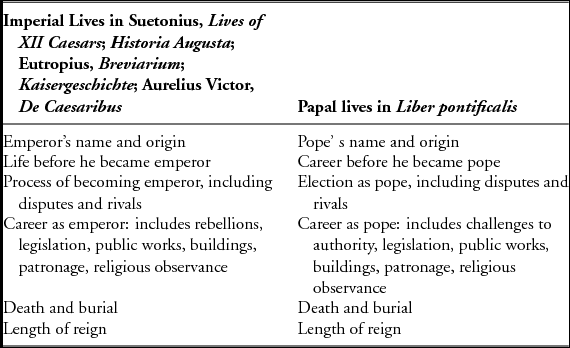
Of crucial importance to the theme of Church and empire, first of all, is the way the Liber pontificalis recast the genre of imperial serial biography, with all the ideological implications such a historiographical choice implies. The closest parallels to the papal biographies are the imperial biographical narratives of Suetonius, (pseudo)-Aurelius Victor and the Historia Augusta, rather than Old Testament kings, martyrs or saints, as can be seen from the schematic comparison on the next page.Footnote 19
Serial Biography: Structural Models

There are, first of all, consistent structural parallels between late antique imperial biographical narratives and the Liber pontificalis in the formulaic presentation of information about the subject's name, origin, parentage and career before and after elevation to the imperial or papal throne, including details about disputed elections and rival candidates, challenges to his authority, public works, patronage, buildings and religious observance, his length of reign, death and burial, even if the length accorded each topic varies considerably. I shall return below to the significance of the buildings as a way of establishing a physical presence and lasting memory.
Secondly, the authors portray the relations between the popes and the emperors in a manner that highlights the pre-eminence of the bishop in Rome. This takes a number of forms. It is particularly apparent in the representation of the early Christian community in Rome as a small and vulnerable group, sometimes tolerated and sometimes persecuted, led by a ‘monarch bishop’.Footnote 20 In contrast to other texts relating to the many Christian groups in Rome before the early fourth century, the Liber pontificalis gives only a slight indication of underlying divisions and divided loyalties or any of the tensions within the Christian communities of Rome discussed by Allen Brent.Footnote 21 The theologian Hippolytus (170–235), for example, is only mentioned as a priest who accompanied Bishop Pontian (pope 230–5) into exile. The challenge presented by the rigorist Novatian (200–58), author of letters to Cyprian of Carthage and to Bishops Fabian (236–50) and Cornelius (251–3) (Lives 21 and 22) in the middle of the third century, is subordinated to the curious story in the life of Bishop Cornelius about the translation of the bodies of Saints Peter and Paul from the Via Appia to new resting places on the sites of their respective executions.Footnote 22
The bishop of Rome is presented, moreover, as the principal creator of the institutional structure, administration, clerical office and liturgy, not merely for Rome but for the whole Church by the beginning of the fourth century. The text thus affirms the antiquity of the church in Rome and the apostolic underpinning of all its arrangements long before the conversion of Constantine and formal legal recognition of Christianity within the Roman empire.
The insistent catalogue of steadfast bishops killed for their faith by the pagan emperors before Constantine also underpins the bishops’ role. Only with the appearance in the narrative of Constantine are the emperors cast in a more favourable light, but even then the author(s) of the Liber pontificalis contrive to indicate that it is the bishop who is masterminding the affairs of the Church and in Rome. According to Life 34, Silvester (315–35) not only baptized the emperor Constantine, but is also credited with convening the synod of Nicaea, as well as a synod in Rome at which many provisions for clerical organization and behaviour were made.Footnote 23
The provision of a chronological framework by reference to the reign of emperors in the Liber pontificalis might be thought significant. They are noted up to Life 37 of Liberius while the Liber pontificalis was still able to follow the Liberian catalogue.Footnote 24 Thus Julius (Life 36) was ‘bishop in the time of Constantine’. But this seems to be a simple chronological device used while it was available from an already existing list. After Liberius, the next regnal year dating point offered is not until that of Odoacer and Theodoric for Felix III already referred to. For the rest of the period of Ostrogothic rule, dating clauses were inserted as follows:
Life 51: Gelasius I, in the time of Theodoric and the emperor Zeno.
Life 52: Anastasius, bishop in the time of King Theodoric.
Life 53: Symmachus, bishop in the time of King Theodoric and the emperor Anastasius.
Life 54: Hormisdas, bishop in the time of King Theodoric and the emperor Anastasius from the consulship of Senator to that of Symmachus and Boethius.
Life 55: John I, bishop from the consulship of Maximus to that of Olybrius in the time of Theodoric and the Christian emperor Justin.
Life 56: Felix IV, bishop in the time of King Theodoric and of the emperor Justin from 12 July in the consulship of Maburtius to 12 October in that of Lampadius and Orestes.
Life 57: Boniface II, bishop in the time of the heretic king Athalaric and of the emperor Justin.
Life 58: John II, bishop in the time of king Athalaric and the emperor Justinian.Footnote 25
These too can be regarded as a simple means of adding some chronological precision rather than offering statements about political affiliations or sympathies. It may be significant that it is only during the Ostrogothic period that the secular rulers are particularly acknowledged. Thereafter there are no regnal years of any secular rulers added, except for insertions in a couple of Carolingian manuscripts for the eighth-century lives which again simply seem to be insertions by scribes to provide more precise chronological landmarks.
Rather more substantial narrative strategies to represent relations between the bishops of Rome and the emperors while still in the West either report imperial interference in Roman affairs or concern doctrinal dispute. Thus Julius, Liberius and Felix II were exiled in turn by Constantine II and Constantius, the heretic sons of Constantine. Damasus was noted in passing as being bishop in the time of Julian. The interference of the Emperors Valentinian III and Honorius and the Empress Placidia in the disputed election of Boniface and Eulalius in 418 resulted in the success of the candidate preferred by the imperial family, but the biography of Boniface made it clear that Eulalius, consecrated in the Constantinian basilica, was favoured by the clergy and people of Rome. Valentinian III intervened again when Sixtus III was arraigned by the aristocrat Bassus, a descendant of the famous fourth-century Christian prefect of the city of Rome, Junius Bassus, by ordering that a synod be convened to consider the charge. Sixtus was declared innocent and Bassus condemned, though the synod conceded that he was not to be denied the last rites. Valentinian and Placidia were indignant about this concession, condemned Bassus themselves and confiscated his estates, though they were ‘merged with the catholic church’; Sixtus nevertheless saw to it that Bassus's body, on the latter's death soon afterwards, was buried in the family tomb chamber in St Peter's basilica, and Sixtus ‘saw to the wrapping of his body with linens and spices with his own hands’.Footnote 26 Only in the notorious case of Vigilius's elevation as a hoped-for puppet pope by Justinian, however, does the Liber pontificalis retrospectively record direct secular intervention to impose an imperial candidate.Footnote 27 The Liber pontificalis does not record Felix IV as Theodoric's appointee, or John II as Athalaric's.
The episodes concerning the papal standoffs with the Christian emperors on matters of doctrine during the Acacian schism and Three Chapters dispute and prolonged papal resistance to Monophysite and Monothelite interpretations of the Trinity, culminating in the Lateran Council of 649, in addition to persecution and punishment by heretic emperors, are numerous but consistent. These doctrinal controversies have been exhaustively addressed by scholars over the past few decades, so I offer only a sample here.Footnote 28 The Liber pontificalis’s entry for Leo I is happy to record that the synod of Chalcedon was gathered in the Emperor Marcian's presence, but it is the statement of Chalcedonian orthodoxy in the Tome of Leo and Leo's authority which is emphasized. The ‘pious emperor Marcian and the empress Pulcheria’ even ‘laid their royal majesty aside and expounded their faith in the sight of the holy bishops’ and insisted on a written version being sent to Pope Leo.Footnote 29 Leo's famous embassy to the Huns, moreover, is introduced with the statement that he did it ‘[f]or the sake of the Roman name’ without reference to the emperor.Footnote 30 Leo's successor Hilarus (461–8) confirmed the statements of faith from the three synods of Nicaea, Ephesus and Chalcedon and Leo's Tome, condemned the teaching of Eutyches and Nestorius, and asserted ‘the dominion and preeminence of the holy, catholic and apostolic see’.Footnote 31
The Liber pontificalis offers a steady narrative of the Acacian schism. It starts with the condemnation of Peter of Alexandria (who was suspected of Eutychianism) mentioned in the life of Simplicius, the condemnation of Acacius and Peter by Felix III/IV (483–92) and the excommunication of the Roman legate Misenus for accepting Byzantine bribes, the restoration of Misenus by Pope Gelasius I, Gelasius's offer of refuge to the Catholic rival John, bishop of Alexandria, and Gelasius's subsequent condemnation of Acacius and Peter once more and his composition of five books against Nestorius and Eutyches.Footnote 32 Anastasius (496–8) earned a thoroughly negative portrait in the Liber pontificalis, even though he was buried in St Peter's basilica along with his predecessors. Because he had ‘wanted secretly to reinstate Acacius’ and had failed to ‘consult the priests bishops and clerics of the whole catholic church’, he was ‘struck down by God's will’.Footnote 33 Hormisdas (514–23), on the other hand, made such a determined effort to assert the orthodox position maintained in Rome that the enraged the emperor vigorously protested: ‘It is our wish to give orders, not to take them’, only to be struck down by a divine thunderbolt.Footnote 34
It was King Theodoric, not the emperor, who was asked to adjudicate in the disputed election between Laurentius and Symmachus, but Theodoric's relationship with the bishops of Rome is inconsistent and needs fuller analysis than can be attempted here.Footnote 35 It was Theodoric whose advice Hormisdas sought in order finally to effect a reconciliation with the new Emperor Justin and restore ‘unity with the apostolic see’.Footnote 36 The account of Theodoric's treatment of Pope John I (523–6), by contrast, adds a perplexingly sour note to the presentation of a mostly cooperative working relationship between the bishops of Rome and the Ostrogothic kings as rulers of distinct domains.Footnote 37
Thereafter the Liber pontificalis reiterates the zeal, even anxiety, with which the emperors reassure the pope of their orthodoxy, reinforced in the life of John II (533–5) by splendid gifts of gold and silver vessels and purple-dyed cloth by the Emperor Justinian to St Peter. This first section of the Liber pontificalis culminates in the trouncing by Pope Agapitus of both the Emperor Justinian and the Patriarch Anthemius of Constantinople in argument, and his affirmation of the two natures in one Christ. The emperor then ‘abased himself before the apostolic see, prostrating himself before the blessed pope Agapitus’.Footnote 38
The seventh- and early eighth-century sections of the Liber pontificalis further enhanced and reinforced the popes’ theological and political relationship with the Byzantine emperor, and represent the Roman perception of occasional and irritating imperial intervention in Roman affairs. Not least in relation to a pope's candidature and election and the announcement sent as a courtesy to Constantinople, the Roman perception articulated in the Liber pontificalis was that imperial intervention in Roman affairs was not necessary to validate or legitimate the pope's position. I have further suggested, in a recent article on the papacy and Byzantium in the seventh and early eighth centuries, that the composition of the Liber pontificalis was resumed in the seventh century in order both to provide a historical record of the popes’ confrontations with Byzantium and the patriarch of Constantinople in doctrinal matters and to affirm the papal position in relation to Monothelitism.Footnote 39 The Liber pontificalis became, in the first and second continuations (Lives 60–71, from Silverius to Boniface V, and Lives 72–90, from Honorius to Constantine I), therefore, an essentially political argument articulated in the form of historical narrative. In so doing, the second and third generations of Liber pontificalis authors maintained the very particular agenda of their predecessors, and represented the pope as upholder of the orthodox Christian faith, the leader of the Church, the ruler of Rome and a rival to Byzantium. The second continuation culminates in another papal visit to Constantinople, where Pope Constantine I celebrated mass, after ‘the Christian Augustus, crown on head, had prostrated himself and kissed the feet of the pontiff’.Footnote 40
In the form in which it was circulated in the seventh and eighth centuries,Footnote 41 the Liber pontificalis became a powerful and influential text for Frankish, English and even Byzantine knowledge and understanding of the popes and of their championing of orthodox doctrine, especially of the papal leadership in insisting on Chalcedonian Christological orthodoxy and the principal decisions of the councils of the Lateran in 649 and Constantinople in 680/1.Footnote 42 That knowledge and understanding also underpinned the separate lives of the eighth-century popes of the ‘third continuation’ (Lives 91–6 from Gregory II to Stephen III), up to the eve of Charlemagne's conquest of the Lombard kingdom.Footnote 43 While still sacellarius and a deacon, for example, Pope Gregory II (715–31) had accompanied Pope Constantine I to Constantinople. After he became pope he headed the opposition to remnants of imperial taxation in Italy and opposed the new ideas about iconoclasm emanating from the Byzantine empire, as did his successor Gregory III (731–41): this holy man sent ‘written warnings, with the authority of the holy see's teaching, for them to change their minds and quit their error’.Footnote 44 Gregory III's messenger George was too frightened to deliver them and when he was allowed by the pope to try again, the imperial authorities in Sicily detained the luckless George en route and prevented subsequent messengers from delivering their messages as well. Having made the point about the emperor's intransigence, the author of Life 92 says no more about the pope's contact with Constantinople. Life 93 on Zacharias (741–52) records only the sending of the ‘usual’ profession of orthodox faith to Constantinople. Life 94 of Stephen II (752–7) simply mentions the attempts by imperial envoys to prevent the pope's envoys reaching the Frankish ruler Pippin. His brother Pope Paul I (757–67), however, was rather more active in reaction to the iconoclast council of Hieria. He is credited with sending envoys frequently to the emperors in Constantinople, exhorting them ‘to restore and establish in their erstwhile veneration the sacred images of our Lord God and Saviour Jesus Christ, his holy mother, the blessed apostles, and all the saints, prophets, martyrs and confessors’.Footnote 45 On the fourth day of the synod of Rome in 769 recorded in Life 96 of Stephen III, the Roman attitude to Byzantium and its affairs appears to be neatly summarized in the comment that they ‘disallowed and anathematized the execrable synod recently held in the districts of Greece for the removal of these sacred images’.Footnote 46
From these examples, the portrayal in the Liber pontificalis of the bishop of Rome in relation to the secular rulers usually assumed to be in political control of Rome is particularly striking. A comparison with the formulation of the history of the Coptic patriarchs of Alexandria in the seventh century is instructive. The History of the Patriarchs is thought to have been compiled first of all in the context of the Arab incursions into Egypt for the benefit of the vulnerable Christian community, to aid them to forge communal bonds. It survives in an eleventh-century Arabic version of the text. The history of a community within the jurisdiction of the bishop of Alexandria is achieved by focusing on the bishop, whom the authors clearly wished to be seen as the leader.Footnote 47 In the case of both the Liber pontificialis and the History of the Patriarchs, that leadership in its turn was given a long pedigree in the text, not just by claiming a direct line of apostolic succession from St Peter and St Mark respectively. In Rome's case this leadership was not only of the many Christian religious communities of Rome but extended to the entire Christian Church. Its representation, moreover, was cast not only as a replacement of imperial rule in religious matters and as the opportunity for the bishop to assume political responsibility in Rome and its territories as well, but also as a deliberate emulation of imperial behaviour.
This is manifest above all in the record included in the Liber pontificalis of the papal embellishment of Rome. The Liber pontificalis is famous, from the Life of Silvester onwards, for the lists and lavish descriptions of buildings dedicated, constructed, repaired and decorated and filled with gifts of gold, silver and bronze furnishings, lights, liturgical vessels and silk hangings, initially by Constantine and his immediate successors, but with Mark's founding of two basilicas in 336, almost exclusively by the popes.Footnote 48
This textual replacement of emperors with popes as patrons and benefactors in the Liber pontificalis is reflected in the architectural styles of Rome's churches as well as the materials from which they were constructed and embellished. Just as the text offers imperial parallels which are then developed in a distinctively papal context and manner, so too in the material evidence their (self-)presentation develops in distinctively complex ways. I can only touch on this issue here, for I intend to develop it more fully elsewhere. Massive Christian basilicas resembling imperial aulae or assembly halls, and built with expensive marble and stone, opus sectile pavements and revetted walls, mosaics and frescos, ornamented in decorative schemes similar those of imperial temples and palaces, offer visual physical evidence of imperial emulation. How deliberate this was has become a matter of debate. In particular, the use of late antique spolia in these buildings has prompted a range of interpretations, from assigning it momentous symbolic significance to treating the reuse of older Roman building materials as a practical expedient. These extremes are not necessarily mutually exclusive, for in many instances it can be demonstrated that there is meaning to be perceived in such reuse, though of course contemporary – as distinct from our own – perceptions may well need to be distinguished.Footnote 49 In an exposition that has precipitated considerable constructive as well as critical debate, for example, Maria Fabricius Hansen has suggested with reference to the Lateran baptistery, endowed by Constantine and built early in the fourth century but remodelled under Sixtus III (432–44), that the Christians borrowed imperial ‘badges of grandeur and rank’ in using purple porphyry stone, as well as recycling spolia from imperial buildings. She has drawn attention in particular to the massive porphyry exterior columns of the narthex of the baptistery with composite second-century capitals and white marble first-century bases. The capitals may have been transferred from the Temple of Venus Genetrix in the Forum of Caesar. Hansen has further suggested that the builders ‘may have wished to make the point that the principles of renewal and procreation embodied in Venus Genetrix were now replaced by baptism’. The building's entablature, very like that of the temple of Hadrian, and the ornamented marble opus sectile revetment may be further deliberately Christianizing elements of the decorative styles of imperial buildings now translated into the decoration of Christian holy places.Footnote 50 Although partly remodelled under Pope Urban VIII (1623–44), the columns of the baptistery are also of imperial purple porphyry, as are the doorways to the chapels built by Pope Hilarus (461–8), to which were added magnificent bronze doors, with his responsibility clearly indicated on the lintel.Footnote 51 The implications of Hansen's arguments for a broader aesthetic interest in recontextualizing aspects of the imperial past in Late Antiquity and the Early Middle Ages merit further exploration and testing that are not possible in this article.
Many of the foundations credited to Constantine, most notably St Peter's basilica, afterwards became recipients of papal munificence, and popes sometimes persuaded later emperors to make generous offerings. Thus, at Sixtus III's request, the Emperor Valentinian III presented an elaborate gold sculpture to St Peter's confessio. He also replaced the silver fastigium (quite what this was is still disputed) originally donated by the Emperor Constantine to the Constantinian basilica or Lateran.Footnote 52 At St Peter's, the Emperor Honorius constructed a family mausoleum at the beginning of the fifth century, close to the basilica and the saint's shrine. Leo I, who also appears to have commissioned the extensive narrative cycle of biblical scenes in the nave and the representations of Peter and Paul on either side of the triumphal arch, was the first pope actually to be buried in Old St Peter's, as if to outdo the imperial claim to proximity to the saint, and thus inaugurated a papal necropolis intimately associated with the shrine of the apostle St Peter.Footnote 53 In the middle of the eighth century Stephen II and his brother Pope Paul I appropriated Honorius's mausoleum and consecrated it as a chapel dedicated to the newly discovered and translated saint, Petronilla.Footnote 54
In some cases, indeed, known imperial endowments, such as the Empress Eudoxia's foundation of S. Petro in Vincoli at the end of the fourth century,Footnote 55 the construction of San Paolo fuori le mura under the Emperors Valentinian II (375–92), Theodosius I (378–95) and Arcadius (395–408), completed under the Emperor Honorius (395–432), or the donation of the triumphal arch at San Paolo by the Empress Galla Placidia, recorded in contemporary inscriptions, are simply not mentioned in the Liber pontificalis. The church of San Paolo itself, however, was in any case more or less claimed by Pope Siricius with the mounting of two inscriptions to record that the building was directed by Flavius Filippus and built in the time of Siricius episcopus tota mente devotus (‘the bishop Siricius [to Christ] with all the devotion’).Footnote 56 The inscriptions concerning the completion of the basilica make it clear that the emperors are serving the saint: ‘Theodosius began and Honorius finished this hall made sacrosanct by the body of Paul, teacher of the world’. The tribute to Galla Placidia cleverly shifts the attention to Pope Leo (440–61): ‘Placida's devoted heart is delighted that all the dignity of her father's work shines resplendent through the zeal of Pope Leo’.Footnote 57
San Paolo became an even more flamboyant assertion of papal rule, self-advertisement and what appears to be deliberate emulation of the imperial images and portraits customarily on public display in late antique Rome.Footnote 58 The fourth-century building contained large roundels depicting the popes in succession from St Peter to Laurentius, originally above the arches on the south and north sides of the nave. The installation, if not first commissioning, of these portraits has been credited to Pope Leo but they were probably then augmented by the anti-pope Laurentius up to Laurentius himself as part of his attempt to consolidate his election as pope in rivalry to Pope Symmachus.Footnote 59 This first set is usually dated on stylistic grounds to c.500. They were then continued in the Middle Ages but quite how far is not clear, for many of these portraits were destroyed in the catastrophic fire of 1823. Some survive in the Lapidary Museum at San Paolo, but a record of the first series in the form of watercolour reproductions in reduced format was also made in 1634 by Antonio Eclissi.Footnote 60 Old St Peter's had a similar set of portraits, all destroyed by the sixteenth- and seventeenth-century Roman equivalents of the 1960s town planners in Britain when they pulled down the old basilica.Footnote 61 This series was allegedly created during the reign of Bishop Liberius (d. 354) and they were described by Giacomo Grimaldi in 1619.Footnote 62
The representation of the popes in mosaics in some of the churches they endowed, moreover, differs from representations of imperial apotheoses in that the popes are depicted in the company of, and usually even in intimate proximity to, Christ, Mary the Virgin and the saints, and are portrayed as donors. Pope Felix IV (526–30), for example, added a mosaic to the apse of the hall of the ‘Temple of Romulus’, converted it into a church and dedicated it to the twin martyr ‘medical’ saints, Cosmas and Damian, announcing to all who saw the mosaic: ‘Felix has made to the Lord this offering, worthy of the Lord's servant, that he may be granted life in the airy vault of heaven’.Footnote 63 The glorious apse mosaic, today visible at eye level in the upper church because of the seventeenth-century rebuilding, depicts Felix offering a model of his church to Christ, the apostles Paul and Peter and the two saints Cosmas and Damian.Footnote 64
As part of the extraordinary efforts the popes dedicated to the promotion of martyr cults in Rome,Footnote 65 Pelagius II (579–90) created a gallery basilica over the tomb of the martyr Lawrence (d. 258) on the Via Tiburtina. The mosaic on the triumphal arch which divides the sixth-century basilica from the thirteenth-century extension created under Honorius III (1216–27), sets Pelagius, holding a model of his church as donor, in the company of Christ, the apostles Peter and Paul and the martyrs Lawrence, Hippolytus and Stephen. An inscription, once probably in the apse, records the decision made by Pelagius to create the shrine for Lawrence.Footnote 66
A model of his church of Santa Agnese fuori le mura, perhaps in emulation of his predecessor, Pelagius II, was presented by Pope Honorius (625–38) to St Agnes in the mosaic recording his replacement of the church built by Pope Symmachus (498–514), who is also portrayed in the apse mosaic. The inscription evokes the gold and purple of the tesserae, and ends as follows: ‘what all can see in a single upward glance are the sacred offerings dedicated by Honorius. His portrait is identified by robes and by the building. Wearing a radiant heart, he radiates in appearance also’.Footnote 67
In the seventh-century chapel added to the Constantinian Baptistery at the Lateran by Pope John IV 640–2), mosaics commissioned by his successor Theodore (642–9) depict Christ, the two Saints John (the Baptist and the Evangelist), the Virgin Mary, St Paul, the martyr Venantius, Pope John IV holding a model of his chapel, St Peter, Pope Theodore I and another martyr, presumably among those whose remains John IV had had brought along with those of Venantius from Dalmatia. The apse inscription records John's gift: ‘John bishop by God's consecration, made devout prayers to the martyrs for the Lord Christ’.Footnote 68
The self-advertisement of Pope John VII (705–7) seemed rather extreme to the author of his Life in the Liber pontificalis, for he commented in the account of John's munificence, especially the paintings commissioned for the church of Santa Maria Antiqua, that the bishop ‘provided images in various churches; whoever wants to know what he looked like will find his face depicted on them’.Footnote 69 The portrait of John VII still extant in the Vatican Treasury was once part of a larger mosaic depicting him with the Virgin.Footnote 70 It was John, moreover, who appropriated the structures above the church on the Palatine hill, possibly hitherto used by secular officials, to build an episcopium. Footnote 71
Most spectacularly of all, Paschal I (817–24)’s basilica of Santa Prassede, with its apse, triumphal arch and the mosaics of the chapel Paschal dedicated to St Zeno as a memorial for his mother ‘episcopa Theodora’, is a dramatic indication of the continuation of the papal display established by his predecessors. Paschal had himself portrayed with a square nimbus and holding a model of his church and flanking the saints Praxedis and Pudenziana, Zeno, and Christ at his Second Coming. Paschal added his distinctive monogram to the decorative scheme. The inscriptions, set out in gold glass tesserae on blue, reiterate the announcement of Paschal's gift: that he was the ‘alumnus’ of the apostolic seat. The verse at the entrance to the chapel states: ‘Ornament shines in the hall, the work of the prelate Paschal, because he made devout prayers and was earnest in paying this due to the Lord’.Footnote 72 Paschal's portrait is also to be seen in the apse mosaics of Santa Maria in Domnica and Santa Cecilia in Trastevere.Footnote 73 Paschal may have derived the idea for the flamboyant location at least of his monogram from the inscription ‘Sixtus the bishop to the People of God’ that Sixtus III (432–40) placed at the centre of the triumphal arch in his church of Santa Maria Maggiore.Footnote 74
By 500 there were twenty-seven churches inside the walls of Rome and seven major basilicas outside the walls, including St Peter's and San Paolo fuori le Mura.Footnote 75 Between Simplicius in the later fifth century and Theodore in the middle of the seventh, many more popes are credited in the Liber pontificalis with endowing and embellishing churches, both within Rome and in outlying districts. They are presented as continuing an imperial tradition of display and religious devotion.
The Liber pontificalis rarely mentions churches built or paid for by ordinary citizens or clergy of Rome. A notable exception is Santa Sabina, for in the Life of Sixtus III the patronage of Peter the priest for the construction of the fifth-century basilica of St Sabina on the Aventine hill is confirmed by the spectacular contemporary inscription still in this church recording his endowment, in which Peter refers to the time when ‘Celestinus held the highest apostolic throne and shone forth gloriously as the foremost bishop of the whole world’.Footnote 76 The widow Vestina, moreover, in the time of Pope Innocent (402–17) left her jewellery to fund the building of basilicas (St Gervasius and Protasius),Footnote 77 the handmaid Demetrias gave land for the building of St Stephen's basilica, the matronae Priscilla and Lucina who gave land for cemeteries; the latter also made her own house into a titulus.Footnote 78
This has not been the place to offer a detailed challenge to the assumptions concerning the pope's relationship to the Byzantine empire, especially in the aftermath of the Ostrogothic wars. Instead, I have argued that this Roman narrative challenges the usual assumptions about the consequences both of the deposition of the last Roman emperor in the West and of Justinian's military campaigns in Ostrogothic Italy. The authors of the Liber pontificalis created a powerful picture of the popes and a coherent articulation of their ideological and practical position, especially within the city of Rome itself, as the rulers of Rome and of the Church. It is no accident that it was most probably during the pontificate of Pope Paul I (757–67) that the notorious claims in the document known as the Constitutum Constantini or Donation of Constantine were forged. There are close textual parallels with many details, especially the gifts of Constantine listed in the Life of Silvester. Most obviously, however, the ideological position adopted in the Constitutum and the Liber pontificalis is very similar, as the most striking sentences from the Constitutum demonstrate:
This sacred church as we determine is to be named, honoured, venerated and proclaimed as the head and summit of all the churches throughout the whole world, just as we have determined through our other imperial decrees.
and further:
. . . the city of Rome and all the provinces of the whole of Italy and the western regions, their districts and cities, we grant and relinquish to that aforesaid pontiff of ours Silvester the universal pope; these . . . are to be administered by his power and authority and that of the pontiffs who shall succeed him, and we grant that they shall remain under the jurisdiction of the sacred church of Rome.Footnote 79
Charlemagne's conquest of the Lombard kingdom and the creation of an entirely different political configuration in the West certainly had long-term consequences for the papacy itself, but the deliberately imperial elements of papal self-presentation, quite apart from the importance of Rome's primacy, apostolic succession and orthodoxy articulated so emphatically within the Liber pontificalis, indicate the multitude of strands by which the papacy wove the fabric of its own imperium or power, an imperium like no other because of the apostolic claims to succession from Christ's disciple St Peter.