Introduction
Interest in local food has exploded over the past few years. Although much of this interest has been expressed in direct marketing enterprises, such as farmers' markets and community-supported agriculture (CSA), recent efforts have addressed broader aspects of restructuring the food system to have a more local or regional focus. For example, under the Obama administration, the USDA has created the Know Your Farmer, Know Your Food initiative, designed to funnel funds into pre-existing programs, but with a renewed emphasis on local food. One of the USDA's public statements says that this program, ‘promotes local and regional food systems by stimulating community and economic development and ensuring equitable access to affordable, fresh and local food’1. While much of this funding is aimed at the traditional thematic areas of rural development and agricultural marketing, there is also recognition that communities are grappling to coordinate local production and distribution with increased demand. To address these needs, some food systems researchers have identified a role for ‘transitional’ food systemsReference Clancy2 that piggyback on the pre-existing, conventional local food system infrastructure, while moving toward the social and economic benefits of direct marketing. However, achieving these benefits outside the context of direct interactions between producers and consumers may be challenging, since most conventional food businesses are situated within the very system that direct marketing aims to challenge.
Value chains offer one model for restructuring regional food systems that operate at a larger scale than direct marketing while deliberately embedding mechanisms to ensure social, environmental and economic benefits for supply chain participants. Originating in the business and supply chain fields of study, the value chain framework has been adapted for the agrifood system by Stevenson and PirogReference Stevenson, Pirog, Lyson, Stevenson and Welsh3 as part of their work with the U.S.-based Agriculture of the Middle task force4. In this context, value chains refer to the businesses involved in each stage of the supply chain from field to table. These business relationships are distinguished from traditional supply chains by focusing on value-added products and value-based interactions that add an ethical component to economic exchange. Yet the value chain model also incorporates issues of scale and efficiency, which are crucial for addressing the problem of low margins in many agricultural production systemsReference Archer, Dawson, Kreuter, Hendrickson and Halloran5.
In this paper, we employ Stevenson and Pirog's value chain model as a heuristic framework to analyze how food distributors who are accustomed to working within the logic of the conventional produce industry incorporate local food in their overall operations. We are particularly interested in the organizational and equity implications of these practices. We use the value chain structure and its governance mechanisms as points of comparison to examine two food distribution networks, one based in a rural and the other in an urban region of Pennsylvania. Both food distribution networks focus on conventional wholesale produce distributors who serve as the link between local producers and local buyers. Stevenson and Pirog derived their value chain model in part from case studies of farmer cooperatives and food distributors that have actively designed their operations to incorporate alternative agrifood movement goals and values. In contrast, the cases we examine focus on food distribution networks that have developed to meet local produce needs, but lack explicit origins in the alternative agrifood movement. By comparing these networks to value chains, we are able to identify challenges that are specific to food systems that are in a transitional state and are moving toward regionalization by combining local resources with differentiated products. Findings from this research highlight the difficulties that conventional distributors face both in integrating themselves into successful local food system development and in pursuing equity outcomes for both producers and consumers. The distributors in these case studies faced challenges in coordinating local food distribution networks in ways that, through a comparison with the value chain framework, stand out as specific to transitional food systems. In the following sections, we will lay out the elements of successful value chain management, and then use these elements to identify and explore these challenges.
Value Chain Framework
Localized food systems that reduce the number of intermediaries and spatial distance between producers and consumers are often described as strategies to promote rural development; they achieve this by redistributing value along the food supply chainReference Renting, Marsden and Banks6, Reference Marsden, Banks and Bristow7. In contrast to the ‘conventional price squeeze,’ these food systems offer opportunities for local development through entrepreneurship that focuses on creating specialty and value-added products and using innovative marketing techniques to re-connect producers and consumersReference Martinez, Hand, Da Pra, Pollack, Ralston, Smith, Vogel, Clark, Lohr, Low and Newman8.
Value chains can play a role in local food system development that benefits a wide range of producers and consumers. Stevenson and Pirog describe the value chain framework as: ‘… strategic alliances between midsize independent (often cooperative) food production, processing and distribution or retail enterprises that seek to create and retain more value on the front (farmer or rancher) end of the chain, and effectively operate at regional levels’ (p. 120)Reference Stevenson, Pirog, Lyson, Stevenson and Welsh3.
This framework incorporates traditional concerns about food supply chain economic performance, which may correspond to the structure, organization and practices of the chain as well as its geographic locus and product focusReference King, Hand, DiGiacomo, Clancy, Gómez, Hardesty, Lev and McLaughlin9. It also reflects elements that have been explored in studies of other sectors, such as the garment industry, which have examined how personal relations and trust across supply chain partners foster shared governance and the ability to solve problems of mutual concernReference Doel10, Reference Uzzi11. Thus, Stevenson and Pirog's framework emphasizes a value chain structure that integrates various conventional supply chain management techniques with more explicitly ‘alternative’ goals of creating equitable social and economic benefits for all chain participants.
The key elements that distinguish value chains from traditional supply chains and which support these alternative goals include: differentiating value-added products, committing to the welfare of all participants, creating strategic partnerships and the role of trust and shared governanceReference Stevenson, Pirog, Lyson, Stevenson and Welsh3. We briefly describe these features below, which then provide an analytical framework for evaluating the organizational structure and equity implications of food distribution networks that combine conventional infrastructure and local produce.
Differentiation and value-added
‘Differentiation’ adds value to produce through strategies such as processing or labeling. Such differentiation often brings price premiums that can promote economic viability for producersReference Painter12. Based on consumer demand and preference, various product and process-based characteristics now differentiate food products. Such characteristics address consumers' health concerns (e.g. hormone and antibiotic-free, as for meat and dairy), environmental concerns (e.g. organic or sustainably grown), or growing interest in the geographic provenance of foodReference Stevenson, Pirog, Lyson, Stevenson and Welsh3. Producers who can take advantage of the special skills or qualifications for creating these differentiated products may have a competitive advantage in the marketplace.
Product differentiation and adding value is in large part reliant on consumer perceptions. In many cases, regional provenance is recognized as providing social, economic, environmental and health benefits for producers and consumersReference DeLind13. Quality is therefore increasingly associated in consumers' minds with local provenance, despite the fact that many researchers have outlined ways that promoting ‘local’ food and agriculture does not necessarily ensure positive social or environmental outcomesReference Winter14–Reference DuPuis and Goodman18. However, the popularity of the local food movement has helped to bestow value on labels that indicate product origin, which can be used to differentiate products. One area of differentiation is a label or brand that helps to tell the ‘farm story’ of the productReference Stevenson, Pirog, Lyson, Stevenson and Welsh3. In addition to adding value, a farm-based brand can help even out power imbalances along the value chain by giving producers more control over the product. Labels provide information about the producer and a recognizable brand that creates consumer trust, and are also an important part of communicating the various quality attributes mentioned above.
Committing to the welfare of all participants
The next important aspect in value chain development concerns the redistribution of the economic value created through differentiation. Value chain participants must be committed to ‘the welfare of all participants in the value chain,’ which includes the fair distribution of profits. Stevenson and Pirog describe pricing mechanisms that include ‘… formulas for adequate margins above production costs and adequate returns on investment,’ as well as ‘‘target- or cost-based’ pricing’ (p. 131)Reference Stevenson, Pirog, Lyson, Stevenson and Welsh3. In calculating their costs, value chain participants also take into account the need to provide a living wage and benefits to employees.
While these strategies are economic in nature, their ultimate goal is to use economic viability as a means to ensure the social well-being of all participants along the supply chain. Because they are based on the concept that all participants deserve to be fairly rewarded based on their costs and reasonable return on investment, value chains tend to eschew the competitive pricing and bidding common in most industries.
Creating partnerships
This philosophy of fair distribution of value shifts the nature of business relationships between supply chain participants. Stevenson and PirogReference Stevenson, Pirog, Lyson, Stevenson and Welsh3 contrast value chains with two other business models that are most common in the traditional produce industry, specifically arms-length and vertical integration. One of the key differences between these models and value chains is that relationships are constructed as strategic alliances in the value chain model. Treating producers and food processors as partners represents an important conceptual difference between value chains and the conventional food system, especially since most food system actors ‘… are accustomed to operating as cheap input suppliers in adversarial and/or arm's-length market relationships’ (p. 129)Reference Stevenson, Pirog, Lyson, Stevenson and Welsh3. Because value chains are based on cooperation along the vertical structure of the supply chain, they can increase overall efficiency and adaptability; in comparison, vertically integrated chains are not as flexible in the marketplace, while traditional adversarial relationships can impede the functioning of the chain as a unit.
Increased efficiency and adaptability are accomplished, in part, through active coordination of the supply chain, including sharing information between participants and joint problem solving. Such information sharing can be challenging for actors in supply chains who are accustomed to adversarial, competitive relationships. Treating each other as partners and recognizing mutual interdependence help to enhance trust so that sensitive information can be used to coordinate the supply chainReference Stevenson, Pirog, Lyson, Stevenson and Welsh3.
The role of trust and shared governance
This shift from arms-length relationships to partnerships often necessitates a shift in governance, which raises issues of power and perceived justice. The Agriculture of the Middle task force seeks to empower mid-size producers, who may be too large to rely solely on direct markets, but too small to fare well in commodity markets. The value chain model is seen as one promising way to shift the balance of power in a food system that tends to disadvantage mid-size producersReference Stevenson, Pirog, Lyson, Stevenson and Welsh3, Reference Lyson, Stevenson, Welsh, Lyson, Stevenson and Welsh19. However, Stevenson and Pirog balance the ideas of partnerships and empowerment with realistic views of supply chain operations. They recognize that most supply chains will most likely not distribute power equally, but may still retain elements of procedural justice, which is, ‘the perceived fairness of the powerful party's process for managing the relationship’ (p. 128)Reference Stevenson, Pirog, Lyson, Stevenson and Welsh3. Procedural justice may also encompass, ‘… trust in the fairness, stability, and predictability of the procedures and agreements among strategic partners; and that policies are consistent and stable over time, and do not change with new management or personnel’ (p. 124–125)Reference Stevenson, Pirog, Lyson, Stevenson and Welsh3. Thus, Stevenson and Pirog suggest that trust between organizations becomes more important than personal trust, which is the hallmark of direct marketing. Personal trust could prove to be an unstable resource, if and when key individuals leave organizationsReference Doel10. Procedural mechanisms for establishing inter-organizational trust include minority ownership, quality assurance systems, third party certification and long-term agreements. Often agreements may be informal, and therefore rely more on a sense of mutual obligation and interdependence than on formal legal grounds. These types of mechanisms embed trust in the procedural management of the supply chain.
Methods
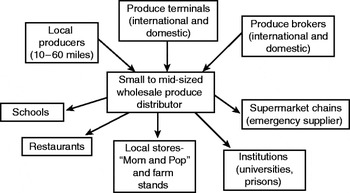
Qualitative case study methods were used to develop two case accounts examining how actors from the conventional food system, specifically wholesale produce distributors, manage the supply chain between local producers and buyers. The two cases were originally identified through a study of Farm-to-School (FTS) programs in Pennsylvania, USAReference Hinrichs and Schafft20. A mail survey of public school district food service directors permitted identification of districts procuring local foods for their food services. Case studies of FTS initiatives were conducted in eight school districts. Although FTS programs are often assumed to involve direct marketing by farmers to school food services21, our district case studies found that some districts instead purchase their local produce through wholesale produce distributors, a situation confirmed in other research on FTS programs in the U.S. Northeast and MidwestReference Izumi, Wright and Hamm22. This paper focuses on two such distributors who purchased some produce directly from local producers, and also purchased nationally and internationally through conventional channels such as produce terminals and brokers. These two distributors provided points of entry for the investigation of two food networks that connect local producers and local buyers by way of one intermediary (see Fig. 1 for a schematic). Our approach emphasized multiple participants' perceptions of and interactions within the network, instead of focusing on the distributor's role alone. Based on network participants' place perceptions and 2000 census population data, we characterize one network as ‘rural’ and the other as ‘urban.’
Composite food distribution network centered on a conventional distributor.

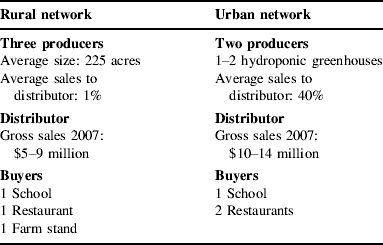
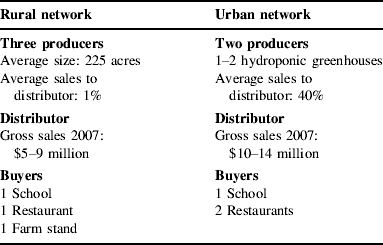
A snowball sampling method was used wherein the two wholesale distributors served as key informants and provided the names of others (e.g. producers and buyers) in the network. We asked the distributor for the names of those producers and buyers whom he considered to be ‘local’; as a result, participants in both cases were located within 10 and 60 miles of the distributors. In the urban case, the initial interview with the distributor revealed that an outside organization had been very active in facilitating the relationships between the distributor and producers, and therefore the scope of the study was expanded to include this non-profit actor. We interviewed three producers in the rural food distribution network and two in the urban; one distributor for each case; and three local buyers in each case, for a total of 14 participants for the entire study (see Table 1). Two interviews were conducted with each distributor; all other study participants were interviewed once.
Study participants in the urban and the rural food distribution networks.
Both distributors in this research have been in the wholesale produce business for at least 10 years. Neither business was established in order to take advantage of the recent intensified enthusiasm for local foods, although each has subsequently responded to that opportunity. Therefore both businesses can be considered part of a pre-existing food system infrastructure that is now playing some role in the transition toward a regionally based food systemReference Clancy2. In addition, each of the distributor's business is independently owned and operated, which sets them apart from the corporate-dominated industry.
Structurally, the rural distributor is slightly smaller in terms of gross sales than the urban distributor (see Table 1). The producers in the rural food distribution network are larger on average than those in the urban food distribution network. Notable buyer characteristics include the large size and tourist attraction status of the rural network restaurant, and that both urban network restaurants serve high-end markets. The influence of context on how these conventional infrastructure actors handle local produce, and the relationships that arise from its procurement and distribution, are considered in the next section.
Applying the Value Chain Framework
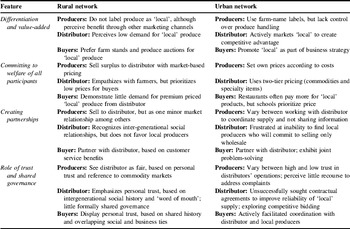
In the following sections, we compare the four aspects of successful value chain organization to the two case studies of food distribution networks. The style and emphasis of each area's local food movement, as reported by case study participants, provide important context for how local produce is differentiated. The approach to differentiation as ‘local’ has implications for how profits are distributed, the character of business relationships that distributors form with local producers and local buyers and the governance mechanisms coordinating the supply chain. As we describe how these two food distribution networks correspond to (and depart from) the value chain framework, we highlight organizational and equity issues that deserve consideration in charting pathways for transitioning toward a more sustainable regional food system (see Table 2 for an overview of these findings).
Value chain framework elements in the rural and urban food distribution networks.

Differentiation and value-added
The ability of producers and distributors to extract value from local produce depends on consumers' willingness to recognize and pay a premium for that extra value. In this study, that willingness appears to rely in part on the nature of the local food movement that prevails in each area. In the rural case, the distributor, farm stand owner and restaurant owner reported that their customers' association of local produce with their rural and agricultural heritage fostered the idea that farm stands and produce auctions were more appropriate sources of such produce than a produce distribution company. For example, the farm stand owner had a pre-season agreement with two local farmers to provide produce, in addition to the sweet corn that he and his family grew themselves. The restaurant owner found it more economical to buy produce by the ton or half ton from the local produce auction, which he also felt supports the local farm economy. For these buyers, freshness and volume made these sources more appealing than buying through the distributor. The farm stand owner noted, ‘When my local sources become available, that immediately takes precedence over what would be handled through a distributor.’
The fact that his buyers also sourced local produce from other establishments may help to explain why the distributor did not perceive much consumer demand for local produce, and therefore why he did not consider local produce a differentiated product meriting much of a price premium. This was partially reflected in his opinion of labels, such as PA Preferred, which is run by the Pennsylvania Department of Agriculture to help identify and promote Pennsylvania produce. The distributor said that he found such promotional efforts too expensive and not necessarily beneficial for producers: ‘I'm not a big advertising person. So, it's an expense for them. And I don't know if it's justified by the return, because there's no guarantee that they're going to get an extra quarter or dollar a package just because it has a PA label sticker on the box.’ In the rural network, the producers and buyers used such place of origin labels only minimally. One producer did not use any labels, but believed that his ability to sell directly to a local supermarket chain had improved because of the demand for local produce. The farm stand owner did not highlight PA Preferred labels, but relied instead on homemade signs saying, ‘Our Own,’ or ‘Raised Here.’ Although the distributor did not receive much demand for local produce over the summer, the farm stand owner reported that the customers that come to his farm stand, ‘… wouldn't look at something that was shipped in, actually, I couldn't sell certain items-like corn, if I had my own sitting there and something that was shipped, I don't think I could sell the others!’ These divergent perspectives on the presence of demand for specifically ‘local’ produce suggests that while there may be demand in this area, it circumvents traditional suppliers such as the distributor in favor of other sources.
In comparison, in the urban context the distributor, producers and restaurant chefs reported that a well-articulated local food movement had gained momentum over the past 5 years. This movement corresponds to a larger national trend and is manifested by deliberate and sometimes coordinated efforts to promote urban agriculture, farmers' markets and sustainable agricultureReference DeLind13. Here, the presence of an active local food movement has stimulated consumer demand for local products. Urban network participants were therefore very aware that local food offered value as part of a successful business strategy. The demand for local produce and the strong presence of a local food movement encouraged product differentiation based on provenance, where the quality of being ‘local’ is considered a clear added value. Being able to identify and label local food is necessary for it to contribute to a business strategy. All participants in the urban network had done this. Producers and buyers relied on the marketing efforts of the distributor and reported that labels such as PA Preferred or Buy Local did not carry as much weight as they would in the retail market, because the distributor actively promoted product origins by using farm names. Such promotion of named local products is part of a business strategy that helped the distributor to develop his reputation. Offering high-quality local produce allowed him to take advantage of a niche market and gave him a competitive advantage. For example, he said: ‘… You're always looking for a way to expand your business to be a leader, ok, you always want to be one step ahead of the game … this product I bring in nobody else has, it's sort of like Microsoft—everybody uses Microsoft because they're the leader, because they set the bar.’ The urban distributor valued his buyers' recognition of his commitment to local produce, and the chefs purchasing from him also indicated that their consumers were discerning when it came to their produce choices.
Both the distributor and the chefs in this network said that they perceived greater demand for local products than for certified organic products. In addition to addressing consumers' health concerns during food scares, promoting local produce gave these restaurants a certain cachet, based on the implied superiority of their products. One chef pointed to the positive publicity that purchasing local and having an environmental slant got them, and how it served to differentiate them from other restaurants to provide a competitive advantage, ‘We're being basically grouped together with the rest that are trying to be more ‘green,’ so to speak, and trying to buy local, better-for-you food. And to be talked about in that capacity, and to be grouped together with restaurants that also function like that, has definitely shined a positive light on us.’ Only the school district, whose limited budget made low prices a priority, did not actively seek and promote local produce, except in the context of a once-a-year celebration of local apples.
Both producers in the urban food distribution network were highly aware of the economic value of the quality of being local, and used their own specific labels identifying their operations by name. Although the value chain framework describes branding techniques such as farm-based labels to help producers maintain ownership over the product throughout the supply chain, both producers in the urban network, in contrast, reported concerns about losing control over their product once it passed to the hands of the distributor. One producer said, ‘When we drop off our lettuce, it can sit on that dock for 2–3 hours before it gets put in the freezer, put in the cooler, so it could sit out there and wilt, go bad, and my name's on it. So I lose the control on that.’ Both producers pointed out that because the product carries a label identifying their operation by name, and this is the information that restaurant chefs often include on their menus, the end consumer's judgment of the quality of that product affects their operation's reputation. Lack of control over product handling before its sale was a frustrating aspect of these producers' relationship with the distributor, indicating some lack of confidence in the distributor's operation. One producer said that he saw no way to address this issue, because his product was out of his hands once it reached the distributor. Here, despite having ownership over his label, the producer did not feel empowered, nor did he feel that he had the right to express his opinion about how the distributor handled his product. This suggests that differentiation alone may not ensure a sense of partnership among supply chain participants. The development and maintenance of collaborative relationships between participants in transitional food distribution networks, such as these, can face obstacles.
Committing to the welfare of all participants
Whether or not local produce can generate a premium affects the type of returns producers get for their product. In these cases, both distributors struggled between their recognition that producers need to receive fair prices to survive and their own need to offer low prices to their buyers to stay competitive. Because of lower demand for local produce through the distributor's business in the rural food distribution network, offering fair prices to local producers was often more challenging for the rural distributor than for the urban. The rural distributor often talked about giving producers fair prices in order to maintain these relationships and, perhaps partly because of his own farming background, appeared to have a lot of empathy for producers. For example, he talked about how he and the producers purchased from shared economic goals, the reciprocity of the relationship and his attempts at maintaining fairness as follows:
So you know, I try not to take advantage of them. They need to make a profit, I need to make a profit, that's why we're both here; lot of people want to gouge you, and I try not to do that. I try to make a fair profit to cover my expenses, give as much back as possible. Because if you don't give any back this year, they won't be there next year.
These comments convey the distributor's recognition that producers' economic returns are related to their operation's viability and economic sustainability. Although he talked about fair prices, the distributor said that he was only interested in local products when producers' prices were comparable to the same non-local product: ‘If they're just getting started and have very little volume, if they can get a premium price—call me when you have a surplus, then I can deal with it.’ The ‘premium price’ that the distributor was referring to here has to do with the timing of the product, since producers can receive higher prices when there is scarcity in the market for a particular product. It was not a higher price based on the quality of being a local producer or based on a producer's costs, but rather on market conditions. Fairness was therefore not built into the price of local items, despite the distributor's recognition of the need to pay farmers good prices to help them stay in business. The fact that he only dealt with local farmers when they could meet his needs on price and volume limited him to buying surplus produce when the market was flooded and prices were low.
For the urban distributor, the presence of high-end buyers who were willing to pay more for local produce allowed him to be more flexible with pricing. The distributor balanced between determining prices for more commodified items according to the market and allowing producers for specialty products to set their own prices based on cost. In this way, he treated some producers as arms-length suppliers of generic products and others as strategic partners. For example, with a commodity like corn, the distributor said, ‘We try to go off the market. If corn gets wiped out, they're going to want more money for it, and that's just fair; if there's an abundance of corn, I expect to be treated fairly.’ However, with specialty items such as one of the local producer's micro-greens, he said, ‘[That Producer] is more stable pricing.’ Both of the local producers included in the urban case study sold specialty products that they were able to price based on their costs; one producer clearly stated that he was able to do so because the ‘local value’ of his product meant that it was not a ‘real commodity.’
The fact that the urban distributor's buyers were willing to pay more for local products helped to support this pricing system, although the distributor also said that there was a limit to how much more buyers would pay for local produce. When it came to prices, the urban distributor was acutely aware of his responsibility toward his buyers and respected the fact that most of his clients needed to re-sell the produce. His awareness of his client's financial limits was especially true for the school district, where he said, ‘Cause here's the thing, if I can get Florida tomatoes for 60 cents a pound in the fall, and the local guy wants a dollar a pound, how am I supposed to justify to [the Food Service Purchaser] that I'm doing my job also, as her buyer, and selling her the best price possible?’ Here he clearly prioritized the buyers' needs, although working as well with higher end restaurants gave him some freedom to support producers when they sought higher prices.
Creating partnerships
Consumer demand and the value attributions for local produce also corresponded to the types of business relationships that developed between distributors and local producers and buyers. In both the rural and urban local food distribution networks, the relationships between these distributors and their buyers tended to be more characteristic of partnerships according to the value chain model than were their relationships with local producers. For the rural distributor, his relationships with both buyers and producers were characterized by an intergenerational social history; however, commitment to customer service led him to prioritize buyer needs over his established relationships with producers. In his relationships with producers, he alternated between acknowledging the needs and goals of the producers that he worked with, which made the producers sound like strategic partners, and reverting to standard, arms-length relationships, where the producers sounded more like generic suppliers. Despite his intentions to give producers what he called a ‘fair shake,’ ultimately the distributor also needed to seek out low-priced items in order for his business to remain competitive. When the distributor transferred the responsibility for his relationship with producers onto the demands of consumers, it made these long-term relationships sound much more tenuous. For example he said:
I might deal with them this year and not next year, it's just depending on the market, it's no bad feelings between the farmer, no favor between me and the farmer, but maybe they just don't have what I need and that's how you need it. Have it this year, might not have it next year.
There was little sense that the distributor would work with a producer and the consumer to coordinate supply and demand, or that they would work together to address problems. Consumer demands took precedence over pre-established relationships with local producers and if the distributor could better meet these demands by sourcing a product from a non-local source, either because of price or quality considerations, he did. As mentioned earlier, this often restricted the distributor's local purchases to times when there were surpluses and low prices on the market. The distributor unwittingly contributed to competition between local and international producers by comparing prices and quality between these two sources and not privileging one over the other based on mutual interdependence, as described in the value chain model. This tension points to the inherent difficulties of creating a sense of partnership all along the supply chain, especially because of the often diverging economic needs of producers and consumers.
In the urban food distribution network, the distributor combined arms-length relationships and strategic partnerships depending on his buyer's demands. Most of the produce that he sourced for the school district required arms-length relationships with producers and brokers that grew and handled commodified, standardized produce. However, with buyers who demanded local produce, such as the chefs from high-end restaurants, the distributor took a more active role in sourcing local produce and attempting to foster partnerships with local producers. Still, when working with his buyers, this distributor also prioritized consumer demands above local produce purchasing, and often described his relationships with buyers in ways that resonated with the value chain framework. For example, when lettuce prices skyrocketed, the Food Service Purchaser for the school district said that she had daily communication with the distributor, who helped her plan how much to buy, when to buy it and switched vendors to keep prices down. On her end, the Food Service Purchaser worked with schools to reorganize their menus and replace or reduce the amount of lettuce they were using. The distributor and the buyer exhibited joint problem-solving efforts to address the purchaser's financial constraints; however, unlike in the value chain model, this was done without any type of coordination on the producer's end, and was achieved by switching vendors, not by working through the problem on the supply end as well as on the purchasing end.
When dealing with local chefs, the distributor actively sought more strategic relationships with local producers; however, the high demand for local produce in this area put pressure on the distributor, which in turn shaped his relationships with local producers. Because purchasing and promoting local food was an integral part of the distributor's business strategy, he was interested in finding ways of securing consistent, reliable relationships with local producers in order to coordinate the supply chain dynamics between production and consumption. However, the presence of a local food movement and high consumer demand provided economic opportunities for producers through direct marketing outlets such as farmers' markets and selling direct wholesale to supermarket chains. This high profit margin retail market for producers created tension in the relationship between the distributor and local producers and impeded partnership development. It also motivated the distributor to work with a non-profit organization to find local producers willing to sell exclusively to a wholesale market. While many producers would have liked to sell only their surplus to the distributor, the distributor needed a steadier supply of local produce to meet his buyers' demand; however, he could not compete with the higher prices offered in the direct retail and direct wholesale markets. The distributor wanted consistent relationships that may resemble partnerships under the value chain model, while the producers appeared to prefer remaining more like suppliers and dealing with the distributor only when it was beneficial for them. New opportunities in local markets shifted power toward the producers, who treated the distributor with the type of inconsistency that producers usually face in conventional supply chain relationships. For the producers that chose to sell exclusively wholesale to the distributor, their perceptions of their relationships differed. The less experienced grower felt that he worked with the distributor to coordinate supply and demand, showing a sense of shared partnership, while the other producer preferred remaining autonomous in terms of his product selection and promotion.
The role of trust and shared governance
Relationships that distributors formed with local producers and buyers in turn provided the context for the expression of trust and specific governance mechanisms coordinating the supply chain. While the rural distributor relied on a mixture of personal and market-based mechanisms to manage his relationships with local producers, the urban distributor struggled to find appropriate mechanisms to maintain consistent relationships with local producers. The rural distributor had intergenerational social ties with the three local producers, which fostered personal trust. While this may have led to perceived fairness, it did not necessarily create inter-organizational trust through shared governance and procedural mechanisms, as described in the value chain framework. The distributor acknowledged the role of personal trust in maintaining his relationships with local producers and gave a compelling example of how producers would deliver their products to him before they had settled on a price: ‘Nine times out of ten, [the Producer] will send me stuff with no price on it, and I price it after I sell it. I've done that for years, I guess they just trust me.’ The producers' faith that the distributor would be honest in pricing their products was based in part on personal trust and in part on the distributor's upfront reliance on commodity markets to determine prices. When asked how he decided which producers to buy from, the rural distributor responded, ‘… as far as buying from the people I deal with, they're just reputable people, they're honest and reputable people.’ Personal characteristics such as honesty formed a basis of trust for the distributor, and this trust appeared to be reciprocal, although backed by market mechanisms. For both buyers and producers in the rural network, the fact that they all moved in similar social circles may have helped to maintain these relationships, and may have served as a check on their business relationships. Although they did not enter into agreements that would have legally enforceable consequences if trust were broken, the distributor's reliance on ‘word of mouth’ and social connections with producers and buyers may have provided some incentive to remain honest, reliable and responsive to any potential problems. Despite little evidence of inter-organizational trust, personal trust here may have served as a governance mechanismReference Granovetter23, Reference Raub and Weesie24.
Personal trust between producers and the distributor and perceived fairness notwithstanding, the rural network did not share governance in a way that might foster partnerships and ensure equity along the supply chain. No procedures were in place to coordinate the chain, and the distributor said that he told producers, ‘I'll tell you guys, if you don't have it, you don't have it, but it's just a phone call away to find it someplace else.’ One of the local producers supported this point, saying independently of the distributor, ‘Oh, if he can buy a similar product for cheaper, you won't see him. You won't see him. He's a money man.’ Beyond the absence of explicit agreements or other mechanisms, these comments reveal little mutual interdependence between the producers and distributor. This distributor's readiness to source products from non-local sources to ensure his supply suggests clear limits to an ideal of shared, collaborative interests.
In contrast, the urban distributor struggled to determine what types of supply chain mechanisms he might utilize to bring a degree of consistency to his relationships with local producers. Although he expressed interest in our first interview in working with the non-profit organization to establish contracts with local producers, the producers expressed little interest in committing to pre-season contracts, which they believed would be too constraining. By our second interview, the distributor had shifted away from the idea of contracts, while still expressing frustration with producers' desire to switch in and out of different types of markets. For example, he said, ‘It's not an agreement, you just hope—look, if I'm buying off of them, I want to be kept in the loop, I want my product, I don't want to hear, well, it's the [County] farm show, I'm going to take all my stuff retail and I can't get you this this week … I'm going to buy it, I want it.’ Here, the distributor reflected on the challenge of establishing a relationship of commitment between partners, with the reliable outcome that a producer would give this relationship precedence over other possible markets. He did not specifically see this relationship working yet through contracts, and he did not mention any other procedural mechanism that might help to formalize and consolidate his relationships with producers. However, he mentioned that he had recently decided to buy from a produce auction in a nearby rural county to ensure being able to obtain the volume of local items at the prices he needed to maintain his business. He remained committed to buying local produce, but his switch to an outlet relying on competitive bidding to establish prices can be viewed as a move away from a value chain model and toward the replication of traditional arms-length supply chain relationships with producers. Here again, the producers that did maintain a relationship with the distributor diverged in their perceptions of these relationships, with the less experienced grower expressing high levels of trust and the other remaining unsatisfied with how the distributor handled his product, but feeling that he did not have recourse to address the issue. The buyers in this network, on the other hand, saw themselves as active facilitators in coordinating the local food supply chain, as evidenced by one of the chef's role in connecting the distributor with local producers.
Discussion and Conclusions
We have used the value chain framework as a lens for examining the organizational and equity implications of supply chain dynamics that emerge as conventional food distributors play a greater part in local food markets. In this study, we found that transitional food systems that pivot on actors accustomed to working in the traditional produce industry can encounter challenges surrounding the generation and distribution of economic value, as well as coordinating supply and demand. These challenges arise, in part, because consumers and producers may not identify conventional produce distributors as a source or destination for local products. In the rural network, for example, buyers preferred sources other than the distributor for local produce, while in the urban network, specialty producers could earn more by selling, not to the distributor, but to other buyers. Such situations can undermine the conditions for developing a sense of partnership between local producers and distributors, as occurred in this study even though differentiation, local branding and heightened consumer demand were all present. Shortfalls in partnership development may also derive from distributors' prioritization of customer service over a commitment to local growers. Distributors often felt caught between offering fair prices to producers and giving low prices to their buyers, with the latter being the most crucial for distributors' economic viability.
This study provides food for thought for policy-makers and practitioners who view conventional infrastructure as a potential vehicle for ‘scaling-up’ local food systems, thereby contributing to both rural development through expanded markets for producers as well as accessibility to local produce for consumersReference Friedmann25. Both the networks studied here faced barriers to meeting the dual goals of making local produce more widely accessible while also redistributing value along the supply chain to all participants. Although the value was redistributed toward specialty producers in the urban network, these small-scale producers and the limited nature of the outlets for their products (which included high-end restaurants, but excluded larger buyers, such as the school district), may mean that this type of food distribution network will have a limited contribution toward scaling up the local food system, and in turn influencing the local economy. On the other hand, in the rural network, the weak differentiation of local produce posed a barrier to generating economic value. This restricted the ability of this food distribution network to contribute to rural development by bolstering producers' economic viability.
Another barrier for these two local food distribution networks seemed to be the common perception in both cases that local produce would be less expensive than imported produce because of shorter shipping distances. For example, when asked who may or may not benefit from a more localized food system, the chef from one of the urban restaurants responded, ‘But I mean, the farmers would benefit, the consumers would benefit, the middleman, the places that are buying the stuff will benefit. You know, it's cheaper to get the product there, and often times cheaper than buying stuff from far away.’ Although this claim may be true during the height of the summer growing season, its general validity is questionable, particularly if consumers are not willing to pay enough more for local produce so as to improve the economic outcomes of local producers. Producers, however, understood that local produce is not necessarily cheaper just because it has been shipped shorter distances. In fact, one producer in the urban network said, as a hypothetical customer for his own product, ‘I wouldn't pay what they're paying for that lettuce—it's outrageous!’ This statement highlights the challenge that local food distribution networks, based on a value chain model, face in providing local produce to a wider consumer base while still generating enough economic value to support all chain participants.
These findings suggest that promoting rural development by moving local produce through the conventional food system infrastructure will require additional strategies to generate and redistribute value. Addressing the broader infrastructural needs of local and regional food systems could foster economic development and meet the divergent needs of both producers and consumers. For example, locally owned processors could create economic opportunities for producers to add value to local produce, as well as increase the ability of local buyers to purchase it. This is especially true for institutional buyers such as schools, hospitals or prisons that often have limited on-site processing capabilities and increasingly rely on pre-processed itemsReference Bloom26. Other research indicates that expanding the networks that develop around producers to include processing and distribution facilities (i.e., agrifood clusters) can have a positive impact on the overall economic performance of such networks, which in turn has important spillover effects on the local economyReference Brasier, Goetz, Smith, Ames, Green, Kelsey, Rangarajan and Whitmer27. In addition, supporting the development of processors that are independently owned and operated provides opportunities for entrepreneurship and increased rural employmentReference Brasier, Goetz, Smith, Ames, Green, Kelsey, Rangarajan and Whitmer27, Reference Welsh28.
Another strategy to consider is promoting more shared ownership models. While the value chain framework identifies a role for shared ownership in the form of minority ownership (e.g., where the downstream actor has a stake in the suppliers' business), Brasier et al.Reference Brasier, Goetz, Smith, Ames, Green, Kelsey, Rangarajan and Whitmer27 provide the example of a producer cooperative that expanded to establish a processing facility. Here producers have a stake in the ownership of the facility, as do community members who choose to invest in the business, both to support local farmers and to protect the area's farmland. Welsh's research further supports shared ownership models, such as producer cooperatives; he cites several studies that analyze the impacts of state policies that protect farmers' collective bargaining rightsReference Welsh28. These studies showed that, ‘membership in the marketing cooperative enabled growers to have more input into the terms and conditions of their contracts with apple processors' (p. 26), in addition to achieving higher pricesReference Welsh28. Some new generation cooperatives, such as Organic Valley, the largest organic farmer-owned cooperative in North America, offer evidence that a formal cooperative model can provide a platform for creative deployment of value chain elements that yield business success, social innovation and equitable outcomesReference Stevenson29. But even though they may emerge as a response to increased market demand, shared ownership models may not readily mesh with the business histories and norms of conventional food distributors, as studied in this research.
Based on comparisons with the value chain framework, our research suggests that food distribution networks relying on conventional infrastructure to promote and provide local produce may face challenges in meeting both producers' and consumers' needs. Several avenues for future research on the transition to more local and regional food systems can be highlighted as a result. As conventional agrifood enterprises and institutions step in to buy and sell local and regional foods, it will be important to evaluate the longer term organizational and equity implications of this practice. More extended organizational studies can evaluate whether moving local food through conventional food system infrastructure is a necessary, but ephemeral practice that serves food system transition or whether it is a more transformative and ongoing practice for conventional food system businesses. In other words, do conventional food distributors simply play a short-term role conveying local food in a given market that still lacks sufficient dedicated infrastructure? Do the perceived drawbacks of these arrangements actually create opportunities for new businesses more explicitly embracing value chain equity considerations to emerge? Or does the very engagement of conventional food businesses with local and regional food markets gradually transform the operation and orientation of such businesses so that they make sustained and important contributions to more local and regional systems? By identifying and evaluating diverse distribution models for local and regional foods, we can better recognize and support the changes in institutions, enterprises and individuals that offer promising pathways to a more sustainable food system.
Acknowledgements
This research was supported in part by a grant from the Center for Rural Pennsylvania, a legislative agency of the Pennsylvania General Assembly. Information provided in this paper does not necessarily reflect the views of individual board members or the Center for Rural Pennsylvania.