In the nineteenth century for the first and only time, the four nations of the British Isles were united under one parliament in Westminster. The nationalities of the English, Irish, Welsh, and Scots were, at least in theory, subjugated to a greater identity as Britons. Though the extent to which the new nationality was ever a reality in Ireland is certainly a moot point, the dominant interpretation has been that, at least in Wales and Scotland, the dual identity was accepted for the most part.Footnote 1 But the political Union did not mean that the differences among the nations were erased. In fact the Union sometimes heightened tensions as the various nations defined themselves in opposition to their neighbors. Further, the fact that the English were often inclined to equate English and British made questions of nationality even murkier for the residents of Britain. The tensions and uncertainties were manifest in many areas. This essay will focus on their role in homicide cases.
The reactions of the nations of the Isle of Britain to homicides involving ethnic or religious minorities were clearly colored by their own perceptions of themselves and their neighbors.Footnote 2 Though anti-Irish sentiments have been extensively studied, my study of homicide has also revealed significant tensions and differences among the English, Scots, and Welsh in their perceptions of themselves and each other, as well as in their attitudes toward the Irish. Though homicide is relatively rare, homicide trials often reveal important assumptions about class, gender, and ethnicity. This essay will focus on the ways prevailing sentiments about the characteristics of the various peoples of the British Isles influenced the courts and the press in their reactions to homicides. These reactions also reveal significant differences among the English, Scots, and Welsh regarding both the basis for national differences and their significance in homicidal behavior.
The materials used for this essay are part of a larger comparative study of homicide in the United Kingdom between 1867 and 1892. Using The Times index, I have compiled a database of 3,986 homicides in England and 258 homicides in Wales. The database includes all murders reported in the Parliamentary Papers Judicial and Criminal Statistics. However, between a third and a half of reported manslaughters were not reported in The Times. While the Criminal Registers include minimal information on each case, The Times reports include information about the motive, the relationship between killer and victim, and the ethnicity of both—information that is not available in the Criminal Registers. Because The Times was particularly likely to give minimal coverage to Welsh cases, I have also consulted the Welsh press, though the lack of an English language paper of record for the period made a systematic compilation impossible. For Scotland, the database is based on the records of the High Court of Justiciary, which was the only court empowered to hear murder cases in Scotland. The records include the name and ethnicity of the offenders in all homicide cases. I have also used Scottish newspapers for additional information. I have information on 917 Scottish homicide cases. Though the database is not exhaustive, it contains information in twenty-five categories for over five thousand homicides and allows both quantitative and qualitative analysis.
ENGLAND
National identity is a complex issue, and in the nineteenth-century United Kingdom, definitions and distinctions were rarely clear-cut. In fact the largest nation, the English, had the most difficult task of self-definition. Even The Times admitted that “there is no Englishman in history or now living who has not the blood of many races in his veins.”Footnote 3 Perhaps because of the indefinite nature of the English bloodlines, English national identity as presented in the press and the courts was often defined on the basis of character. Frequently these definitions were based on the negative, as Dickens's Mr. Podsnap would have it, “Not English!”Footnote 4 Even when commenting on ill deeds by Englishmen, foreigners were the frame of reference. For example, when a man was kicked to death in Exeter, the jury added a criticism of the bystanders: “We cannot separate without expressing our indignation that any English men should have run away when this brutal conduct was committed.”Footnote 5 One judge complained, “People were accustomed to speak of Spaniards and Italians being addicted to the habit of using weapons, but he doubted whether there was anything like the homicide and wounding with intent to do grievous bodily harm by the knife in any country greater than in England.”Footnote 6
Civilized behavior was what distinguished Englishmen from others.Footnote 7 The worst criminals were described as acting like foreign barbarians. In 1872, The Times reported that at the Northern Assize, “a succession of murder and minor outrages has presented a picture of drunken brutality such as might be more fitly expected in some savage island in the far Pacifics where the natives had just tasted for the first time the terrible poison of drink.” Clearly such behaviors were letting down the national image. “Are these not a sufficiently sad collection of scenes from common life in the North of England in a country which boasts to be civilized Christian and the enlightener of the world?”Footnote 8 The Spectator took on an anthropological tone after a murder in Liverpool: “Naturally a rough race, habituated to violence, always armed—for the steel-tipped shoe on a strong man's foot is a deadly weapon—feel themselves almost above the law … delight in a monstrous exercise of physical power.”Footnote 9
To make these analogies useful, The Times regularly carried stories on crimes in other countries, usually with comments on the savage nature of the population and the stupidity of their courts. In fact, The Times often devoted more column inches to murders in France or Italy than to homicide trials heard at the Central Criminal Court in London.Footnote 10 Unsolved murders in England were also often attributed to foreigners. During the Jack the Ripper terror, a correspondent wrote The Times to offer evidence that “the perpetrator of these several outrages is a man of foreign origin.” First, he suggested that there was no record of “a series of crimes of murder and mutilation of the particular character here involved committed by a person of English origin.” Second, “The celerity with which the crimes were committed is inconsistent with the ordinary English phlegmatic nature.”Footnote 11
Given that their character was presumed to be inferior, it only seemed fair that foreigners tried for crimes in English courts needed special assistance. When foreign nationals were tried in an English courtroom, their consul could be present, they were provided with an interpreter, and they had the option of including six foreigners on the jury. When a Belgian servant was tried in London for the murder of her French mistress, the presiding judge warned the jurors that “more patience, attention and vigilance should be exercised by the jury through the trial of a foreigner than in a similar proceeding against a British subject.”Footnote 12 Sometimes judges even made allowances for the national failings. When a Greek sailor was accused of stabbing an Italian sailor, in addition to having a jury including six Greeks, Justice Willes charged against a murder verdict because “foreigners when from home, acted differently from what they did when they were surrounded by their friends and neighbors.” The jury returned a manslaughter verdict, and Willes sentenced the man to ten years.Footnote 13 After one woman killed another in a boarding house “in a locality almost exclusively inhabited by Italians,” the defense “besought the jury picturing to themselves the scene of a party of angry Italian of both sexes fighting promiscuously in a dark underground kitchen where it would be impossible to determine what really occurred.” The jury acquitted.Footnote 14
The fate of foreigners in U.K. courts varied considerably according to nationality. There was a general consensus that Americans were more savage and placed less value on human life than any of their British or even Irish cousins. In 1867 The Times complained, “one is sometimes tempted to think that the life of a man is thought little more of in America than the life of a rat.”Footnote 15 In a shooting case in 1879 an Irish judge noted, “it appeared that the prisoner was sometime in America, and he was afraid the prisoner had learned there to regard other men's lives more cheaply than they were regarded in this country under our law.”Footnote 16 In a Welsh case when a man shot his wife, the local newspaper reported that he “had lived in the US and adopting a habit of many people of that country, always kept a loaded pistol in his house.”Footnote 17
Asians and Africans were also assumed to be particularly prone to violence. But the assumption that non-Europeans were savages could also work in their favor. Asian and African defendants were more likely to be convicted but much less likely to be executed. Generally they were assumed to be less able to control their passions. At Winchester, Justice Cotton explained that he was reducing a manslaughter sentence from fifteen to ten years, as “the prisoner was a man of colour and therefore the use of the knife was somewhat more excusable than it would have been had he been a white man.”Footnote 18 On the other hand, continental Europeans were more likely to be convicted and executed than English defendants.
Where the peoples of the other nations of the United Kingdom were placed on the hierarchy varied. Though technically part of the United Kingdom, the Irish were usually described as both alien and inferior—often serving as a foil to highlight their neighbors’ better manners. To the English they were, at best, a mystery. As a Times editorial noted in 1877, “How often will it have to be confessed that Ireland is England's enigma? Before we have half understood the meaning of one Irish mood, Irishmen are out of it and well-nigh through another. Their haste bewilders us.”Footnote 19 But even this was an unusually positive spin on Ireland and the Irish. Another editorial complained that even allowing for the poverty and “squalid conditions” of the Irish peasantry, the Irish were uniquely barbaric. Poverty and squalor were found all over the European continent, the paper noted, “yet in none of these countries do we find anything to compare with the violence and cruelty which are the standing disgrace of Ireland … the indiscriminate brutality which ignores the claims alike of race and humanity.”Footnote 20
Though the Irish were regularly portrayed as violent semibarbarians, incapable of showing gratitude for the blessings of British rule, The Times had no patience with Irish nationalism. “Ireland has not lost her nationality for she never had a nationality to lose. Ireland apart from her connection with Great Britain has either no history or no creditable history. She has done nothing, she represents nothing and she gives promise of nothing. If she is severed from Great Britain, the change will not be made in response to a genuine national aspiration. The materials for such an impulse do not exist in Ireland.”Footnote 21
Not only were the Irish in Ireland seen as barbarians, the enormous migration into Great Britain of Irish escaping the famine of the late 1840s and its aftermath had done nothing to improve perceptions of Irish character. To many in England, the simple fact was that the Irish immigrants were dangerous.Footnote 22 During a trial at the Old Bailey in which an Irish laborer was accused of killing his roommate, The Times reported that “the victim was one of ninety-seven people, all of them Irish, who lived in the same lodging house and the landlady said it was a point with her not to keep a poker in the house.”Footnote 23 A London magistrate told an Irish woman charged with assaulting a neighbor who had spilled water in the hall that he “was satisfied that an unprovoked and violent assault had been committed. It was but too characteristic of the class of Irish to which the defendant belonged to commit savage assaults and then try to screen themselves by falsehood. He would never allow such things to be done with impunity.”Footnote 24 Another magistrate told a teenage pauper charged with using threatening language to a relieving officer, “He must be taught that such violence would not be tolerated in England, whatever might be the case in Ireland.”Footnote 25
Confronted by statistics showing that crime rates were markedly higher in England than in Ireland, The Times suggested that “the Irish make up for their innocence at home by an excessive criminality abroad.”Footnote 26 Even though a statistical study published in The Times the same year concluded that “among persons over the age of twenty years of age in London, Liverpool, and Manchester, the Irish
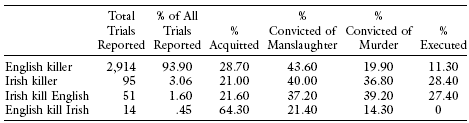
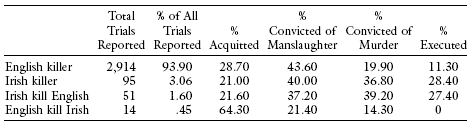
—Homicide Trials Reported in The Times between 1867 and 1892
born were less criminal than the natives,” the Irish continued to be suspect in England.Footnote 27
Determining what percentage of homicides in England were committed by Irish killers is extremely difficult. The criminal statistics for England reported the number of Irish born in the English prison population but did not specify for which crimes they were being held, nor did the statistics record information regarding the criminality of those born in England of Irish parents. However, in the reports of homicide trials in The Times, the designation “Irish” often followed the name of the accused. Table 1 reflects the number of homicide trials reported in The Times between 1867 and 1892. The Times did not report all homicide trials though they did cover all murder trials. It is likely that cases in which both the victim and the killer were Irish were underreported. For example, in 1867 The Times report on the Durham Assize concluded, “a number of other cases were disposed of in the course of the day—charges of manslaughter, arising out of Irish rows, cutting and wounding, and other cases of no public interest.”Footnote 28
Clearly, the Irish were more likely to be convicted and much more likely to be executed than English defendants. The 1881 census showed the Irish born as 2.2 percent of the total population of England and Wales. Yet over 7 percent of those hanged for murder in England between 1867 and 1892 were Irish.
Though the Irish were particularly suspect for the English press, the distinctiveness of the Scots and Welsh were often either ignored or mocked. As The Times explained, “An Englishman has but one patriotism because England and the United Kingdom are to him practically the same thing.”Footnote 29 The conflation of the two identities may have been in part from the lack of a clear sense of a separate English identity. The Times noted that at a Metropolitan Choral Schools concert at the Crystal Palace some three thousand children sang “The Campbells Are Coming” and “Men of Harlech” and then noted that “they also sang ‘Home Sweet Home’ which is almost the only English melody which may truly be termed national.”Footnote 30 But there was little question in the English press that the virtues of Great Britain were primarily those of England. “Scotchmen and Irishmen are great as far as they are also Englishmen. They are not great without us and apart from us, but as members of our own family and sharers of our unsurpassed stock of common words, ideas and associations.”Footnote 31
The Times usually credited the Scots with fully appreciating the opportunities offered by the Union. After the Irish nationalist leader Charles Stewart Parnell suggested that the Scots had lost their nationality, The Times responded, “Scotland has lost her nationality in Mr. Parnell's sense by accepting her place as a constituent member of the greater nationality of the United Kingdom.”Footnote 32 The reward for being perceived as having given up their nationality was that the Scots were usually presented in the English press as progressive, well-mannered, and happily assimilated, though the English sometimes joked that they were too civilized. In a summary of the year 1888, The Times noted, “it is perhaps to the credit of Scotland that it makes a poor figure in the history of the year. … The quietness, not to say the neglect with which Scotland had become used after the experience of years, is the penalty for which an orderly, reasonable and on the whole well-behaved country must lay its account.”Footnote 33 Scottish prudishness was a source of amusement. In an article headlined “Scotland's Weak Points,” The Times noted, “Scotland is proverbially a staid, sober and thrifty nation and for general respectability of demeanor and observance of the Sabbath, among the whole family of nations there is not one which bears so high a reputation. At the same time it must be confessed even Scotland has her weak points.” The Times then dissected a Free Church report on “religion and morals,” which reported such failings as, “‘Some London journals of a sensational character are occasionally sold and read.’ Dancing during the winter is reported to be a ‘great hindrance to the young … growing class in the towns, addicted to Sabbath walking, dog coursing and excursions to the seaside for bathing purposes.’” The article smugly concluded that “with the exception of these little shortcomings the general condition of Scotland appears to be satisfactory.”Footnote 34
As for the Welsh, they seemed to suffer from the national version of coverture. Like married couples in Blackstone, England and Wales had become one entity—England.Footnote 35The Times was confident that Welsh nationalism was a nonstarter. A correspondent noted under the headline “What Is Wales, and Who Are the Welsh?” “What difference in short is there between the man on one side of the hedge and the man on the other, which would make it expedient to violently sever them? They are one in sentiment, character and needs. The differences which exist between some Welshmen and some Englishmen are those gradually shaded off distinctions which exist between a partly and imperfectly assimilated fraction of a nation and the main body of the same people.”Footnote 36The Times was confident that Welsh loyalty to the Union was never in question. “They quite understand the value of belonging to this United Kingdom, to say nothing of such minor matters as prestige. They value the English market for their cattle, their ponies, their coal, their slate. They do not despise the English tourist who every year fill their watering places.” Even their Celticness could be seen in a positive light: “The Welsh, like all peoples of Celtic stock, are a race in whose composition sentiment has a large share and there is therefore nothing surprising in their giving way to the sentiment of loyalty in a remarkable manner.”Footnote 37
Though unwilling to acknowledge claims of nationalists, The Times freely admitted the distinctive character of the Celtic kingdoms, especially the negative aspects. When The Times mentioned Wales, it was usually to report an example of Welsh bumptiousness. In 1867 under the headline “A Welsh Wedding,” The Times reported that a pair of “well-to-do” farmers coming home from a wedding had gotten into a drunken scuffle and that one of the men had died from his injuries. Deaths from drunken scuffles after celebrations were hardly unique to Wales, but the tone of the item indicates that there was something particularly comical about “tipsy” Welsh farmers.Footnote 38 A year later, The Times noted that “A Welsh district newspaper devotes a considerable space to reporting the proceedings of an Eisteddfodd [a Welsh cultural festival] held last week at Ynyaybwl, which, to insure identification is described as being ‘near Llanwonno.’” Having established the remoteness of the area, the article then noted the sorts of honors that might appeal to such folk. “Adjudications were made upon a wide range of subjects, prizes being awarded, inter alia, for ‘the best pair of white stockings; the best pair of black stockings; and for the best essay upon the duties of ratepayers with regard to the Reform Bill.’”Footnote 39
An editorial in The Times implied that the Welsh might make good mascots: “They are a picturesque ingredient in our too tame and matter of fact community. Truth to say their most charming quality is their sweet self-complacency, their lovely self-conceit their absolute satisfaction with what they suppose to be their poetry and history.” In fact, the editorial praised the Welsh for their lack of accomplishment. “They do not excite the jealousy of the English by dashing to the front as the Irishmen do, or by slowly and safely working their way to that position, with the certainty of success as Scotchmen do. The Welsh do not meet us everywhere and beat us in the race of life.” The editorial was subtly critical of both the English and the Welsh. “We feel them safe and easy neighbors who will not set the pace too strong for us. It is pleasant to glance over the shoulder and see at least one of our neighbors always steadily in the rear, and more than satisfied with that position.”Footnote 40
But occasionally the Welsh were described as the same sort of savages as their Irish relatives. Under the headline “Welsh Humanity,” The Times reported that a “carman fell over cliff and lay there for thirty-six hours then struggled to the door of an inn where he was refused admission because the Lord Lieutenant was staying there.”Footnote 41 But, most often the Welsh were simply ignored. Except for the odd human interest story, as The Times noted in 1889, the Welsh scarcely merited much attention. “Welsh controversies are either plagued in an obscurity that repels the most intractable seeker after truth, or they turn upon sordid and commonplace notions. The principality indeed seems the chosen home of the commonplace. For some reason, which we cannot here attempt to penetrate, Wales does not turn out her due proportion of great men.”Footnote 42
Though the stereotypes were in place, internal migration sometimes made it difficult to determine to which part of the United Kingdom someone belonged. In one case The Times reported, “Deceased was an Englishman, born of an Irish father.”Footnote 43 In a tongue-in-cheek article under the headline “The Welsh and the Irish,” a Welsh newspaper reported that an eleven-year-old Welsh boy had been charged with killing an Irish boy in Liverpool as the result of “a dispute about nationalities.” The prisoner said the deceased “taunted him with being Welsh, and he strongly repelled this insinuation although he admitted that his father was guilty of belonging to that branch of the Celtic race.” The victim “remarked that it was just like the Welsh who were a deceitful lot and could not stay in their own country. The prisoner made the obvious retort that the Irish were afflicted with the same roving tendency.” From there things escalated and the victim died after being “kicked in a dangerous part of the body.”Footnote 44
The fact that this confrontation was seen as a source of humor despite the death of the Irish child illustrates the way the late Victorian British press often viewed ethnic homicides. Though, as seen above, Irishmen who killed Englishmen usually met with severe retribution, by the 1870s the respectable press and courts had little patience with ethnic violence. The homicides that occurred in ethnic or sectarian riots in England and Wales between 1867 and 1892 were reported as embarrassments. From the perspective of English courts, such melees represented the lowest classes at their worst. After hearing trials involving riotous brawls between Welsh and Irish laborers, the presiding judge described them as “a war of savages.”Footnote 45
Though Welsh, English, and Scottish workers were all involved in such riots, Irish immigrants were the most frequent targets. British laborers often suspected the Irish of threatening their jobs by accepting lower wages. A confrontation between railway gangs near Carlisle in 1870 was typical. “The men consist of Englishmen, Irishmen and Scotchmen, divided into distinct gangs who work together, drink together and fight together too. The English appear to have fancied that the Irishmen were working for less money than themselves and this suspicion engendered much ill-feeling, which vented itself in a very forcible manner when the men had drunk deep.” The English workers had gone to an Irish pub on a Saturday night after payday. Upon their arrival, the pubkeeper took his wife and children to the cellar to hide while “a general fight ensued in which many heads were broken and one man fatally injured.” The dead man, an Irishman, “had been held up and kicked in a very savage manner while another man battered his head with a spade.” The defense attorney for three Englishmen accused of the homicide stressed that all of the prosecution witnesses were Irishmen and that it had been a pitch-dark night, making their eyewitness accounts unreliable. All three men were acquitted by an English jury.Footnote 46
The initial press reports of such cases often described them as motiveless assaults by the Irish. In September of 1868, under the headline “Brutal Murder Near Altrincham,” The Times reported that a gang of Irish laborers “without any provocation set upon the foreman at the tile works and battered in his head with bricks and palings. The murder is one of unprecedented atrocity.”Footnote 47 Such impulsive violence was typical of the Irish, according to a Times editorial that compared the English and the Irish: “While we are slow, Irishmen are quick; while we are anxious and careworn they are careless and negligent of the future.” Ultimately, the Irish failed to live up to English standards. “Our unwritten law is that everything is to be done in the best way possible, and that everybody is to act up to the most exalted canons of duty.”Footnote 48 However, lower-class Englishmen might also sometimes fail to live up to the exalted canons. Despite the initial reports, when ten Irish laborers were tried in the Altrincham case, the evidence showed that the victim had been caught in a crossfire during a confrontation between Irish and English laborers throwing brickbats. An English jury acquitted them all.Footnote 49
Though Irish defendants were more likely to be convicted, judges stressed that such violence was unacceptable regardless of ethnicity. While hearing a case in Liverpool in which a gang of Irishmen were charged with killing an Englishman who had allegedly challenged them saying, “Come on I’ll have satisfaction now, there is plenty of us,” Chief Justice Coleridge told the jurors, “Prisoners would seem to have engaged in the disturbance from a spirit of national animosity, which induced them to have recourse to disgraceful violence. Such outrages must be put down by the strong hand of the law, and if persons engaged in such fighting and sad results followed, they must be taught that such conduct could not be allowed.” However, the only prison sentences for this riot went to the two Irishmen described as the ringleaders of the group.Footnote 50
Large-scale brawls were so strongly linked with the Irish that the term “Irish row” was sometimes used to describe brawls in which none of the participants were actually Irish.Footnote 51 The fights among the navvies of the various nations often resembled traditional Irish faction fights—including planned encounters and ritual challenges.Footnote 52 A report of a murder trial from Durham began, “From the opening statement of learned counsel it appeared that the deceased man was an Irishman and the prisoner was an Englishman and at the time of the deceased meeting with his death there was ill-feeling existing between the English and the Irish in Willington.” Both the accused, Joseph Turnbull, and the victim, Martin Hogan, were pitmen attending the races. At the race Turnbull told an Irishman, “Go back and tell the Irishmen to prepare for tonight; but let them come in ones and not in gangs.” That night a brawl involving sixty to seventy people began when Hogan asked someone to give him a match. In faction fights the mention of smokes, matches, or pipes was often the signal for the fight to begin. Witnesses testified that after Hogan was knocked down, Turnbull danced upon Hogan's chest saying “I’ll tramp his Irish guts out!” Hogan died before they could get him to the hospital.Footnote 53
The rituals of the faction fight may have also been a factor in a homicide in Durham two years later. The initial report was that a small tradesman had been murdered by “four Irish ruffians” who beat and kicked him to death for refusing to drink with them. According to the victim's wife and son, one of the prisoners who came in the shop to buy matches had words with an Irishman who was lodging with the victim's family. The prisoners then asked the victim to step outside, but he refused. However, a few minutes later, the victim stood in the doorway, lit his pipe, and began to smoke. The prisoners then dragged him out of the doorway and beat him to death. “The deceased man was an Englishman, thirty-nine years of age, whom his wife described as a sober, quiet man whom no one had ever seen drunk.” While it is possible that the English victim was unaware of the significance of his action, the Irish lodger, who must have been aware, refused to speak to police after the homicide and left town to avoid the trial. The judge told the jurors that if they could find any evidence of a previous quarrel or provocation they should acquit the prisoners, but he was unable to point out such evidence. All four were convicted of murder on the grounds that they were acting in concert, and two of them were executed.Footnote 54 However, when four English workers were charged with beating an Irish harvester to death as he was leaving a pub, the judge ordered an acquittal, since there was no way to establish which man had struck the fatal blow.Footnote 55
By the late nineteenth century, the overall homicide rate was falling as was the number of deaths occurring in brawls. However, the number of homicides from ethnic or sectarian brawls was falling at a much sharper rate. Between 1880 and 1892, ethnic tensions were cited as the motive in only one such homicide, and in that case only four men were actually involved in the violence.Footnote 56 Large-scale melees still occurred, but the rallying cries were no longer based on ethnicity or religion—instead, they were based on local connections. For example, one homicide occurred in a fight between the youth of two towns. Others involved teenage gangs in London and Manchester. While it is certainly possible that the adolescent gangs had Irish members, ethnicity was no longer the basis for allegiance.Footnote 57
There are several possible explanations for the change. The change is partly the result of a generational shift; by the 1880s the young men most likely to be involved in brawls were probably the sons and grandsons of the famine immigrants and may not have felt any strong allegiance to the land of their ancestors. Between 1881 and 1891, the Irish born fell from 2.17 percent to 1.58 percent of the total population of England and Wales.Footnote 58 The decline in fatalities from ethnic brawls may also reflect the assimilation of the Irish. Roger Swift has argued that “by the 1870s at least, the Irish were less alienated; more integrated and increasingly tolerated in local society than they had been earlier in the nineteenth century.”Footnote 59
But in addition to assimilation, it is also arguable that the courts and the press were less likely to see such violence in ethnic terms. Rowdy Irishmen were increasingly perceived as part of a larger residuum of people of various races, including some English born, who were failing to live up to standards. By the 1880s, gang violence was something only roughs participated in, and one savage was as bad as another. In 1888, when a young man was murdered by a gang of English youths in Regent's Park, The Times noted, “The public mind will dwell with painful interest on the revelation which the trial gives of the thick stratum of barbarism underlying our civilization. That the whole class of ‘roughs’ is a class which regards the police as its natural enemies, and is only kept from constant outbreaks of violence by fear, is a fact sufficiently familiar.” The report compared the gang wars of London youth to “the tribal feuds of the Arabs and the Red Indians.”Footnote 60
The same sense that all savages were equally despicable was evident in the
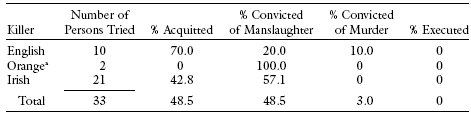
—English Homicide Trials Reported in The Times between 1867 and 1892 in Which Conflicts Involved More than One Person on Each Side and the Participants Expressed Their Motives in Ethnic or Sectarian Terms
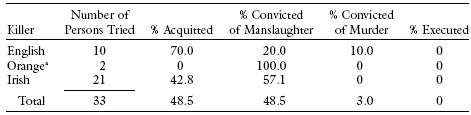
a In The Times, the terms “Orange” and “English” are used interchangeably, although it seems likely that the Orangemen may well have been from Ulster.
treatment of sectarian conflict. Despite the association of Irishness with Catholicism, English courts treated sectarian violence with a disdain for both sides. In cases in which one of the combatants was killed, the sentence was less than two years in every case regardless of the religion of the killer and victim. However, when the violence troubled respectable Englishmen, the reaction was different. In a case from Liverpool in which an Englishman who had tried to make peace between an Orangeman and a Catholic was stabbed to death, the Protestant who killed him was sentenced to life in prison.Footnote 61
These results are in line with the philosophy expressed by the English judge who heard cases stemming from the Murphy riots in Manchester in the late 1860s.Footnote 62 While both the police response and the jury verdicts in the case reflected a strong anti-Irish bias, in his remarks at sentencing Justice Hannen made a point of calling all the prisoners together before him to show that “the law would not nicely distinguish between the degrees of guilt. Some of the prisoners had been proven to be guilty of serious acts of violence and some only of being present. Some were of the English and some of the Irish party, but these circumstances made no difference to his mind.” The issue, Hannen insisted, was not religion but order. “All were guilty of the same offense in substance, that of disturbing the public peace. It was probable that each side thought the other was the aggressor; but that made no difference in their degree of criminality as it was the duty of all persons, even though aggrieved to abstain from taking the law in their own hands.” All were sentenced to four months regardless of the charges against them.Footnote 63
As seen in table 2, even though the Irish were far more likely to be convicted than English defendants, the deaths of participants in ethnic or sectarian conflicts were usually treated more leniently by the courts than homicides generally. The only murder conviction in a case with an ethnic component was in the case from Durham in which four Irishmen had killed the English shopkeeper. Willing participants in ethnic and sectarian brawls had placed themselves outside the bounds of civilized English behavior regardless of their place of birth. The deaths of such savages were less serious than those of Englishmen who lived up to the name.
SCOTLAND
The Scots took considerable pride in the tradition that “Scotland, although a little nation, merely by the moral power that animated it, contrived to inspire fear and respect in one much its superior in numbers and every other element of strength.”Footnote 64 They were also adamant about the differences between themselves and their neighbors and resented English ignorance of Scottish concerns. In 1868, the Scotsman complained, “We want some credit for our country and we want it on the true facts of the case and not upon these strange and persistent mistakes as to persons and places which our London counterparts in particular seem somehow to prefer making for themselves rather than accept the precise and plain truths furnished them every day from a variety of Scottish sources.”Footnote 65 Despite their national pride, the Scots were sometimes willing to see themselves as North Britons, though sometimes the designation may have been ironic. In the Glasgow Herald under the headline “Crime in the Country,” the majority of the crimes reported occurred in England, and English homicides usually merited much larger headlines than Scottish ones.
The Scots jealously guarded both their history and their distinctive institutions, which as a correspondent to the Scotsman noted, “were preserved from demolition by no generous sufferance on the part of the English nation, who would gladly have annexed Scotland in the manner and on the terms afforded to Wales and Ireland.” Under the terms of the Union, the Scots had kept their justice system, which included fifteen member juries in which a simple majority could render a verdict. Scottish juries also enjoyed an additional possible verdict. Defendants could be found guilty or not guilty, or the charge could be found not proven—in which case the defendant was freed but presumably with an impaired reputation. Nevertheless, the Scotsman suggested, “the minds of prisoners are much the same on both sides of the Tweed, and so are the minds of juries.”Footnote 66
In fact, the Scottish courts were more xenophobic than the English. Even though non-Scots made up only 13 percent of those tried for homicide in Scotland, they accounted for nearly a third of those executed for murder. The Scots were also highly suspicious of the Irish among them.Footnote 67 The Scotch Census Commissioners reported in 1876, “It is painful to contemplate what may be the ultimate effect of this Irish immigration on the morals and habits of the people and on the future prospects of the country.”Footnote 68 When accused of homicide, the Irish were more likely to be convicted than Scottish defendants and were more than twice as likely to be executed.
The tensions between the Scots and the Irish were particularly acute in southwest Scotland. Driven by rural poverty in Ireland and attracted by better wages in the heavy industry of Scotland, the Irish were an important source of cheap labor, but they also inspired considerable resentment. Nearly a quarter of persons indicted for homicide in Glasgow between 1867 and 1892 were Irish born. The Irish immigrants were also suspect on religious grounds. The Glasgow Herald concluded a report on capital crimes in Glasgow, “It is perhaps not unworthy of note that of eight culprits, six were Roman Catholic.”Footnote 69 Roman Catholic in this case was certainly code for Irish.
As Irish Protestants joined the migration, the sectarian tensions of Northern Ireland were played out in southwestern Scotland. Two homicides in Scotland in the 1870s could be traced to sectarian violence involving Irish immigrants. But unlike England, where sectarian violence was condemned regardless of who won, in Scotland the sectarian divide led to very different outcomes. In 1870 in Linlithgow a group of Protestant Orangemen, who had spent the day parading and drinking, attacked the home of a local Roman Catholic. Shouting “Down with Papists!” they dragged the man out of his home and beat him to death. Their defense attorney said that one of the Protestants had been struck by a man who had run into the victim's house, and the situation had been confusing. The prosecution asked for a verdict of culpable homicide (the Scottish equivalent of manslaughter), but the jury returned a unanimous verdict of not proven, the verdict Scottish juries often used to give the benefit of the doubt to sympathetic defendants.Footnote 70
Two years later the roles were reversed. On 12 July 1872, Orangemen held a procession in Wisham in North Lanarkshire. Later that night, two Catholics were pretending to duel with railroad ties when John Skillen, who, according to the Glasgow Herald, was not an Orangeman but “may have used provocative language,” arrived on the scene. Skillen died the next day of head injuries inflicted with railroad ties. The two Catholics accused of his murder said all they remembered was a drunken fight. Their defense attorney “impressed on the jury the unlikelihood of their assaulting in the manner described a man they did not know, without the slightest provocation and against whom they could have no malice.” Nevertheless the judge was indignant: “These party processions were a disgrace to a civilized country.” Despite the fact that the party procession had been by the Orangemen, the judge rejected the defense's suggestion that the crime was culpable homicide, not murder. “If the accused struck these blows with the weapon intending to do serious bodily injury, it was of no merit, in regard to the legal character that he did not intend to kill or that he had no malice. … He could only say that except in a case where a clear personal motive had been adduced, he had seldom seen proved in a court of justice a more cold-blooded, brutal and savage homicide.” The verdict was murder, and the sentence was death.Footnote 71
Scottish attitudes toward both Ireland and Irish immigrants in Scotland hardened as the Irish Home Rule movement developed. In the 1860s, the Scotsman took a measured approach. In 1869 an editorial noted, “The task we have before us is to create in the Irish character a respect for law, and this can only be done by separating the law from all alliances with injustice.”Footnote 72 As the Land War began in 1879, the Scotsman still described the Irish character as “very much though not wholly what it has been made, and it may be expected to change, in the process of time with good and just government.”Footnote 73 But the newspaper also chided the Irish as whiners. “Irishmen show a wonderful incapacity for helping themselves, and a wonderful capacity for getting others people's help. … An infusion of Scotch habits and characteristics would we rather think be a great blessing to Ireland, not even excepting Kerry.”Footnote 74 By 1882, while a little more skeptical about Irish character, the Scotsman was still willing to blame the historical oppression for much of the problem. “The lawlessness of the criminal class in Ireland may be due in some measure to the hot recklessness of the Celtic blood. It is certainly largely due to the bad laws under which Irishmen have been forced to live. Ireland is now receiving better and fairer laws but the character of a race cannot be changed in a day or in a year.”Footnote 75
But by 1886, when the Irish Home Rule Bill was heard in the British Parliament, the Scotsman's sympathy with the Irish had evaporated. “It should be understood once and for all that the people of Ireland have and have had their times and chances just as good and as bad as the people of the rest of the three United Kingdoms. They have been raised from tribal barbarism into comparative civilization and decency, much more by their connection with Great Britain than by their own unaided efforts.” Complaints about prior injustice would no longer be tolerated. “The most skilled and civilized observer[s] of Ireland before the English law was introduced are at one in the opinion that there was nothing to be found but oppression by native chiefs and utter barbarism among native occupants.” The nationality card was also rejected. “Who however can say who were the native occupants of Ireland? The Celts were themselves invaders and after the Celts the many waves of Danish, Saxon, Norman and other invasions are much the same as those which have resulted in England and Scotland in the great British nationality.” Regarding the purely Celtic Irish, “It would be a dereliction of clear duty as well as a want of political sense not only to leave these ignorant people to themselves, but to give them power to reduce their better countrymen to their own level.” The editorials now reflected the assumption that the Irish character was fatally flawed. “It is the misfortune of most Irishmen that they cannot conceive the possibility of arguing a case without resort to violence. Their first action against the man they believe to be wrong is, not to try to convince him of his error by arguments, but to attack and beat him down by noise or outrage.”Footnote 76
The growing impatience with and distrust of the Irish extended to those living in Scotland. “The lower Irish race are well known in both England and Scotland. They are in the great cities and mining districts of England and Scotland where they are to be found the cause of a large proportion—one half to one third—of the worst crime.” Not only were Irish immigrants to blame for much of the crime, the Scotsman suggested that they had also corrupted their neighbors. “It is they who have demoralized the mob by their frightful examples of brutal assaults on men when down to the utter forgetfulness of English and Scottish notions of fair play. It is not enough for an Irish combatant as he is known in this country, to knock his man down, he must proceed to kick and stamp upon his opponent when helpless.” Finally, it was the Irish immigrants who were overburdening the ratepayers. “Every Criminal Court in England or Scotland knows of such brutalities. But for this Irish immigrant population, low in civilization, there would be no need for many courts and for many policemen.”Footnote 77
The fear and loathing demonstrated in the Scotsman was also reflected in the Scottish courts. Even though the number of homicides committed by the Irish in Scotland fell both in absolute numbers and as a percentage of total homicides between 1867 and 1892, the conviction rate for the Irish accused of homicide in Scotland rose nearly 30 percent. The sentences also got heavier. The number of convictions that led to sentences of penal servitude rose by 25 percent, and the likelihood of an Irishmen arrested for homicide in Scotland being executed nearly tripled during the 1880s.
The increasing intolerance shown by the respectable Scottish press and the courts suggests that for the middle and upper classes ethnicity was a major concern. For the Scots, coping with dual nationalities, the Irish may have appeared as embarrassing poor relations. By failing to assimilate, the Irish were reinforcing the worst stereotypes about the Celts. Further, Irish nationalist leaders often criticized the Scots for their lack of national pride. The Scotsman defensively insisted that the Scots rightly took pride in realizing that “the nationality which every reasonable person desires to cultivate is the great nationality common to the Englishmen, Scotsmen and Irishmen alike.”Footnote 78 For respectable Scots, the Irish among them were an alien menace as well as a nagging reminder of lost national autonomy.
WALES
The Welsh were also suspicious of their neighbors, though their doubts were more wide-ranging. Though legally and politically the Welsh were indistinct from the English, culturally the differences were significant. The fact that the majority of the Welsh still spoke Welsh as their first language meant that in some ways the Welsh remained the most segregated of the four nations. An editorial in the Carmarthen Weekly Reporter contrasted the Welsh with their Celtic cousins: “The Irishman has no patriotic objection to conversing in England. The Highlander is as ready to give up his Gaelic as to give up the kilts which have for years been abandoned to gamekeepers, children and English tourists.” The editorial noted that the Welsh retained their language “without betraying any sentiment of hostility or envy towards the races which drove them westward. On the contrary the Welsh are a satisfied, industrious, law-abiding people who have long ago accepted their connection with England as the best thing that could have happened to them.”Footnote 79
But however accepting they were of the connection, the Welsh were certain that they were the most virtuous characters in the British Isles. “Murders are rare in Wales—would they were rarer—and no witness has need to fear assassination for giving evidence against the destroyer of human life. Welshmen may poach, may steal, may commit minor offenses yet it appears that they do less of these things than our English, Irish and Scottish neighbors do.”Footnote 80 The point was well made. Judges frequently remarked on light calendars at Welsh Assize. Justice Cleasby said in his charge at Pembrokeshire that “in most of the counties I have visited I should have thought the calendar before me was a light one, but it seems that here it is regarded as a heavy one.”Footnote 81 Justice Cockburn echoed the sentiments at the South Wales Assize: “Its population is one which is entitled to the highest possible praise for order, good conduct and obedience to the law.”Footnote 82 Even The Times occasionally admitted the Welsh were a peaceful lot. “It was certainly remarkable and gratifying circumstances that in these four counties [South Wales circuit] there should not have been one case in which any violence had been offered to any man or woman, either for the purpose of gaining anything by force, or in the case of drunken brawls or for the purpose of indulging any evil or revengeful passion.”Footnote 83
Welsh newspaper editors suspected that crimes within their borders were often the work of their British neighbors. “It is a notorious fact that the bulk of convictions at Welsh Assizes are of English tramps.” When a young woman was found murdered and robbed in a Welsh port, the press report insisted “there is not a scrap of evidence to show that she was murdered by a Welshman or that a solitary Welshman knows who the murderer was. The probability therefore is that she was slain by one or more of those tramps from England, Scotland, or Ireland who continually infest Welsh society and who cost the Principality so much for prosecution and imprisonment.”Footnote 84
Welsh newspapers were also full of sensational reports of crimes among their neighbors. The headline for a report of two murders, one on the Isle of Man and one in London, was “Two Typical English Tragedies.”Footnote 85 In an editorial headlined “Our Country's Crime,” the North Wales Chronicle noted that “it is not only in Ireland. … From all parts of the United Kingdom reports reach us which are calculated to fill our minds with dismay. … Scotland makes us fear that there is no crime too revolting for wicked men to commit for the sake of gain.”Footnote 86
In addition to reporting the crimes of their neighbors, the Welsh press sometimes took on the tone of a slighted sibling. “There are a few old fogies so blinded with prejudice that everything Welsh is bad. On the other hand, England is all good and especially Scotland, the latter being held up to our gaze as all but the pink of perfection while Ireland and Wales are fit only to point a moral or adorn a tale.” The editor of the Carmarthen Weekly Reporter was determined to show that the Scots were overrated. “Scotland, the most cultivated and civilized portion of her Majesty's dominion and with the most conservative and religious people in the world—so it is assumed—can still set some of the worst examples possible to the present age. One of these is drunkenness.” However, in the desire to show the Scots in the worst light, the editor did seem rather desperate for ammunition: “There was cock-fighting in Glasgow. If this be civilization and proper work for any day we have no wish to partake. Better run naked and sink into barbarism than be guilty of such deeds.”Footnote 87
Though jealous of the praise the Scots received, the Welsh shared the assumption that the Irish were particularly violent. In the report of a murder of a local gentleman by his gamekeeper the newspaper reported, “Seldom has the principality been the scene of a tragedy so horrible. The fatal shot once fired there seems to have awakened in the killer that wild beast thirst for blood which (perhaps inherited from some ferocious and barbarian Irish chieftain) had so long slumbered unsuspected or unnoted in his nature.”Footnote 88 The Llanelly Guardian reported under the headline “An Irish Row” that “in a quarter of town where a race of people live some of whom are celebrated for breaking each other's heads” a brawl had taken place inside a house where “about a dozen true sons and daughters of the Emerald Isle were all jabbering together.” The report also noted that instead of shillelaghs they “took a more modern course, viz, seize hold of the first earthen utensil that comes to hand and let fly.”Footnote 89
The contrast between the Welsh and the Irish was stressed in the account of a confrontation between Irishmen and Welshmen outside a pub in South Wales. “Two or three Welshmen in a pub had been pelted with stones by Irishmen. The Welsh remonstrated with them for their conduct and a fierce quarrel ensued.” The police separated the groups and then arrested one of the Irish “who had called on his countrymen for help and again the Irish threw stones.” According to the Welsh press at this point the Welshmen cried out, “Don’t abuse the police, they are only doing their duty.” The Irish then launched an attack on the Welsh and a general melee ensued. The police separated the two groups but, again according to the Welsh account, “the Irish gathered stones and again attacked the Welsh and the police. Only then did the Welsh become enraged and threw stones at Irish houses. It is not true that the police called on the locals to assist. It is not true that the Welshmen sought revenge on the Irish. They threw the stones at the doors and the windows in self-defense.”Footnote 90
There were at least three homicides stemming from ethnic riots in Wales between 1867 and 1892, though the Irish were not always involved. When an English worker was beaten to death during a fight between Welsh and English railway workers, the local press explained, “What took place seems to have arisen from the jealousy of races, and partly from that which so often accompanies crimes of that description the excitement of drink.” At the trial a witness testified to hearing one of the Welsh prisoners say “that the next English—that was out of the hut I’ll knock the brains out of his head.” The defense argued that the “dispute between the navvies was one of nationality and that on the night the victim was injured the three accused were pursued by a dozen English navvies and struck the victim in self-defense.” A Welsh jury acquitted them all.Footnote 91 But in the two other cases in which Irish laborers were killed by Welshmen, the juries convicted their compatriots of manslaughter, and they were sentenced to penal servitude.Footnote 92
CONCLUSION
Despite the Acts of Union, the nations of Britain remained distinct in their nationalities, their attitudes toward each other, and homicides stemming from those attitudes. Though English judges and juries dealt severely with Irish suspects, by the end of the century fears of Irish roughs were increasingly subsumed by concerns about the gap between residents who were living up to respectable English standards and those who were not, regardless of their place of birth. “English Savages,” as a Times headline referred to them, were as blameworthy as those of other nations, if not more so.Footnote 93 Increasingly, native-born roughs in London and the north seemed as dangerous and alien as the Irish or other foreigners. The Pall Mall Gazette even suggested that the measures taken against the natives in Ireland and the colonies should be used in Liverpool. “A body of police should patrol the district large enough to make the inhabitants aware that there is not an angry word or a loud cry or a rough jostle which will not bring the eye of a constable upon them. … These are the methods by which disorder has been put down in Ireland and India, and there is no reason why the disease should be harder to control in Liverpool.”Footnote 94 Englishness was not simply a matter of bloodlines or birthplace, it was a matter of character.Footnote 95
Neither the Welsh nor the Scots were completely comfortable with limiting their own identity to that of Britons. For the Scots, this dual identity made the Irish even more of a psychological problem than they were for the English. The Irish in Scotland were perceived as a criminal menace. Meanwhile, Irish nationalism served as an embarrassing reminder both of the Scots's own Celtic heritage and the fact that Scottish nationalism had yielded to the Union. In 1887, The Times claimed that “a Scotchman has two [patriotisms], but he is sensible of no opposition between them. He is none the less loyal to the United Kingdom because he is also loyal to Scotland; and he believes the day may come when the same will be true of an Irishman.”Footnote 96 As the Irish grew more rather than less aware of the opposition between the two, the Scots may have felt the English were all too willing to ignore Scottish distinctiveness. When the English government objected to the erection of a monument to celebrate the Scottish victory at Bannockburn, the Scotsman insisted: “We cannot really afford to forget that at terrible odds we fought against our great neighbor throughout twelve generations for our existence as a nation, and that at last we won it on that spot whereon we hope the ruddy lion rampant in gold will float on every 24th June as long as men shall class patriotism as a virtue and freedom as a blessing.”Footnote 97
But that battle was long past, and the late nineteenth-century Scots were sensitive to criticism of their failure to match the nationalist fervor of the contemporary Irish. The Scotsman indignantly explained: “We have not felt that we did ourselves dishonour or disservice by becoming part, not of England but of the United Kingdom.” Further they suggested proudly that no one should presume “so far upon our want of rationality or our superabundance of nationality as to suggest that it would have been justifiable, if not preferable to have betaken ourselves to murder and arson, as a means to the restoration of disunion and conflict.”Footnote 98 Being the most rational nation of the United Kingdom was never easy.
As to the Welsh, the press frequently complained that their virtues, their culture, and their very existence was all too often overlooked by their stronger neighbors. They also suspected that what few homicides there were in Wales were the action of intruders from other parts of the United Kingdom. But, ultimately, there was also a sense of resignation. After a riot in which Welsh workers had attacked English ones, the North Wales Guardian suggested attacks were out of character: “The Welsh as a nation have ever had the credit of being hospitable to strangers. It should be remembered that there are many Welshman working in English districts. It is also silly to find prejudices of race in a land where all are Britons and should live together in good fellowship.” Perhaps more telling was the last sentence: “The law of England must be upheld … and no doubt it will be found powerful enough to protect an Englishman even in isolated districts of North Wales.”Footnote 99
However resigned they may have been to English power, the Scots and the Welsh had by no means relinquished their sense of a separate identity. They were particularly unwilling to adapt the simple dichotomy that all things good were British, which all too often in the English press was taken to mean “English.” In the courts and the press the Scots and Welsh continued to insist that “the greater British nationality” was far more diverse than the Podsnaps of the world might allow.