Iridopsis panopla Prout, 1932 and Thyrinteina arnobia (Stoll, 1782) (Lepidoptera: Geometridae) are eucalyptus defoliators that in recent years have reached high population levels, especially in eucalyptus plantations in the State of Mato Grosso do Sul, Brazil. In 2021, favourable climatic conditions led to outbreaks of these two pests on 13 plantations (approximately 181 174 ha of cultivated eucalyptus; Wilcken et al. Reference Wilcken, Santos and Pereira2021).
Interest in Iridopsis spp. was previously triggered by outbreaks of Lepidoptera associated with eucalyptus plantations in the state of Minas Gerais, Brazil (Zanuncio et al. Reference Zanuncio, Santos, Sartório, Anjos and Martins1989). Subsequent study identified Iridopsis fulvitincta (Warren, 1897) (Lepidoptera: Geometridae) and an unidentified Iridopsis species from the municipality of Sao Carlos in the state of Sao Paulo, Brazil (Geraldo Reference Geraldo2011). Two new species, I. hausmanni and I. parrai, were identified from northern Chile (Vargas Reference Vargas2007).
Because they are important natural enemies of Lepidoptera, identifying the hymenopteran parasitoids of I. panopla is of interest. Two potential such parasitoids are Trichospilus diatraeae Cherian and Margabandhu, 1942 (Eulophidae) (Pereira et al. Reference Pereira, Zanuncio, Tavares, Pastori and Jacques2008) and Brachymeria annulata (Fabricius, 1793) (Chalcididae) (Santos-Murgas et al. Reference Santos-Murgas, Gutiérrez-Lanzas and Lanuza-Garay2021). Trichospilus diatraeae is a gregarious endoparasitoid that develops mainly in T. arnobia pupae in eucalyptus (Pereira et al. Reference Pereira, Zanuncio, Tavares, Pastori and Jacques2008; Pastori et al. Reference Pastori, Pereira, Andrade, Silva, Zanuncio and Pereira2012). Brachymeria annulata is a solitary parasitoid that parasitises prepupae of different lepidopteran hosts, including Erinnyis ello (Linnaeus, 1758) (Sphingidae) (Santos et al. Reference Santos, Tavares, Sutil, Vasconcelos, Azevedo and Diogo2017) and Talides hispa Evans, 1955 (Hesperiidae) (Santos-Murgas et al. Reference Santos-Murgas, Gutiérrez-Lanzas and Lanuza-Garay2021).
The objective of the present study was to rear parasitoids from pupae of I. panopla to determine the potential occurrence and biological aspects of B. annulata and T. diatraeae.
Pupae (n = 100) of what was subsequently confirmed to be Iridopsis sp. were collected from a commercial plantation of Eucalyptus grandis in Ribas do Rio Pardo, Mato Grosso do Sul (21° 03′ 22″ S, 53° 48′ 04″ W; 516 m above sea level), on 27 May 2019. Pupae were placed individually in plastic vials (80 mL) and brought to the Laboratory of Biological Control of Insects (22º 11′ 56,56″ S, 54º 56′ 1,396″ W), Faculty of Biological and Environmental Sciences of the Federal University of Grande Dourados (Mato Grosso do Sul, Brazil). Specimens were kept at 25 °C room temperature until the emergence of moths or parasitoids.
To confirm the identity of the Iridopsis species, co-authors Carlos Frederico Wilcken and Fábio Araújo dos Santos collected and sent adults to Dr. Alberto Soares Côrrea, Laboratory of Molecular Ecology of Arthropods, Department of Entomology and Acarology, Luiz de Queiroz College of Agriculture, University of São Paulo (Piracicaba, São Paulo, Brazil), for molecular barcoding. The cytochrome oxidase subunit 1 mitochondrial gene region of the DNA sample was amplified, sequenced, and compared with the Barcode of Life database (BOLD Systems, https://www.boldsystems.org/index.php/databases), obtaining 100% homology with I. panopla.
After 18 days, a chalcidoid species emerged from 55 pupae (one individual per pupa), and a eulophid species emerged from two pupae (168.5 ± 41.5 individuals per pupa; 88% female). The species were subsequently identified as B. annulata and T. diatraeae, respectively, and provide evidence for the first time that these species can find, parasitise, and develop in I. panopla pupae. (All values throughout the article are reported as mean ± standard error.)
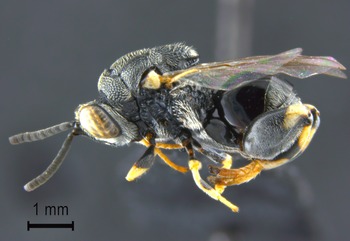
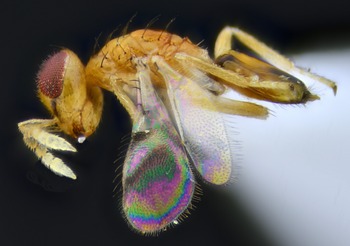
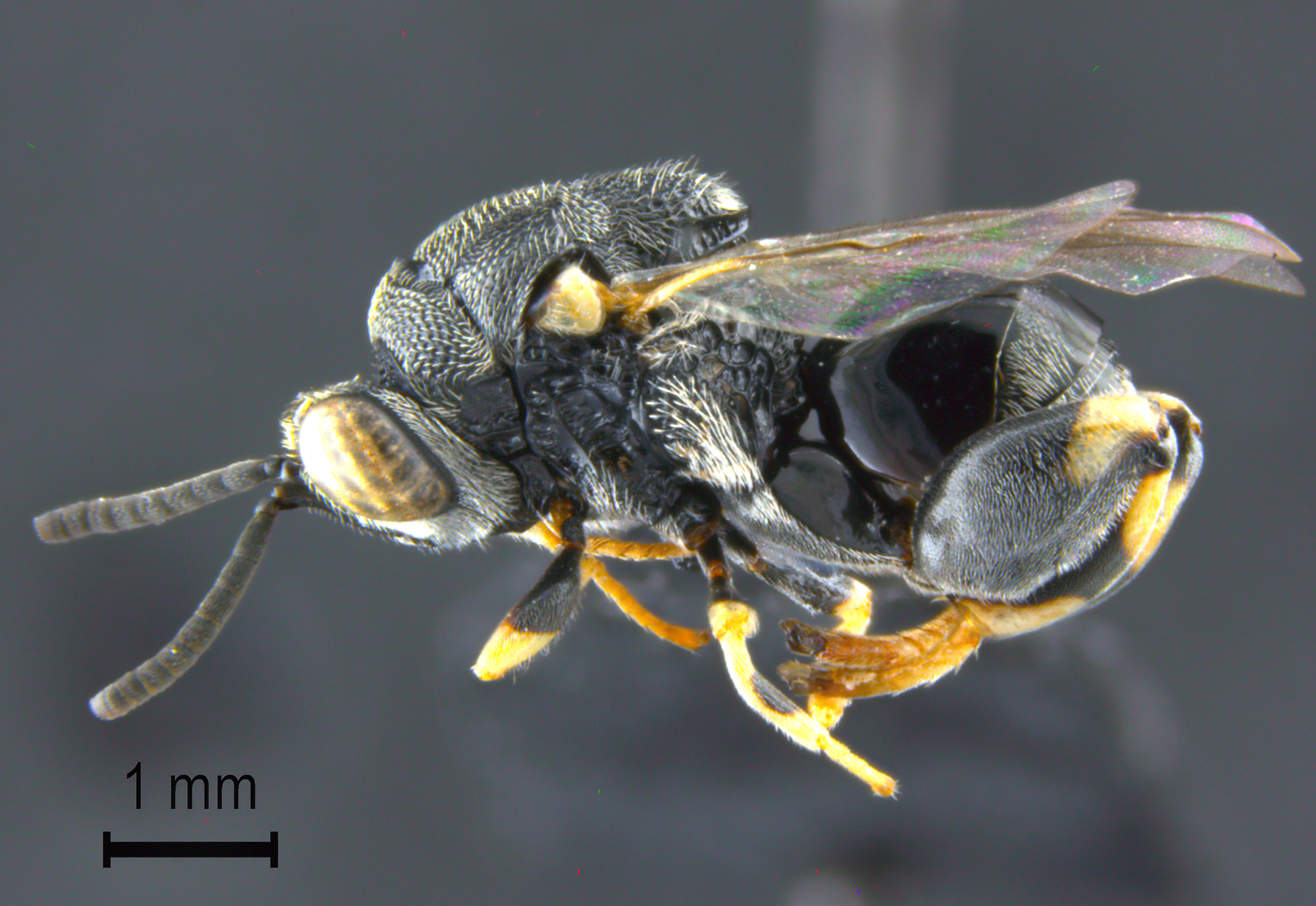
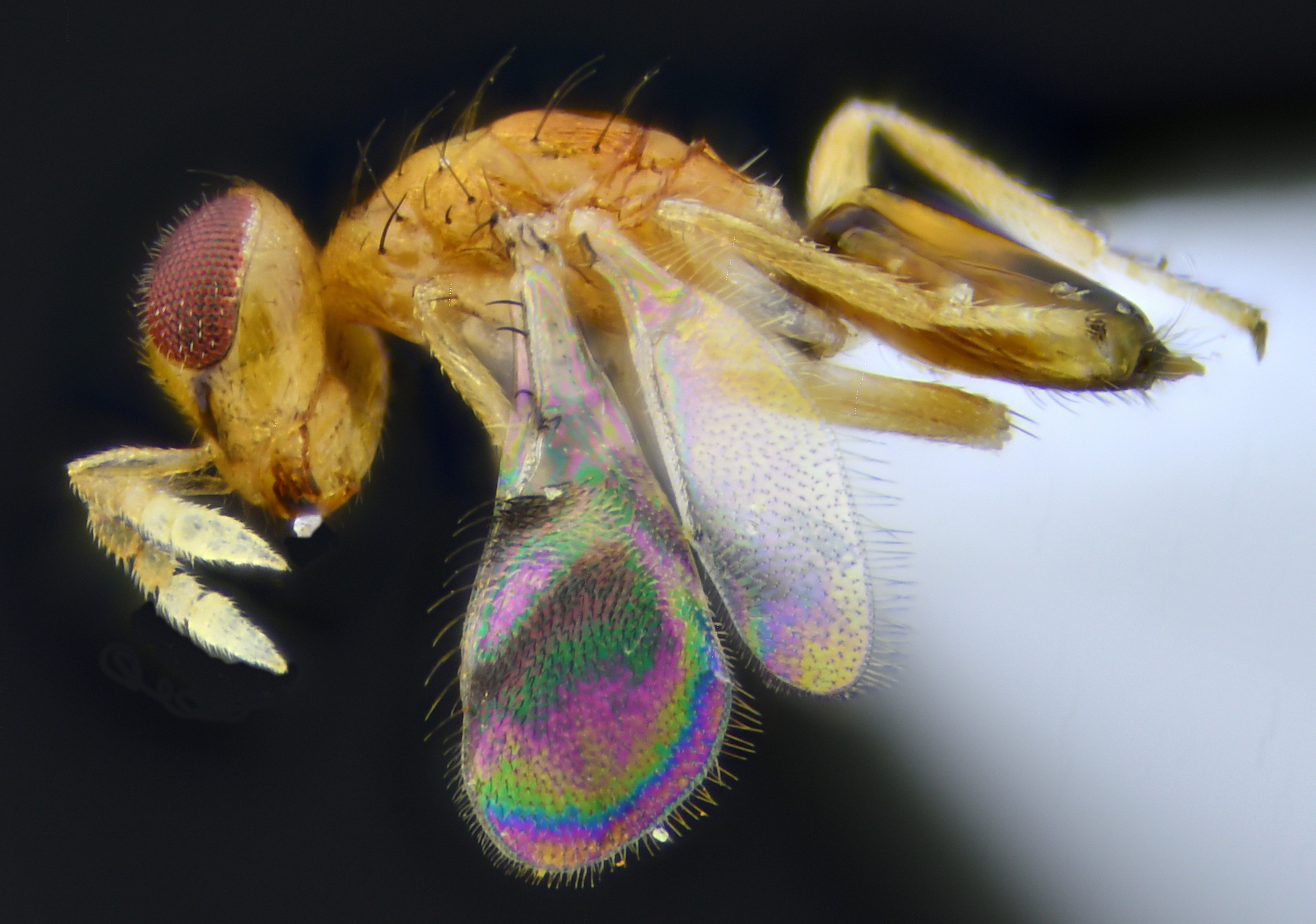
For parasitoid identification, specimens were fixed in 70% ethanol and sent to Dr. Marcelo Teixeira Tavares, Department of Biological Sciences, Federal University of Espírito Santo (Vitória, Espírito Santo, Brazil), who identified the chalcidoid as B. annulata (Fig. 1) and the eulophid as T. diatraeae (Fig. 2). To make these determinations, the specimens were dehydrated and dried through ethanol series and hexamethyldisilazane baths following Dal Molin (Reference Dal Molin2018), glued on the tip of a card triangle, and then examined using a Leica M205 C camera with a 16× ocular, a 1× Planapo objective, and a LED5000 RL ring light (Leica, Wetzlar, Germany). The identification of B. annulata was made by comparing the specimens to a type series of New World Brachymeria species (mainly the lectotypes of Chalcis annulipes Walker, 1834 and Oncochalcis jörgenseni Cameron, 1909 – both junior synonymies of B. annulata) and based on comments provided by Bouček and Delvare (Reference Bouček and Delvare1992). The identification of T. diatraeae was made based on the descriptions and keys by Bouček (Reference Bouček1976), Ubaidillah (Reference Ubaidillah2006), Narendran (Reference Narendran2011). Voucher specimens are deposited in the Entomological Collection of the Universidade Federal do Espírito Santo, Vitória, Brazil.
Brachymeria annulata.
Trichospilus diatraeae.
Following the collection and identification of the parasitoids, we then conducted experiments to elucidate some aspects of the biology of T. diatraeae in I. panopla pupae. Caterpillars were reared on eucalyptus branches covered with organza fabric cages until the pupal stage. Fifteen pupae (aged 24 hours; mass range of 63–185 mg) were then individually placed in plastic vials (80 mL) and exposed for 24 hours to a mated female T. diatraeae (aged 48 hours) under conditions of 25 ± 2 °C temperature, 70 ± 20% relative humidity, and a 14-hour photoperiod. Fifteen additional pupae were individually reared under the same conditions without parasitoid exposure (negative control) to assess adult I. panopla emergence in the absence of parasitism. The biological aspects evaluated were (1) percentage parasitism (%P) [(number of I. panopla pupae with parasitoid emergence + pupae without emergence of I. panopla adults/(total number of pupae) × 100]; (2) percentage emergence (%E) [(number of I. panopla pupae with emergence of the parasitoid adults)/(number of parasitised pupae) × 100]; (3) duration of the life cycle (period of immature parasitoid development counted from the day of parasitism until emergence of the adult); (4) total progeny (number of emerged parasitoids per parasitised host); (5) relative female frequency (number of females/total number of emerged parasitoids); and (6) average adult longevity (male and female). The parasitoids were kept in plastic vials (80 mL) with a droplet of pure bee honey for food.
Under laboratory conditions, the percentages of parasitism and emergence of T. diatraeae in I. panopla pupae were 93.3% ± 6.7% and 46.7% ± 17.6%, respectively. The death of host pupae from which parasitoids did not emerge was attributed to parasitoid-induced death, because adult I. panopla emerged from all of the pupae that were not exposed to T. diatraeae. Parasitoid-induced death without parasitoid emergence is still important because it reduces insect pest reproduction. In comparison with our laboratory findings, parasitism of T. arnobia pupae by T. diatraeae was 20% in commercial eucalyptus plantations, which reduced the population of this pest after 45 days (Pereira et al. Reference Pereira, Pastori, Kassab, Torres, Cardoso, Fernandes, Parra, Pinto, Nava, Oliveira and Diniz2021). The present study’s finding suggests similar reductions could be achieved for I. panopla. In this context, a biological control programme was established for I. panopla (Pereira et al. Reference Pereira, Pastori, Kassab, Torres, Cardoso, Fernandes, Parra, Pinto, Nava, Oliveira and Diniz2021).
Values of percentage parasitism and emergence obtained in our laboratory study are similar to those reported for Palmistichus elaeisis Delvare and LaSalle, 1993 (Hymenoptera: Eulophidae) parasitising T. arnobia pupae, which is the main defoliating lepidopteran of eucalyptus (Barbosa et al. Reference Barbosa, Zanuncio, Pereira, Kassab and Rossoni2016). The parasitism and emergency of P. elaeisis in T. arnobia were 58.30 and 28.60, respectively. Life cycle duration (egg–adult) and total progeny of P. elaeisis in T. arnobia pupae were 25.00 days and 30.00 individuals per host, respectively. The relative female frequency of P. elaeisis was 0.46 ± 0.45 (Barbosa et al. Reference Barbosa, Zanuncio, Pereira, Kassab and Rossoni2016).
Life cycle duration (egg–adult) and total progeny of T. diatraeae in I. panopla pupae were 25.33 ± 0.9 days and 64.08 ± 28.0 individuals per host, respectively. The relative female frequency of T. diatraeae was 0.89 ± 0.06. The longevity of T. diatraeae adult females and males in I. panopla pupae was 15.53 ± 1.50 and 24.33 ± 1.35 days, respectively.
Half of the field-collected I. panopla pupae examined were parasitised by B. annulata, suggesting a high level of control for I. panopla in eucalyptus, particularly given that the host pupae are in the soil and in the litter. Studies related to rearing techniques in the laboratory are warranted to evaluate the efficiency of B. annulata as a biological control for this pest.
On the other hand, an average of 169 T. diatraeae emerged per field-parasitised I. panopla pupa, but field parasitism was only 2%. Nevertheless, this parasitoid also should be evaluated as a biological control agent, given that it parasitised 93% of I. panopla pupae exposed in the laboratory.
Life cycle duration, emergence, sex ratio, and longevity of male and female T. diatraeae in I. panopla pupae were similar to those found for T. diatraeae in T. arnobia (Zaché et al. Reference Zaché, Zaché and Wilcken2011), Diaphania hyalinata (Linnaeus, 1758) (Silva et al. Reference Silva, Zanuncio, Pereira, Wilcken, Pereira, Serrão and Zanuncio2014), and Diatraea saccharalis (Fabricius, 1794) (Lepidoptera: Crambidae) (Table 1), and this parasitoid, T. diatraeae, has been employed for its control of D. saccharalis (Vargas et al. Reference Vargas, Pereira, Calado, Glaeser, Rodrigues and Silva2014).
Biological characteristics of Trichospilus diatraeae (Hymenoptera: Eulophidae) in pupae of different hosts.

This is the first record of the natural parasitism and biological aspects of B. annulata and T. diatraeae in I. panopla pupae. Both parasitoid species have been recorded attacking other defoliating lepidopterans on eucalyptus in Brazil. Brachymeria annulata has been recorded attacking T. arnobia (Souza et al. Reference Souza, Junqueira, Wilcken, Soliman, Camargo and Nickele2016; Candelária et al. Reference Candelária, Souza, Jorge, Becchi, Puretz and Wilcken2017). In addition to attacking T. arnobia, T. diatraeae has been recorded attacking Melanolophia consimilaria Walker, 1860 (Lepidoptera: Geometridae) (Zaché et al. Reference Zaché, Wilcken, Costa and Soliman2010). This allows us to evidence that B. annulata and T. diatraeae are one of the biotic factors of natural pupae mortality. Therefore, conservation strategies for these parasitoids among the understorey and fragments of native vegetation surrounding the plantations are important for the population balance of eucalyptus lepidopterans defoliators (Dall’Oglio et al. Reference Dall’Oglio, Ribeiro, Ramalho, Fernandes, Wilcken and Assis Júnior2016).
Further research should be carried out to verify the biological efficiency of these pupae parasitoids under laboratory, semi-field, and field conditions, including the number of parasitoids and field releases, the timing and culture of phenology, and its interference in the ability to search for the parasitoid, as well as the cost of manual and unmanned aerial vehicle release (Barbosa et al. Reference Barbosa, Pereira, Motomiya, Kassab, Rossoni and Torres2019). Determining that information would help to lay the groundwork to determine whether the parasitoids could be registered as biological products at the Brazilian Ministry of Agriculture, Livestock and Supply to be used by foresters for biological control of I. panopla in eucalyptus.
Acknowledgements
Professor Dr. Alberto Soares Côrrea, Luiz de Queiroz College of Agriculture, University of São Paulo, Piracicaba, São Paulo, Brazil conducted the 55 molecular identification of Iridopsis panopla (Lepidoptera: Geometridae). Financial support for this research was provided by the Coordination for the Improvement of Higher Education Personnel (CAPES) and the National Council for Scientific and Technological Development (CNPQ) – (Processes 304055/2019-0; 437490/2018-1). The Sul-Mato-Grossense Association of producers and consumers of planted forests (REFLORE-MS) provided human and financial support for this research. M.T.T. and B.C.S. are grateful for the financial support of the Instituto Nacional de Ciência e Tecnologia dos Hymenoptera Parasitoides (INCT HYMPAR) (CNPq Proc. # 465562/2014-0; FAPESP Proc. # 2014/50940-2) and CAPES (Program DS, Proc. # 88887.482505/2020-00).