1 Introduction
Major financing problems of the public pay-as-you-go (PAYG) pension system are caused by the demographic change. Therefore, keeping up the PAYG system is contingent upon the development of the working to non-working or the old-age dependency ratio. These ratios in turn are influenced by the birth rate, life-expectancy as well as the level of migration. Decreasing birth rates and increasing lifespan result in a larger proportion of elderly people in the population, which has to be financed by a decreasing number of younger people.
To meet the financing problems Germany, among many other countries has implemented pension reforms reducing the overall pension level (reform in 2001) and raising the statutory retirement age (reform in 2005). Especially the first change will lead to significantly lower old-age income. Thus the current standard of living might not be ensured. The German government attempted to increase private old-age provisions, by introducing incentives. In 2002, the so-called ‘Riester pension’Footnote 1 was implemented to foster the voluntary retirement arrangements through supplementary allowances and tax credits offered by the state. Since then the ‘Riester pension’ has grown in popularity. Today, about 13.6 million contracts are registered (end of 2010). In contrast to the ‘Riester pension’, the traditional private pension insurance is less regulated by the government and therefore offers higher flexibility concerning the payment of the insurance benefit.
One shortcoming of the public subsidization of private old-age provisions is the low participation rate among individuals eligible for the ‘Riester contract’. Up to now – and despite the growing popularity – merely 35% of the eligible population owns a ‘Riester contract’. This low uptake shows the necessity of a detailed analysis of the effect of governmental subsidies and how these subsidies affect other forms of private old-age provisions.
A large number of studies (e.g., Börsch-Supan et al. Reference Börsch-Supan, Reil-Held and Schunk2008b; Coppola and Reil-Held, Reference Coppola and Reil-Held2009; Corneo et al. Reference Corneo, Keese and Schröder2009, Reference Corneo, Keese and Schröder2010) analyze how these subsidies work. They focus on the determinants of individuals’ savings or the uptake behavior regarding ‘Riester pensions’. These studies therefore investigate, whether younger individuals join the subsidized new pension scheme more frequently than the elderly, or whether private savings are crowded out through the heavily subsidized ‘Riester pension’.
The main focus of most of the literature on private old-age provisions in Germany is either on the determinants of ‘Riester pensions’ using one cross-section (except of Pfarr and Schneider, Reference Pfarr and Schneider2011) or an investigation – using panel data – of the effects of public subsidies on the individual savings in general (see Corneo et al. Reference Corneo, Keese and Schröder2010). To our best knowledge, no study examining the dependency of subsidized ‘Riester pensions’ and unsubsidized private pension insurance using panel data exists.
The main aim of this paper is to study the relation between subsidized ‘Riester pensions’ and unsubsidized private pension schemes using German panel data. We address two research questions: First, do governmental subsidies induce special forms of private pension schemes? Second, is the uptake of private pension schemes influenced by insurance agents? Our paper contributes to the existing literature by reinvestigating the relationship between subsidized and unsubsidized pension schemes using the German SAVE study. Using methods for simultaneous equations, we analyze whether the decision for a ‘Riester pension’ is independent of the decision for unsubsidized private pension insurance.
The main findings of the paper can be summarized as follows: Regarding our first research question, we find positive incentive effects of child subsidies, whereas low income earners are not seen to increase their old-age provisions. Further, there is strong evidence that individuals already seeking financial security by obtaining various assets make additional investments in ‘Riester pensions’ or private pension insurances. Concerning the second research question, demand inducement can be assumed for the subsidized ‘Riester pension’, but not for traditional private pensions. Therefore, financial intermediates seem to play an important role in the decision-making process on ‘Riester pensions’. These results confirm most of the findings in the previous literature and enhance the evidence with respect to income effects and the influence of children. Further results strengthen the hypothesized behavior of financial intermediates on the uptake of a ‘Riester pension’.
The remainder of the paper is organized as follows: section 2 describes the German old-age pension scheme and gives a brief introduction to the subsidized private ‘Riester pension’. Section 3 gives an overview of the related empirical literature dealing with the incentive effects of subsidized private pension schemes. In the following section 4, we describe the dataset and discuss the empirical methodology followed by the presentation of the results in section 5. Section 6 finally concludes the findings.
2 The German pension scheme
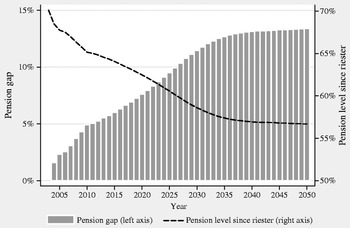
Currently, the old-age provision of German citizens usually consists of three independent pillars: the public PAYG system, occupational pension schemes and private old-age provision.Footnote 2 The public PAYG system is still the most important institution to prevent poverty and to ensure the standard of living after retirement. To date, 80% of the working population is covered by the statutory pension insurance, while more than 89% of the retirees receive such a pension (see BMAS, 2010b, p. 12). However, the PAYG system is exposed to major financing problems due to the demographic change. Two trends are the major causes of population ageing: first, increasing life expectancy and second, a decreasing fertility. To stabilize the system and to secure its financial sustainability the German government began to reform the public pension system. As a result the overall pension level will gradually be reduced and the statutory retirement age will increase from 65 up to 67 years. The 2001 reform will lead to a notably lower old-age income in future which may not ensure the current standard of living. This linkage can be visualized by the pension gap, which is calculated as the difference between the net pension level before the pension reforms and the net pension level after the reforms. Thus, the overall net pension level of a German ‘standard pensioner’ (Eckrentner) – before the reforms – amounted to 70% of the current average net income in the public PAYG system. As the pension level is decreasing because of the reforms in the years 2001 and 2005, the pension gap is increasing. This pattern is shown in Figure 1.
Future cuts in public pension. Source: Börsch-Supan et al. (Reference Börsch-Supan, Essig and Wilke2005, p. 22); own visualization.

The figure shows the described development of the future pension level after the ‘Riester reform’ (black dashed line). Starting 2003, the overall pension level has decreased from ca. 70% to ca. 65% in 2011 and will further decrease to 56.69% in the year 2050. This results in an increasing pension gap (grey bars) that has to be closed by private old-age provisions to ensure the standard of living before the reform. As Figure 1 shows, individuals retiring in the year 2020, compared to the pension level in the year 2001, will suffer from a pension gap of about 8%. Consequently, individuals have to make private old-age provisions to compensate for these future cuts in public pensions. By introducing incentives the German government has attempted to increase old-age provisions (cf. EStG (German Income Tax Act) 2001). First, individuals have the option to defer a part of their salary into contributions to pension plans (second pillar). This is promoted by the government through tax deferrals and exemption from social security contributions. Second, individuals may choose to invest in private old-age provision to offset the pension gap.
2.1 Private old-age provision in Germany: subsidized and unsubsidized pension schemes
One of the major goals of the 2001 pension reform was to prompt especially low-income earners to make provision for old-age as this group is – still today – very strongly affected by the reduction of the overall pension level. This refers to the fact that low-income earners pay fewer contributions to the public PAYG system resulting in very strongly low expected pensions. By the reduction of the pension level (see Figure 1), low-income earners expected pension will once again decrease.
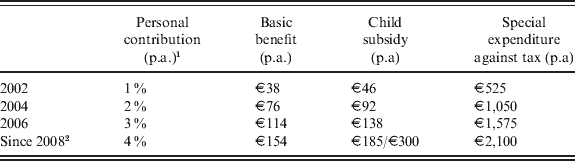
The German government promotes ‘Riester pension’ products through fixed supplements and tax incentives (see Börsch-Supan and Wilke, Reference Börsch-Supan and Wilke2004; BMAS, 2009).Footnote 3 People are entitled to subsidized ‘Riester pension plans’ if they are directly affected by the 2001 pension reform and are still actively insured in the public pension scheme. Moreover, spouses without direct entitlement are indirectly entitled conditioned on partners’ direct eligibility. Individuals, who are not mandatorily insured in the public system, such as self-employed, students as well as low-income earners (up to €400 per month) are not eligible.Footnote 4 Since the last adaption in 2008, the maximum subsidies are granted, if the personal contribution including the governmental subsidy accounts for at least 4% of the individual's gross income of the previous year. If the contributions to a ‘Riester contract’ are lower, the subsidies are reduced proportionally. Moreover, higher subsidies directly lower the personal net contribution.Footnote 5 Since the introduction, financial support has been increased in four steps (see Table 1).
‘Riester pension’ steps
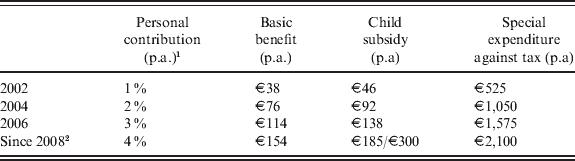
1 To qualify for the maximum subsidies, the personal contribution including the governmental subsidies must account for 4% of the individuals’ gross income of the previous year.
2 Since the year 2006, ‘Riester pension’ contracts have to be unisex tariffs. Since January 1, 2008, individuals aged 25 and younger receive a one-time additional benefit of €200 in the first year.
Source: Börsch-Supan et al. (Reference Börsch-Supan, Reil-Held and Schunk2008b, p. 298); own presentation.
Since 2008, the ‘Riester pension’ has reached its highest level of public assistance. The basic benefit now amounts to €154 and the child subsidy to €185 per year for each child for whom the beneficiary receives child benefit. For children born from 2008 onwards, the child supplement is €300. In addition, the retirement pension contributions of up to €2,100 (taking the supplement into account) can be offset as additional special expenditure against tax. Because of the design of the German income tax system, tax expenditures are favorable for higher incomes. A modification of the ‘Riester pension’ in the year 2005 simplified the application procedure and reduced the complexity, causing the demand for a subsidized old-age provision to increase. Overall, the official statistics of the Federal Ministry of Labour and Social Affairs (BMAS, 2010a) shows a strongly increasing uptake of subsidized ‘Riester pensions’. By the end of 2010 more than 13.6 million ‘Riester contracts’ were signed.
To evaluate the success of the ‘Riester pension’ scheme, two aspects are of high relevance. First, acceptance in wide parts of the population is very important in order to reach political objectives targeted by the subsidized ‘Riester pension’. Accordingly, the total number of ‘Riester contracts’ has to be set in relation to the number of all individuals eligible, which amount to about 37 million (Sommer, Reference Sommer2007; Fasshauer and Toutaoui, Reference Fasshauer and Toutaoui2009). Therefore, by the end of 2010, a total of 13.6 million ‘Riester contracts’ result in a diffusion rate of 36.7%. Consequently, within the last 8 years a broad coverage – at least within the eligible population – has not been achieved.
Second, the characteristics of individuals who have taken up a ‘Riester pension’ have to be considered. From 2002 to 2010, the total sum of allowances – without tax deductibles – paid by the government amounts to 8.4 billion euros (cf. Stolz and Rieckhoff, Reference Stolz and Rieckhoff2010). In the contribution year 2008Footnote 6, the average personal contribution including the governmental subsidies amounted to €822. However, 4% of the average wage of the PAYG system would require an average personal contribution of €1.200, which is clearly above the €822 realized in 2008. This corresponds with the fact that only 60% of the eligible individuals received the full allowances in 2008. Looking at further characteristics, 56.7% of the beneficiaries were women, 25.9% of the beneficiaries lived in East Germany and about 41% of the individuals receiving a basic allowance additionally also received child allowances for at least one child (Stolz and Rieckhoff, Reference Stolz and Rieckhoff2010). Corresponding to these figures the political goals have not yet been achieved. This makes further research on the determinants and the uptake behavior of ‘Riester pensions’ even more important.
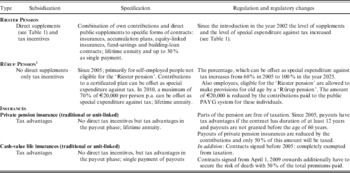
Generally, various types of assets closely related to old-age provision exist (see Table 2). Besides the ‘Riester pension’, the ‘Rürup pension’ was introduced in 2005. These two schemes mainly differ with respect to the inclusion of self-employed. While self-employed are not eligible to sign a ‘Riester contract’ (unless they are voluntarily insured in the public PAYG system) they have access to the ‘Rürup pension’. In contrast to the ‘Riester pension’, the ‘Rürup pension’ is exclusively based on tax incentives (see Table 2). Apart from subsidized pension plans, private pension insurances are popular instruments for old-age provision. In addition, cash-value life insurances are also important as an instrument for old-age and survivor provision. Both forms differ with respect to taxation of revenues and the inclusion of the event of death. For cash-value life insurances, this means that the inclusion of the risk of death leads to a higher risk component in relation to the savings component. To determine the relative risk of individuals, a health questionnaire has to be filled out prior to the signing. Comparability of ‘Riester plans’, ‘Rürup plans’ and the private pension insurance to cash-value life insurances is limited by the fact that these are characterized through a single payment of the whole payout. Thus, we refrain from cash-value life insurances and concentrate on investments with a lifetime annuity.
Saving types in Germany with respect to old-age provision

1 The ‘Rürup pension’ was named after the economist Bert Rürup.
Remark: There exist other forms of non-subsidized (supplements or tax incentives) assets related to provisions for old-age such as accumulation plan, federal treasury bill, stocks and different forms of funds and real estate. As we focus on private old-age provisions, occupational pension schemes are left out.
Source: Stiftung Warentest (2010) ; own presentation.
Regarding the taxation of private old-age provisions, revenues from a ‘Riester contract’ are fully taxed, whereas taxable revenues from private pension insurance are only taxed up to 18%. Therefore, private pension insurances are not directly subsidized by allowances, but rather through tax concessions. As the personal tax rate is usually lower for retirees, the private pension insurance provides implicit tax deferrals. Furthermore, private pension insurances are more flexible during the saving as well as the payout phase and offer a more transparent choice between different products. To sum up, ‘Riester pensions’ and traditional private pension schemes are comparable investments, but differ with respect to subsidization, flexibility and taxation. Hence, it is interesting to analyze whether the demand for these two forms of old-age provisions differs with respect to socio-economic characteristics.
3 Literature review
For the purpose of this analysis, the literature on the determinants of private old-age provision can be classified into tree strands. One strand emphasizes the uptake of a subsidized ‘Riester pension’. The focus of the second strand is on the signing of unsubsidized private pension insurance. Finally, the third strand considers international evidence.
Most research contributions concentrate on the substitution effect based on the ‘Riester pension’.Footnote 7 Corneo et al. (Reference Corneo, Keese and Schröder2009, Reference Corneo, Keese and Schröder2010) analyze the propensity to save of low-income private households in Germany. The data used in their analysis are from the German Socioeconomic PanelFootnote 8 and the German SAVE study.Footnote 9 The results of these studies indicate that governmental subsidies neither have an effect on the propensity to save of private households nor do they increase the proportion of saving households within low-income groups. The authors conclude that ‘Riester pensions’ substitute other forms of savings. Furthermore, Börsch-Supan et al. (Reference Börsch-Supan, Reil-Held and Schunk2007) give additional evidence for the existence of the substitution effect. Using one cross-section from the 2005 German SAVE study, the authors investigate the uptake of a subsidized ‘Riester pension’ and find public subsidies to be of main importance. Younger individuals and those with children sign a ‘Riester pension’ more likely, whereas low-income earners show a lower probability to own a ‘Riester pension’. The analysis of Coppola and Reil-Held (Reference Coppola and Reil-Held2009) provides related results using more recent data. Their findings reinforce the negative income effect. Using data from the German Socioeconomic Panel for the year 2007, Geyer and Steiner (Reference Geyer and Steiner2009) focus on low-income households. The results are in line with Börsch-Supan et al. (Reference Börsch-Supan, Reil-Held and Schunk2007) and Coppola and Reil-Held (Reference Coppola and Reil-Held2009), suggesting that the political goal has not been achieved up to now. In a further study using one cross-section from the German Socioeconomic Panel for the year 2007, Lampig and Tepe (Reference Lampig and Tepe2009) provide evidence that individuals holding more than one investment have a higher probability to own a ‘Riester contract’. In contrast to previously named studies treating ‘Riester pension’ as dependent variable, Pfarr and Schneider (Reference Pfarr and Schneider2011) use panel data for the years 2004, 2006 and 2007 from the German Socioeconomic Panel. They explore whether subsidized savings are driven by the incentives of child benefits and if supplier-induced demand is an important factor. The authors find supporting evidence in line with the studies mentioned above. In addition, Pfarr and Schneider show that a contact with an insurance agent in the year previous to the contract formation is one major factor for the uptake of a ‘Riester pension’.
The second strand of the literature highlights determinants fostering the uptake of unsubsidized private pension insurance. Schulte and Zirpel (Reference Schulte and Zirpel2010) concentrate on adverse selection in the determinants of private pension insurance uptake in Germany using data from the German SAVE study for the year 2005. The results show that subjective life-expectancy is positively related to the probability of signing a private pension insurance. Thus, individuals rationally decide to make provisions for old age given their expectations on their own life expectancy. Besides, the negative effect of the number of children can be interpreted as a form of altruism. Börsch-Supan et al. (Reference Börsch-Supan, Reil-Held and Schunk2007) investigate factors of signing private pension insurance contracts. Employing the same data source, they infer that the number of children as well as low income is negatively related to private pension insurance. Furthermore, individuals who save to secure for old-age reasons invest more in private pensions.
Finally, there is one study similar to our approach. Börsch-Supan et al. (Reference Börsch-Supan, Reil-Held and Schunk2008b) study the impact of household characteristics on the uptake of either subsidized ‘Riester pension’ or unsubsidized private pension insurance.Footnote 10 The decision to enroll in one of the two forms of old-age provision is modeled simultaneously. The results drawn from one cross-section of the 2005 German SAVE study suggest that the most important factor for obtaining a ‘Riester pension’ is the number of children. However, this effect does not account for taking up unsubsidized pension insurances. Furthermore, income is only relevant for the decision on private pension insurance. Controlling for saving motives, they find a positive effect for subsidies as a reason for saving only for ‘Riester’. Alternative forms of savings are captured in one variable containing for instance occupational pension schemes or life-insurance contracts. This variable positively affects the probability of signing both forms of pension schemes. The authors conclude that households use different approaches to make provisions for old age resulting in a ‘crowding-in’ among private pension products.
As a shortcoming, all the presented studies – except of Corneo et al. (Reference Corneo, Keese and Schröder2010) and Pfarr and Schneider (Reference Pfarr and Schneider2011) – rely on cross-section data and therefore omit the possibility to control for time effects and unobserved heterogeneity through the application of panel data models. While the first study analyzes how ‘Riester pensions’ affect the propensity to save in general, Pfarr and Schneider explicitly address the likelihood of signing a ‘Riester pension’. Nevertheless, there is no study combining socioeconomic factors with saving motives, alternative investments and the effect of demand inducement as well as adverse selection on one approach.
International literature emphasizes the role of tax incentives and a possible ‘crowding-in’ effect. For the US, Poterba et al. (Reference Poterba, Venti and Wise1995) present evidence that 401(k) contributions are no close substitutes for alternative investments and also for Individual Retirement Account (IRA) savings using household saving data from the SIPP (Survey of Income and Program Participation). Using BHPS data (1994–2003) for Great Britain, Rossi (Reference Rossi2009) shows that no crowding-out effect of contributions to personal pension plans (PPP) exists. Moreover, a positive correlation between conventional savings and contributions to PPPs implies that the latter lead to increases in other forms of savings. This result supports German evidence regarding a ‘crowding-in’ among alternative investments. In addition, Börsch-Supan (Reference Börsch-Supan2004) focuses on European countries and concludes that while governmental subsidies increase savings in the subsidized products, total savings are not affected at all. This general result is confirmed by Antón et al. (Reference Antón, de Muoz Bustillo and Fernández-Macias2011) for Spain. Using the Spanish Survey of Household Finances (SSHF) for the years 2002 and 2005, the results of fixed-effects estimations indicate that national savings in Spain are not influenced by tax reliefs aiming at stimulating private supplementary pensions. Also, with respect to a possible ‘crowding-in’ among alternative investments, the study of Antón et al. (Reference Antón, de Muoz Bustillo and Fernández-Macias2011) leads to supportive evidence that subsidized pensions in Spain are substitutes for other forms of savings. Duflo et al. (Reference Duflo, Gale, Liebman, Orszag and Saez2007) analyze the impact of the ‘saver's credit’, a programme that provides financial incentives on retirement savings for low- and middle-income tax filers in the US. Using data from the largest tax preparer in the US, Duflo et al. derive that ‘saver's credit’ only has an inconsiderable effect on the decision to contribute to the IRAs.
The possibilities of comparing socio-economic determinants of taking up a supplementary pension across countries are very limited due to the specific underlying pension schemes. Nevertheless, Attanasio et al. (Reference Attanasio, Banks and Wakefield2004) present evidence for the US and UK that tax reliefs on supplementary private pensions favor wealthier individuals and lead to distributional effects. According to this, individuals with higher income are more likely to take up a tax incentivized supplementary private pension.
4 Data and methods
For the following analysis, we use data from the representative German SAVE study. The SAVE study is conducted by the Mannheim Research Institute for the Economics of Aging (MEA) and started in 2001 (Börsch-Supan et al. Reference Börsch-Supan, Coppola, Essig, Eymann and Schunk2008a). The longitudinal study on individuals’ financial behavior focuses on savings and old-age provisions. As is observable in other survey studies, item non-response can lead to problems for the analysis of those variables with non-responses as well as for the estimation results and covariance structures. This case frequently occurs for variables covering income, assets or old-age provisions. One possibility to deal with this problem is to delete all observations with non-responses which reduces sample size and goes along with a loss of statistical efficiency. In the SAVE data, missing values are estimated using a variant of the iterative multiple imputation procedure (cf. Little and Rubin, Reference Little and Rubin2002). Hence, instead of one original data set containing missing values, we work with five completely imputed datasets for each observation year (2005–2009), where all missings are replaced by imputed values.Footnote 11 These datasets differ slightly with respect to the imputed variables and reflect the uncertainty about the true values of the missing attributes. For all datasets, five repetitions are used to generate each imputed dataset.
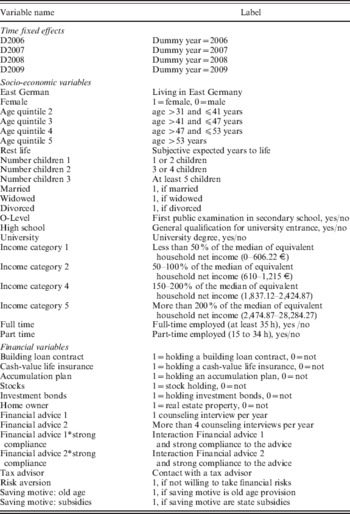
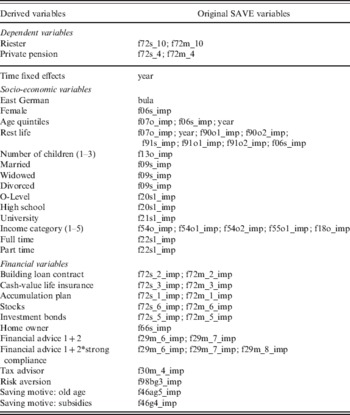
According to the classification in Table 2, ‘Riester/Rürup plans’ are subsidized by the government. While ‘Riester pensions’ are widespread across the German population (about 13.6 million contracts in 2010), the number of ‘Rürup pensions’ remains relatively small (about 1 million in 2010) (cf. Stiftung Warentest, 2010). As the SAVE data does not differentiate between ‘Riester’ and ‘Rürup plans’, for the remaining paper, we label both subsidized pension plans as Riester. For the study at hand, we restrict our dataset to those individuals eligible for a ‘Riester pension’.Footnote 12 Entitlement is identified in two stages: first, we exclude individuals from our analysis who are retired or aged 65 and older, who are in education, self-employed or who are not married and earn an individual income lower than €400 per month. In a second step – to incorporate individuals with indirect entitlement – we only omitted those who earn an individual monthly net income lower than €400 and who are married but the spouse is not entitled.Footnote 13 Therefore, entitlement is identified on the individual as well as on the household level. However, only individuals enter the regression. Thus, we concentrate on individuals and if available on the respondents’ spouse, but as separate observations. We run a regression for two binary-dependent variables Riester and private pension on socio-economic, financial and saving-motives variables using an unbalanced panel structure.Footnote 14 A full description of the variables is presented in Table 3 and an overview of the derived variables from the original SAVE variables is given in Table 4.
Variable description

Note: Lower and upper bounds for the income categories are reported for the year 2005 and the first imputation dataset.
Source: SAVE (2010) ; own calculation.
Original SAVE variables and derived variables for analysis

Note: With the exception of household income (f54o_imp) only individual data were used.
Source: SAVE (2010) ; own calculation.
To cover nonlinear age effects, we apply age quintiles for our analysis. The reference is age quintile 1 consisting of those individuals aged 31 or younger. To control adverse selection in the private annuity market, we additionally take the subjective life-expectancy into account. The reason behind this is the presence of information asymmetries between insurers and the insured. Regarding a private pension insurance, information asymmetries are present if individuals can predict their length of life more precisely than the insurer. Given that individuals – who expect to live relatively long – systematically take up a ‘Riester pension’ or private pension insurance more often, this would result in adverse selection in the respective market. The variable Rest life reflects the years between the stated life-expectancy in the survey and the current age. The interpretation is as follows: a higher value of Rest life indicates a considerable time to live. Thus, if during the decision-making process individuals take their life expectancy into account, the variable Rest life should have a positive coefficient. This measure differs from the one used in Schulte and Zirpel (Reference Schulte and Zirpel2010). In their study, the authors use self-rated life expectancy as an indicator for adverse selection. Therefore, the results in this paper are only loosely related to the ones presented in Schulte and Zirpel (Reference Schulte and Zirpel2010). Further, the group of socio-economic factors covers gender effects, the influence of education, whether the respondent lives in East or West Germany as well as family and labor force status. Especially in terms of the subsidized ‘Riester pension’, the child-related subsidies are expected to positively affect the probability to sign a ‘Riester contract’. In contrast, the literature indicates that the number of children has a negative impact on owning a private pension insurance. Income is divided into five income categories using the monthly net household income. To consider economies of scale in household consumption related to household size, we adjusted the monthly net income by dividing the income by the square root of the number of household members (Buhmann et al. Reference Buhmann, Rainwater, Schmaus and Smeeding1988; and for an application refer to Siciliani and Verzulli, Reference Siciliani and Verzulli2009). The reference category is the 100–150% interval of median income. Referring to the literature, we predict a negative impact of the lowest income category on the uptake of a ‘Riester pension’. The same is true for private pension insurance. Moreover, the effect of income on taking up a subsidized or unsubsidized old-age provision is highly relevant.
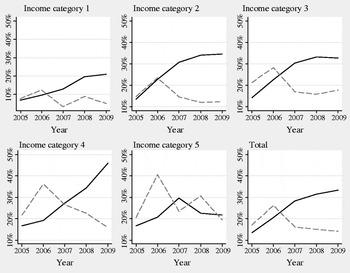
Figure 2 reflects the development of the uptake of ‘Riester contracts’ and private pension insurance in the restricted dataset for each of the five income categories separately. For the years 2005–2009 (horizontal axis), the vertical axis displays the coverage of ‘Riester pensions’ (solid line) and private pension insurance (dashed line). In addition to the development of the coverage for the five income categories, Figure 2 also includes a sub-graph of the total coverage. Large differences in the level and development over the categories can be seen. In 2009, merely 25% of individuals in income category 1 held a ‘Riester pension’, but only a small fraction of this group owns private pension insurance. In contrast to this, about half of the respondents in the third income category had taken up a ‘Riester contract’ in 2009. As expected, the highest proportion of pension insurance is observed in the highest income category. It should be noted that the presented development of holding a private pension insurance may underestimate the true value since we constrain our dataset to those eligible for a subsidized ‘Riester pension’ excluding self-employed.
Coverage of ‘Riester pension’ and private pension insurance in the population by income categories. Note: The solid line indicates the coverage of ‘Riester pension’ in the respective year, whereas the dashed line resembles the coverage of private pension insurance. Source: SAVE (2010) ; own visualization.

In a second specification, we assess the impact of alternative savings. The SAVE data contains questions on various forms of financial assets. With respect to the categorization in Table 2, we include cash-value life insurances as explanatory variable. While this form of asset gains from tax advantages during payout, it is not comparable to private pension insurances since payouts are specified as a single payment. Also building loan contracts, accumulation plans, real estate ownership and stock ownership are incorporated. These forms are primarily used to accumulate assets that can also serve for old-age provision purposes. We assume that individuals use several instruments to provide for old age. Therefore, the coefficient of these alternative savings should have a positive sign.
Moreover, demand for financial advice and strength of financial compliance are considered as explanatory factors. We hypothesize that individuals visiting an advisor are more likely to sign a ‘Riester contract’ or private pension insurance than others. To control for possible demand inducement, we also consider an interaction between financial advice and the strength of financial compliance. The appeal of ‘Riester products’ for the financial industry in Germany is obvious. Through the complexity and non-transparency of ‘Riester pension’ products, competition between various providers is minimized (cf. Oehler, Reference Oehler2009, p. 173). Thus, the insurance commissions as well as the marketing costs for ‘Riester products’ are relatively high. As a result, the active marketing of ‘Riester pensions’ may result in demand inducement. Recently, this is reflected in a debate about the return on investment of ‘Riester products’ (see GDV, 2011a; Hagen and Kleinlein, Reference Hagen and Kleinlein2011). On the one hand, it is argued that such products show a lack of transparency and comparability, uncertainty about commissions and marketing costs as well as windfall gains for certain population groups. Except for the latter point, the argumentation is in line with our hypothesized influence of financial intermediates. On the other hand, the insurance industry claims that ‘Riester products’ are profitable especially for low-income earners and families. This argument is closely related to the child subsidies. The profitability of a ‘Riester pension’ for low incomes is questioned by the fact that this group shows a significantly lower likelihood to take up such a product. This discussion might create additional uncertainty concerning the relevance of additional old-age provisions.
Finally, saving motives are covered through two binary variables. The first, Saving motive: old age is assumed to positively influence the probability of both ‘Riester pension’ and private pension insurance. The second, Saving motive: subsidies is included to check whether respondents act in accordance to their stated motives.
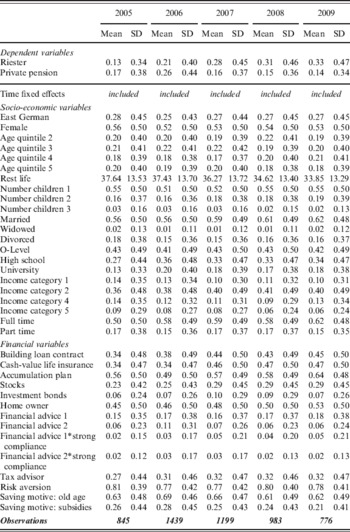
The summary statistics – decomposed by year – are presented in Table 5Footnote 15. Overall, the unbalanced panel dataset consists of 5,242 individuals with the highest number of observations in the years 2006 and 2007.
Summary statistics

Source: Own calculation based on SAVE (2010). For ‘Riester pension’ eligible sample.
Apart from the variable rest life, all explanatory variables are binary. Table 5 clearly shows that the share of respondents holding a ‘Riester pension’ increases from 13% in 2005 to 33% in 2009. At the same time, the proportion of individuals owning private pension insurance first strongly increases from 17% in 2005 to about 26% in 2006 and then decreases to 14% in 2009. As the five dummy variables, which indicate the age group of the respondent, were constructed using quintiles, one would expect that each variable accounts for 20% of the total sample. However, as age is measured in full years there are small deviations from the expected proportion. The mean of expected years to live is approximately 37 years in the year 2005 and decreases due to the aging of the panel. Between 51% and 55% of the respondent's state having one or two children, and about 56–61% report being married. The most common income category is income category 2 covering about 36% of the respondents in the year 2005. In addition, one can gather the typical right-skewed income distribution from the mean of income variables. In view of financial assets, the percentage of individuals holding alternative investments such as building loan contracts, cash-value life insurances or accumulation plans is relative high. While a large proportion in our dataset holds diverse assets, it is interesting that only about 15–18% of the respondents’ state to visit an advisor once a year. A smaller fraction visits an advisor more than four times a year. Moreover, the proportion of individuals following the advice is only up to 5%. The demand for insurance may also depend on the risk aversion of the respondent. In our data, more than 77% are not willing to take financial risks. According to the data, the main reason for saving is to provide for old age. State subsidies are only relevant for about 21–28% of the respondents.
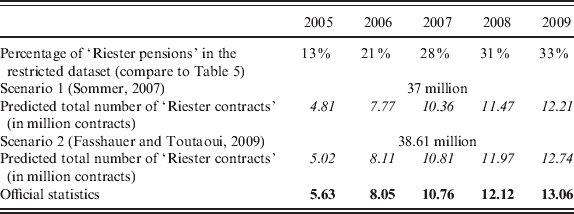
To assess the adequacy of the underlying restricted dataset, we forecast the total number of ‘Riester contracts’ in Germany based on the share of ‘Riester pensions’ in the dataset for each year. The share of ‘Riester pensions’ in the underlying restricted dataset is reported in the first row of Table 6. According to Sommer (Reference Sommer2007) the number of all eligible individuals for the ‘Riester pension’ amount to about 37 million (scenario 1). Thus, the share of ‘Riester pensions’ multiplied with the number of eligible individuals results in the predicted total number of ‘Riester contracts’. In the second scenario, we use the approximation of the number of eligible individuals of Fasshauer and Toutaoui (Reference Fasshauer and Toutaoui2009) and repeat the calculation. Finally, the last row of Table 6 shows the official number of ‘Riester contracts’ for the respective year. As a result, the official number of ‘Riester contracts’ is adequately depicted by the underlying restricted dataset. The small underestimation can be explained by the fact that we consider only the case that one individual owns a ‘Riester pension’. However, an individual is allowed to hold more than one of such contracts. Conversely, this pattern indicates that we are able to include the eligible individuals in the following analysis.
Comparing administrative data and the underlying SAVE dataset
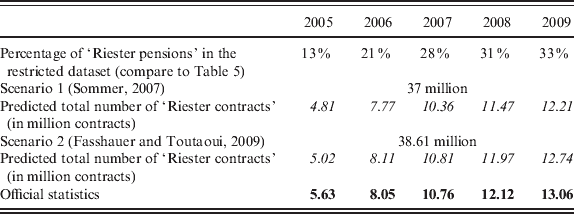
Note: As our dependent variable also covers ‘Rürup pensions’, the adequate approach would be a comparison of our restricted dataset with official statistics that include both forms of old-age provisions without self-employed individuals. To our best knowledge, no data for ‘Rürup pensions’ of non-self-employed individuals are available. The total number of ‘Rürup pensions’ has increased from 296.000 in the year 2006 to about 1 million contracts in 2009 (GDV, 2011b).
Source: Fasshauer and Toutaoui (Reference Fasshauer and Toutaoui2009), Sommer (Reference Sommer2007), BMAS (2010a) and SAVE (2010) ; own calculation.
Moreover, it is very difficult to compare socio-economic characteristics of individuals in the underlying restricted dataset with administrative data to evaluate the quality of the dataset. The reason behind this is that official statistics only report data concerning the whole population or distinct population subgroups. No official statistics covering socio-economic characteristics of individuals eligible for ‘Riester pension’ exist. Hence, the share of females in our dataset overestimates the ‘true’ proportion of women in Germany (about 55% in the dataset vs. 50.97% in the administrative data). Also, the share of individuals from Eastern Germany is overestimated. This pattern is common to survey data. As a comparison, the German Socio-Economic Panel overestimates the proportion of individuals living in Eastern Germany as well. Nevertheless, applying weighting factors would not change this pattern. Finally, as can be seen in Table 6, the proposed dataset for the following analysis represents the number of eligible individuals very well.
4.1 Estimation approach
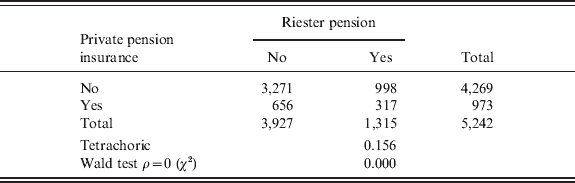
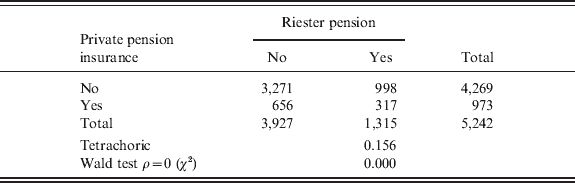
To analyze the decision on subsidized and unsubsidized private pensions, we use an empirical model for simultaneous equations. The advantage of this procedure is that we are able to estimate two equations that seem to be independent at first view. Moreover, there might be a correlation between them due to the structure of the errors. A cross tabulation for the binary variables Riester and private pension as well as the tetrachoric correlation (Table 7) are used to examine the relationship between them: 317 people owning a ‘Riester pension’ already hold private pension insurance, whereas 3,271 people have neither.
Cross-tabulation and tetrachoric correlation
Source: Own calculation based on SAVE (2010). For ‘Riester pension’ eligible sample.
The tetrachoric correlation measures the correlation between two binary variables since the common Pearson Product Moment correlation is inapplicable and is rather used for continuous variables (cf. Greene and Hensher, Reference Greene and Hensher2010). In other words, the tetrachoric correlation corresponds to the bivariate probit model without explanatory variables (constant only model). In our case, the correlation is 0.156, which is relatively small but highly significant differing from zero. Hence, the proposed bivariate model for simultaneous equation seems adequate to analyze the decisions on ‘Riester’ and private pension insurance.
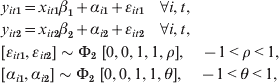
As we use binary-dependent variables as proxy for owning a ‘Riester pension’ and private pension insurance, we require an estimation technique for qualitative-dependent variables. Given the panel structure of our data, the following bivariate probit model is estimated:
 $$\openup2\matrix{ {y_{it\setnum{1}} \equals x_{it\setnum{1}} \beta _{\setnum{1}} \plus \alpha _{i\setnum{1}} \plus \varepsilon _{it\setnum{1}} \quad \forall i\comma t\comma } \hfill \cr {y_{it\setnum{2}} \equals x_{it\setnum{2}} \beta _{\setnum{2}} \plus \alpha _{i\setnum{2}} \plus \varepsilon _{it\setnum{2}} \quad \forall i\comma t \comma } \hfill \cr {\lsqb \varepsilon _{it\setnum{1}} \comma \varepsilon _{it\setnum{2}} \rsqb \sim \rmPhi _{\setnum{2}} {\rm \ }\lsqb 0\comma 0\comma 1\comma 1\comma \rho \rsqb \comma \quad \minus 1 \lt \rho \lt 1\comma } \hfill \cr {\lsqb \alpha _{i\setnum{1}} \comma \alpha _{i\setnum{2}} \rsqb \sim\rmPhi _{\setnum{2}} \ \lsqb 0\comma 0\comma 1\comma 1\comma \theta \rsqb \comma \quad \minus 1 \lt \theta \lt 1\comma } \hfill \cr}$$
where yit 1 is the binary-dependent variable of equation j. The vector βj is the coefficient vector that is constant over individuals and time. Heterogeneity is described by two components: first, heterogeneity between individuals represented by the time invariant parameter αij that is random over individuals; second, heterogeneity between the true disturbances ∊itj. The parameter ρ reflects the covariance between the two error terms. In other words, ρ measures the impact of unobserved factors on the probability to own a ‘Riester pension’ or private pension insurance. Both equations (4.1) can be estimated consistently as single equation probit models. However, this might be inefficient as it ignores the correlation between the disturbances (cf. Greene and Hensher, Reference Greene and Hensher2010). Therefore, the correlation coefficient might be of interest. If ρ is statistically different from zero – indicating non-independence of the error terms εit 1 and εit 2 – then the above model should not be estimated as two independent equations (cf. Maddala, Reference Maddala1983, p. 123). Thus, equation (4.1) forms a simultaneous equation system.Footnote 16
With respect to the panel structure, the question how to deal with unobserved heterogeneity is important. For the bivariate probit model for panel data, we use a generalized form of a random effects model proposed by Greene. Since the implementation of random effects for a bivariate probit model is non-trivial, our approach applies to a random parameters method (cf. Greene, Reference Greene2001). The underlying specification of the vector of coefficients is
 $$\beta _{i} \equals \beta \plus \rmDelta z_{i} \plus \rmGamma v_{i} \comma$$
where β is the vector of unconditional means. Furthermore, Δ is a matrix of unknown location parameters, zi is a vector of individual characteristics (heterogeneity term), Γ is a matrix of unknown variance parameters and vi is the vector of random latent individual effects, with zero mean. In the general random parameters model, parameters are randomly distributed across individuals with possibly heterogeneous mean and variance:
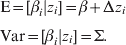 $$\openup6\matrix{ {{\rm E} \equals \lsqb \beta _{i} \vert z_{i} \rsqb \equals \beta \plus \rmDelta z_{i} } \hfill \cr {{\rm Var} \equals \lsqb \beta _{i} \vert z_{i} \rsqb \equals \rmSigma .} \hfill \cr}$$
The second term is optional meaning that the parameter matrix Δ = 0. In this case and conditional that the coefficient βi is constant, the parameter in view is non-random. In our application of a bivariate probit model, we assume that all parameters – other than the constant terms – in both equations are non-random. In effect, this implementation of a random parameters model is equivalent to a random effects bivariate probit model for panel data. In our case, a random effects model based on the random parameters approach is applied using Limdep. Instead of random draws we use the Halton sequence for the simulated maximum likelihood to reduce the number of draws and computation time.
4.2 Obtaining results from multiple imputed datasets
The estimation with different imputations requires some caution with respect to the ‘averaging’ of the results (see Little and Rubin, Reference Little and Rubin2002, p. 86). Let  $\hats{b}_{k}$ be the estimated regression coefficient in sample k of the M samples from the random parameters bivariate probit regressions. The coefficient vector of the multiple imputation analysis can be represented by the mean of the single estimations.
 $$\bar{b}_{M} \equals {1 \over M}\mathop{\sum}\limits_{k \equals \setnum{1}}^{M} {\hats{b}_{k} } \semi \quad k \equals 1\comma 2\comma \ldots \comma M.$$
The five imputation datasets are conditional draws rather than conditional means. Thus, under a good imputation model they provide valid estimates. The standard error  $\bar{s}_{M}$ has two components: (i) the average within and (ii) the between imputation variance. The within-imputation variance
 $\hat{s}_{k}^{\setnum{2}}$ is the mean of the estimated standard errors of the responding imputation M (
 $\hat{s}_{k}$), whereas the between-imputation variance depends on the difference between the estimated coefficients and the corresponding estimate for all imputed datasets
 $\lpar b_{k} \minus \bar{b}_{M} \rpar$. Hence, the standard error is calculated by taking the square root of the sum of the average of the sampling variance and the variance of the estimated coefficients that is multiplied by a correction factor 1 + 1/M.
 $$\bar{s}_{M} \equals \sqrt {{1 \over M}\mathop{\sum}\limits_{k \equals \setnum{1}}^{M} {\hat{s}_{k}^{\setnum{2}} \plus \left( {1 \plus {1 \over M}} \right)\left( {{1 \over {M \minus 1}}} \right)\mathop{\sum}\limits_{k} {\left( {b_{k} \minus \bar{b}_{M} } \right)^{\setnum{2}} } } } .$$
One shortcoming of the estimation of multiple imputed datasets is that specification tests such as the likelihood ratio test are not applicable because it is not possible to average the likelihood values across the different imputations.
5 Results
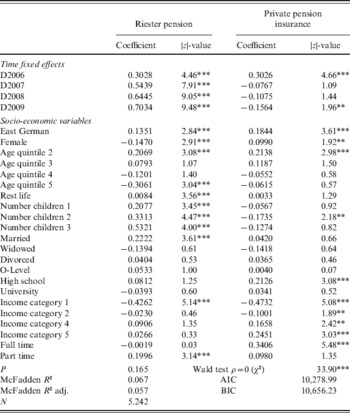
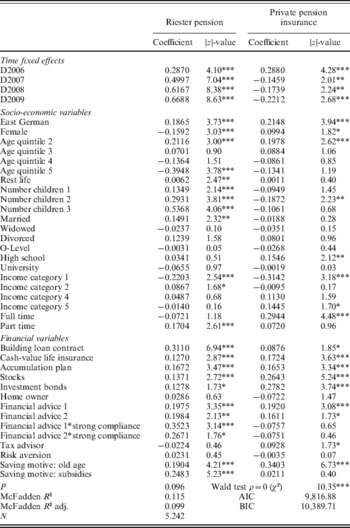
Our estimation results for both restricted and full specification indicate that decisions on ‘Riester pensions’ and private pensions are not independent and the proposed random-parameters bivariate probit model results in efficiency gains compared to separate probit estimations. As can be seen from Tables 8 and 9, the correlation of the residuals ρ is significantly positive, indicating that unobservable factors positively influence the likelihood to sign subsidized and unsubsidized private pensions. However, when including financial variables the correlation decreases but remains significant.
Estimation results bivariate probit model – restricted

* p < 0.1, **p < 0.05, ***p < 0.01.
Source: Own calculation based on SAVE (2010). For ‘Riester pension’ eligible sample.
Estimation results bivariate probit model – full specification

* p < 0.1, **p < 0.05, ***p < 0.01.
Source: Own calculation based on SAVE (2010). For ‘Riester pension’ eligible sample.
In detail, we observe differences in the magnitude of the coefficient and the corresponding level of significance between both equations. For the restricted model (see Table 8) – which does not incorporate financial variables – we find a highly significant and positive time gradient for Riester, whereas only two years are relevant for private pension insurance. Further differences occur regarding age quintiles and the number of children. The probability for a ‘Riester contract’ increases for the second age quintile, but decreases for the highest quintile. For private pensions, only the second quintile shows a significantly positive effect. Subjective years to live (Rest life) show a highly significant and positive effect only for ‘Riester pensions’. The interpretation is as follows: individuals reporting a higher rest-life span tend to sign a subsidized pension more likely. In contrast to Schulte and Zirpel (Reference Schulte and Zirpel2010) who found evidence of adverse selection in the decision-making process for private pension insurance, our results suggest that adverse selection is only relevant for the uptake of ‘Riester’.
As the subsidies increase with the number of children, we find a strong and positive gradient for the ‘Riester pension’. Thus, the incentives to take up a subsidized pension are working. On the contrary, the impact of the number of children is insignificant or even negative for the probability of a private pension. To explain these reverse effects, it needs to be recalled how the subsidies work. The combination of subsidy and personal contribution must account for at least 4% of the individual's yearly gross income to be eligible for the subsidies in the first place; the higher the subsidies the lower the personal contribution. This means that each additional child helps to reduce the personal contribution down to the lower limit of €60 per year. Once the minimum personal contribution of €60 is reached, any additional subsidy increases the personal saving rate. This results in a considerable ‘leverage effect’. The observed results for children regarding subsidized ‘Riester pension’ are consistent with these incentives. On the other hand, an unsubsidized pension, which does not provide an additional child benefit, is chosen less often by individuals with more than one child.
Taking a look at income variables, we find a significantly negative coefficient for the first income category in both equations.Footnote 17 Instead, to be in income categories 4 and 5 positively influences to take up only private pension schemes. No significant effect can be found for ‘Riester contracts’. These findings indicate that political aims to induce higher old-age provisions of low income earners are not achieved. Thus, the effects of public subsidies as incentive for low-income groups need to be questioned. The employment effects are as expected: individuals who are employed full-time have a significantly higher likelihood to own a private pension, while those in part-time employment use public subsidies and tend to have ‘Riester pensions’.
Regarding our full model (see Table 9), the inclusion of financial variables changes the effect of income and time variables. While in the restricted model, only the time dummies for 2006 and 2009 are significant for private pension insurance, in the full model all time variables have a significant effect. In comparison with the reference year 2005, we observe a higher probability of owning private pension insurance in 2006. In the following years, the probability decreases, a pattern similar to Figure 2. The magnitude of the first income category decreased for Riester and for private pension insurance, and only the lowest and the highest category remain significant. This effect can be explained by the inclusion of various financial variables. In the restricted model, income is the only indicator regarding earnings and wealth, whereas assets are explicitly included in the full model.
Alternative investments positively affect the uptake of both forms of provisions. It is interesting that other government-promoted investments (such as building loan contracts) are only highly significant for the ‘Riester’ decision, indicating an affinity to state allowances. With exemption of home ownership, the positive effects of other assets can be viewed as ‘crowding-in’ among alternative investments. Hence, individuals use various forms of assets to make provisions for old age. Especially those who make use of financial advice are more likely to sign either form of pension. It is even interesting to see that the interaction between advice and strong financial compliance is only relevant for the decision on ‘Riester’. Financial intermediates seem to have an incentive to promote the highly regulated ‘Riester pension’. The complexity of these products limits competition between various providers. High insurance commissions and marketing costs strengthen the incentives resulting in active marketing of ‘Riester pensions’. Although this is no exact proof of a demand inducement hypothesis, this result gives some evidence that financial consultants play an important role in the decision-making process.
The advantageous tax rules for private pension schemes are reflected by the significant positive coefficient of tax advisor. On the contrary, tax expenditures for ‘Riester pensions’ are limited and only favorable for high-income groups. Saving motives play an important role for the old-age provision. Respondents stating to save for old age own both forms of pensions. This result is statistically significant. However, a closer look shows that the effect for private pension insurance has nearly twice the effect for ‘Riester’. While the reason for this might be unclear at first glance, taking subsidies as a saving motive into account sheds light on the investment decision. As expected, we find no effect of this saving motive for private pensions. Instead, the highly significant effect for ‘Riester pensions’ indicates the importance of public subsidies. Comparing the magnitude of the saving motives’ coefficients lets us conclude that the subsidies motive dominates the old-age motive. Thus, people do not only take up a ‘Riester pension’ because of securing pension payments but also to take advantage of granted subsidies (windfall gains).
Our findings relate to the literature on ‘Riester contracts’ as follows: Our results confirm the findings of Corneo et al. (Reference Corneo, Keese and Schröder2009; Reference Corneo, Keese and Schröder2010), Coppola and Reil-Held (Reference Coppola and Reil-Held2009), Geyer and Steiner (Reference Geyer and Steiner2009) as well as Börsch-Supan et al. (Reference Börsch-Supan, Reil-Held and Schunk2007) with respect to a negative income effect of the lowest income category on the likelihood to take up a ‘Riester pension’. Furthermore, we also find a positive effect of the number of children in line with Börsch-Supan et al. (Reference Börsch-Supan, Reil-Held and Schunk2007) and Coppola and Reil-Held (Reference Coppola and Reil-Held2009). Contrary to Lampig and Tepe (Reference Lampig and Tepe2009), we use separate variables for alternative investments. Doing so, our results offer a more accurate view on the effects of investments that influence the decisions. We provide evidence that individuals who are covered by alternative investments more frequently sign a ‘Riester contract’ or private pension insurance. Nevertheless, the magnitudes differ between the decision on ‘Riester’ and private pension insurance. In comparison with the only study using panel data (Pfarr and Schneider, Reference Pfarr and Schneider2011), we also find a positive effect of the number of children as well as a significant demand inducement. In contrast to Pfarr and Schneider, we are able to strongly emphasize the role and importance of financial intermediates. Nevertheless, while Pfarr and Schneider give evidence for positive effects of education, our results do not indicate such effects.
Comparing our results to the literature on the determinants of private pension insurance, we cannot affirm the effects of adverse selection within the private pension insurance market which is suggested by the work of Schulte and Zirpel (Reference Schulte and Zirpel2010). Our results indicate that this effect is only present for ‘Riester’. In addition, they substantiate the findings of Börsch-Supan et al. (Reference Börsch-Supan, Reil-Held and Schunk2007), as we also find that individuals at the bottom of the income distribution sign a private pension insurance less often.
In contrast to Börsch-Supan et al. (Reference Börsch-Supan, Reil-Held and Schunk2008b), our results – using panel data – imply that the decisions on ‘Riester’ and private pension insurance are not independent. We are able to validate the findings of Börsch-Supan et al. regarding the effects of children. Additionally, we provide evidence of a negative income effect of the lowest income category on the probability to own a ‘Riester pension’.
To sum up, we are among the first providing evidence of the dependency of decisions on subsidized and unsubsidized private pension schemes. While our results are in line with the literature in many cases, we present evidence for income effects and the influence of the number of children. Further results confirm the hypothesized behavior of financial intermediates as well as the existence of a ‘crowding-in’ of alternative investments.
5.1 Fixed-effects results
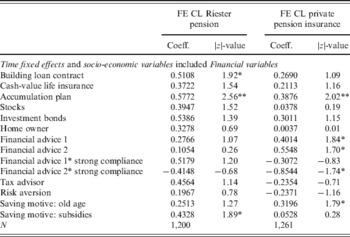
Regarding the significant correlation of the error terms in the bivariate probit model, unobservables seem to play an important role in the decision about private pensions. To analyze these unobserved effects, we apply separate fixed-effects conditional logit models for Riester and private pension insurance to consider individual time-invariant unobserved heterogeneity.Footnote 18 As we are using a fixed effects (conditional) logit model, only observations exhibiting variation in the dependent variable enter the regression. Thus, the number of observations is cut down to those individuals, changing their status at least once, e.g., taking up a ‘Riester pension'/ private pension insurance or withdrawing from a contract. The reduced number of observations amount to 1,200 for the Riester estimation and to 1,261 for the private pension insurance estimation. The results of the separate estimates are presented in Table A1 in the appendix. Regarding building-loan contracts and accumulation plans the results drawn from the Riester equation of the conditional logit model correspond with the findings from the bivariate probit model as these investments increase the likelihood of an uptake of ‘Riester pensions’ significantly. While subsidies as a saving motive shows the same significant positive effect, no significance can be found for any of the variables concerning financial advice for signing a new contract. Hence, we again find evidence for a ‘crowding-in’ effect among different alternative investments. In contrast to the findings of the bivariate estimation that analyzes the existence of private pension schemes, the role of financial agents seems to be less prominent for either new ‘Riester contracts’ or withdrawals from such contracts. For private pensions insurance, financial advice seems to be important. Moreover, only the interaction between more than four counseling interviews per year and strong compliance is significant. The negative impact suggests that individuals seeking financial advice more often and who consequently follow the advice are less likely to take up a private pension insurance. Comparing saving motives, the results of the fixed-effects estimates support our findings of the bivariate probit model. Thus, while subsidies are relevant for the decision for Riester, the motive to make provisions for old age dominates for private pension insurances.
6 Summary
By introducing the ‘Riester pension’, the German government aimed at fostering voluntary retirement arrangements by granting supplementary allowances and tax credits. Since the year 2002, ‘Riester pensions’ have grown in popularity. On the contrary, the coverage of private pension insurance – as a second type of old-age provisions – has become less attractive. One obstacle to the public subsidization is that until now, only 35% of the eligible individuals own a ‘Riester contract’. This calls for a detailed investigation of the effect of governmental subsidies and how these subsidies affect other forms of private old-age provisions. Hence, we analyze whether subsidization incentivizes special forms of private pension schemes and whether the uptake is influenced by insurance agents.
Regarding our first research questions, our results confirm the positive incentive effects of governmental subsidies on private pension schemes. This is evident especially with regard to child allowances for the ‘Riester pension’, i.e., each additional child helps to reduce the personal contribution down to the lower limit. On the contrary, the effect of children points to the opposite direction for private pension insurance. For both forms of provision, we find a negative income effect. According to this the political aims to induce higher old-age provisions of low-income earners may have not yet been achieved. Subsidization thus seems to have no effect, and the incentives for low-income groups failed to work. Alternative investments seem to have an important impact on old-age provision. Thus, individuals use various forms of assets to ensure their current standard of living in future. These effects can be interpreted as ‘crowding-in’ among alternative investments. This also means that financial literacy is highly relevant. To conclude, a primary objective for policy-makers would be to enhance the financial literacy of individuals.
The second research question, whether the uptake of private pensions is influenced by insurance agents can be confirmed. Indeed, demand inducement can be assumed for the subsidized ‘Riester pension’, but not for traditional private pensions. In this case, financial intermediates have an incentive to promote the highly regulated ‘Riester pension’. If demand inducement for the uptake of subsidized private pension is present, simplifying the complex set of regulations would not be a primary goal as long as the financial intermediates act as perfect agents.
In addition, saving motives play an important role. In the decision-making process to take up a ‘Riester pension’, granting subsidies dominate the old-age motive. As unobservables seem to play an important role, separate fixed-effects estimations were applied. The results substantiate the findings regarding a possible ‘crowding-in’ among alternative investments and additionally the role of saving motives.
Generally, regarding the future gap in the public pension system, it can be seen as a positive sign that individuals put more effort in securing for old-age regardless of the type of investment. But it remains unclear whether the higher demand for ‘Riester pensions’ in fact increases private saving rates. Instead, we might observe a substitution of unsubsidized through subsidized products. Finally, our empirical findings emphasize the relationship between different forms of private provision for old age. Further research should analyze if individuals take the full choice set of different investments into account or if governmental subsidies distort competition between these alternatives.
Appendix
To analyze time invariant heterogeneity, we apply a conditional fixed effects logit model to separately investigate the likelihood to take up a Riester or a private pension insurance. Therefore, we estimate the probability that individual i signs a ‘Riester contract’ or private pension insurance in period t or not. The estimation equation is given by (Verbeek, Reference Verbeek2008, p. 394):
 $$y_{it}{\ast } \equals x_{it} \beta \plus \alpha _{i} \plus \varepsilon _{it} .$$
As yit is not observable, we use the model of a latent variable. αi forms the fixed parameters representing unobserved heterogeneity in the dataset and, an additional estimation of N parameters is necessary. Thus, for a given T the parameters αi cannot be estimated consistently (incidental parameters problem) (Baltagi, Reference Baltagi2008, p. 238). The implementation of a within-estimator – as it is common in OLS-models – is not feasible with respect to the model of a latent variable. αi can be eliminated in the latent structural model; however, an application to the observable y*it is not possible. Therefore, we use a conditional logit model suggested by Chamberlain (Reference Chamberlain, Griliches and Intrilligator1984). The results of the separate estimates are presented in Table A1.
Selected results of the fixed effects conditional logit models1