Categorical perception (CP) is a major, although nonspecific, property of speech perception. It is defined as heightened discrimination of an acoustic difference crossing a phonological boundary compared to the same acoustic difference when located within a phonological category (Liberman, Harris, Hoffman, & Griffith, Reference Liberman, Harris, Hoffman and Griffith1957). CP is commonly evaluated using identification and discrimination tasks with stimuli that vary along a continuum (for a review, see Damper & Harnard, Reference Damper and Harnad2000; Liberman et al., Reference Liberman, Harris, Hoffman and Griffith1957). The relation between these two tasks is evaluated by comparing observed discrimination scores (corresponding to the discrimination responses) to expected discrimination scores (derived from the identification responses). The stronger the relationship between these two scores, the higher the degree of CP. Another categorical property refers to the boundary precision that can be evaluated by measuring either the steepness of the identification curve (Simon & Fourcin, Reference Simon and Fourcin1978) or the size of the discrimination peak around the phoneme boundary (Wood, Reference Wood1976). A steeper slope indicates that the boundary, which corresponds to the 50% identification point on the stimulus continuum, is less variable over different trials and can therefore be located with greater precision. Similarly, a higher discrimination peak indicates that the boundary is more frequently located within the same stimulus interval and is therefore more reliable. In addition, the location of the boundary itself is also of interest in indicating the point along the continuum where the change in perception takes place between categories.
Although CP can be observed for all phonological features, voicing perception is the most frequently studied in developmental and training studies. This feature is mainly based on the temporal relationships between two discrete events in stop consonants: the release of the supraglottal closure (burst onset) and the onset of voicing (laryngeal vibrations), that is, voice onset time (VOT; Lisker & Abramson, Reference Lisker and Abramson1964). Conventionally, negative VOT corresponds to prevoiced stops, whereas positive VOT corresponds to voicing starting after the release.
Studies of human babies younger than 6 months of age (Lasky, Syrdal-Lasky, & Klein, Reference Lasky, Syrdal-Lasky and Klein1975; Streeter, Reference Streeter1976), nonhuman animals (Kuhl & Miller, Reference Kuhl and Miller1975, Reference Kuhl and Miller1978), and cross-linguistic perception/production (Lisker & Abramson, Reference Lisker, Abramson, Hala, Romporti and Jonota1970) all suggest the existence of two universal boundaries located at −30 and +30 ms VOT (Aslin, Pisoni, Hennessy, & Perey, Reference Aslin, Pisoni, Hennessy and Perey1981). However, in Polish, Hebrew, Dutch, French, Spanish, and Arabic (Flege & Eefting, Reference Flege and Eefting1986; Horev, Most, & Pratt, Reference Horev, Most and Pratt2007; Maassen, Groenen, Crul, Assman-Hulsmans, & Gabreëls, Reference Maassen, Groenen, Crul, Assman-Hulsmans and Gabreëls2001; Serniclaes, Reference Serniclaes1987; Williams, Reference Williams1977; Yeni-Komshian, Caramazza, & Preston, Reference Yeni-Komshian, Caramazza and Preston1977), the boundary is located at approximately at 0 ms VOT. This boundary emerges as a conjunction between universal predispositions and exposure to the native language. After 6 months of age, infants raised in French or Spanish environments move from a language-general (with VOT boundaries located at −30 and +30 ms VOT) to a language-specific mode of perception: the 0 ms VOT boundary become relevant in their languages (Spanish: Eilers, Gavin, & Wilson, Reference Eilers, Gavin and Wilson1979; Lasky et al., Reference Lasky, Syrdal-Lasky and Klein1975; French: Hoonhorst, Colin, et al., Reference Hoonhorst, Colin, Markessis, Radeau, Deltenre and Serniclaes2009). This finding is congruent with the hypothesis that the 0 ms VOT boundary is acquired by a perceptual “coupling” between the −30 and the +30 ms VOT boundaries, that is, by introducing cross-dependencies between the two boundary locations (Serniclaes, Reference Serniclaes, Clements and Ridouane2011). In this context, coupling means that detection of one feature (e.g., negative VOT) affects the detection of another feature (e.g., changes the positive VOT boundary) such that the boundaries relative to each feature are shifted from the psychoacoustic values (−30 and +30 ms) toward the phonological value (0 ms). This mechanism is similar to percept–percept couplings evidenced in visual perception (Epstein, Reference Epstein1982). In some other languages, the phonological boundary straddles one of the two universal boundaries at +30 ms VOT (e.g., for English, see Lisker & Abramson, Reference Lisker and Abramson1967) or both universal boundaries at +30 and −30 ms VOT (e.g., for Thai, see Abramson & Lisker, Reference Abramson, Lisker, Hala, Romporti and Jonota1970; Donald, Reference Donald1978). These universal boundaries seem to be psychoacoustic in nature and do not always correspond to phonological boundaries in specific languages.
Early studies show that this language-specific mode of perception should be fixed in adulthood and resistant to any changes. This hypothesis was linked to the popular and influential notion that puberty and associated neurological changes represent a cutoff point for second language learning (e.g., De Keyser, Reference DeKeyser2000; Lenneberg, Reference Lenneberg1967). It was also supported by the failure in early studies that tried to change adults’ phoneme perception through laboratory training (Strange, Reference Strange1972; Strange & Dittmann, Reference Strange and Dittman1984; Vinegrad, Reference Vinegard1972). However, over the years, this hypothesis was overturned by a growing body of studies that demonstrated an improvement in discrimination or identification of a specific nonnative contrast after a short period of laboratory training, even in adulthood (Golestani & Zatorre, Reference Golestani and Zatorre2004; Kraus et al., Reference Kraus, McGee, Carrell, King, Tremblay and Nicol1995; Tremblay, Kraus, & McGee, Reference Tremblay, Kraus and McGee1998; Tremblay, Kraus, McGee, Ponton, & Otis, Reference Tremblay, Kraus, McGee, Ponton and Otis2001). Such improvement in performances was also observed in studies addressing the impact of training procedures on nonnative boundaries. For instance, Pisoni, Aslin, Perey, and Hennesy (Reference Pisoni, Aslin, Perey and Hennesy1982) trained participants to learn a new nonnative category boundary located around −30 ms VOT. They reported that after a 2-hr laboratory training, monolingual speakers of American English were able to reliably label and discriminate voiceless aspirated, voiceless unaspirated, and voiced stops differing in VOT. Hence, they succeeded in altering the perception of voicing of labial stop consonants from a two-way contrast to a three-way contrast. These findings were interpreted as supporting the view that the perceptual mechanisms used by adults in categorizing speech sounds can be easily modified with laboratory techniques in a short period of time. These findings also suggest that the human perceptual system remains at least somewhat malleable over the life span. In a similar vein, Holt, Lotto, and Diehl (Reference Holt, Lotto and Diehl2004) trained English-speaking adults to categorize the distribution of tone onset time (a nonspeech analogue of VOT). Groups of participants learned categories in which auditory thresholds were either consistent or inconsistent with the distributional boundaries. Although results showed that participants were able to build categories along the nonspeech continuum, they completed them more quickly in the consistent condition, suggesting that auditory discontinuities at the distributional boundary interact with category learning. These two studies illustrate that it is possible to learn a new nonnative category and that auditory thresholds play an important role in category formation.
Pisoni et al. (Reference Pisoni, Aslin, Perey and Hennesy1982) did not examine possible perceptual changes when a two-way contrast enters into conflict with a preexisting two-way phonological contrast perception, and Holt et al. (Reference Holt, Lotto and Diehl2004) did not investigate the interaction between universal boundary and categorization learning in a preexisting phonological system. However, the present study aims to integrate these two limitations by assessing the evolution of voicing identification, discrimination, and CP after an identification training procedure centered at three different values along the VOT continuum in monolingual French-speaking adults. Our training aimed to introduce a conflict between what participants actually perceive and what training teaches them across three different values within a phonological category. To do so, we observed three different training values along the VOT continuum: one centered on a universal boundary (−30 ms VOT) and two others centered on arbitrary values, one being closer to the phonological boundary (−45 ms VOT) and another further away (−60 ms VOT).
Several reasons have been given in the literature to train participants on the negative side of the continuum. Behavioral (Aslin et al., Reference Aslin, Pisoni, Hennessy and Perey1981; Serniclaes, Van Heghe, Mousty, Carré, & Sprenger-Charolles, Reference Serniclaes, Van Heghe, Mousty, Carré and Sprenger-Charolles2004) and electrophysiological (Hoonhorst, Serniclaes, et al., Reference Hoonhorst, Serniclaes, Collet, Colin, Markessis and Radeau2009) studies found an asymmetry in perception between the universal boundary −30 and +30 ms VOT. Several explanations were invoked in the literature. For example, Stevens and Klatt (Reference Stevens and Klatt1974) demonstrated that the underlying reason is the presence of supplementary acoustic cues and, in particular, first formant transitions in positive VOT values, while Burnham, Earnshaw, and Clark (Reference Burnham, Earnshaw and Clark1991) stated that this effect could be explained by a forward masking effect of the high-frequency component (the closure release) by the low-frequency component (the vibration of the vocal cords). To avoid this confound effect, we decided to focus our training along the negative side of the continuum.
For the identification task, we would predict a shift of the phonological boundary initially focused at approximately 0 ms VOT toward the negative side of the continuum and centered on the specific training value after the training sessions. For the discrimination task, we would expect an increase in discrimination across the training value after training; for example, after the training focused on −30 ms VOT, discrimination across −30 ms VOT along the continuum would increase. This expectation is grounded on previous findings by Pisoni et al. (Reference Pisoni, Aslin, Perey and Hennesy1982) showing that English speakers become sensitive to this new nonnative boundary after training. The same reasoning can be implemented for the −45 and the −60 training groups. However, it was predicted that the discrimination peak across the phonological boundary (0 ms VOT) would be maintained after training and induce a decrease in CP in all training groups. This was expected because the 0 ms VOT French boundary is based on a coupling between the −30 and the +30 VOT universal boundaries. Training French speakers to use the −30 ms VOT would thus also reinforce their 0 ms VOT boundary.
In the present study, all stimuli involved in the training were associated with the same phonological category. Through training, participants had to associate portions of these stimuli with the neighboring category, introducing a mismatch in their perception between what participants actually perceived as /də/ or /tə/ and what training taught them. Using CP (comparing observed and expected discrimination scores) and boundary location analysis, we were able to determine the evolution of different parameters in voicing perception after training. Moreover, with three different trainings, we were able to distinguish training across different values within one specific category and to make a comparison between a universal boundary and an arbitrary boundary.
METHOD
Participants
All participants (8 men, 31 women) were native, monolingual French-speaking adults. Ten participants (3 men, 7 women; 18–29 years old, mean = 21.8) were submitted to training centered on the −30 ms VOT value (−30 training group); 10 others (3 men, 7 women; 18–27 years old, mean = 21.1) were submitted to training centered on the −45 ms VOT value (−45 training group); 9 others (2 men, 7 women; 19–27 years old, mean = 22.6) were submitted to training centered on the −60 ms VOT value (−60 training group). The remaining 10 participants (10 women; 18–23 years old, mean = 20) did not receive any training (control group).
Stimuli preparation
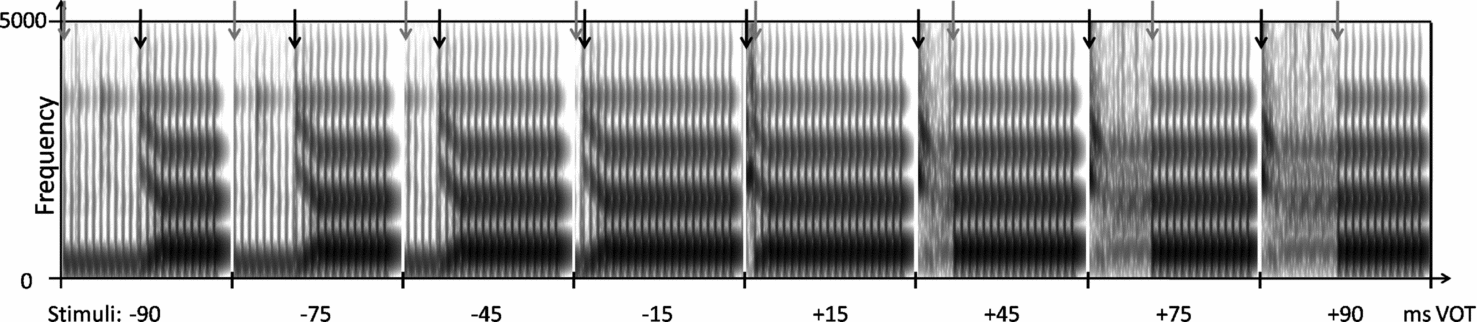
The stimuli were alveolar stop + neutral vowel syllables generated by a parallel formant synthesizer (Klatt, Reference Klatt1980) provided by Carré (Reference Carré2004) forming a /də/–/tə/ VOT continuum, from −90 to +90 ms VOT in 15 ms steps. The onset frequencies of the F1, F2, and F3 transitions were 200, 2200, and 3100 Hz, respectively, and the steady-state formant frequencies were 500, 1500, and 2500 Hz, respectively. The F0 value was constant at 120 Hz, and the syllable duration was held constant at 200 ms. This fixed duration of all stimuli implies that when VOT increases, vowel duration decreases. For a stimulus of 90 ms VOT, the vowel duration was 110 ms; for a stimulus of 15 ms VOT, the vowel duration was 185 ms (see Figure 1). This approach with fixed stimulus duration avoids the participant having to answer on the basis of the perception of a difference in duration rather that on the perception of the stimulus as a whole.
A /də/–/tə/ voice onset time (VOT) continuum spectrogram. The synthetic stimuli varied along a VOT continuum from −90 to +90 ms (from left to right: −90, −75, −45, −15, +15, +45, +75, and +90 ms VOT). The black arrow represents the burst release for each VOT value and the grey arrow the end of the vibration of the vocal cord in the positive VOT and the beginning of the vibration of the vocal cord in the negative VOT.

The /də/–/tə/ continuum was chosen because the mean VOT boundary is located at approximately 0 ms VOT in French in this context (Hoonhorst et al., Reference Hoonhorst, Medina, Colin, Markessis, Radeau and Deltenre2010; Medina, Hoonhorst, Bogliotti, & Serniclaes, Reference Medina, Hoonhorst, Bogliotti and Serniclaes2010). Previous research conducted by Hoonhorst et al. (Reference Hoonhorst, Medina, Colin, Markessis, Radeau and Deltenre2010) using the same continuum showed that French-speaking adults perceived negative VOT stimuli as /də/ and positive VOT values as /tə/.
Procedure
CP was evaluated through identification and discrimination tasks that were carried out before and after training. For the pretraining sessions, half of the participants in each group began with the identification task and the other half with the discrimination task. For posttraining sessions, participants who began with the identification task in the pretraining session began with the discrimination task, and vice versa.
All tasks (identification, discrimination, and training) were programmed and presented using E-Prime (1.1–1.1.4.1) software. The stimuli were binaurally delivered through headphones (Sennheiser HD 202). The participants were seated 50 cm from a 15-in. computer monitor, and all stimuli were presented at 68 dB SPL.
A familiarization task was presented before each identification and discrimination task to teach participants how to manage the computer and the experiment, and to press on the appropriate key on the keyboard to give their answer.
Pre-/posttesting: Identification task
In the identification task, participants were presented with single tokens chosen randomly from the VOT continuum. For each token, they had to decide whether they heard a /də/ or a /tə/ by pressing the appropriate key on the keyboard. Surrounding the key 1 of the computer, a small card indicated that the key was dedicated to the answer de and over the key 0 it was indicated te. After each answer, there was a 2-s delay before the next trial was played.
After a familiarization task of 10 random repetitions of each extreme value of the continuum (−90 and +90 ms VOT), a set of 80 stimuli was presented to each participant (10 repetitions of each of the following stimuli: −60, −45, −30, −15, +15, +30, +45, and +60 ms VOT, all presented in a random orders). For the −60 training group, participants were presented with a set of 100 stimuli (10 repetitions of the −75 and +75 ms VOT were added to the previous ones to cover the larger range of VOT involved in the −60 training group). The endpoint stimuli (−90 and +90 ms VOT) were excluded from the experimental stimuli set to avoid any facilitating effect induced by the familiarization task on these stimuli.
Pre-/posttesting: Discrimination task
In the AX discrimination task (Strange, Reference Strange, Tohkura, Vatikiotis-Bateson and Sagisaka1992), participants had to decide (by pressing the appropriate key) whether two stimuli of a pair were the same or different. The two stimuli for each pair always differed by 30 ms VOT, and the interstimuli interval (ISI) was 100 ms. A short ISI was used in order to trigger direct comparisons in the discrimination task based on acoustic, rather than phonological, differences between stimuli that suggest the activation of low-level auditory processes, which normally occur when the ISI is less than 500 ms (Werker & Logan, Reference Werker and Logan1985). Shorter ISIs would trigger direct comparisons based on acoustic (rather than phonological) differences between the stimuli, which would suggest the activation of low-level auditory processes.
A 2-s intertrial interval separated a given trial from the previous one. The VOT values were chosen to test the sensitivity to stimuli pairs straddling each of the following potential perceptual boundaries: 0 ms VOT (phonological boundary); −30 and +30 ms VOT (universal boundaries); and −45, +45, −60, and +60 ms VOT (arbitrary values).
A familiarization task was presented to each participant using the extreme values of the continuum (−90 and +90 ms VOT). A single set of 20 pairs (five presentations of each of the following pairs: −90/−90, −90/+90, +90/−90, and +90/+90 ms VOT) was presented to each participant in a different random order. Each participant was then exposed to a set of 90 pairs presented in a different random order (five repetitions of each of the eight identical pairs: −60/−60, −30/−30, −45/−45, −15/−15, +15/+15, +45/+45, +30/+30, and +60/+60 ms VOT and five repetitions of each of the 10 different pairs: −60/−30, −30/−60, −45/−15, −15/−45, −15/+15, +15/−15, +15/+45, +45/+15, +30/+60, and +60/+30 ms VOT). For the −60 training group, five repetitions of each of the following pairs were added: −75/−75, −45/−75, −75/−45, +45/+75, +75/+45, and +75/+75 ms VOT (for similar reasons as used in the identification task).
Training
The participants were trained using an identification task called “perceptual fading” (Jamieson & Morosan, Reference Jamieson and Morosan1986). In this training method, we progressively reduced the acoustic distance (magnitude of VOT difference in a pair) between two stimuli as a function of performance, which allows participants who successfully learn to distinguish the endpoint stimuli to attempt to distinguish contrasts with smaller acoustic step size and, thus, to learn more subtle perceptual aspects of the acoustic parameters. Over the course of 2 weeks, participants underwent five 1-hr training sessions with feedback provided every 2 days.
During each session and for each training group (−30, −45, or −60), participants had to perform the largest number of blocks of 20 stimuli in 1 hr. In each block, the 2 stimuli were presented 10 times in random order and could be achieved in at least 2 min, depending on the speed of each participant. It was therefore possible to achieve a maximum of 30 blocks in one session.
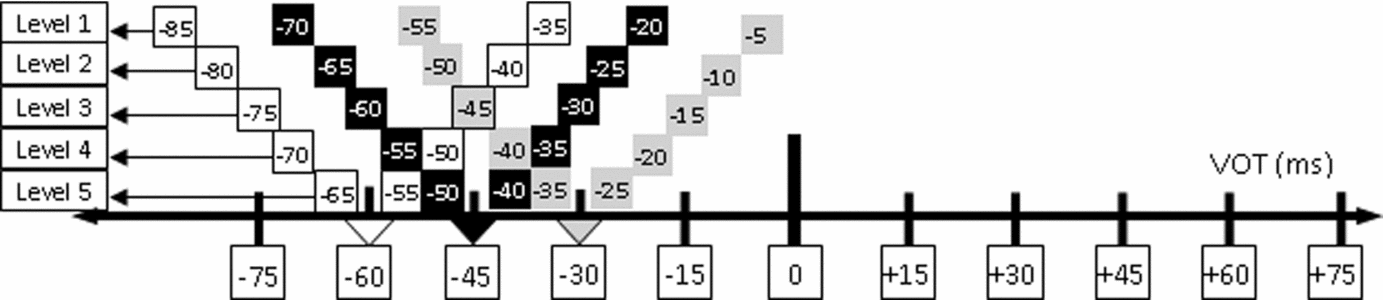
Each participant always began the session at Level 1 (Figure 2) with a 50 ms VOT difference between the two stimuli and centered on the trained value (−30, −45, or −60 ms VOT). When the participants achieved the criterion, which was defined as a minimum of 18/20 correct responses for three consecutive blocks, the acoustic distance was reduced to 40 ms (Level 2), then to 30 ms (Level 3), then to 20 ms (Level 4), and finally to 10 ms (Level 5: see Figure 2). When participants were able to reach this criterion for all five levels, the training session ended, even though the 1-hr training session was not over.
The voice onset time (VOT) values used in the experiment. The white squares refer to the stimuli used in the pre- and posttraining identification and discrimination task. For the training sessions, the values centered on −30, −45, and −60 ms VOT are represented by the grey, black, and white squares, respectively. For all training types, the first level is associated with the largest acoustic distance between the two stimuli in the pair. As the level increases from 1 to 5, the acoustic distance decreases (from 50 to 10 ms VOT).
The participants’ task was to decide whether the stimulus was a /də/ or a /tə/ by pressing the appropriate response key. For the −30 training group, /də/ was considered the correct answer for all stimuli with VOT values below −30 ms VOT, and /tə/ was considered the correct answer for all stimuli with VOT values above −30 ms VOT. In this way, we introduced a mismatch with French phonological perception in which stimuli between −30 and 0 ms VOT are perceived as /də/. The same principle was applied to the −45 and the −60 training groups.
Visual feedback was presented on the computer screen after each trial to indicate whether the response was correct (green screen) or incorrect (red screen). Green feedback appeared for the −30 training group when the subject correctly identified the −25, −20, −15, −10, and −5 ms VOT stimuli as /tə/ and the −35, −40, −45, −50, and −55 ms VOT stimuli as /də/. For the −45 training group, a green reinforcement screen appeared when the subject correctly identified the −40, −35, −30, −25, and −20 ms VOT stimuli as /tə/ and the −50, −55, −60, −65, and −70 ms VOT stimuli as /də/. For the −60 training group, a green reinforcement screen appeared when the subject correctly identified the −55, −50, −45, −40, and −35 ms VOT stimuli as /tə/ and the −65, −70, −75, −80, and −85 ms VOT stimuli as /də/.
Data processing and statistical analysis
The slope of the identification functions was assessed separately for each participant using logistic regression (McCullagh & Nelder, Reference McCullagh and Nelder1983) with the labeling response as the dependent variable and VOT stimulus as the independent variable. The logistic function (McCullagh & Nelder, Reference McCullagh and Nelder1983) has frequently been used for fitting identification curves in studies of speech perception (Nearey, Reference Nearey1990). Boundary location was then computed separately for each participant from the intercept and slope values (for extended information, see Hoonhorst et al., Reference Hoonhorst, Medina, Colin, Markessis, Radeau and Deltenre2010; Medina et al., Reference Medina, Hoonhorst, Bogliotti and Serniclaes2010).
The identification results were tested with two repeated measures analyses of variance (ANOVAs) with Session as the within-subject factor (two levels: pre- and posttraining) and Group as the between-subject factor, with either the slope or the boundary of the identification curve as the dependent variable. Corrections for multiple tests were not performed because comparisons between groups were planned.
CP was assessed by comparing the observed discrimination d′ scores with those from the expected discrimination derived from the identification data computed with elementary probability formulas (Pollack & Pisoni, Reference Pollack and Pisoni1971; for extended information, see Hoonhorst et al., Reference Hoonhorst, Medina, Colin, Markessis, Radeau and Deltenre2010; Medina et al., Reference Medina, Hoonhorst, Bogliotti and Serniclaes2010). Observed and expected discrimination were transformed into d′ by summing the normal deviate z values corresponding to the score of “same” responses to the “same” pairs and those corresponding to the score of “different” responses to the “different” pairs. To circumvent the problem that z (100%) and z (0%) equal infinity, scores above 50% were reduced and scores below 50% were increased by 2.5%, following the procedure described by Macmillan and Creelman (Reference Macmillan and Creelman2005).
The observed discrimination results were tested with a repeated measures ANOVA with Session (two levels: pre- and posttraining) and VOT (five levels: −45, −30, 0, +30, and +45 VOT) as within-subject factors and Group as the between-subject factor, with d′ scores as the dependent variable. The relation between the expected and observed discrimination results for each training group was tested in a repeated measures ANOVA with Task (two levels: expected and observed discrimination), Session (two levels: pre- and posttraining), and VOT (five levels: −45, −30, 0, +30, and +45 VOT) as within-subject factors and Group as the between-subject factor, with d′ scores as the dependent variable.
Whenever the Mauchly sphericity test was significant, Greenhouse–Geisser corrected degrees of freedom values were used.
RESULTS
Identification
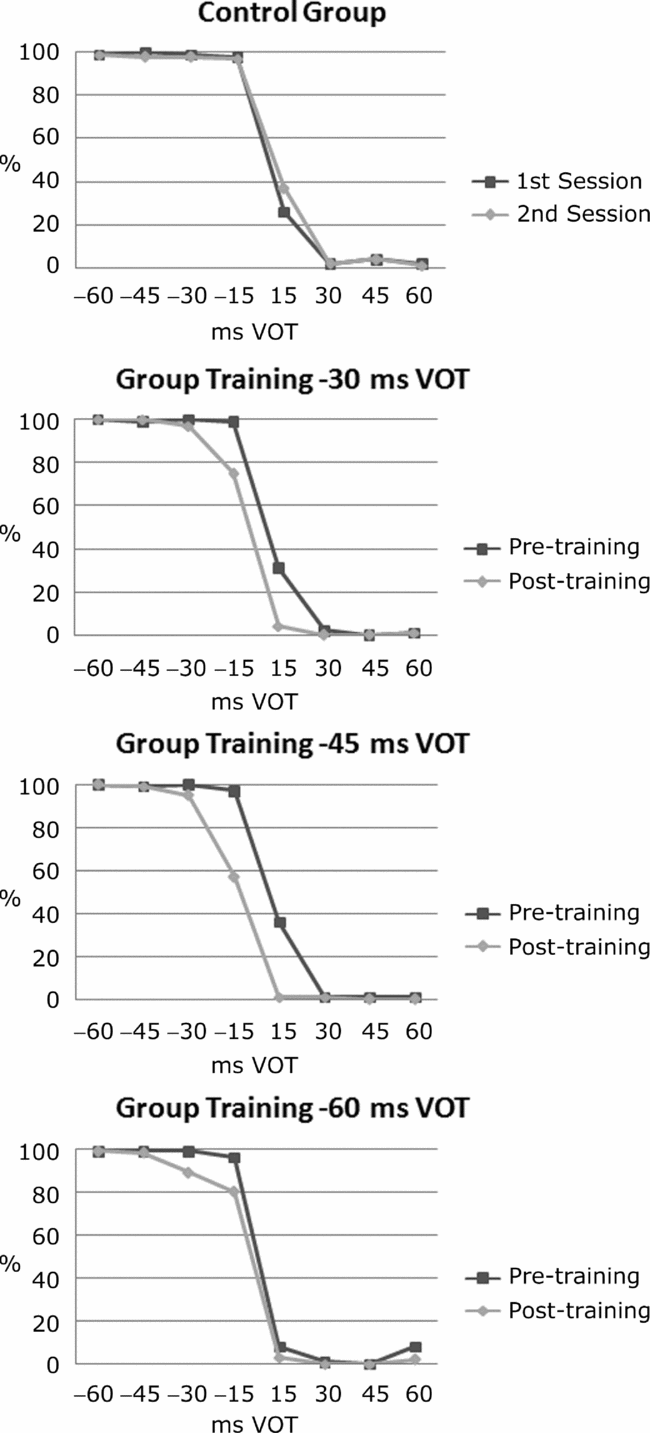
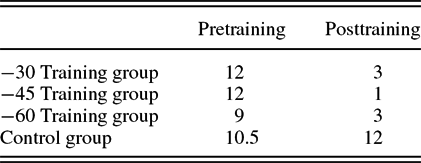
The mean identification curves for each of the four groups are presented in Figure 3. For the mean boundary, significant effects of session, F (1, 3) = 26.9; p < .001; η2 = 0.43, and group, F (3, 35) = 4.6; p = .008; η2 = 0.28, and a significant Session × Group interaction, F (3, 35) = 4.6; p = .008; η2 = 0.28, were observed. For each group, the mean boundary score in pretraining was compared to that in posttraining. The analysis revealed a significant session effect for the −30 training group, F (1, 9) = 29.9; p < .001; η2 = 0.77, and the −45 training group, F (1, 9) = 14.1; p = .004; η2 = 0.6. No effect was reported for either the −60 training group or the control group, F (1, 9) = 3.1; p = .11; η2 = 0.3 and F < 1, respectively. All boundary values in pretraining and posttraining are reported in Table 1.
The identification function curve on the /də–tə/ voice onset time (VOT) continuum in (dark grey) pre- and (light grey) posttraining for the four groups: control group, and the −30,−45, and −60 training groups. The curve corresponds to identification of /də/ (%).
The boundary location values reported for each training group in pretraining and posttraining
Note: All values are expressed in milliseconds of voice onset time (ms VOT).
Discrimination
Observed discrimination responses
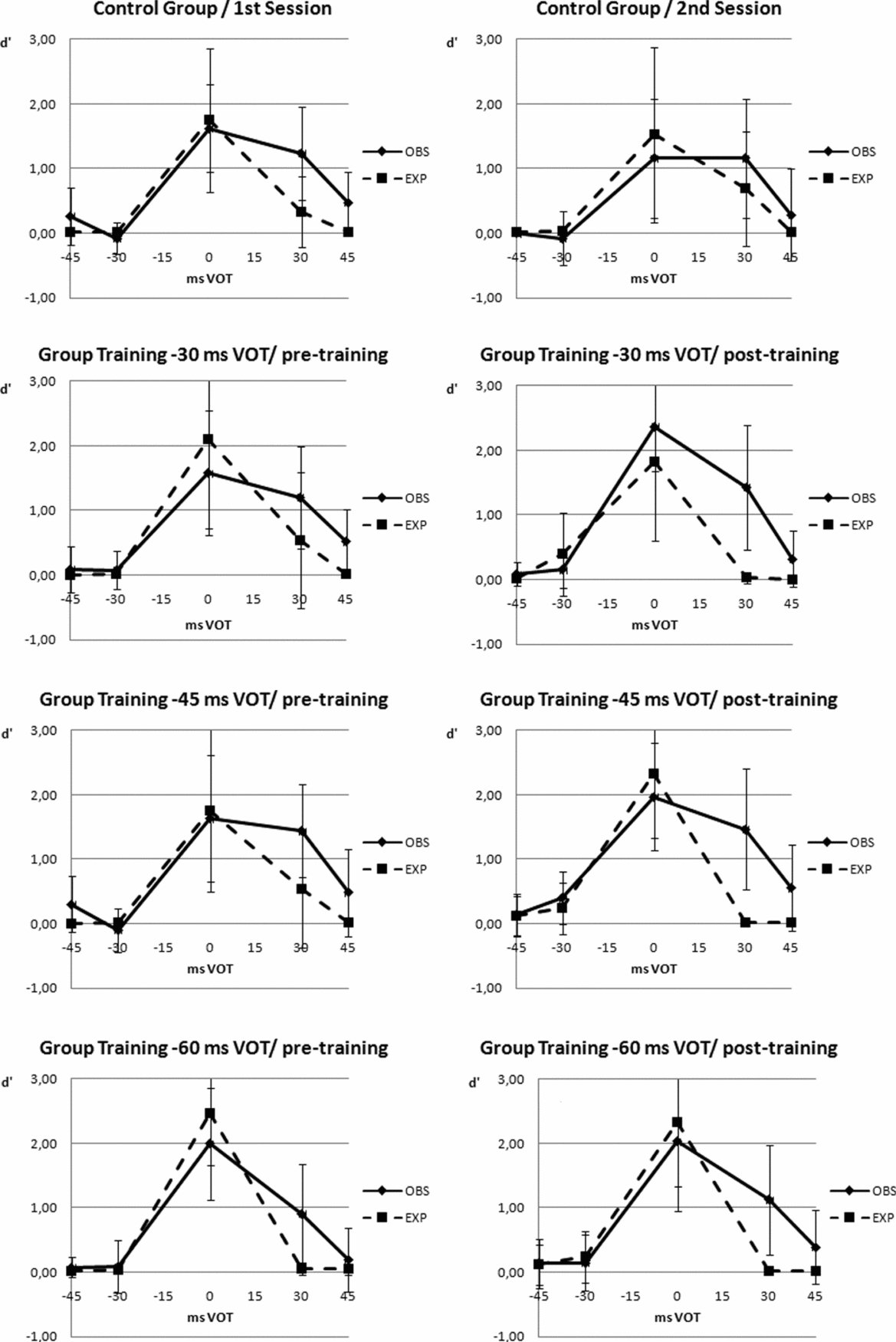
Examination of Figure 4 reveals an increase in the 0 ms VOT discrimination peak between the pre- and posttraining session for the −30 training group, whereas no such increase was present between the first and second sessions for the control group.
The expected (EXP) and observed (OBS) d′ scores on the /də–tə/ voice onset time (VOT) continuum for the control group and the −30, −45, and −60 training groups. Pretraining scores are presented on the left side and posttraining scores on the right side. Error bars represent the standard deviation. The x axis values are the VOT values (ms).
In the ANOVA comparing the −30 training group and the control group, the Session × VOT × Group interaction was significant, after Greenhouse–Geisser correction: F (4, 72) = 4.29; p = .004; η2 = 0.19. The “across versus within-category” planned interaction contrast, that is, the between-group difference in the change from the pre- to posttraining value of the 0 ms discrimination peak, was also significant, F (1, 18) = 7.48; p = .02; η2 = 0.29. When tested separately for each group, the Session × VOT interaction was significant for the −30 training group, after Greenhouse–Geisser correction: F (4, 36) = 5.26; p = .002; η2 = 0.37, but was not significant for the control group (F < 1). The “across versus within-category” planned interaction contrast, that is, the change from the pre- to posttraining value of the 0 ms discrimination peak, was significant, F (1, 9) = 6.86; p = .03; η2 = 0.43, for the −30 training group. There were no important changes in the magnitude of the 0 ms VOT discrimination peak between the pre- and posttraining sessions for either the −45 or the −60 training groups. The Session × VOT × Group interaction was not significant for the comparisons between either the −45 training group or the −60 training group and the control group, F (4, 72) = 1.35; p = .26; η2 = 0.07; F < 1, respectively.
Expected versus observed discrimination responses
Figure 4 shows that for all four groups, CP was far from perfect during the first session: the observed discrimination scores were larger than the expected scores for the + 30 ms VOT within-category pair for all four groups, and the observed discrimination was lower than expected for the 0 ms VOT between-category pair for the −30 and the −60 training groups. Concerning the effect of training on CP, Figure 4 shows that for the -30 training group, there was a decrease in CP after training owing to larger differences between observed and expected discrimination at +30 ms VOT. By contrast, there was no substantial change in CP between the first and second sessions for the control group; the difference between observed and expected discrimination increased slightly for the 0 ms VOT pair but decreased for the +30 ms VOT pair.
The decrease in CP with the −30 training group was confirmed by the results of a repeated measure ANOVA. The Task × Session × VOT × Group interaction was significant after Greenhouse–Geisser correction: F (4, 72) = 3.62; p = .01; η2 = 0.17. However, the “across versus within-category” planned interaction contrast was not significant, F (1, 18) = 2.24; p = .15; η2 = 0.11, indicating that the decrease in CP was due to both across- and within-category changes, that is, to larger differences between the observed and expected discrimination scores at both 0 and +30 ms VOT. When tested separately for each group, the Session × Task × VOT interaction was just below significance for the −30 training group, after Greenhouse–Geisser correction: F (4, 36) = 3.74; p = .06; η2 = 0.29, and the “across- versus within-category” planned interaction contrast, that is, the between-group difference in the change from the pre- to the posttraining value of the difference between the expected and the observed 0 ms discrimination peaks, was not significant, F (1, 9) = 2.70; p = .13; η2 = 0.23.
Concerning the −45 and the −60 training groups, examination of Figure 4 suggests that there were no substantial differences in CP between the pre- and the posttraining sessions. This finding is confirmed by the results of repeated measures ANOVAs showing that the Task × Session × VOT × Group interaction was not significant for comparisons between either the −45 training group or the −60 training group and the control group (both F < 1).
Training
At the end of training, all participants from all groups reached the criterion for the three first levels. For the −30 training group, seven participants were able to reach the fourth level, and only three were able to reach the fifth level. For the −45 training group, four participants were able to reach the fourth level, and six were able to reach the fifth level. For the −60 training group, four participants were able to reach the third level, one reached the fourth level, and four were able to reach the fifth level.
DISCUSSION
The major aim of this study was to assess the effect of identification training on voicing identification, discrimination, and CP in monolingual French-speaking adults. This identification training aimed to introduce a conflict between what participants actually perceive and what training teaches them across three different values within a phonological category. We observed the evolution of three different training values along the VOT continuum: one centered on a universal auditory boundary (–30 ms VOT) and two others centered on arbitrary values, one fairly close to the phonological boundary (–45 ms VOT) and another further away (–60 ms VOT).
Identification: Boundary location
The results of the identification task showed that, after training, the phonological boundary shifted from approximately 10 ms VOT for the −30 and −45 training groups but did not shift for the −60 training group and the control group. These results suggest that the 5 hr of perceptual fading training were sufficient to modify the value of the phonological voicing boundary of adult French speakers. Such modification for the −30 and the −45 training groups could be understood by the training itself. Both the −30 and the −45 training groups exhibited shifts in the identification boundary in the expected direction. No effects on the slope of the identification curves were observed, indicating that the boundary shifts did not affect the precision of the identification boundary. The new boundary was, thus, no less precise in any training groups than was the original, which is a good indication of the quality of the training. However, the absence of shift for the −60 training group is more difficult to explain. This noneffect could be explained by numerous factors. However, if we look carefully at the different VOT values included in the training, we may notice this absence any time the −30 ms VOT value is involved. As we will discuss in the next section, we may suspect that involvement of a universal boundary at any point in the training may induce learning effects.
The long-term effects of this training will certainly remain tenuous. Once the training ends, the participant is again immersed in an environment where no conflict exists in his phonological perception. In this case, the 10 ms VOT shift should quickly fade, and the phonological boundary should resume its initial value. Unfortunately, the long-term effects were not investigated in the present study but will be important to include in future studies.
Discrimination and CP
The results of the discrimination task showed a significant increase (10.5%) in the number of correct discriminations across the French phonological boundary (0 ms VOT) for the −30 training group. Moreover, the CP (correspondence between expected and observed discrimination responses) showed a significant decrease only for the −30 training group, owing to both across- and within-category changes (at both 0 and +30 ms VOT). These results suggest that the 5 hr of perceptual fading training are sufficient to modify discrimination and CP of adult French speakers and that the conflict introduced in perception across the universal boundary had a large impact on the acoustic space compared to that of the other trained values along the VOT continuum. However, we should keep in mind that these training effects will probably vanish through exposure to environmental language input. An open question is to see whether training effects might facilitate the acquisition of the phonological boundaries prevailing in another language during immersion in this language.
As mentioned in the introductory section, the −30 ms VOT is one of two universal auditory thresholds. Children under 6 months of age raised in a Spanish- (Lasky et al., Reference Lasky, Syrdal-Lasky and Klein1975), English- (Aslin et al., Reference Aslin, Pisoni, Hennessy and Perey1981; Eimas, Reference Eimas, Cohen and Salapatek1975), or French-speaking environment (Hoonhorst, Colin, et al., Reference Hoonhorst, Colin, Markessis, Radeau, Deltenre and Serniclaes2009) reacted to both −20/−40 ms VOT and +20/+40 ms VOT contrasts regardless of whether these contrasts straddled the phonological boundary used in their language environment. Moreover, sensitivity to the −30 and +30 ms boundaries has been found in animal studies (Sinnott & Gillmore, Reference Sinnott and Gilmore2004), psychoacoustic studies (Pisoni, Reference Pisoni1977), and neurophysiological investigations of humans (Hoonhorst, Serniclaes, et al., Reference Hoonhorst, Serniclaes, Collet, Colin, Markessis and Radeau2009).
Even though the −30 and the −45 training groups exhibited shifts in the identification boundary in the expected direction, significant training effects on discrimination were only obtained for the −30 training group, suggesting that the training for this boundary had deeper effects than that for −45 ms VOT. This difference in shift was expected from the difference in the auditory status between these boundaries, because −30 ms VOT corresponds to a universal boundary, whereas −45 ms VOT has no special value. Overall, it appears that the closer the training value is to −30 ms VOT, the stronger the effects are according to different criteria (identification shift and change in discrimination scores). However, note that the training does not improve identification and discrimination around the −30 ms boundary. Rather, the training only displaces the identification boundary and discrimination peak toward this value, which suggests that the phonological boundary is strongly anchored around its original value (0 ms VOT) and that possible training effects are constrained by the universal boundaries. This phenomenon can be understood if it is assumed that the French phonological boundary (at 0 ms VOT) arises from a coupling of the universal boundaries (at −30 and +30 ms VOT; Hoonhorst, Colin, et al., Reference Hoonhorst, Colin, Markessis, Radeau, Deltenre and Serniclaes2009; Serniclaes, Reference Serniclaes, Clements and Ridouane2011).
These results support previous studies showing that categorical boundaries can be acquired (Holt et al., Reference Holt, Lotto and Diehl2004) or modified (Pisoni et al., Reference Pisoni, Aslin, Perey and Hennesy1982) following a training procedure within limits imposed by auditory thresholds. However, this study specifies that a phonological boundary is sensitive not only to conflict introduced across auditory thresholds but also to certain arbitrary values near the phonological boundary. Auditory thresholds interact with category shifting but not in a specific way, given that shifts occurred for the group trained around the −30 ms VOT auditory threshold and for the group trained around the −45 ms arbitrary VOT value. However, for discrimination and CP (assessed through comparison between identification and discrimination tasks), this interaction was specific, with changes occurring only for the −30 training group. These results clearly support that modifications in perception (CP and boundary location) can occur even in adulthood.
The present study outlined two methodological novelties. The first showed the importance of using identification and discrimination tasks in order to take into account the relation between these two tasks (CP) for assessing the effects of the training, even if the training was only based on an identification task. Identification training affected both the identification and the discrimination performances, although differently. This finding is congruent with the assumption that these two tasks involve distinct mechanisms that do not reflect the same level of speech representation (Wood, Reference Wood1976). The second methodological novelty concerned the range of stimulus values taken into account for assessing the training effects. Up until now, most studies (Golestani & Zatorre, Reference Golestani and Zatorre2004; Kraus et al., Reference Kraus, McGee, Carrell, King, Tremblay and Nicol1995; Tremblay et al., Reference Tremblay, Kraus and McGee1998, Reference Tremblay, Kraus, McGee, Ponton and Otis2001) have evaluated the effects of training only on the trained contrasts. In the present study, even if the training was centered on three specific values, we measured training effects on the CP along the entire voicing continuum by comparing observed discrimination scores to expected discrimination scores. We showed that the training effects were not restricted to the trained VOT values, illustrating the importance of regarding the phenomenon of learning as a general mechanism that modifies a large part of the perceptual space near the listener's native-language phonological boundary. This phenomenon holds especially true for studies that evaluate these capacities in children with specific language impairments or dyslexia who might suffer from CP troubles (Manis & Keating, Reference Manis and Keating2004; Serniclaes et al., Reference Serniclaes, Van Heghe, Mousty, Carré and Sprenger-Charolles2004; Serniclaes, Sprenger-Charolles, Carré, & Démonet, Reference Serniclaes, Sprenger-Charolles, Carré and Démonet2001). Specifically, the CP deficit in dyslexia arises from an increased sensitivity to universal auditory boundaries that are not phonological in their language but may be in other languages, a phenomenon called “allophonic perception” (for voicing: Bogliotti, Serniclaes, Messaoud-Galusi, & Sprenger-Charolles, Reference Bogliotti, Serniclaes, Messaoud-Galusi and Sprenger-Charolles2008; for place of articulation: Dufor, Serniclaes, Sprenger-Charolles, & Démonet, Reference Dufor, Serniclaes, Sprenger-Charolles and Démonet2009; Noordenbos, Segers, Serniclaes, Mitterer, & Verhoeven, Reference Noordenbos, Segers, Serniclaes, Mitterer and Verhoeven2012). Hence, to improve CP in children with language problems, an appropriate training procedure, centered on the phonological boundary, must be selected, which has already been tested with some success (Collet et al., Reference Collet, Colin, Serniclaes, Hoonhorst, Markessis and Deltenre2012).
This study showed that CP and phonological boundaries can be modified using an appropriate training procedure despite limitations depending on the training value. Because this training is efficient for adult speakers, it seems promising for remediating phonological deficits in language-impaired children (i.e., those with specific language impairment or dyslexia).
ACKNOWLEDGMENTS
This work was financially supported by FER Grant EC9014000007 from the Université Libre de Bruxelles (to C.C.); by FRFC Grant 2.4621.07 (to J.L.); by an FER grant from the Université Libre de Bruxelles (Faculty of Medicine), the Brugmann Foundation, the David and Alice Van Buuren foundation (to P.D.); by the Gosset Foundation (to E.M.); and by ANR Grant ANR-07-BLAN-0014-01 (France; to W.S.). The authors are grateful to René Carré (CNRS Researcher at ENST Paris) for providing the speech synthesis software.