

I. Introduction
The members of the Producteurs de cidre du Québec (PCQ), a trade association of cidermakers, have worked collectively for twenty-five years to enhance cider quality regulation, obtain more advantageous points of sale regulation, and foster communication with consumers to grow the market (Cloutier et al., Reference Cloutier, Renard, Arcand and Laviolette2016). As a result, they have enjoyed a growing domestic market and international recognition for high-end quality products. Since 2012, the market has grown substantially in volume and product variety from sparkling craft ciders, sold in beer-like bottles and kegs.
The horizontal coordination to improve industry performance has always been a challenge among PCQ members. Since 2002, the PCQ has grown from thirty to sixty members (Morrier and St-Georges, Reference Morrier, St-Georges, Cloutier and Détolle2017), which has contributed to some growing pains, given the number of entrants and the emergence of new economic pressures. Not surprisingly, there is heterogeneous production capacity, productivity, and profitability among PCQ members. Consequently, there are ongoing endogenous “coopetitive” tensions among them—that is, competitive behavior within mostly horizontal cooperative relations (Brandenburger and Nalebuff, Reference Brandenburger and Nalebuff1996).
In addition, the industry faces a number of looming business threats. For instance, the domestic market is mostly spared from outside competition. Current production regulations provide for two types of permits : (1) The “Small-scale production permit” requires cidermakers to own one hectare of land, and that ciders be produced on-site from apples grown by them, and (2) The “Industrial permit” requires that ciders produced contain at least 80% of the total final volume from the juice of apples harvested in Quebec.Footnote 1 But, there are pressures to allow for the sale of ciders on the Québec market using input specification standards other than the ones set by current production regulations. It is anticipated that changing this would put a downward pressure on the local market price for ciders given the distinct possibility that low-end mass ciders could be produced and supplied locally at a cheaper cost. For example, in Canada, excluding Québec, the extremely fast-growing demand for ciders has given incentives to international breweries to grow the supply of the unmet demand for ciders with imports (Euromonitor, 2016; Statistics Canada, Reference Canada2017). Such a situation has spurred intense debates among cidermakers in Québec regarding the optimal way to grow the market.
This study identifies and analyzes the collective economic conceptualization of strategic actions to be taken by PCQ members and estimates its conceptual spatial structure. However, the estimation of collective conceptualization represents a significant methodological challenge, mostly due to the absence of innovative methods for facilitating such research (Bouamra-Mechemache and Zago, Reference Bouamra-Mechemache and Zago2015; Meinzen-Dick et al., Reference Meinzen-Dick, DiGregorio and McCarth2004; Rosas, Reference Rosas2017; Vanni, Reference Vanni2014). Group concept mapping (GCM), a mixed methods–based approach, is used to structure qualitative information originating from cidermakers to obtain statistical estimates of the underlying collective conceptualization of strategic action (Kane and Rosas, Reference Kane and Rosas2018; Kane and Trochim, Reference Kane and Trochim2007). In addition to the methodological contribution, the approach makes empirical and practical contributions. Given the horizontal coordination spearheaded by the PCQ, it is relevant to understand the underlying economic conceptualization of strategic actions by its members. This aspect has not been empirically investigated. Business pressures affect the organization of the industry with current production and sales regulation and policies. In particular, GCM is also useful to highlight the producers' priorities regarding individual and collective actions stemming from them.
II. Methods
The empirical work was conducted using the GCM methodological framework, which comprises five steps. For Step 1 (Generating the Ideas), a facilitated group discussion was held with eight participants: board members and the coordinator of the PCQ. They provided ideas to complete a sentence about strategic action initiatives to be collectively undertaken by the PCQ over the next five years. Prior to this session, and in preparation for the group discussion, nineteen in-depth semidirected interviews were conducted with cidermakers.
For Step 2 (Structuring the Items), about 120 ideas collected during the group discussion were structured into a final list of strategic action initiatives numbered from 1 to 48 (k = 48). An extended group of participants made up of PCQ members completed this step. The nonprobabilistic sampling procedure took into consideration each cidery's production volume and geographic location within Québec. The participants completed three tasks: i) complete a contextual questionnaire about their own strategic priorities and those of the industry (n = 30); ii) sort a deck of forty-eight cards (business-card format), on which each item was printed with its identifying number, into piles by themes based on their understanding of how closely each item related to all others (n = 17); and iii) rate on a 5-point Likert-type scale each item in the set for its “relative importance” and “relative feasibility” (n = 30).
Step 3 (Analyzing Concept Maps) consists of statistical data treatments using Concept System® Global MAX™ web-based platform. It structured the quantitative data for the statistical treatment of the qualitative ideas provided by participants. The item sort data from each participant produce a “similarity matrix,” a square binary matrix of 48 × 48 dimensions, one dimension per item in the set (k = 48), based on their intersections in the sorted piles. The similarity matrices of individual participants (n = 17) are summed horizontally to form the “total similarity matrix.” The total similarity matrix is used to estimate the X–Y coordinates of items on the “point map” using multidimensional scaling analysis (MDS) (Kruskal and Wish, Reference Kruskal and Wish1978). The MDS produces a statistical estimation of the “total similarity matrix”—that is, the raw dataset projected onto a bidimensional Euclidian space. One indicator of internal statistical reliability and a validity estimate for information loss in GCM is the stress value. The stress value obtained is low at 0.25, which is an excellent score; stress values found in GCM pooled studies report coefficients ranging on average between 0.26 and 0.28, with a confidence interval of 95% (Rosas and Kane, Reference Rosas and Kane2012).
The distribution of the dots on the Euclidian space gives an overview of the conceptual proximity of participants' representations of the collective strategic actions. In addition, X–Y coordinates and the frequency of items grouped together by participants are used to produce the Anchoring-Bridging Index (ABI) value, or b i , which is calculated to measure the conceptualized proximity of each item on the resulting dot map (Kane and Trochim, Reference Kane and Trochim2007).
The ABI measurement is presented below in the order in which GCM Steps 2 and 3 are executed to produce these values.Footnote 2 The proportion of sorters who put items i and j in the sample pile—that is, P ij —is given by equation (1),
 $$P_{ij} = \displaystyle{{S_{ij}} \over m}\comma$$
where S ij is the number of sorters who place items i and j on the same pile divided by m, the total number of sorters (n = 17). Then, the standardized Euclidian distance, d ij , between all pairs of standardized points from the X–Y coordinates are calculated as shown in equation (2),
 $$d_{ij} = \sqrt {{\left( {x_i - \; x_j} \right)}^2 + {\left( {y_i - \; y_j} \right)}^2\comma} $$
where x i and y i are the estimated MDS x and y coordinates for point i, respectively, and x j and y j are the estimated MDS x and y coordinates for point j, respectively.
Hence, the unstandardized bridging value obtained by calculating bi is given by the ratio shown in equation (3), using the results from equation (1) for the proportion of sorters and equation (2) for the standardized Euclidian distance:
 $${\rm b_i} = \displaystyle{{\mathop \sum \nolimits_{i = 1}^n \mathop \sum \nolimits_{\,j = 1}^n \left( {\,p_{ij}{^\ast}d_{ij}} \right)} \over {\mathop \sum \nolimits_{i = 1}^n \mathop \sum \nolimits_{\,j = 1}^n p_{ij}}}.$$
Normalizing the unstandardized bridging value results in an ABI or b i value that falls in the [0, 1] interval using equation (4):
 $${ b_i} = \displaystyle{{{\rm b_i}\; - \; {\rm min}\left( b \right)} \over {\max \left( b \right)\; - \; {\rm min}\left( b \right)}}$$
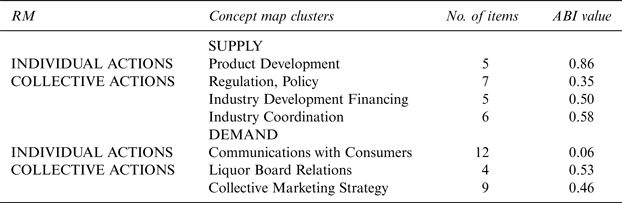
This metric informs results from different angles on the concept map obtained, where min(b) is the minimum and max(b) is the maximum of all the bi values associated with each item. These measures are useful to interpret cluster contents in a spatial sense on the concept map. An ABI value that is closer to 0 tends to indicate a greater sense of meaning for the concept, as it reflects a shorter conceptual distance among participants; an ABI value that is closer to 1 means that it is less defined conceptually, as it reflects a farther conceptual distance among participants (Kane and Trochim, Reference Kane and Trochim2007). The resulting ABI mean values are reported in Table 1 for each cluster on the concept map.
Anchoring-Bridging Index (ABI) by Dimensions and Regions of Meaning (RMs)

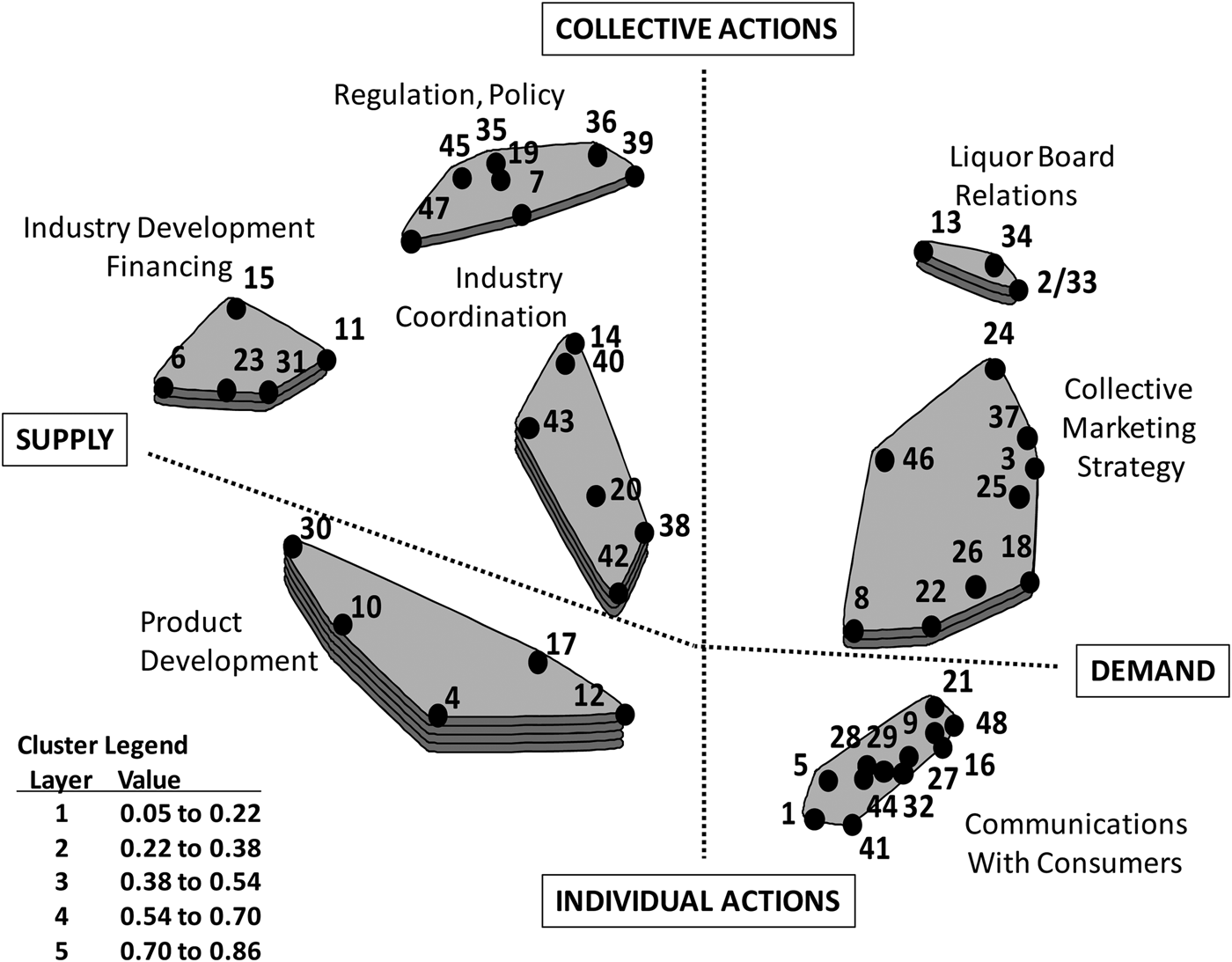
Step 4 (Analyzing the Concept Map) generates sense from the GCM results. The X–Y coordinates of each item are treated with the agglomerative hierarchical cluster analysis (HCA) using the Ward algorithm (Everitt et al., Reference Everitt, Landau, Leese and Stahl2011) as a unified method (Kane and Trochim, Reference Kane and Trochim2007). The results from the HCA generate the polygons on the concept map presented to PCQ board members. A facilitated discussion with them helped identify the number of clusters on the map given the HCA results, and it also included naming clusters on the map. During the discussion, participants settled on a seven-cluster solution over which the forty-eight action items are distributed (see section III.A, Figure 1 and Table 1).
Anchoring-Bridging Index (ABI) Group Concept Map Based on Multidimensional Scaling Analysis (MDS) and Ward's Hierarchical Cluster Analysis (HCA)

In Step 5 (Interpreting the Map and Results), a “knowledge uptake” discussion took place with the PCQ board to examine ABI values and the mean and variance of the relative importance and relative feasibility ratings. The logic used for Steps 1 to 4 of the GCM is essentially inductive, but the sense-making part of it, which consists of interpreting the results, involves a retroduction inference process that roughly consists of generalizing the results based on available theoretical notions (see Mantere and Ketokivi (Reference Mantere and Ketokivi2013) for further details and epistemological underpinnings). The underlying bidimensional point map estimates are used to identify the latent constructs and interpret results (Rosas, Reference Rosas2017). The perception measures of relative importance and relative feasibility scales were used for planning and horizontal coordination among PCQ members (see section III.B, Figure 2 and Table 2).
Pattern Matches Comparing Relative Importance and Relative Feasibility Ratings

Relative Importance and Relative Feasibility Mean and Variance Ratings, Correlation, and Statistical Significance Differences by Dimension

* correlation
III. Findings
The cidermakers' collective economic conceptualization of strategic actions are analyzed in Section III.A, followed in Section III.B by the perception measures of the relative importance and relative feasibility of strategic action clusters.
A. Cidermakers' Economic Conceptualization
The ABI concept map in Figure 1 contains the overlay of the MDS point map estimates (Step 3), the resulting HCA-based cluster map (Step 4), and the two latent construct axes (intersecting dotted lines) (Step 5).
The map represents cidermakers' conceptualization of economic action logic with basic supply-oriented and demand-oriented actions across the spectrum of organizational-oriented and individual-oriented actions (see Table 1). The latent construct along the west-east axis relates to the SUPPLY/production dimension on the left-hand side and to the DEMAND/market dimension on the right-hand side. The latent construct along the north-south axis is labeled COLLECTIVE ACTIONS and INDIVIDUAL ACTIONS. At the north end, clusters are related to the PCQ associative environment, where actions to be carried out are collective; at the south end, clusters are indicative of actions at the cidery level.
The two latent construct axes form “quadrants” that delineate “regions of meaning” (RMs) on the concept map. The map reveals tensions among concepts, given the spatial distribution of clusters on the map across RMs, and the distance versus the proximity of clusters (Kane and Trochim, Reference Kane and Trochim2007).
Table 1 presents the spatial organization of clusters on the map for each RM. The RM bordered by COLLECTIVE ACTIONS – DEMAND has two clusters. The Liquor Board Relations cluster emphasizes the production development orientation of cidermakers' collective actions and the desire to work hand-in-hand with the board to grow market and sales volume. It is neither an anchor nor a bridge action cluster (ABI = 0.53). The Collective Marketing Strategy cluster (ABI = 0.46) aims at taking advantage of market growth, stimulating the demand for the cider product category (item 8), and helping cidermakers be recognized for product quality across broad market segments (item 18). In the RM delineated by axes INDIVIDUAL ACTIONS – DEMAND, the Communications with Consumers cluster is the most anchored (ABI = 0.06) and contains actions about explaining the cidermaking craft to consumers (item 1). But its purpose also extends to include a strong promotional aspect, a discourse, for all ciders as a means for individual cidermakers to differentiate their products; it is output growth-oriented; and it seeks to increase the consumption of locally produced ciders.
The four remaining clusters are supply-oriented. The COLLECTIVE ACTION – SUPPLY RM includes three clusters. R egulation, Policy is a well-anchored action set (ABI = 0.35) related to how regulation ought to evolve and be conducted, to supporting new product development that is volume-oriented, and to allowing online sales by cideries (item 39). Industry Development Financing (ABI = 0.50) is an action cluster about measuring the impact of introducing new fees on cidermakers (item 6) and financing cider promotion independently of government support (item 31). The Industry Coordination cluster aims to develop unifying actions to attenuate tensions in the PCQ such that it is inclusive of the geographic and business model diversity (e.g., artisan crafts compared to larger producers) (items 40, 42).
Finally, in the RM defined by INDIVIDUAL ACTIONS – SUPPLY, there is Product Development. It is clearly a bridging concept (ABI = 0.86) that is perhaps outside the realm of the collective action set—that is, it epitomizes individual decision making regarding cider production (item 12), the improvement of cider production quality based on best practices (item 4), and whether this concept leads to a Protected Designation of Origin (PDO) or other cider-quality label (item 10).
B. Cidermakers' Perceptions of Strategic Actions
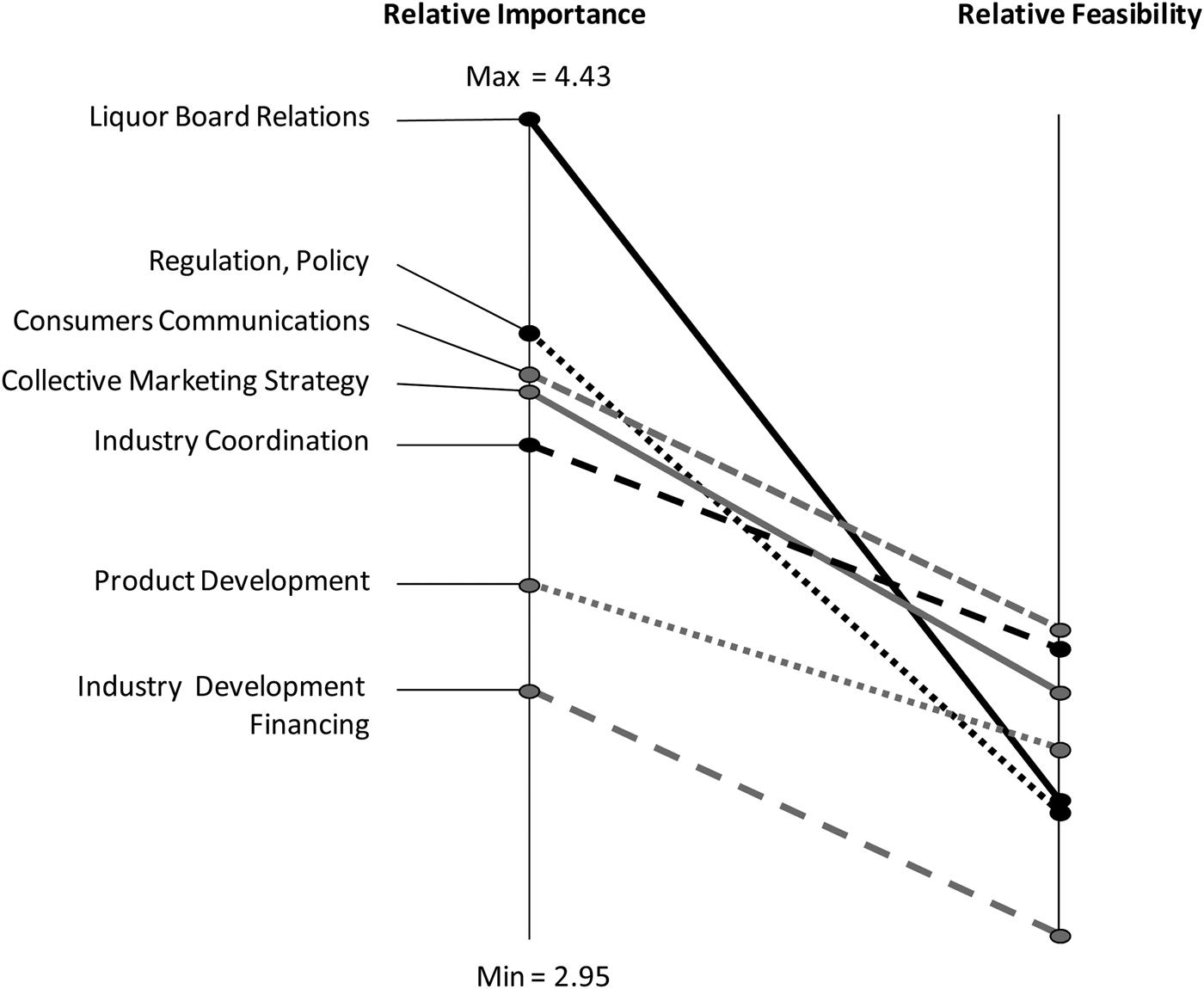
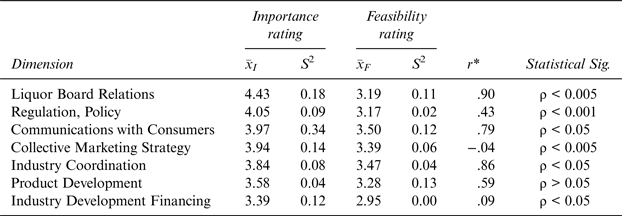
The pattern matches graph shown in Figure 2 displays cidermakers' perceptions of clusters on the map (see also Table 2) and scale estimate incongruence. A nonparametric Wilcoxon Rank-order test for matched pairs is used to compare the overall ranking for relative importance and relative feasibility and is statistically significant (ρ-value < 0.05). This result indicates that significant challenges are associated with the practical feasibility of strategic actions relative to their importance rank-ordering.
The Liquor Board Relations cluster is rated as the relatively most important, while its feasibility rating sits much lower, ranking fifth out of seven (I = 4.43 > F = 3.19; ρ-value < 0.005). Second in relative importance is Regulation, Policy, a cluster of seven items with a perceived relative feasibility at the sixth rank; this cluster also presents a challenging situation going forward and restricts the collective economic action set aimed at bolstering production growth (I = 4.05 > F = 3.17; ρ-value < 0.001). Both clusters involve collective actions aimed at advancing PCQ members' regulatory aspects associated with production (supply) and sales (demand).
One-fourth of all forty-eight action items were sorted into the Communications with Consumers cluster. It is rated third in relative importance, while its relative feasibility clearly is in the hands of individual cidermakers, as it occupies the first rank (I = 3.97 > F = 3.50; ρ-value < 0.05). The Collective Marketing Strategy cluster occupies the fourth rank in relative importance and the third rank in relative feasibility (I = 3.94 > F = 3.39; ρ-value < 0.005).
Industry Coordination ranks fifth in relative importance and third in relative feasibility (I = 3.84 > F = 3.47; ρ-value < 0.05), indicating that these actions may have more to do with the collective will of PCQ members.
The Product Development cluster ranks sixth for relative importance, yet its relative feasibility ranks fourth (I = 3.50 > F = 3.28; ρ-value > 0.05), and it is the only cluster with no statistical difference between the relative importance and relative feasibility scales.
Finally, the relative importance and relative feasibility ratings for Industry Development Financing are both rated lowest on both scales (I = 3.39 > F = 2.95; ρ-value < 0.05). This ranking is perhaps an indication of the tactical reaction of cidermakers, which is that collective funding ought to come from some place other than their own wallets.
IV. Discussion and Conclusion
The GCM mixed methods–based approach contributed in this research to estimate empirically the spatial collective economic conceptualization of cidermakers regarding a set of horizontally coordinated strategic actions. As there are often divergent imperatives among cidermaker or winemaker associations leading to coopetitive tensions, the GCM makes it possible to understand them better, as is revealed by the organization of the seven clusters on the concept map, with their associated ABI values, and the two overlaid latent construct axes. These are instrumental in revealing the supply and demand conceptualization by cidermakers and the scope of individual and collective actions.
Regarding the empirical result contribution, individual actions tend to be relatively more feasible, have lower ABI values, and are market-oriented. This result stresses further the feasibility challenges of collective actions, such as those of Liquor Board Relations and Regulation, Policy clusters that are rated as relatively more important. Hence, these collective actions are about lifting supply-constraining regulations, while individual actions are about market relationships with consumers. The collective economic conceptualization of strategic action is a means to an end and not an end in itself. The latter is more strongly associated with cidermakers as entrepreneurs.
At a practical level, a better understanding of the underlying collective economic conceptualization process of cidermakers could help identify managerial economic implications of the industry's organization and of the prioritization scheme and hurdles in strategic action implementation. One important outcome from horizontal coordination in these types of “coopetitive” collectives is the possibility of creating some degree of cohesiveness, such that a common set of collective actions could be carried out productively to members' benefit. The collective economic conceptualization could really make a practical contribution by helping us understand the organizational economic implications of strategic actions on industry structure, conduct, and performance.