Introduction
Our knowledge of the world's fauna of phorid flies, though increasing steadily, is still fragmentary. The provision of keys to the Nearctic (Peterson Reference Peterson, McAlpine, Peterson, Shewell, Teskey, Vockeroth and Wood1987), world (Disney Reference Disney1994), and Central American (Brown Reference Brown, Brown, Borkent, Cumming, Wood, Woodley and Zumbado2010) genera still leaves some of the New World fauna unidentifiable, especially species in the warmer regions. One particularly unresolved genus is the Neotropical and Afrotropical Macrocerides Borgmeier, whose status is reviewed below.
Methods and materials
Specimens collected in alcohol were dried using hexamethyldisilazane (Brown Reference Brown1993).
Holotypes of six species of Macrocerides were examined and photographed during a visit to the Museu de Zoologia, São Paulo, Brazil. The phorid collection of the Smithsonian Institution, including the holotype of a seventh species, is on long-term loan to the author. Photographs of all holotypes, along with those of two new species described here, are deposited in Morphbank.
Specimens are deposited in the following collections:
- INBC
Instituto Nacional de Biodiversidad, Santo Domingo, Costa Rica
- LACM
Natural History Museum of Los Angeles County, Los Angeles, California, United States of America
- MACN
Museo Argentino de Ciencias Naturales, Buenos Aires, Argentina
- MCZC
Entomology Department, Museumof Comparative Zoology, Harvard University, Cambridge, Massachussetts, United States of America
- MUCR
Museo de Insectos, Universidad deCosta Rica, San José, Costa Rica
- MZSP
Museu de Zoolgia, Universidade de São Paulo, São Paulo, Brazil
- TAMU
Texas A&M University, College Park, Texas, United States of America
- USNM
United States National Museum, Smithsonian Institution, Washington, D.C., United States of America
This work is dedicated to the editors of the Manual of Nearctic Diptera, whose pioneering work gave us the possibility and the nerve to tackle the Central American fauna 20 years later (Brown et al. Reference Brown, Borkent, Cumming, Wood, Woodley and Zumbado2009, Reference Brown, Borkent, Cumming, Wood, Woodley and Zumbado2010a).
Systematics
Macrocerides Borgmeier
Macrocerides Borgmeier, Reference Borgmeier1927: 31; 1928: 167; 1969: 69; Schmitz Reference Schmitz1927a: 24; 1927b: 73, 110; 1929: 139; Disney Reference Disney1994: 277–278; Disney et al. Reference Disney, Elizalde and Folgarait2008: 104.
Type species:Macrocerides curtifrons Borgmeier.
Note on gender. The suffix “ides” renders this name masculine.
Historically included species.Macrocerides abaristalis Borgmeier, M. anacleti Borgmeier, M. attophilus Disney, M. brevicornis Borgmeier, M. curtifrons, M. leydheckeri Schmitz, M. luteus Borgmeier, M. neivai Borgmeier, and M. trinitatis Borgmeier.
Taxonomic problems with Macrocerides
In his original paper on Macrocerides, Borgmeier (Reference Borgmeier1927) characterized the genus as “differing from Megaselia principally by the elongate, retort-shaped third antennal segment”. Given the range of forms that are now accepted within the giant, probably paraphyletic (Disney Reference Disney1989; Brown Reference Brown1992) “genus” Megaselia Rondani, however, this diagnosis is inadequate. Eight further species of questionable affinity to M. curtifrons were subsequently described (Borgmeier Reference Borgmeier1928, Reference Borgmeier1969; Beyer Reference Beyer1965; Disney et al. Reference Disney, Elizalde and Folgarait2008), and Disney (Reference Disney1994) commented that the “genus” was likely a polyphyletic assemblage of Megaselia species with modified antennae.
I agree with Disney that Macrocerides is probably not monophyletic as currently conceived, but unfortunately neither is Megaselia. Widely divergent monophyletic groups that potentially arose from within Megaselia are treated by some authors as valid genera (such as Gymnophora Macquart) and others as subgenera of Megaselia (such as Disney's (1994) treatment of Myriophora Brown). Until some resolution of the Megaselia problem is reached, I think it is best to recognize divergent hypothesized monophyletic groups by naming them. These names can be treated as full genera or as subgenera of Megaselia, depending on an author's interpretation of the evidence.
Within Macrocerides, some species are clearly not related to the type species M. curtifrons. In M. anacleti in particular, the form of the oviscape of the female and the short but deep notch on the epandrium of the male terminalia are synapomorphies proposed by Brown (Reference Brown1992) for Myriophora. Macrocerides anacleti is therefore here considered a species of Myriophora (new combination).
I examined the male holotype of Macrocerides brevicornis, which, besides representing a nomenclatural contradiction, also has the epandrium notched on both sides, as is typical of males of Myriophora. I hereby transfer it to that genus, resulting in Myriophora brevicornis (new combination). Similarly, Macrocerides luteus is also a Myriophora species, and is here transferred, resulting in Myriophora lutea (new combination).
Borgmeier (Reference Borgmeier1969) commented that M. neivai (described in 1928) was possibly a species of Apocephalus Coquillett, based on the form of the male terminalia and the female oviscape. After examining the types, I agree that, at least provisionally, it is better placed in Apocephalus subgenus Apocephalus (new combination). This action renders Apocephalus neivai Borgmeier (described in 1931) a junior homonym. I therefore propose A. elizaldae as a replacement name, to recognize the work of Luciana Elizalde on this and other species of Apocephalus (Brown et al. Reference Brown, Brown, Borkent, Cumming, Wood, Woodley and Zumbado2010b).
It seems highly unlikely that the single species from Africa, Macrocerides leydheckeri, is congeneric with the Neotropical species. I examined a specimen of this species in the MZSP and, based on the extremely short setae on the first flagellomere and the highly divergent male terminalia, I herein remove it from Macrocerides and place it in a monobasic new genus, Macrocerophora.
I did not examine the holotype of M. trinitalis, which could not be found in the MZSP, but I am skeptical that it belongs in Macrocerides.
The remaining three described Macrocerides species are the type species M. curtifrons plus M. abaristalis and M. attophilus. The descriptions of two new species are given below. All are known from male specimens only.
Macrocerides curtifrons Borgmeier
(Figs. 1, 5)
Macrocerides curtifrons Borgmeier, Reference Borgmeier1927: 32–33, Figs. 1, 3 (♂, Petrópolis, Rio de Janeiro, Brazil); 1969: 72–73, Figs. 47–49.
Diagnosis
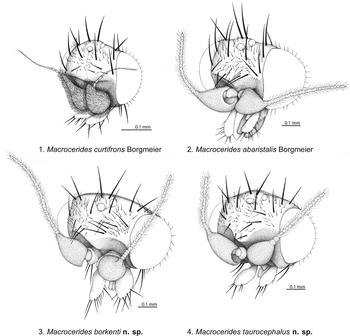
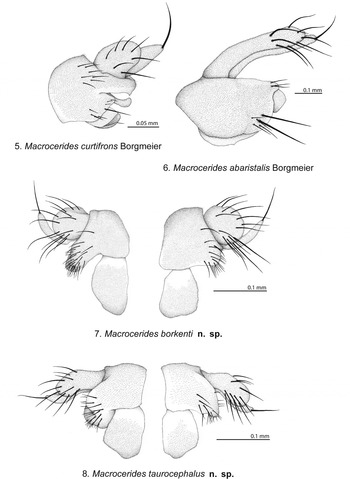
Frons short (Fig. 1). Ventral fronto-orbital setae close to eye margin, reclinate (pointed dorsally). Flagellomere 1 conical, arista present. Midtibia lacking dorsal longitudinal setal palisade and posterodorsal row of differentiated setae. Hind tibia with complete dorsal longitudinal setal palisade and posterodorsal row of differentiated setae, most apical seta not enlarged. Male terminalia (Fig. 5) with cercus short, laterally flattened, on long process of epandrium.
Heads of Macrocerides spp., anterolateral view.

Material examined
1♂, BRAZIL. Rio de Janeiro: Petrópolis, 19.xii.1949, T. Borgmeier (USNM).
Male terminalia of species of Macrocerides subgenus Tauricornus (Figs. 5, 6, left lateral view; Figs. 7, 8, right and left lateral views).

Tauricornus new subgenus
Type species: Macrocerides (Tauricornus) taurocephalus new species.
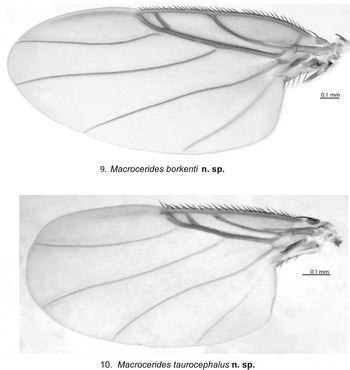
Left wings of two species of Macrocerides subgenus Tauricornus, dorsal view.

Gender
For purposes of nomenclature, this subgenus is considered masculine.
Diagnosis
Flagellomere 1 lacking arista, apically drawn out into a long, bumpy process. Hind tibia with enlarged apical posterodorsal seta.
Phylogenetic relationships
Within the subgenus, I consider M. (T.) abaristalis to be the sister-species of the monophyletic M. (T.) taurocephalus group.
Recognition
In Disney's (1994) key to males of world genera, Tauricornus species key to couplet 110 as “Macrocerides (part)”. In Peterson's (1987) key, they key to couplet 32, where questions about an arista impede progress; insertion of a new couplet before 32, “Arista absent, flagellomere 1 greatly drawn out”, will separate Macrocerides (Tauricornus) from the other genera. Finally, in Brown's (2010) key, one species of Macrocerides (Tauricornus) will key to couplet 59 (as “Macrocerides Borgmeier, in part”). This couplet should be moved to become couplet 57, the current couplet 57 to become 58, and 58 to become 59; these changes allow all Macrocerides (Tauricornus) to be identified at the new couplet 57.
Derivation of the name
This name is a combination of Latin words meaning “bull horn”, referring to the elongate first flagellomere.
Included species.
Macrocerides (Tauricornus) abaristalis Borgmeier and the three species of the M. (T.) taurocephalus group.
Macrocerides (Tauricornus) abaristalis Borgmeier
(Figs. 2, 6)
Macrocerides abaristalis Borgmeier, Reference Borgmeier1969: 69–70, Figs. 43, 44 (♂, Suiza de Turrialba, Costa Rica).
Diagnosis
Frons short (Fig. 2). Ventral fronto-orbital setae close to eye margin, reclinate. Midtibia with complete dorsal longitudinal setal palisade and both anterodorsal and posterodorsal row of differentiated setae. Hind tibia with complete dorsal longitudinal setal palisade and posterodorsal row of differentiated setae, most apical seta enlarged. Costa 0.61–0.63 wing length. Male terminalia (Fig. 6) with cercus elongate.
Recognition
This species is most easily recognized by the dark-brown body and elongate cercus.
Distribution
Mid-elevation Costa Rica.
Material examined
COSTA RICA. Cartago: Dulce Nombre, 9.83°N, 83.52°W, 2♂, vi–viii.1993, P. Hanson, Malaise trap, 1400m; San José: Zurquí de Moravia, 10.05°N, 84.02°W, 1♂, iii.1991, 1♂, vii.1992, 2♂, iv–v.1993, 1♂, vi.1993, 1♂, ix–x.1993, 1♂, i.1996, P. Hanson, Malaise trap, 1600 m (LACM).
Macrocerides (Tauricornus) taurocephalus group
Diagnosis
Ventral fronto-orbital seta greatly displaced medially (Figs. 2–4), in some species nearly vertically above ventral interfrontal seta. Proboscis greatly reduced. Hind tibia with only a single apical posterodorsal seta, other posterodorsal setae greatly reduced in size. Hypandrium short but deep.
Included species
Macrocerides (Tauricornus) attophilus Disney, M. (T.) borkenti new species, M. (T.) taurocephalus new species.
Macrocerides (Tauricornus) attophilus Disney
Macrocerides attophilus Disney, in Disneyet al. Reference Disney, Elizalde and Folgarait2008: 104–106, Figs. 13–14.
Holotype ♂,: ARGENTINA. Reserva Natural Formosa, 4.x.2004, over Atta saltensis (MACN; not examined).
Diagnosis (from Disney et al. 2008)
Palpus with short setae. Wing length 1.7–1.9 mm. Costa 0.59–0.64 wing length. Wing vein M2 straight on apical two-thirds. Alula with two or three setae. Cercus nearly circular.
I sent a photograph of Macrocerides (T.) borkenti to Dr. Henry Disney, who kindly responded “While it is very similar I think it is different. Vein 4 is distinctly more sinuous in your specimen (in M. attophilus it is more-or-less straight in the last two thirds) and the palp bristles are longer (cf fig. 13 in our paper)”.
Material examined
None.
Macrocerides (Tauricornus) borkenti new species
(Figs. 3, 7, 9)
Diagnosis
Palpus with long setae (Fig. 3). Wing length 2.3mm, costa 0.59 wing length, wing vein M2 sinuous on apical two-thirds, alula with five setae (Fig. 9). Cercus nearly circular (Fig. 7).
Description
Male (female unknown). Body length 2.3–2.6mm. Frons (Fig. 3) short, brown, with shallow median furrow; frontal setation varied, frequently asymmetrical, with seven to nine large setae per side; most variation in the placement and presence of ventral interfrontal seta and supra-antennal setae; occasionally with supernumerary setae on frons. Flagellomere 1 brown, greatly drawn out into a long, bumpy process; arista absent. Palpus light brown, with several long apical to subapical setae. Proboscis greatly reduced, possibly vestigial. Scutum and scutellum brown; scutum with scattered setulae and one humeral, two notopleural, two supra-alar (one on posterior margin), and several posterior setae, including possible intra-alar, dorsocentral, and acrostichal setae. Scutellum with two pairs of long setae, posterior ones slightly longer and notably thicker; scutellum in some specimens with supernumerary setae, sometimes asymmetrically arranged (as in holotype). Proepisternum small, with only two ventral setae. Anepisternum with dorsoventral furrow, without setae. Legs light brown, lacking large isolated setae; midtibia with nearly complete dorsal longitudinal setal palisade; hind tibia with a complete dorsal longitudinal setal palisade, a slightly enlarged and differentiated posterodorsal row of setae, and one large posterodorsal seta at distal apex. Wing (Fig. 9) with mean costal length 0.59 wing length, range 0.58–0.60. Vein R1 lacking small seta at distal tip. Alula with five setae, upper calypter with six setae. Halter brown. Abdominal tergites dark brown, venter of abdomen gray, with minute setulae only. Terminalia (Fig. 7) brown; cercus light brown, nearly round in shape.
Distribution
Costa Rica to northern South America.
Derivation of specific epithet
Named for my colleague Dr. Art Borkent, another bull-headed organism.
Holotype ♂,: COSTA RICA. Limón: 16km W Guapiles [10.15°N, 83.92°W], v.1989, P. Hanson, Malaise trap, 400 m [barcode label: LACM ENT 260300] (LACM). Paratypes: COSTA RICA. Heredia: La Selva Biological Station, 10.43°N, 84.02°W, 1♂, 17–23.v.1988, B.V. Brown, Malaise trap, primary forest, CES 200 (LACM), 1♂, iv.1991, P. Hanson, Malaise trap (LACM), 1♂, iii.1993, 1♂, iv.1993, 1♂, 15.vii.1993, 1♂, 15.i.1994, ALAS, M/14/029, M/01/064, M/08/158, M/01/320 (INBC), 3♂, 6–11.vii.1993, B. Brown, D. Feener, Malaise trap No. 1, SHO 50 (LACM); Limón: 7km SW Bribri, 9.58°N, 82.88°W, 8♂, ix–xi.1989, 4km NE Bribri, 9.63°N, 82.82°W, 8♂, xii.1989–iii.1990, 2♂, iv–v.1990, 1♂, vii–ix.1990, P. Hanson, Malaise trap, 50m (LACM, MCZC, MUCR, USNM), 16km W Guapiles, 10.15°N, 83.92°W, 3♂, ii.1989, 1♂, iii.1989, 1♂, iv.1989, 3♂, v.1989, 7♂, iii–v.1990, 1♂, v–vi.1990, 1♂, vii–xi.1990, 3♂, vi–ix.1991, P. Hanson, Malaise trap, 400m (LACM), Pacuarito, 10.11°N, 83.46°W, 1♂, 23–26.viii.1996, Gustafsson, Pape, Viklund, Malaise trap, 300 m (LACM). GUYANA. Berbice, Warniabo Creek, Dubulay Ranch, 5.66°N, 57.88°W, 1♂, 16–20.i.1999, B. Brown, M. Sharkey, Malaise trap No. 9 (LACM).
Macrocerides (Tauricornus) taurocephalus new species
(Figs. 4, 8, 10)
Diagnosis
Palpus with long setae (Fig. 4). Wing length 1.4mm, costa 0.5 wing length, wing vein M2 sinuous on apical two-thirds, alula with three setae (Fig. 10). Male cercus twice as long as deep, slightly ventrally curved (Fig. 8).
Description
Male (female unknown). Body length 1.0–1.3mm. Frons (Fig. 4) short, brown, with shallow median furrow; frons with eight large setae per side, as follows: inner vertical seta and dorsal fronto-orbital seta slightly displaced medially from eye margin; ventral fronto-orbital seta greatly displaced medially, almost directly above ventral interfrontal seta, and both of these setae medioclinate; two proclinate supra-antennal setae present. Flagellomere 1 brown, greatly drawn out into long, bumpy process; arista absent. Palpus light brown, with a few medium-sized apical setae. Proboscis greatly reduced, possibly vestigial. Scutum and scutellum darker brown than frons; scutum with scattered setulae and one humeral, two or three notopleural, two supra-alar (one on posterior margin), and one posterior intra-alar and dorsocentral seta. Scutellum with one pair of long setae. Proepisternum small, with only two ventral setae. Anepisternum with dorsoventral furrow, without setae. Legs light brown, lacking large isolated setae; midtibia with dorsal longitudinal setal palisade ending at distal three-quarters; hind tibia with complete dorsal longitudinal setal palisade and one large posterodorsal seta at distal apex. Wing (Fig. 10) with mean costal length 0.50 wing length, range 0.47–0.52. Alula with three or four setae, upper calypter with two setae. Halter light brown. Abdominal tergites dark brown, venter of abdomen gray, with minute setulae only. Terminalia (Fig. 8) brown; cercus light brown, twice as long as deep.
Geographical distribution
Southern Texas, United States of America.
Derivation of specific epithet
From Greek tauros and kephale for “bull-headed”, referring to the long, hornlike first flagellomeres.
Holotype ♂,: United States of America. Texas: Travis Co., Austin, Brackenridge Field Station, 30.30°N, 97.78°W, 21–28.xi.1989, C.R. Nelson, Malaise trap [barcode label: LACM ENT 029961] (LACM). Paratypes: 7♂, 5 as holotype (LACM), and 2♂, 30.vii 20.viii.1990, R. Wharton (TAMU).
Key to males of Macrocerides subgenus Tauricornus
1. Cercus elongate, narrow (Fig. 6); body dark brown with light-brown halter; found in mid-elevation Costa Rica………M. (T.) abaristalis Borgmeier
— Cercus shorter, flat (Figs. 7, 8); body light brown with dark-brown halter; found in New World tropical to temperate lowlands………2
2. Cercus about twice as long as deep, not circular (Fig. 9); costa about 0.5 wing length; found in southern Texas, United States of America………M. (T.) taurocephalus new species
— Cercus short, nearly circular (Fig. 7); costa about 0.6 wing length; found in Central and South America………3
3. Alula with two or three setae; palpus with relatively short setae aside from apical pair; wingvein M2 straight on apical two-thirds; found in Argentina………M. (T.) attophilus Disney
— Alula with five setae (Fig. 9); palpus with several longer setae; wing vein M2 slightly sinuous apically (Fig. 9); found in Central America and northern South America………M. (T.) borkenti new species
Acknowledgements
I thank Brian Koehler for expertly preparing the line drawings and wing photographs, Giar-Ann Kung and Vladimir Berezovskiy for technical help, and Paul Hanson and Robert Wharton for sending me Malaise-trap samples to sort. This research was funded by National Science Foundation grant DEB-1025922 to B.V. Brown and P. Smith.