



Introduction
The Trigoniida Dall, Reference Dall1889 is an order of non-siphonate bivalves with very low recent diversity, as only two Australian genera (the Holocene Neotrigonia Cossmann, Reference Cossmann1912 and its putative ancestor, the Paleocene–Late Miocene Eotrigonia Cossmann, Reference Cossmann1912) are known for the entire Cenozoic (Darragh Reference Darragh1986). However, the Trigoniida was once a major invertebrate group that grew in diversity and prevalence from its Paleozoic origins through the Mesozoic, becoming a globally distributed, ecologically dominant group of shallow-burrowing bivalves by the Cretaceous (Newell and Boyd Reference Newell and Boyd1975; Stanley Reference Stanley1978). At that point, they had attained a striking morphological disparity that included some very peculiar forms. As a result, fossil trigoniids are often both conspicuous and recurrent components of Mesozoic benthic invertebrate assemblages.
The Mesozoic representatives of the Trigoniida are characterized by an array of unusual morphological features, which include a commonly opisthogyrous shell covered by a complex, regionalized sculpture, large hinge teeth with transverse ridges, and a large, T-shaped muscular foot (present in Neotrigonia and indirectly inferred to be present in extinct forms; see Stanley Reference Stanley1977), among other traits (Cox Reference Cox1969; Stanley Reference Stanley1977; Cooper Reference Cooper1991). Moreover, external shell features such as its general shape and sculpture patterns are extremely variable among Mesozoic trigoniids, motivating an extensive literature devoted to their classification (see Newell and Boyd Reference Newell and Boyd1975; Francis and Hallam Reference Francis and Hallam2003, and references therein). However, most of the taxonomic, morphological, and functional diversity of the group was lost during the end-Cretaceous mass extinction (Stanley Reference Stanley1977), and the Cenozoic heirs of the lineage display a much more restricted range of morphologies and habitats (Newell and Boyd Reference Newell and Boyd1975). As a result, delving into their paleobiology is often challenging, and insights other than those that can be gained from actualistic inference are required. In this sense, the focus has been traditionally made on the paleoecological and adaptive significance of the idiosyncratic morphology of trigoniids by means of morpho-functional, taphonomic, and paleoecological analysis (e.g., Stanley Reference Stanley1977; Francis and Hallam Reference Francis and Hallam2003). These studies helped establish modes of life and habitat preferences of trigoniids, as well as the probable function of their distinctive traits during burrowing.
However, other important paleobiological aspects related to the influence of historical and structural determinants of the unusual trigoniid morphology have received less attention. Regarding the latter, ontogeny holds a central place among the processes that generate and bias phenotypic variation (Gould Reference Gould1977, Reference Gould2002), and thus its study represents a fundamental step in understanding the evolution of morphological diversity (Sheets and Zelditch Reference Sheets and Zelditch2013). Still, the study of ontogeny from fossil remains is often challenging, as paleontologists are only rarely blessed with an adequate representation of the range of morphologies displayed through the lifespan of extinct organisms and/or the information necessary to tell ontogenetic variation apart from that generated by other sources. In practice, ontogenetic studies in fossil organisms are usually forced to rely on cross-sectional data (i.e., ontogeny of individual specimens is sampled at a single stage, size, or age—usually the one the animal died at—allowing estimation of the average ontogenetic trajectory from a sample of specimens), which can include a considerable amount of noise introduced by nondevelopmental processes. However, these limitations are greatly mitigated in the case of bivalves, as the excellent fossil record and accretionary growth of the bivalve shell—which leaves a record of the phenotype the animal displayed at different post-larval ages (Ponder et al. Reference Ponder, Lindberg and Ponder2019)—allow the collection of abundant longitudinal data (i.e., ontogeny of individual specimens is sampled at multiple stages, sizes, or ages, allowing reconstruction of individual ontogenetic trajectories and the assessment of their within-sample variability; Klingenberg et al. Reference Klingenberg, Neuenschwander and Flury1996). Moreover, the morphology of the bivalve shell is expected to strongly reflect both phylogenetic and adaptive constraints, especially for shallow-burrowing bivalves (Stanley Reference Stanley1970; Crampton and Maxwell Reference Crampton and Maxwell2000) and is therefore highly informative regarding their paleobiology. Thus, although the approach has been successfully applied to other groups exhibiting accretionary growth (e.g., Ackerly Reference Ackerly1989; De Baets et al. Reference De Baets, Klug and Monnet2013), bivalves have been a recurrent target of longitudinal ontogenetic studies (e.g., Jones and Gould Reference Jones and Gould1999; Crampton and Maxwell Reference Crampton and Maxwell2000; Ubukata Reference Ubukata2003; Collins et al. Reference Collins, Crampton, Neil, Smith, Gazley and Hannah2016; Perez and Santelli Reference Perez and Santelli2018). The present work is an attempt to take advantage of these attributes with the ultimate goal of improving our comprehension of the poorly known trigoniid ontogeny, an aspect crucial to understand the drivers behind their rise and demise. To do so, we focus on the detailed characterization and analysis of the ontogenetic variation displayed by one of its most prominent Gondwanan representatives.
The Case Study
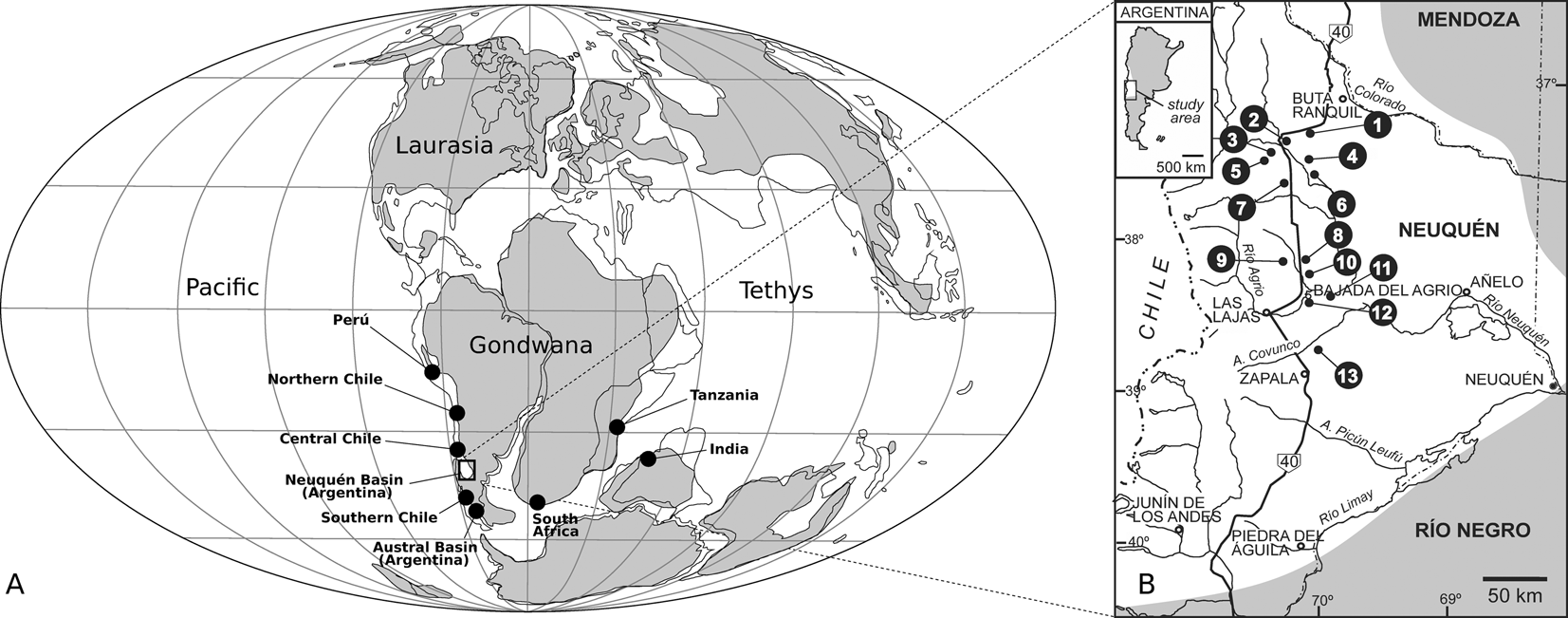
The superfamily Myophorelloidea Kobayashi, Reference Kobayashi1954 includes several trigoniid genera characterized by conspicuously nodular oblique flank ribs (Cooper Reference Cooper1991; Carter et al. Reference Carter, Altaba, Anderson, Araujo, Biakov, Bogan, Campbell, Campbell, Jin-Hua, Cope, Delvene, Dijkstra, Zong-Jie, Gardner, Gavrilova, Goncharova, Harries, Hartman, Hautmann, Hoeh, Hylleberg, Bao-Yu, Johnston, Kirkendale, Kleemann, Koppka, Kříž, Machado, Malchus, Márquez-Aliaga, Masse, McRoberts, Middelfart, Mitchell, Nevesskaja, Özer, Pojeta, Polubotko, Pons, Popov, Sánchez, Sartori, Scott, Sey, Signorelli, Silantiev, Skelton, Steuber, Waterhouse, Wingard and Yancey2011). The steinmanellines (Cooper Reference Cooper1991) comprise a lineage of large myophorellids that inhabited the western and eastern margins of Gondwana and Laurasia during the Late Jurassic–Late Cretaceous, and whose taxonomic rank goes from familial to tribal depending on the author (e.g., Carter et al. Reference Carter, Altaba, Anderson, Araujo, Biakov, Bogan, Campbell, Campbell, Jin-Hua, Cope, Delvene, Dijkstra, Zong-Jie, Gardner, Gavrilova, Goncharova, Harries, Hartman, Hautmann, Hoeh, Hylleberg, Bao-Yu, Johnston, Kirkendale, Kleemann, Koppka, Kříž, Machado, Malchus, Márquez-Aliaga, Masse, McRoberts, Middelfart, Mitchell, Nevesskaja, Özer, Pojeta, Polubotko, Pons, Popov, Sánchez, Sartori, Scott, Sey, Signorelli, Silantiev, Skelton, Steuber, Waterhouse, Wingard and Yancey2011; Cooper and Leanza Reference Cooper and Leanza2017). Within this group is Steinmanella Crickmay, Reference Crickmay1930, a Gondwanan genus represented by more than 20 species that can be found in the Late Jurassic–Early Cretaceous of South America, Africa, and India (Lazo Reference Lazo2003; Fig. 1A), and is characterized by a large, thick, anteroposteriorly elongated shell of subrectangular to subtriangular outline (Fig. 2). Externally, the shell displays two main carinae defining three different surfaces or regions, each one furnished with a different sculpture pattern. Ventral to the marginal carina is the flank, a surface covered by strong, nodular oblique ribs, whereas immediately dorsal to the marginal carina is the area, a region ornamented with commarginal rugae. Dorsally, the inner carina separates the area from the escutcheon, the latter being a dorsal surface covered by sparse or aligned nodes, smaller than those of the flank. Traditionally, Steinmanella has been the only genus of steinmanellines recognized for Gondwana, although showing considerable levels of intra- and interspecific morphological variation. However, morphological differences between the species traditionally assigned to this genus are large enough to be judged by some authors as being of intergeneric rank (Cooper and Leanza Reference Cooper and Leanza2017). As a starting point, we adhere to the traditional (i.e., single-genus) scenario, though the issue is discussed at greater length below. Although establishment of phylogenetic relationships within the steinmanellines has been attempted (e.g., Cooper and Leanza Reference Cooper and Leanza2017), these efforts lack a robust methodological framework and should therefore be considered with caution.
A, Paleogeographic configuration reconstructed for the Early Cretaceous (modified from Smith et al. Reference Smith, Smith and Funnell2004; López-Martinez et al. Reference López-Martínez, Aguirre-Urreta, Lescano, Concheyro, Vennari and Ramos2017) showing occurrences of Steinmanella along the margin of Gondwana (filled circles) as well as the region studied here. B, Map of the Neuquén (modified from Milla Carmona et al. Reference Milla Carmona, Lazo and Soto2017) showing the localities the samples come from: 1, Puerta Curaco; 2, Loma Tilhué; 3, Cerro Caicayén; 4, Gasoducto; 5, Arroyo Truquicó; 6, Mina San Eduardo; 7, Pichaihue; 8, Agua de la Mula; 9, Cerrito de la Ventana; 10, Salado; 11, Agrio del Medio; 12, Bajada del Agrio; 11, Cerrito de la Ventana; 12, Salado; 13, Cerro Mesa.
Schematic representation of Steinmanella, showing the external morphology in (A) dorsal view and (B) right lateral view, as well as (C) the digitally processed surface with the four fixed landmarks (black circles) and 13 curve semilandmarks (white circles) digitized as part of the initial protocol for surface quantification, and the 12 curve semilandmarks digitized to capture reference rib shape.

In Argentina, the genus is present in two important Mesozoic depocenters, the Austral and Neuquén Basins (Fig. 1A). In the latter, Steinmanella can be found in the Lower Cretaceous marine deposits in both great numbers and excellent state of preservation. While most of the research on the Argentinian occurrence of Steinmanella has revolved around systematics and biostratigraphic applications (Steinmann Reference Steinmann1881, Reference Steinmann1882; Weaver Reference Weaver1931; Leanza and Garate Zubillaga Reference Leanza, Garate Zubillaga and Volkheimer1987; Leanza Reference Leanza1993, Reference Leanza1998; Luci Reference Luci2010; Luci and Lazo Reference Luci and Lazo2012; Lazo and Luci Reference Lazo and Luci2013; Cooper and Leanza Reference Cooper and Leanza2017), some studies have also addressed its paleoecological characterization, including taphonomic observations and description of associated sedimentary facies (e.g., Lazo Reference Lazo2003; Luci Reference Luci2010; Luci and Lazo Reference Luci and Lazo2012). These findings depict Steinmanella as a soft-bottom, shallow burrower that could tolerate a range of conditions, living partially buried—with the area and escutcheon exposed—in both high-energy sandy shoreface and low-energy muddy offshore environments (although the latter seemed to be their preferred habitat; Luci Reference Luci2010; Cooper and Leanza Reference Cooper and Leanza2017). In contrast, only one study to date has attempted the description of the ontogenetic variation of a Steinmanella species, and only to draw comparisons to other related trigoniid genera that were the focus of interest (Echevarría Reference Echevarría2016). Thus, our understanding of this basic source of intraspecific variation remains limited, as is our ability to capitalize its potential connection to other better known paleobiological aspects of Steinmanella to draw general lessons about the evolutionary dynamics within the Trigoniida.
The proximate goals of this work are twofold: first, we aim to characterize the Steinmanella ontogeny by describing the intraspecific, post-larval ontogenetic changes displayed by seven species from the early Valanginian–late Hauterivian of the Neuquén Basin (an interval selected for its particularly rich and well-preserved fossil record). These species are Steinmanella quintucoensis Weaver, Reference Weaver1931 (early Valanginian; Fig. 3A), Steinmanella subquadrata Luci and Lazo, Reference Luci and Lazo2012 (early Valanginian; Fig. 3B), Steinmanella curacoensis Weaver, Reference Weaver1931 (early Valanginian–early/late Valanginian; Fig. 3C), Steinmanella caicayensis Lazo and Luci, Reference Lazo and Luci2013 (early/late Valanginian–late Valanginian; Fig. 3D), Steinmanella pehuenmapuensis Leanza, Reference Leanza1998 (late Valanginian; Fig. 3E), Steinmanella aff. Steinmanella transitoria Steinmann, Reference Steinmann1881 (the assignation of the samples studied here to S. transitoria is regarded as inadequate upon inspection of the type material, which is why we adopt an open nomenclature) (early Hauterivian; Fig. 3F), and Steinmanella vacaensis Weaver, Reference Weaver1931 (late Hauterivian; Fig. 3G). Second, we seek to assess the evolution of the Steinmanella ontogeny by performing interspecific comparisons between the ontogenetic trajectories of these species and discussing possible processes and implications. Because shell represents the main biological structure addressed (as it encloses the soft parts of the animal, defining their general size and geometry), our attention is primarily directed at shell shape patterns. Sculpture, though conspicuous, is a feature subordinate to shell and hence, although measured, analyzed, and discussed to a certain extent, is considered only of secondary interest here.
The seven species of Steinmanella addressed in this work. A, Steinmanella quintucoensis (CPBA-20300.63). B, Steinmanella subquadrata (BMHN-126; taken from Luci and Lazo Reference Luci and Lazo2012). C, Steinmanella curacoensis (CPBA-20545.5). D, Steinmanella caicayensis (CPBA-20938.3). E, Steinmanella pehuenmapuensis (CPBA-23359.2). F, Steinmanella aff. Steinmanella transitoria (CPBA-19708.1). G, Steinmanella vacaensis (CPBA-23374.1). Scale bar, 5 cm.

Geological Setting
The Neuquén Basin is a predominantly Mesozoic marine depocenter located in the west-central region of Argentina, between 32°S and 40°S. Its outcrops form a roughly triangular surface of more than 120,000 km2 and contain more than 4000 m thick of marine and continental sedimentary rocks deposited during the Early Triassic–early Paleogene (Howell et al. Reference Howell, Schwarz, Spalletti, Veiga, Veiga, Spalletti, Howell and Schwarz2005). This basin is of critical paleontological importance for the region, containing a strikingly rich and diverse fossil record. Notably, the Neuquén Basin possesses one of the best fossil records of marine invertebrates for the Jurassic and Cretaceous of the Southern Hemisphere (see Howell et al. Reference Howell, Schwarz, Spalletti, Veiga, Veiga, Spalletti, Howell and Schwarz2005 and references therein). Moreover, due to its condition as an important hydrocarbon reservoir, the Neuquén Basin has been the focus of intense research (see Leanza et al. Reference Leanza, Arregui and Danieli2011a), which has accrued into an excellent understanding of its geological and sedimentary history. The long tradition of biostratigraphic studies centered on its abundant Jurassic–Cretaceous ammonoid faunas has led to the development of high-resolution biostratigraphic charts for southwestern Gondwana and their correlation with the Tethys (e.g. Riccardi et al. Reference Riccardi, Leanza, Damborenea, Manceñido, Ballent and Zeiss2000; Aguirre-Urreta et al. Reference Aguirre-Urreta, Rawson, Concheyro, Bown, Ottone, Veiga, Spalletti, Howell and Schwarz2005, Reference Aguirre-Urreta, Mourgues, Rawson, Bulot and Jaillard2007, Reference Aguirre-Urreta, Lazo, Griffin, Vennari, Parras, Cataldo, Garberoglio, Luci, Leanza, Arregui and Danieli2011; Lazo et al. Reference Lazo, Concheyro, Ottone, Guler and Aguirre-Urreta2009; Aguirre-Urreta and Rawson Reference Aguirre-Urreta and Rawson2012). These detailed ammonoid zonations provided the temporal framework used here (for further details, see Milla Carmona et al. Reference Milla Carmona, Lazo and Soto2018).
This study is concerned with three consecutive units covering the early Valanginian–late Hauterivian interval (Early Cretaceous). The Vaca Muerta Formation is mostly represented by marine mudstones and limestones deposited between the early Tithonian and the early Valanginian during a highstand period (Leanza et al. Reference Leanza, Sattler, Martinez, Carbone, Leanza, Arregui and Danieli2011b), although only its early Valanginian record is dealt with here. The Mulichinco Formation (early/late Valanginian) is a thin unit representing a lowstand wedge mainly composed of both continental and marine deposits, including conglomerates, sandstones, and carbonates (Schwartz et al. Reference Schwarz, Spalletti, Veiga, Leanza, Arregui and Danieli2011). Finally, the Agrio Formation (late Valanginian–late Hauterivian) is mostly composed of marine mudstones intercalated with carbonate and sandy levels, corresponding to two highstand periods (one represented by the Pilmatué Member and another represented by the Agua de la Mula Member) separated by a continental member deposited during a lowstand interval in which the entire basin desiccated (the Avilé Member) (Spalletti et al. Reference Spalletti, Veiga, Schwarz, Leanza, Arregui and Danieli2011). During this interval, the Neuquén Basin developed as a retro-arc basin at the southeastern margin of Gondwana, showing a steady thermal subsidence resulting in an extended epeiric sea. This was partially open to the Proto-Pacific Ocean, forming a large triangular embayment with shallow, low-relief ramp features and a restricted circulation caused by the enclosing presence of a volcanic island arc on its western margin (Howell et al. Reference Howell, Schwarz, Spalletti, Veiga, Veiga, Spalletti, Howell and Schwarz2005; Aguirre-Urreta et al. Reference Aguirre-Urreta, Price, Ruffell, Lazo, Kalin, Ogle and Rawson2008; Lazo et al. Reference Lazo, Aguirre-Urreta, Price, Rawson, Ruffell and Ogle2008; Guler et al. Reference Guler, Lazo, Pazos, Borel, Ottone, Tyson, Cesaretti and Aguirre-Urreta2013).
Materials and Methods
Materials
The Paleontological Collection of the University of Buenos Aires (CPBA) houses an exceptional collection of specimens of Steinmanella, consisting of thousands of shells with updated taxonomic identification and precise biostratigraphic and geographic data. As mentioned earlier, all the material studied here was found in deposits corresponding to the Vaca Muerta, Mulichinco, and Agrio Formations (early Valanginian–late Hauterivian). Ten specimens per species were selected on the basis of preservation, the only exception being the scarce Steinmanella subquadrata for which only seven specimens could be included (CPBA collection numbers: Steinmanella quintucoensis: 20301.11; 20302.41, 46, 161, 162, 166, 168, 169, 193; 23358.4; S. subquadrata: 20304.58, 80; 20305.85; 20321.1, 591, 20547.1; 21609.1; Steinmanella curacoensis: 20939.1, 20941.3, 20545.1, 5, 33, 35; 23359.1, 2; 23359.4; 23360.1; Steinmanella caicayensis: 20919.3, 20921.5; 20922.15, 17; 20923.2; 20932.2; 20938.1; 23361.4, 11, 12; Steinmanella pehuenmapuensis: 19686.9, 29, 34; 19688.1, 10; 19690.1; 19691.9, 29; 19699.11; 20949.1; Steinmanella aff. Steinmanella transitoria: 19797.59; 19708.1, 3; 19712.1, 2; 19713.2; 19714.1; 23371.2; 23369.1, 2; Steinmanella vacaensis: 20833.1, 4, 8; 23374.1; 23375.7, 8, 12; 23377.2, 3; 23381.4). These specimens were collected at the localities of Agrio del Medio, Agua de la Mula, Arroyo Truquicó, Bajada del Agrio, Cerrito de la Ventana, Cerro Caicayén, Cerro Mesa, Gasoducto, Salado, Loma Tilhué, Pichaihue, Puerta Curaco, and Mina San Eduardo (Fig. 1B). The external morphology of the left valve (or, taking advantage of equivalve condition, the mirrored right valve when necessary) of each of these 67 specimens was digitized as a 3D surface using a HandyScan3D manual laser scanner and associated VXElements software (v. 6.0, Creaform, Québec, Canada). The resulting 3D meshes were digitally processed using MeshLab (v. 2016.12; Cignoni et al. Reference Cignoni, Callieri, Corsini, Dellepiane, Ganovelli and Ranzuglia2008) to remove irregular features from the surface of the shell. Smoothing of these features, which included attached encrusters and sediment, but also sculptural features (because the morphology, number, and relative position of the different sculptural elements change even for a single individual, thus disrupting accurate quantification of shell surface), was supervised visually. Longitudinal data were collected by identifying between three and five growth lines on the surface of each specimen's shell surface. These growth lines were manually traced upon the largest (i.e., oldest) smoothed mesh of each specimen using the raw nonsmoothed mesh as reference, and then used to clip the former to define the perimeter of the shell at different sizes. A total of 278 surfaces were obtained for further analysis (approximately 42 ± 3 surfaces per species, except for S. subquadrata, for which only 27 surfaces could be gathered).
Morphometrics
Variation in external morphology of the shell was quantified using 3D geometric morphometrics. To do so, four landmarks (the umbo, the intersection of the inner and marginal carinae with the margin of the shell, and the transition between the ventral and anterior margins) and 13 curve semilandmarks (marking the perimeter of the dorsal, posterior, ventral, and anterior margins, as well as the marginal and inner carinae) were placed on each specimen using MeshLab (Fig. 2C). These 17 coordinates were used to sample the geometry of the shell surface with 90 automatically placed, roughly equally spaced surface semilandmarks, following the procedures described in Schlager (Reference Schlager, Zheng, Li and Szákely2017). The number of surface semilandmarks was chosen to avoid a scenario in which the number of input variables exceeds the number of sampled specimens and retains no less than 87% of the total geometric information (estimated here as the percentage of the total surface area retained when subsampled to a given number of coordinates based on MacLeod [1999]). Body size of each specimen was estimated by calculating its centroid size (Bookstein Reference Bookstein1986).
Variation in the ribbing pattern of the flank was quantified by selecting a reference rib from each shell surface following a structurally constant (rather than biologically homologous) criterion (e.g., Milla Carmona et al. Reference Milla Carmona, Lazo and Soto2017). Thus, the rib from the flank most closely intersecting the transition between the ventral and anterior margins (Fig. 2C) was quantified as an open 3D curve using 12 semilandmarks (a number of coordinates retaining 99% of the original curve length; see MacLeod Reference MacLeod1999) (Fig. 2C). At this stage, the original 17 coordinates were discarded, and the remaining shell surface and rib curve semilandmarks were allowed to slide to minimize bending energy (Gunz et al. Reference Gunz, Mitteroecker, Bookstein and Slice2005). The complete configurations (i.e., merging shell surface and rib curve semilandmarks) were then superimposed by means of a generalized Procrustes analysis (Gower Reference Gower1975) in which only shell surface semilandmarks were assigned (equal) weight; thus, the resulting superimposition was “passively transferred” to rib curve semilandmarks (note that these contain rib shape information as well as variation in orientation and position of the reference rib relative to the surface of the shell). Shape variables resulting from these procedures still conflate several sources of variation, many of which are considered nuisance for the purposes of this work and include individual differences, geographic variation, and anagenetic evolution. The relative contributions of these three sources of variation, together with allometric and interspecific variation, were estimated using the mean squares derived from type II sum of squares estimated by a Procrustes linear model (Goodall Reference Goodall1991) (including individual, geographic provenance, biostratigraphic position, log-transformed centroid size and species as explanatory variables) before being standardized within each species by computing the corresponding shape residuals (i.e., residuals from a multivariate linear model of shape on nuisance factors). In the procedures that follow, shell and rib data sets were analyzed separately and, since variation among individuals was factored out in the standardization step, data belonging to the same species were pooled and treated as independent samples.
Because ribs are located on the surface of the shell, rib variation quantified in this way is also partially redundant with shell shape variation (e.g., rib variation will include differences caused by changes in inflation of the shell). To remove this redundancy, rib variation “predicted” purely by changes in shell shape was estimated by computing the thin-plate spline deformation involved in transforming each specimen's smaller shell configuration into the shell configuration of that same specimen at the other measured sizes and then applying this transformation to the rib configuration of that smaller specimen to obtain a predicted rib shape for each given size. The predicted variation was then subtracted from rib variation by computing the residuals of the linear regression of the former on the latter for each variable. These processed rib variables are much more informative than those obtained from the superimposition of raw rib coordinates (results not shown), which is why this procedure is put in place. For simplicity, these processed variables are subsequently referred to as “rib shape” variables (although, as already mentioned, they also include variation in position and orientation upon the surface of the shell, differences that were judged relevant).
Finally, a morphospace was constructed by performing a principal component analysis (PCA) on these refined (devoid of undesired variation) shell and rib shape variables. Only meaningful PC axes, determined using Horn's parallel analysis (see Monteiro Reference Monteiro2013 and references therein) were retained and used as input variables in subsequent analyses. Theoretical shape models were generated for depicting shape variation by back-calculating configurations corresponding to specific positions in the morphospace (MacLeod Reference MacLeod2009). Shell model configurations were not depicted directly but instead were used to calculate the thin-plate spline deformations of the implied transformations, which were used to interpolate the deformation of a reference surface mesh. In the case of rib model configurations, these were directly embedded in the surface mesh corresponding to the mean shape of the entire Steinmanella sample. Geometric morphometric procedures and manipulations were carried out in the R environment (v. 4.0.3; R Core Team 2020) using functions provided by the Morpho (Schlager Reference Schlager, Zheng, Li and Szákely2017), geomorph (Adams et al. Reference Adams, Collyer and Kaliontzopoulou2019), paran (Dinno Reference Dinno2018), abind (Plate and Heiberger Reference Plate and Heiberger2016), and akima (Akima and Gebhardt Reference Akima and Gebhardt2016) packages, as well as some additional functions written by PSMC.
Ontogenetic Analyses
Morphospaces (i.e., the sets of meaningful PC axes) were designed with the specific intention of isolating and emphasizing the allometric component of shape variation produced by the ontogeny of the different Steinmanella species. The trajectory described by each was reconstructed by regressing the pooled within-species PC scores describing variation in shell and rib shape on log-transformed centroid size (a proxy for body size). Aside from a simple multivariate linear regression—representing a single-phase ontogeny—the potential existence of up to three distinct ontogenetic phases (i.e., intervals of the allometric trajectory showing different directions of shape change; Zelditch et al. Reference Zelditch, Swiderski and Sheets2012) was tested by fitting multivariate segmented linear regressions with two and three segments. In each case, breakpoints were estimated by grid-searching along the partial range of log-transformed centroid sizes (i.e., starting at 25% and ending at 75% of that range; segments encompassing less than 20% of the corresponding species’ sample size were discarded) for the value minimizing the sum of squared partial Procrustes distances between the “observed” and expected shape configurations. Then, the best model (the one achieving the best balance between explanatory power and complexity) was selected using the Akaike information criterion corrected for small sample sizes (AICc; see Anderson Reference Anderson2008), computed following the procedures described in Head and Polly (Reference Head and Polly2015; see also Webster and Sundberg Reference Webster and Sundberg2020). These AICc scores are scaled such that the best model attains the higher AICc value (Head and Polly Reference Head and Polly2015).
Interspecific comparisons of shell ontogenetic trajectories were carried out in three ways. First, detailed comparisons between species with overlapping or adjacent stratigraphic distributions (i.e., putative ancestor–descendant pairs) were carried out using trajectory analysis. For each comparison we tested (1) the difference between the expected shape for each species’ smaller specimen (measured as the Euclidean distance between the PC scores marking the position of the starting point of each trajectory) and (2) the angle between length-normalized (i.e., transformed so that the square root of the summed squared coefficients equals one; see Zelditch et al. Reference Zelditch, Swiderski and Sheets2012) homologous phase vectors (e.g., between each species’ first phase, between each species’ second phase, and so on). Differences in these attributes were tested by means of bootstrap procedures in which shape residuals from ontogenetic trajectories were bootstrapped and randomly assigned to the expected shapes several times (estimating each attribute's variability while preserving the covariance structure among variables; Zelditch et al. Reference Zelditch, Swiderski and Sheets2012; Sheets and Zelditch Reference Sheets and Zelditch2013). Second, we tested whether species’ trajectories show a general direction more similar than expected by chance by permuting the within-species averaged vector's coefficients and computing the Pearson correlation coefficient between them (Zelditch et al. Reference Zelditch, Swiderski and Sheets2012); this second set of comparisons was made for all possible pairwise combinations of species. All resampling procedures were carried out using 999 random iterations and an alpha of 0.01. Finally, a new, low-dimensional ordination synthesizing variation in trajectories’ direction was constructed. To do so, the linear combinations of PC axes defining each phase vector (i.e., the regression slope coefficients for the corresponding segment, computed during a previous step) were extracted, normalized to unit length, arranged as a matrix, and subjected to a new PCA. The resulting “allometric space” (sensu Gerber et al. Reference Gerber, Eble and Neige2008) was used to assess similarities and differences displayed by the ontogenetic phases of the different Steinmanella species. As done for morphospaces, theoretical shape models were generated to aid interpretation of this space. In this case, a back-calculation step was added at the start of the procedure for computing theoretical linear regression coefficients representing particular locations (scores) of this ordination and was used to reconstruct shape configurations representing the end positions of these vectors. The transformations between these configurations were used to deform the mean configuration of the entire Steinmanella sample to display their effect on a neutral shape. All ontogenetic analyses were performed in the R environment using functions from base R, as well as from the packages Morpho, geomorph, abind, and shapes (Dryden Reference Dryden2019). All the data, meshes, and code necessary to perform the procedures described here are available in Supplementary Material 1.
Results
Morphometrics
Allometric variation represents the vast majority of the raw shape variation present in the sample, as more than 88.5% is explained by differences in log-transformed centroid size. The remaining 11.5% corresponds to interspecific variation (3.5%), differences between individuals (2.3%), biostratigraphic zones (2.1%), locality (2.1%), and residual variation (1.4%).
As for standardized variables, Horn's parallel analysis found 10 and 3 meaningful axes for shell and rib morphospaces, respectively, retaining 95.8% and 84.3% of the total shape variation, respectively. The first shell PC (52.5% of variation) captures variation in the degree of anteroposterior elongation of the shell, elevation of the umbo, and position of the maximum width of the shell (Fig. 4), whereas the second shell PC (17.9% of variation) expresses changes in the inclination of the anterior margin, the homogeneity of the ventral curvature, and the general inflation of the shell (Fig. 4). The third shell PC (7.3% of variation) captures changes in the degree of elevation of the escutcheon and the curvature of the posterior portion of the ventral margin (Fig. 4). All three PCs capture some degree of variation in the posterior projection of the posterior end of the shell and inclination of the posterior margin and the development of the flank in relation to the area (Fig. 4). In regard to variation in rib shape, the first rib PC (48.6% of variation) reflects differences in the orientation and point of maximum curvature of the reference rib along the dorsoventral axis. The second rib PC (22.4% of variation) captures changes in the position of the dorsal end and dorsal portion of the reference rib and the consequent differences in concavity and position of maximum curvature. The third rib PC (13.3% of variation) expresses differences in the degree of separation between the marginal carinae and the dorsal end of the reference rib, along with slight differences in the point of maximum curvature (Fig. 5). Although some species occupy somewhat distinctive regions in both these morphospaces (e.g., Steinmanella quintucoensis, Steinmanella subquadrata, or Steinmanella vacaensis), the distribution of the seven species largely overlaps (especially for the cases of Steinmanella caicayensis, Steinmanella curacoensis, and Steinmanella aff. Steinmanella transitoria), as shown in Figures 6A,B and 7A,B.
Shape models representing shape variation along the first three axes from the standardized shell morphospace, computed at −2 and +2 SD. Shell is represented in right lateral (left) and anterior (right) views.

Shape models representing shape variation along the first three axes from the standardized “residual” rib morphospace, computed at −3 and +3 SD. Ribs curves are represented over the mean shape of the entire Steinmanella sample.

A, B, Distribution of the 278 shapes quantified in this study over the first three axes from the standardized shell morphospace. C, D, Ontogenetic trajectories estimated for the seven Steinmanella species, projected into the same axes depicted in A and B (sizes of circles are proportional to body sizes). See Fig. 4 for shell shape models depicting variation captured by each axis.

A, B, Distribution of the 278 shapes quantified in this study over the first three axes from the standardized, “residual” rib morphospace. C, D, Ontogenetic trajectories estimated for the seven Steinmanella species, projected into the same axes depicted in A and B (sizes of circles are proportional to body sizes). See Fig. 5 for rib shape depicting variation represented by each axis.

Ontogenetic Trajectories: The Steinmanella Species
All seven species display two phases of shell shape change during their ontogeny (Table 1; Fig. 6C,D), the second of which starts at relatively small size (i.e., having attained between 30% and 40% of their maximum sizes). The only exceptions to this are Steinmanella pehuenmapuensis and S. aff. S. transitoria, whose second phase starts at 45% and 50% of their maximum sizes, respectively. Rib shape displays a simpler ontogeny, being single phased for all the species studied here, except for S. quintucoensis and S. vacaensis, whose rib trajectories are biphasic (Table 1). When compared with their corresponding shell shape trajectories, rib phase changes of these two species appear to be delayed, as breakpoints occur at a larger size (Table 1). Projection of the inferred trajectories in morphospaces reveals their marked allometric structure and greatly improves interpretation of the allometric variation by cleaning the noise introduced by intraspecific variation around each species’ trajectory (Figs. 6C,D, and 7C,D). Following the convention adopted here, the shells predicted at the start, breakpoint, and end of the trajectory are referred to as juvenile, immature, and adult, respectively (Crampton and Maxwell Reference Crampton and Maxwell2000).
Results from model selection for regressions with different number of segments. The Akaike information criterion corrected for small sample sizes (AICc) score from the best model for each trait in each species is highlighted in bold. Note that these scores are scaled such that the better model has the highest score. RSS, residual sum of squares; k, number of parameters estimated.

Shape changes realized during the reconstructed ontogeny of each species are represented in Figures 8 and 9 (see also animations provided in Supplementary Material 2), whereas results from stratigraphically ordered trajectory analyses are shown in Table 2. Overall, the stratigraphically older species (S. subquadrata and S. quintucoensis) display the more distinct ontogenies (Table 2), characterized by their noticeably different juveniles (showing a more developed posterior half with a blunt posterior end and a relatively high area surface), their very limited opisthogyrous coiling, and restricted anteroposterior elongation, resulting in a subquadrate to subrectangular adult shape. As can be better appreciated in Figure 7C,D (see also Fig. 5), their rib shape changes are also distinctive, as the reference rib becomes progressively more horizontal as ontogeny advances (as opposed to the rest of the species). Stratigraphically younger species (S. curacoensis, S. caicayensis, S. pehuenmapuensis, S. aff. S. transitoria, and S. vacaensis) display juveniles with a relatively lower area surface, a more developed anterior half, and an acuter posterior end. The juveniles of these five species differ for some comparisons (Table 2) but appear to be more similar to each other than to the juveniles of the previous two species (Figs. 6–9). These ontogenies display a more conspicuous (although still subtle) opisthogyrous coiling during their first phase (Figs. 8–9) and a more marked anteroposterior elongation during the second (especially for the late Valanginian–late Hauterivian species; Fig. 9), which result in more roughly triangular (even weakly crescentic in some cases), anteroposteriorly elongated adult shapes (see also Fig. 6C). These differences are also reflected in the statistical comparison of between-phases angles, which show significant differences between the early Valanginian–early/late Valanginian species for the first phase (a stratigraphically late change in angle is also detected; see Table 2) and between the early/late Valanginian–late Valanginian species for the second phase. A more detailed description of the ontogenetic shape changes experienced by each of the seven Steinmanella species is presented in the Supplementary Material 3.
Shell and rib shape models depicting juvenile (J), immature (I), and adult (A) shapes estimated for species from the early Valanginian–early/late Valanginian (i.e., ancient and late transitional ontogenies; see text). Inflection points found for rib shape are represented as additional rib shape models placed upon translucent shell models. The horizontal axis is centroid size in its natural scale. See also animations provided in Supplementary Material 2.

Shell and rib shape models depicting juvenile (J), immature (I), and adult (A) shapes estimated for species from the late Valanginian–late Hautervian (i.e., late derived ontogenies; see text). Inflection points found for rib shape are represented as additional rib shape models placed upon translucent shell models. The horizontal axis is centroid size in its natural scale. See also animations provided in Supplementary Material 2.

Stratigraphically ordered pairwise trajectory analyses, showing the estimated distance between starting points, angle between first phases, and angle between second phases, as well as the corresponding p-values obtained through resampling procedures. Statistically significant results are highlighted in bold.

Ontogenetic Trajectories: the Genus Steinmanella
As can be drawn from the descriptions outlined, certain regularities emerge among and between the ontogenies of the species studied here. First, the first and second ontogenetic phases within the genus can be readily recognized as distinct transformations (Fig. 10). In particular, first-phase transformations describe a slight yet noticeable crescentic trend caused by faster growth along the posterior portion of the dorsal margin (dorsally bending the shell, generating a concave dorsal margin, and elevating the umbonal region), the anterior portion of the ventral margin (displacing the maximum height anteriorly), and the posterior tip of the shell (yielding an acuter posterior end). The second-phase transformation, on the other hand, can retain some of these features to certain extent, but is characterized by a greater component of growth along the posterior portion of the ventral margin and the posterior margin of the shell (thus producing a more uniform elongation along the anteroposterior axis). Both trends are accompanied by a more or less marked increase in inflation, which is more pronounced for the first phase.
Allometric space (sensu Gerber et al. Reference Gerber, Eble and Neige2008) portraying variation in allometric coefficients corresponding to the first (empty circles) and second phases (filled circles) of each species (i.e., modes of shape change identified through their ontogenetic trajectories). Axes of main between- and within-phase variation (solid and dashed lines, respectively) are depicted, along with shape models representing the transformations undergone by a neutral shape (the consensus of the entire sample) when the allometric coefficients represented by specific coordinates of this space are applied on it.

Second, ontogenetic trajectories within Steinmanella exhibit a more general, time-structured interspecific variation that is better evidenced by their overall orientation in the morphospace, allowing the recognition of two main groups of species (Table 3). The first group corresponds to the two oldest species, S. quintucoensis and S. subquadrata, both of which display trajectories in which the component of anteroposterior elongation and posterior projection of the posterior tip are more limited and the growth along the anterior portion of the ventral margin is more pronounced (Figs. 6C,D, and 8). The other five younger species form the second group, characterized by trajectories mixing a more or less marked anteroposterior elongation with a full (although still attenuated) crescentic trend (i.e., both the anterior portion of the ventral margin and the posterior tip of the shell grow faster; Figs. 6C,D, 8, and 9). This second group can be further divided into two groups by virtue of their second phases: the species from the early–early/late Valanginian (S. curacoensis and S. caicayensis) and the species from the late Valanginian–late Hauterivian (S. pehuenmapuensis, S. aff. S. transitoria, and S. vacaensis). The former species’ second phases are more similar to those of S. quintucoensis and S. subquadrata, in that the anteroposterior elongation of the shell is more restricted, whereas the latter species show a more marked elongation (Fig. 10).
Comparisons of general direction of shape change between all possible pairwise combinations of species, showing the angle between general directions and p-values obtained through permutation procedures. Statistically significant results are highlighted in bold.

Discussion
General Characterization of Steinmanella Ontogeny
The analyses carried out here lay bare an ontogeny of moderate complexity for the genus Steinmanella. The overall ontogeny of the genus can be regarded as highly allometric, and all the species addressed display biphasic ontogenetic trajectories. Of course, breaking these trajectories into two discrete phases is only a convenient, general way to characterize ontogeny; as the retention by the second phase of trends corresponding to attenuated first-phase changes suggests, these phases probably intergrade. Instead, our results are interpreted as evidencing the expression of two distinct modes of shape change through ontogeny.
The first of these modes corresponds to a phase in which the shell becomes increasingly crescentic and inflated, and results from the relatively strong tangential (i.e., acting in the sagittal plane tangentially to it) and a moderate transverse (i.e., acting at right angles to the sagittal plane) growth components of the opisthogyrous shell (see Wilbur and Owen Reference Wilbur, Owen, Wilbur and Yonge1964; Echevarría Reference Echevarría2014). This is followed by a second phase in which the shell elongates anteroposteriorly, resulting from a relatively stronger radial component (i.e., acting in the sagittal plane radiating from the umbo) of growth, especially in the posterior ventral and posterior margins of the shell. That the difference between these modes is so sharp and consistent in spite of the “noise” introduced by the considerable observed interspecific variation (Fig. 10) attests to how conserved these phases are in the ontogeny of Steinmanella over a stratigraphic interval spanning almost 7 Myr (see Milla Carmona et al. Reference Milla Carmona, Lazo and Soto2018).
Another interesting feature of the Steinmanella ontogeny is the presence of allometric variation in allometric shape variation itself (i.e., shape variability in Steinmanella is size dependent; results from a post hoc analysis are shown in Supplementary Fig. S1). Shape variation in all seven species experiences a sustained reduction as the individuals grow larger—and older—a phenomenon that has been recognized in other animal taxa (e.g., Adams and Nistri Reference Adams and Nistri2010; Parsons et al. Reference Parsons, Skúlason and Ferguson2010; Monnet et al. Reference Monnet, Bucher, Guex and Wasmer2012), although not yet in bivalves (as far as we are aware). Such a pattern is commonly attributed to ontogenetic canalization, that is, developmental regulatory mechanisms that suppress and/or compensate deviations from the species average phenotype manifested during ontogeny (see Zelditch et al. Reference Zelditch, Lundrigan and Garland2004).
The final general aspect of the Steinmanella ontogeny that can be inferred from our results is the lack of ontogenetic integration shown by rib and shell shape changes, as implied by their decoupled within-species trajectories (displaying either disjointed breakpoints or a different number of phases). Although this effect could be partially caused by the analytic removal of “redundant” rib shape variation, there is no logical need for the “residual” component of rib shape variation to display ontogenetic trajectories different from those shown by shell shape. The decoupled nature of ontogenetic changes in rib and shell shape among the species studied here can therefore be interpreted as evidencing the ontogenetic independence of these two traits in Steinmanella, that is, they behave as separate developmental modules (Mitteroecker Reference Mitteroecker2009).
Evolution of Steinmanella Ontogeny
As could be expected from the various speciation events implied by the presence of seven species, the ontogeny of Steinmanella underwent several changes during the Early Cretaceous. Interestingly, these changes are not distributed randomly over ontogeny, as changes in the starting point of the trajectory are by far the most frequent type of change found between interspecific transitions, followed by changes in orientation of the first phase; changes in late ontogeny are the rarest, with only one transition showing a significant change in orientation of the second phase (Table 2). Therefore, evolutionary changes in ontogeny are concentrated in early stages (i.e., earlier than the starting points studied here), becoming increasingly scarcer as ontogeny progresses. In other words, early ontogeny was more prone to evolve, whereas late ontogeny was more conservative. Further research focused on the detailed characterization of ecological variation through ontogeny in trigoniids will allow exploration and evaluation of potential ecological drivers behind this pattern.
The stratigraphically older ontogenies addressed here (namely “ancient” ontogenies, incarnated by Steinmanella quintucoensis and Steinmanella subquadrata) display a relatively weaker tangential component and thus less marked crescentic growth during their first phase, as well as a more subtle radial component that is also more uniformly distributed over the ventral and posterior margins. Ontogenies from the early–early/late Valanginian (namely “late transitional” ontogenies, represented by Steinmanella curacoensis and Steinmanella caicayensis), experienced a substantial change in their starting shape, which went from displaying an expanded posterior half to showing a more evenly circular aspect and a narrower posterior end. Compounding this change, there is also a significant general reorientation of trajectories caused by the accentuation of the tangential component of growth during the first phase and the slight increase of the radial component of growth along the posterior margin during the second phase. Finally, the more recent ontogenies (namely “late derived” ontogenies, belonging to Steinmanella pehuenmapuensis, Steinmanella aff. Steinmanella transitoria, and Steinmanella vacaensis) display starting shapes and first phases very similar to those of the late transitional ontogenies but differ in taking the increase in radial growth along the posterior margin even further.
In regard to the origin of the generalized Steinmanella ontogeny, this study benefits greatly from the groundwork laid by Echevarría (Reference Echevarría2014, Reference Echevarría2016), focused in the ontogeny of Myophorella Bayle, Reference Bayle1878—a genus presumed to be the ancestor of the one addressed here on the basis of morphological resemblance and stratigraphic precedence (see Echevarría Reference Echevarría2016 and references therein). Echevarría studied the ontogeny of Myophorella garatei Leanza, Reference Leanza1981 in great detail, identifying the presence of two modes of shape change during development of its post-larval shell: one in which the flank-to-area surface ratio increased, and a rostrum developed, followed by a phase of crescentic growth in which the dorsal margin bent (Echevarría Reference Echevarría2014). These modes were later deduced as characterizing the ancestral ontogeny of Myophorella and were used to infer a pedomorphic origin for the generalized Steinmanella morphology (Echevarría Reference Echevarría2016). This conclusion was supported by both the projection of the ontogenetic shell shape variation shown by S. caicayensis into the M. garatei ontogenetic morphospace (showing that the former roughly followed the first mode of ontogenetic change of the latter) and the detailed description of sculpture patterns from both species (evidencing a resemblance between the adult pattern of S. caicayensis and the juvenile one of M. garatei). We do not dispute the latter line of evidence, though in light of the ontogenetic independence shown by sculpture and shell shape (see the “General Characterization of Steinmanella Ontogeny” section), we view this evidence as of limited scope.
However, our results paint a different scenario for shell ontogeny. We found a very slight (when compared with Myophorella) yet consistent crescentic mode of growth that is evident when the corresponding shape transformation is represented on a neutral shape and exaggerated beyond its original range of variation (Fig. 10). A noticeable dorsal curvature of the marginal carina, suggestive of crescentic growth, had been already identified but disregarded by Echevarría (Reference Echevarría2016) as an artifact caused by the projection of a 3D structure in a 2D plane, something we are able to rule out here. On the other hand, the second mode of ontogenetic change reported herein for Steinmanella had not been recognized previously, something we associate with the loss of morphological resolution caused by its projection into the much more marked ontogenetic transformation undergone by M. garatei. Thus, the transition between Myophorella and Steinmanella involved (1) a decrease of the tangential component of growth, attenuating the crescentic transformation experienced by the shell; and (2) the addition of a new, terminal phase with a more marked radial growth component, resulting in the roughly monotonic anteroposterior elongation of the shell.
While is tempting to invoke heterochrony in this context, it is worth noting that its standard definition (Gould Reference Gould1977; Alberch et al. Reference Alberch, Gould, Oster and Wake1979) is better suited to deal with changes that can be described by referencing static morphologies along a conserved ontogenetic trajectory (see Webster and Zelditch Reference Webster and Zelditch2005). For this reason, we adopt the more general framework developed by Webster and Zelditch (Reference Webster and Zelditch2005) for describing the evolutionary changes in ontogeny (of which heterochronic modes represent particular cases). Following this classification, we recognize two types of evolutionary changes involved in the origin of Steinmanella and its ontogeny: (1) a rate modification causing a decrease of the amount of crescentic growth accomplished; and (2) an allometric repatterning of the late portion of the ancestral trajectory, resulting in the establishment of a novel mode of allometric shape change, which we identify as a second ontogenetic phase. Once established, the ontogeny of Steinmanella underwent two main events of evolutionary rate modification, this time increasing the amount of shape change: one event affecting its first phase (at the transition between ancient and late ontogenies) and another affecting its second phase (at the transition between late transitional and late derived ontogenies).
Taxonomic Implications
As mentioned earlier, the taxonomy of the Gondwanan representatives of the steinmanellines is an issue under ongoing discussion, with two main stances regarding the number of genera present—positions located at different ends of the “lumper–splitter” spectrum. Traditionally, Steinmanella has been the only genus of steinmanellines recognized for the Late Jurassic–Early Cretaceous of Argentina (e.g., see Camacho and Olivero Reference Camacho and Olivero1985; Leanza Reference Leanza1993; Aguirre-Urreta et al. Reference Aguirre-Urreta, Lazo, Griffin, Vennari, Parras, Cataldo, Garberoglio, Luci, Leanza, Arregui and Danieli2011). Because of the fair amount of morphological variability accommodated within Steinmanella, the genus has grown to be quite speciose, amounting to more than 20 described species grouped in four subgenera. In contrast, Cooper and Leanza (Reference Cooper and Leanza2017), in their recent review of the systematics and paleobiogeography of the Steinmanellinae, split Steinmanella into several genera. These authors retained the original genus (now containing the species S. caicayensis, among others) while creating numerous new taxa, four of which would be represented here: Garatella (including the species S. quintucoensis and S. subquadrata), Weaverella (including the species S. curacoensis), Neuquenella (including the species S. pehuenmapuensis), and Transitrigonia (including the species S. aff. S. transitoria and S. vacaensis). In the absence of a detailed assessment of intra- and interspecific variation, a unified criterion for genus delimitation, and/or the implementation of phylogenetic analyses sorting morphological variation under an explicit model of evolution (as is the general case for the Myophorellidae; Schneider and Kelly Reference Schneider and Kelly2014), neither proposal can claim paleobiological precedence.
Although limited, the taxonomic sampling of this study is nonetheless inclusive enough to draw some generalizations valuable in the context of the aforementioned debate. Ontogeny has long been recognized as a key character that both influences and reflects evolutionary history (see Gould Reference Gould1977; Kluge and Strauss Reference Kluge and Strauss1985 and references therein). In regard to bivalves, Crampton and Maxwell (Reference Crampton and Maxwell2000) found pervasive parallelism among the ontogenetic trajectories of several species belonging to the crassatellid genus Spissatella but nonparallel trajectories between the latter and other closely related genera, ascribed by the authors to major changes occurring in ontogenetic stages earlier than those measured therein. These findings led Crampton and Maxwell (Reference Crampton and Maxwell2000) to propose the orientation of ontogenetic trajectories as a “key genus-level taxonomic character” in bivalves. In the case of Steinmanella, there is a general reorientation of ontogenetic trajectories taking place at the transition between ancient and late species, occurring between the early Valanginian and the early–early/late Valanginian (Table 3, Fig. 6). If the conclusions from Crampton and Maxwell (Reference Crampton and Maxwell2000) can be generalized, this result would support the distinction of the genus Garatella (including subquadrata and quintucoensis, but potentially also the likes of neuquensis or raimondii, which were not included in this study) from the rest of the species. Thus, the ontogenetic information gathered herein supports a middle ground between postures by hinting the presence of more than one group of species, but not as many as Cooper and Leanza (Reference Cooper and Leanza2017) recognize. A systematic revision is beyond the scope of this work, but these results highlight the need for further investigation (especially considering we only analyzed two traits and ignored other taxonomically relevant aspects of morphology, such as the sculpture covering the area and escutcheon or internal shell features), as well as the importance of entertaining alternative criteria derived from paleobiological aspects not considered previously.
Functional Implications
Throughout its ontogeny, Steinmanella shows a number of morphological changes admitting functional interpretation. (1) A conspicuous increase in size (evidenced by the large adult shell) developing mostly during the second-phase interval: small individuals burrowed relatively fast, although they were also more prone to exhumation, whereas large individuals burrowed more sluggishly but were also more stable within the sediment (Stanley Reference Stanley1970). (2) The progressive development of a flat, wall-like anterior margin resulting from the crescentic growth trend of the first phase: this structure could have acted similar to the broad umbo and lunule of prosogyrous burrowing bivalves, that is, offering a wide surface that would have locked the anterior end in place during the rocking motions of burrowing, preventing upward displacement of the shell and making burrowing movements more efficient (e.g., as in veneroid bivalves; see Stanley Reference Stanley1975). (3) The progressive expansion of the anteroventral region occurring mainly during the first-phase transformation: the expansion of the anteroventral region usually hints at a larger foot (as this organ is located anteriorly and protrudes at the ventral point most distant from the hinge axis) and therefore better burrowing capabilities (Stanley Reference Stanley1970). (4) An increasingly elevated and expanded umbonal region, developed during the first phase and to a lesser extent during the second phase: this expansion would have allowed accommodation of larger hinge teeth, necessary for maintaining valve alignment during the wider opening required to protrude a larger foot (Stanley Reference Stanley1977). (5) An increasing anteroposterior elongation (mostly during the second phase): this feature is typical of more sluggish shallow burrowers, as the rocking burrowing movements are more difficult to perform and the resistance to penetration is higher for shells with eccentric rotation axes and longer posterior portions; however, as these animals are relatively heavier and locate their center of gravity deeper into the sediment, they are also more stable (Stanley Reference Stanley1970).
Hence, shell changes displayed by Steinmanella during early life suggest an increased ability for active burrowing in young individuals, whereas shell changes occurring late in life made the animal more stable within the sediment and are consistent with a more sedentary lifestyle—a trend that has been widely reported in bivalves (e.g., Stanley Reference Stanley1970; Hayami and Hosoda Reference Hayami and Hosoda1988; Jones and Gould Reference Jones and Gould1999; Márquez et al. Reference Márquez, Amoroso, Sainz and Van der Molen2010; Echevarría Reference Echevarría2014). The adult shell of Steinmanella (i.e., thick, moderately inflated, posteriorly elongated) is typical of bivalves inhabiting moderately protected environments subject to sporadic high-energy events, in which fine sedimentation and firm bottoms predominate (Stanley Reference Stanley1970). This is in accordance with the preference shown by this genus for low-energy, inner to distal shelf settings with low sedimentation rates and muddy, firm substrata (Lazo Reference Lazo2006; Luci Reference Luci2010; Cooper and Leanza Reference Cooper and Leanza2017), although as already mentioned, there is evidence the genus tolerated a wider range of oxygenation, energetic, and sedimentary regimes (Lazo Reference Lazo2003; Luci Reference Luci2010; Luci and Lazo Reference Luci and Lazo2012).
Connections to Morphological Disparity
Disparity, or diversity of morphologies, is the most conspicuous attribute of extinct trigoniid forms. Because ontogeny is the proximate cause of disparity (Zelditch et al. Reference Zelditch, Sheets and Fink2003; McNamara and McKinney Reference McNamara and McKinney2005; Sheets and Zelditch Reference Sheets and Zelditch2013), it is worth exploring the potential connections between the ontogenetic features identified here and an increased morphological disparity. The crescentic mode of growth displayed during the first phase of the Steinmanella ontogeny requires an ability for localized shell production (i.e., at the anterior ventral margin and in the surroundings of the posterior ends of the marginal and inner carinae), and thus implies a greater heterogeneity for the rates of shell secretion at different points along the mantle edge. This is in contrast to a second phase in which a continuous region of the mantle edge (i.e., the entire posterior margin and, to a lesser extent, the posterior of the ventral margin of the shell) needs to be secreting at a roughly even rate. In other words, during early life, the animal underwent a period characterized by a more complex, possibly multimodal aperture map (i.e., the distribution of relative rates of shell deposition along the shell aperture; see Rice Reference Rice1998; Ubukata Reference Ubukata2003), resulting in a stage in which shell morphology is capable of greater malleability. Although virtually all shallow-burrowing bivalves display some limited degree of shell coiling (Raup Reference Raup1966), a more or less marked crescentic growth—generally associated to an opisthogyrous condition—is widespread across all major groups of Mesozoic trigoniids (as apparent from the ubiquity of both strikingly crescentic and more subtle subtriangular forms), hinting at a possible causal relation.
In Steinmanella, a stage of greater malleability at the start of ontogeny is also consistent with other observations reported here. A progressive contraction of shape variation around expected values throughout ontogeny usually has been interpreted as indicative of a high degree ecological specialization (e.g., Adams and Nistri Reference Adams and Nistri2010; Parsons et al. Reference Parsons, Skúlason and Ferguson2010), which is at odds with the wide range of paleoenvironmental conditions this genus was able to tolerate. We view this pattern as more likely produced by a gradient in the potential for disparity experienced between early and late life: the more malleable patterns of shell deposition are, the more deviant the morphologies induced by developmental perturbations; as the strength of this signal fades, so does the magnitude of potential deviation from the expected shape. The reason why these differences do not accrue through ontogeny is because of the homogenizing effect that an increasingly stable developmental pathway has over the relative nature of shape variables: as individuals grow, the initially large differences are retained but confined in an increasingly local region of the shell surface, and shapes become relatively more similar. In addition, because this phase that is capable of greater disparity manifests early in ontogeny, changes occurring at increasingly early stages have higher probability of resulting in new morphospecies (i.e., trigger non-cryptic speciation). This would explain the pervasive early-stage interspecific variation found for Steinmanella and the increasing scarcity of differences occurring at progressively later stages. The ontogenetic decoupling of shape and rib shape, as observed here for Steinmanella, would facilitate their independent evolution and is therefore another factor contributing to an increased diversity of morphologies.
Though speculative, these considerations suggest possible avenues for further research. If correct, we would expect characterizations framed within the approach of theoretical morphology (e.g., Ubukata Reference Ubukata2003) to evidence changes through ontogeny toward simplification of aperture maps (e.g., going from a multimodal to a unimodal aperture map). Also, because ontogenetic variation can channel evolution by establishing preferential lanes for phenotypic change to take place (Gould Reference Gould2002), we would expect intergeneric morphometric variation to be at least noticeably spread along an axis synthesizing crescentic shape change (rather than other distinct styles of shape change common to bivalves, such as an anteroposterior elongation of the shell reported here) (e.g., Renaud and Auffray Reference Renaud and Auffray2013). Finally, measurements of disparity should be higher for taxonomic groups capable of more pronounced crescentic growth (e.g., Wilson Reference Wilson2013). In any case, the potential validity and range of taxonomic application of these predictions can be readily tested using a taxonomically inclusive data set and the battery of methods already described in the literature.
Acknowledgments
We extend our thanks to V. García Alonso, L. Luci, D. Pérez, and L. Aristide for their help at different stages of this work, as well to J. Crampton and two anonymous reviewers whose corrections and suggestions greatly improved the quality of the original draft. We are also grateful to M. Webster, who kindly shared the code our segmented regression's workflow is based on. This work was supported by the National Scientific and Technical Research Council of Argentina (PIP 2017–2019, CONICET), the National Agency for Scientific and Technological Promotion (PICT-2017-0220 and PICT-2015-1381), and the University of Buenos Aires (UBACyT) funds granted to DGL and IMS, as well as a subsidy for postgraduate students granted by the Argentinian Paleontological Association to PSMC. This is the contribution R-401 of the IDEAN.
Data Availability Statement
Data available from the Dryad Digital Repository: https://doi.org/10.5061/dryad.fj6q573vq.



