1. Introduction
How does domestic terrorism affect the political survival of national leaders? Terrorism research has been thriving, especially after the end of the Cold War. Although the full-scale war between two countries has become an infrequent phenomenon, terrorism by non-state actors remains a more common form of violence, along with civil war.
Numerous studies have examined the impact of terrorism on targeted societies (Galea et al., Reference Galea, Vlahov, Resnick, Ahern, Susser, Gold, Bucuvalas and Kilpatrick2003; Gaibulloev and Sandler, Reference Gaibulloev and Sandler2008; Richman et al., Reference Richman, Cloninger and Rospenda2008; DiMaggio et al., Reference DiMaggio, Galea and Li2009; Thompson, Reference Thompson2011). Nevertheless, relatively few studies have examined the political impact of terrorism. Considering that a significant body of literature has studied the consequences of domestic violence on domestic politics (e.g., Bellows and Miguel, Reference Bellows and Miguel2006, Reference Bellows and Miguel2009; Flores and Nooruddin, Reference Flores and Nooruddin2012; Gilligan et al., Reference Gilligan, Pasquale and Samii2014; Burchard, 2015; Hartzell and Hoddie, Reference Hartzell and Hoddie2015; Canetti et al., Reference Canetti, Elad-Strenger, Lavi, Guy and Bar-Tal2017; Zhukov and Talibova, Reference Zhukov and Talibova2018; Tellez, Reference Tellez2019) the paucity of research on the political effects of terrorism is notable. In particular, while some previous works have examined how international terrorism affects domestic politics, such as the likelihood of leader survival (e.g., Park and Bali, Reference Park and Bali2017), surprisingly little attention has been paid to the effects of domestic terrorism.
The significance of domestic terrorism is noteworthy. In a recent survey conducted by PBS NewsHour, NPR, and Marist Poll on American people, 49% of respondents answered that domestic terrorism posed the most significant threat, while 41% responded that international terrorism did. This result contrasts sharply with those of the same survey conducted in 2002, in which the respective percentages of respondents were 30 and 56.Footnote 1 Given that domestically originated terrorism may send a meaningful signal regarding the absence of social cohesion in the society and the lack of responsibility of the ruling government, we argue that the political consequence of domestic terrorism deserves academic scrutiny.
We aim to fill the abovementioned gap in the literature by examining the relationship between domestic terrorism and leader survival. To do so, we formulate a theoretical argument of why and how domestic terrorism affects the political survival of national leaders and provide statistical tests based on global cross-national data for 1970–2014. Our findings suggest that incumbent leaders are more likely to lose political power when their societies experience terrorism from domestic perpetrators.
Our theoretical discussion and empirical analysis enhance our understanding of why terrorists continue to engage in such risky and seemingly ineffective activities without gaining apparent political concessions from targeted governments most of the time. The rest of this paper is organized as follows. The following section is a review of existing terrorism studies. We then discuss how domestic terrorism has a leadership-destabilizing impact. The fifth section discusses data and measurement, followed by the sixth section that discusses statistical analyses and results. We conclude this study with implications for policy and future research.
2. Literature review
An enormous body of terrorism literature studies the causes and conditions for terrorism. The literature is too vast to be thoroughly reviewed here. Gassebner and Luechinger (Reference Gassebner and Luechinger2011) provide a most comprehensive assessment. On the one hand, economic freedom, human rights, a large population share of young people, and primary goods exports are negatively related to terrorism. On the other hand, the factors that attract more terrorism include state centralization, population size, military expenditure, civil wars, interstate wars, ethnic conflict, and political affinity with the USA. Some recent studies focus on how political regime type affects terrorism. Conventional wisdom says that terrorism originates from autocratic regimes. However, the evidence is more complicated. Terrorism is no more likely to occur in autocracies than in democracies (Chenoweth, Reference Chenoweth2013). It is hard to say that democracy is an antidote to terrorism, despite the positive views held by many influential world leaders, such as George W. Bush, Barack Obama, and Tony Blair (Kibble, Reference Kibble2006; Cooper et al., Reference Cooper, Landler and Mazzetti2011; Dalacoura, Reference Dalacoura2011). However, statistical research reveals that partial and transitioning democracies suffer from the most terrorism, while advanced democracies do not experience an exceptionally high level of chronic terrorism (de la Calle and Sanchez-Cuenca, Reference de la Calle and Sanchez-Cuenca2012; Piazza, Reference Piazza2012).
The effects of terrorism have also been substantially examined in the literature. For example, literature discusses whether terrorist attacks are indeed effective in inducing the intended government compliance (Rose et al., Reference Rose, Murphy and Abrahms2007; Abrahms, Reference Abrahms2011, Reference Abrahms2013; Thomas, Reference Thomas2014). Besides, although studies are relatively few, they have mainly looked at socioeconomic or human health-related consequences. Briefly, terrorism is found to be detrimental to economic growth, capital flows, consumption, stock valuation, life satisfaction, and mental and physical health (Galea et al., Reference Galea, Vlahov, Resnick, Ahern, Susser, Gold, Bucuvalas and Kilpatrick2003; Gaibulloev and Sandler, Reference Gaibulloev and Sandler2008; Richman et al., Reference Richman, Cloninger and Rospenda2008; DiMaggio et al., Reference DiMaggio, Galea and Li2009; Thompson, Reference Thompson2011). However, there may be some unexpected side effects associated with terrorism that are counter-productive for terrorists themselves. Terrorism can make a target society hold together, increase the level of support for national leaders, and thus decrease the chance that the target government concedes to terrorist demands (Davis, Reference Davis2007; Indridason, Reference Indridason2008; Chenoweth, Reference Chenoweth2010; Abrahms, Reference Abrahms2012).
Despite its unexpected sociologically unifying effect, terrorism may have severe political impacts.Footnote 2 For instance, studies show that terrorism affects voting behavior and changes electoral outcomes (Holmes and De Pineres, Reference Holmes and Gutiérrez De Piñeres2002; Langer and Cohen, Reference Langer and Cohen2005; Berrebi and Klor, Reference Berrebi and Klor2006, Reference Berrebi and Klor2008; Montalvo, Reference Montalvo2011; Getmansky and Zeitzoff, Reference Getmansky and Zeitzoff2014). However, these studies are based on single events (e.g., the Madrid train bombings) or single-country cases (e.g., Israel and the USA) and are thus hardly generalizable to other cases and the greater outside world. Three notable exceptions exist. Gassebner et al. (Reference Gassebner, Jong-A-Pin and Mierau2011), examining 150 countries cross-nationally during 1970–2002, demonstrated that frequent terrorism incidents make cabinet turnover more frequent. Williams et al. (Reference Williams, Koch and Smith2013) studied the effect of transnational terrorism based on a sample of 18 advanced parliamentary democracies from the late 1960s to 2003. They found that transnational terrorism weakens the political prospects of leftwing governments in parliamentary systems while rightwing governments are relatively immune to that government-destabilizing effect. Most recently, Park and Bali (Reference Park and Bali2017) used a global sample for the 1968–2004 period and found that international terrorism shortens the tenure of incumbent leaders in targeted societies. They found that the leadership-destabilizing effect of international terrorism is much more apparent for autocracies than democracies, whether presidential systems or parliamentary systems. These three studies provide cross-national and longitudinal evidence that global terrorism significantly influences domestic politics. However, they either focus on transnational terrorism (Williams et al., Reference Williams, Koch and Smith2013; Park and Bali, Reference Park and Bali2017) or mix domestic terrorism and transnational terrorism without sorting the former from the latter (Gassebner et al., Reference Gassebner, Jong-A-Pin and Mierau2011).
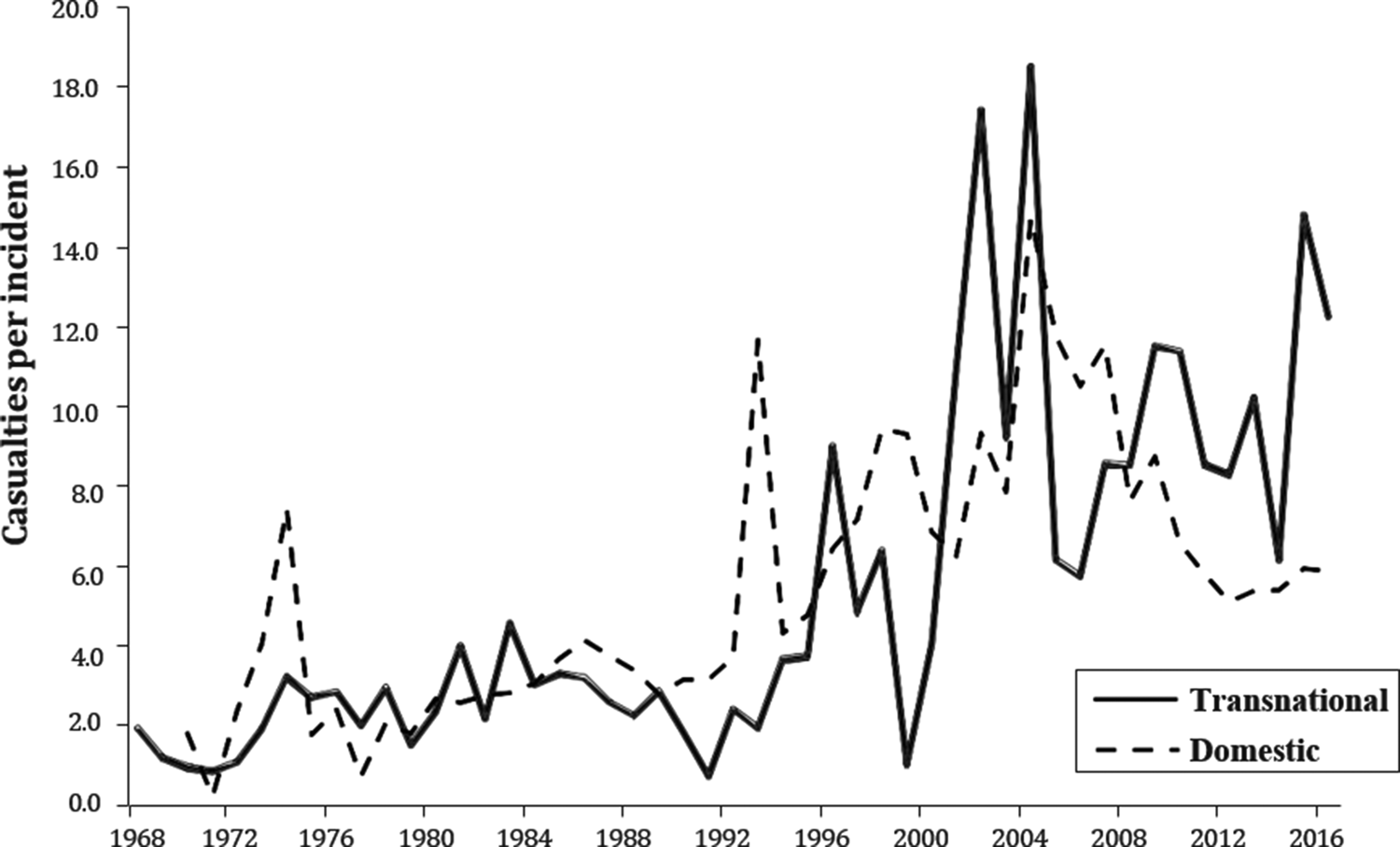
To the best of our knowledge to date, no study has examined the direct link between domestic terrorism and leader survival across the globe over a substantive time period. This task is important to advance the terrorism literature in several dimensions. First, one cannot draw a complete picture of how terrorism affects domestic politics with a sole focus on transnational terrorism or by conflating domestic terrorism and transnational terrorism. Domestic terrorism overwhelmingly outnumbers transnational terrorism in terms of the number of incidents per year (Berkebile, Reference Berkebile2015; Gaibulloev and Sanlder, Reference Gaibulloev and Sandler2019; Stieb, Reference Stieb2019). It is worth exerting Figures 1 and 2 from Gaibulloev and Sandler (Reference Gaibulloev and Sandler2019: 282–283) that describe the annual total number of terrorism incidents and the number of causalities per incident over time.Footnote 3 Domestic incidents have been much more prevalent than foreign incidents across the globe. Despite the huge difference in frequency, the levels of lethality between domestic terrorism and transnational terrorism are not considerably different. The political effect of domestic terrorism deserves more academic scrutiny.
The Number of Transnational and Domestic Terrorist Incidents.

The Number of Casualties per Incident.

Second, examining the impact of domestic terrorism on leader tenure can also help find a complete answer for another important riddle in the literature: why do terrorists continue to engage in such ineffective activities when terrorism rarely draws appeasement and conciliation from target governments? Acts of terrorism are too risky for terrorists to perpetrate as they may not be effective. For example, Abrahms (Reference Abrahms2006, Reference Abrahms2012) shows that the majority of foreign terrorist attacks that caused civilian deaths failed to coerce target governments to make political concessions that terrorists publicly demanded. Abrahms (Reference Abrahms2008) provides an answer from social bonding rather than political rationality. He argues that terrorists, usually recruited from the pool of socially isolated and marginalized people, gain social utility by joining terrorist groups and participating in terrorism activities. They experience a high level of social solidarity and a bond of friendship with other members. However, there are two shortcomings in Abrahms' (Reference Abrahms2006, Reference Abrahms2012) empirical evidence. First, his analysis is only based on foreign terrorist attacks. We have yet to understand how domestic terrorist incidents, much more frequent than transnational incidents, affect domestic politics. Second, terrorists' proclaimed goals or demands can differ from what they want from the targeted governments. Also, many governments officially announce that they never negotiate with terrorists or their groups (Miller, Reference Miller2011), which can cause underreporting biases in the data for the policy concessions that the target government has made behind the scenes. Furthermore, quite often, terrorists do not publicize their identities or demands to maximize the fear and horror that their attacks can invoke against target societies (Hoffman, Reference Hoffman2010). The actual political impacts of terrorism may go beyond immediate policy concessions, just as terrorists' goals go beyond their immediate targets (Hoffman, Reference Hoffman2006; Enders et al., Reference Enders, Sandler and Gaibulloev2011; Park and Bali, Reference Park and Bali2017). If terrorism can destabilize incumbent leadership, it is a political impact of terrorism and should fit the political purposes of terrorists who have grievances and antagonism against government policy. Therefore, what terrorists want may include the political destabilization of incumbent leadership as well as the social solidarity that they can feel with other members.
3. Theory and hypotheses
This section draws rationales and hypotheses for the impact of domestic terrorism on the political survival of incumbent leaders. How does domestic terrorism destabilize incumbent governments? We identify four rationales for the leadership-destabilizing impacts of domestic terrorism.
First, frequent domestic terrorism incidents may indicate a severe lack of social cohesion within domestic society. Terrorism is widely defined as a deliberately planned threat of unlawful violence by (usually weaker) non-state actors against (usually stronger) central governments to change the latter's policy direction (Chenoweth, Reference Chenoweth2013). Those politically, economically, and culturally marginalized would organize terrorist groups and coordinate attacks when they find no other effective routes or tools to express and vent their enmities and grievances. There is much evidence in line with this argument. For instance, Moore et al. (Reference Moore, Bakker and Hill2011) find that frequent dissident protest activities lead to frequent terrorist attacks. According to Piazza (Reference Piazza2009, Reference Piazza2011), the practices that increase domestic terrorist activities include political underrepresentation, economic discrimination, and ethnic marginalization. With increased terrorist activities by those on the social, economic, and political margins, incumbents are subject to the charge that they failed to handle social dissents and grievances and integrate the nation without enacting and executing appropriate policies.
It is widely accepted that governments and leaders are responsible for policy outcomes, and constituents reward and punish them accordingly (King et al., Reference King, Alt, Burns and Laver1990; Bueno de Mesquita et al., Reference Bueno de Mesquita, Morrow, Siverson and Smith1999; Goemans, Reference Goemans2008; Williams et al., Reference Williams, Koch and Smith2013). Terrorism is not inevitable in fragmented societies, but something that can be nipped in the bud by social welfare policies. For example, Burgoon (Reference Burgoon2006) shows that spending more money on social welfare policies helped reduce terrorism incidents. Krieger and Meierrieks (Reference Krieger and Meierrieks2010) demonstrate that social welfare spending dampens terrorist activities by ameliorating poor socioeconomic conditions, such as unemployment, poverty, inequality, and dissatisfaction. These studies suggest that frequent terrorist activities represent a policy failure even in fragmented societies.
Second, the prevalence of domestic terrorism in a society is a policing and security failure, revealing the ineptness of incumbent government leaders in preventing unlawful insider threats and violence. Taking this issue seriously, constituents may accuse the incumbents of being incapable of conducting a fundamental government task, that is, to protect the nation and maintain law and order. Several studies show that people hold their government politically responsible for terror incidents with some electoral consequences (Holmes and Gutiérrez De Pineres, Reference Holmes and Gutiérrez De Piñeres2002; Berrebi and Klor, Reference Berrebi and Klor2006; Siqueira and Sandler, Reference Siqueira and Sandler2007).
Third, terrorism is detrimental to the general mood of society. In addition to the direct injuries and premature mortality of victims, fear and distress incurred by terrorism cause various mental health problems such as depression, anxiety, and posttraumatic stress disorder (Schlenger et al., Reference Schlenger, Caddell, Ebert, Jordan, Rourke, Wilson, Thalji, Dennis, Fairbank and Kulka2002; Galea et al., Reference Galea, Vlahov, Resnick, Ahern, Susser, Gold, Bucuvalas and Kilpatrick2003; Rousseau et al., Reference Rousseau, Jamil, Bhui and Boudjarane2013). Terrorism-related distress is associated with increased drinking and smoking (Richman et al., Reference Richman, Cloninger and Rospenda2008; DiMaggio et al., Reference DiMaggio, Galea and Li2009). Terrorism also negatively affects individual life satisfaction. Frey et al.'s (Reference Frey, Luechinger and Stutzer2009) case study for France and the UK shows that people living in terrorism-prone areas have lower life satisfaction and are willing to sacrifice up to 20% of their annual income for the sake of a terror-free life. Based on a sample of 81 countries from 1994 to –2009, Farzanegan et al. (Reference Farzanegan, Krieger and Meierrieks2017) provide cross-national evidence for the negative effect of terrorism on life satisfaction. As such, fear and distress due to terrorism overcloud the public's mood in the target societies. To make matters worse, if government measures are over-reactive, as is often the case with a heightened terrorist threat, it will exacerbate fear and distress (Benmelech et al., Reference Benmelech, Berrebi and Klor2015). It is hard to expect public support for incumbent leadership to remain intact when the overall social mood is on the decline. An empirical study by Ward et al. (Reference Ward, De Neve, Ungar and Eichstaedt2021) examines how life satisfaction affects voting choice. Using the data aggregated from over 2 million individual surveys on the 2012 and 2016 US presidential elections, it finds that a low level of life satisfaction led to a substantial portion of anti-incumbent voting in both elections. The authors suggest that eudaemonic wellbeing should be routinely considered alongside economic factors when explaining electoral choices.
Fourth, a substantive body of research has shown that endemic terrorism has various negative economic externalities, ultimately damaging the overall state of the economy (Abadie and Gardeazabal, Reference Abadie and Gardeazabal2003; Larocque et al., Reference Larocque, Lincourt and Normandin2010; Gaibulloev and Sandler, Reference Gaibulloev and Sandler2011). It reduces consumption and investment (Blomberg et al., Reference Blomberg, Hess and Weerapana2004; Eldor and Melnick, Reference Eldor and Melnick2004; Crain and Crain, Reference Crain and Crain2006). It shrinks the inflow of foreign direct investment (Bandyopadhyay et al., Reference Bandyopadhyay, Chakraborty and Bhattacharyya2014) and the amount of trade across borders (Nitsch and Schumacher, Reference Nitsch and Schumacher2004). Prevalent terrorism also deters travel and inhibits tourism (Drakos and Kutan, Reference Drakos and Kutan2003; Baker, Reference Baker2014). There are also indirect economic costs related to persistent terrorism. Substantive opportunity costs are incurred as terrorism becomes endemic, leading to higher spending on security and policing. These additional costs for security and policing could be more productively used for other public good areas, such as education, health care, R&D, and infrastructure (Meierrieks and Gries, Reference Meierrieks and Gries2013). Indeed, recurrent terrorist attacks can induce the suboptimal allocation of resources, causing economic fractures and distortions in target societies and making the macroeconomy unhealthy.
Cinar (Reference Çinar2017) provides a comprehensive analysis of the macroeconomic consequences of terrorism experienced worldwide. Based on data from 115 countries between 2000 and 2015, he finds that frequent terrorist attacks have a negative impact on economic growth, and that this adverse economic effect is particularly stronger in low-income countries, when compared to high-income countries. This finding corroborates the evidence accumulated from a number of extant studies that focus on a single case, a set of cases, or particular regions of the world analyzed using a case study or statistical methods (Abadie and Gardeazabal, Reference Abadie and Gardeazabal2003; Tavares, Reference Tavares2004; Gaibulloev and Sanlder, Reference Gaibulloev and Sandler2009; Gries et al., Reference Gries, Krieger and Meierrieks2011; Musayev, Reference Musayev2016).
How the health of the macroeconomy affects government support and leadership change has been well-documented in the economic voting literature (Lewis-Beck and Stegmaier, Reference Lewis-Beck, Stegmaier, Voigt, Grofman and Congleton2018). Evidence suggests that people highly value the macroeconomic performances of incumbents and ascribe the sluggish national economy to incumbent leadership and thus, inflict an electoral punishment. This is not only the case in advanced democracies but also in many other countries across the world including those in East-Central Europe (Pacek, Reference Pacek1994), Latin America (Remmer, Reference Remmer1991), and developing regions (Gelineau, Reference Gélineau2013). Regarding political survival, many recent studies provide direct evidence that economic growth significantly affects incumbent leadership (Marinov, Reference Marinov2005; Burke, Reference Burke2012; Park, Reference Park2017; Park and Bali, Reference Park and Bali2017; Stockemer and Kailitz, Reference Stockemer and Kailitz2020). The findings reveal that incumbent leaders are more likely to retain their position when the economy is booming. Contrastingly, a sluggish economy is found to increase the likelihood of the incumbents being removed from their office.
In sum, much evidence indicates that prevalent terrorist incidents hurt the social, mental, physical, and material well-being of people. As their lives become harder in many respects, people will begin to question the competence of incumbent leadership. Numerous studies have shown that public evaluation of leaders and governments is based on social, economic, and political wellbeing, and it affects the probability of incumbent leadership holding or losing power (Bueno de Mesquita et al., Reference Bueno de Mesquita, Smith, Siverson and Morrow2003; Marinov, Reference Marinov2005; Leigh, Reference Leigh2009; Park and Bali, Reference Park and Bali2017; Lewis-Beck and Stegmaier, Reference Lewis-Beck, Stegmaier, Voigt, Grofman and Congleton2018). Therefore, we hypothesize as follows:
Hypothesis: Domestic terrorism is likely to increase the probability that incumbent leaders lose their power
4. Addressing counterarguments
In this section, we identify and address three possible counterarguments or caveats that may render our causal statement for terrorism and leadership spurious or biased: (1) rally effects, (2) endogeneity, and (3) autocratic exemption. Accounting for these issues theoretically and empirically should increase the plausibility of our explanations, prediction, and findings.
4.1 Rally effects
One may question if frequent domestic terrorism events may have a rallying effect, which is positively associated with a leader's tenure. However, previous research suggests that domestic terrorism may not evoke a ‘rally-people-around-the leader’ effect as much as transnational terrorism can. In general, heightened security threats can provide incumbents with substantial political leverage to mobilize public support and overcome troubled times (Davis, Reference Davis2007; Berinsky, Reference Berinsky2009; Merolla and Zechmeister, Reference Merolla and Zechmeister2009; Chenoweth, Reference Chenoweth2010). However, whether the security threats come from the inside or outside could make a difference. The external threat is likely to generate a larger unified public and thus a weaker tenure-reducing effect as it is a threat from external enemies, not from internal social divisions. Internal divisions are likely to be exacerbated by further domestic terrorist incidents (Mueller, Reference Mueller1973). Similarly, Chowanietz (Reference Chowanietz2010) finds that rallying around the flag following terrorist acts is frequent when the attacks are perpetrated by foreign groups rather than domestic groups. Although based on a limited sample including five well-established democracies, France, Germany, Spain, the UK, and the USA, from 1990 to 2006, the evidence suggests a stronger tenure-reducing effect for domestic terrorism than transnational terrorism.
4.2 Endogeneity
We acknowledge two possible sources of endogeneity: (1) the reversal causation that leadership instability causes domestic terrorism and (2) an unobserved confounding factor that weakens and splits a state to cause both domestic terrorism and leadership failure.Footnote 4 It is plausible that fragile incumbent leadership attracts more terrorism-related violence because terrorists, if rational and strategic, would look for the right timing and target to attack. Equally plausible is that a weakened government and split society provide conditions conducive to terrorist activities and leadership failure. If our empirical analysis does not consider this causality-endogeneity concern, it can inaccurately attribute irrelevant leadership changes to domestic terrorism, inflating its leadership-destabilizing effect. In the empirical section, we account for the possible presence of endogeneity in four related, yet distinct, ways. Although none of them would be a perfect solution by itself, they are complementary enough to merit the veracity of our empirical estimate, which is not driven by unaddressed endogeneity.
First, we account for the overall strengths and fragmentation of society and state by employing various controls such as GDP, wealth, military capability, and war. Furthermore, we control for the effects of military conflict and economic sanctions that a given country is experiencing in a given year. These are the two most severe forms of external hostilities that can fracture a society and destabilize an incumbent leadership. Additionally, we control for the length of a leader remains in office. This measure can help address the endogeneity issue as well as the temporal dependence, which are probably present due to the time-series nature of our data. How long a given leadership can last should be an indicator of governmental and societal sturdiness.
Second, we adopt a 1-year lag structure to account for the possible causality issue between domestic terrorism and leader survival. By lagging all the independent variables by 1 year, we ensure that all of our independent variables are observed before our dependent variable. Third, we include fixed effects in our statistical tests to account for country-specific characteristics that may simultaneously affect domestic terrorism and leader survival. This approach helps eliminate omitted variable bias if the unobserved confounding factors are time-invariant. Additionally, we include time-specific fixed effects to control for macro-systemic shocks and obtain unbiased estimates for the parameters.
Fourth, we take a step further by employing an instrument technique and conducting an augmented regression test. The results from this process will indicate whether it is necessary to use an instrumental variable to get an unbiased estimate of the effect of domestic terrorism on leader survival. This last step should constitute a complete approach for robustness checks because it not only tests endogeneity but it also provides a solution. This approach can address whether the sources of endogeneity are caused by a reciprocal causality or an unobserved confounding factor.
4.3 Autocratic exemption
The causal mechanisms that we have laid out in the previous section suggest that frequent terrorist attacks are detrimental to the political survival of incumbent leaders as they reveal their policy incompetence and produce negative socio-economic consequences. These should deteriorate the public sentiment toward incumbent leadership. One might question whether and how these negative externalities of domestic terrorism and the resulting public dissatisfaction can play out for the removal of incumbents in autocracies. Indeed, owing to the lack of free, fair, and regular elections, which are features of an autocratic rule, autocrats are hardly held accountable to their citizens through electoral processes. However, this does not necessarily mean that they are exempt from public sentiment and political accountability (Weeks, Reference Weeks2008). We believe that an anti-incumbent mood among the general public is just as important for the removal of leaders in autocracies as they are in democracies.
Many studies theoretically and empirically demonstrate that leaders in autocracies are often punished for security policy failures (Bueno de Mesquita et al., Reference Bueno de Mesquita, Smith, Siverson and Morrow2003; Goemans, Reference Goemans2008; Weeks, Reference Weeks2008; Debs and Goemans, Reference Debs and Goemans2010; Chiozza and Goemans, Reference Chiozza and Goemans2011). The kinds of punishments autocrats face are much graver than those faced by democrats, as the former becomes not just deprived of power but is often jailed, exiled, or even killed. Being a ruler in an autocracy does not mean that they can just get away with political challenges. As Svolik (Reference Svolik2012) rightly illustrates, autocrats encounter constant threats from the two domains of their constituents. First, the regime-insider elites, with whom autocrats share power. Second, the much larger regime-outsider masses whom the autocrats reign over. Since autocrats face these fundamental conflicts, it is crucial for them to acquire popular support and ensure loyalty among the elite. When the number of unsatisfied regime-outsiders increases, an incumbent autocrat is more likely to be ousted through institutionalized procedures or irregular means, such as assassinations, mass protests, pressures, rebellions, and civil wars (Goemans, Reference Goemans2008; Svolik, Reference Svolik2012; Croco and Weeks, Reference Croco and Weeks2016). As more elites have divided loyalties, the chances of a ruler being forcefully removed from their office increases – this mostly occurs through coups (Svolik, Reference Svolik2012; Aksoy et al., Reference Aksoy, Carter and Wright2015).
We have made the case that repeated terrorist attacks expose leadership incompetence and security failures and produce unfavorable socio-economic externalities, such as the dampening of the public mood and damaging the national economy. These, in turn, should elevate the level of public dissatisfaction with incumbent leadership. Therefore, as dissipated public support is detrimental to autocratic leadership, domestic terrorism and its negative socio-economic consequences should destabilize incumbent leaders in autocracies as well as those in democracies.
The public dissatisfaction caused by domestic terrorism can also prompt leader removal via coups by regime-insiders. Coups by regime-insider elites are the most frequent form of leader removal in autocracies (Svolik, Reference Svolik2012). Attempting a coup is costly for potential plotters from the ruling coalition because it can fail and thereby, risk their existing privileges and even lives. They must be able to coordinate between the opposition and both the other elites and the citizens to launch a coup and oust rulers. Even well-executed coups often provoke a furious public backlash when their motives and aims cannot be justified to the citizens (Galetovic and Sanhueza, Reference Galetovic and Sanhueza2000; Cassell et al., Reference Cassell, Booth and Seligson2018; Geddes et al., Reference Geddes, Wright and Frantz2018). Conversely, widespread mass dissatisfaction heightens the risks of leadership-change coups (Aksoy et al., Reference Aksoy, Carter and Wright2015). Repeated security failures, damaged socio-economic conditions, and the resulting public dissatisfaction with frequent terrorist attacks provide a focal point for coup coordination.
The negative economic consequences of domestic terrorism can also impair incumbents' material capabilities to maintain their power. Leaders need a significant amount of resources to invest in buying-off elite support, coopting potential challengers, repressing dissenters and protesters, and building various coup-proofing institutions (Bueno de Mesquita and Downs, Reference Bueno de Mesquita and Downs2005; Miller, Reference Miller2012). A declining economy can rapidly drain the resources that are available to the leaders to fund their patronages. To avoid becoming vulnerable to regime-insider rebellions, they have to substitute the loss of revenues (Escriba-Folch and Wright, Reference Escribà-Folch and Wright2010). This is not an easy task because tough economic times create more urgent needs, wants, and demands for resources across all different sectors of the society. In such situations, leaders face a difficult choice between making a focused resource allocation to the core in-group supporters and stretching the already reduced resources across various constituents who are in need. Concentrated allocation will increase anti-incumbent sentiment among the general public, while stretched allocation leads to the loss of elite loyalty – either way, damaging leaders' hold on the power.
The findings from a broad range of literature lend empirical credence to what we have discussed about domestic terrorism – its negative socio-economic consequences and autocratic leadership change. For example, recent time-series cross-national investigations from the economic modernization literature examine how economic development affects autocratic leaders and their regimes. They show that a fast-growing economy significantly reinforces autocratic leadership and increases its durability (Kennedy, Reference Kennedy2010; Burke, Reference Burke2012; Miller, Reference Miller2012; Treisman, Reference Treisman2015; Park, Reference Park2017; Stockemer and Kailitz, Reference Stockemer and Kailitz2020; Choi and Park, Reference Choi and Park2021). These studies together cover quite extensive periods of time, from the 1810s to the 2010s.
Aksoy et al. (Reference Aksoy, Carter and Wright2015) examine how terrorism affects military coups, the most frequent method of leader-ouster in autocracies. Their data analysis, which covers all coups and terrorist attacks that occurred in global autocracies during the 1971–2006 period, reveals that heightened terrorist threats are associated with a higher risk of coups. Park and Bali (Reference Park and Bali2017) examine the impact of international terrorism on leader survival using the 1968–2004 global data. They find that international terrorist attacks significantly increase the likelihood of leadership failure, and this leadership-destabilizing effect holds stronger for autocracies than for democracies. Asongu and Nwachukwu (Reference Asongu and Nwachukwu2017) adopt a more general concept – governance – to examine the general political effect of terrorism in 53 African countries during the period between 1998 and 2012. They measure governance in terms of political stability, political accountability, government effectiveness, regulation quality, corruption, and the rule of law. They find that terrorism significantly hurts governance in target societies, although this impact is stronger with international terrorism than with domestic terrorism.
Although these findings from extant research support our argument, there is no direct evidence for the effect of domestic terrorism on leader survival, globally. As discussed, some look at regime duration, coup occurrence, or governance rather than the leader's tenure, while some fail to differentiate domestic terrorism and international terrorism. Additionally, some only consider international incidents that are much fewer in number than domestic incidents, while others only focus on limited regions. Thus, the contributions of this present study to the understanding of terrorism and its political impact are two folds. First, it provides theoretical explanations regarding why domestic terrorism-related violence destabilizes incumbent leadership. Second, it offers a direct test for the leadership-destabilizing impact of domestic terrorism, globally, during the 1970–2014 period.
5. Data and method
This study spans the 1970–2014 period for which data for the primary independent and dependent variables, domestic terrorism and leader removal, are jointly available. Data analysis for this period covers 172 countries worldwide. When all the control variables are included in the statistical analysis, the end year becomes 2007 and the number of the countries covered becomes 160 because of the reduced joint availability of all the relevant data.
Our dependent variable is leader removal, coded 1 for removal, and 0 otherwise. This variable is an annual observation of whether a national leader stepped out of political office in a given country. Right censored cases, such as retirement for sickness, natural death, and deposition by a foreign force, are excluded from our analysis. We use the information on leader removal from the Archigos data (Goemans et al., Reference Goemans, Gleditsch and Chiozza2009), which reveals how and when national leaders across the world obtained and lost power from 1875 to 2015.Footnote 5 Unlike the Archigos, however, the unit of analysis in our study is not leader year but country year. This is because there are cases in which, within a given country year, multiple leaders come into power and then leave the office. We do not have precise information regarding which terrorist attack is directed at which leader in those years. Additionally, these cases inflate the number of leadership failures in our data relative to that of nonfailures. Therefore, we only consider the first failure. Besides, using country year as the unit of analysis and taking only the first failure is necessary for the 1-year lag structure we adopt. By lagging all our independent variables by 1 year, we ensure that they are observed before the dependent variable.
Our main independent variable is domestic terrorism. Terrorism is generally defined as: ‘the premeditated use or threat to use violence by individuals or subnational groups against noncombatants to obtain a political or social objective through the intimidation of a large audience beyond that of the immediate victims’ (Enders et al., Reference Enders, Sandler and Gaibulloev2011: 321). From this general definition, Enders et al. (Reference Enders, Sandler and Gaibulloev2011: 321) distinguish domestic terrorism from transnational terrorism, focusing on the origins of perpetrators, targets, and the venues of terrorism incidents: domestic terrorism must be ‘homegrown’ and thus its venues, targets, and perpetrators should be ‘all from the same country.’ They partition domestic terrorism incidents from the most widely used terrorism dataset, the Global Terrorism Database (GTD), which contains information on domestic and transnational terrorism, but does not distinguish them.Footnote 6 Using an updated version of Enders et al.'s data, we measure domestic terrorism in terms of the number of domestic terrorist incidents in a country in a given year. We take the natural logarithm of this measure, as it has a skewed distribution and its effect on leader tenure is likely to be curvilinear.
We include other control variables important for leader tenure in the literature. First, countries' internal characteristics matter to leadership stability. We control for material and economic strengths in terms of wealth, economic growth rate, and military capability. The wealth variable is measured as the GDP per capita of a country in a given year. We use an updated version of Gleditsch's (Reference Gleditsch2002) expanded GDP data. The Correlates of War's (COW) Composite Index of National Capability score is used to measure countries' national capability. Additionally, we consider the effect of political structure. The electoral rules of democracy tend to limit the tenure of executive leaders to certain lengths and terms. Certain democracies experience more terrorism incidents than autocracies (Chenoweth, Reference Chenoweth2013). Even the presence of electoral cycles in democracies can reinforce that tendency (Bali and Park, Reference Bali and Park2014). Hence, it is necessary to control for the effect of democracy. We use the polity2 score of the Polity IV data that measures the levels of democracy (and autocracy) on a 21-point scale from −10 (full autocracy) to 10 (full democracy) (Jaggers and Gurr, Reference Jaggers and Gurr1995). In addition, we account for leadership failure by the term limit. The variable Term limit is coded either 1 or 0, and comes from the database of political institutions (DPI) (Cruz et al., Reference Cruz, Keefer and Scartascini2018).
Second, we control for other forms of hostilities such as war, militarized dispute, and economic sanctions. War is coded 1 for a country experiencing a civil war or interstate war in a given year and 0 otherwise, according to the information in the COW Intrastate War data. Militarized interstate dispute is a dummy indicator for whether a country was involved in an interstate military conflict short of a full-scale war. We use the COW Militarized Interstate Dispute data. We also control for the effect of interstate economic hostilities such as economic sanctions. We measure sanction as a binary indicator, coded 1 when an economic sanction was imposed upon a country, and 0 otherwise, based on the information from the Threat and Imposition of Economic Sanctions (TIES) data (Morgan et al., Reference Morgan, Bapat and Kobayashi2014).
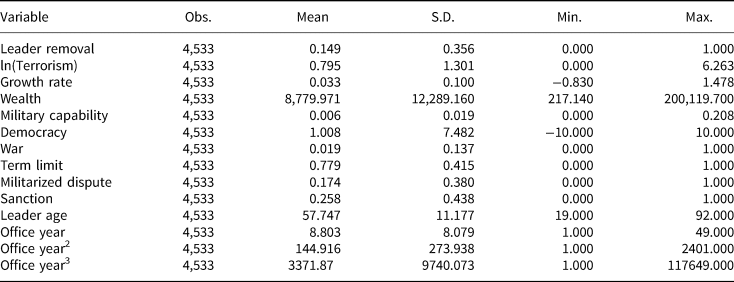
Third, our data are structured in a binary time-series cross-section format that requires accounting for the possible temporal dependence and the possible heteroskedasticity (Beck et al., Reference Beck, Katz and Tucker1998). We follow Carter and Signorino's (Reference Carter and Signorino2010) suggestion to include the year counter (office year) since the last occurrence of the dependent variable and its cubic polynomials. We estimate logit regression with Huber/White robust standard errors (Beck et al., Reference Beck, Katz and Tucker1998). We also control for the age of leaders based on the expectation that as leaders get older, they are more likely to lose power. We first use unconditional logit for our estimation. Then we repeat our estimation with conditional logit that includes both country and time-specific fixed effects to capture the effect of unobserved cross-national differences and the influence of aggregate time-series trends. The descriptive statistics of the independent and dependent variables, such as mean, standard deviation, minimum and maximum, are reported in Table 1.
Descriptive statistics, 1970–2014

6. Results
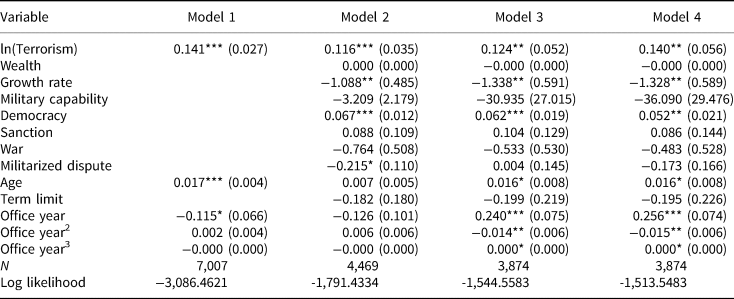
Table 2 reports the relationship between domestic terrorism and leader removal using an unconditional logit model. We begin with a barebone model estimation result in the first column, which does not include the control variables except for those employed to account for the possible temporal dependence of the data. This exclusion of the control variables allows us to assess the relationship for the most extended number of years, 1970–2014, without concern for the problems associated with complex multiple regression models, such as multicollinearity and post-treatment bias (Achen, Reference Achen2002; Ray, Reference Ray2005; King, Reference King2010). The logged counter for domestic terrorism incidents, ln(Terrorism), is statistically significant with a positive sign at the 0.01 level (two-tailed) in model 1. The result suggests that a national leader is more likely to be removed from political power as domestic terrorism attacks are rampant in their society. Hence, the data support our hypothesis. The time-related control variables are statistically significant. The positive sign for leader age suggests that leader removal is more likely as a leader gets older. Office year is weakly significant at the 10% level. The other polynomial terms for office year, office year2, and office year3 are not statistically significant. Yet, the F-test for joint significance suggests including all three polynomial terms in the model. Models 2–4 present the effect of domestic terrorism on leader removal with different model specifications. Model 2 reports pooled analysis including control variables, and we further control for country dummy in model 3 and both country and year dummies in model 4, respectively.
Logit analysis: domestic terrorism and leader removal, 1970–2014

Mode 3: country dummy variable is included.
Model 4: both country and year dummy variables are included.
Robust standard errors clustered by country are in parentheses.
*P < 0.1; **P < 0.05; ***P < 0.01.
The results indicate that the logged measure for domestic terrorism incidents, ln(Terrorism), has a significant positive sign on leader removal with different model specifications. Other things being equal, a political leader is more likely to be removed from office when domestic terrorism is prevalent in their society.Footnote 7 Regarding the control variables, the Polity measure for democracy (democracy), and the counting measure for leader age are statistically significant with the coefficient signs in the expected directions. The results indicate that democracy, age, and economic growth are three other important factors that reduce the spell of leaders staying in power. The coefficient Militarized dispute is negative and statistically significant (model 2), suggesting that the involvement in interstate military conflict increases the likelihood that the national leader stays in power for a given year. This may capture the rallying effect. The other control variables, such as wealth, national capability, and imposed sanctions, hardly affect leaders' political survival as their measures are statistically insignificant in predicting leader removal. The polynomial terms for office year are generally statistically significant. This result indicates the presence of serial correlation in the data and the necessity to account for it.
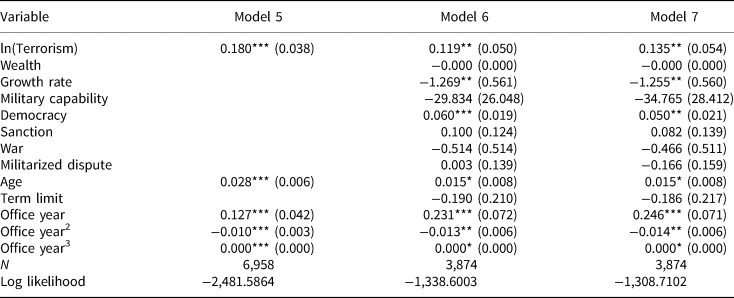
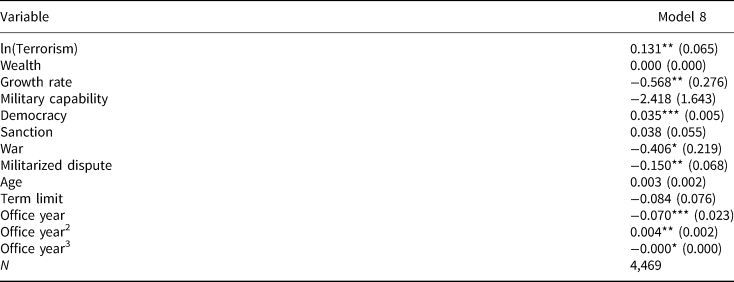
In Table 3, we retest our hypothesis using the fixed effects conditional logit. The significant result for ln(Terrorism) holds for all models in Table 3. Additionally, similar to the findings in Table 2, Growth rate, Democracy, Militarized dispute, and Leader age are also robust to both year- and country-specific fixed effects (models 6 and 7). Indeed, our results do not differ significantly across the different model specifications.
Fixed effects conditional logit: domestic terrorism and leader removal, 1970–2007

Model 7: year dummy variable is included.
Robust standard errors clustered by country are in parentheses.
*P < 0.1; **P < 0.05; ***P < 0.01.
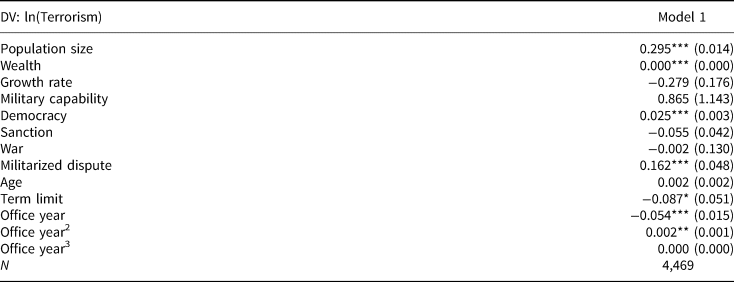
Finally, we conduct an additional robustness test using an instrumental variable approach. A good instrument should be relevant and valid; thus it should be correlated with the explanatory variable (i.e., terrorism), but unrelated to the outcome variable (i.e., leader tenure). Building on Park and Bali (Reference Park and Bali2017) we use a population size (logged) as an instrumental variable. While a country with a large population has a more chance to experience domestic terrorism, the same factor does not appear to affect the likelihood of leadership failure.Footnote 8 The first-stage F-test statistic is 36, which is higher than the conventional threshold of 10 (Stock and Yogo, Reference Stock, Yogo, Andrews and Stock2005).Footnote 9 Table 4 presents the estimation result using an two-step IV probit estimator. The coefficient of the domestic terrorism variable is positive and significant as we predicted, supporting our hypothesis.
Instrumental variable approach: domestic terrorism and leader removal, 1970–2014

Robust standard errors clustered by country are in parentheses.
*P < 0.1; **P < 0.05; ***P < 0.01.
7. Conclusion
In this study, we explored how domestic political instabilities can influence domestic politics, focusing on the relationship between domestic terrorism and leader tenure. We believe our exploration of this relationship helps deepen our understanding of terrorism and its societal and political consequences.
Terrorism literature has thrived since the end of the Cold War era; however, it has been relatively silent about the various societal and political impacts that terrorism can have on targeted societies. In this respect, recent scholarly attempts to undercover the leadership-destabilizing impacts of terrorism are encouraging (Williams et al., Reference Williams, Koch and Smith2013; Park and Bali, Reference Park and Bali2017). However, these studies focus on transnational terrorism and thus paint only a partial picture of how frequent terrorism incidents affect the political prospect of incumbents in targeted societies. This partial picture is because transnational terrorism accounts for only a very small proportion of total incidents compared to domestic terrorism. Some studies look at domestic terrorism incidents to uncover the influence of domestic terrorism on voting behavior and electoral outcomes (Holmes and Gutiérrez De Pineres, Reference Holmes and Gutiérrez De Piñeres2002; Berrebi and Klor, Reference Berrebi and Klor2006). However, these studies focus on single countries.
Our present study fills this gap by examining the relationship between domestic terrorism and the political survival of leaders based on a worldwide sample from 1970 to 2014. We find that incumbent leaders are more likely to lose political power when their societies increasingly experience terrorism attacks from domestic perpetrators. This incumbent-hurting effect of domestic terrorism is robust to various model specifications. The findings from this present study corroborate those from the previous studies that only consider transnational terrorism (Park and Bali, Reference Park and Bali2017) and/or conflate domestic and transnational incidents (Aksoy et al., Reference Aksoy, Carter and Wright2015).
Our study's findings have important implications for political leaders, especially in nondemocratic countries. Many autocrats commonly use harsh and violent measures to silence opponents, dissenters, and even average citizens. Their repressive policies can backfire because repression, in general, changes dissenters into terrorists (Bravo and Dias, Reference Bravo and Dias2006) and increases the amount of domestic terrorism (Piazza, Reference Piazza2016). In turn, the increased number of domestic terror incidents will promote the removal of the autocrats from political power, as found in this present study. Our policy suggestion is that autocrats should not resort to repressive measures to close off the avenue of nonviolent dissents and grievances. Rather, they should focus their efforts on bettering social welfare fundamentals to improve poor socio-economic and political conditions such as poverty, unsanitary conditions, inequality, underrepresentation, dissatisfaction, and unemployment (Burgoon, Reference Burgoon2006; Krieger and Meierrieks, Reference Krieger and Meierrieks2010).
We conclude with suggestions for future research. It would be interesting to examine how domestic terrorism affects the economy in the separation of transnational terrorism. Some scholars argue that domestic terrorism has a lower negative impact on the economy than transnational terrorism because the latter is thought to scare away foreign direct investment and increase defense expenditure (Gaibulloev and Sandler, Reference Gaibulloev and Sandler2008). However, domestic terrorism may disrupt the target economy through other important routes such as fragmenting national unity, draining social capital and government resources, and increasing costs for policing and repression. It would also be fruitful to examine the relationship between terrorism and the popularity of democratic leaders in a more direct way. Both transnational terrorism and domestic terrorism hardly hurt leaders' hold on power in highly democratic countries. This null effect may be due to their well-institutionalized electoral systems. The processes of leader selection and removal in such regimes are highly stable, and thus it would be challenging to find the impact of such extraneous threats and shocks as terrorist attacks with typical survival analysis. One way to address the problem is to look at how the approval ratings of democratic leaders fluctuate vis-à-vis the trends of terrorism incidents. No systematic analysis has been done on this dynamic relationship, except for those that focus on some extreme anecdotal incidents such as the 9/11 attack (Hetherington and Nelson, Reference Hetherington and Nelson2003; Davis and Silver, Reference Davis and Silver2004). Another way is to appraise the election outcomes directly rather than the spell of time that democrats stay in office. One can hypothesize that an incumbent national leader or their party is not likely to win an election if her country has experienced a lot of terrorist attacks during their period of service in the position.
Supplementary material
The supplementary material for this article can be found at https://dataverse.harvard.edu/dataset.xhtml?persistentId=doi:10.7910/DVN/P3ORE3
Acknowledgment
This work was supported by Incheon National University Research Grant in 2018.
Conflict of interest
The authors declare none.
Appendix
Instrumental variable approach (first stage): domestic terrorism and leader removal, 1970–2014